Automotive Sunroof Systems Market (2026-2036)
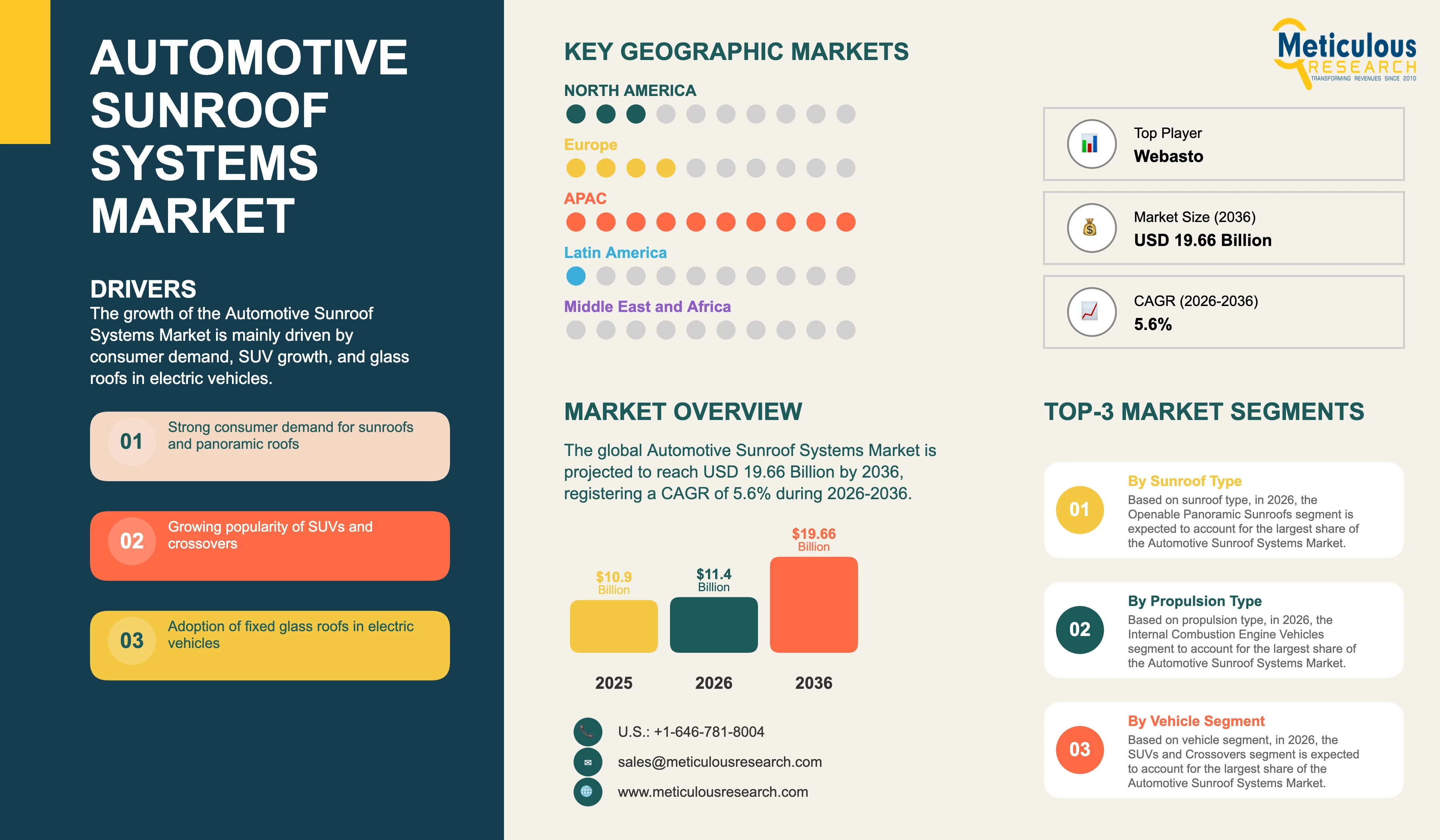
The global automotive sunroof systems market was valued at USD 10.90 billion in 2025. This market is expected to reach USD 19.66 billion by 2036 from an estimated USD 11.40 billion in 2026, registering a CAGR of 5.6% during the forecast period (2026-2036).
- Published
- Nov 2026
- Pages
- 273
- Format
- PDF + Excel
- Report ID
- MRAUTO - 1042901
- Base year
- 2025
- 2025 · BASELINE
- $10.90B
- 2036
- $19.66B
- CAGR 2026–2036
- 5.6%
2025 baseline · 2026–2036 forecast at 5.6% CAGR · hover a bar for the value
Key highlights
Webasto, one of the largest suppliers of roof systems, reported revenue of about EUR 4.0 billion in 2025, down 7.4% from the previous year, with roof systems accounting for about EUR 3.0 billion, or 79% of revenue, according to Webasto. The company reported that its revenue mix is shifting toward Asia-Pacific, supported by strong growth of roof systems in India.
Webasto announced on February 26, 2026 that it will build its third plant in India, in the Delhi region, with production starting in the fourth quarter of 2026, according to Webasto. The new plant will supply roof systems to vehicle makers in India, where sunroofs have become a key purchase factor for buyers of SUVs and mid-range vehicles.
Webasto agreed on May 26, 2026 to take a 30% stake in a joint venture with Zhejiang Fujia Technology (FJT) to produce fixed glass roofs in China, according to Webasto. The joint venture shows how roof system suppliers are adapting to the rapid growth of fixed glass roofs in Chinese electric vehicles.
Global electric car sales topped 20 million units in 2025, according to the IEA. Many electric vehicles, including popular models from Tesla and Chinese brands, use large fixed glass roofs, which give a sense of space, reduce weight and roof height compared with openable sunroofs, and allow a sleek design.
Glass makers, such as Fuyao Glass, Saint-Gobain Sekurit, and AGC, supply large laminated glass panels and complete fixed glass roof modules to vehicle makers, often with features such as infrared-reflective coatings, low-emissivity coatings, and switchable smart glass that reduce heat and glare.
Leading suppliers include Webasto, Inalfa Roof Systems, Aisin, Inteva Products, Fuyao Glass, Saint-Gobain Sekurit, and AGC. Fixed glass roofs are the fastest-growing sunroof type, and smart glass and feature-integrated sunroofs are the fastest-growing feature segment, as electric vehicle makers adopt large glass roofs with advanced glass functions. India is now one of the most important growth markets for sunroof suppliers. Glass makers are gaining share in this segment.
By sunroof type, openable panoramic sunroofs account for the largest share of 34.0% in 2026, while fixed glass roofs register the highest CAGR.
By feature, standard sunroofs account for the larger share in 2026, while smart glass and feature-integrated sunroofs register the higher CAGR.
By propulsion type, internal combustion engine vehicles account for the largest share in 2026, while battery electric vehicles register the highest CAGR.
By vehicle segment, SUVs and crossovers account for the largest share of 58.0% in 2026 and also register the highest CAGR.
By geography, Asia-Pacific accounts for the largest share of 55.0% in 2026, while Asia-Pacific registers the highest CAGR of 6.6%.
Report summary
| Particulars | Details |
|---|---|
| Forecast Period | 2026-2036 |
| Base Year | 2025 |
| Estimated Year | 2026 |
| CAGR (Value) | 5.6% |
| Format | PDF, Excel & Cloud Portal · 273 pages |
| Market Size (Value) in 2025 | USD 10.90 billion |
| Market Size (Value) in 2026 | USD 11.40 billion |
| Market Size (Value) by 2036 | USD 19.66 billion |
| Largest Segment by Sunroof Type (2026) | Openable Panoramic Sunroofs (34.0%) |
| Largest Segment by Vehicle Segment (2026) | SUVs and Crossovers (58.0%) |
| Largest Region (2026) | Asia-Pacific (55.0%) |
| Fastest-Growing Region | Asia-Pacific (CAGR 6.6%) |
| Segments Covered | Sunroof Type, Feature, Propulsion Type, Vehicle Segment, Geography |
| Countries Covered | U.S., Canada, Mexico, Germany, France, U.K., Spain, Italy, Sweden, Czech Republic, Poland, Slovakia, Hungary, Romania, Rest of Europe, China, India, Japan, South Korea, Thailand, Indonesia, Malaysia, Vietnam, Philippines, Taiwan, Australia, Rest of Asia-Pacific, Brazil, Argentina, Chile, Colombia, Rest of Latin America, Saudi Arabia, UAE, Turkey, Morocco, South Africa, Israel, Rest of Middle East & Africa |
| Key Companies | 7 companies and other companies |
Report overview
Segments covered: sunroof type, feature, propulsion type, vehicle segment.
Automotive sunroof systems are roof openings or glass roof panels that let light and, in openable designs, fresh air into the vehicle cabin. They range from small tilt-and-slide sunroofs and spoiler sunroofs to large openable panoramic sunroofs with two or more glass panels and fixed glass roofs that cover most of the roof area. A complete sunroof system typically includes the glass panels, frame, mechanism and drive motor for openable designs, sunshade or roller blind, seals, drainage system, and control electronics.
The growth of this market is mainly driven by strong consumer demand for sunroofs and panoramic roofs, especially in SUVs and crossovers, the growing popularity of SUVs worldwide, the adoption of fixed glass roofs in electric vehicles, which give a sense of space and can save weight and height, the rapid spread of sunroofs to mid-range and entry-level vehicles in China and India, and new features, such as switchable smart glass, integrated ambient lighting, and solar roofs. However, the high cost of large glass roofs, concerns about heat, weight, and noise, and price pressure from vehicle makers are expected to restrain the growth of this market to some extent.
Sunroofs have moved from a niche luxury option to a mainstream feature in many vehicle markets. Early sunroofs were small steel or glass panels that could be tilted or slid open, mainly offered in premium sedans. Over the past two decades, vehicle makers have introduced large panoramic sunroofs that cover much of the roof, often with two glass panels, the front one of which can slide open. More recently, fixed glass roofs, which use a single large laminated glass panel that does not open, have become popular in electric vehicles. Today, sunroofs are offered on a large share of SUVs and crossovers and are spreading to mid-range and entry-level vehicles, especially in China and India.
This report covers the global automotive sunroof systems market, including openable panoramic sunroofs, fixed glass roofs, tilt-and-slide and spoiler sunroofs, and other roof systems, such as folding fabric roofs and removable roof panels. The market is analyzed by sunroof type, feature, propulsion type, vehicle segment, and geography. The market is valued at the selling price of complete sunroof systems and fixed glass roof modules supplied to vehicle makers, including glass, frames, mechanisms, motors, sunshades, and control electronics. Convertible roof systems for open-top vehicles, aftermarket sunroofs, and sunroof replacement parts are not included.
Openable panoramic sunroofs use two or more glass panels, with the front panel able to tilt and slide back over or under the rear panel. They offer both a large glass area and fresh air, which makes them popular in SUVs and premium vehicles. Fixed glass roofs use a single large laminated glass panel that does not open and replace most or all of the steel roof. They are lighter, simpler, and lower than openable panoramic sunroofs, which helps electric vehicles save weight and cabin height. Tilt-and-slide and spoiler sunroofs are smaller and less expensive, and they remain common in sedans, hatchbacks, and entry-level SUVs, especially in India and other emerging markets.
Sunroof systems face several technical challenges that suppliers and vehicle makers must solve together. Large glass roofs can let in a lot of heat and sunlight, which increases cabin temperature and the energy needed for air conditioning, which reduces driving range in electric vehicles. To address this, suppliers use tinted glass, infrared-reflective and low-emissivity coatings, and sunshades or roller blinds. Some vehicles use switchable smart glass, such as polymer dispersed liquid crystal or suspended particle device glass, which can change from clear to dark at the touch of a button. Openable sunroofs must also be sealed against water and wind noise, which requires precise mechanisms, seals, and drainage systems.
The market includes roof system specialists, Japanese and North American suppliers, and glass makers. Webasto and Inalfa Roof Systems are the largest roof system specialists, supplying openable and fixed sunroof systems to vehicle makers worldwide. Aisin and Inteva Products also supply sunroof systems, mainly to Japanese and North American vehicle makers. Glass makers, such as Fuyao Glass, Saint-Gobain Sekurit, and AGC, supply glass panels for all types of sunroofs and increasingly supply complete fixed glass roof modules directly to vehicle makers, which increases competition with roof system specialists in this fast-growing segment.
Regional differences in buyer preferences and vehicle mix are important in this market. In China, sunroofs and panoramic roofs are very popular, and many electric vehicles use large fixed glass roofs. In India, sunroofs have become one of the most desired features for car buyers, and vehicle makers are adding them to SUVs and even compact vehicles, which has made India one of the fastest-growing sunroof markets. Webasto reported strong growth of roof systems in India and is building its third Indian plant, according to Webasto. In North America and Europe, panoramic sunroofs are common in SUVs and premium vehicles, and fixed glass roofs are growing in electric vehicles.
In 2026, openable panoramic sunroofs account for the largest share of the market by sunroof type, while fixed glass roofs are the fastest-growing sunroof type. Standard sunroofs account for the largest share by feature, while smart glass and feature-integrated sunroofs are the fastest-growing feature segment. Internal combustion engine vehicles account for the largest share by propulsion type, while battery electric vehicles are the fastest-growing propulsion type. SUVs and crossovers account for the largest share by vehicle segment and are also the fastest-growing vehicle segment. Asia-Pacific accounts for the largest share of the market and is also the fastest-growing region.
Market growth over the forecast period will depend on the growth of SUVs, the spread of sunroofs to mid-range and entry-level vehicles in emerging markets, the adoption of fixed glass roofs in electric vehicles, the adoption of smart glass and other advanced features, and price pressure from vehicle makers. Higher sunroof installation rates and larger, more feature-rich glass roofs will increase market value, while strong price competition, especially in China, will limit value growth. Overall, the market is expected to grow faster than vehicle production through 2036.
Asia-Pacific is expected to account for the largest share of 55.0% of the market in 2026, mainly due to China's large vehicle production, high sunroof installation rates, and the rapid spread of sunroofs in India.
Asia-Pacific is also projected to register the highest CAGR of 6.6% during the forecast period, driven by fixed glass roofs in Chinese electric vehicles and rising sunroof installation rates in India.
The report profiles 7 companies, including Webasto, Inalfa Roof Systems, Aisin, Inteva Products, Fuyao Glass, Saint-Gobain Sekurit, and AGC.
An openable panoramic sunroof has two or more glass panels, and the front panel can tilt and slide open, while a fixed glass roof uses a single large glass panel that does not open and is lighter and thinner.
Sunroofs have become one of the most desired features for Indian car buyers, and vehicle makers are adding them to compact SUVs, mid-size SUVs, and some hatchbacks to attract buyers to higher trims.
Smart glass is switchable glass that can change from clear to dark at the touch of a button, which removes the need for a sunshade, allows thinner roofs with more headroom, and helps control heat and glare.
Report infographic
Market dynamics
17 factors across 5 forcesStrong consumer demand for sunroofs and panoramic roofs
Consumers in many markets see sunroofs and panoramic roofs as a desirable premium feature that makes the cabin brighter and more spacious. In China and India, sunroofs have become one of the most requested features for car buyers, and vehicle makers use them to differentiate their models and justify higher trim prices. In North America and Europe, panoramic sunroofs are common in SUVs and premium vehicles and are often included in popular option packages. This strong demand leads vehicle makers to offer sunroofs on more models and trims.
Webasto reported strong growth of roof systems in India and is building its third Indian plant in the Delhi region, with production starting in the fourth quarter of 2026, according to Webasto. This reflects the rapid increase in sunroof installation rates in India, where vehicle makers have added sunroofs to compact SUVs and mid-range models. As sunroof installation rates rise in emerging markets, demand for sunroof systems is expected to grow faster than vehicle production over the forecast period.
Growing popularity of SUVs and crossovers
SUVs and crossovers have become the largest vehicle segment in most markets, including China, North America, Europe, and India, and their share of vehicle sales continues to grow. SUVs and crossovers have large roofs that are well suited to panoramic sunroofs and fixed glass roofs, and buyers of these vehicles often expect a sunroof as a premium feature. Vehicle makers offer sunroofs on a much higher share of SUVs than of sedans and hatchbacks, and the sunroofs used in SUVs are usually larger and more valuable.
SUVs and crossovers are the largest and fastest-growing vehicle segment in this market, supported by the continued shift from sedans and hatchbacks to SUVs and by the growth of compact SUVs in India, Southeast Asia, and other emerging markets. The growing number of electric SUVs, many of which use large fixed glass roofs, also supports this segment's growth.
Adoption of fixed glass roofs in electric vehicles
Global electric car sales topped 20 million units in 2025, according to the IEA, and many electric vehicles use large fixed glass roofs. Fixed glass roofs give a sense of space and a modern design, and they can be lighter and thinner than openable panoramic sunroofs, which saves weight and cabin height. This is especially useful in electric vehicles, where the battery under the floor raises the seating position and designers need to keep the roof low for aerodynamics.
Fixed glass roofs are the fastest-growing sunroof type in this market, supported by electric vehicles in China, North America, and Europe. Webasto agreed in May 2026 to take a 30% stake in a joint venture with Zhejiang Fujia Technology to produce fixed glass roofs in China, according to Webasto, which shows the importance of this segment. Glass makers, such as Fuyao Glass, Saint-Gobain Sekurit, and AGC, are also expanding their supply of fixed glass roof modules.
Spread of sunroofs to mid-range and entry-level vehicles
Sunroofs were once offered mainly in premium vehicles, but vehicle makers in China and India are now offering them in mid-range and even entry-level vehicles to attract buyers. In India, compact SUVs and some hatchbacks are offered with electric sunroofs, and many buyers choose higher trims mainly to get a sunroof. In China, competition among electric vehicle makers has led many brands to offer large glass roofs as standard on affordable models.
This trend is increasing sunroof installation rates in the world's largest and fastest-growing vehicle markets, which supports strong growth in Asia-Pacific, the largest and fastest-growing region in this market. It also supports demand for cost-effective tilt-and-slide sunroofs and fixed glass roofs that suit lower-priced vehicles. Suppliers with local production and cost-effective designs in China and India are best placed to capture this growth.
New features: smart glass, lighting, and solar roofs
Vehicle makers are adding new features to sunroofs and glass roofs to make them more attractive and to address heat and glare. Switchable smart glass, which can change from clear to dark at the touch of a button, removes the need for a sunshade and allows thinner roofs with more headroom. Infrared-reflective and low-emissivity coatings reduce heat entering the cabin, which helps reduce air conditioning use and extends driving range in electric vehicles. Some glass roofs also include ambient lighting, such as LED patterns, and a few vehicles offer solar cells in the roof that charge the battery or power ventilation. Glass makers and roof system suppliers are developing these features together with vehicle makers, and they are being introduced first in premium and electric vehicles before spreading to mid-range models. Smart glass and feature-integrated sunroofs have much higher value than standard sunroofs and are the fastest-growing feature segment in this market, supported by electric vehicles and premium SUVs in China, Europe, and North America. As the cost of smart glass and coatings falls, these features are expected to reach a wider range of vehicles over the forecast period, which will further increase sunroof value per vehicle.
Table of contents
12 chapters · 184 sections · 273 pages · click to expandSegmental analysis
| Segment | Largest share (2026) | Fastest growth (2026–2036) |
|---|---|---|
| By Sunroof Type | Openable panoramic sunroofs | Fixed glass roofs |
By Sunroof Type
- The standard sunroofs segment is expected to account for the larger share of the automotive sunroof systems market, while the smart glass and feature-integrated sunroofs segment is projected to register the higher CAGR during the forecast period.
- The internal combustion engine vehicles segment is expected to account for the largest share of the automotive sunroof systems market, while the battery electric vehicles segment is projected to register the highest CAGR during the forecast period.
- SUVs and crossovers are expected to account for the largest share of 58.0% of the market in 2026 and are also projected to register the highest CAGR, driven by the shift to SUVs and the growth of compact SUVs with sunroofs.
Geographic analysis
Asia-Pacific
Largest shareIn 2026, Asia-Pacific is expected to account for the largest share of 55.0% of the global automotive sunroof systems market. The large share of this region is mainly due to China's position as the largest vehicle and electric vehicle producer in the world, the very high installation rate of sunroofs and glass roofs in Chinese vehicles, the rapid spread of sunroofs in India, and the presence of roof system suppliers and glass makers, such as Fuyao Glass, AGC, and Aisin, along with large plants of Webasto and Inalfa Roof Systems. China is the largest market in the region, followed by India, Japan, and South Korea. Asia-Pacific is also projected to register the highest CAGR of 6.6% during the forecast period. The rapid growth of this region is mainly driven by continued growth of electric vehicles with fixed glass roofs in China, the rapid increase in sunroof installation rates in India, the growth of SUVs in Southeast Asia, and new investments, such as Webasto's third Indian plant and its fixed glass roof joint venture in China, according to Webasto. India is expected to be one of the fastest-growing countries, supported by strong consumer demand for sunroofs, the growth of compact and mid-size SUVs, and rising vehicle production. Within Asia-Pacific, Japan and South Korea are mature markets with steady demand for sunroofs in SUVs and premium models, while Thailand, Indonesia, Malaysia, and Vietnam are growing as sunroofs spread to more SUVs built in the region by Japanese and Chinese vehicle makers. Australia is an import market with strong demand for SUVs.
Europe
Europe accounts for a significant share of the market, supported by the large production of premium vehicles, which often offer panoramic sunroofs and smart glass, the growth of electric vehicles with fixed glass roofs, and the presence of suppliers, such as Webasto, Inalfa Roof Systems, and Saint-Gobain Sekurit. Germany is the largest market in the region, followed by France, the U.K., and Spain. Eastern European countries, such as the Czech Republic, Poland, Slovakia, Hungary, and Romania, are important production hubs for vehicles and sunroof systems. However, slower vehicle production limits growth in the region. In Europe, Sweden and the U.K. have smaller but important premium vehicle production that uses panoramic sunroofs and fixed glass roofs.
North America
North America accounts for a significant share of the market, supported by the large production of SUVs and pickup trucks, the high installation rate of panoramic sunroofs in SUVs, the growth of electric vehicles with fixed glass roofs, and the presence of suppliers, such as Webasto, Inalfa Roof Systems, Inteva Products, and Aisin. The U.S. is the largest market in the region, followed by Mexico and Canada, and Mexico is an important production base for vehicles and sunroof systems.
Latin America
Latin America and the Middle East and Africa account for smaller shares, with Brazil the largest market in Latin America and Turkey, Morocco, and South Africa important vehicle production hubs, while Saudi Arabia and the UAE are import markets with strong demand for SUVs with sunroofs.
Competitive landscape
The global automotive sunroof systems market includes roof system specialists, Japanese and North American suppliers, glass makers that supply glass panels and fixed glass roof modules, and Chinese suppliers that serve local vehicle makers. The market is moderately concentrated, with Webasto and Inalfa Roof Systems holding strong positions in openable sunroof systems, while glass makers are gaining share in fixed glass roofs. Suppliers increasingly compete on fixed glass roof capabilities, smart glass and coatings, lightweight designs, local production in China and India, and cost.
Webasto supplies roof systems worldwide, with roof systems accounting for about EUR 3.0 billion, or 79% of its 2025 revenue of about EUR 4.0 billion, according to Webasto. Inalfa Roof Systems supplies openable and fixed sunroof systems to vehicle makers in all major regions. Aisin and Inteva Products supply sunroof systems mainly to Japanese and North American vehicle makers. Fuyao Glass, Saint-Gobain Sekurit, and AGC supply glass panels and fixed glass roof modules, with features such as infrared-reflective coatings and switchable smart glass.
Companies in this market compete mainly on design and engineering capabilities, glass and coating technologies, mechanism reliability and sealing, weight, cost, local production and engineering in growing markets, and long-term relationships with vehicle makers. Key strategies in this market include expanding fixed glass roof capabilities, forming joint ventures and partnerships with glass makers, building plants in India and China, developing smart glass and energy-saving roofs, and reducing the weight and cost of openable sunroofs.
Recent competitive activity in this market has mainly focused on India and fixed glass roofs. Webasto announced its third Indian plant, in the Delhi region, on February 26, 2026, with production starting in the fourth quarter of 2026, and agreed on May 26, 2026 to take a 30% stake in a fixed glass roof joint venture with Zhejiang Fujia Technology in China, according to Webasto. Glass makers continue to expand their supply of fixed glass roof modules to electric vehicle makers.
We expect competition to increase over the forecast period as glass makers expand in fixed glass roofs, as Chinese suppliers grow with Chinese vehicle makers at home and abroad, and as suppliers compete for fast-growing business in India. Suppliers with strong fixed glass roof capabilities, smart glass and coating technologies, local production in China and India, and partnerships across the glass and roof system value chain are expected to strengthen their positions.
Some of the key players operating in the automotive sunroof systems market are Webasto SE, Inalfa Roof Systems Group B.V., Aisin Corporation, Inteva Products, LLC, Fuyao Glass Industry Group Co., Ltd., Saint-Gobain Sekurit, and AGC Inc., among others.
- —
Webasto announced its third Indian plant in February 2026, with production from the fourth quarter of 2026, and agreed in May 2026 to take a 30% stake in a fixed glass roof joint venture in China.
- Webasto SE
- Inalfa Roof Systems Group B.V.
- Aisin Corporation
- Inteva Products, LLC
- Fuyao Glass Industry Group Co., Ltd.
- Saint-Gobain Sekurit
- AGC Inc.
Expert perspectives
Automotive sunroof systems are a growing market supported by strong consumer demand, the popularity of SUVs, and the adoption of glass roofs in electric vehicles. Sunroofs have moved from a luxury option to a mainstream feature in China and India, and vehicle makers continue to add larger and more feature-rich glass roofs to their vehicles. At the same time, the shift to fixed glass roofs is changing the competitive balance between roof system specialists and glass makers.
Over the forecast period, the market is expected to grow at a CAGR of 5.6%, from USD 11.40 billion in 2026 to USD 19.66 billion in 2036. Growth will be driven by strong consumer demand for sunroofs, the growing popularity of SUVs, the adoption of fixed glass roofs in electric vehicles, the spread of sunroofs to mid-range and entry-level vehicles, and new features, such as smart glass, lighting, and solar roofs. The high cost and weight of large glass roofs and concerns about heat and noise will limit growth to some extent.
Among the market segments, openable panoramic sunroofs are the largest sunroof type, while fixed glass roofs grow fastest. Standard sunroofs are the largest feature segment, while smart glass and feature-integrated sunroofs grow fastest. Internal combustion engine vehicles are the largest propulsion type, while battery electric vehicles grow fastest. SUVs and crossovers are the largest vehicle segment and also grow fastest. Asia-Pacific is the largest region and is also the fastest-growing region, led by China and India.
In our view, India will be one of the most important growth markets for sunroof systems over the forecast period. Sunroofs have become a key purchase factor for Indian car buyers, and vehicle makers are adding them to more models and trims. Webasto's investment in a third Indian plant shows how suppliers are responding to this demand, and we expect other suppliers to expand in India as well.
We also see fixed glass roofs as the most important change in the market. Fixed glass roofs are growing fastest, supported by electric vehicles, and they shift value from mechanisms toward glass, coatings, and smart glass functions. Glass makers are well placed in this segment, and roof system specialists must partner with them or develop strong fixed glass roof capabilities of their own.
Overall, we believe that the automotive sunroof systems market will grow steadily over the forecast period, with fixed glass roofs, smart glass and feature-integrated sunroofs, battery electric vehicles, SUVs and crossovers, and Asia-Pacific providing the fastest growth. Companies with strong fixed glass roof, smart glass, and coating capabilities, and with local production in China and India, will be best positioned to capture this growth.
Customer perspectives
“A full glass roof is now expected on our electric models, and buyers compare it with rivals. We chose fixed glass with an infrared coating to keep the cabin cool and save range.”
“A sunroof is now one of the first things our buyers ask about. We added it to more compact SUV trims, and those trims now sell the most.”
“Our SUV customers expect a panoramic roof, but cost and weight are always under review. We need lighter mechanisms and good sealing.”
Frequently asked questions
The global automotive sunroof systems market was valued at USD 10.90 billion in 2025, up from USD 10.60 billion in 2024, and is estimated at USD 11.40 billion in 2026. The market includes openable panoramic sunroofs, fixed glass roofs, and tilt-and-slide sunroofs.
The global automotive sunroof systems market is expected to reach USD 19.66 billion by 2036, driven by consumer demand, SUV growth, fixed glass roofs in electric vehicles, sunroofs in mid-range vehicles, and smart glass features.
The market is expected to register a CAGR of 5.6% from 2026 to 2036, with the fastest growth in fixed glass roofs, smart glass sunroofs, battery electric vehicles, SUVs and crossovers, and Asia-Pacific.
Market growth is mainly driven by strong consumer demand for sunroofs and panoramic roofs, the growing popularity of SUVs, the adoption of fixed glass roofs in electric vehicles, the spread of sunroofs to mid-range vehicles, and new smart glass and lighting features.
The high cost and weight of large glass roofs and concerns about heat, noise, and reliability restrain growth, while competition from glass makers and price pressure in China are key challenges.
Key growth opportunities include fixed glass roof modules for electric vehicles, rapid growth of sunroofs in India, smart glass and energy-saving roof features, and lightweight and thin sunroof designs.
Openable panoramic sunroofs are expected to account for the largest share of 34.0% of the market in 2026, while fixed glass roofs are projected to register the highest CAGR, driven by electric vehicles.
In 2026, the standard sunroofs segment is expected to account for the larger share of the automotive sunroof systems market, while the smart glass and feature-integrated sunroofs segment is projected to register the higher CAGR during the forecast period.
In 2026, the internal combustion engine vehicles segment is expected to account for the largest share of the automotive sunroof systems market, while the battery electric vehicles segment is projected to register the highest CAGR during the forecast period.
SUVs and crossovers are expected to account for the largest share of 58.0% of the market in 2026 and are also projected to register the highest CAGR, driven by the shift to SUVs and the growth of compact SUVs with sunroofs.
Asia-Pacific is expected to account for the largest share of 55.0% of the market in 2026, mainly due to China's large vehicle production, high sunroof installation rates, and the rapid spread of sunroofs in India.
Asia-Pacific is also projected to register the highest CAGR of 6.6% during the forecast period, driven by fixed glass roofs in Chinese electric vehicles and rising sunroof installation rates in India.
The report profiles 7 companies, including Webasto, Inalfa Roof Systems, Aisin, Inteva Products, Fuyao Glass, Saint-Gobain Sekurit, and AGC.
Webasto announced its third Indian plant in February 2026, with production from the fourth quarter of 2026, and agreed in May 2026 to take a 30% stake in a fixed glass roof joint venture in China.
An openable panoramic sunroof has two or more glass panels, and the front panel can tilt and slide open, while a fixed glass roof uses a single large glass panel that does not open and is lighter and thinner.
Sunroofs have become one of the most desired features for Indian car buyers, and vehicle makers are adding them to compact SUVs, mid-size SUVs, and some hatchbacks to attract buyers to higher trims.
Smart glass is switchable glass that can change from clear to dark at the touch of a button, which removes the need for a sunshade, allows thinner roofs with more headroom, and helps control heat and glare.
Cite this report
Meticulous Research. (2026). Automotive Sunroof Systems Market - Global Opportunity Analysis and Industry Forecast (2026-2036) (Report No. MRAUTO - 1042901). Meticulous Market Research Pvt. Ltd. https://www.meticulousresearch.com/product/automotive-sunroof-systems-market-7584