Automotive Door Modules Market (2026-2036)
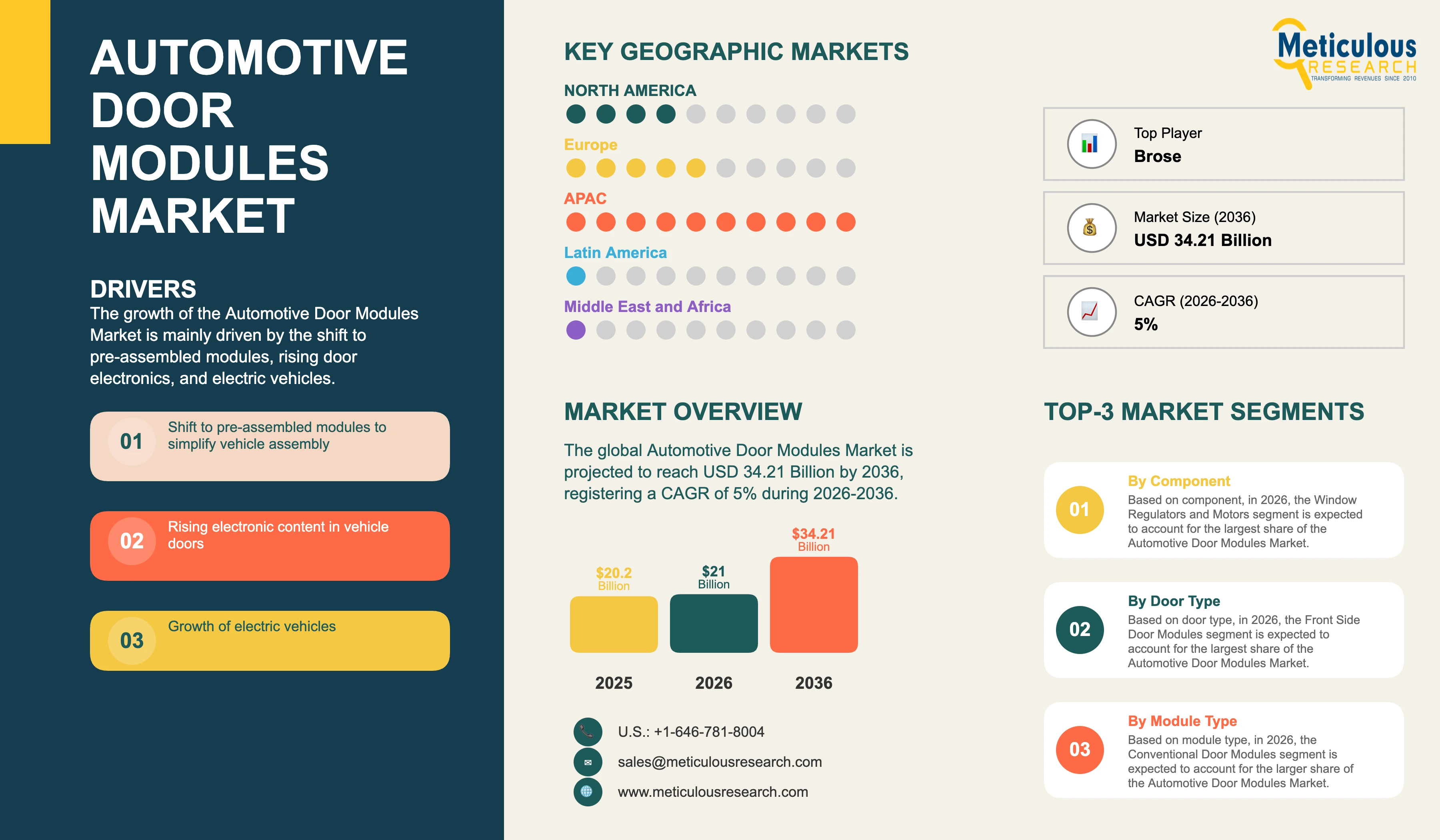
The global automotive door modules market was valued at USD 20.20 billion in 2025. This market is expected to reach USD 34.21 billion by 2036 from an estimated USD 21.00 billion in 2026, registering a CAGR of 5.0% during the forecast period (2026-2036).
- Published
- Nov 2026
- Pages
- 272
- Format
- PDF + Excel
- Report ID
- MRAUTO - 1042902
- Base year
- 2025
- 2025 · BASELINE
- $20.20B
- 2036
- $34.21B
- CAGR 2026–2036
- 5.0%
2025 baseline · 2026–2036 forecast at 5.0% CAGR · hover a bar for the value
Key highlights
Brose supplies door systems for the Mercedes-Benz C-Class from its plant in Bremen, Germany, using a just-in-sequence method in which the plant has around 280 minutes after an order is placed to assemble and test the door systems and deliver them to the nearby vehicle plant, with more than 700 different variants, according to Brose. This shows the high level of variant management and logistics that door module suppliers must handle.
Brose showed a concept prototype that integrates all the modules needed to automate the opening and closing of doors and the adjustment of seats at the SAE Brasil 2026 Congress, held on October 7 and 8, 2026 in São Paulo, according to Autodata. Brose has also developed an automated side door drive with sensors that prevent the door from closing on a person or opening into an object.
Brose has developed a door control unit that integrates all door functions, from the window regulator to collision protection, which cuts costs, saves space, and reduces weight while enabling new functions, according to Brose. Integrated door electronics are the fastest-growing component in door modules.
Kwangjin, a Korean supplier of window regulators and door modules, was named a 2025 Supplier of the Year by General Motors in April 2025, according to General Motors, along with other door system suppliers, such as Magna International.
Global electric car sales topped 20 million units in 2025, according to the IEA. Many electric vehicles use flush or retractable door handles, electric latches, and frameless doors, which increase the number of electronic parts in each door and the value of door modules per vehicle.
Leading suppliers include Brose, Grupo Antolin, Magna International, Inteva Products, Hi-Lex, Aisin, and Kwangjin. Smart and power-operated door modules are the fastest-growing module type, and liftgate and tailgate modules are the fastest-growing door type, as vehicle makers add power functions to SUVs and pickup trucks. Brose also offers power liftgate and pickup tailgate systems.
By component, window regulators and motors account for the largest share of 34.0% in 2026, while electronics and control units register the highest CAGR.
By door type, front side door modules account for the largest share in 2026, while liftgate and tailgate modules register the highest CAGR.
By module type, conventional door modules account for the larger share in 2026, while smart and power-operated door modules register the higher CAGR.
By vehicle type, passenger cars account for the larger share of 86.0% in 2026 and also register the higher CAGR.
By geography, Asia-Pacific accounts for the largest share of 49.0% in 2026, while Asia-Pacific registers the highest CAGR of 5.8%.
Report summary
| Particulars | Details |
|---|---|
| Base Year | 2025 |
| Estimated Year | 2026 |
| Forecast Period | 2026-2036 |
| Market Size in 2025 | USD 20.20 billion |
| Market Size in 2026 | USD 21.00 billion |
| Market Size by 2036 | USD 34.21 billion |
| CAGR (2026-2036) | 5.0% |
| Format | PDF, Excel & Cloud Portal · 272 pages |
| Largest Segment by Component (2026) | Window Regulators and Motors (34.0%) |
| Largest Segment by Vehicle Type (2026) | Passenger Cars (86.0%) |
| Largest Region (2026) | Asia-Pacific (49.0%) |
| Fastest-Growing Region | Asia-Pacific (CAGR 5.8%) |
| Companies Profiled | 7 companies and other companies |
| Segments Covered | Component, Door Type, Module Type, Vehicle Type, Geography |
| Countries Covered | U.S., Canada, Mexico, Germany, France, U.K., Spain, Italy, Sweden, Czech Republic, Poland, Slovakia, Hungary, Romania, Rest of Europe, China, Japan, South Korea, India, Thailand, Indonesia, Malaysia, Vietnam, Philippines, Taiwan, Australia, Rest of Asia-Pacific, Brazil, Argentina, Chile, Colombia, Rest of Latin America, Turkey, Morocco, South Africa, Saudi Arabia, UAE, Israel, Rest of Middle East & Africa |
Report overview
Segments covered: component, door type, module type, vehicle type.
Automotive door modules are pre-assembled units that combine the main functional parts of a vehicle door on a single carrier plate or inner panel. A typical door module includes the window regulator and its motor, the door latch and handle linkages, the wiring harness and connectors, speaker mountings, and, increasingly, a door control unit and sensors. The complete module is delivered to the vehicle assembly line, often in the exact sequence of vehicles being built, and installed in the door in one step, which reduces assembly time, part handling, and quality checks at vehicle plants.
The growth of this market is mainly driven by steady growth of global vehicle production, vehicle makers' preference for buying complete pre-assembled modules instead of separate parts, the rising number of electronic functions in vehicle doors, such as anti-pinch window control, electric latches, soft-close functions, and ambient lighting, the growth of electric vehicles, which often use flush door handles, frameless doors, and electric latches, and the growing use of power liftgates and tailgates in SUVs and pickup trucks. In addition, power-operated side doors and sensor-based collision protection are starting to appear in premium vehicles. However, strong price pressure from vehicle makers, the complexity of integrating many functions in a small space, and slow vehicle production in some regions are expected to restrain the growth of this market to some extent.
Door modules were introduced in the 1990s as vehicle makers looked for ways to simplify door assembly. Before door modules, workers on the vehicle assembly line installed the window regulator, latch, wiring, speakers, and other parts into each door one by one through small openings in the inner door panel, which was slow and caused quality problems. With door modules, a supplier mounts these parts on a carrier plate made of plastic, steel, or aluminum, tests the complete module, and delivers it to the vehicle plant, where it is fitted into the door in one step. This approach reduces assembly time and errors, improves sealing between the wet and dry sides of the door, and allows the supplier to optimize the layout of the parts.
This report covers the global automotive door modules market, including front side door modules, rear side door modules, sliding door modules, and liftgate and tailgate modules, for passenger cars and commercial vehicles. The market is analyzed by component, door type, module type, vehicle type, and geography. The market is valued at the selling price of complete pre-assembled door modules supplied to vehicle makers, including the carrier plate and the window regulators, motors, latches, handles, wiring, electronics, speaker mountings, and other parts mounted on it. Door outer panels, door inner trim panels, door glass supplied separately, and aftermarket replacement parts are not included.
Conventional door modules combine a power window regulator, a mechanical latch with a central locking actuator, the wiring harness, and speaker mountings on a carrier plate. They are used in most mass-market vehicles today. Smart and power-operated door modules add more advanced functions, such as electric latches without a mechanical release, soft-close and cinching functions, power-operated door drives, door control units that manage all door functions locally, sensors that detect obstacles, and connections to the vehicle network. These modules have much higher value than conventional modules and are growing quickly in premium vehicles, electric vehicles, and SUVs with power liftgates.
Vehicle doors are becoming more complex as vehicle makers add comfort, safety, and design features. A modern premium vehicle door may contain a window regulator and motor, an electric latch, a soft-close drive, a mirror control, door lighting, speakers, a door control unit, sensors for keyless entry and collision protection, and, in some cases, a power door drive. All these parts must fit into a small space, work reliably in wet and cold conditions, meet crash safety requirements, and be easy to service. This complexity increases the value of door modules and favors suppliers with strong mechanical, motor, electronics, and system integration capabilities, such as Brose, Magna International, and Inteva Products.
The market is led by door system specialists that produce window regulators, latches, and door electronics and assemble them into complete modules. Brose, Grupo Antolin, Magna International, and Inteva Products supply door modules to vehicle makers worldwide, while Hi-Lex and Aisin supply mainly Japanese vehicle makers and Kwangjin supplies Korean vehicle makers and General Motors. Door module plants are usually located very close to vehicle plants because modules are delivered just-in-sequence, often several times per hour, in the exact order of vehicles on the assembly line. Brose's Bremen plant, for example, has around 280 minutes to assemble, test, and deliver each door system to the nearby Mercedes-Benz plant, according to Brose.
Electric vehicles are changing door module design and increasing the content of each door in several ways. Many electric vehicles use flush or retractable door handles to reduce aerodynamic drag, which require motors and electronic controls in the door. Electric latches, which release the door electronically instead of through a cable, are common in electric vehicles and allow new interior and exterior designs. Frameless doors, popular in many electric vehicles, need window regulators with short-drop functions. These features increase the number of electronic parts in each door and the value of door modules per vehicle, especially in China, where electric vehicle makers compete strongly on design and features.
In 2026, window regulators and motors account for the largest share of the market by component, while electronics and control units are the fastest-growing component. Front side door modules account for the largest share by door type, while liftgate and tailgate modules are the fastest-growing door type. Conventional door modules account for the largest share by module type, while smart and power-operated door modules are the fastest-growing module type. Passenger cars account for the largest share by vehicle type and are also the fastest-growing vehicle type. Asia-Pacific accounts for the largest share of the market and is also the fastest-growing region.
Market growth over the forecast period will depend on vehicle production, the share of vehicle makers that buy complete door modules instead of separate parts, the adoption of electronic and power functions in doors, the growth of electric vehicles and SUVs, and price pressure from vehicle makers. More electronic content and power functions will increase the value of door modules per vehicle, while strong price competition for conventional modules will limit value growth. Overall, the market is expected to grow faster than vehicle production through 2036, as each door module carries more functions and higher value.
Passenger cars are expected to account for the larger share of 86.0% of the market in 2026 and are also projected to register the higher CAGR, driven by electric vehicles, smart door modules, and power liftgates in SUVs.
Asia-Pacific is expected to account for the largest share of 49.0% of the market in 2026, mainly due to China's large vehicle production and the fast adoption of smart door features by Chinese vehicle makers.
Asia-Pacific is also projected to register the highest CAGR of 5.8% during the forecast period, driven by electric vehicles in China, vehicle production growth in India, and new plants in Southeast Asia.
The report profiles 7 companies, including Brose, Grupo Antolin, Magna International, Inteva Products, Hi-Lex, Aisin, and Kwangjin.
An automotive door module is a pre-assembled unit that combines the window regulator, motor, latch, wiring, speaker mountings, and often a door control unit on a carrier plate, which is installed in the door in one step.
A smart door module adds electronic functions, such as electric latches, soft-close functions, a door control unit, power door drives, and obstacle sensors, to a conventional door module, which increases its value and functionality.
Vehicle makers buy complete door modules to reduce assembly time, part handling, and quality problems at their plants, and to receive tested modules delivered just-in-sequence in the order of vehicles on the assembly line.
Report infographic
Market dynamics
17 factors across 5 forcesShift to pre-assembled modules to simplify vehicle assembly
Vehicle makers are under pressure to reduce assembly time, cost, and complexity at their plants, especially as they launch new electric vehicle platforms and build new plants. Buying complete pre-assembled door modules allows vehicle makers to reduce the number of parts they handle, the number of assembly steps, and the number of suppliers they manage. Door module suppliers test the complete module before delivery, which reduces quality problems at the vehicle plant. Modules are usually delivered just-in-sequence, which reduces inventory at the vehicle plant.
This shift is well established in Europe and North America and is spreading in China, India, and Southeast Asia as vehicle makers build new plants and seek higher productivity. New electric vehicle makers, which often lack in-house door engineering teams, also prefer to buy complete door modules. Brose's Bremen plant, which assembles and delivers door systems for the Mercedes-Benz C-Class just-in-sequence with more than 700 variants, shows how door module suppliers support vehicle makers' production, according to Brose. This trend supports steady growth of the door modules market.
Rising electronic content in vehicle doors
Vehicle doors contain a growing number of electronic functions, including one-touch and anti-pinch window control, electric latches, soft-close functions, power-folding and heated mirrors, door lighting, keyless entry sensors, and speakers. Vehicle makers increasingly want these functions managed by a door control unit that is integrated into the door module, which reduces wiring, weight, and cost and allows new functions to be added through software. Brose has developed a door control unit that integrates all door functions, from the window regulator to collision protection, according to Brose.
This rising electronic content increases the value of door modules per vehicle and supports the growth of electronics and control units, the fastest-growing component in this market. As vehicle makers adopt new electrical architectures with zonal controllers, door modules are expected to become more closely connected to the vehicle network, which further increases their electronic content. Suppliers with strong electronics and software capabilities are best placed to benefit from this trend.
Growth of electric vehicles
Global electric car sales topped 20 million units in 2025, according to the IEA, and electric vehicles are expected to account for a growing share of new vehicle sales over the forecast period. Many electric vehicles use flush or retractable door handles, electric latches, frameless doors, and power-operated functions, which increase the number of motors, sensors, and electronic parts in each door. Electric vehicle makers also use doors as a way to differentiate their vehicles with new designs and features.
These features increase the value of door modules in electric vehicles compared with conventional vehicles. Electric vehicle makers also tend to buy complete door modules to simplify assembly at new plants and to speed up vehicle launches. Chinese electric vehicle makers, which launch new models quickly and compete strongly on features, are among the most active adopters of smart door modules, which supports strong growth in Asia-Pacific.
Growing use of power liftgates and tailgates
Power liftgates, which open and close the rear door of SUVs, hatchbacks, and MPVs electrically, are becoming common in mid-range and premium vehicles, and many offer hands-free opening with a kick sensor. Power tailgates are also spreading to pickup trucks, which account for around 20% of the vehicle market in North America, according to Brose. Brose's system for power opening and closing of pickup truck tailgates, which includes a drive, a control unit, and two latches with power cinching, is in series production, according to Brose.
Liftgate and tailgate modules with power drives, latches, and sensors have much higher value than manual liftgate hardware, and their adoption is growing in all regions. Liftgate and tailgate modules are the fastest-growing door type in this market, supported by the growing popularity of SUVs and pickup trucks and by customer demand for convenience features. Suppliers with strong drive, latch, and electronics capabilities are best placed to capture this growth.
Power-operated side doors and collision protection
Power-operated side doors, which open and close automatically at the touch of a button, a gesture, or a smartphone command, are starting to appear in premium vehicles and are being developed for robotaxis and shared vehicles. These doors use electric drives, sensors that prevent the door from closing on a person or opening into an object, and control units that manage the door's movement. Brose has developed an automated side door drive and showed a concept prototype integrating fully automated doors and seats at the SAE Brasil 2026 Congress in October 2026, according to Brose and Autodata. Collision protection sensors, often based on radar, can also stop a manually opened door before it hits a wall, a post, or another vehicle, which reduces damage and improves safety. These features add significant value to door modules and are expected to spread from premium vehicles to mid-range vehicles as their cost falls. They also support the growth of smart and power-operated door modules, the fastest-growing module type in this market, as vehicle makers look for new comfort and convenience features to differentiate their vehicles. Robotaxi and shared vehicle programs, which need doors that open and close without a driver, are expected to provide an additional source of demand for power-operated door modules over the forecast period.
Table of contents
12 chapters · 184 sections · 272 pages · click to expandSegmental analysis
| Segment | Largest share (2026) | Fastest growth (2026–2036) |
|---|---|---|
| By Component | Front side door modules | Liftgate and tailgate modules |
By Component
- The front side door modules segment is expected to account for the largest share of the automotive door modules market, while the liftgate and tailgate modules segment is projected to register the highest CAGR during the forecast period.
- The conventional door modules segment is expected to account for the larger share of the automotive door modules market, while the smart and power-operated door modules segment is projected to register the higher CAGR during the forecast period.
Geographic analysis
Asia-Pacific
Largest shareIn 2026, Asia-Pacific is expected to account for the largest share of 49.0% of the global automotive door modules market. The large share of this region is mainly due to China's position as the largest vehicle and electric vehicle producer in the world, the large vehicle production of Japan, South Korea, and India, the fast adoption of smart door features by Chinese electric vehicle makers, and the presence of door module suppliers, such as Hi-Lex, Aisin, and Kwangjin, along with large plants of Brose, Grupo Antolin, Magna International, and Inteva Products. China is the largest market in the region, followed by Japan, South Korea, and India. Asia-Pacific is also projected to register the highest CAGR of 5.8% during the forecast period. The rapid growth of this region is mainly driven by continued growth of vehicle and electric vehicle production in China, the growing use of smart door modules and electric latches by Chinese vehicle makers, rising vehicle production in India, and the growth of vehicle production in Southeast Asia, including new plants built by Chinese and Japanese vehicle makers. India is expected to be one of the fastest-growing countries, supported by vehicle production growth, the spread of power windows and central locking to entry-level vehicles, and new plants that use complete door modules. Within Asia-Pacific, Japan and South Korea are mature markets where Japanese and Korean suppliers, such as Hi-Lex, Aisin, and Kwangjin, hold strong positions with local vehicle makers, while Thailand, Indonesia, Malaysia, and Vietnam are growing as production hubs.
Europe
Europe accounts for a significant share of the market, supported by the early and wide adoption of door modules by European vehicle makers, the large production of premium vehicles with smart door features and power liftgates, the growth of electric vehicles, and the presence of leading suppliers, such as Brose, Grupo Antolin, and Magna International. Germany is the largest market in the region, followed by France, Spain, and Italy. Eastern European countries, such as the Czech Republic, Poland, Slovakia, Hungary, and Romania, are important production hubs for vehicles and door modules. However, slow vehicle production growth limits growth in the region.
North America
North America accounts for a significant share of the market, supported by the large production of SUVs and pickup trucks, the growing use of power liftgates and power tailgates, the growth of electric vehicles, and the presence of suppliers, such as Brose, Magna International, Inteva Products, and Hi-Lex. The U.S. is the largest market in the region, followed by Mexico and Canada, and Mexico is an important production base for vehicles and door modules.
Latin America
Latin America and the Middle East and Africa account for smaller shares. Brazil is the largest market in Latin America, where Brose is expanding local production of automated comfort systems, while Turkey, Morocco, and South Africa are important vehicle production hubs in the Middle East and Africa. In Latin America, Brazil and Argentina have local vehicle production, while Chile and Colombia are mainly import markets.
Middle East & Africa
In the Middle East and Africa, Saudi Arabia and the UAE are import markets with a high share of SUVs.
Competitive landscape
The global automotive door modules market includes door system specialists that produce window regulators, latches, and door electronics and assemble them into complete modules, Japanese and Korean suppliers that serve their home vehicle makers, and Chinese and other regional suppliers that serve local vehicle makers. The market is moderately concentrated, with a few global door system suppliers holding strong positions with global vehicle makers, while regional suppliers compete strongly in their home markets. Suppliers increasingly compete on electronics and system integration capabilities, as well as on cost and logistics.
Brose supplies door systems, window regulators, latches, door control units, and power liftgate and door drives to vehicle makers worldwide and operates door system plants close to vehicle plants, such as its Bremen plant for the Mercedes-Benz C-Class, according to Brose. Grupo Antolin, Magna International, and Inteva Products supply door modules and door hardware globally, and Inteva Products has developed a patented window regulator for frameless doors. Hi-Lex and Aisin supply door modules and door hardware mainly to Japanese vehicle makers, while Kwangjin supplies Korean vehicle makers and General Motors.
Companies in this market compete mainly on system integration capabilities, electronics and software, quality and reliability, just-in-sequence logistics, cost, global production footprint, and long-term relationships with vehicle makers. Key strategies in this market include developing smart door modules with integrated control units, offering power liftgate, tailgate, and side door systems, building plants close to vehicle plants in growing markets, automating module assembly, and partnering with sensor and electronics companies.
Recent competitive activity in this market has mainly focused on smart and automated door functions and on growth in emerging markets. Brose showed a concept prototype with fully automated doors and seats at the SAE Brasil 2026 Congress in October 2026, according to Autodata. Antolin opened a new plant in Thailand in September 2025 to serve vehicle makers in Southeast Asia with modular interior solutions, including door panels. Kwangjin and Magna International were among the suppliers named 2025 Supplier of the Year by General Motors, according to General Motors.
We expect competition to increase over the forecast period as suppliers compete for smart door module business on new electric vehicle platforms, as Chinese suppliers grow in their home market and abroad, and as vehicle makers continue to apply price pressure on conventional modules. Suppliers with strong electronics, power drive, and system integration capabilities, as well as global production footprints and plants close to vehicle makers in growing markets, are expected to strengthen their positions.
Some of the key players operating in the automotive door modules market are Brose Fahrzeugteile SE & Co. KG, Grupo Antolin-Irausa, S.A., Magna International Inc., Inteva Products, LLC, Hi-Lex Corporation, Aisin Corporation, and Kwangjin Co., Ltd., among others.
- —
Brose showed a concept with fully automated doors and seats at the SAE Brasil 2026 Congress in October 2026, Antolin opened a new plant in Thailand in September 2025, and General Motors named Kwangjin a 2025 Supplier of the Year.
- Brose Fahrzeugteile SE & Co. KG
- Grupo Antolin-Irausa, S.A.
- Magna International Inc.
- Inteva Products, LLC
- Hi-Lex Corporation
- Aisin Corporation
- Kwangjin Co., Ltd.
Expert perspectives
Automotive door modules are a large market that is growing steadily as doors carry more functions. Vehicle makers continue to shift from installing door parts one by one to buying complete pre-assembled modules, and each door is carrying more motors, sensors, and electronics. At the same time, strong price pressure on conventional modules and the complexity of just-in-sequence delivery keep the market highly competitive.
Over the forecast period, the market is expected to grow at a CAGR of 5.0%, from USD 21.00 billion in 2026 to USD 34.21 billion in 2036. Growth will be driven by the shift to pre-assembled modules, rising electronic content in vehicle doors, the growth of electric vehicles, the growing use of power liftgates and tailgates, and power-operated side doors and collision protection. Strong price pressure and in-house door assembly by some vehicle makers will limit growth to some extent.
Among the market segments, window regulators and motors are the largest component, while electronics and control units grow fastest. Front side door modules are the largest door type, while liftgate and tailgate modules grow fastest. Conventional door modules are the largest module type, while smart and power-operated door modules grow fastest. Passenger cars are the largest vehicle type and also grow fastest. Asia-Pacific is the largest region and is also the fastest-growing region, led by China and India.
In our view, electronics will be the most important driver of value growth in this market. Integrated door control units, electric latches, power drives, and sensors are turning the door module from a mechanical assembly into a mechatronic system, and vehicle makers are willing to pay more for modules that add new comfort and safety features. Suppliers that win smart door module business on new electric vehicle platforms will gain long-term positions, as door module suppliers are rarely changed during a vehicle's production life.
We also see the safety of electronic door functions as an important issue for the market. Electric latches and power doors must always allow occupants to open the door, even after a crash or power failure, and regulators are paying closer attention to this issue. Suppliers that design reliable emergency releases and backup power systems will be better placed to win business as safety rules change.
Overall, we believe that the automotive door modules market will grow steadily over the forecast period, with electronics and control units, liftgate and tailgate modules, smart and power-operated door modules, passenger cars, and Asia-Pacific providing the fastest growth. Companies with strong electronics, power drive, and system integration capabilities, and with plants close to vehicle makers in growing markets, will be best positioned to capture this growth.
Customer perspectives
Customers in the automotive door modules market are mainly vehicle makers, which buy complete door modules for their assembly plants. They focus on quality and reliability, smooth and quiet operation, door electronics and software, safety of electronic latches and power doors, weight, cost, just-in-sequence delivery performance, plants close to their vehicle plants, and long-term supply. Electric and premium vehicle makers place the highest value on smart door modules with integrated control units, electric latches, and power functions, while makers of mass-market vehicles focus strongly on cost and delivery reliability. Customers also expect suppliers to support them across several regions, as the same vehicle platform is often built in several countries, and to provide engineering support during new vehicle launches.
This comment explains why smart and power-operated door modules are the fastest-growing module type and why Asia-Pacific is the largest and fastest-growing region, with a 49.0% share in 2026.
This comment explains why window regulators and motors account for 34.0% of the market and why just-in-sequence capability is a key purchase factor.
This comment explains why liftgate and tailgate modules are the fastest-growing door type, while passenger cars account for 86.0% of the market and are also the fastest-growing vehicle type.
“Our new models use electric latches and flush handles, so the door is now full of electronics. We buy the complete smart door module from one supplier.”
“Door modules arrive in the exact order of our build sequence, several times every hour. One late delivery can stop the line, so supplier reliability matters as much as price.”
“Customers now expect a power liftgate on our SUVs and a power tailgate on our pickups. These features help us sell higher trims.”
Frequently asked questions
The global automotive door modules market was valued at USD 20.20 billion in 2025, up from USD 19.60 billion in 2024, and is estimated at USD 21.00 billion in 2026. The market includes side door, liftgate, tailgate, and sliding door modules.
The global automotive door modules market is expected to reach USD 34.21 billion by 2036, driven by the shift to pre-assembled modules, rising electronic content, electric vehicles, power liftgates, and power-operated doors.
The market is expected to register a CAGR of 5.0% from 2026 to 2036, with the fastest growth in electronics and control units, liftgate and tailgate modules, smart door modules, passenger cars, and Asia-Pacific.
Market growth is mainly driven by the shift to pre-assembled modules, rising electronic content in vehicle doors, the growth of electric vehicles, the growing use of power liftgates and tailgates, and power-operated side doors and collision protection.
Strong price pressure and in-house door assembly by some vehicle makers restrain growth, while managing complexity and just-in-sequence delivery and ensuring the safety of electronic door functions are key challenges.
Key growth opportunities include smart door modules for electric vehicles, power door systems for robotaxis and shared vehicles, growth in India and Southeast Asia, and integration with zonal architectures and software features.
Window regulators and motors are expected to account for the largest share of 34.0% of the market in 2026, while electronics and control units are projected to register the highest CAGR, driven by integrated door control units.
In 2026, the front side door modules segment is expected to account for the largest share of the automotive door modules market, while the liftgate and tailgate modules segment is projected to register the highest CAGR during the forecast period.
In 2026, the conventional door modules segment is expected to account for the larger share of the automotive door modules market, while the smart and power-operated door modules segment is projected to register the higher CAGR during the forecast period.
Passenger cars are expected to account for the larger share of 86.0% of the market in 2026 and are also projected to register the higher CAGR, driven by electric vehicles, smart door modules, and power liftgates in SUVs.
Asia-Pacific is expected to account for the largest share of 49.0% of the market in 2026, mainly due to China's large vehicle production and the fast adoption of smart door features by Chinese vehicle makers.
Asia-Pacific is also projected to register the highest CAGR of 5.8% during the forecast period, driven by electric vehicles in China, vehicle production growth in India, and new plants in Southeast Asia.
The report profiles 7 companies, including Brose, Grupo Antolin, Magna International, Inteva Products, Hi-Lex, Aisin, and Kwangjin.
Brose showed a concept with fully automated doors and seats at the SAE Brasil 2026 Congress in October 2026, Antolin opened a new plant in Thailand in September 2025, and General Motors named Kwangjin a 2025 Supplier of the Year.
An automotive door module is a pre-assembled unit that combines the window regulator, motor, latch, wiring, speaker mountings, and often a door control unit on a carrier plate, which is installed in the door in one step.
A smart door module adds electronic functions, such as electric latches, soft-close functions, a door control unit, power door drives, and obstacle sensors, to a conventional door module, which increases its value and functionality.
Vehicle makers buy complete door modules to reduce assembly time, part handling, and quality problems at their plants, and to receive tested modules delivered just-in-sequence in the order of vehicles on the assembly line.
Cite this report
Meticulous Research. (2026). Automotive Door Modules Market - Global Opportunity Analysis and Industry Forecast (2026-2036) (Report No. MRAUTO - 1042902). Meticulous Market Research Pvt. Ltd. https://www.meticulousresearch.com/product/automotive-door-modules-market-7585