Ziegler Natta Catalysts Market (2026-2036)
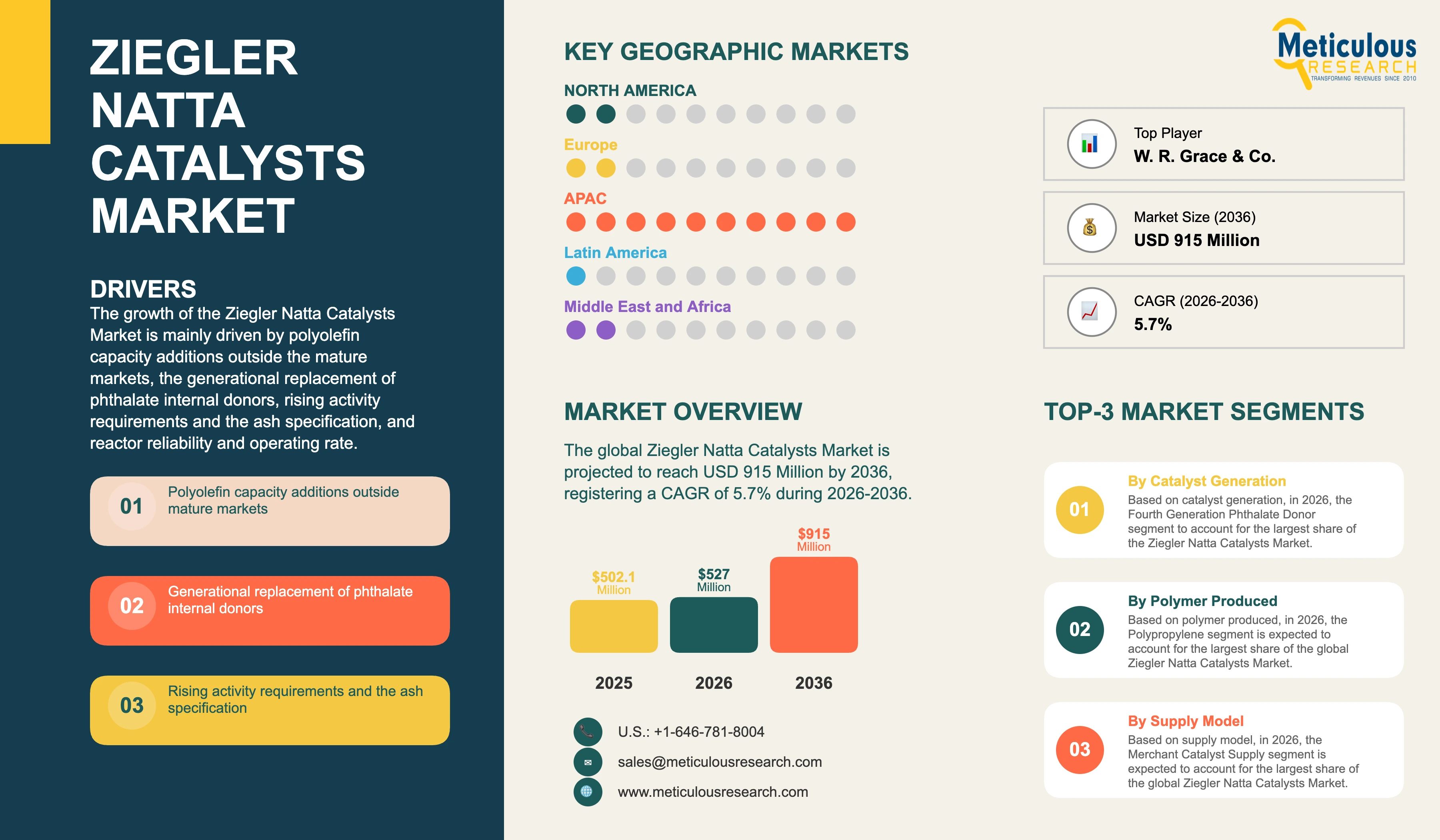
The Ziegler Natta catalysts market is valued at USD 527.0 million in 2026 and is projected to reach USD 915.0 million by 2036, at a CAGR of 5.7% during the forecast period. The market was valued at USD 502.1 million in 2025 and at USD 482.5 million in 2024.
- Published
- Nov 2026
- Pages
- 263
- Format
- PDF + Excel
- Report ID
- MRCHM - 1042742
- Base year
- 2025
- 2024 · HISTORICAL
- $482.5M
- 2036
- $915.0M
- CAGR 2026–2036
- 5.7%
2024–2025 baseline · 2026–2036 forecast at 5.7% CAGR · hover a bar for the value
Key highlights
This market sizes the solid catalyst as supplied to the reactor: the magnesium chloride support, the titanium species on it, and the internal donor that sets stereospecificity.
The alkylaluminium cocatalyst and the external donor are excluded, because both are commodity chemicals with large consumption outside polyolefin polymerisation and are procured separately.
That basis differs from the metallocene catalysts title in this series, where the methylaluminoxane activator is included because it is made for metallocene activation and sold with the complex.
Chromium catalysts of the Phillips type are excluded. They serve high density polyethylene from a different site chemistry and are not substitutable within a given reactor without a licence change.
Metallocene and other single-site catalysts are counted in the metallocene catalysts title and are not additive to this market.
Ziegler Natta systems carry the great majority of world polyolefin output on more than twice the catalyst tonnage, at below a quarter of the single-site price, so the two markets stand closer in value than in tonnage.
The polymer produced is counted in the polypropylene and polyethylene resin markets. This market measures only the catalyst charge.
Unlike every other catalyst title in this series, this market generates no spent catalyst stream. Modern grades hold ash below 30 ppm, so the catalyst is consumed into the polymer and never reclaimed.
Value growth at 5.7% runs at roughly twice volume growth at 2.8%. Tonnage tracks polyolefin output; value tracks the price paid for a higher generation donor system.
Commission Regulation (EU) 2018/2005 of 17 December 2018 restricted DEHP, DBP, BBP and DIBP in articles generally from 7 July 2020 at 0.1% by weight of the plasticised material.
Polypropylene falls within that definition, but the threshold sits far above internal donor residue and the restriction exempts food contact materials, medical devices and electrical equipment, so conversion is driven by customer specification rather than by the limit.
W. R. Grace & Co. markets its HYAMPP range as non-phthalate catalysts on a next generation internal donor system, stating that it aligns producers with global regulatory standards and brand owner sustainability goals.
The range is offered for the Spheripol, Hypol, Innovene and Novolen process technologies. Qualification is process-specific, which is why much of this market moves through the licensor rather than through tender.
Grace states that the range reaches high in-reactor melt flow rates without peroxides, gives broad xylene solubles capability with lower silane usage, and increases comonomer randomness. Each shifts cost out of the polymer plant, and those are the arguments for a higher catalyst price.
Named applications include packaging, automotive, battery separators, and food and medical packaging. Separator film has converted fastest, on thin gauge, tight purity and a concentrated customer base.
The named driver of capacity additions is contradicted in the mature markets. On 24 December 2025 Mitsui Chemicals, Inc., Idemitsu Kosan Co., Ltd. and Sumitomo Chemical Company, Limited agreed to move the domestic polypropylene and linear low density polyethylene businesses of Sumitomo Chemical into Prime Polymer Co., Ltd.
That lifts polypropylene capacity there from 1.26 to 1.59 million tonnes a year and polyethylene from 0.55 to 0.72, on FY2024 net sales of 387.3 billion yen, with a savings target above 8 billion yen a year, justified by unresolved oversupply and demand expected to shrink.
Consolidation of that kind redistributes catalyst purchasing without adding to it, which is why Japan carries the lowest country CAGR and Europe the lowest regional CAGR in this report.
Report summary
| Particulars | Details |
|---|---|
| Base Year | 2025 |
| Actual Years | 2024-2025 |
| Forecast Period | 2026-2036 |
| Market Size in 2024 | USD 482.5 million |
| Market Size in 2025 | USD 502.1 million |
| Market Size in 2026 | USD 527.0 million |
| Market Size in 2036 | USD 915.0 million |
| Value CAGR (2026-2036) | 5.7% |
| Format | PDF, Excel & Cloud Portal · 263 pages |
| Volume in 2025 | 6.05 kilotons |
| Volume in 2026 | 6.20 kilotons |
| Volume in 2036 | 8.17 kilotons |
| Volume CAGR (2026-2036) | 2.8% |
| Average Selling Price, 2026 | USD 85.00 per kg |
| Average Selling Price, 2036 | USD 112.00 per kg |
| Units | Value in USD million; volume in kilotons of solid catalyst; price in USD per kg |
| Measurement Basis | Solid Ziegler Natta catalyst as supplied to the reactor, comprising the magnesium chloride support, the titanium species and the internal donor |
| Exclusions | Alkylaluminium cocatalyst and external donor; chromium (Phillips) catalysts; metallocene and other single-site catalysts; the polyolefin resin produced |
| Segments: Catalyst Generation | Fourth Generation Phthalate Donor; Fifth and Sixth Generation Non-Phthalate Donor; Polyethylene Ziegler Natta; Slurry and Legacy Systems |
| Segments: Polymer Produced | Polypropylene; High Density Polyethylene; Linear Low Density Polyethylene; Other Polyolefins |
| Segments: Supply Model | Merchant Catalyst Supply; Captive and Licensor-Supplied Catalyst |
| Largest Segment by Generation, 2026 | Fourth Generation Phthalate Donor |
| Fastest-Growing Segment by Generation | Fifth and Sixth Generation Non-Phthalate Donor, at 10.4% |
| Largest Segment by Polymer, 2026 | Polypropylene |
| Fastest-Growing Segment by Polymer | Linear Low Density Polyethylene, at 6.6% |
| Largest Segment by Supply Model, 2026 | Merchant Catalyst Supply |
| Fastest-Growing Segment by Supply Model | Captive and Licensor-Supplied Catalyst, at 6.4% |
| Largest Region, 2026 | Asia-Pacific |
| Fastest-Growing Region | Middle East & Africa, at 6.6% |
| Fastest-Growing Country | India, at 8.0% |
| Slowest-Growing Country | Japan, at 1.8% |
| Regions Covered | Asia-Pacific; Europe; North America; Latin America; Middle East & Africa |
| Countries Covered | China; India; Japan; South Korea; Germany; Belgium; Netherlands; U.S.; Brazil; Saudi Arabia; U.A.E. |
| Key Players | W. R. Grace & Co.; LyondellBasell Industries N.V.; Clariant AG; Toho Titanium Co., Ltd.; Mitsui Chemicals, Inc.; China Petroleum & Chemical Corporation |
| Top Five Share, 2026 | 58.4% |
| Profiled Companies Share, 2026 | 66.2% |
| Currency | USD |
Report overview
Market value is measured in in USD million; volume in kilotons of solid catalyst; price in USD per kg. Segments covered: catalyst generation, polymer produced, supply model.
The growth of this market is mainly driven by polyolefin capacity additions in Asia-Pacific and the Middle East, the generational replacement of phthalate internal donors across the installed polypropylene base, and rising activity requirements that lower catalyst residue in the finished polymer. However, factors such as the maturity of polyolefin demand in Japan and Western Europe, the very high polymer yield per unit of catalyst that caps tonnage growth, catalyst consumption being tied to reactor operating rates rather than to nameplate capacity, and the displacement of Ziegler Natta duty by single-site systems in selected grades are expected to restrain the growth of this market to some extent.
A Ziegler Natta catalyst is a titanium species supported on activated magnesium chloride, charged to the reactor with an alkylaluminium cocatalyst that reduces and alkylates the titanium and, for propylene, with an internal donor fixed on the support and an external donor fed separately. The internal donor is what makes the system commercially distinct: it blocks the non-stereospecific sites so that propylene inserts with a consistent configuration, and it therefore sets the isotacticity, the xylene solubles content and the stiffness of the polymer that results.
Because the donor sets those properties, the donor chemistry defines the catalyst generation and the price band it sells in. Fourth generation systems use a phthalate diester internal donor with an alkoxysilane external donor, a combination that has run the great majority of world polypropylene capacity for three decades and remains the reference against which replacements are measured.
Fifth and sixth generation systems replace the phthalate with a succinate, a substituted 1,3-diether, an aminosilane or a malonate, and in several cases dispense with the external donor entirely. The reason a producer pays more for them is that the substitution is not merely equivalent: diether donors give very high activity and a narrow molecular weight distribution suited to high melt flow grades, while succinates give a broad distribution suited to pipe and sheet, so the donor becomes a product design choice rather than a compliance step.
That design freedom is why W. R. Grace & Co. describes its HYAMPP range not as a phthalate substitute but as a next generation internal donor system on enhanced support technology, offered across homopolymers, random copolymers, impact copolymers and terpolymers, high-stiffness homopolymers and impact copolymers, low melt flow cast film, high-clarity high melt flow random copolymer for injection moulding with taste and odour performance, and low heat seal initiation randoms and terpolymers. A range that wide is a product line, not a drop-in replacement.
The performance claims attached to that range show where the value accrues. Grace states that the catalyst delivers reduced fines and improved reactor reliability with less unplanned downtime, broad xylene solubles capability with lower silane usage, hydrogen response sufficient to reach high in-reactor melt flow rates without peroxide visbreaking, enhanced reactor stability and throughput in gas phase processes, activity high enough to hold ash below 30 ppm, and increased comonomer randomness for low heat seal initiation. Every one of those is a saving in the polymer plant rather than in the catalyst purchase, and that is the basis on which a higher catalyst price is accepted.
The ash figure deserves separate attention because it determines the economics of the whole market. At residues below 30 ppm the catalyst is consumed into the polymer and is not removed, so there is no deashing step, no catalyst recovery and no spent catalyst to refine. A producer therefore buys catalyst once per tonne of polymer and never sees it again, which makes the purchasing question purely one of kilograms of polymer per kilogram of catalyst.
That arithmetic is also what bounds the tonnage of this market. A modern polypropylene catalyst converts tens of thousands of kilograms of monomer per kilogram of catalyst, so the whole world requirement for solid Ziegler Natta catalyst is measured in single-digit kilotons against polyolefin output measured in hundreds of millions of tonnes. Each activity improvement reduces the tonnage needed for the same output, which is why volume in this market grows at 2.8% while the capacity it serves grows faster.
Catalyst qualification runs through the process technology rather than around it. Grace offers the HYAMPP range specifically for Spheripol, Hypol, Innovene and Novolen, four distinct polypropylene process technologies with different reactor configurations, residence times and hydrogen partial pressures. A catalyst that performs in a bulk loop does not transfer unchanged to a gas phase reactor, so the licensor is usually a party to the catalyst decision.
The consequence is that a substantial part of this market is not openly tendered. Where a producer operates under a licence, the licensor commonly specifies or supplies the catalyst, and the producer evaluates alternatives only at a turnaround or a grade slate change. That structure keeps supplier shares stable between campaigns and makes the market harder to enter than its technology maturity would suggest.
Regulation enters this market through the phthalate restriction rather than through any rule on catalysts. Commission Regulation (EU) 2018/2005 of 17 December 2018, adopted under Article 68(1) of REACH and published at OJ L 322/14 on 18 December 2018, replaced entry 51 of Annex XVII and brought DEHP (CAS 117-81-7), DBP (84-74-2), BBP (85-68-7) and DIBP (84-69-5) within a single restriction.
The operative provision for this market is paragraph 3, which from 7 July 2020 bars the placing on the market of articles containing any of the four, individually or combined, at 0.1% or more by weight of the plasticised material. Paragraph 5 defines plasticised material to cover homogeneous materials including PVC, PVDC, PVA and polyurethanes together with any other polymer, polymer foams and rubber included, except silicone rubber and natural latex coatings, so polypropylene is squarely within the definition.
What the provision does not do is compel a non-phthalate donor. A phthalate internal donor is present in finished polymer at residue levels far below a 0.1% threshold, and paragraph 3 exempts food contact materials regulated under Regulation (EC) No 1935/2004 or Regulation (EU) No 10/2011, medical devices, and electrical and electronic equipment under Directive 2011/65/EU, alongside articles for exclusively industrial or agricultural use and motor vehicles placed on the market before 7 January 2024. Those exemptions cover most of the applications where phthalate-free polypropylene is in fact demanded.
The transition is therefore specification-led, and that distinction matters commercially because a specification can move faster and reach further than a restriction. Brand owners in packaging, automotive interiors and medical devices write phthalate-free into supply agreements for the whole of their resin purchase regardless of where the regulatory line falls, and a producer that cannot certify the donor chemistry loses the grade rather than the licence. That is the pressure driving replacement across the installed base.
Demand for the polymer itself is diverging sharply by region, and the catalyst market follows it. The Mitsui Chemicals, Idemitsu Kosan and Sumitomo Chemical agreement of 24 December 2025 moves the domestic polypropylene and linear low density polyethylene businesses of Sumitomo Chemical into Prime Polymer Co., Ltd., lifting polypropylene capacity there from 1.26 to 1.59 million tonnes a year and polyethylene from 0.55 to 0.72, on combined FY2024 net sales of 387.3 billion yen, with Mitsui Chemicals holding 52%, Idemitsu Kosan 28% and Sumitomo Chemical 20%, and a stated target of more than 8 billion yen a year in savings.
The three companies set out their reasoning plainly: polyolefins are about half of Japanese plastics demand, domestic oversupply has not been resolved, and domestic demand is expected to shrink. A restructuring on that basis moves catalyst volume between buyers without increasing it, and where it rationalises reactors it reduces it. The growth in this market is in genuinely new capacity, which is being built in Asia-Pacific outside Japan and in the Middle East.
Taken together, these conditions give a market that is mature in tonnage and active in value. The catalyst charge per tonne of polymer keeps falling as activity rises, the geography of consumption keeps shifting toward new capacity, and the price per kilogram keeps rising as the installed base converts to higher generation donors. Value grows at 5.7% on volume growth of 2.8%, and the difference is the generational change rather than the capacity cycle.
It does not. The regulation restricts DEHP, DBP, BBP and DIBP in articles from 7 July 2020 at 0.1% by weight of the plasticised material, a threshold far above the residue an internal donor leaves in finished polymer, and it exempts food contact materials, medical devices and electrical and electronic equipment from that provision. Those exemptions cover most of the applications where phthalate-free polypropylene is demanded, so the regulation sets direction while customer specification compels the change.
Yes. Paragraph 5 of the replaced entry 51 defines plasticised material to cover homogeneous materials including PVC, PVDC, PVA and polyurethanes together with any other polymer, polymer foams and rubber included, except silicone rubber and natural latex coatings. Polypropylene falls within that definition, which is why the restriction sets the direction of travel even though the threshold does not reach catalyst residue.
Only outside the mature markets. On 24 December 2025 Mitsui Chemicals, Idemitsu Kosan and Sumitomo Chemical agreed to move the domestic polypropylene and linear low density polyethylene businesses of Sumitomo Chemical into Prime Polymer Co., Ltd., lifting polypropylene capacity there from 1.26 to 1.59 million tonnes a year and polyethylene from 0.55 to 0.72, on combined FY2024 net sales of 387.3 billion yen with a target of more than 8 billion yen a year in savings, citing unresolved domestic oversupply and demand expected to shrink. That redistributes catalyst purchasing rather than adding to it, and Japan is forecast at 1.8% and Europe at 2.6%.
Asia-Pacific is expected to account for the largest share of this market in 2026, on the concentration of world polyolefin capacity in China, India, South Korea and Japan. The Middle East & Africa is expected to register the highest CAGR of 6.6%, on new licensed capacity in Saudi Arabia and the United Arab Emirates built against advantaged feedstock.
No. At the activities modern grades reach, ash in the finished polymer is held below 30 ppm, so the catalyst is consumed into the product and is never discharged, reclaimed or refined. This is the only catalyst title in this series with no spent catalyst stream, and the spent catalyst recycling title carries no revenue attributable to polyolefin catalysts.
Catalyst qualification is process-specific. W. R. Grace & Co. offers its HYAMPP range for the Spheripol, Hypol, Innovene and Novolen polypropylene process technologies, four distinct configurations with different residence times and hydrogen partial pressures, and a catalyst proven in one does not transfer unchanged to another. Where a producer operates under a licence the licensor is commonly party to the catalyst decision, which is why captive and licensor-supplied volume grows faster than merchant supply.
On catalyst cost per tonne of polymer rather than price per kilogram of catalyst, and on a demonstration run on their own reactor. A supplier seeking a higher price must show a yield, reliability or downstream saving that covers it, and where the claim cannot be shown on the specific reactor the producer defaults to the incumbent grade.
W. R. Grace & Co. states that its range reaches high in-reactor melt flow rates through hydrogen response without peroxides, gives broad xylene solubles capability with lower silane usage, and delivers increased comonomer randomness for low heat seal initiation. Avoiding a peroxide visbreaking pass removes a chemical cost and releases extrusion capacity, and reduced silane consumption removes a recurring external donor cost, both of which are counted against the catalyst price in the producer evaluation.
The key players operating in this market are W. R. Grace & Co. (U.S.), LyondellBasell Industries N.V. (Netherlands), Clariant AG (Switzerland), Toho Titanium Co., Ltd. (Japan), Mitsui Chemicals, Inc. (Japan), and China Petroleum & Chemical Corporation (China). The five largest participants are estimated to hold 58.4% of this market in 2026 and the six profiled companies 66.2%, with the remainder held by regional catalyst producers in China and India serving domestic polyolefin capacity.
Report infographic
Market dynamics
21 factors across 5 forcesPolyolefin Capacity Additions Outside the Mature Markets
Catalyst consumption is a direct function of polymer produced, so a new polyolefin reactor creates recurring catalyst demand from the moment it reaches saleable grade. The additions that matter are in Asia-Pacific outside Japan and in the Middle East, where feedstock advantage and domestic demand growth both support operating rates, and that geography is why Asia-Pacific is forecast to hold 56.0% of this market in 2026 and the Middle East & Africa to grow fastest at 6.6%.
New capacity also arrives qualified on current generation catalyst rather than on legacy grades, because a greenfield plant has no incumbent slate to protect. Capacity additions therefore raise both the tonnage and the average price of this market, and they are the principal reason regional growth rates here diverge by more than a factor of two.
Generational Replacement of Phthalate Internal Donors
The installed polypropylene base was built on fourth generation phthalate donor catalysts and is now converting, not because the catalyst is prohibited but because customers specify against it: brand owners in packaging, automotive interiors and medical applications write phthalate-free into resin supply agreements, and a producer that cannot certify the donor chemistry loses the grade.
Commission Regulation (EU) 2018/2005 set the direction those specifications follow. By restricting DEHP, DBP, BBP and DIBP in articles generally from 7 July 2020 at 0.1% by weight of the plasticised material, and by defining plasticised material to include any polymer other than silicone rubber and natural latex coatings, it established phthalates as a restricted class across polymer articles. W. R. Grace & Co. markets the resulting products as non-phthalate catalysts on a next generation internal donor system that aligns producers with global regulatory standards and brand owner sustainability goals.
Replacement of this kind lifts value without lifting tonnage, because the new catalyst displaces the old charge-for-charge at a higher price. Non-phthalate donor systems are forecast to grow at 10.4% against 2.4% for the systems they displace, and that substitution accounts for most of the gap between value and volume growth in this market.
Rising Activity Requirements and the Ash Specification
Catalyst activity determines the residue left in finished polymer, and that residue is specified by the customer. Grace states that the HYAMPP range supports ash below 30 ppm, a level achievable only at high activity, and thin-gauge film, battery separator and medical applications specify at or below it.
Higher activity is also a direct saving in the polymer plant, because fewer kilograms of catalyst produce the same tonnes of polymer. A grade that raises activity can therefore command a materially higher price while reducing catalyst cost per tonne, which is why average selling price rises from USD 85.00 per kg to USD 112.00 per kg while volume grows at only 2.8%.
Reactor Reliability and Operating Rate
Catalyst morphology governs how a reactor runs. Fines and irregular particle growth cause sheeting and fouling, and Grace states that its range delivers reduced fines with improved reactor reliability and less unplanned downtime, together with enhanced stability and throughput in gas phase processes. An hour of unplanned downtime costs a producer far more than the catalyst consumed in it, so morphology is a purchasing criterion in its own right.
Because catalyst consumption tracks actual output rather than nameplate capacity, reliability gains raise the volume of this market as well as its price, and that effect compounds with the capacity additions above.
In-Reactor Property Control Displacing Downstream Processing
Grades that once required post-reactor treatment are increasingly made at the reactor. Grace states that the range gives hydrogen response sufficient to reach high in-reactor melt flow rates without peroxides, broad xylene solubles capability with lower silane usage, and increased comonomer randomness enabling low heat seal initiation. Avoiding peroxide visbreaking eliminates an extrusion pass and the molecular weight penalty attached to it, and lower silane usage removes a recurring external donor cost.
The commercial effect is that catalyst value rises as processing value falls. A producer transfers spend from peroxide, silane and extrusion capacity into the catalyst charge, and that transfer is the mechanism by which price in this market outruns the polyolefin output it serves.
Table of contents
11 chapters · 127 sections · 263 pages · click to expandSegmental analysis
| Segment | Largest share (2026) | Fastest growth (2026–2036) |
|---|---|---|
| By Catalyst Generation | Fourth generation phthalate donor systems | Fifth and sixth generation non-phthalate donor systems |
| By Polymer Produced | Polypropylene | Linear low density polyethylene |
| By Supply Model | Merchant catalyst supply | — |
| By Geography | Asia-Pacific | Middle East & Africa |
By Catalyst Generation
- Ziegler Natta Catalysts Market Analysis by Catalyst Generation
- This market is segmented by catalyst generation into fourth generation phthalate donor systems, fifth and sixth generation non-phthalate donor systems, polyethylene Ziegler Natta systems without a stereospecificity donor, and slurry and legacy systems.
- Fourth generation phthalate donor systems are expected to hold the largest share of this market in 2026.
- The segment holds that position because the installed polypropylene base was built on it over three decades, the grade slates running on it are fully qualified, and a producer changes catalyst only at a turnaround with saleable-grade risk attached.
- Conversion away from it is therefore scheduled rather than immediate, and the segment is forecast at 2.4%, the slowest rate of any segment in this report.
- Fifth and sixth generation non-phthalate donor systems are expected to record the highest CAGR of 10.4% during the forecast period.
- Growth at that rate reflects a substitution rather than new demand: brand owners specify phthalate-free resin across packaging, automotive interior and medical portfolios, and W.
- R.
- Grace & Co. markets its HYAMPP range as non-phthalate catalysts on a next generation internal donor system that supports ash below 30 ppm and high in-reactor melt flow rates without peroxides.
- Because the new catalyst replaces the old charge-for-charge at a higher price, the segment contributes disproportionately to the value growth of this market.
- Polyethylene Ziegler Natta systems serve high density and linear low density polyethylene from titanium on magnesium chloride without a stereospecificity donor, since ethylene has no tacticity to control.
- The segment grows with polyethylene output and with the hexene and octene comonomer grades that Ziegler Natta systems still hold against single-site alternatives.
- Slurry and legacy systems cover older unsupported and first to third generation titanium trichloride chemistries still running in a small number of plants.
- The segment declines as those units are converted or closed, and it is retained in this report because the catalyst tonnage per tonne of polymer on these systems is far higher than on modern supported grades.
- Fourth generation phthalate donor systems are expected to hold the largest share, because the installed polypropylene base was built on them, the grade slates running on them are fully qualified, and a producer changes catalyst only at a turnaround with saleable-grade risk attached.
- Fifth and sixth generation non-phthalate donor systems are expected to record the highest CAGR of 10.4%.
- The growth is a substitution driven by brand owner specifications for phthalate-free resin in packaging, automotive interior and medical applications, and because the new catalyst replaces the old charge-for-charge at a higher price it contributes disproportionately to value growth.
By Polymer Produced
- Ziegler Natta Catalysts Market Analysis by Polymer Produced
- This market is segmented into polypropylene, high density polyethylene, linear low density polyethylene, and other polyolefins.
- Polypropylene is expected to account for the largest share of this market in 2026.
- The segment leads because propylene polymerisation requires an internal donor to control tacticity, which makes the catalyst more complex and more expensive per kilogram than an ethylene catalyst, and because Ziegler Natta systems retain almost the whole of world polypropylene capacity.
- The generational donor change is also concentrated here, so the segment carries both the largest tonnage and the highest average price in this market.
- Linear low density polyethylene is expected to register the highest CAGR of 6.6% during the forecast period.
- The segment grows with film demand in Asia-Pacific and the Middle East, and Ziegler Natta systems hold the butene and hexene commodity film grades where single-site catalysts cannot match the activity at the price.
- Growth here is a volume story rather than a price story, which distinguishes it from the polypropylene segment.
- High density polyethylene is served by Ziegler Natta systems in competition with chromium catalysts, which are excluded from this market.
- Bimodal pipe and blow moulding grades made in cascaded reactors are the part of the segment where Ziegler Natta systems are most firmly held, because the molecular weight distribution is built by reactor sequencing rather than by site uniformity.
- Other polyolefins cover polybutene, poly-4-methyl-1-pentene, ethylene propylene elastomers made on Ziegler Natta systems, and polyolefin wax.
- The segment is small but carries a high catalyst price per tonne of polymer because the grades are specialised and the campaign volumes short.
By Supply Model
- Ziegler Natta Catalysts Market Analysis by Supply Model
- This market is segmented into merchant catalyst supply and captive and licensor-supplied catalyst.
- Merchant catalyst supply is expected to hold the largest share of this market in 2026, comprising catalyst bought from an independent catalyst house against a producer specification.
- The segment leads because most operating polyolefin plants are past their original licence term and procure catalyst on their own account, and because catalyst houses have built grade portfolios broad enough to cover a full slate.
- Captive and licensor-supplied catalyst is expected to record the higher CAGR of 6.4% during the forecast period.
- W.
- R.
- Grace & Co. offers the HYAMPP range specifically for the Spheripol, Hypol, Innovene and Novolen process technologies, and that structure shows why: catalyst qualification is process-specific, so a new licensed plant typically takes its catalyst through the licence rather than through tender.
- Because new capacity is being licensed in Asia-Pacific and the Middle East while mature-market plants rationalise, this segment grows faster than merchant supply.
- Captive production by integrated producers is counted in this segment at an internal transfer basis.
- China Petroleum & Chemical Corporation and Mitsui Chemicals, Inc. both produce catalyst for their own polyolefin capacity as well as for third parties, and the internal volume is sized here because it displaces merchant purchase.
By Geography
- Ziegler Natta Catalysts Market Analysis by Geography
- Geographically, this market is segmented into Asia-Pacific, Europe, North America, Latin America, and the Middle East & Africa, with individual country sizing within each region.
- Asia-Pacific is expected to account for the largest share of this market in 2026, on the concentration of world polyolefin capacity in China, India, South Korea and Japan and on continuing additions outside Japan.
- The Middle East & Africa is expected to register the highest CAGR of 6.6%, on new licensed capacity in Saudi Arabia and the United Arab Emirates built against advantaged feedstock.
- Europe is expected to record the lowest regional CAGR of 2.6%, and Japan the lowest country rate of 1.8%.
- Both reflect the same condition the Mitsui Chemicals, Idemitsu Kosan and Sumitomo Chemical agreement of 24 December 2025 described: polyolefins at about half of plastics demand, unresolved domestic oversupply, and demand expected to shrink.
- Where capacity consolidates, catalyst purchasing moves between buyers without increasing.
Geographic analysis
Asia-Pacific
Largest shareAsia-Pacific is expected to account for the largest share of this market in 2026. The region holds the majority of world polypropylene and polyethylene capacity, and China and India continue to add reactors while consumption growth supports operating rates. Catalyst consumption follows polymer output directly, so the regional share tracks the capacity base closely. India is expected to record the highest country CAGR in the region at 8.0%, on new polypropylene capacity built against refinery-integrated propylene and on domestic packaging demand. China follows at 7.0%, where the scale of the installed base means even moderate growth adds more catalyst tonnage than any other country. Japan is expected to record the lowest country CAGR in this report at 1.8%. The agreement of 24 December 2025 among Mitsui Chemicals, Inc., Idemitsu Kosan Co., Ltd. and Sumitomo Chemical Company, Limited to move the domestic polypropylene and linear low density polyethylene businesses of Sumitomo Chemical into Prime Polymer Co., Ltd., lifting polypropylene capacity there from 1.26 to 1.59 million tonnes a year and polyethylene from 0.55 to 0.72, was justified by unresolved domestic oversupply and demand expected to shrink. That is a redistribution of catalyst purchasing, not an addition to it.
Middle East & Africa
The Middle East & Africa is expected to register the highest regional CAGR at 6.6%, led by the United Arab Emirates at 7.0% and Saudi Arabia at 6.6%. New capacity in both is licensed rather than self-developed, which means catalyst arrives qualified on the process and current in generation, raising both the tonnage and the average price the region contributes.
North America
North America is expected to grow at 4.6%, with the United States at the same rate. Ethane-advantaged polyethylene capacity supports the polyethylene catalyst segment, while polypropylene capacity is stable and the growth there is in the non-phthalate donor conversion rather than in new reactors.
Europe
Europe is expected to record the lowest regional CAGR at 2.6%, with Belgium at 2.6%, the Netherlands at 2.4% and Germany at 2.2%. The region is the origin of the phthalate restriction and is the most fully converted to non-phthalate donors, so the price uplift available there is largely already taken while the volume base is flat to declining.
Latin America
Latin America is expected to grow at 5.0%, with Brazil at the same rate. The region consumes catalyst against established polypropylene and polyethylene capacity serving domestic packaging and agriculture, and its growth is driven by operating rate and by donor conversion rather than by new trains.
Competitive landscape
The global Ziegler Natta catalysts market is concentrated among a small number of catalyst houses and process licensors, because a catalyst is qualified against the reactor and the process it runs in and a change of supplier requires a commercial trial that risks saleable polymer. The key players operating in this market are W. R. Grace & Co. (U.S.), LyondellBasell Industries N.V. (Netherlands), Clariant AG (Switzerland), Toho Titanium Co., Ltd. (Japan), Mitsui Chemicals, Inc. (Japan), and China Petroleum & Chemical Corporation (China).
W. R. Grace & Co. competes on the breadth of its non-phthalate portfolio and on multi-process qualification. Its HYAMPP range is offered for the Spheripol, Hypol, Innovene and Novolen polypropylene process technologies and extends across homopolymers, randoms, impacts and terpolymers, high-stiffness homopolymers and impact copolymers, low melt flow cast film, high-clarity high melt flow injection moulding grades with taste and odour performance, and low heat seal initiation randoms, with stated activity supporting ash below 30 ppm. A portfolio structured by end grade rather than by polymer type is what allows the company to contest a full slate at a single plant rather than individual grades.
LyondellBasell Industries N.V. holds the distinct position of being both a catalyst supplier and the licensor of the most widely installed polypropylene process technology, which gives it access to the catalyst decision at the point a plant is licensed rather than at tender. That access is most valuable in the regions where new capacity is licensed rather than self-developed, which is the pattern in the Middle East and in South and Southeast Asia.
Clariant AG and Toho Titanium Co., Ltd. compete on donor chemistry and support morphology, the two variables that set stereospecificity and fines content respectively, and both supply catalyst houses and producers across more than one process technology. Mitsui Chemicals, Inc. occupies a third position as catalyst producer, process licensor and integrated polyolefin producer through Prime Polymer Co., Ltd., whose capacity rises to 1.59 million tonnes a year of polypropylene and 0.72 million tonnes a year of polyethylene under the agreement of 24 December 2025. China Petroleum & Chemical Corporation supplies its own very large polyolefin base and sells into the Chinese merchant market, where it competes primarily on price and delivery rather than on donor generation.
The five largest participants are estimated to hold 58.4% of this market in 2026, and the six companies profiled in this report 66.2%. The remainder is held by regional catalyst producers in China and India serving domestic polyolefin capacity, whose individual positions are not separately quantified in this report. Competitive movement over the forecast period is expected to come from non-phthalate donor qualification rather than from capacity, because the conversion decision is taken at a turnaround and the supplier that wins it holds the line for the following campaign cycle as well.
- W. R. Grace & Co.
- LyondellBasell Industries N.V.
- Clariant AG
- Toho Titanium Co., Ltd.
- Mitsui Chemicals, Inc.
- China Petroleum & Chemical Corporation
Expert perspectives
The named demand driver for this market is polyolefin capacity additions, and the evidence supports it only in part. New reactors do create recurring catalyst demand, and they are the reason the Middle East & Africa is forecast at 6.6% and India at 8.0%. But capacity additions are not the reason this market grows at 5.7% in value, because catalyst tonnage grows at only 2.8% and will keep doing so while activity improvements reduce the charge needed per tonne of polymer.
The growth is in the generational change of internal donors. Non-phthalate donor systems are forecast at 10.4% against 2.4% for the phthalate systems they replace, and because the replacement is charge-for-charge at a higher price it lifts average selling price from USD 85.00 per kg to USD 112.00 per kg without adding tonnage. Any assessment of this market that treats capacity as the growth variable will overstate volume and understate price.
The usual account of what compels that change does not hold on examination. Commission Regulation (EU) 2018/2005 restricts DEHP, DBP, BBP and DIBP in articles from 7 July 2020 at 0.1% by weight of the plasticised material, a threshold far above the residue an internal donor leaves in polymer, and it exempts food contact materials, medical devices and electrical and electronic equipment from that provision. Those exemptions cover the applications where phthalate-free polypropylene is most demanded, so the restriction sets direction without compelling the substitution.
What compels it is the customer. Brand owners apply phthalate-free requirements across whole resin portfolios irrespective of the regulatory threshold, and W. R. Grace & Co. markets its range on alignment with global regulatory standards and brand owner sustainability goals in the same breath. A specification-led transition runs faster and reaches further than a restriction-led one, and it does not reverse if regulatory attention moves elsewhere.
The mature markets are moving in the opposite direction from the driver. The agreement of 24 December 2025 among Mitsui Chemicals, Idemitsu Kosan and Sumitomo Chemical consolidates Japanese polypropylene and linear low density polyethylene into Prime Polymer Co., Ltd. with a target of more than 8 billion yen a year in savings, justified by unresolved oversupply and shrinking demand. Japan at 1.8% and Europe at 2.6% are the arithmetic consequence, and the divergence between those rates and 8.0% in India is the widest in any catalyst title in this series.
One structural feature sets this market apart from every other catalyst market. At the activities modern grades reach, ash in finished polymer is held below 30 ppm, so the catalyst is consumed into the product and never recovered. There is no spent catalyst stream, no reclamation revenue and no residual metal value, which means the entire economic life of the catalyst is captured in the purchase price and the polymer yield it delivers.
Frequently asked questions
The Ziegler Natta catalysts market is valued at USD 527.0 million in 2026 and is projected to reach USD 915.0 million by 2036, at a CAGR of 5.7% during the forecast period. In volume terms the market is estimated at 6.20 kilotons of solid catalyst in 2026, rising to 8.17 kilotons by 2036 at a CAGR of 2.8%.
Cite this report
Meticulous Research. (2026). Ziegler Natta Catalysts Market - Global Opportunity Analysis and Industry Forecast (2026-2036) (Report No. MRCHM - 1042742). Meticulous Market Research Pvt. Ltd. https://www.meticulousresearch.com/product/ziegler-natta-catalysts-market-7425