Refractory Metal Powders Market (2026-2036)
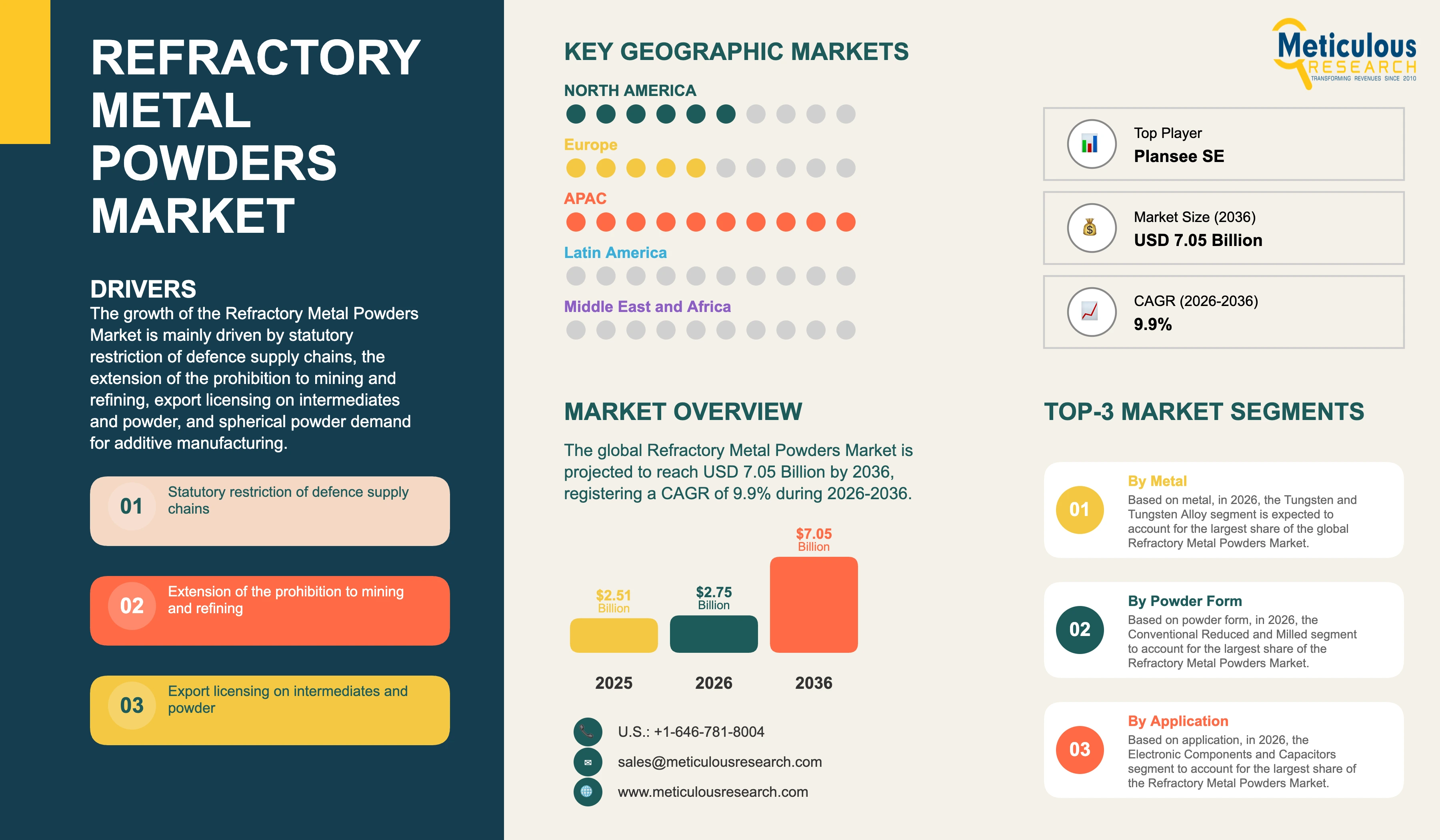
The refractory metal powders market is valued at USD 2.75 billion in 2026 and is projected to reach USD 7.05 billion by 2036, at a CAGR of 9.9% during the forecast period. The market was valued at USD 2.51 billion in 2025 and at USD 2.30 billion in 2024.
- Published
- Nov 2026
- Pages
- 249
- Format
- PDF + Excel
- Report ID
- MRCHM - 1042747
- Base year
- 2025
- 2024 · HISTORICAL
- $2.30B
- 2036
- $7.05B
- CAGR 2026–2036
- 9.9%
2024–2025 baseline · 2026–2036 forecast at 9.9% CAGR · hover a bar for the value
Key highlights
This market measures refractory metal and alloy powders on a contained powder mass basis, covering tungsten, tantalum, molybdenum, niobium and rhenium and their alloys.
Tungsten carbide powder and the other carbide powders are excluded and counted in cemented carbide markets. That exclusion is large, because carbide is the dominant end use of tungsten, and it is the reason this market is smaller than tungsten consumption suggests.
Mill products and finished components are excluded: sheet, rod, crucibles, sputtering targets and heavy alloy parts are counted downstream. This market ends at the powder.
The ores and intermediates are also excluded, including ammonium paratungstate, tungsten oxide, ferrotungsten, tantalite and ferroniobium, counted in mineral and intermediate markets.
Rhenium in catalyst form is counted in the rhenium catalyst materials title in this series and rhenium metal powder for components here, so the two are complementary rather than additive. Refractory bricks measured in the refractory bricks title are a ceramic rather than a metal class.
Value growth at 9.9% runs well above volume growth at 5.8%, because the mix moves toward spherical and qualified non-covered powder rather than because metal prices rise.
The decisive development here is legal rather than technical. Section 4872 of Title 10 of the United States Code prohibits the Secretary of Defense from acquiring covered materials melted or produced in a covered nation, or end items containing them.
The covered materials named in that section are samarium-cobalt magnets, neodymium-iron-boron magnets, tungsten metal powder, tungsten heavy alloy and finished or semi-finished components containing it, and tantalum metals and alloys, the last added in 2019.
The covered nations are North Korea, China, Russia and Iran. Tungsten metal powder is therefore named in statute, which places two of the five refractory metals under a procurement prohibition rather than a preference.
The prohibition applies to prime contracts and to subcontracts at any tier, so it propagates through the whole supply chain rather than resting with the prime contractor.
A 2021 amendment extends the prohibition from materials melted or produced in a covered nation to materials mined, refined or separated there, taking effect five years after 1 January 2021. Powder melted outside a covered nation from covered-nation intermediate ceases to qualify.
The exceptions are narrow: the Secretary may proceed only where satisfactory quality and quantity cannot be obtained in the form needed when needed at a reasonable price, or for end items used outside the United States.
The commercially available off-the-shelf exception does not apply to items that are at least 50% tungsten by weight, nor to unincorporated mill products such as bars, billets, plates or sheets, and the section carries no de minimis threshold.
From the opposite direction, Decision No. 10 of 2025 of the Chinese Ministry of Commerce and General Administration of Customs, announced on 4 February 2025, imposed export controls on tungsten, tellurium, bismuth, molybdenum and indium related items.
The tungsten items named are ammonium paratungstate, tungsten oxide, non-controlled tungsten carbide, solid tungsten of specified characteristics, and tungsten-nickel-iron and tungsten-nickel-copper alloys. The only molybdenum item named is molybdenum powder.
Exporters must obtain permission before export, and the production technologies and materials for those items are covered as well. China cited safeguarding national security and fulfilling international non-proliferation obligations.
The two measures name the same products from opposite ends. The United States bars tungsten metal powder and tungsten heavy alloy of Chinese origin from its defence chain, while China licenses the export of molybdenum powder, tungsten heavy alloy compositions, and the ammonium paratungstate and tungsten oxide from which tungsten powder is made.
Those are the same points in the chain, so the growth in this market is the reconstruction of a qualified non-covered supply chain rather than any change in thermal performance requirements.
Report summary
| Particulars | Details |
|---|---|
| Base Year | 2025 |
| Actual Years | 2024-2025 |
| Forecast Period | 2026-2036 |
| Market Size in 2024 | USD 2.30 billion |
| Market Size in 2025 | USD 2.51 billion |
| Market Size in 2026 | USD 2.75 billion |
| Market Size in 2036 | USD 7.05 billion |
| Value CAGR (2026-2036) | 9.9% |
| Format | PDF, Excel & Cloud Portal · 249 pages |
| Volume in 2025 | 32.80 kilotons |
| Volume in 2026 | 34.00 kilotons |
| Volume in 2036 | 59.75 kilotons |
| Volume CAGR (2026-2036) | 5.8% |
| Average Selling Price, 2026 | USD 81.00 per kg |
| Average Selling Price, 2036 | USD 118.00 per kg |
| Units | Value in USD million; volume in kilotons of powder; price in USD per kg |
| Measurement Basis | Refractory metal and alloy powders on a contained powder mass basis, covering tungsten, tantalum, molybdenum, niobium and rhenium and their alloys |
| Exclusions | Tungsten carbide and other carbide powders, counted in cemented carbide markets; mill products and finished components; ores and intermediates including ammonium paratungstate, tungsten oxide, ferrotungsten, tantalite and ferroniobium; rhenium in catalyst form |
| Segments: Metal | Tungsten and Tungsten Alloy; Tantalum and Tantalum Alloy; Molybdenum and Molybdenum Alloy; Niobium, Rhenium and Other |
| Segments: Powder Form | Conventional Reduced and Milled; Spherical for Additive Manufacturing; Agglomerated and Spray-Dried |
| Segments: Application | Electronic Components and Capacitors; Mill Products and Extreme Temperature Components; Heavy Alloy and Defence Components; Thermal Spray and Wear Coatings; Additive Manufacturing Parts and Other |
| Largest Segment by Metal, 2026 | Tungsten and Tungsten Alloy |
| Fastest-Growing Segment by Metal | Niobium, Rhenium and Other, at 13.0% |
| Largest Segment by Powder Form, 2026 | Conventional Reduced and Milled |
| Fastest-Growing Segment by Powder Form | Spherical for Additive Manufacturing, at 18.0% |
| Largest Segment by Application, 2026 | Electronic Components and Capacitors |
| Fastest-Growing Segment by Application | Heavy Alloy and Defence Components, at 15.0% |
| Largest Region, 2026 | Asia-Pacific |
| Fastest-Growing Region | North America, at 12.6% |
| Fastest-Growing Country | Canada, at 13.0% |
| Slowest-Growing Country | China, at 6.4% |
| Regions Covered | Asia-Pacific; North America; Europe; Rest of the World |
| Countries Covered | China; Japan; South Korea; India; U.S.; Canada; Germany; Austria; U.K.; Brazil |
| Key Players | Plansee SE; Xiamen Tungsten Co., Ltd.; CMOC Group Limited; Mitsubishi Materials Corporation; Global Advanced Metals Pty Ltd; Molibdenos y Metales S.A. |
| Top Five Share, 2026 | 42.6% |
| Profiled Companies Share, 2026 | 47.4% |
| Currency | USD |
Report overview
Market value is measured in in USD million; volume in kilotons of powder; price in USD per kg. Segments covered: metal, powder form, application.
In volume terms, the market is estimated at 34.00 kilotons of powder in 2026, rising to 59.75 kilotons by 2036, at a CAGR of 5.8%. The average selling price is estimated at USD 81.00 per kg in 2026 and USD 118.00 per kg in 2036, the increase reflecting a shift toward spherical powders for additive manufacturing and toward qualified non-covered supply, both of which carry a premium over conventional reduced and milled powder.
The growth of this market is mainly driven by statutory restrictions that require defence supply chains to be rebuilt outside a small group of countries, export licensing on the intermediates from which these powders are made, additive manufacturing demand for spherical refractory metal powder, and tantalum powder consumption in electronic components. However, factors such as the concentration of ore and intermediate supply in a single country, the cost and time required to qualify a non-covered supply chain, substitution away from tantalum in capacitors, and the sensitivity of these powders to metal price cycles are expected to restrain the growth of this market to some extent.
Among metals, tungsten and tungsten alloy powders are expected to hold the largest share of this market in 2026, while niobium, rhenium and other refractory metal powders are expected to record the highest CAGR during the forecast period. Geographically, Asia-Pacific is expected to account for the largest share of this market in 2026, while North America is expected to register the highest CAGR during the forecast period.
A refractory metal is one that resists heat and wear far beyond the range of steel or nickel alloys, and the five that matter commercially are tungsten, molybdenum, tantalum, niobium and rhenium. All five melt above 2,400 degrees Celsius and none can be cast and machined by conventional routes at useful scale, which is why they reach their end uses as powder: the powder is pressed and sintered, or it is sprayed, or it is melted selectively in an additive machine.
Powder is therefore not a stage on the way to a product but the form in which the metal is traded and specified. Particle size distribution, oxygen content, apparent density and flow behaviour determine whether a press-and-sinter part reaches full density, whether a thermal spray coating adheres, and whether an additive build completes without porosity, so a powder is qualified for a route rather than sold as a metal.
The production chain runs from concentrate through an intermediate to the powder. Tungsten moves from scheelite or wolframite concentrate to ammonium paratungstate, then to tungsten oxide, then by hydrogen reduction to metal powder. Molybdenum moves from concentrate through technical oxide to powder. Tantalum and niobium are separated from the same ores and reduced to powder by sodium or other routes. Those intermediate steps are where the market is now constrained.
This report measures the powder and excludes the intermediates and the mill products, and it also excludes tungsten carbide powder, which is counted in cemented carbide markets. That last exclusion is substantial, because carbide is the dominant end use of tungsten, and it is the reason this market is smaller than world tungsten consumption implies. The Chinese control list treats carbide as a distinct item class as well, which supports the same division.
The applications divide less neatly than the name of this market suggests. Electronic components and capacitors are the largest application at 30.0%, which is a tantalum story rather than a temperature one: tantalum powder is pressed into capacitor anodes for the volumetric efficiency its oxide dielectric provides, in duty where heat resistance is incidental.
Mill products and extreme temperature components, the application the name of this market suggests, account for 26.0% and grow at 8.4%, below the market rate. Furnace heating elements, crucibles, glass melting electrodes, sputtering targets, rocket nozzles and X-ray targets all draw on the properties the metals are named for, and that demand is steady rather than accelerating.
The fastest application is heavy alloy and defence components at 15.0%, and it is growing for a reason unconnected with temperature. Section 4872 of Title 10 of the United States Code prohibits the Secretary of Defense from acquiring tungsten metal powder, tungsten heavy alloy or finished and semi-finished components containing it, and tantalum metals and alloys, where melted or produced in North Korea, China, Russia or Iran.
That prohibition reaches prime contracts and subcontracts at any tier, which makes it a requirement on the whole chain rather than on the contracting entity. It carries no de minimis threshold, and the commercially available off-the-shelf exception that softens many procurement rules does not apply to items at least 50% tungsten by weight or to unincorporated mill products such as bars, billets, plates or sheets.
The one route around it is narrow. The Secretary may proceed only where satisfactory quality and quantity cannot be obtained in the form needed when needed at a reasonable price, or for end items used outside the United States. Unavailability, not inconvenience or cost, is the test.
A 2021 amendment changes the nature of the obligation. It extends the prohibition from materials melted or produced in a covered nation to materials mined, refined or separated there, taking effect five years after 1 January 2021. Powder melted outside a covered nation from covered-nation intermediate satisfied the original test and does not satisfy the amended one.
That is the point at which a procurement rule becomes an industrial problem, because tungsten ore and intermediate supply is concentrated in China. Meeting the amended test requires a chain in which the mining, the refining and the powder production all sit outside the four covered nations, which is a different undertaking from relocating a reduction furnace.
From the other side, Decision No. 10 of 2025 of the Ministry of Commerce and the General Administration of Customs of China, announced on 4 February 2025, placed export controls on tungsten, tellurium, bismuth, molybdenum and indium related items, requiring exporters to obtain permission before export and covering the production technologies and materials for those items as well.
The named tungsten items are ammonium paratungstate, tungsten oxide, non-controlled tungsten carbide, solid tungsten of specified characteristics, and tungsten-nickel-iron and tungsten-nickel-copper alloys. The sole molybdenum item is molybdenum powder. China cited safeguarding national security and fulfilling international non-proliferation obligations under its Export Control Law, Foreign Trade Law, Customs Law and dual-use export control regulations.
Read together, the two measures name the same products from opposite directions. Tungsten-nickel-iron and tungsten-nickel-copper alloy is tungsten heavy alloy, which the United States prohibits and China licenses. Ammonium paratungstate and tungsten oxide are the intermediates from which tungsten metal powder is made, and they are precisely where the amended American upstream test and the Chinese licence both apply.
Neither measure requires the other to have effect, and together they sever the established route. That is the condition this market now operates in, and it explains why North America is forecast at 12.6% against 8.4% for an Asia-Pacific region holding 46.0% of the market, and why heavy alloy and defence components grow at 15.0% while extreme temperature components grow at 8.4%.
Running alongside the legal change is a technical one. Spherical powder for additive manufacturing is forecast at 18.0%, the fastest form in this market, because gas atomisation or plasma spheroidisation produces the flow and packing behaviour powder bed fusion requires, and because an additive route makes tungsten and molybdenum geometries that press-and-sinter cannot. Spherical powder sells at a multiple of conventional reduced and milled powder, which is why average selling price rises from USD 81.00 per kg to USD 118.00 per kg while tonnage grows at 5.8%.
Report infographic
Market dynamics
22 factors across 5 forcesStatutory Restriction of Defence Supply Chains
Section 4872 of Title 10 of the United States Code prohibits the Secretary of Defense from acquiring tungsten metal powder, tungsten heavy alloy and components containing it, and tantalum metals and alloys, melted or produced in North Korea, China, Russia or Iran, and the prohibition reaches subcontracts at any tier.
There is no de minimis threshold, and the commercially available off-the-shelf exception does not apply to items at least 50% tungsten by weight or to unincorporated mill products. The only general relief is a determination that satisfactory quality and quantity cannot be obtained in the form needed when needed at a reasonable price.
A rule of that construction creates demand for qualified non-covered powder regardless of price, which is why heavy alloy and defence components are forecast at 15.0% and North America at 12.6%, the fastest application and region in this report.
Extension of the Prohibition to Mining and Refining
A 2021 amendment extends the prohibition from materials melted or produced in a covered nation to materials mined, refined or separated there, taking effect five years after 1 January 2021. Powder melted outside a covered nation from covered-nation intermediate satisfied the original test and fails the amended one.
Because tungsten ore and intermediate supply is concentrated in China, satisfying the amended test requires mining, refining and powder production all outside the four covered nations, which is a different undertaking from relocating a reduction furnace and takes years rather than quarters.
The amendment converts a sourcing preference into a requirement to rebuild a chain, and it does so in the base year of this forecast. It is the single largest reason value in this market compounds at 9.9% against volume at 5.8%.
Export Licensing on Intermediates and Powder
Decision No. 10 of 2025 of the Ministry of Commerce and the General Administration of Customs of China, announced on 4 February 2025, requires export permission for ammonium paratungstate, tungsten oxide, non-controlled tungsten carbide, specified solid tungsten, tungsten-nickel-iron and tungsten-nickel-copper alloys, and molybdenum powder, together with the production technologies and materials for them.
Licensing the intermediates rather than only the finished powder is what makes the measure consequential, because ammonium paratungstate and tungsten oxide are the feedstock from which tungsten metal powder is reduced anywhere in the world.
The effect on this market is to raise the value of non-Chinese intermediate and powder capacity and to lengthen qualification queues at the producers that hold it. It supports price across the whole tungsten segment, forecast at 10.2%, rather than in a single application.
Spherical Powder Demand for Additive Manufacturing
Gas atomisation and plasma spheroidisation produce the flow and packing behaviour that powder bed fusion requires, and an additive route makes tungsten and molybdenum geometries that press-and-sinter tooling cannot, including thin-walled collimators, conformally cooled components and lattice shielding.
Spherical powder sells at a multiple of conventional reduced and milled powder because the spheroidisation step is energy intensive and the yield within the usable size fraction is limited, so the premium reflects process cost as well as scarcity.
Spherical powder for additive manufacturing is forecast at 18.0%, the fastest form in this report against 7.4% for conventional powder, and it is the principal mechanism lifting average selling price from USD 81.00 per kg to USD 118.00 per kg.
Tantalum Powder Consumption in Electronic Components
Tantalum powder is pressed and sintered into capacitor anodes for the volumetric efficiency its oxide dielectric provides, in duty where heat resistance is incidental and reliability under ripple and temperature cycling is the specification.
Tantalum metals and alloys are among the covered materials in the United States prohibition, so the defence and aerospace share of that demand carries the same non-covered sourcing requirement as tungsten, while the commercial electronics share does not.
Electronic components and capacitors are the largest application in this market at 30.0% and grow at 8.0%. The segment anchors the volume base and explains why the largest application in a market named for refractory metals has little to do with temperature.
Table of contents
11 chapters · 128 sections · 249 pages · click to expandSegmental analysis
| Segment | Largest share (2026) | Fastest growth (2026–2036) |
|---|---|---|
| By Metal | Tungsten and tungsten alloy powders | Niobium, rhenium and other refractory metal powders |
| By Powder Form | Conventional reduced and milled powder | Spherical powder for additive manufacturing |
| By Application | Electronic components and capacitors | Heavy alloy and defence components |
| By Geography | Asia-Pacific | North America |
By Metal
- Refractory Metal Powders Market Analysis by Metal
- This market is segmented by metal into tungsten and tungsten alloy powders, tantalum and tantalum alloy powders, molybdenum and molybdenum alloy powders, and niobium, rhenium and other refractory metal powders.
- Tungsten and tungsten alloy powders are expected to hold the largest share of this market in 2026 and to grow at 10.2%.
- The segment leads on density and hardness duty, in heavy alloy counterweights and penetrators, radiation shielding, X-ray targets and mill products, and it is the segment on which both governing restrictions bear.
- Section 4872 of Title 10 of the United States Code names tungsten metal powder and tungsten heavy alloy among its covered materials, and the Chinese measure of 4 February 2025 licenses ammonium paratungstate, tungsten oxide and tungsten-nickel-iron and tungsten-nickel-copper alloys for export.
- Tungsten carbide powder is excluded here and counted in cemented carbide markets.
- Niobium, rhenium and other refractory metal powders are expected to record the highest CAGR of 13.0% during the forecast period, serving superconducting radio frequency cavities, rocket nozzle liners, high-temperature alloy additions and medical implants.
- Volumes are small and prices an order above tungsten and molybdenum, so the segment contributes to value well ahead of its tonnage, and its qualification base is narrow enough that positions persist for a programme life.
- Rhenium in catalyst form is counted in the rhenium catalyst materials title in this series.
- Tantalum and tantalum alloy powders grow at 9.0%, pressed and sintered into capacitor anodes for the volumetric efficiency the oxide dielectric provides.
- Tantalum metals and alloys were added to the covered materials in the American prohibition in 2019, so the defence and aerospace share of that demand carries the same non-covered sourcing requirement as tungsten while the commercial electronics share does not.
- Substitution toward multilayer ceramic and polymer capacitors holds the segment below the market rate.
- Molybdenum and molybdenum alloy powders grow at 9.4%, serving thermal spray coatings on piston and synchroniser rings, furnace heating elements, sputtering targets and glass melting components.
- Molybdenum powder is the sole molybdenum item named in the Chinese export control measure, which places the segment under licensing without the corresponding American procurement prohibition that applies to tungsten and tantalum.
By Powder Form
- Refractory Metal Powders Market Analysis by Powder Form
- This market is segmented into conventional reduced and milled powder, spherical powder for additive manufacturing, and agglomerated and spray-dried powder.
- Conventional reduced and milled powder is expected to account for the largest share of this market in 2026, produced by hydrogen reduction of oxide followed by milling and classification.
- The form leads because press-and-sinter remains the dominant route to refractory metal parts and because the process is established at scale, and it grows at 7.4%, the slowest form in this report.
- Spherical powder for additive manufacturing is expected to register the highest CAGR of 18.0% during the forecast period.
- Gas atomisation and plasma spheroidisation deliver the flow and packing behaviour powder bed fusion requires, and an additive route produces thin-walled collimators, conformally cooled components and lattice shielding that press-and-sinter tooling cannot.
- Because spheroidisation of metals melting above 2, 400 degrees Celsius is energy intensive and only part of the output falls within the usable size fraction, the premium over conventional powder reflects process cost rather than scarcity alone and is correspondingly durable.
- Agglomerated and spray-dried powder grows at 12.0%, engineered for thermal spray feedstock where flow through a gun and melting behaviour in the plume govern coating quality.
- The form sits between the other two in both price and growth, and it serves the coating duty that is least exposed to the procurement rules governing the rest of this market.
By Application
- Refractory Metal Powders Market Analysis by Application
- This market is segmented into electronic components and capacitors, mill products and extreme temperature components, heavy alloy and defence components, thermal spray and wear coatings, and additive manufacturing parts and other applications.
- Electronic components and capacitors are expected to account for the largest share of this market in 2026 and to grow at 8.0%.
- The application leads on tantalum anode consumption, where volumetric efficiency and reliability under ripple and temperature cycling are specified and heat resistance is incidental, which is why the largest application in a market named for refractory metals has little to do with temperature.
- Substitution toward multilayer ceramic and polymer capacitors constrains it.
- Heavy alloy and defence components are expected to register the highest CAGR of 15.0% during the forecast period, covering counterweights, penetrators, shielding and inertial components in tungsten-nickel-iron and tungsten-nickel-copper compositions.
- Growth rests on procurement law rather than on demand: the American prohibition reaches these products at any subcontract tier with no de minimis threshold and no commercially available off-the-shelf relief for items at least 50% tungsten by weight, and the 2021 amendment extending it to material mined, refined or separated in a covered nation takes effect five years after 1 January 2021.
- Mill products and extreme temperature components, the duty this market is named for, grow at 8.4%, below the market rate.
- Furnace heating elements, crucibles, glass melting electrodes, sputtering targets, rocket nozzles and X-ray targets all draw on the properties these metals are named for, and that demand is steady rather than accelerating.
- Additive manufacturing parts and other applications grow at 11.4%, consuming the spherical powder that is the fastest form in this market, while thermal spray and wear coatings grow at 9.0% on replacement demand tied to component production and refurbishment rather than to new capacity.
By Geography
- Refractory Metal Powders Market Analysis by Geography
- Geographically, this market is segmented into Asia-Pacific, North America, Europe, and the Rest of the World, with individual country sizing within each region.
- Asia-Pacific is expected to account for the largest share of this market in 2026, on the concentration of ore, intermediate and powder capacity in China and on electronics manufacturing across Japan, South Korea and China.
- North America is expected to register the highest CAGR of 12.6%, because the procurement prohibition creates demand there for powder that must be sourced outside the four covered nations.
- China is expected to record the lowest country CAGR of 6.4%.
- The country holds the supply position that both restrictions are directed at, and the combination of an American procurement prohibition on its output and its own export licensing reduces the share of world demand its powder can serve.
Geographic analysis
Asia-Pacific
Largest shareAsia-Pacific is expected to account for the largest share of this market in 2026. Tungsten ore, ammonium paratungstate and tungsten oxide capacity is concentrated in China, and tantalum powder consumption follows the electronics manufacturing located across Japan, South Korea and China. India is expected to grow at 11.4% and South Korea at 10.0%, both adding powder and component capacity as customers seek supply outside the four nations named in the American prohibition. Japan grows at 9.0%, holding established tungsten and molybdenum powder capability through integrated producers serving both domestic and export demand. China is expected to record the lowest country CAGR in this report at 6.4%. Its Decision No. 10 of 2025 licenses the export of ammonium paratungstate, tungsten oxide, specified solid tungsten, tungsten heavy alloy compositions and molybdenum powder, while the American prohibition bars its tungsten metal powder and tantalum from defence supply chains, so the share of world demand its output can serve is narrowing from both directions.
North America
North America is expected to register the highest regional CAGR at 12.6%, with Canada at 13.0% and the United States at 12.6%. The procurement prohibition applies to subcontracts at any tier with no de minimis threshold, and the 2021 amendment extending it to material mined, refined or separated in a covered nation creates demand for a chain that must be documented from the mine, which is drawing both powder and intermediate investment into the region.
Europe
Europe is expected to grow at 9.4%, with Germany at 9.4%, Austria at 9.0% and the United Kingdom at 8.6%. The region holds substantial tungsten and molybdenum powder capability and supplies both European and American customers, and its producers are among the beneficiaries of a prohibition that names four countries none of which is in Europe. The Rest of the World is expected to grow at 11.0%, with Brazil at the same rate on niobium production and processing. Niobium supply is concentrated outside the covered nations, which leaves the segment unaffected by the restrictions that govern tungsten and tantalum while sharing their pricing environment. The geographic pattern of this market is therefore set by law rather than by freight or by demand. Powder is valuable enough per kilogram to ship anywhere, so capacity locates where it can be documented as compliant, and the regional rates diverge from the regional shares more sharply than in any other title in this sub-domain.
Competitive landscape
The global refractory metal powders market is moderately concentrated, and the decisive qualification is now the provenance of the metal rather than the capability to reduce it. Some of the key players operating in the refractory metal powders market are Plansee SE (Austria), Xiamen Tungsten Co., Ltd. (China), CMOC Group Limited (China), Mitsubishi Materials Corporation (Japan), Global Advanced Metals Pty Ltd (Australia), and Molibdenos y Metales S.A. (Chile), among others.
Plansee SE holds the leading position outside China in tungsten and molybdenum powder and mill products, integrated from powder through to finished components, which matters because the American prohibition reaches both the powder and the semi-finished component containing it. Integration allows the company to evidence provenance through steps that a powder-only supplier must document across several holders.
Xiamen Tungsten Co., Ltd. and CMOC Group Limited hold the largest Chinese positions in tungsten and molybdenum respectively, with access to the ore and intermediate capacity that the rest of the world depends on. Their output serves commercial demand without restriction while being excluded from American defence supply chains and subject to Chinese export licensing, which separates their addressable market from that of non-covered producers rather than reducing their scale.
Mitsubishi Materials Corporation competes in tungsten powder and downstream products from a Japanese base with recycling capability, which is commercially significant because secondary tungsten recovered outside the covered nations can satisfy a provenance requirement that primary material cannot. Global Advanced Metals Pty Ltd holds a tantalum powder position with Australian ore, placing both the mining and the processing outside the covered nations.
Molibdenos y Metales S.A. holds the principal molybdenum and rhenium processing position in Chile, outside both the export licensing and the procurement prohibition. The five largest participants are estimated to hold 42.6% of this market in 2026 and the six companies profiled 47.4%, with the remainder held by regional powder producers and toll converters whose individual positions are not separately quantified. Competitive movement over the forecast period is expected to come from documented provenance and from spherical powder capability rather than from reduction capacity.
- Plansee SE
- Xiamen Tungsten Co., Ltd.
- CMOC Group Limited
- Mitsubishi Materials Corporation
- Global Advanced Metals Pty Ltd
- Molibdenos y Metales S.A
Expert perspectives
The named driver for this market is extreme temperature components, and it is the classical reading of what refractory metals are for. Furnace heating elements, crucibles, glass melting electrodes, sputtering targets, rocket nozzles and X-ray targets all draw on the properties these metals are named for, and mill products and extreme temperature components account for 26.0% of this market.
That application grows at 8.4%, below the market rate, and it is neither the largest nor the fastest. The largest is electronic components and capacitors at 30.0%, which is a tantalum anode story in which heat resistance is incidental. The fastest is heavy alloy and defence components at 15.0%, and it is growing for a reason unconnected with temperature.
Section 4872 of Title 10 of the United States Code prohibits the Secretary of Defense from acquiring tungsten metal powder, tungsten heavy alloy and components containing it, and tantalum metals and alloys, melted or produced in North Korea, China, Russia or Iran. The prohibition reaches subcontracts at any tier, carries no de minimis threshold, and its commercially available off-the-shelf exception does not apply to items at least 50% tungsten by weight or to unincorporated mill products.
A 2021 amendment changes its character. Extending the test from melted or produced to mined, refined or separated, with effect five years after 1 January 2021, means powder melted outside a covered nation from covered-nation intermediate no longer qualifies. Because tungsten ore and intermediate supply is concentrated in China, the amendment converts a sourcing preference into a requirement to rebuild a chain from the mine, and it does so in the base year of this forecast.
From the opposite direction, Decision No. 10 of 2025 of the Ministry of Commerce and the General Administration of Customs of China, announced on 4 February 2025, requires export permission for ammonium paratungstate, tungsten oxide, tungsten-nickel-iron and tungsten-nickel-copper alloys and molybdenum powder. Tungsten-nickel-iron and tungsten-nickel-copper alloy is tungsten heavy alloy, and ammonium paratungstate and tungsten oxide are the feedstock from which tungsten powder is reduced anywhere in the world.
The two measures therefore bite at the same step from opposite sides, and neither needs the other to have effect. That is why North America is forecast at 12.6% against 8.4% for an Asia-Pacific region holding 46.0% of the market, why China records the lowest country rate at 6.4%, and why value compounds at 9.9% against volume at 5.8%. The constraint on realising it is that demand for documented non-covered material can rise faster than such material exists, and the American unavailability exception means the restriction binds less tightly precisely where supply fails to appear.
Customer perspectives
Defence contractors now ask where the metal was mined rather than where the powder was made, because the test reaches mining, refining and separation rather than melting.
We used to qualify a powder on its specification. Now we qualify a chain, and the specification is the easy half of it.
Buyers report that the prohibition reaching subcontracts at any tier pushes the documentation burden onto suppliers who have never maintained a chain of custody.
Purchasers report that powder is fungible, blended and often toll converted, which makes provenance harder to evidence than composition and is the practical obstacle to compliance.
Buyers of tungsten heavy alloy components report that the commercially available off-the-shelf exception does not help them, because their parts are well above 50% tungsten by weight.
Contractors report relying on unavailability determinations where no qualified non-covered source exists, and treating that as a temporary position rather than a solution.
Additive manufacturing users specify spherical powder on flow and packing behaviour and accept a multiple of conventional powder price, because build failure costs more than feedstock.
Capacitor manufacturers specify tantalum powder on volumetric efficiency and reliability under ripple and temperature cycling, and evaluate ceramic and polymer alternatives on cost at every design refresh.
Thermal spray users buy agglomerated powder on flow through the gun and melting behaviour in the plume rather than on the metal specification alone.
Buyers report valuing secondary material recovered outside the covered nations, because recycled metal can satisfy a provenance requirement that primary material from the same region cannot.
Purchasing teams report that lead times at qualified non-covered producers have lengthened faster than prices have risen, and that allocation rather than cost is the binding constraint.
Frequently asked questions
The refractory metal powders market is valued at USD 2.75 billion in 2026 and is projected to reach USD 7.05 billion by 2036, at a CAGR of 9.9% during the forecast period. In volume terms the market is estimated at 34.00 kilotons of powder in 2026, rising to 59.75 kilotons by 2036 at a CAGR of 5.8%.
Cite this report
Meticulous Research. (2026). Refractory Metal Powders Market - Global Opportunity Analysis and Industry Forecast (2026-2036) (Report No. MRCHM - 1042747). Meticulous Market Research Pvt. Ltd. https://www.meticulousresearch.com/product/refractory-metal-powders-market-7430