Protein Sequencing Market (2026-2036)
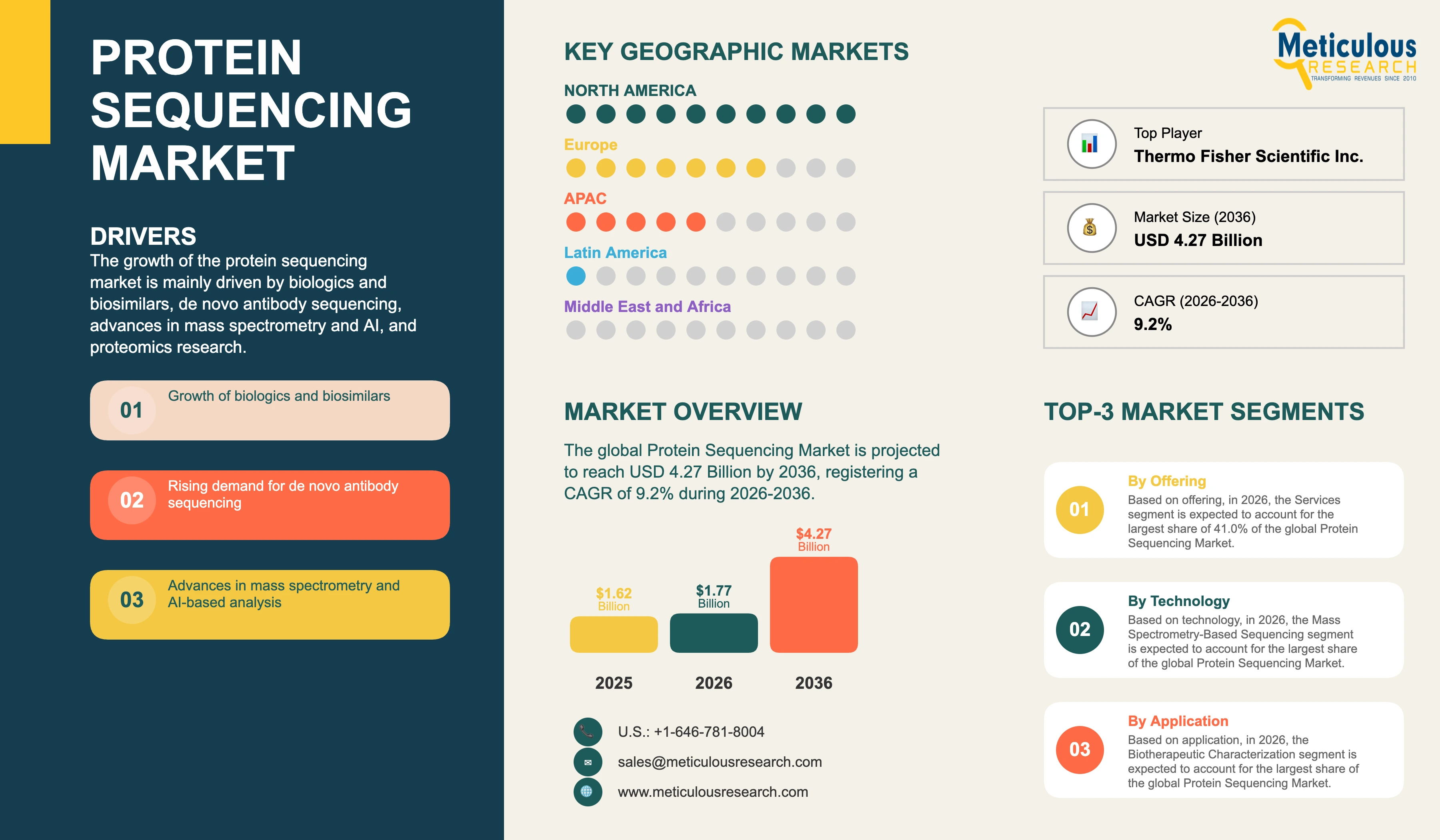
The global protein sequencing market was valued at USD 1.62 billion in 2025. This market is expected to reach USD 4.27 billion by 2036 from an estimated USD 1.77 billion in 2026, registering a CAGR of 9.2% during the forecast period (2026-2036).
- Published
- Nov 2026
- Pages
- 275
- Format
- PDF + Excel
- Report ID
- MRHC - 1042564
- Base year
- 2025
- 2025 · BASELINE
- $1.62B
- 2036
- $4.27B
- CAGR 2026–2036
- 9.2%
2025 baseline · 2026–2036 forecast at 9.2% CAGR · hover a bar for the value
Key highlights
Quantum-Si, the developer of the first commercial benchtop single-molecule protein sequencer, reported third-quarter 2026 revenue of USD 212,000 during its transition from the Platinum system to its next-generation Proteus platform, and said Proteus remains on track for commercial launch in the second quarter of 2027 after interim data presented at World HUPO showed about 30 times more sequencing output per chamber than its current system in a controlled peptide study, and launched a pre-order program for the new system.
Earlier in 2026, Quantum-Si reported that its developmental Proteus sequencing kit could detect 17 amino acids, up from 15 in December 2025, and that early customer samples run on Proteus prototypes showed about twice the average read length of the Platinum system, while the company identified an estimated USD 4 billion non-human proteomics opportunity in areas such as agriculture, pathogen detection, and viral protein surveillance.
Nautilus Biotechnology unveiled its Voyager platform at US HUPO 2026 on February 24, 2026, designed to analyze up to 10 billion intact protein molecules in a single run, but in the second quarter of 2026 it postponed indefinitely the launch of its broad-scale proteome application and pivoted to targeted proteoform analysis, starting with tau proteoforms linked to Alzheimer's disease.
Thermo Fisher Scientific expanded its Orbitrap mass spectrometry platforms, AI-enabled software, and integrated proteomics workflows at the ASMS 2026 conference, reflecting continued investment by mass spectrometry leaders in faster and deeper protein characterization for research and biopharmaceutical customers.
Nanopore companies are also entering the field, with Portal Biotech reporting internal prototypes of a nanopore-based protein sequencer capable of analyzing full-length proteins and Oxford Nanopore continuing to develop nanopore-based protein analysis, which points to a growing range of next-generation protein sequencing technologies that could complement mass spectrometry in the coming years.
By offering, services account for the largest share of 41.0% in 2026, while software registers the highest CAGR.
By technology, mass spectrometry-based sequencing accounts for the largest share in 2026, while single-molecule protein sequencing registers the highest CAGR.
By application, biotherapeutic characterization accounts for the largest share in 2026, while clinical research and diagnostics register the highest CAGR.
By end user, pharmaceutical and biotechnology companies account for the largest share of 48.0% in 2026, while CROs and CDMOs register the highest CAGR.
By geography, North America accounts for the largest share of 44.0% in 2026, while Asia-Pacific registers the highest CAGR of 11.8%.
Report summary
| Particulars | Details |
|---|---|
| Base Year | 2025 |
| Estimated Year | 2026 |
| Forecast Period | 2026-2036 |
| Market Size in 2025 | USD 1.62 billion |
| Market Size in 2026 | USD 1.77 billion |
| Market Size by 2036 | USD 4.27 billion |
| CAGR (2026-2036) | 9.2% |
| Format | PDF, Excel & Cloud Portal · 275 pages |
| Largest Segment by Offering (2026) | Services (41.0%) |
| Largest Segment by End User (2026) | Pharmaceutical and Biotechnology Companies (48.0%) |
| Largest Region (2026) | North America (44.0%) |
| Fastest-Growing Region | Asia-Pacific (CAGR 11.8%) |
| Companies Profiled | 13 companies and other companies |
| Segments Covered | Offering, Technology, Application, End User, Geography |
| Countries Covered | U.S., Canada, Germany, U.K., Switzerland, France, Belgium, Denmark, Ireland, Netherlands, Sweden, Spain, Italy, Rest of Europe, China, Japan, South Korea, India, Australia, Singapore, Taiwan, Rest of Asia-Pacific, Brazil, Mexico, Argentina, Rest of Latin America, Israel, Saudi Arabia, U.A.E., South Africa, Rest of Middle East & Africa |
Report overview
Segments covered: offering, technology, application, end user.
The growth of this market is mainly driven by the rapid growth of biologic drugs, including monoclonal antibodies, bispecific antibodies, antibody-drug conjugates, and biosimilars, which require detailed sequence confirmation and characterization, the growing use of de novo antibody sequencing in drug discovery and in recovering lost or legacy antibody sequences, advances in high-resolution mass spectrometry and AI-based data analysis that make protein sequencing faster and more accurate, rising investment in proteomics and biomarker research, and the emergence of single-molecule protein sequencing technologies that could make protein sequencing more accessible. However, factors such as the high cost of mass spectrometry instruments, the need for skilled specialists to run and interpret experiments, the difficulty of sequencing complex proteins and post-translational modifications, and the slow commercialization of next-generation sequencing platforms are expected to restrain the growth of this market to some extent.
Protein sequencing is the process of determining the order of amino acids in a protein or peptide, along with any chemical modifications attached to them. Unlike DNA, proteins cannot be copied and amplified, and they are made from 20 different building blocks with many possible modifications, which makes protein sequencing much more difficult than DNA sequencing. This report covers the global market for protein sequencing instruments, reagents and consumables, software, and services across mass spectrometry-based sequencing, Edman degradation, and emerging single-molecule protein sequencing technologies.
Mass spectrometry is the dominant technology for protein sequencing, and in a typical workflow, proteins are digested into smaller peptides with enzymes, separated by liquid chromatography, and analyzed by high-resolution mass spectrometers that measure the mass of each peptide and its fragments. Software then reconstructs the amino acid sequence by matching the data to protein databases or, in de novo sequencing, by reading the sequence directly from the fragment patterns without a reference. Mass spectrometry can also identify post-translational modifications, such as glycosylation, phosphorylation, and oxidation, which are important for protein function and drug quality.
Edman degradation, the classical chemical method for protein sequencing developed in the 1950s, removes and identifies amino acids one at a time from the N-terminus of a protein. It is still used for confirming the N-terminal sequence of purified proteins, especially in regulatory and quality control settings, but it is slow, limited to relatively short sequences, and cannot analyze mixtures. Its share of the market is declining as mass spectrometry methods improve.
Single-molecule protein sequencing is an emerging field that aims to read individual protein molecules directly, similar to how next-generation sequencing reads DNA. Quantum-Si offers the first commercial benchtop single-molecule protein sequencer and is developing its next-generation Proteus system, while Nautilus Biotechnology, Portal Biotech, Oxford Nanopore, Glyphic Biotechnologies, and academic groups are developing alternative approaches based on fluorescent recognizers, iterative affinity mapping, and nanopores. These technologies are still at an early commercial stage, but they could expand protein sequencing to many more laboratories that do not have mass spectrometry facilities.
The largest application of protein sequencing is the characterization of biotherapeutics, as pharmaceutical and biotechnology companies must confirm the amino acid sequence of every biologic drug, check for sequence variants, and characterize modifications during development and manufacturing, as required by regulators such as the FDA and EMA and by ICH guidelines. Biosimilar developers use protein sequencing to show that their products match the reference biologic. De novo antibody sequencing is also widely used to recover sequences of antibodies produced by hybridomas or found in patient samples, which supports antibody discovery and protects valuable research reagents.
Protein sequencing is also important in proteomics research, where scientists identify and quantify thousands of proteins in cells, tissues, and body fluids to understand biology and discover biomarkers. In immunology, mass spectrometry-based sequencing of peptides presented by HLA molecules, known as immunopeptidomics, helps identify targets for cancer vaccines and T-cell therapies. Other applications include food authenticity and allergen testing, agricultural research, forensic science, pathogen detection, and paleoproteomics.
Services account for the largest share of the market, as many companies and research groups outsource protein sequencing and characterization to specialized service laboratories, CROs, and CDMOs that have high-end mass spectrometers and expert staff. Instruments, including high-resolution mass spectrometers, Edman sequencers, and new single-molecule platforms, are the second-largest segment, while reagents, consumables, and software provide recurring revenue.
The market includes mass spectrometry instrument manufacturers, Edman sequencer suppliers, single-molecule protein sequencing developers, software providers, and protein sequencing service providers. Leading companies include Thermo Fisher Scientific, Bruker, Waters, Agilent Technologies, SCIEX (Danaher), Shimadzu, Quantum-Si, Nautilus Biotechnology, Rapid Novor, Bioinformatics Solutions, Protein Metrics (Dotmatics), Creative Proteomics, and Portal Biotech.
Over the forecast period, the protein sequencing market is expected to grow steadily, as biologic drug pipelines expand, as mass spectrometry and AI-based software improve speed and accuracy, as proteomics research grows, and as single-molecule technologies begin to reach commercial scale.
Pharmaceutical and biotechnology companies are expected to account for the largest share of 48.0% of the market in 2026, while CROs and CDMOs are projected to register the highest CAGR as outsourcing increases.
North America is expected to account for the largest share of 44.0% of the market in 2026, mainly due to the large biologics industry, high proteomics research funding, and the presence of leading instrument suppliers, service providers, and single-molecule developers in the U.S.
Asia-Pacific is projected to register the highest CAGR of 11.8% during the forecast period, driven by biologic and biosimilar development, rising proteomics research funding, and the expansion of CRO and CDMO services in China, South Korea, India, and Japan.
The report profiles 13 companies, including Thermo Fisher Scientific, Bruker, Waters, Agilent, SCIEX, Shimadzu, Quantum-Si, Nautilus Biotechnology, Rapid Novor, Bioinformatics Solutions, Protein Metrics, Creative Proteomics, and Portal Biotech.
Report infographic
Market dynamics
16 factors across 5 forcesGrowth of biologics and biosimilars
Biologic drugs, including monoclonal antibodies, bispecific antibodies, antibody-drug conjugates, fusion proteins, and therapeutic enzymes, are one of the largest and fastest-growing classes of medicines, and every biologic must be fully characterized during development and manufacturing. Regulators require developers to confirm the amino acid sequence of the drug, identify sequence variants caused by errors in transcription or translation, and characterize post-translational modifications that can affect safety and efficacy. These requirements make protein sequencing a routine part of biologic development, release testing, and comparability studies.
New and more complex formats, such as bispecific and multispecific antibodies, antibody-drug conjugates, and engineered proteins, require more detailed sequence and modification analysis, which increases the amount of protein sequencing per program. The growth of biosimilars also supports demand, since biosimilar developers must demonstrate that their products have the same amino acid sequence and similar modifications as the reference product. As patents on major biologics expire over the forecast period, biosimilar development is expected to increase.
Contract manufacturers and testing laboratories that serve biologic developers are expanding their characterization capabilities, which adds to demand for high-resolution mass spectrometers, software, and sequencing services across the biologics value chain.
Rising demand for de novo antibody sequencing
De novo antibody sequencing, which determines the full sequence of an antibody directly from the protein without prior genetic information, has become an important tool in drug discovery and research. It allows companies to recover the sequences of antibodies from hybridomas that have stopped producing or been lost, to protect valuable antibody reagents by converting them to recombinant form, and to sequence antibodies found in the blood of patients or immunized animals, which can be a source of new therapeutic candidates.
Specialized service providers, such as Rapid Novor, and software developers, such as Bioinformatics Solutions with its PEAKS software, have built businesses around de novo antibody sequencing, and the demand from pharmaceutical companies, biotechnology companies, diagnostic developers, and reagent suppliers continues to grow. Advances in mass spectrometry and AI-based de novo sequencing algorithms have improved accuracy and reduced turnaround time.
Antibody sequencing is also important for diagnostic and research reagent companies, which need to secure the supply of key antibodies and ensure lot-to-lot consistency. In addition, sequencing of antibodies from convalescent patients and vaccinated individuals has been used to discover therapeutic antibodies against infectious diseases, which became widely known during the COVID-19 pandemic.
Advances in mass spectrometry and AI-based analysis
High-resolution mass spectrometers have become faster, more sensitive, and more accurate, allowing more peptides and proteins to be identified and sequenced from smaller samples. Leading suppliers, including Thermo Fisher Scientific with its Orbitrap platforms, Bruker with its timsTOF systems, SCIEX, Waters, and Agilent, regularly launch new instruments and workflows for proteomics and biopharmaceutical characterization, and Thermo Fisher expanded its Orbitrap and AI-enabled software offerings at ASMS 2026.
AI and machine learning are also transforming data analysis, as deep learning models can predict peptide fragmentation patterns, improve de novo sequencing accuracy, and identify modifications more reliably, which reduces the need for expert manual interpretation and speeds up analysis. These advances make protein sequencing more accessible and support broader use in research and industry.
Instrument suppliers are also simplifying workflows with automated sample preparation, standardized methods, and easier software, which allow laboratories with less mass spectrometry experience to perform protein sequencing reliably. Benchtop mass spectrometers designed for routine biopharmaceutical testing are expanding the use of mass spectrometry beyond specialist laboratories into process development and quality control.
Growth of proteomics and biomarker research
Investment in proteomics research is growing, as scientists and pharmaceutical companies recognize that proteins, rather than genes, carry out most functions in cells and are the targets of most drugs. Large-scale proteomics projects, including population-scale studies of plasma proteins and research on disease mechanisms, generate demand for mass spectrometry-based protein identification and sequencing. Immunopeptidomics, which identifies peptides presented to the immune system, is a fast-growing area that supports cancer vaccine and T-cell therapy development.
Protein sequencing also supports the discovery of protein biomarkers for disease diagnosis and monitoring, as well as research on protein variants and modifications that affect disease. Funding from government agencies, foundations, and pharmaceutical companies for proteomics continues to grow, supporting instrument purchases and service demand across North America, Europe, and Asia-Pacific.
Table of contents
12 chapters · 159 sections · 275 pages · click to expandSegmental analysis
| Segment | Largest share (2026) | Fastest growth (2026–2036) |
|---|---|---|
| By Offering | Mass spectrometry-based sequencing | Single-molecule protein sequencing |
By Offering
- The mass spectrometry-based sequencing segment is expected to account for the largest share of the protein sequencing market, while the single-molecule protein sequencing segment is projected to register the highest CAGR during the forecast period.
- The biotherapeutic characterization segment is expected to account for the largest share of the protein sequencing market, while the clinical research and diagnostics segment is projected to register the highest CAGR during the forecast period.
Geographic analysis
North America
Largest shareIn 2026, North America is expected to account for the largest share of 44.0% of the global protein sequencing market. The large share of this region is mainly due to the large number of pharmaceutical and biotechnology companies developing biologics in the U.S., the high level of research funding for proteomics from the NIH and other sources, the presence of leading instrument manufacturers, single-molecule sequencing developers such as Quantum-Si and Nautilus, and service providers, and early adoption of new technologies. The U.S. is also the main center for biologic drug development, with a large number of clinical-stage antibody and protein therapeutics that require characterization. Canada also has a strong position in the market, as home to service providers such as Rapid Novor and software developers such as Bioinformatics Solutions.
Europe
Europe is the second-largest market, supported by strong pharmaceutical and biotechnology industries in Germany, Switzerland, the U.K., France, Belgium, Denmark, Ireland, and the Netherlands, leading proteomics research institutions, a large biosimilar industry, and the presence of companies such as Bruker and Oxford Nanopore. European regulators' requirements for biologic and biosimilar characterization support demand for sequencing services, and Europe has one of the most active biosimilar markets in the world. Sweden, Spain, and Italy are also important research markets, and European research consortia and infrastructure programs support shared access to advanced proteomics facilities.
Asia-Pacific
Fastest growthAsia-Pacific is projected to register the highest CAGR of 11.8% during the forecast period. The rapid growth of this region is mainly driven by the rapid growth of biologic and biosimilar development and manufacturing in China, South Korea, India, and Japan, the expansion of CRO and CDMO services in the region, rising research funding for proteomics, and increasing adoption of high-resolution mass spectrometry. Japan has a strong proteomics research community and is home to Shimadzu, while Singapore, Australia, and Taiwan are growing research markets. China has become one of the largest markets for high-resolution mass spectrometers, supported by government research funding and a large number of biopharmaceutical companies and CROs.
Latin America
Latin America and the Middle East & Africa account for small shares of the market. Brazil, Mexico, and Argentina have growing biopharmaceutical, biosimilar, and research sectors, while Israel, Saudi Arabia, the U.A.E., and South Africa are investing in biotechnology and research infrastructure, which supports demand for protein sequencing services and instruments, mainly in academic, government, and biopharmaceutical research laboratories.
Competitive landscape
The global protein sequencing market is moderately consolidated, with the top five players estimated to account for about 50% of the market in 2025. The market includes mass spectrometry instrument manufacturers, Edman sequencer suppliers, single-molecule protein sequencing developers, software providers, and service providers.
Thermo Fisher Scientific is the leading supplier of mass spectrometry instruments for protein sequencing, with its Orbitrap platforms, chromatography systems, software, and reagents, and it also provides characterization services. Bruker offers the timsTOF family of mass spectrometers for proteomics, while SCIEX (Danaher), Waters, and Agilent provide mass spectrometry systems and workflows for biopharmaceutical characterization. Shimadzu supplies Edman protein sequencers and mass spectrometers.
The instrument market is concentrated among a few large suppliers with broad portfolios, global service networks, and strong relationships with pharmaceutical companies, which makes it difficult for new entrants to compete in high-end mass spectrometry. In contrast, the service and software segments are more fragmented, with many specialized companies serving niche applications.
Quantum-Si is the first company to commercialize benchtop single-molecule protein sequencing and is preparing to launch its Proteus platform, while Nautilus Biotechnology is developing its Voyager platform for single-molecule proteoform analysis, and Portal Biotech and Oxford Nanopore are developing nanopore approaches. Rapid Novor and Creative Proteomics are leading protein sequencing service providers, and Bioinformatics Solutions and Protein Metrics (Dotmatics) supply protein sequencing and characterization software.
Companies in this market compete on accuracy, sensitivity, throughput, sequence coverage, ability to characterize modifications, ease of use, software capabilities, regulatory compliance, turnaround time, and price. Key strategies adopted by these companies include new instrument and software launches, the integration of AI into data analysis, partnerships with pharmaceutical companies, expansion of service capacity, and the development of next-generation sequencing technologies.
We expect mass spectrometry suppliers to maintain their leadership over the forecast period, while single-molecule developers compete to establish new markets and prove the value of their platforms to pharmaceutical and academic customers. Partnerships between single-molecule companies and established life science companies are possible, as are acquisitions of service providers and software developers by larger companies. Competition among service providers is also likely to increase, especially from Asia-Pacific providers offering lower prices.
Some of the key players operating in the protein sequencing market are Thermo Fisher Scientific Inc., Bruker Corporation, Waters Corporation, Agilent Technologies, Inc., SCIEX (Danaher Corporation), Shimadzu Corporation, Quantum-Si Incorporated, Nautilus Biotechnology, Inc., Rapid Novor Inc., Bioinformatics Solutions Inc., Protein Metrics (Dotmatics), Creative Proteomics, and Portal Biotech Ltd., among others.
- —
Quantum-Si presented Proteus performance data at World HUPO and set a Q2 2027 launch, Nautilus unveiled its Voyager platform and pivoted to targeted proteoform analysis, and Thermo Fisher expanded its Orbitrap and AI-enabled proteomics workflows at ASMS 2026, while nanopore companies advanced protein analysis prototypes.
- Thermo Fisher Scientific Inc.
- Bruker Corporation
- Waters Corporation
- Agilent Technologies, Inc.
- SCIEX · Danaher Corporation
- Shimadzu Corporation
- Quantum-Si Incorporated
- Nautilus Biotechnology, Inc.
- Rapid Novor Inc.
- Bioinformatics Solutions Inc.
- Protein Metrics · Dotmatics
- Creative Proteomics
- Portal Biotech Ltd.
Expert perspectives
Protein sequencing is an essential capability for modern biopharmaceutical development and proteomics research, and the market is supported by the steady growth of biologics, proteomics, and outsourcing, which together provide a stable and diversified base of demand. At the same time, the field is at an interesting point, as single-molecule technologies promise to change how proteins are sequenced, although their commercialization has been slower than expected.
Over the forecast period, the market is expected to grow at a CAGR of 9.2%, from USD 1.77 billion in 2026 to USD 4.27 billion in 2036. Growth will be supported mainly by biotherapeutic characterization, de novo antibody sequencing, proteomics research, and advances in mass spectrometry and AI.
Services remain the largest offering segment, while software grows fastest, and mass spectrometry-based sequencing dominates, while single-molecule protein sequencing grows fastest from a very small base. Biotherapeutic characterization is the largest application, while clinical research and diagnostics grows fastest. Pharmaceutical and biotechnology companies are the largest end user, while CROs and CDMOs grow fastest. North America remains the largest region, and Asia-Pacific is the fastest-growing region at a CAGR of 11.8%.
We view mass spectrometry as the backbone of protein sequencing throughout the forecast period. Single-molecule technologies are likely to start in research and niche applications where they offer clear advantages, such as antibody and variant analysis, pathogen detection, and non-human proteomics, and to expand as their performance improves. The successful launch of Quantum-Si's Proteus in 2027 will be an important test of market readiness.
We note that the near-term environment for protein sequencing instrument sales is mixed, with constrained academic budgets and cautious biotechnology spending, while pharmaceutical demand for characterization and outsourced services remains strong. We expect services and software to grow faster than instruments in the near term, with instrument demand recovering from 2027 as new platforms are launched and research funding stabilizes.
For vendors, the key priorities over the forecast period are to improve speed, sensitivity, and ease of use, integrate AI-based analysis, support regulated biopharmaceutical workflows, and expand services in fast-growing regions. Service providers that combine expertise, regulatory compliance, and fast turnaround will continue to gain share as outsourcing grows, especially among small and mid-sized biotechnology companies.
In the longer term, we see the combination of high-resolution mass spectrometry, single-molecule sequencing, and AI as the foundation for much more complete analysis of proteins and their modifications, which could have a major impact on drug development and diagnostics, similar to the way next-generation DNA sequencing changed genomics.
Customer perspectives
Director of Analytical Development - Biologics company, U.S.
Every antibody we take into the clinic needs full sequence confirmation and variant analysis. We run routine sequence confirmation in-house on our mass spectrometers and send complex projects and de novo sequencing to specialist service labs with deeper expertise.
“AI-based software has made de novo sequencing and modification analysis much faster and more reliable. We are watching single-molecule platforms closely and may test them for specific projects, but mass spectrometry remains our workhorse for both research and service projects.”
“Demand from local biosimilar and biologic developers in the region is growing very quickly, and many global clients now outsource characterization work to us because we combine high-end instruments with competitive pricing.”
Frequently asked questions
The global protein sequencing market was valued at USD 1.62 billion in 2025, up from USD 1.49 billion in 2024, and is estimated at USD 1.77 billion in 2026. The market includes all protein sequencing instruments, reagents and consumables, software, and services.
Cite this report
Meticulous Research. (2026). Protein Sequencing Market - Global Opportunity Analysis and Industry Forecast (2026-2036) (Report No. MRHC - 1042564). Meticulous Market Research Pvt. Ltd. https://www.meticulousresearch.com/product/protein-sequencing-market-7247