Smart Pill Dispensers Market (2026-2036)
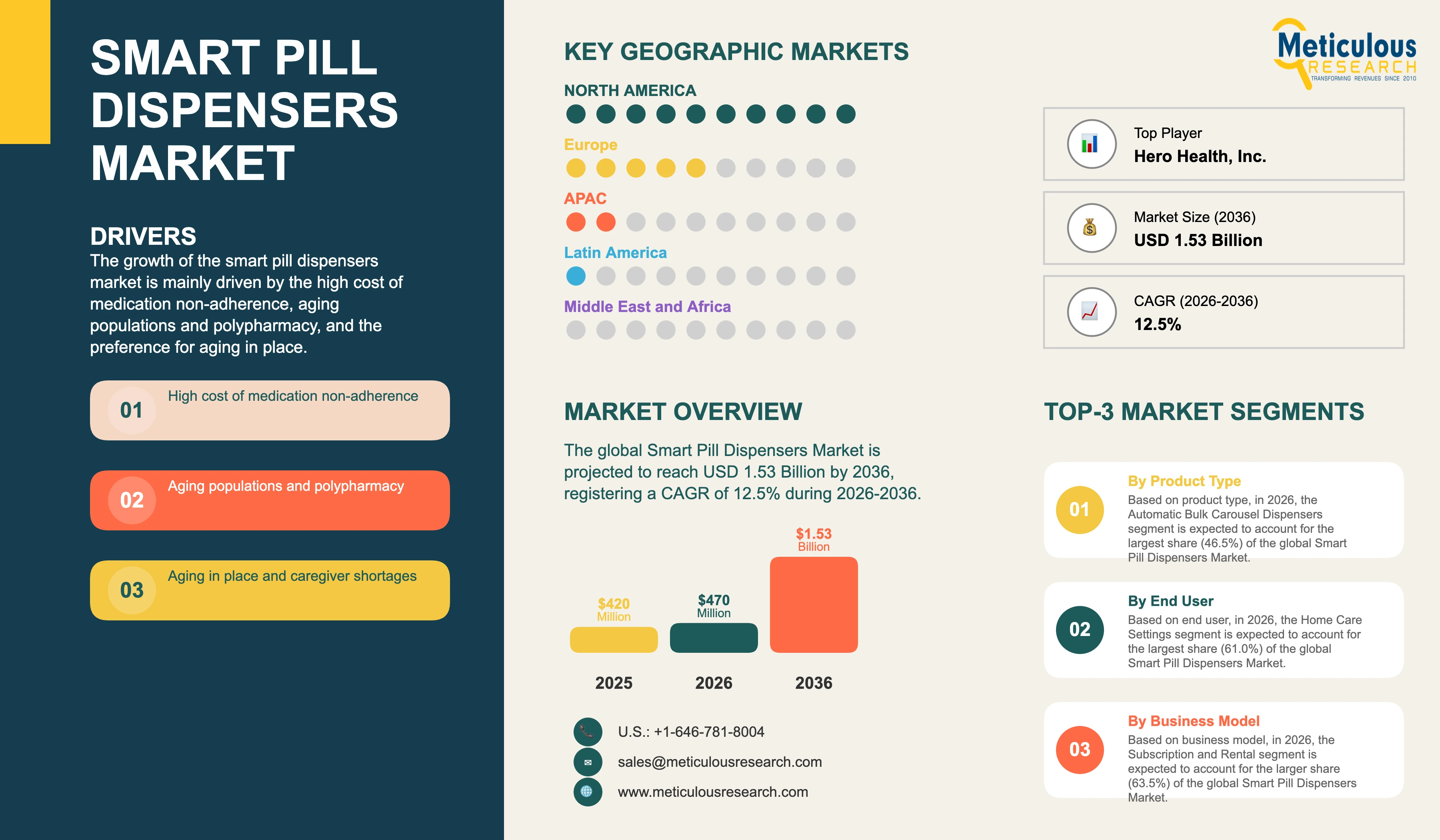
The global smart pill dispensers market was valued at USD 420.0 million in 2025. This market is expected to reach USD 1.53 billion by 2036 from an estimated USD 470.0 million in 2026, registering a CAGR of 12.5% during the forecast period (2026-2036).
- Published
- Nov 2026
- Pages
- 277
- Format
- PDF + Excel
- Report ID
- MRHC - 1042560
- Base year
- 2025
- 2025 · BASELINE
- $420.0M
- 2036
- $1.53B
- CAGR 2026–2036
- 12.5%
2025 baseline · 2026–2036 forecast at 12.5% CAGR · hover a bar for the value
Key highlights
The World Health Organization has reported that only about half of patients with chronic diseases in developed countries take their medications as prescribed, and medication non-adherence is widely linked to avoidable hospitalizations, disease progression, and deaths. In the U.S., estimates published in the Annals of Internal Medicine have put the avoidable healthcare cost of non-adherence at between USD 100 billion and USD 300 billion per year.
In September 2026, Custom Health Holdings, a TSX-listed medication management company, completed its acquisition of Spencer Health Solutions, the developer of the spencer smart medication dispenser and in-home monitoring platform, in a deal valued at up to USD 25 million, bringing its in-home dispensing technology fully in-house. Custom Health's CEO said the deal would cut its hardware costs roughly in half.
Hero Health offers its smart dispenser, which stores and dispenses up to 10 different medications with up to a 90-day supply, as part of an all-inclusive subscription with a caregiver app and 24/7 support. Hero lists the device as an FDA-registered Class I medical device and offers plans from about USD 44.99 per month with a 12-month commitment.
Municipal home care services in the Nordic countries and the Netherlands have adopted automated medication dispensing robots, such as Evondos in Finland, Sweden, Norway, and Denmark and Medido in the Netherlands, to reduce the number of nurse visits needed for medication administration, which frees up staff time and lowers care costs.
Pharmacy-linked dispensing models are growing, as pharmacies, specialty pharmacies, and medication management companies such as MedMinder, Custom Health, and Karie Health combine pre-filled pouches or trays with connected dispensers and pharmacist monitoring, which removes the burden of loading pills from patients and caregivers.
Remote therapeutic monitoring and remote patient monitoring billing codes in the U.S., together with supplemental benefits in some Medicare Advantage plans, are creating new ways for healthcare providers and payers to fund smart dispenser programs for high-risk patients.
By product type, automatic bulk carousel dispensers account for the largest share of 46.5% in 2026, while pre-packaged pouch and blister dispensers register the highest CAGR.
By business model, subscription and rental accounts for the larger share in 2026 and also registers the higher CAGR.
By connectivity, wi-fi accounts for the largest share in 2026, while cellular registers the highest CAGR.
By end user, home care settings account for the largest share of 61.0% in 2026, while pharmacies and payer programs register the highest CAGR.
By geography, North America accounts for the largest share of 55.5% in 2026, while Asia-Pacific registers the highest CAGR of 16.5%.
Report summary
| Particulars | Details |
|---|---|
| Base Year | 2025 |
| Estimated Year | 2026 |
| Forecast Period | 2026-2036 |
| Market Size in 2025 | USD 420.0 million |
| Market Size in 2026 | USD 470.0 million |
| Market Size by 2036 | USD 1.53 billion |
| CAGR (2026-2036) | 12.5% |
| Format | PDF, Excel & Cloud Portal · 277 pages |
| Largest Segment by Product Type (2026) | Automatic Bulk Carousel Dispensers (46.5%) |
| Largest Segment by End User (2026) | Home Care Settings (61.0%) |
| Largest Region (2026) | North America (55.5%) |
| Fastest-Growing Region | Asia-Pacific (CAGR 16.5%) |
| Companies Profiled | 15 companies and other companies |
| Segments Covered | Product Type, Business Model, Connectivity, End User, Geography |
| Countries Covered | U.S., Canada, Finland, Sweden, Norway, Denmark, Netherlands, U.K., Germany, France, Belgium, Switzerland, Italy, Spain, Rest of Europe, Japan, Australia, China, South Korea, Singapore, Taiwan, New Zealand, India, Rest of Asia-Pacific, Brazil, Mexico, Chile, Argentina, Rest of Latin America, Israel, Saudi Arabia, U.A.E., South Africa, Rest of Middle East & Africa |
Report overview
Segments covered: product type, business model, connectivity, end user.
The growth of this market is mainly driven by the large human and economic cost of medication non-adherence, the rising number of older adults who take several medications every day, the preference of older people to age in place in their own homes, caregiver shortages in home care and long-term care, the growth of remote patient monitoring and remote therapeutic monitoring programs, the interest of pharmacies, health plans, and specialty pharmacy providers in adherence programs, and municipal home care programs in Europe that use automated dispensers to reduce nurse visits. However, factors such as high device and subscription costs, limited insurance coverage in many countries, the difficulty of loading and managing dispensers for complex regimens, and resistance to new technology among some older adults are expected to restrain the growth of this market to some extent.
Smart pill dispensers are connected or electronic devices that store medications, remind patients when doses are due, dispense the correct dose at the correct time, and record whether doses were taken or missed. Many smart dispensers lock medications to prevent double dosing, alert caregivers or pharmacists when a dose is missed, and connect to mobile apps or monitoring platforms through Wi-Fi or cellular networks. This report covers the global revenue from smart pill dispensers and related subscription and monitoring services, including automatic bulk carousel dispensers, pre-packaged pouch and blister dispensers, and smart pill boxes and organizers, used in home care settings, pharmacy and payer programs, assisted living and long-term care facilities, and hospitals and clinical research.
Medication non-adherence is one of the largest and most persistent problems in healthcare. Patients miss doses, take the wrong dose, take doses at the wrong time, or stop taking their medications altogether, for reasons that include forgetfulness, complex regimens, cognitive decline, side effects, cost, and poor understanding of their treatment. The problem is particularly serious for older adults with several chronic conditions, who may take five, ten, or more medications every day, and for people with dementia, mental illness, or serious diseases such as heart failure, diabetes, and cancer.
The consequences of non-adherence include worse health outcomes, avoidable emergency department visits and hospital admissions, moves into long-term care, and deaths. In older adults, medication errors such as double dosing can also cause falls, bleeding, and other serious adverse events. Smart pill dispensers address these problems by organizing medications, reminding patients at the right time, preventing errors, and alerting caregivers when a dose is missed, so that problems can be addressed quickly.
The market includes several types of products, and automatic bulk carousel dispensers, such as Hero, Livi, and MedaCube, are loaded with bottles or cartridges of pills and automatically sort and dispense the right combination of pills for each dose. Pre-packaged pouch and blister dispensers, such as spencer, Evondos, Medido, and MedMinder's tray-based systems, use multi-dose pouches or blister packs prepared by a pharmacy, which the dispenser releases at the scheduled time. Smart pill boxes and organizers are simpler devices with compartments, alarms, lights, and connectivity that remind patients and record when compartments are opened.
Business models vary across these products, and in the U.S., most leading smart dispensers are offered through monthly subscriptions that include the device, app, and support, and sometimes pharmacy services. Some devices are sold outright to consumers, often at prices of several hundred to more than a thousand dollars. In Europe, municipalities and home care organizations often lease dispensing robots and pay for service as part of publicly funded home care. Pharmacies, specialty pharmacies, health plans, and care management companies also provide dispensers to their patients as part of adherence and care management programs.
Technology in the market is improving, as new devices offer touchscreens, voice prompts, cellular connectivity that works without home Wi-Fi, facial or fingerprint recognition to confirm the right user, sensors that confirm when pills are removed, and integration with telehealth, remote monitoring, and pharmacy systems. Some research groups and companies are also developing devices that use AI and cameras to verify which pills are dispensed and taken.
The market is fragmented and includes medication management companies, consumer health technology companies, pharmacy automation companies, telecare providers, and specialized device makers. Leading companies include Hero Health, MedMinder Systems, Custom Health (Spencer Health Solutions), Connect America (Philips Medication Dispensing Service), Evondos, Innospense (Medido), PharmRight (Livi), MedaCube, Karie Health, AdhereTech, Tabsafe, and e-pill.
Over the forecast period, the smart pill dispensers market is expected to grow steadily, as older populations grow, as more care moves into the home, and as pharmacies, payers, and home care providers adopt smart dispensers as part of adherence and care management programs. The shift toward pharmacy-prepared pouch systems, cellular connectivity, and service-based business models is expected to continue, and evidence of reduced hospital admissions and care costs will be essential for wider reimbursement and adoption.
The dispensing robots have reduced the number of visits our nurses make only to give medications, so they can spend more time on care that really needs a person. The pharmacy prepares the pouches, which makes the process safe.
Report infographic
Market dynamics
16 factors across 5 forcesHigh cost of medication non-adherence
Medication non-adherence imposes a very large cost on healthcare systems, payers, and patients. The World Health Organization's landmark report on adherence to long-term therapies found that only about half of patients with chronic diseases in developed countries follow their prescribed treatment, and later studies have confirmed that non-adherence remains common in conditions such as hypertension, diabetes, heart failure, and depression. In the U.S., published estimates have put the avoidable healthcare costs of non-adherence at between USD 100 billion and USD 300 billion per year, mainly from hospital admissions and emergency visits.
Health plans, accountable care organizations, and health systems that are paid to manage the total cost of care for their members or patients have strong financial incentives to improve adherence. In the U.S., medication adherence measures for diabetes, hypertension, and cholesterol medications are part of the Medicare Part D Star Ratings, which affect plan payments, giving Medicare Advantage and Part D plans a direct reason to invest in adherence programs. Smart pill dispensers, especially for high-risk members with complex regimens, are one of the tools these organizations use.
Pharmaceutical companies also have an interest in adherence, because patients who stop taking their medications early reduce treatment effectiveness and revenue. Some specialty pharmacies and pharmaceutical companies support adherence programs that include connected dispensers or packaging for high-cost therapies, such as oral cancer drugs. These programs also generate real-world data on how patients use their medications, which is valuable for both clinical teams and manufacturers.
Aging populations and polypharmacy
The number of older adults is growing rapidly in North America, Europe, and Asia-Pacific, and older adults are the main users of smart pill dispensers. Many older people have several chronic conditions and take many medications every day, a situation known as polypharmacy. Managing complex regimens with different doses, times, and instructions is difficult, especially for people with declining memory, vision, or dexterity.
Errors in taking medications, such as missed doses, double doses, or taking the wrong pills, can lead to serious harm, including falls, bleeding, low blood sugar, and hospital admissions. Smart dispensers reduce these risks by sorting medications automatically and dispensing only the right dose at the right time, and by locking medications to prevent double dosing. As the number of older adults with polypharmacy increases, demand for these devices is expected to grow. Hospital discharge is a particularly risky time, since patients often leave hospital with new or changed medications, and transitional care programs are increasingly using dispensers to support patients during the first weeks at home.
Aging in place and caregiver shortages
Most older adults want to stay in their own homes as long as possible, and governments and health systems are shifting long-term care toward home and community-based services because they are usually less expensive than residential care. Medication management is one of the most common reasons that older adults need help from family caregivers or home care workers, and difficulties with medications are a common reason for moves into assisted living or nursing homes.
At the same time, many countries face shortages of home care workers and nurses, and family caregivers often live far away or have work and family responsibilities. Smart pill dispensers can reduce the need for in-person medication visits by nurses and home care aides, and they give family caregivers remote visibility of whether their relatives are taking their medications. In the Nordic countries and the Netherlands, municipal home care services use automated dispensers to replace some nurse visits, and studies by these municipalities report significant time savings for staff.
Growth of remote monitoring and value-based care
The growth of remote patient monitoring and remote therapeutic monitoring is creating new channels for smart pill dispensers. In the U.S., the Centers for Medicare and Medicaid Services introduced billing codes for remote therapeutic monitoring that can cover the monitoring of medication adherence in some cases, and some providers bill remote patient monitoring codes for programs that include connected dispensers. Medicare Advantage plans can also offer supplemental benefits that include in-home support services and technology for members with chronic conditions.
Value-based care models, in which providers share in savings when they reduce hospital admissions and costs, also encourage investment in adherence tools. Care management companies, home health agencies, and health systems are building programs that combine smart dispensers with pharmacist and nurse monitoring, telehealth, and care coordination for high-risk patients.
Table of contents
12 chapters · 156 sections · 277 pages · click to expandSegmental analysis
| Segment | Largest share (2026) | Fastest growth (2026–2036) |
|---|---|---|
| By Product Type | Automatic bulk carousel dispensers | Pre-packaged pouch and blister dispensers |
| By Business Model | — | — |
| By Connectivity | Wi-Fi | Cellular |
| By End User | Home care settings | Pharmacies and payer programs |
| Other segments | Wi-fi | Cellular |
By Product Type
- Smart Pill Dispensers Market Analysis by Product Type
- The automatic bulk carousel dispensers segment is expected to account for the largest share of 46.5% of the global smart pill dispensers market.
- The large share of this segment is mainly due to the popularity of all-in-one automatic dispensers, such as Hero, Livi, and MedaCube, among older adults and family caregivers in the U.S., their ability to store large supplies of many different medications and automatically sort and dispense the correct combination for each dose, and the availability of these devices through subscriptions and direct purchase.
- These dispensers can be loaded directly from standard pill bottles, so they do not require special pharmacy packaging, which makes them easy to adopt for families regardless of which pharmacy they use.
- Automatic carousel dispensers also offer advanced features, such as locking compartments, dose limits, caregiver apps with real-time alerts, refill reminders, and support for as-needed medications.
- Some vendors also integrate refill delivery and pharmacy services, which adds value for families.
- As a result, this segment has the highest average revenue per user in the home market.
- However, the need to load and program the device correctly and the high price of some devices limit adoption among some users, and vendors are working to simplify setup and reduce costs.
- Carousel dispensers are also being adapted for new channels, as some vendors offer their devices through Medicare Advantage plans, home care agencies, and remote monitoring programs, which reduces the cost burden for families and expands the potential user base.
- Vendors are adding features to support caregivers who manage medications for relatives remotely, such as remote schedule changes, low-pill alerts, and automatic refill coordination, which increases the appeal of these devices for adult children living far from their parents.
- Remote management also reduces the number of home visits caregivers need to make each week.
- This saves families time and travel.
- Retail availability through online stores also supports this segment.
- However, the pre-packaged pouch and blister dispensers segment is projected to register the highest CAGR during the forecast period.
- The rapid growth of this segment is driven by the expansion of pharmacy-integrated dispensing models, the wide use of multi-dose pouch packaging by pharmacies, the success of dispensing robots in municipal home care in Europe, Custom Health's acquisition of Spencer Health Solutions, and the lower risk of loading errors, since pharmacies prepare and verify each dose before delivery.
- Pouch-based dispensers also make it easier to change prescriptions, since the pharmacy simply prepares new pouches, and they allow pharmacists to monitor adherence and intervene when doses are missed.
- Smart pill boxes and organizers form the lowest-priced segment and are widely sold through retail and online channels, often to people with simpler regimens who mainly need reminders and basic caregiver alerts.
By Business Model
- Smart Pill Dispensers Market Analysis by Business Model
- The subscription and rental segment is expected to account for the larger share of the global smart pill dispensers market.
- The large share of this segment is mainly due to the subscription model used by leading U.S. vendors such as Hero Health and MedMinder, which combine the dispenser, caregiver app, monitoring, and support for a monthly fee, and the leasing of dispensing robots by municipalities and home care providers in Europe as part of publicly funded home care services.
- Subscriptions lower the upfront cost for families and make it easier to replace or upgrade devices.
- Subscription models also give vendors ongoing contact with users, which helps them provide support, monitor device performance, and add new services such as pharmacy refills and remote therapeutic monitoring.
- For payers, pharmacies, and care providers, rental and service contracts allow them to deploy dispensers to patients for as long as needed and move devices between patients as needs change.
- Recurring revenue also gives vendors more stable income than one-time device sales.
- Payer and pharmacy programs almost always use service contracts, since they need monitoring, data reporting, and device replacement as part of the program.
- Bundling dispensers with pharmacy services, such as pre-filled pouches and automatic refills, further strengthens the subscription model.
- The subscription and rental segment is also projected to register the higher CAGR during the forecast period, supported by the shift toward service-based models, the growth of pharmacy and payer programs, and the lower upfront cost for consumers.
- The outright purchase segment, which includes standalone automatic dispensers such as Livi and MedaCube and lower-priced smart pill boxes sold through retail and online channels, remains important for families who prefer a one-time payment and do not need professional monitoring.
By Connectivity
- Smart Pill Dispensers Market Analysis by Connectivity
- The Wi-Fi segment is expected to account for the largest share of the global smart pill dispensers market.
- The large share of this segment is mainly due to the use of home Wi-Fi by many leading consumer dispensers, including Hero, to connect to mobile apps and cloud platforms, the lower cost of Wi-Fi modules compared with cellular modules, and the growing number of older adults who live in homes with broadband internet.
- Wi-Fi connectivity supports caregiver alerts, remote schedule changes, and refill coordination at low cost.
- However, Wi-Fi devices depend on the user's home network, which can be unreliable or difficult for older adults to set up, and some homes do not have Wi-Fi at all.
- Vendors are addressing these issues with simpler setup processes, support teams that help with installation, and offline operation that continues to dispense and remind even when the connection is lost.
- Wi-Fi remains the most common choice for consumer subscription services in the U.S. Some vendors offer devices that support both Wi-Fi and cellular connectivity, which allows them to serve a wider range of households with a single product.
- However, the cellular segment is projected to register the highest CAGR during the forecast period.
- The rapid growth of this segment is driven by the need for reliable connectivity in homes without Wi-Fi, easier out-of-the-box installation for older adults, and the use of cellular devices in pharmacy, payer, and municipal programs that require dependable monitoring and reporting of adherence data.
- Cellular devices from MedMinder, spencer, and European dispensing robots report data without depending on the patient's home network.
- Bluetooth and standalone devices remain popular as low-cost options for users who need simple reminders without remote monitoring.
By End User
- Smart Pill Dispensers Market Analysis by End User
- The home care settings segment is expected to account for the largest share of 61.0% of the global smart pill dispensers market.
- The large share of this segment is mainly due to the large and growing number of older adults with complex medication regimens who live in their own homes, the strong preference for aging in place, the role of family caregivers who buy dispensers to help relatives manage medications, and the use of automated dispensers in publicly funded home care services in Europe.
- Home care is also where medication management is most difficult, since patients do not have staff to give them their medications, and missed or incorrect doses often go unnoticed until a problem occurs.
- Home care users include older adults living alone, people with early dementia, patients recently discharged from hospital with new medications, and people with chronic conditions such as heart failure and diabetes.
- Home health agencies and visiting nurse services also use dispensers to support patients between visits, reducing the number of visits needed for medication administration.
- As more care moves into the home and as family caregivers seek remote visibility, demand from this segment is expected to remain strong.
- However, the pharmacies and payer programs segment is projected to register the highest CAGR during the forecast period.
- The rapid growth of this segment is driven by pharmacy-integrated dispensing models, the interest of health plans and Medicare Advantage plans in adherence programs that improve Star Ratings and reduce hospital admissions, the growth of specialty pharmacy adherence services, and the use of remote therapeutic monitoring and remote patient monitoring billing to fund dispenser programs.
- Assisted living and long-term care facilities are also adopting smart dispensers and connected medication carts to reduce medication errors and staff time, particularly in facilities where residents manage some of their own medications.
- Hospitals and clinical research organizations use connected dispensers mainly for clinical trials and transitional care programs.
Other segments
- The wi-fi segment is expected to account for the largest share of the smart pill dispensers market, while the cellular segment is projected to register the highest CAGR during the forecast period.
Geographic analysis
North America
Largest shareIn 2026, North America is expected to account for the largest share of 55.5% of the global smart pill dispensers market. The large share of this region is mainly due to the large number of older adults with polypharmacy in the U.S., high awareness of medication adherence problems, the presence of leading vendors such as Hero Health, MedMinder, Custom Health and Spencer Health Solutions, Connect America, PharmRight, AdhereTech, and Tabsafe, the role of Medicare Part D Star Ratings in encouraging adherence programs, and the availability of remote therapeutic monitoring and remote patient monitoring billing codes. Canada also has an active market, supported by pharmacies and home care providers that use dispensers for older adults.
Europe
Europe is the second-largest market, led by the Nordic countries and the Netherlands, where municipal home care services have adopted automated dispensing robots on a large scale. Evondos, based in Finland, provides dispensing robots to municipalities in Finland, Sweden, Norway, and Denmark, while Medido, developed by Innospense, is widely used in the Netherlands. These programs use pharmacy-prepared pouches and report significant reductions in nurse visits for medication administration. The U.K., Germany, and France are also showing growing interest in automated dispensing as home care staff shortages increase. Germany, France, Belgium, Switzerland, Italy, and Spain are at earlier stages of adoption but have large older populations, growing home care staff shortages, and pharmacies that already prepare multi-dose packaging for many patients.
Asia-Pacific
Fastest growthAsia-Pacific is projected to register the highest CAGR of 16.5% during the forecast period. The rapid growth of this region is mainly driven by very rapid aging in Japan, China, South Korea, Taiwan, and Australia, the high prevalence of chronic diseases and polypharmacy among older adults, government programs that promote home-based care and smart elderly care, and the growth of digital health and connected devices. Japan, with one of the oldest populations in the world and a long-term care insurance system, and Australia, with government-funded home care packages, are important markets for medication management technology. Taiwan, Singapore, New Zealand, and India are also emerging markets, where pharmacies, private hospitals, and home care providers are beginning to adopt connected medication management tools.
Latin America
Latin America and the Middle East & Africa currently account for small shares of the market, but they are expected to grow as populations age, private healthcare and pharmacy sectors develop, and connected health technologies become more affordable. Brazil, Mexico, Israel, the U.A.E., and Saudi Arabia are among the more important markets in these regions. In these regions, private hospitals, pharmacy chains, and home care companies are likely to be the main early adopters. Lower-cost cellular devices will be important for growth. Local pharmacy partnerships will also matter. Insurers may also fund programs for high-risk members. Chile, Argentina, and South Africa are also expected to see gradual adoption through private pharmacies and health insurers.
Competitive landscape
The global smart pill dispensers market is fragmented, with the top five players estimated to account for about 45% of the market in 2025. The market includes medication management and pharmacy service companies, consumer health technology companies, telecare providers, specialized dispensing robot makers, and makers of smart pill boxes and connected packaging.
Hero Health is one of the leading providers in the U.S. home market, offering its automatic dispenser through an all-inclusive subscription. MedMinder Systems combines cellular-connected locking dispensers with its own pharmacy services and pre-filled trays. Custom Health, which acquired Spencer Health Solutions in 2026, combines pharmacist-led medication management with in-home pouch dispensing. Connect America offers the medication dispensing service formerly provided by Philips Lifeline, while PharmRight (Livi), MedaCube, Tabsafe, and e-pill offer automatic dispensers and smart pill boxes.
In Europe, Evondos and Innospense (Medido) lead the market for dispensing robots used in municipal home care, while Pilloxa and other companies offer smart pill boxes. Karie Health operates a pharmacist-monitored dispensing service in Canada, and AdhereTech provides smart pill bottles used in specialty pharmacy and clinical trial adherence programs. Telecare and personal emergency response providers also offer dispensers as part of broader aging-in-place services. These providers can bundle dispensers with fall detection and emergency response, which appeals to families looking for a single service.
Companies compete on ease of use, the number and types of medications supported, reliability, connectivity, caregiver and pharmacist features, integration with pharmacy and care platforms, evidence of outcomes, subscription pricing, and partnerships with pharmacies, payers, home care providers, and municipalities. Key strategies include acquisitions to combine pharmacy services and dispensing technology, partnerships with health plans and specialty pharmacies, expansion into remote therapeutic monitoring programs, product launches with cellular connectivity and simplified setup, and international expansion.
We expect consolidation to continue as pharmacy and medication management companies acquire device makers, and as larger healthcare technology, telecare, and pharmacy companies enter the market. Vendors with strong evidence of outcomes and integrated pharmacy and monitoring services are likely to gain share. Smaller device makers without pharmacy or payer partnerships may find it harder to compete as buyers look for complete medication management services rather than standalone devices.
Some of the key players operating in the smart pill dispensers market are Hero Health, Inc., MedMinder Systems, Inc., Custom Health Holdings Inc. (Spencer Health Solutions), Connect America, Evondos Oy, Innospense B.V. (Medido), PharmRight Corporation (Livi), MedaCube, Karie Health, AdhereTech, Inc., Tabsafe Medical Services, Inc., e-pill, LLC, and Pilloxa AB, among others.
- —
Custom Health completed its acquisition of Spencer Health Solutions in September 2026 to bring in-home dispensing technology fully in-house, Hero Health expanded its subscription service and caregiver features, and municipalities in the Nordic countries and the Netherlands continued to expand the use of automated dispensing robots in home care.
- Hero Health, Inc.
- MedMinder Systems, Inc.
- Custom Health Holdings Inc. (Spencer Health Solutions)
- Connect America
- Evondos Oy
- Innospense B.V. · Medido
- PharmRight Corporation · Livi
- MedaCube
- Karie Health
- AdhereTech, Inc.
- Tabsafe Medical Services, Inc.
- Pilloxa AB
Expert perspectives
The smart pill dispensers market addresses one of the most costly and persistent problems in healthcare, medication non-adherence, and it is benefiting from aging populations, the shift of care into the home, and caregiver shortages. However, the market is still relatively small and fragmented, and its long-term growth depends on whether vendors can prove that dispensers reduce hospital admissions and costs at scale and secure funding from payers, pharmacies, and public care programs.
Over the forecast period, the market is expected to grow at a CAGR of 12.5%, from USD 470.0 million in 2026 to USD 1.53 billion in 2036. Growth will be supported by pharmacy-integrated dispensing models, payer adherence programs, municipal home care programs in Europe and Asia-Pacific, and the shift to subscription and cellular-connected devices.
Automatic bulk carousel dispensers remain the largest product type, while pre-packaged pouch and blister dispensers grow fastest. Subscription and rental models account for the larger share and grow faster than outright purchase, and cellular connectivity is the fastest-growing connectivity type. Home care settings remain the largest end user, while pharmacies and payer programs grow fastest. North America remains the largest region, and Asia-Pacific is the fastest-growing region at a CAGR of 16.5%.
For vendors, the key priorities are to simplify setup and loading, offer reliable cellular connectivity, integrate with pharmacy services and care platforms, and build strong clinical and economic evidence. We believe that pharmacy-integrated models, in which pharmacies prepare and verify doses and monitor adherence remotely, offer the best combination of safety, convenience, and scalability, and we expect them to gain share over the forecast period. Device makers that do not have pharmacy partners may need to form them to stay competitive.
We also expect payers to play a much larger role in the market. Medicare Advantage plans, Medicaid managed care organizations, and accountable care organizations have strong incentives to improve adherence and reduce hospital admissions, and vendors that can show measurable savings will be able to win large contracts. Outcome-based pricing and integration with remote therapeutic monitoring will be important tools for vendors pursuing this channel. Vendors that can integrate adherence data into the care management systems used by health plans will also have an advantage in winning and renewing these contracts.
Outside the U.S., the success of municipal dispensing programs in the Nordic countries and the Netherlands offers a model that other countries can follow as home care staff shortages grow. We expect Japan, Australia, Germany, and the U.K. to be important growth markets for vendors that can adapt their solutions to local care systems and pharmacy practices.
Customer perspectives
Buyers of smart pill dispensers include older adults and family caregivers, pharmacies and specialty pharmacies, health plans and care management companies, home care agencies, municipalities, assisted living and long-term care operators, and clinical research organizations. Their purchase decisions depend mainly on ease of use, reliability, safety features, caregiver and pharmacist monitoring, cost, and evidence of improved adherence.
Family caregiver of a 79-year-old parent with heart failure - U.S.
My father takes eleven pills a day at different times, and before the dispenser he regularly missed doses or took them twice. Now the dispenser gives him the right pills at the right time and I get an alert on my phone if he misses one, which gives our whole family peace of mind.
Director of Clinical Programs - Medicare Advantage health plan, U.S.
Medication adherence directly affects our Star Ratings and our hospital admission rates. We are piloting connected dispensers with pharmacist monitoring for our highest-risk members, and if we see fewer admissions, we will expand the program.
Frequently asked questions
The global smart pill dispensers market was valued at USD 420.0 million in 2025, up from USD 375.0 million in 2024, and is estimated at USD 470.0 million in 2026. The market includes automatic carousel dispensers, pouch and blister dispensers, and smart pill boxes, together with related subscription and monitoring services.
Cite this report
Meticulous Research. (2026). Smart Pill Dispensers Market - Global Opportunity Analysis and Industry Forecast (2026-2036) (Report No. MRHC - 1042560). Meticulous Market Research Pvt. Ltd. https://www.meticulousresearch.com/product/smart-pill-dispensers-market-7243