Single-Cell Analysis Market (2026-2036)
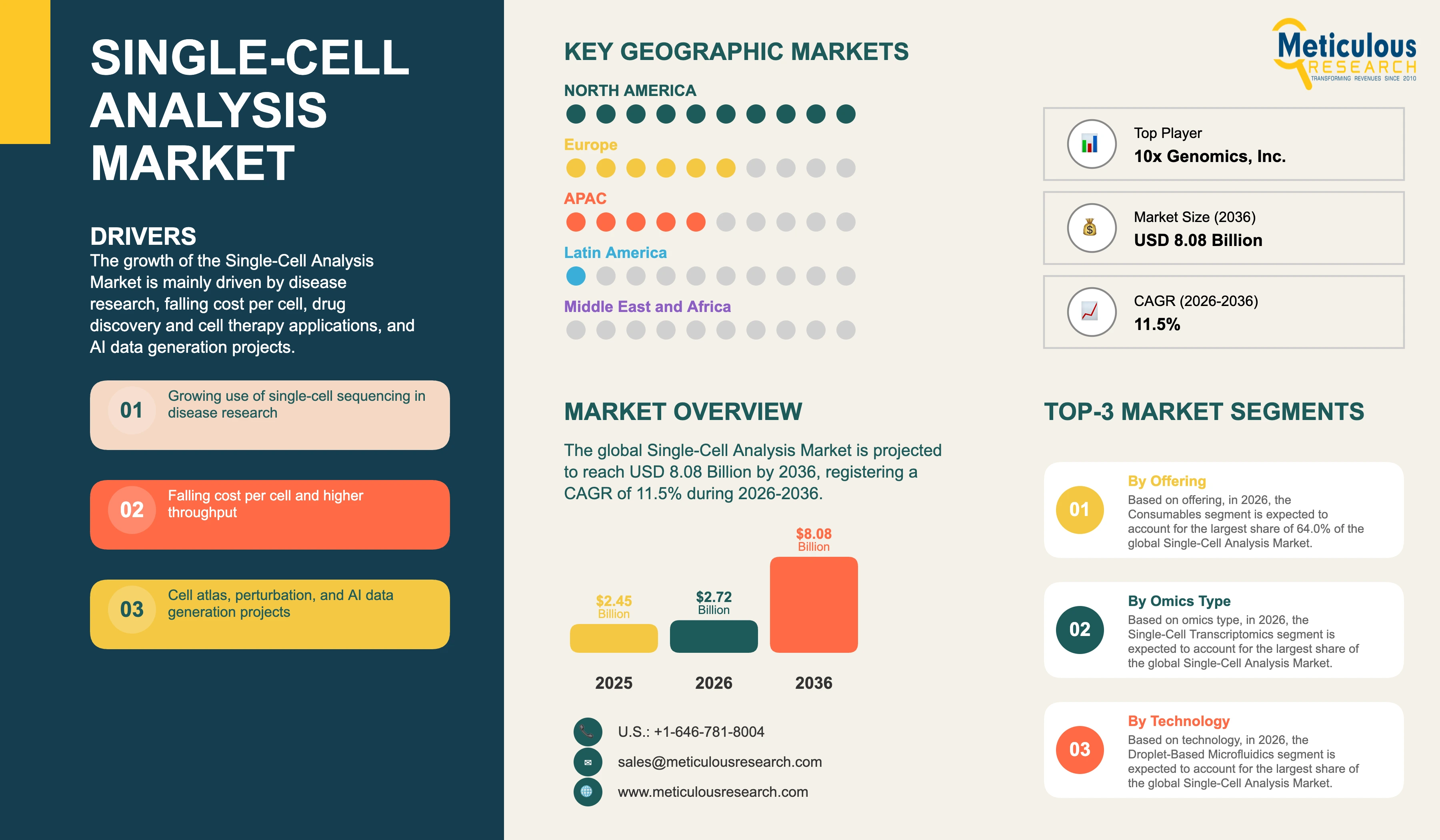
The global single-cell analysis market was valued at USD 2.45 billion in 2025. This market is expected to reach USD 8.08 billion by 2036 from an estimated USD 2.72 billion in 2026, registering a CAGR of 11.5% during the forecast period (2026-2036).
- Published
- Nov 2026
- Pages
- 260
- Format
- PDF + Excel
- Report ID
- MRHC - 1042562
- Base year
- 2025
- 2025 · BASELINE
- $2.45B
- 2036
- $8.08B
- CAGR 2026–2036
- 11.5%
2025 baseline · 2026–2036 forecast at 11.5% CAGR · hover a bar for the value
Key highlights
10x Genomics, the largest supplier of single-cell analysis products, reported third-quarter 2026 revenue of USD 150.7 million, up 1% year-on-year, as growth in consumables offset a 43% fall in instrument revenue, and raised its full-year 2026 revenue guidance to USD 625 million to USD 635 million while introducing Sentira, a cloud-based analysis platform that uses accelerated computing and AI for single-cell and spatial data analysis.
QIAGEN acquired Parse Biosciences, a provider of instrument-free combinatorial barcoding kits for single-cell sequencing, for up to USD 280 million, and Parse launched its Evercode Whole Transcriptome v4 chemistry on February 19, 2026, followed by FFPE-compatible whole transcriptome single-cell kits on March 31, 2026, bringing single-cell analysis to the most common archival tissue format.
Waters Corporation completed its combination with BD's Biosciences and Diagnostic Solutions businesses on February 9, 2026, forming Waters Biosciences, which includes flow cytometry instruments and reagents and the BD Rhapsody single-cell multiomics portfolio, a sign of growing consolidation in the cell analysis industry.
Parse Biosciences and Graph Therapeutics announced on January 20, 2026 a partnership to build one of the largest immune cell perturbation atlases, while the Chan Zuckerberg Initiative's Billion Cells Project, launched in 2025 with 10x Genomics and Ultima Genomics, aims to generate single-cell data from one billion cells to train AI models of cell biology.
Illumina has entered single-cell analysis through its acquisition of Fluent BioSciences and the commercial launch of its single-cell sample preparation product, and it has announced plans for a single-cell Perturb-seq product, increasing competition with established single-cell platform providers and linking single-cell sample preparation more closely with its sequencing instruments and software.
By offering, consumables account for the largest share of 64.0% in 2026, while software and services register the highest CAGR.
By omics type, single-cell transcriptomics account for the largest share in 2026, while single-cell multiomics register the highest CAGR.
By technology, droplet-based microfluidics account for the largest share in 2026, while combinatorial (split-pool) barcoding registers the highest CAGR.
By application, oncology accounts for the largest share in 2026, while immunology and infectious diseases register the highest CAGR.
By end user, academic and research institutes account for the largest share of 52.0% in 2026, while pharmaceutical and biotechnology companies register the highest CAGR.
By geography, North America accounts for the largest share of 45.0% in 2026, while Asia-Pacific registers the highest CAGR of 14.3%.
Report summary
| Particulars | Details |
|---|---|
| Base Year | 2025 |
| Estimated Year | 2026 |
| Forecast Period | 2026-2036 |
| Market Size in 2025 | USD 2.45 billion |
| Market Size in 2026 | USD 2.72 billion |
| Market Size by 2036 | USD 8.08 billion |
| CAGR (2026-2036) | 11.5% |
| Format | PDF, Excel & Cloud Portal · 260 pages |
| Largest Segment by Offering (2026) | Consumables (64.0%) |
| Largest Segment by End User (2026) | Academic and Research Institutes (52.0%) |
| Largest Region (2026) | North America (45.0%) |
| Fastest-Growing Region | Asia-Pacific (CAGR 14.3%) |
| Companies Profiled | 14 companies and other companies |
| Segments Covered | Offering, Omics Type, Technology, Application, End User, Geography |
| Countries Covered | U.S., Canada, U.K., Germany, France, Netherlands, Switzerland, Sweden, Belgium, Denmark, Spain, Italy, Rest of Europe, China, Japan, South Korea, Australia, Singapore, India, Taiwan, Hong Kong, Rest of Asia-Pacific, Brazil, Mexico, Argentina, Rest of Latin America, Israel, Saudi Arabia, U.A.E., Qatar, South Africa, Rest of Middle East & Africa |
Report overview
Segments covered: offering, omics type, technology, application, end user.
The growth of this market is mainly driven by the growing use of single-cell sequencing in cancer, immunology, and neuroscience research, the falling cost per cell of single-cell experiments as instrument-free and highly multiplexed methods scale to millions of cells, the rising use of single-cell data in drug target discovery and cell and gene therapy development, large cell atlas and perturbation projects that generate training data for AI models of biology, and the growing adoption of multiomics workflows that measure RNA, protein, chromatin, and immune receptors in the same cell. However, factors such as the high cost of instruments and sequencing, complex sample preparation, the difficulty of analyzing very large datasets, and constrained academic research budgets in the U.S. and Europe are expected to restrain the growth of this market to some extent.
Single-cell analysis refers to the technologies used to measure the genetic, transcriptional, epigenetic, and protein content of individual cells, rather than the average signal of a bulk tissue sample. By profiling thousands to millions of cells one at a time, researchers can identify rare cell types, map how cells change during development and disease, study how tumors and immune cells respond to treatment, and understand how genetic variation affects individual cells. This report covers single-cell consumables, instruments, and software and services across single-cell transcriptomics, genomics, proteomics, epigenomics, and multiomics. Conventional flow cytometry, which is covered in a separate Meticulous Research report, is excluded, while mass cytometry and other high-parameter single-cell proteomic methods are included.
Single-cell RNA sequencing is the core of the market, and in a typical workflow, a tissue or blood sample is dissociated into single cells or nuclei, each cell is tagged with a unique molecular barcode, and the barcoded RNA is converted into a sequencing library that is read on a next-generation sequencer. Software then assigns each sequencing read to its cell and builds a map of gene expression across all cells. The leading approaches include droplet-based microfluidics, used by 10x Genomics, microwell-based partitioning, used by the BD Rhapsody system and others, and combinatorial or split-pool barcoding, used by Parse Biosciences and others, which does not require a dedicated instrument.
The field has moved quickly from profiling a few hundred cells to profiling millions of cells in one experiment. Combinatorial barcoding kits can now process several million cells and hundreds of samples in a single run, while droplet-based systems have added high-throughput and fixed-sample chemistries. These advances have reduced the cost per cell and made large studies possible, such as cell atlases of entire organs, population-scale immune profiling, and CRISPR perturbation screens that read out the effect of thousands of genetic changes at single-cell resolution.
The market is also expanding beyond RNA. Single-cell multiomics methods measure RNA together with surface proteins, chromatin accessibility, or T-cell and B-cell receptor sequences in the same cell, which gives a more complete view of cell identity and function. Single-cell DNA sequencing is used to study tumor clonal evolution and to detect rare mutations in blood cancers, while mass cytometry and other high-parameter proteomic methods measure dozens of proteins per cell. New methods also allow single-cell analysis of fixed and archived samples, such as FFPE tissue, which opens large clinical sample collections to single-cell research.
Software and data analysis have become a major part of the workflow and a growing source of value. Single-cell experiments generate very large datasets that require specialized computational tools for quality control, clustering, cell type annotation, and integration with other datasets. Vendors are building cloud-based analysis platforms and using AI to automate cell annotation and interpretation, while large public datasets from cell atlas projects are being used to train foundation models of cell biology that can predict how cells respond to genetic changes and drugs.
Academic and research institutes are the largest users of single-cell technologies, supported by funding from the NIH, the European Union, national research agencies, and foundations such as the Chan Zuckerberg Initiative. Pharmaceutical and biotechnology companies are increasingly using single-cell data in target discovery, biomarker development, and cell and gene therapy programs, and clinical research groups are exploring single-cell methods for cancer diagnosis and monitoring.
The market includes single-cell platform providers, sequencing companies, life science tools companies, specialized single-cell startups, and service providers. Leading companies include 10x Genomics, Waters Corporation (BD Biosciences), QIAGEN (Parse Biosciences), Illumina, Thermo Fisher Scientific, Bio-Rad Laboratories, Standard BioTools, Bruker, Takara Bio, Mission Bio, BioSkryb Genomics, Singleron Biotechnologies, MGI Tech, and Miltenyi Biotec.
Over the forecast period, the single-cell analysis market is expected to grow strongly, as the cost per cell continues to fall, as multiomics and fixed-sample methods broaden the range of studies, as pharmaceutical companies use single-cell data and AI models to select drug targets, and as single-cell methods move gradually from research into translational and clinical applications.
Academic and research institutes are expected to account for the largest share of 52.0% of the market in 2026, while pharmaceutical and biotechnology companies are projected to register the highest CAGR.
North America is expected to account for the largest share of 45.0% of the market in 2026, mainly due to high research funding, a large biopharmaceutical industry, and the presence of leading single-cell technology providers.
Asia-Pacific is projected to register the highest CAGR of 14.3% during the forecast period, driven by research investment in China, Japan, South Korea, Singapore, and Australia and the growth of local technology providers.
The report profiles 14 companies, including 10x Genomics, Waters (BD Biosciences), QIAGEN (Parse Biosciences), Illumina, Thermo Fisher Scientific, Bio-Rad, Standard BioTools, Bruker, Takara Bio, Mission Bio, BioSkryb Genomics, Singleron, MGI Tech, and Miltenyi Biotec.
Report infographic
Market dynamics
16 factors across 5 forcesGrowing use of single-cell sequencing in disease research
Single-cell sequencing has become a standard tool in cancer, immunology, neuroscience, and developmental biology research, because it reveals cell types and states that are hidden in bulk measurements. In cancer research, single-cell analysis shows how tumors are made up of different cell populations, how cancer cells interact with immune and stromal cells, and how tumors become resistant to treatment. In immunology, it allows researchers to profile immune cells and their receptors in detail, which is important for vaccine development, autoimmune disease research, and cancer immunotherapy.
The number of scientific publications using single-cell methods has grown rapidly over the past decade, and single-cell experiments are now common in leading research institutions and core facilities around the world. As more laboratories adopt these methods and as funders support single-cell studies, demand for consumables, instruments, and analysis tools continues to grow. The use of single-cell data in neuroscience, including brain cell atlases funded by the NIH BRAIN Initiative and similar programs, is another important source of demand, as these projects profile millions of cells from many brain regions.
The availability of fixed-sample chemistries has also made it easier to run single-cell studies across many sites and time points, since samples can be fixed and stored before processing. This is particularly important for clinical studies and for large consortium projects that collect samples from many hospitals.
Falling cost per cell and higher throughput
The cost of single-cell experiments has fallen significantly as technology providers have increased throughput and reduced the cost per cell. Combinatorial barcoding kits from Parse Biosciences and others can profile millions of cells in a single experiment without a dedicated instrument, while droplet-based providers such as 10x Genomics have launched high-throughput and multiplexed chemistries that allow many samples to be pooled in one run. Falling sequencing costs on platforms from Illumina, Ultima Genomics, Element Biosciences, and MGI Tech also reduce the total cost of single-cell studies.
Lower costs make it practical to run larger studies with more samples and more cells per sample, which improves statistical power and allows researchers to study rare cell types and small differences between patients. This has opened new applications, such as population-scale studies of immune variation, large drug screening experiments, and genome-wide CRISPR perturbation screens with single-cell readout, which all require very large numbers of cells and drive consumables demand. Lower costs have also brought single-cell methods within reach of smaller laboratories and of research groups in emerging markets.
Rising use in drug discovery and cell and gene therapy
Pharmaceutical and biotechnology companies are using single-cell analysis across the drug development process, from identifying disease-relevant cell types and drug targets to understanding drug mechanisms, finding biomarkers, and selecting patients for clinical trials. Single-cell data helps companies understand which cells express a drug target, how cells respond to treatment, and why some patients do not respond. Several companies have built internal single-cell capabilities and work with service providers to run large studies.
Cell and gene therapy developers use single-cell analysis to characterize CAR-T and other cell products, track the persistence and behavior of therapeutic cells in patients, and study the effects of gene editing on individual cells. As the number of cell and gene therapy programs grows, demand for single-cell tools in this area is expected to increase, especially for multiomics and immune receptor profiling methods.
Cell atlas, perturbation, and AI data generation projects
Large cell atlas and perturbation projects are generating very large single-cell datasets. The Human Cell Atlas aims to map every cell type in the human body, and the Chan Zuckerberg Initiative's Billion Cells Project aims to generate data from one billion cells to train AI models of cell biology. Companies such as Parse Biosciences, 10x Genomics, and others are partnering with AI-focused biotechnology companies to build perturbation atlases that show how cells respond to genetic changes and drugs.
These projects consume large volumes of single-cell consumables and sequencing, and they create demand for high-throughput platforms and data services. They also increase the value of single-cell data for AI model development, which is attracting investment from technology companies, pharmaceutical companies, and venture investors. We expect AI-driven data generation to remain an important source of demand throughout the forecast period.
Table of contents
13 chapters · 163 sections · 260 pages · click to expandSegmental analysis
| Segment | Largest share (2026) | Fastest growth (2026–2036) |
|---|---|---|
| By Offering | Single-cell transcriptomics | Single-cell multiomics |
By Offering
- The single-cell transcriptomics segment is expected to account for the largest share of the single-cell analysis market, while the single-cell multiomics segment is projected to register the highest CAGR during the forecast period.
- The droplet-based microfluidics segment is expected to account for the largest share of the single-cell analysis market, while the combinatorial (split-pool) barcoding segment is projected to register the highest CAGR during the forecast period.
- The oncology segment is expected to account for the largest share of the single-cell analysis market, while the immunology and infectious diseases segment is projected to register the highest CAGR during the forecast period.
Geographic analysis
North America
Largest shareIn 2026, North America is expected to account for the largest share of 45.0% of the global single-cell analysis market. The large share of this region is mainly due to the high level of life science research funding from the NIH and private foundations, the large number of leading research institutions, cancer centers, and pharmaceutical and biotechnology companies in the U.S., the strong presence of single-cell technology providers such as 10x Genomics, Parse Biosciences, Illumina, Mission Bio, and BioSkryb Genomics, and early adoption of single-cell methods in drug discovery and AI-driven biology. Canada also has strong single-cell research programs at universities and research institutes in Toronto, Montreal, and Vancouver, supported by federal and provincial research funding.
Europe
Europe is the second-largest market, supported by strong research institutions and funding in the U.K., Germany, France, the Netherlands, Sweden, Switzerland, Belgium, Denmark, Spain, and Italy, major consortium projects such as the Human Cell Atlas, which has strong European participation through the Wellcome Sanger Institute and others, and the presence of companies such as Miltenyi Biotec and QIAGEN, both headquartered in the region. European research budgets have been under some pressure, but single-cell research remains a priority area, and European pharmaceutical companies in Switzerland, Denmark, and the U.K. are important commercial users.
Asia-Pacific
Fastest growthAsia-Pacific is projected to register the highest CAGR of 14.3% during the forecast period. The rapid growth of this region is mainly driven by large research investments in China, Japan, South Korea, Singapore, and Australia, the growth of local single-cell technology providers such as Singleron Biotechnologies and MGI Tech, lower-cost sequencing from local providers, and the rapid expansion of cell therapy development and pharmaceutical research in China. India, Taiwan, and Hong Kong are also growing markets for single-cell products and services, supported by government research programs, new genomics centers, and expanding biotechnology sectors.
Latin America
Latin America and the Middle East & Africa account for small shares of the market. Brazil, Mexico, and Argentina have growing single-cell research at leading universities and cancer centers, while Israel, Saudi Arabia, the U.A.E., and Qatar are investing in national genomics and precision medicine research programs that include single-cell methods.
Middle East & Africa
South Africa also has active research in infectious disease immunology, including HIV and tuberculosis studies that use single-cell immune profiling. Adoption in these regions is supported by distributors and by partnerships between local institutions and international research consortia.
Competitive landscape
The global single-cell analysis market is moderately consolidated, with the top five players estimated to account for about 50% of the market in 2025. The market includes single-cell platform providers, large life science tools and sequencing companies, specialized single-cell startups, and service providers.
10x Genomics is the market leader, with its Chromium platform for single-cell gene expression, multiomics, and immune profiling, a large installed base, and a broad portfolio that also includes spatial products. Waters Corporation, through Waters Biosciences (formerly BD Biosciences), offers the BD Rhapsody single-cell multiomics platform and reagents. QIAGEN entered the market through its acquisition of Parse Biosciences, which offers instrument-free combinatorial barcoding kits and large-scale services through its GigaLab.
Illumina, the leading sequencing company, has entered single-cell sample preparation through its acquisition of Fluent BioSciences, while Thermo Fisher Scientific, Bio-Rad Laboratories, and Takara Bio offer single-cell sample preparation and library products. Standard BioTools offers CyTOF mass cytometry for high-parameter single-cell proteomics, and Bruker offers single-cell functional proteomics through its cellular analysis business. Mission Bio and BioSkryb Genomics focus on single-cell DNA and multiomics analysis, while Singleron Biotechnologies and MGI Tech serve the Asia-Pacific market. Miltenyi Biotec provides cell separation and sample preparation products used in single-cell workflows, and many service providers and contract research organizations offer single-cell sequencing and analysis to customers that do not have their own platforms.
Companies compete on throughput, sensitivity, cost per cell, assay breadth, sample compatibility, ease of use, data analysis software, and intellectual property. Key strategies include product launches of higher-throughput, multiomics, and fixed-sample chemistries, acquisitions by large life science companies, partnerships with AI-focused biotechnology companies and research consortia, and investment in cloud-based and AI-enabled analysis tools.
We expect the competitive landscape to continue to consolidate, as large life science and sequencing companies use their scale and customer relationships to bundle single-cell products with sample preparation, sequencing, and software. At the same time, price competition from instrument-free methods and Asian vendors is expected to continue to pressure prices. Intellectual property will remain an important factor, as leading vendors protect their barcoding and partitioning technologies through patents and licensing.
Some of the key players operating in the single-cell analysis market are 10x Genomics, Inc., Waters Corporation (BD Biosciences), QIAGEN N.V. (Parse Biosciences), Illumina, Inc., Thermo Fisher Scientific Inc., Bio-Rad Laboratories, Inc., Standard BioTools Inc., Bruker Corporation, Takara Bio Inc., Mission Bio, Inc., BioSkryb Genomics, Inc., Singleron Biotechnologies, MGI Tech Co., Ltd., and Miltenyi Biotec B.V. & Co. KG, among others.
- —
QIAGEN acquired Parse Biosciences, which launched Evercode WT v4 and FFPE-compatible kits in 2026, Waters completed its combination with BD Biosciences in February 2026, and 10x Genomics launched the Sentira AI-enabled analysis platform while raising its 2026 revenue guidance.
- 10x Genomics, Inc.
- Waters Corporation (BD Biosciences)
- QIAGEN N.V. · Parse Biosciences
- Illumina, Inc.
- Thermo Fisher Scientific Inc.
- Bio-Rad Laboratories, Inc.
- Standard BioTools Inc.
- Bruker Corporation
- Takara Bio Inc.
- Mission Bio, Inc.
- BioSkryb Genomics, Inc.
- Singleron Biotechnologies
- MGI Tech Co., Ltd.
- Miltenyi Biotec B.V. & Co. KG
Expert perspectives
Single-cell analysis has become one of the most important and widely used technologies in modern biology, and it is entering a new phase driven by scale, multiomics, and AI. The ability to profile millions of cells at low cost, combined with the demand for large datasets to train AI models of cell biology, is changing how the technology is used and who buys it.
Over the forecast period, the market is expected to grow at a CAGR of 11.5%, from USD 2.72 billion in 2026 to USD 8.08 billion in 2036. Growth will be supported by the steady expansion of disease research, falling costs, drug discovery and cell therapy applications, and large data generation projects.
Consumables remain the largest offering segment, while software and services grow fastest. Single-cell transcriptomics is the largest omics type, while multiomics grows fastest. Droplet-based microfluidics is the largest technology, while combinatorial barcoding grows fastest. Oncology is the largest application, while immunology and infectious diseases grow fastest. Academic and research institutes are the largest end user, while pharmaceutical and biotechnology companies grow fastest. North America remains the largest region, and Asia-Pacific is the fastest-growing region at a CAGR of 14.3%.
We note that the near-term environment is mixed, as constrained academic budgets have reduced instrument purchases, and revenue growth at leading vendors has slowed in 2026. However, consumables demand has remained resilient, and the shift toward instrument-free and high-throughput methods means that the volume of cells profiled is growing faster than instrument revenue. We expect growth to accelerate from 2027 onward as research funding stabilizes and as pharmaceutical and AI-driven demand grows, with consumables and services leading the recovery.
For vendors, the key priorities are to reduce cost per cell further, broaden multiomics and fixed-sample offerings, invest in AI-enabled analysis software, and build relationships with pharmaceutical companies and AI-focused biotechnology firms. Vendors that can offer complete and easy-to-use workflows, from sample preparation to biological insight, are best positioned to gain share. We also expect service providers and data factories to become a larger channel, as some users prefer to buy data rather than run experiments themselves.
In the longer term, we see clinical and translational applications, such as single-cell monitoring of blood cancers and characterization of cell therapy products, as the largest untapped opportunity. Standardized, validated workflows, clear regulatory pathways, and evidence of clinical utility will be needed to realize this opportunity, and we expect the early clinical use of single-cell methods to focus on blood cancers and cell therapy monitoring.
Customer perspectives
Director - Single-cell genomics core facility, U.S. research university
Most of our spending is on kits, not instruments, because researchers want to run more samples and more cells, so we use multiplexed and fixed-sample chemistries that let us pool hundreds of samples in a run.
“We need data from tens of millions of cells under thousands of perturbations to train our models. Instrument-free barcoding and large service labs are the only practical way to reach that scale.”
“Single-cell immune profiling with paired receptor sequencing is now part of many of our oncology and autoimmune trials. It helps us understand why some patients respond and others do not, and it guides our biomarker strategy.”
Frequently asked questions
The global single-cell analysis market was valued at USD 2.45 billion in 2025, up from USD 2.18 billion in 2024, and is estimated at USD 2.72 billion in 2026. The market includes single-cell consumables, instruments, and software and services.
Cite this report
Meticulous Research. (2026). Single-Cell Analysis Market - Global Opportunity Analysis and Industry Forecast (2026-2036) (Report No. MRHC - 1042562). Meticulous Market Research Pvt. Ltd. https://www.meticulousresearch.com/product/single-cell-analysis-market-7245