Personal Emergency Response Systems (PERS) Market (2026-2036)
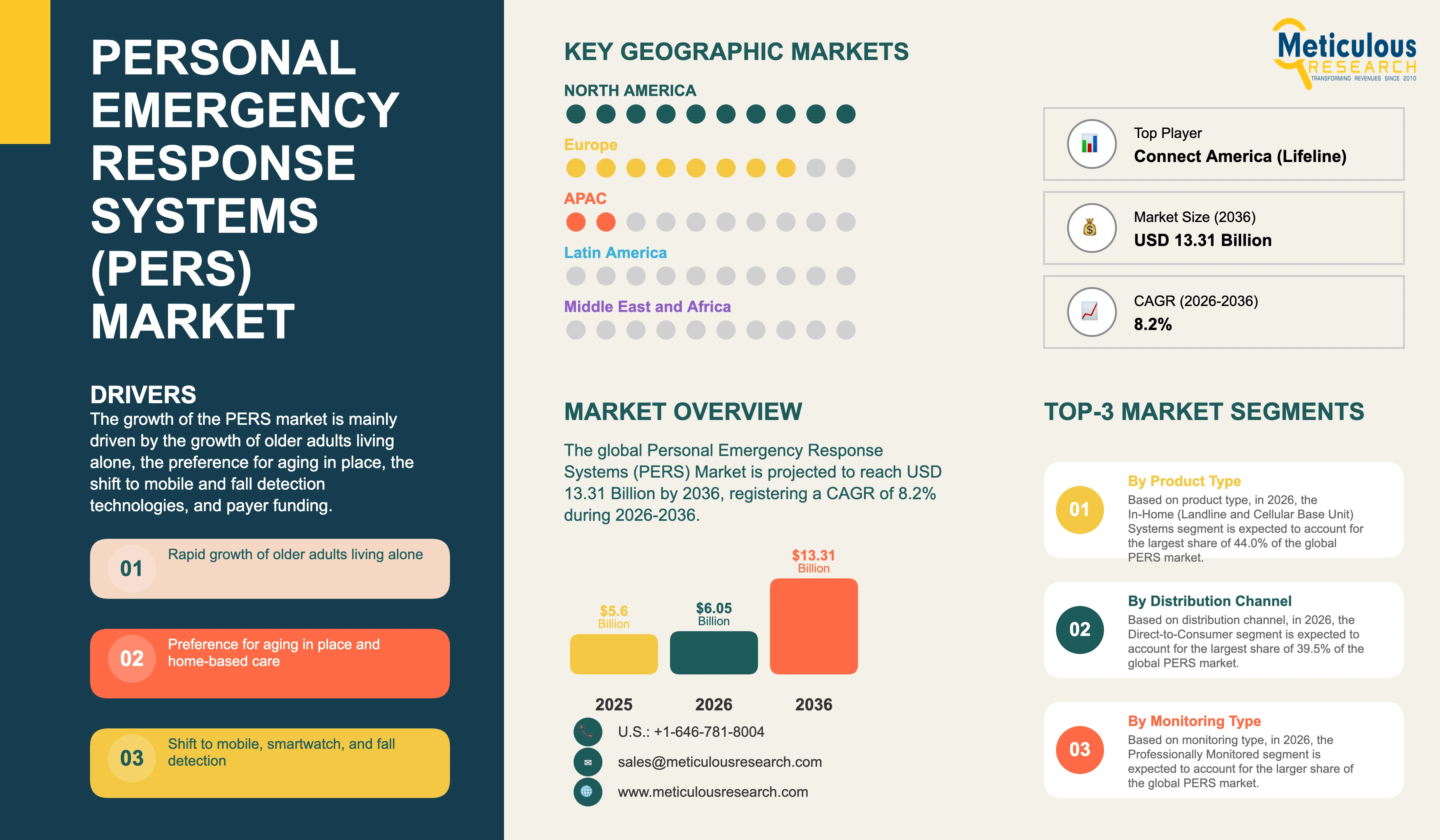
The global personal emergency response systems (PERS) market was valued at USD 5.60 billion in 2025. This market is expected to reach USD 13.31 billion by 2036 from an estimated USD 6.05 billion in 2026, registering a CAGR of 8.2% during the forecast period (2026-2036).
- Published
- Nov 2026
- Pages
- 281
- Format
- PDF + Excel
- Report ID
- MRHC - 1042567
- Base year
- 2025
- 2025 · BASELINE
- $5.60B
- 2036
- $13.31B
- CAGR 2026–2036
- 8.2%
2025 baseline · 2026–2036 forecast at 8.2% CAGR · hover a bar for the value
Key highlights
Connect America, one of the largest PERS providers in North America, acquired Royal Philips' Aging and Caregiving business, including the Lifeline personal emergency response service, in 2021, creating a combined company with more than 900,000 subscribers at the time, and it later acquired 100Plus to combine PERS with AI-assisted remote patient monitoring for payers and at-risk populations.
Medical Guardian, another leading U.S. PERS provider, acquired MedScope America in 2021, creating one of the largest providers of personal emergency response systems in the U.S. and expanding its healthcare and care partnership channels.
Berg Insight's 2026 research on telecare and medical alert solutions identifies a growing group of integrated, platform-led providers in North America, including Aloe Care Health, Becklar Personal Health and Safety, Connect America, Life Alert Emergency Response, Lively, LogicMark, Mytrex, Medical Guardian, and QMedic, and notes that providers are moving toward continuous wellbeing support that combines monitoring, prevention, response, and follow-up care.
In the U.K., the national switch from analog to digital telephone lines is driving the replacement of more than a million analog telecare alarms with digital units, as local authorities and housing associations upgrade the services that support older and vulnerable residents.
Tunstall Healthcare, Legrand Care, Careium, and Chiptech are among the main suppliers of digital telecare hubs and cloud monitoring platforms to U.K. and Nordic local authorities, and their digital platforms allow councils to add activity sensors and proactive wellbeing calls to their services.
The CDC reports that more than 14 million older Americans, or about one in four, report falling each year, and that falls are the leading cause of injury among adults aged 65 and older, which is a major reason families and care providers choose PERS with automatic fall detection.
By product type, in-home (landline and cellular base unit) systems account for the largest share of 44.0% in 2026, while smartwatch-based systems register the highest CAGR.
By offering, monitoring services account for the larger share in 2026, while devices register the higher CAGR.
By monitoring type, professionally monitored accounts for the larger share in 2026, while self-monitored and caregiver-monitored registers the higher CAGR.
By distribution channel, direct-to-consumer accounts for the largest share of 39.5% in 2026, while healthcare payers and providers register the highest CAGR.
By geography, North America accounts for the largest share of 48.0% in 2026, while Asia-Pacific registers the highest CAGR of 12.9%.
Report summary
| Particulars | Details |
|---|---|
| Base Year | 2025 |
| Estimated Year | 2026 |
| Forecast Period | 2026-2036 |
| Market Size in 2025 | USD 5.60 billion |
| Market Size in 2026 | USD 6.05 billion |
| Market Size by 2036 | USD 13.31 billion |
| CAGR (2026-2036) | 8.2% |
| Format | PDF, Excel & Cloud Portal · 281 pages |
| Largest Segment by Product Type (2026) | In-Home (Landline and Cellular Base Unit) Systems (44.0%) |
| Largest Segment by Distribution Channel (2026) | Direct-to-Consumer (39.5%) |
| Largest Region (2026) | North America (48.0%) |
| Fastest-Growing Region | Asia-Pacific (CAGR 12.9%) |
| Companies Profiled | 15 companies and other companies |
| Segments Covered | Product Type, Offering, Monitoring Type, Distribution Channel, Geography |
| Countries Covered | U.S., Canada, U.K., Germany, France, Spain, Italy, Netherlands, Sweden, Norway, Denmark, Finland, Belgium, Ireland, Switzerland, Rest of Europe, Japan, China, Australia, South Korea, Taiwan, Singapore, Hong Kong, New Zealand, India, Rest of Asia-Pacific, Brazil, Mexico, Chile, Argentina, Rest of Latin America, Israel, Saudi Arabia, U.A.E., South Africa, Rest of Middle East & Africa |
Report overview
Segments covered: product type, offering, monitoring type, distribution channel.
The growth of this market is mainly driven by the rapid growth of the older population and the number of older adults living alone, the strong preference for aging in place, the high risk and cost of falls and medical emergencies among older adults, the shift from landline-based home units to mobile devices with cellular connectivity and GPS, the addition of automatic fall detection, health monitoring, and caregiver apps, the transition from analog to digital telecare in the U.K. and other European countries, and growing funding of PERS through Medicaid waiver programs, Medicare Advantage supplemental benefits, the U.S. Department of Veterans Affairs, and public social care programs. However, factors such as monthly subscription costs, limited insurance coverage for many older adults, low wearing compliance, false alarms, and competition from consumer smartwatches and smart speakers are expected to restrain the growth of this market to some extent.
Personal emergency response systems, also known as medical alert systems or telecare alarms, are devices and services that allow older adults, people with disabilities, and other vulnerable individuals to call for help in an emergency. The user wears a pendant, wristband, or smartwatch, or uses a mobile device, with a help button that connects to a 24/7 monitoring center or to family caregivers. Many systems also include automatic fall detection, GPS location, two-way voice communication, and caregiver apps. This report covers the global revenue from PERS devices and monitoring services, across in-home, mobile GPS, smartwatch-based, and standalone systems, and across professional and self-monitored services.
PERS has been used for decades, starting with simple home units connected to landline telephones and a pendant with a help button. When the button is pressed, the system calls a monitoring center, where an operator speaks with the user, checks the situation, and contacts family members, neighbors, or emergency services as needed. This model remains the core of the market, especially in Europe, where public telecare services provide alarms to millions of older people living at home, and in the U.S., where direct-to-consumer brands such as Life Alert, Lifeline, Medical Guardian, and Bay Alarm Medical are well known.
The market has changed significantly over the past decade, as mobile PERS devices with cellular connectivity and GPS allow users to call for help anywhere, not only at home, and they have become the fastest-growing product type. Automatic fall detection, based on accelerometers and algorithms, is now offered by most providers. Smartwatches designed for older adults combine PERS functions with health tracking, medication reminders, and messaging, while some providers integrate their services with mainstream smartwatches. Caregiver apps let family members see alerts, device status, and location.
PERS is increasingly part of broader aging-in-place and connected care services, as providers are combining emergency response with remote patient monitoring, medication management, activity monitoring, and care coordination, and they are selling these services to health plans, health systems, and government programs that want to support older adults at home and reduce hospital admissions. Connect America's acquisition of 100Plus, a remote patient monitoring company, is an example of this trend.
Funding sources vary by country, and in the U.S., most PERS services are paid privately by users or their families, but Medicaid home and community-based services waivers, Medicare Advantage supplemental benefits, the Department of Veterans Affairs, and some private insurers also fund PERS for eligible members. In the U.K., the Nordic countries, the Netherlands, Spain, and other European countries, local authorities, municipalities, and housing providers fund telecare as part of social care, while private payment is growing. In Japan, security companies offer elderly monitoring services, and local governments support emergency alarms for older people living alone.
Technology changes are also affecting the market, as the shutdown of 2G and 3G mobile networks has required providers to replace many mobile devices with 4G LTE and LTE-M devices, while the switch from analog to digital telephone networks in Europe is forcing the replacement of home units that relied on analog lines. These transitions create replacement demand but also add costs for providers and customers.
The market includes PERS service providers, device manufacturers, monitoring center operators, telecare platform providers, home security companies, and consumer electronics companies. Leading companies include Connect America (Lifeline), Medical Guardian, ADT Inc., Bay Alarm Medical, LifeStation, Life Alert Emergency Response, MobileHelp, LogicMark, Tunstall Healthcare, Legrand Care, Careium, Chiptech, Essence Group, and SECOM.
Over the forecast period, the PERS market is expected to grow steadily, as the number of older adults living alone increases, as mobile and smartwatch-based devices broaden the appeal of PERS to more active older adults, as digital telecare platforms replace analog systems in Europe, and as health plans and governments fund PERS as part of home-based care. The market is also expected to shift from emergency response toward proactive monitoring and prevention, supported by digital platforms and sensors.
Direct-to-consumer is expected to account for the largest share of 39.5% of the market in 2026, while healthcare payers and providers are projected to register the highest CAGR.
North America is expected to account for the largest share of 48.0% of the market in 2026, mainly due to the large U.S. direct-to-consumer medical alert industry and payer funding through Medicaid, Medicare Advantage, and the VA.
Asia-Pacific is projected to register the highest CAGR of 12.9% during the forecast period, driven by rapid aging in Japan, China, South Korea, and Australia and government support for home-based care.
The report profiles 15 companies, including Connect America (Lifeline), Medical Guardian, ADT, Bay Alarm Medical, LifeStation, Life Alert, MobileHelp, LogicMark, Tunstall Healthcare, Legrand Care, Careium, Chiptech, Essence Group, SECOM, and Aloe Care Health.
In 2026, the monitoring services segment is expected to account for the larger share of the PERS market, while the devices segment is projected to register the higher CAGR during the forecast period.
In 2026, the professionally monitored segment is expected to account for the larger share of the PERS market, while the self-monitored and caregiver-monitored segment is projected to register the higher CAGR during the forecast period.
Report infographic
Market dynamics
16 factors across 5 forcesRapid growth of older adults living alone
The number of older adults is growing rapidly in North America, Europe, and Asia-Pacific, and a large and rising share of them live alone. In the U.S., the Census Bureau and the Administration for Community Living report that millions of adults aged 65 and older live alone, and the share increases with age. In Europe and Japan, the number of older people living alone is also rising, driven by longer life expectancy, smaller families, and changes in living arrangements.
Older adults living alone are at particular risk in emergencies, because no one may be present to help if they fall, have a stroke or heart attack, or become ill. A person who falls and cannot get up may remain on the floor for hours, which can lead to serious complications. PERS gives these individuals a way to call for help at any time, and it gives their families confidence that help will be called. This makes PERS one of the most widely used technologies for supporting older adults at home.
Health systems and hospitals also recommend PERS at discharge for patients who live alone, as an emergency alert service can reduce the risk that a fall or sudden illness at home goes unnoticed. Social workers, home care agencies, and Area Agencies on Aging play an important role in referring older adults to PERS programs.
Adult children, who often live far from their aging parents, are also important buyers and influencers. Many families buy PERS for a parent after a fall or hospital stay, and caregiver apps that show alerts and device status make PERS more attractive to these families.
Preference for aging in place and shift to home-based care
Most older adults prefer to stay in their own homes as long as possible, and governments and health systems are shifting long-term care toward home and community-based services, which are usually less expensive than residential care. In the U.S., Medicaid home and community-based services programs support millions of people, and PERS is a common service in these programs. In Europe, local authorities fund telecare as part of social care that helps older people remain at home.
PERS is an important part of the support that allows older adults to live safely at home, alongside home care, meal services, and home modifications. As care continues to shift from hospitals and nursing homes to the home, demand for PERS is expected to grow, and providers are developing services that integrate emergency response with other home care services.
Shift to mobile, smartwatch, and fall detection technologies
The shift from landline-based home units to mobile devices with cellular connectivity and GPS has expanded the appeal of PERS to more active older adults who spend time outside the home. Mobile devices can be used while walking, shopping, gardening, or traveling, and GPS location helps monitoring centers send help to the right place. Automatic fall detection, which calls for help even if the user cannot press the button, has become a standard option and is a major reason families choose PERS.
Smartwatch-based PERS devices, which look like regular watches and offer health tracking and other features, reduce the stigma that some older adults associate with traditional pendants. Providers are launching senior-focused smartwatches with professional monitoring, and some offer services that work with mainstream smartwatches. These newer devices command higher prices and help attract younger seniors, which supports market growth.
Improvements in battery life, waterproof designs that can be worn in the shower, and LTE-M connectivity have also made mobile and wearable devices more practical for daily use, which helps increase wearing compliance and the value of the service.
Funding by health plans, government programs, and payers
Health plans, government programs, and other payers increasingly fund PERS as a way to support members at home and reduce costly hospital admissions and nursing home placements. Medicare Advantage plans can offer PERS as a supplemental benefit, Medicaid waiver programs fund PERS for eligible older and disabled people, and the Department of Veterans Affairs provides medical alert systems to veterans. Hospital discharge programs and care management organizations also provide PERS to high-risk patients.
Payer funding expands access to PERS beyond those who can afford to pay privately, and it encourages providers to offer services that integrate with care management, such as remote patient monitoring and reporting of events to care teams. Providers that build strong relationships with payers and show outcomes such as reduced hospital use are well positioned to grow.
Table of contents
12 chapters · 162 sections · 281 pages · click to expandSegmental analysis
| Segment | Largest share (2026) | Fastest growth (2026–2036) |
|---|---|---|
| By Product Type | In-home (landline and cellular base unit) systems | Smartwatch-based systems |
| By Offering | — | — |
| By Monitoring Type | — | Rapid growth of this |
| By Distribution Channel | Direct-to-consumer | Healthcare payers and providers |
By Product Type
- The in-home (landline and cellular base unit) systems segment is expected to account for the largest share of 44.0% of the global PERS market.
- The large share of this segment is mainly due to the very large installed base of home units with wearable help buttons used by older adults in North America and Europe, the widespread use of home units in publicly funded telecare services in the U.K., the Nordic countries, the Netherlands, Spain, and other European countries, and the suitability of home units for older adults who spend most of their time at home.
- Home units typically include a base station with a loudspeaker and microphone and a pendant or wristband button, and many now use cellular rather than landline connections.
- In-home systems remain the main product offered through social care and Medicaid waiver programs, and they are often combined with other telecare sensors, such as smoke detectors, bed and chair occupancy sensors, door sensors, and medication dispensers, which create a home safety system.
- Housing providers and local authorities often install home units as standard in sheltered and extra care housing.
- The transition from analog to digital telephone networks in Europe is driving the replacement of many home units with digital models, which supports device revenue in this segment even as its share declines.
- However, the smartwatch-based systems segment is projected to register the highest CAGR during the forecast period.
- The rapid growth of this segment is driven by the appeal of discreet, watch-style devices to younger and more active older adults, the addition of health tracking and fall detection, the launch of senior-focused smartwatches with professional monitoring, and integration of PERS services with mainstream smartwatches.
- Mobile GPS systems are also growing quickly and are expected to become the largest product type over the forecast period, as active older adults seek protection both at home and outside.
By Offering
- The monitoring services segment is expected to account for the larger share of the global PERS market.
- The large share of this segment is mainly due to the recurring monthly fees that users, families, and payers pay for 24/7 professional monitoring, the large number of active subscribers in North America and Europe, and the value of trained operators who can assess situations, reassure users, and coordinate help from family members or emergency services.
- Monitoring services are the core of the PERS business model and generate stable, recurring revenue for providers.
- Monitoring centers operated by providers such as Connect America, Medical Guardian, LifeStation, Tunstall, and others handle millions of calls each year, many of which are not emergencies but reassurance calls, accidental activations, or checks on users who need help but not an ambulance.
- Providers are using technology to improve monitoring center efficiency, such as automated call routing, caregiver notifications, and AI-assisted triage, and they are adding services such as wellness calls and care coordination.
- The devices segment is projected to register the higher CAGR during the forecast period, driven by the replacement of devices for 4G and LTE-M networks, the digital telecare transition in Europe, the shift to higher-priced mobile and smartwatch-based devices, and the growth of device sales through retail and online channels.
- Device revenue is also growing as providers sell or lease devices to health plans and care organizations.
By Monitoring Type
- The professionally monitored segment is expected to account for the larger share of the global PERS market.
- The large share of this segment is mainly due to the preference of most older adults, families, and payers for 24/7 monitoring by trained operators who can respond to any alert at any time, the requirements of public telecare and Medicaid programs for professional monitoring, and the ability of monitoring centers to assess situations and dispatch the right type of help.
- Professional monitoring is particularly important for older adults with health conditions, cognitive impairment, or no nearby family.
- Professional monitoring also supports additional services, such as wellness check calls, medication reminders, and care coordination, which increase the value of the service.
- Monitoring centers must meet quality standards, such as those set by the TSA in the U.K. and industry associations in the U.S., and providers invest in training, technology, and redundancy to ensure reliable response.
- However, the self-monitored and caregiver-monitored segment is projected to register the higher CAGR during the forecast period.
- The rapid growth of this segment is driven by lower-cost devices and smartwatches that send alerts directly to family members, the growth of caregiver apps, and the preference of some families to manage alerts themselves.
- Many of these devices can also connect to emergency services, and some providers offer hybrid models that combine caregiver alerts with professional backup.
By Distribution Channel
- The direct-to-consumer segment is expected to account for the largest share of 39.5% of the global PERS market.
- The large share of this segment is mainly due to the large U.S. market for privately paid medical alert services sold directly to older adults and their families through television advertising, online marketing, and call centers, the strong brands of providers such as Life Alert, Lifeline, Medical Guardian, Bay Alarm Medical, and ADT, and the growing role of online and retail sales of mobile and smartwatch-based devices.
- Direct-to-consumer providers compete on price, device features, fall detection, and customer service.
- Direct-to-consumer providers spend heavily on marketing and customer acquisition, and they are increasingly using online channels, partnerships with retailers such as Best Buy and Walmart, and affinity organizations such as AARP to reach customers.
- Families often buy PERS after a fall or health scare, so providers aim to be visible at these moments.
- Subscription pricing with optional fall detection and mobile service is common, and providers offer free equipment or trials to attract customers.
- However, the healthcare payers and providers segment is projected to register the highest CAGR during the forecast period.
- The rapid growth of this segment is driven by Medicare Advantage supplemental benefits, Medicaid waiver programs, Veterans Affairs programs, hospital discharge and care transition programs, and the integration of PERS with remote patient monitoring and care management.
- Public telecare and social care programs remain a large channel in Europe, while senior living and housing providers are important channels for both home units and facility-wide systems.
Geographic analysis
North America
Largest shareIn 2026, North America is expected to account for the largest share of 48.0% of the global PERS market. The large share of this region is mainly due to the large number of older adults living alone in the U.S., the well-developed direct-to-consumer medical alert industry with strong brands and high awareness, the availability of PERS through Medicaid waiver programs, Medicare Advantage plans, and the Department of Veterans Affairs, and the presence of leading providers such as Connect America, Medical Guardian, ADT, Bay Alarm Medical, LifeStation, Life Alert, MobileHelp, and LogicMark. The U.S. also has an active market for PERS funded through state Medicaid waiver programs and the Department of Veterans Affairs, which provides devices to eligible veterans. Canada is also an important market, with private providers and provincial home care programs offering medical alarm services.
Europe
Europe is the second-largest market, supported by well-established public telecare services in the U.K., the Nordic countries, the Netherlands, Spain, France, Germany, and other countries. The U.K. has one of the largest telecare markets in the world, with local authorities and housing associations providing alarms to more than a million people, and the digital switchover is driving large upgrade programs. Sweden, Norway, Denmark, and Finland have municipal telecare services, while Spain provides teleassistance through regional and municipal programs. Germany, France, Italy, Belgium, Ireland, and Switzerland have growing private and insurance-funded markets, with Tunstall, Legrand Care, Careium, Verklizan, and others serving the region.
Asia-Pacific
Fastest growthAsia-Pacific is projected to register the highest CAGR of 12.9% during the forecast period. The rapid growth of this region is mainly driven by very rapid aging in Japan, China, South Korea, Taiwan, and Australia, the growing number of older people living alone, government programs that promote home-based and smart elderly care, and the growth of mobile and smartwatch-based devices. Japan has an established market for elderly monitoring services from security companies such as SECOM and ALSOK, while Australia's aged care programs fund personal alarms. Singapore, New Zealand, India, and Hong Kong are also growing markets.
Latin America
Latin America and the Middle East & Africa account for small shares of the market but are expected to grow as populations age and private healthcare and security services expand. Brazil, Mexico, Chile, and Argentina have growing private medical alert services, often provided by security companies and health insurers, while Israel, Saudi Arabia, the U.A.E., and South Africa are adopting mobile PERS and telecare services for older adults.
Competitive landscape
The global PERS market is fragmented, with the top five players estimated to account for about 30% of the market in 2025. The market includes direct-to-consumer PERS providers, telecare providers serving public programs, home security companies, device manufacturers, monitoring center operators, and consumer electronics companies.
Connect America, which owns the Lifeline brand acquired from Philips, is one of the largest PERS providers in North America and has expanded into remote patient monitoring and medication management. Medical Guardian is another leading U.S. provider, with a strong direct-to-consumer business and healthcare partnerships, while ADT offers medical alert services through its home security business. Bay Alarm Medical, LifeStation, Life Alert, and MobileHelp are other important U.S. providers, and LogicMark supplies PERS devices, including to the Department of Veterans Affairs.
In Europe, Tunstall Healthcare, Legrand Care, Careium, Chiptech, and Verklizan are leading telecare equipment and platform providers, serving local authorities, housing providers, and private customers. Essence Group supplies PERS and telecare devices to service providers worldwide, while SECOM is a leading provider of elderly monitoring services in Japan.
Aloe Care Health offers voice-activated smart hubs and mobile devices with caregiver apps, while Lively, owned by Best Buy, sells mobile alert devices and phones for older adults through retail channels. Doro, Mytrex, QMedic, and Becklar are other notable providers of devices and monitoring services in Europe and North America.
Companies compete on device design and features, fall detection accuracy, mobile coverage, monitoring center quality and response times, caregiver apps, integration with health services, price, and brand. Monitoring center scale and accreditation are also important when bidding for public telecare and payer contracts. Key strategies include acquisitions to gain scale, partnerships with health plans, health systems, retailers, and affinity organizations, the launch of mobile and smartwatch-based devices, investment in digital telecare platforms, and expansion into remote patient monitoring and connected care.
We expect consolidation to continue, as larger providers acquire smaller monitoring companies and technology firms, and as private equity investors back connected care platforms. Competition from consumer electronics companies is likely to increase, pushing traditional PERS providers to differentiate through professional monitoring, care services, and payer partnerships.
Some of the key players operating in the PERS market are Connect America (Lifeline), Medical Guardian LLC, ADT Inc., Bay Alarm Medical, LifeStation, Inc., Life Alert Emergency Response, Inc., MobileHelp LLC, LogicMark, Inc., Tunstall Healthcare Group Limited, Legrand Care, Careium AB, Chiptech Ltd., Essence Group, SECOM Co., Ltd., and Aloe Care Health, among others.
- —
Connect America expanded from PERS into remote patient monitoring through its acquisition of 100Plus, U.K. local authorities continued large digital telecare upgrade programs ahead of the analog switch-off, providers moved customers to LTE-M mobile devices, and senior-focused smartwatches with professional monitoring gained share.
- Connect America · Lifeline
- Medical Guardian LLC
- ADT Inc.
- Bay Alarm Medical
- LifeStation, Inc.
- Life Alert Emergency Response, Inc.
- MobileHelp LLC
- LogicMark, Inc.
- Tunstall Healthcare Group Limited
- Legrand Care
- Careium AB
- Chiptech Ltd.
- Essence Group
- SECOM Co., Ltd.
- Aloe Care Health
Expert perspectives
The PERS market is benefiting from strong demographic tailwinds and from the broader shift of care into the home. At the same time, the market is changing from a mature, landline-based emergency response business into a connected care industry that combines mobile devices, fall detection, health monitoring, and care coordination. We see this transition as both a challenge and an opportunity for traditional PERS providers.
Over the forecast period, the market is expected to grow at a CAGR of 8.2%, from USD 6.05 billion in 2026 to USD 13.31 billion in 2036. Growth will be supported by the rising number of older adults living alone, the shift to mobile and smartwatch-based devices, the digital telecare transition in Europe, and payer funding for PERS and connected care.
In-home systems remain the largest product type, while smartwatch-based systems grow fastest and mobile GPS systems are expected to overtake in-home systems over the forecast period. Monitoring services account for the larger share, while devices grow faster. Professional monitoring dominates, while self-monitored solutions grow faster. Direct-to-consumer remains the largest distribution channel, while healthcare payers and providers grow fastest. North America remains the largest region, and Asia-Pacific is the fastest-growing region at a CAGR of 12.9%.
For providers, the key priorities are to offer attractive, easy-to-use mobile and smartwatch devices with reliable fall detection, to integrate emergency response with remote monitoring and care services, to build partnerships with payers and health systems, and to manage network transitions and monitoring center costs efficiently. Providers that can demonstrate reduced hospital use and better outcomes will be best placed to win payer funding.
We expect consumer electronics companies to continue expanding their emergency and health features, which will put pressure on basic PERS services. However, we believe that professional monitoring, human support, and integration with care services will remain valuable for many older adults, especially those with health conditions, cognitive impairment, or limited family support.
In Europe, the digital telecare transition offers a once-in-a-generation opportunity for providers to modernize services and introduce proactive monitoring. Local authorities that use this transition to adopt digital platforms and preventive services will be able to support more older people at home with limited care staff.
We also expect payer funding to become a more important source of growth, especially in the U.S., as Medicare Advantage plans and Medicaid programs look for low-cost ways to support older members at home. Providers that can integrate PERS data with care management systems and report outcomes to payers will be best positioned in this channel.
Customer perspectives
Adult son of an 82-year-old widow - U.S.
After my mother fell and could not reach the phone, we signed her up for a medical alert service with a base unit and fall detection. Knowing that someone answers within seconds, day or night, gives our whole family peace of mind.
Head of Technology-Enabled Care - local authority, U.K.
The digital switchover has forced us to replace our analog alarms, and we are using the opportunity to move to a digital platform with activity sensors and proactive calls. We want to prevent emergencies, not only respond to them.
Director of Supplemental Benefits - Medicare Advantage health plan, U.S.
We offer mobile medical alert devices to members who are at high risk of falls or recently left the hospital. Linking alerts to our care managers helps us follow up quickly and avoid readmissions.
Frequently asked questions
The global personal emergency response systems (PERS) market was valued at USD 5.60 billion in 2025, up from USD 5.18 billion in 2024, and is estimated at USD 6.05 billion in 2026. The market includes PERS devices and monitoring services across in-home, mobile, smartwatch-based, and standalone systems.
Cite this report
Meticulous Research. (2026). Personal Emergency Response Systems (PERS) Market - Global Opportunity Analysis and Industry Forecast (2026-2036) (Report No. MRHC - 1042567). Meticulous Market Research Pvt. Ltd. https://www.meticulousresearch.com/product/personal-emergency-response-systems-market-7250