Industrial DataOps Market (2026-2036)
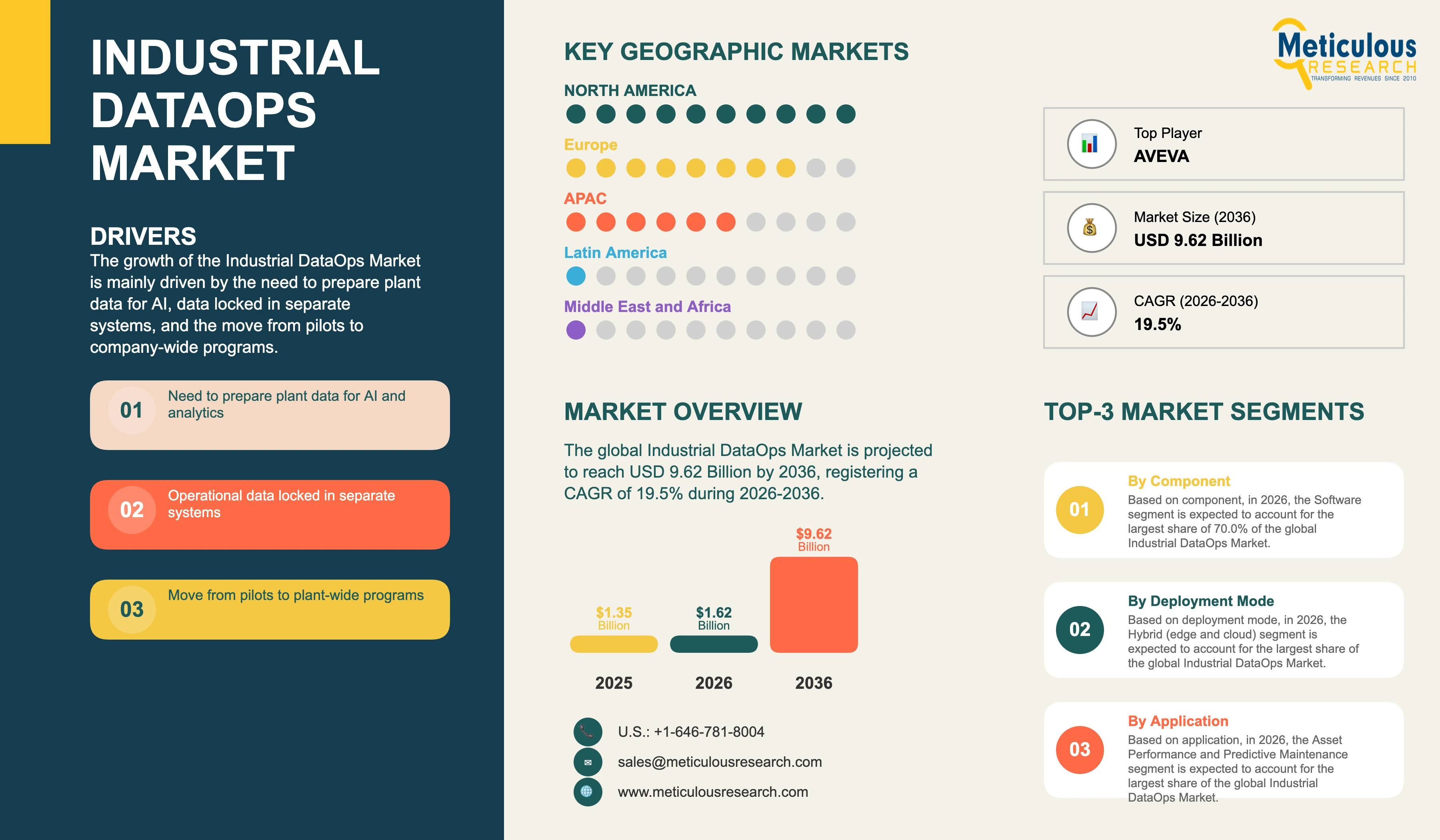
The global industrial DataOps market was valued at USD 1.35 billion in 2025. This market is expected to reach USD 9.62 billion by 2036 from an estimated USD 1.62 billion in 2026, registering a CAGR of 19.5% during the forecast period (2026-2036).
- Published
- Nov 2026
- Pages
- 253
- Format
- PDF + Excel
- Report ID
- MRICT - 1042608
- Base year
- 2025
- 2025 · BASELINE
- $1.35B
- 2036
- $9.62B
- CAGR 2026–2036
- 19.5%
2025 baseline · 2026–2036 forecast at 19.5% CAGR · hover a bar for the value
Key highlights
In June 2026, Schneider Electric entered into a definitive agreement to acquire Cognite, a provider of industrial data and AI software, in an all-cash transaction valued at USD 3.1 billion, with plans to integrate Cognite into AVEVA, its industrial software business, according to Schneider Electric and Verdantix.
IDC assessed the industrial DataOps category for the first time in its 2026 MarketScape and named HighByte and Cognite as Leaders, according to a summary published by Litmus.
AVEVA acquired Crosser, a low-code industrial edge DataOps software provider, in April 2026 and integrated its technology, including unified namespace capabilities, into the AVEVA CONNECT cloud platform, according to ARC Advisory Group.
LNS Research survey data shows that roughly a third of industrial organizations are stuck in the DataOps pilot stage with no clear path to production, while industrial AI leaders, the top 18% of respondents, are significantly ahead in adopting DataOps, according to LNS Research.
At AVEVA World 2026, AVEVA positioned CONNECT as a platform within which industrial AI partners, such as Augury, Seeq, and TrendMiner, can reach its industrial customer base, while AVEVA PI System remains one of the most widely deployed industrial process historians, according to Verdantix.
In October 2026, HighByte held its final DataOps Day event of the year in Boston, part of a series of events promoting the idea of treating industrial data as a product, according to ABI Research. The EU Data Act, which became applicable in September 2025, gives users of connected industrial equipment new rights to access and share the data their machines generate, which is expected to increase the flow of machine data between manufacturers, equipment makers, and service providers. These developments show that industrial data platforms have moved to the center of the strategies of large automation and software companies. Specialist vendors, such as HighByte, Litmus, and HiveMQ, continue to grow alongside the large automation companies. Interest in industrial data platforms is also rising among cloud and enterprise data providers.
By component, software accounts for the larger share of 70.0% in 2026 and also registers the higher CAGR.
By deployment mode, hybrid (edge and cloud) accounts for the largest share in 2026, while cloud registers the highest CAGR.
By application, asset performance and predictive maintenance accounts for the largest share in 2026, while industrial AI data foundations register the highest CAGR.
By end-use industry, oil and gas account for the largest share of 19.0% in 2026, while pharmaceuticals and life sciences register the highest CAGR.
By geography, North America accounts for the largest share of 38.0% in 2026, while Asia-Pacific registers the highest CAGR of 23.1%.
Report summary
| Particulars | Details |
|---|---|
| Base Year | 2025 |
| Estimated Year | 2026 |
| Forecast Period | 2026-2036 |
| Market Size in 2025 | USD 1.35 billion |
| Market Size in 2026 | USD 1.62 billion |
| Market Size by 2036 | USD 9.62 billion |
| CAGR (2026-2036) | 19.5% |
| Format | PDF, Excel & Cloud Portal · 253 pages |
| Largest Segment by Component (2026) | Software (70.0%) |
| Largest Segment by End-Use Industry (2026) | Oil and Gas (19.0%) |
| Largest Region (2026) | North America (38.0%) |
| Fastest-Growing Region | Asia-Pacific (CAGR 23.1%) |
| Companies Profiled | 15 companies and other companies |
| Segments Covered | Component, Deployment Mode, Application, End-Use Industry, Geography |
| Countries Covered | U.S., Canada, Germany, U.K., France, Italy, Spain, Netherlands, Switzerland, Belgium, Sweden, Denmark, Norway, Finland, Austria, Poland, Ireland, Rest of Europe, China, Japan, India, South Korea, Australia, Singapore, Indonesia, Thailand, Malaysia, Vietnam, Philippines, Taiwan, New Zealand, Rest of Asia-Pacific, Brazil, Mexico, Argentina, Colombia, Chile, Peru, Rest of Latin America, Saudi Arabia, U.A.E., Qatar, Israel, South Africa, Turkey, Rest of Middle East & Africa |
Report overview
Segments covered: component, deployment mode, application, end-use industry.
The growth of this market is mainly driven by the need of manufacturers and asset-heavy companies to prepare plant data for AI and advanced analytics, the large amount of operational data that remains locked in separate machines, control systems, and historians, the move from pilot projects to plant-wide and company-wide data programs, the growing use of edge-to-cloud architectures and a unified namespace, and the push to improve uptime, quality, energy use, and emissions reporting. In addition, large acquisitions, such as Schneider Electric's agreement to buy Cognite for USD 3.1 billion, show the growing value placed on industrial data platforms. However, the high cost and effort of connecting older equipment, the shortage of staff with both operations and IT skills, and concerns about cybersecurity when connecting plant systems to the cloud are expected to restrain the growth of this market to some extent.
Industrial DataOps refers to the software, processes, and services used to collect, organize, add context to, govern, and deliver data from industrial operations to the people and systems that use it. In a typical factory or plant, data is spread across machines, programmable logic controllers, control systems, historians, manufacturing execution systems, maintenance systems, and spreadsheets, and it often uses different formats and names. Industrial DataOps platforms connect to these sources, convert raw signals into standard data models, link data to assets and processes, and send clean, labeled data to analytics tools, AI models, dashboards, and enterprise systems in a controlled and repeatable way.
This report covers the global industrial DataOps market, including software, such as edge connectivity and data collection software, data modeling and contextualization platforms, industrial knowledge graphs, unified namespace and message broker software, data pipeline and governance tools, and services, such as consulting, integration, implementation, and managed services. The market is analyzed by component, deployment mode, application, end-use industry, and geography. Market size is measured on a revenue basis and includes software licenses, subscriptions, and related services. Revenue from general-purpose enterprise data platforms, standalone historians, analytics applications, and control system hardware is not included.
The industrial DataOps market has grown quickly as manufacturers have tried to use AI and advanced analytics and found that their data was not ready. Many companies ran pilot projects that worked in one plant but could not be repeated in others because each plant used different equipment, naming, and systems. LNS Research has found that about a third of industrial organizations are stuck in the DataOps pilot stage, while the companies that are succeeding with industrial AI are well ahead in adopting DataOps. This has made data preparation a priority before larger AI investments, and many companies now set aside part of their AI budgets for data platforms and data modeling work. Industrial companies are also finding that the same data foundation can support many different applications, which improves the return on their investment.
Industry activity in 2026 shows how important industrial data has become to the large automation and software companies. Schneider Electric agreed to acquire Cognite, whose Cognite Data Fusion platform combines a cloud-based design, an industrial knowledge graph, and developer tools to add context to industrial data, for USD 3.1 billion. AVEVA, already owned by Schneider Electric, acquired Crosser in April 2026 and integrated its edge DataOps software into CONNECT. Siemens, Rockwell Automation, Emerson, Honeywell, and ABB are also expanding their industrial data offerings and partnering with enterprise data and cloud providers.
Specialist companies remain an important part of the market and often lead in new features and vendor-neutral designs. HighByte offers a no-code DataOps platform designed to connect, model, and govern operational data, Litmus offers an edge platform that combines connectivity, data modeling, and edge execution, and HiveMQ provides MQTT message broker software widely used to build a unified namespace. IDC's first MarketScape for the category in 2026 named HighByte and Cognite as Leaders. Inductive Automation, Seeq, TrendMiner, and Tulip also offer products that connect to or build on industrial DataOps platforms.
Data architectures in factories and plants are also changing as companies plan for company-wide analytics and AI. Many manufacturers are building a unified namespace, a central and standard structure through which all plant data is published and shared, often using MQTT and OPC UA. Edge software collects and processes data close to machines, while cloud platforms store and analyze data across many plants. Hybrid edge-and-cloud deployments have become the most common model, as they allow fast local processing while supporting company-wide analytics and AI.
In 2026, software accounts for the larger share of the market by component and also grows faster. Hybrid (edge and cloud) deployments account for the largest share by deployment mode, while cloud deployments grow fastest. Asset performance and predictive maintenance is the largest application, while industrial AI data foundations is the fastest-growing application. Oil and gas is the largest end-use industry, while pharmaceuticals and life sciences is the fastest-growing end-use industry. North America accounts for the largest share of the market, while Asia-Pacific is the fastest-growing region.
Over the forecast period, the industrial DataOps market is expected to grow rapidly as more companies move from pilots to plant-wide and company-wide programs, as industrial AI applications require clean and labeled data, and as automation vendors build DataOps into their standard offers. Consolidation is expected to continue as large companies acquire specialist providers.
Oil and gas is expected to account for the largest share of 19.0% of the market in 2026, while pharmaceuticals and life sciences is projected to register the highest CAGR, driven by strict quality and documentation requirements.
North America is expected to account for the largest share of 38.0% of the market in 2026, mainly due to its large industrial base, early adoption of industrial AI and cloud platforms, and the presence of leading DataOps and automation vendors.
Asia-Pacific is projected to register the highest CAGR of 23.1% during the forecast period, driven by its large and growing manufacturing base, rapid growth in semiconductor and electronics production, and government support for smart manufacturing.
The report profiles 15 companies, including AVEVA (Schneider Electric), Cognite, HighByte, Litmus, HiveMQ, Siemens, Rockwell Automation, Emerson, Honeywell, ABB, Inductive Automation, Seeq, TrendMiner, Tulip, and Hitachi Vantara.
A unified namespace is a central and standard structure through which all data from a plant or company is published and shared, usually using protocols such as MQTT and OPC UA. It replaces many point-to-point connections and makes data easier to find and use.
Industrial DataOps platforms convert raw operational data into standard, labeled, and linked data that AI models and agents can use directly. LNS Research has found that companies that are succeeding with industrial AI are significantly ahead in adopting DataOps.
Report infographic
Market dynamics
18 factors across 5 forcesNeed to prepare plant data for AI and advanced analytics
Manufacturers and asset-heavy companies are investing in AI and advanced analytics to improve uptime, quality, throughput, and energy use, but most have found that their operational data is not ready for these tools. Data from machines and control systems is often unlabeled, inconsistent, and missing context, such as which asset, product, or batch it relates to. AI models trained on poor data give poor results, and data scientists spend much of their time cleaning and organizing data rather than building models.
Industrial DataOps platforms solve this problem by converting raw data into standard, labeled, and linked data that AI and analytics tools can use directly. LNS Research has found that industrial AI leaders are significantly ahead in adopting DataOps, which shows the close link between data readiness and AI success. As companies increase AI investments, spending on data preparation is expected to grow with it, and industrial AI data foundations is the fastest-growing application in this market.
Large amounts of operational data locked in separate systems
A typical manufacturing plant has machines, control systems, and software from many vendors installed over several decades, each storing data in its own format. Process plants may have historians with years of time-series data, while discrete manufacturers have data spread across machines, quality systems, and manufacturing execution systems. Connecting these systems one by one creates complex, fragile point-to-point links that are hard to maintain.
Industrial DataOps platforms provide a central way to connect to many sources, convert data into common models, and share it with many users, which replaces point-to-point integrations. This reduces the cost and time of each new data project and makes it easier to repeat successful projects across plants, since each new application can draw from the same prepared data instead of building its own links. The need to free up data held in separate systems is a basic driver of the market.
Move from pilot projects to plant-wide and company-wide programs
Many industrial companies have completed pilot projects in data analytics and AI and are now trying to expand them across all of their plants. Scaling requires standard data models, repeatable processes, and governance so that a solution built for one plant can be used in others with little rework. Without DataOps, each new plant requires a new integration project, which makes scaling slow and costly.
Industrial DataOps platforms are designed to support this scaling, with templates, version control, and fleet management features that allow companies to roll out standard data models across many sites. Litmus, for example, offers template-based rollout and version control for its edge platform. As more companies move from pilots to large programs, demand for DataOps software and services is expected to increase.
Growing use of edge-to-cloud architectures and unified namespace
Manufacturers are adopting new data architectures that combine processing at the edge, close to machines, with storage and analytics in the cloud. Many are building a unified namespace, a central structure through which all plant data is published and shared using standard protocols, such as MQTT and OPC UA. These architectures need software to collect, model, and route data between the edge and the cloud, which is the core function of industrial DataOps platforms.
Automation vendors, cloud providers, and specialist software companies are all supporting these architectures. AVEVA integrated Crosser's edge DataOps and unified namespace capabilities into CONNECT in 2026, and HiveMQ's MQTT broker software is widely used to build a unified namespace. The growth of edge-to-cloud architectures is a key reason why hybrid deployments account for the largest share of the market.
Focus on uptime, quality, energy use, and emissions reporting
Industrial companies are under pressure to reduce unplanned downtime, improve product quality, lower energy costs, and report on emissions and sustainability. All of these goals depend on reliable, timely data from operations. Predictive maintenance needs data from equipment sensors linked to maintenance records, quality programs need process data linked to product batches, and energy and emissions reporting needs data from meters and equipment across sites. Industrial DataOps platforms provide the data needed for these programs, and asset performance and predictive maintenance is the largest application in this market. New rules on sustainability reporting in Europe and other regions are also increasing the need for accurate, well-documented operational data.
Table of contents
12 chapters · 173 sections · 253 pages · click to expandSegmental analysis
| Segment | Largest share (2026) | Fastest growth (2026–2036) |
|---|---|---|
| By Component | — | — |
| By Deployment Mode | Hybrid (edge and cloud) | Cloud |
| By Application | Asset performance and predictive maintenance | Industrial AI data foundations |
| By End-Use Industry | Oil and gas | Pharmaceuticals and life sciences |
| Other segments | Asset performance and predictive maintenance | Industrial AI data foundations |
By Component
- Industrial DataOps Market Analysis by Component
- The software segment is expected to account for the larger share of 70.0% of the global industrial DataOps market.
- The large share of this segment is mainly due to the central role of software platforms in collecting, modeling, and delivering industrial data, the growing number of subscriptions for cloud and hybrid DataOps platforms, the adoption of edge connectivity, unified namespace, and contextualization software by manufacturers and process companies, and the large number of vendors offering DataOps software, including AVEVA, Cognite, HighByte, Litmus, HiveMQ, Siemens, and Rockwell Automation.
- The software segment is also projected to register the higher CAGR during the forecast period, driven by the move to subscription-based platforms, the expansion of DataOps from pilots to many plants, and the growing use of software for industrial AI data foundations.
- The services segment includes consulting, data strategy, integration, implementation, training, and managed services provided by system integrators, consulting firms, and software vendors.
- Services are an important part of the market because industrial DataOps projects require significant work to connect equipment, build data models, and integrate with existing systems.
- Managed services are expected to grow as mid-sized manufacturers look for ways to adopt DataOps without building large in-house teams.
- Pricing for industrial DataOps software is usually based on annual subscriptions, with fees linked to the number of plants, data sources, connections, or data volumes.
- Services are usually priced by project or as ongoing managed service fees.
- Many vendors offer free or low-cost entry versions, such as Litmus Edge Developer Edition, to encourage trials before larger purchases.
- Over time, more services are expected to be delivered by partners trained on vendor platforms.
By Deployment Mode
- Industrial DataOps Market Analysis by Deployment Mode
- The hybrid (edge and cloud) segment is expected to account for the largest share of the global industrial DataOps market.
- The large share of this segment is mainly due to the need to collect and process data close to machines for speed, reliability, and security, while also sending data to the cloud for company-wide analytics and AI, the adoption of edge-to-cloud architectures and unified namespace designs, and the product strategies of vendors such as AVEVA, Siemens, and Litmus, which combine edge software with cloud platforms.
- Hybrid deployments also allow companies to keep sensitive data on-site while sharing selected data with the cloud.
- However, the cloud segment is projected to register the highest CAGR during the forecast period.
- The rapid growth of this segment is driven by the growing use of cloud platforms for company-wide data storage, analytics, and AI, the lower upfront cost and faster deployment of cloud subscriptions, the integration of industrial platforms with enterprise data platforms, such as Databricks, Snowflake, and Microsoft Fabric, and the move of vendors toward cloud-based offers, such as AVEVA CONNECT and Cognite Data Fusion.
- The on-premises segment includes deployments in which all data is stored and processed within the company's own facilities, which remain important in industries with strict security requirements, such as defense, critical infrastructure, and some pharmaceutical operations.
- The hybrid (edge and cloud) segment is expected to account for the largest share of the industrial DataOps market, while the cloud segment is projected to register the highest CAGR during the forecast period.
By Application
- Industrial DataOps Market Analysis by Application
- The asset performance and predictive maintenance segment is expected to account for the largest share of the global industrial DataOps market.
- The large share of this segment is mainly due to the high cost of unplanned downtime in industrial operations, the long history of predictive maintenance programs in oil and gas, power, chemicals, and manufacturing, the need to link sensor data with asset and maintenance records, and the clear return on investment that predictive maintenance can deliver.
- Partners such as Augury, Seeq, and TrendMiner offer analytics applications that use data prepared by DataOps platforms.
- However, the industrial AI data foundations segment is projected to register the highest CAGR during the forecast period.
- The rapid growth of this segment is driven by the growing investment in industrial AI and AI agents, the need for accurate, labeled, and linked data to train and run AI models, and the development of industrial knowledge graphs and AI interfaces by vendors such as Cognite and Litmus.
- The production and process optimization segment includes applications that improve throughput, yield, and efficiency, while the quality management segment includes applications that monitor and improve product quality.
- The energy and sustainability management segment includes applications that track energy use and emissions, and the other applications segment includes supply chain, safety, and compliance applications.
By End-Use Industry
- Industrial DataOps Market Analysis by End-Use Industry
- The oil and gas segment is expected to account for the largest share of 19.0% of the global industrial DataOps market.
- The large share of this segment is mainly due to the large and complex assets operated by oil and gas companies, the high cost of downtime and safety incidents, the long history of data and analytics programs in the industry, and the early adoption of industrial data platforms, such as Cognite Data Fusion, which was first developed for oil and gas companies in Norway.
- Oil and gas companies also have large volumes of historian data that need to be organized and linked for analytics and AI.
- However, the pharmaceuticals and life sciences segment is projected to register the highest CAGR during the forecast period.
- The rapid growth of this segment is driven by strict quality and documentation requirements, the need for detailed batch and process data to support compliance and process improvement, the growth of advanced manufacturing for biologics and other complex products, and the earlier stage of DataOps adoption in the industry compared with oil and gas.
- The chemicals, power and utilities, and metals and mining segments include process industries with large assets and long-running data programs, while the automotive, food and beverage, and semiconductors and electronics segments include discrete and batch manufacturers that are adopting DataOps to improve quality, yield, and efficiency.
- The other industries segment includes aerospace, pulp and paper, and water and wastewater.
Other segments
- The asset performance and predictive maintenance segment is expected to account for the largest share of the industrial DataOps market, while the industrial AI data foundations segment is projected to register the highest CAGR during the forecast period.
Geographic analysis
North America
Largest shareIn 2026, North America is expected to account for the largest share of 38.0% of the global industrial DataOps market. The large share of this region is mainly due to the large number of manufacturing, oil and gas, chemicals, and pharmaceutical companies in the U.S. and Canada, early adoption of industrial AI and cloud platforms, the presence of leading DataOps and automation vendors, such as HighByte, Litmus, Rockwell Automation, Emerson, Honeywell, Inductive Automation, and Seeq, and strong investment in manufacturing modernization and reshoring. North American companies are also among the leading users of enterprise data platforms, which increases demand for industrial data integration. Government support for advanced manufacturing and semiconductor production in the U.S. is also adding demand for data platforms in new plants. Canadian oil sands, mining, and utility companies are also active users of industrial data platforms.
Asia-Pacific
Fastest growthAsia-Pacific is projected to register the highest CAGR of 23.1% during the forecast period. The rapid growth of this region is mainly driven by the large and growing manufacturing base in China, Japan, South Korea, India, and Southeast Asia, the rapid growth of semiconductor, electronics, battery, and automotive production, government programs that support smart manufacturing, and the increasing use of cloud services and industrial AI by manufacturers in the region. Many new plants in the region, especially in electronics and batteries, are being designed with modern data architectures from the start, which supports faster adoption of DataOps. Japanese and South Korean manufacturers are expanding data programs across their regional and global plants, while India is seeing strong growth in new factories in electronics, pharmaceuticals, and automotive components.
Europe
Europe accounts for a significant share of the market, supported by strong manufacturing industries in Germany, France, Italy, and other countries, the presence of leading automation and industrial software companies, such as Siemens, Schneider Electric, AVEVA, ABB, Cognite, HiveMQ, and TrendMiner, and the early adoption of industrial data programs in oil and gas and chemicals. The EU Data Act, which gives users the right to access data from connected equipment, and sustainability reporting requirements are also expected to increase demand for industrial data platforms in the region. Norway, the Netherlands, and Germany are among the most active markets for industrial data projects, and the U.K. has a strong group of process industry users in chemicals and energy.
Latin America
Latin America and the Middle East & Africa account for smaller shares of the market but offer growth opportunities.
Middle East & Africa
In the Middle East, national oil companies and large industrial groups in Saudi Arabia, the U.A.E., and Qatar are investing in digital programs for oil and gas, petrochemicals, and new industrial cities, while in Latin America, mining companies in Chile and Peru and automotive and food manufacturers in Mexico and Brazil are adopting industrial data and analytics tools. Growth in these regions is expected to accelerate as cloud services expand and as global automation vendors offer their platforms more widely.
Competitive landscape
The global industrial DataOps market is moderately fragmented, with the top five players estimated to account for about 40% of the market in 2025. The market includes large automation and industrial software companies with broad customer bases, specialist DataOps vendors, message broker and connectivity providers, and system integrators.
AVEVA, which is owned by Schneider Electric, is a leading provider through its CONNECT platform and PI System, and its position is expected to grow with the planned acquisition of Cognite. Siemens, Rockwell Automation, Emerson, Honeywell, and ABB offer industrial data software as part of their automation portfolios. Specialist vendors, such as HighByte, Litmus, and HiveMQ, which sell to customers using equipment from many vendors, focus on DataOps, edge connectivity, and unified namespace software, and IDC named HighByte and Cognite as Leaders in its 2026 MarketScape. Inductive Automation, Seeq, TrendMiner, Tulip, and Hitachi Vantara offer software that connects to or builds on industrial data platforms.
Companies in this market compete on the range of supported data sources, equipment brands, and protocols, ease of use, data modeling and contextualization capabilities, scalability across plants, security, openness and vendor neutrality, integration with enterprise data and AI platforms, customer support, and price. Key strategies include acquisitions, partnerships with cloud and enterprise data providers, channel partnerships with system integrators, development of no-code tools and industry templates, and building AI features, such as assistants and agents, on top of data platforms.
Recent competitive activity in the industrial DataOps market has focused on acquisitions, platform integration, and customer education events. Schneider Electric agreed to acquire Cognite in June 2026, AVEVA integrated Crosser into CONNECT, and HighByte held a series of DataOps Day events in several cities in 2026 to promote its approach to data as a product.
We expect consolidation to continue as large automation companies seek to own the data layer of industrial operations. Independent vendors that offer strong vendor-neutral platforms are expected to remain attractive to customers concerned about lock-in. Partnerships between industrial software vendors and enterprise data and cloud providers are also expected to increase, as customers want operational data to be available alongside business data.
Some of the key players operating in the industrial DataOps market are AVEVA Group Limited (Schneider Electric SE), Cognite AS, HighByte, Inc., Litmus Automation, Inc., HiveMQ GmbH, Siemens AG, Rockwell Automation, Inc., Emerson Electric Co., Honeywell International Inc., ABB Ltd., Inductive Automation, LLC, Seeq Corporation, TrendMiner NV, Tulip Interfaces, Inc., and Hitachi Vantara LLC, among others.
- —
Schneider Electric agreed to acquire Cognite for USD 3.1 billion in June 2026, AVEVA acquired Crosser in April 2026 and integrated it into CONNECT, and IDC published its first industrial DataOps MarketScape, naming HighByte and Cognite as Leaders.
- HighByte
- Litmus
- HiveMQ
Expert perspectives
The industrial DataOps market has become a priority area for industrial companies and their technology suppliers, as companies have learned that AI and analytics depend on clean, labeled, and linked operational data. Schneider Electric's planned USD 3.1 billion acquisition of Cognite shows how much value large companies now place on industrial data platforms, and IDC's first MarketScape assessment for the category in 2026 shows that analysts now treat it as a distinct market.
Over the forecast period, the market is expected to grow at a CAGR of 19.5%, from USD 1.62 billion in 2026 to USD 9.62 billion in 2036. Growth will be driven by the move from pilots to company-wide programs, the growth of industrial AI and AI agents, the adoption of edge-to-cloud and unified namespace architectures, and the need for data to support uptime, quality, energy, and emissions programs.
Among the market segments, software is the larger and faster-growing component, reflecting the shift to subscription platforms. Hybrid deployments are the largest deployment mode, while cloud deployments grow fastest. Asset performance and predictive maintenance is the largest application, while industrial AI data foundations grows fastest, and oil and gas is the largest end-use industry, while pharmaceuticals and life sciences grows fastest. North America is the largest region, and Asia-Pacific is the fastest-growing region at a CAGR of 23.1%.
In our view, the most important factor for the market over the next five years will be the ability of vendors to help companies move from pilots to plant-wide and company-wide programs. Many companies have shown that DataOps works in one plant, but scaling requires standard models, governance, and skills that are still scarce. Vendors that offer templates, no-code tools, and managed services will be well placed. Companies that build strong internal data teams and governance processes will also see faster results.
We also see consolidation as a key factor in the competitive structure. Large automation companies are buying data platforms to strengthen their software offers and to own more of the data layer in their customers' plants, which gives them scale but may raise concerns about vendor neutrality among customers that use equipment from many vendors. Independent specialists and open standards are expected to remain important, especially for companies with mixed equipment fleets.
Overall, we believe the industrial DataOps market will grow rapidly over the forecast period, with cloud deployments, industrial AI data foundations, pharmaceuticals and life sciences, and Asia-Pacific providing the fastest growth. Companies with broad connectivity, strong data modeling, open architectures, and clear links to AI results will be best positioned to capture this growth.
Customer perspectives
Head of Digital Operations - Oil and Gas Company, U.S.
We had years of data in historians but nobody could use it for AI. Once we linked it to our assets and maintenance records, our models finally started to work.
“Because every plant used different systems and names for the same data, we built a common data model, and now the same quality dashboards run at all our sites.”
“Our new plant was built with a data platform from day one. It makes it much easier to add AI tools later.”
Frequently asked questions
The global industrial DataOps market was valued at USD 1.35 billion in 2025, up from USD 1.12 billion in 2024, and is estimated at USD 1.62 billion in 2026. The market includes software and services used to collect, organize, add context to, govern, and deliver industrial data.
Cite this report
Meticulous Research. (2026). Industrial DataOps Market - Global Opportunity Analysis and Industry Forecast (2026-2036) (Report No. MRICT - 1042608). Meticulous Market Research Pvt. Ltd. https://www.meticulousresearch.com/product/industrial-dataops-market-7291