Fiber to the Home (FTTH) Market (2026-2036)
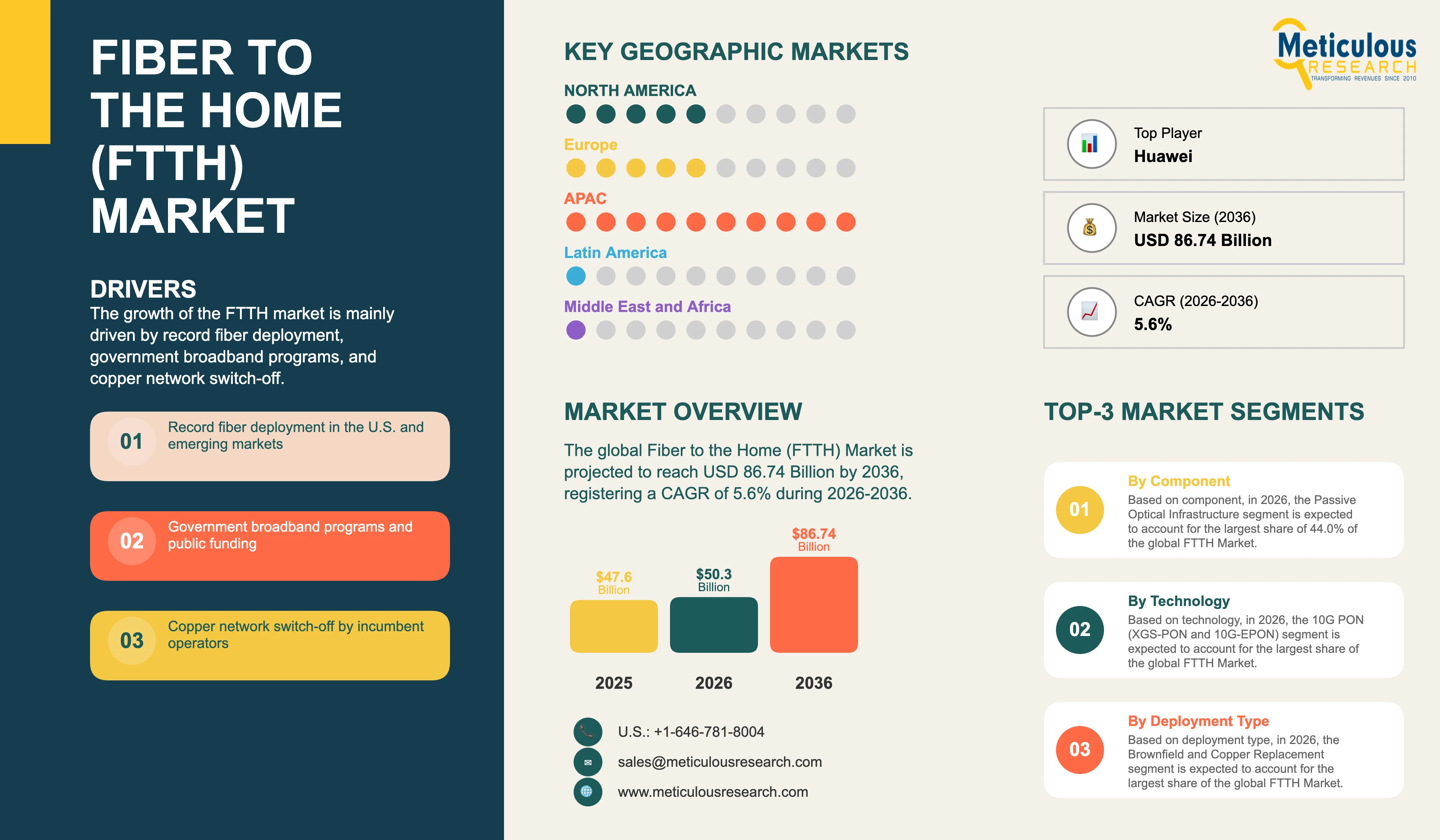
The global fiber to the home (FTTH) market was valued at USD 47.60 billion in 2025. This market is expected to reach USD 86.74 billion by 2036 from an estimated USD 50.30 billion in 2026, registering a CAGR of 5.6% during the forecast period (2026-2036).
- Published
- Nov 2026
- Pages
- 249
- Format
- PDF + Excel
- Report ID
- MRICT - 1042612
- Base year
- 2025
- 2025 · BASELINE
- $47.60B
- 2036
- $86.74B
- CAGR 2026–2036
- 5.6%
2025 baseline · 2026–2036 forecast at 5.6% CAGR · hover a bar for the value
Key highlights
U.S. fiber providers passed a record 11.8 million homes in 2025, up from 10.3 million in 2024, bringing the total to 84.6 million unique homes, or about 60% of U.S. households, according to the Fiber Broadband Association and RVA Market Research. The Fiber Broadband Association expects another record in 2026 and about 60 million more homes to be passed over the next five years.
FTTH/B networks passed about 295 million homes across 39 European countries as of September 2025, representing 79.3% household coverage, with 160 million subscribers, according to the FTTH Council Europe's 2026 Market Panorama produced by IDATE. The council expects FTTH/B networks to reach about 353 million premises and more than 251 million subscribers by 2031.
In August 2026, NTIA approved the last of the 56 state and territorial final proposals under the USD 42.45 billion BEAD program. The approved plans cover 3.79 million locations and about USD 18.2 billion of deployment spending, with fiber serving about 63% of locations, according to NTIA and Broadband Breakfast.
India's wireline subscriber base grew 30.25% to 48.25 million at the end of March 2026, from 37.04 million a year earlier, led by fiber home broadband from Reliance Jio and Bharti Airtel, according to TRAI. More than 1.4 million FTTH connections had been provided under BharatNet as of January 2026.
Dell'Oro Group forecasts that broadband access equipment spending will peak at USD 18.8 billion in 2028 and that XGS-PON will remain the main technology for mass-market residential fiber through at least 2030, as the large-scale rollout of 50G PON has been pushed out, according to Dell'Oro Group and RCR Wireless.
Huawei estimated around 75 million fiber to the room (FTTR) users in China compared with roughly 500,000 elsewhere, according to GlobalData, which found that FTTR remains a specialist offering outside China despite operator trials. These facts highlight the strong demand for fiber cable, connectivity products, and equipment in the U.S. during the forecast period.
By component, passive optical infrastructure accounts for the largest share of 44.0% in 2026, while installation and services register the highest CAGR.
By technology, 10G PON (XGS-PON and 10G-EPON) accounts for the largest share in 2026, while 25G and 50G PON registers the highest CAGR.
By deployment type, brownfield and copper replacement accounts for the largest share in 2026, while fiber to the room (FTTR) registers the highest CAGR.
By end user, residential accounts for the largest share of 74.0% in 2026, while large enterprises and campuses register the highest CAGR.
By geography, Asia-Pacific accounts for the largest share of 46.0% in 2026, while North America registers the highest CAGR of 7.2%.
Report summary
| Particulars | Details |
|---|---|
| Base Year | 2025 |
| Estimated Year | 2026 |
| Forecast Period | 2026-2036 |
| Market Size in 2025 | USD 47.60 billion |
| Market Size in 2026 | USD 50.30 billion |
| Market Size by 2036 | USD 86.74 billion |
| CAGR (2026-2036) | 5.6% |
| Format | PDF, Excel & Cloud Portal · 249 pages |
| Largest Segment by Component (2026) | Passive Optical Infrastructure (44.0%) |
| Largest Segment by End User (2026) | Residential (74.0%) |
| Largest Region (2026) | Asia-Pacific (46.0%) |
| Fastest-Growing Region | North America (CAGR 7.2%) |
| Companies Profiled | 16 companies and other companies |
| Segments Covered | Component, Technology, Deployment Type, End User, Geography |
| Countries Covered | China, Japan, India, South Korea, Australia, Indonesia, Thailand, Singapore, Malaysia, Vietnam, Philippines, Taiwan, New Zealand, Rest of Asia-Pacific, U.S., Canada, Germany, U.K., France, Italy, Spain, Netherlands, Switzerland, Belgium, Sweden, Denmark, Norway, Portugal, Austria, Poland, Ireland, Rest of Europe, Brazil, Mexico, Argentina, Colombia, Chile, Peru, Rest of Latin America, Saudi Arabia, U.A.E., Qatar, South Africa, Nigeria, Kenya, Egypt, Rest of Middle East & Africa |
Report overview
Segments covered: component, technology, deployment type, end user.
The growth of this market is mainly driven by record fiber deployment in the U.S. and continued rollout in Europe, India, and other emerging markets, government broadband programs, such as the BEAD program in the U.S. and BharatNet in India, the switch-off of copper networks by incumbent operators, the rising demand for faster and more reliable home internet for video, gaming, remote work, and connected devices, and the upgrade of fiber networks to 10G PON and higher speeds. In addition, the growing use of fiber inside the home, known as fiber to the room (FTTR), and the use of fiber networks to serve businesses, mobile sites, and data centers are creating new opportunities. However, the high cost and long timelines of fiber construction, rising labor and material costs, and competition from fixed wireless access and satellite broadband are expected to restrain the growth of this market to some extent.
Fiber to the home (FTTH) is a broadband access network in which optical fiber runs all the way from the operator's central office to individual homes and buildings, replacing copper telephone lines and coaxial cable. Most FTTH networks use passive optical network (PON) technology, in which a single fiber from an optical line terminal (OLT) in the central office is split by passive splitters to serve many homes, each with an optical network terminal (ONT). FTTH offers much higher speeds, lower latency, and better reliability than copper networks, and it can be upgraded to higher speeds by changing the equipment at each end without replacing the fiber.
This report covers the global FTTH market, including passive optical infrastructure, such as fiber optic cable, splitters, connectors, closures, cabinets, and drop cables, active equipment, such as OLTs, ONTs, ONUs, and FTTR units, and installation and services, such as network design, engineering, construction, installation, and maintenance. The market is analyzed by component, technology, deployment type, end user, and geography. Market size is measured on a revenue basis and includes spending by telecom operators, alternative network builders, cable operators, utilities, municipalities, and governments on FTTH networks. Revenue from broadband subscriptions is not included.
FTTH has become the main technology for new fixed broadband networks around the world. China, Japan, South Korea, Spain, and several other countries already have very high fiber coverage, and operators in the U.S., Europe, India, Latin America, and the Middle East are building fiber networks at a fast pace. In the U.S., fiber providers passed a record 11.8 million homes in 2025, according to the Fiber Broadband Association, while in Europe, FTTH/B networks covered 79.3% of homes in 39 countries as of September 2025, according to the FTTH Council Europe.
The market is now moving into a new phase in many countries. In Europe, the FTTH Council Europe has said that the market is shifting from large-scale deployment to a post-rollout phase in which the main challenge is to convert homes passed into paying customers. Take-up among homes passed was 54.9% in the EU27 and the U.K. as of September 2025, according to Opensignal and FTTH Council Europe data. In China, where fiber is already almost universal, operators are focusing on upgrades to 10G PON, early 50G PON deployments, and fiber to the room. In the U.S. and India, however, large-scale construction is still at an early to middle stage, which supports strong demand for cable, equipment, and installation services.
Government programs play an important role in the market, especially in rural areas where private investment is not enough. In the U.S., the BEAD program has approved plans to connect 3.79 million locations, with fiber serving about 63% of those locations and taking most of the deployment funding. In India, BharatNet is extending fiber to rural areas, and the government has allowed operators to use existing FTTH connections as backhaul, which lowers costs. In Europe, national programs and EU rules support fiber rollout and the switch-off of copper networks, and Norway and Spain have already completed their copper switch-off.
Technology is also changing, as operators move to faster PON standards and new uses of fiber. Most new networks now use 10G PON technologies, such as XGS-PON, which can deliver multi-gigabit speeds. Dell'Oro Group expects XGS-PON to remain the main residential technology through at least 2030, while 25G and 50G PON will be used first for business, campus, and other targeted applications. Fiber is also being used in new ways, such as connecting mobile sites, serving businesses, and connecting equipment inside data centers. Dell'Oro expects data center PON equipment revenue to increase more than eightfold in 2026.
In 2026, passive optical infrastructure accounts for the largest share of the market by component, while installation and services is the fastest-growing component. 10G PON is the largest technology segment, while 25G and 50G PON is the fastest-growing technology. Brownfield and copper replacement deployments account for the largest share by deployment type, while fiber to the room grows fastest. Residential customers are the largest end user, while large enterprises and campuses are the fastest-growing end user. Asia-Pacific accounts for the largest share of the market, while North America is the fastest-growing region.
Over the forecast period, the FTTH market is expected to grow steadily as operators complete fiber rollouts in the U.S., India, and other countries, upgrade existing networks to higher speeds, and extend fiber deeper into homes and buildings. Growth is expected to be strongest in the first half of the forecast period, when government-funded and private construction programs are at their peak, and to continue later through upgrades and new uses of fiber.
Residential customers are expected to account for the largest share of 74.0% of the market in 2026, while large enterprises and campuses are projected to register the highest CAGR, driven by passive optical LANs and data center PON.
Asia-Pacific is expected to account for the largest share of 46.0% of the market in 2026, mainly due to China's large fiber market and ongoing upgrades, rapid fiber growth in India, and high fiber coverage in Japan and South Korea.
North America is projected to register the highest CAGR of 7.2% during the forecast period, driven by record fiber construction in the U.S., the BEAD program, operator fiber expansion plans, and network upgrades to XGS-PON.
The report profiles 16 companies, including Huawei, ZTE, Nokia, Corning, Prysmian, Amphenol, Fujikura, Sumitomo Electric, Furukawa Electric, Calix, Adtran, FiberHome, YOFC, Hengtong, STL, and Clearfield.
FTTH brings fiber to the home, where an ONT connects to the home network, usually through Wi-Fi. FTTR extends fiber from the main ONT to individual rooms, where small units provide Wi-Fi and wired connections, delivering full fiber speeds throughout the home.
Dell'Oro Group expects XGS-PON to remain the primary technology for mass-market residential deployments through at least 2030. 25G and 50G PON will be deployed first for business, campus, and premium services, and their share is expected to rise later in the forecast period.
Report infographic
Market dynamics
18 factors across 5 forcesRecord fiber deployment in the U.S. and emerging markets
Fiber deployment is running at record levels in several large markets, led by the U.S. and India. In the U.S., fiber providers passed 11.8 million homes in 2025, beating the previous records of 10.3 million in 2024 and 9.1 million in 2023, according to the Fiber Broadband Association. The association expects 2026 to set another record and about 60 million more homes to be passed over the next five years. AT&T has said it plans to accelerate its fiber build to an additional 1 million locations each year in 2026, and many regional operators, cable companies, and private equity-backed builders are also expanding their fiber networks.
In India, the wireline subscriber base grew 30.25% in the year to March 2026, driven by fiber home broadband from Reliance Jio and Bharti Airtel, according to TRAI. Operators in Latin America, the Middle East, Africa, and Southeast Asia are also building fiber networks to meet rising demand for fast home internet. These large construction programs drive demand for fiber cable, passive components, active equipment, and installation services, which is the main source of growth in the FTTH market.
Government broadband programs and public funding
Governments around the world are funding fiber networks to close the digital divide and support economic growth. In the U.S., the BEAD program has approved plans to spend about USD 18.2 billion to connect 3.79 million unserved and underserved locations, with fiber serving about 63% of those locations. Other U.S. programs, such as state grants and earlier federal funds, also support fiber construction in rural areas. Because fiber projects cost more per location than wireless or satellite projects, fiber is expected to take most of the BEAD deployment funding.
In India, BharatNet is extending fiber to villages, with more than 1.4 million FTTH connections provided as of January 2026, and the program is managed as a national asset under the Digital Bharat Nidhi. In Europe, national programs in Germany, Italy, the U.K., and other countries fund fiber in areas where private investment is not commercially viable. These programs create long-term demand for FTTH equipment and services, especially in rural and remote areas.
Copper network switch-off by incumbent operators
Incumbent telecom operators in many countries are switching off their old copper networks, which are expensive to maintain and cannot deliver the speeds customers now expect. Norway and Spain have completed their copper switch-off, and operators in France, the U.K., Germany, the U.S., and other countries have announced plans to retire copper over the next several years. Copper switch-off requires operators to connect remaining customers to fiber, which creates demand for brownfield fiber deployment.
Switching off copper also lowers operating costs for operators, as fiber networks use less power, need fewer repairs, and take up less space in central offices. These savings help justify the cost of fiber construction. The FTTH Council Europe has said that supporting the switch-off of legacy copper is a key part of the next phase of fiber in Europe. Brownfield and copper replacement deployments account for the largest share of the market by deployment type.
Rising demand for fast and reliable home internet
Households are using more data than ever before, driven by high-definition video streaming, online gaming, video calls, remote work, cloud services, and a growing number of connected devices in the home. Fiber offers much higher speeds, more upload capacity, and better reliability than copper or cable networks, which makes it the preferred choice for many customers. Operators are offering multi-gigabit fiber plans to attract customers and increase revenue per user.
The demand for better home internet is also driving operators to improve the in-home experience, for example by offering Wi-Fi 7 gateways and fiber to the room. In China, FTTR packages have helped operators increase revenue from new gigabit customers. Rising demand for fast and reliable home internet is expected to support FTTH spending throughout the forecast period.
Network upgrades to 10G PON and higher speeds
Operators are upgrading their fiber networks from GPON, which offers speeds of up to about 2.5 Gbps shared among users, to 10G PON technologies, such as XGS-PON, which offer about four times the capacity. This upgrade allows operators to offer multi-gigabit plans and serve more customers on each fiber. Dell'Oro Group expects PON equipment revenue to grow mainly due to XGS-PON deployments in North America, EMEA, and Latin America. Spending on PON OLT ports increased 6% year on year in the first quarter of 2026, according to Dell'Oro. Network upgrades require new OLTs and ONTs but use the existing fiber, which makes them a cost-effective way for operators to increase speeds and compete with cable and wireless broadband.
Table of contents
12 chapters · 183 sections · 249 pages · click to expandSegmental analysis
| Segment | Largest share (2026) | Fastest growth (2026–2036) |
|---|---|---|
| By Component | Passive optical infrastructure | Installation and services |
| By Technology | 10G PON (XGS-PON and 10G-EPON) | 25G and 50G PON |
| By Deployment Type | Brownfield and copper replacement | Fiber |
| By End User | Residential | Large enterprises and campuses |
| Other segments | Brownfield and copper replacement | Fiber |
By Component
- The passive optical infrastructure segment is expected to account for the largest share of 44.0% of the global FTTH market.
- The large share of this segment is mainly due to the large volume of fiber optic cable, splitters, connectors, closures, cabinets, and drop cables needed to build new networks, the record pace of fiber construction in the U.S. and the rapid rollout in India and other emerging markets, the fact that passive infrastructure must be installed for every home passed, and the long life of passive components, which makes them a large share of initial network cost.
- Corning, Prysmian, Fujikura, Sumitomo Electric, Furukawa Electric, YOFC, Hengtong, STL, and Amphenol are among the leading suppliers of passive optical infrastructure.
- However, the installation and services segment is projected to register the highest CAGR during the forecast period.
- The rapid growth of this segment is driven by the large construction programs in the U.S., including BEAD-funded projects, rising labor costs, the need for network design, engineering, and permitting services, and the growing complexity of rural and underground deployments.
- Copper switch-off programs and FTTR installations also require significant installation work, as each home must be visited and connected.
- The active equipment segment includes OLTs, ONTs, ONUs, and FTTR units, which are supplied by companies such as Huawei, ZTE, Nokia, Calix, Adtran, and FiberHome, and this segment is supported by both new networks and upgrades to 10G PON.
- Pricing in the FTTH market varies widely by region and by the source of supply.
- Equipment and cable from Chinese suppliers are generally cheaper than products from North American and European suppliers, while U.S. programs, such as BEAD, include domestic product rules that favor equipment made in the U.S. These rules have encouraged several vendors to expand manufacturing in the U.S., which supports local supply but may increase costs for some projects.
By Technology
- The 10G PON (XGS-PON and 10G-EPON) segment is expected to account for the largest share of the global FTTH market.
- The large share of this segment is mainly due to the wide adoption of XGS-PON for new networks and upgrades in North America, Europe, and Latin America, the large-scale deployment of 10G PON in China, the ability of 10G PON to support multi-gigabit services and more users on each fiber, and the falling cost of XGS-PON equipment.
- Dell'Oro Group expects XGS-PON to remain the main residential technology through at least 2030.
- The GPON and EPON segment includes older but still widely used technologies, which continue to be deployed in cost-sensitive markets, such as India, Southeast Asia, Africa, and parts of Latin America.
- However, the 25G and 50G PON segment is projected to register the highest CAGR during the forecast period.
- The rapid growth of this segment is driven by early deployments in China, where China Telecom launched the first live 50G PON network, the growing use of 25G PON for business and campus services, the need for more capacity to support mobile sites and data centers, and the availability of equipment that supports several PON generations on one platform.
- The point-to-point Ethernet segment includes networks in which each customer has a dedicated fiber, which are used in some European countries and for business customers.
- The 10G PON (XGS-PON and 10G-EPON) segment is expected to account for the largest share of the FTTH market, while the 25G and 50G PON segment is projected to register the highest CAGR during the forecast period.
By Deployment Type
- The brownfield and copper replacement segment is expected to account for the largest share of the global FTTH market.
- The large share of this segment is mainly due to the large number of existing homes and buildings that are being moved from copper or cable networks to fiber, the copper switch-off programs of incumbent operators in Europe, the U.S., and other countries, and the overbuilding of existing areas by competing fiber providers.
- Most homes in developed markets already have broadband, so most new fiber is built in areas that already have copper or cable networks.
- However, the fiber to the room (FTTR) segment is projected to register the highest CAGR during the forecast period.
- The rapid growth of this segment is driven by the wide adoption of FTTR in China, operator trials and launches in Europe, the Middle East, and Asia, the need to deliver full fiber speeds throughout larger homes, and the ability of FTTR to increase revenue per customer.
- The greenfield new builds segment includes fiber networks built in new housing developments and in areas with no existing broadband, which is supported by new construction and by government programs in rural areas.
By End User
- The residential segment is expected to account for the largest share of 74.0% of the global FTTH market.
- The large share of this segment is mainly due to the focus of most fiber programs on connecting homes, the record pace of residential fiber construction in the U.S. and India, government programs that target unserved and underserved households, and the rising demand for fast home internet for streaming, gaming, remote work, and connected devices.
- Residential customers also account for most FTTR and Wi-Fi 7 gateway spending.
- However, the large enterprises and campuses segment is projected to register the highest CAGR during the forecast period.
- The rapid growth of this segment is driven by the growing use of PON technology in office buildings, campuses, hotels, hospitals, and data centers, the early adoption of 25G and 50G PON for business services, and the lower power use and space needs of passive optical LANs compared with copper networks.
- The small and medium businesses segment includes offices, shops, and other small businesses that use fiber for internet and cloud services, while the government and public institutions segment includes schools, libraries, health centers, and public buildings, many of which are connected through government programs, such as BharatNet in India.
Other segments
- The brownfield and copper replacement segment is expected to account for the largest share of the FTTH market, while the fiber to the room (FTTR) segment is projected to register the highest CAGR during the forecast period.
Geographic analysis
Asia-Pacific
Largest shareIn 2026, Asia-Pacific is expected to account for the largest share of 46.0% of the global FTTH market. The large share of this region is mainly due to the size of China's fiber market, where fiber is almost universal and operators such as China Mobile, China Telecom, and China Unicom continue to invest in 10G PON upgrades, 50G PON, and FTTR, the rapid growth of fiber home broadband in India, where wireline subscribers grew 30.25% in the year to March 2026, high fiber coverage and ongoing upgrades in Japan, South Korea, and Singapore, and fiber rollout in Southeast Asia and Australia. The region is also home to leading FTTH equipment and cable suppliers, such as Huawei, ZTE, FiberHome, YOFC, Hengtong, Fujikura, Sumitomo Electric, Furukawa Electric, and STL.
North America
Fastest growthNorth America is projected to register the highest CAGR of 7.2% during the forecast period. The rapid growth of this region is mainly driven by record fiber deployment in the U.S., where providers passed 11.8 million homes in 2025 and are expected to pass about 60 million more homes over the next five years, the BEAD program, which has approved plans to connect 3.79 million locations with most deployment funding going to fiber, the fiber expansion plans of AT&T, Verizon, cable operators, and regional providers, and the upgrade of networks to XGS-PON. Canada, where nearly 75% of homes are passed by fiber, also continues to invest in rural fiber. The Fiber Broadband Association has set a goal of passing 90% of U.S. homes with fiber by 2030.
Europe
Europe accounts for a significant share of the market, with FTTH/B networks covering 79.3% of homes in 39 countries and 160 million subscribers as of September 2025, according to the FTTH Council Europe. Spain, France, Portugal, Sweden, and Norway already have high fiber coverage and strong take-up, while Germany, the U.K., Italy, Belgium, and Austria are still expanding their networks. The European market is moving from rapid expansion to a more mature phase, with growth expected to come from completing networks in Germany and the U.K., copper switch-off, take-up growth, and network upgrades. The FTTH Council Europe expects FTTH/B networks to reach about 353 million premises by 2031.
Latin America
Latin America and the Middle East & Africa account for smaller shares of the market but offer strong growth potential. In Latin America, Brazil has one of the world's most competitive fiber markets, with many small and regional providers, and Mexico, Chile, Colombia, and Peru are expanding fiber networks.
Middle East & Africa
In the Middle East, Saudi Arabia, the U.A.E., and Qatar have high fiber coverage and are investing in upgrades and FTTR, while several African countries, such as South Africa, Nigeria, and Kenya, are building fiber networks in major cities and nearby towns. Lower-cost equipment and open access network models are expected to support fiber growth in these regions, along with rising demand for home internet and government digital programs.
Competitive landscape
The global FTTH market is moderately fragmented, with the top five players estimated to account for about 35% of the market in 2025. The market includes active equipment vendors, fiber cable and connectivity suppliers, and companies that provide installation and engineering services, many of which operate in specific regions.
Huawei and ZTE are the leading suppliers of PON equipment worldwide, with strong positions in China and other markets in Asia, the Middle East, Africa, and Latin America. Nokia is the leading supplier of PON equipment in North America and Europe, and Calix and Adtran are major suppliers to North American and European operators. FiberHome is a major supplier in China. In fiber cable and passive connectivity, Corning, Prysmian, Fujikura, Sumitomo Electric, Furukawa Electric, YOFC, Hengtong, STL, Amphenol, and Clearfield are among the leading suppliers.
Companies in this market compete on product cost, performance, ease of installation, support for multiple PON generations, supply capacity, and service and support. Key strategies include expanding manufacturing capacity, especially in the U.S. to meet BEAD requirements for domestic products, developing pre-connectorized and easy-to-install products to reduce labor costs, offering combined fiber and Wi-Fi 7 products, and forming long-term supply agreements with large operators.
Recent competitive activity has focused on capacity expansion, product launches, and supply agreements. Adtran expanded its Wi-Fi 7 gateway portfolio in May 2026 to support multi-gigabit fiber services, and vendors have increased fiber cable and connectivity production in the U.S. to meet rising demand. Amphenol completed its acquisition of CommScope's Connectivity and Cable Solutions business in January 2026, which added significant fiber optic connectivity capabilities, and it expects the business to generate sales of about USD 4.1 billion in 2026, according to Amphenol.
We expect competition to remain strong as demand grows in the U.S. and India and as operators upgrade to 10G PON. Vendors that can supply large volumes at competitive prices, support domestic manufacturing rules, and reduce installation time are expected to gain share. Mergers and acquisitions are also expected to continue as companies seek scale in fiber connectivity.
Some of the key players operating in the FTTH market are Huawei Technologies Co., Ltd., ZTE Corporation, Nokia Corporation, Corning Incorporated, Prysmian S.p.A., Amphenol Corporation, Fujikura Ltd., Sumitomo Electric Industries, Ltd., Furukawa Electric Co., Ltd., Calix, Inc., Adtran Holdings, Inc., FiberHome Telecommunication Technologies Co., Ltd., Yangtze Optical Fibre and Cable Joint Stock Limited Company, Jiangsu Hengtong Optic-Electric Co., Ltd., Sterlite Technologies Limited, and Clearfield, Inc., among others.
- —
U.S. fiber providers passed a record 11.8 million homes in 2025, NTIA approved all 56 BEAD final proposals in August 2026, India's wireline subscribers grew 30.25% in the year to March 2026, and FTTH/B networks covered 79.3% of homes in 39 European countries.
- Huawei Technologies Co., Ltd.
- ZTE Corporation
- Nokia Corporation
- Corning Incorporated
- Prysmian S.p.A
- Amphenol Corporation
- Fujikura Ltd.
- Sumitomo Electric Industries, Ltd.
- Furukawa Electric Co., Ltd.
- Calix, Inc.
- Adtran Holdings, Inc.
- FiberHome Telecommunication Technologies Co., Ltd.
- Jiangsu Hengtong Optic-Electric Co., Ltd.
- Sterlite Technologies Limited
- Clearfield, Inc.
Expert perspectives
The FTTH market is at different stages in different parts of the world. China and several other Asian countries have almost universal fiber coverage and are focused on upgrades and new services, Europe is moving from rollout to take-up, and the U.S., India, and many emerging markets are in the middle of large construction programs. This mix supports steady global growth, with demand shifting between regions over the forecast period.
Over the forecast period, the market is expected to grow at a CAGR of 5.6%, from USD 50.30 billion in 2026 to USD 86.74 billion in 2036. Growth will be driven by record construction in the U.S., rapid growth in India and other emerging markets, government programs, such as BEAD and BharatNet, copper switch-off, network upgrades to 10G PON and beyond, and new uses of fiber in homes, businesses, and data centers.
Among the market segments, passive optical infrastructure is the largest component, while installation and services grows fastest. 10G PON is the largest technology, while 25G and 50G PON grows fastest. Brownfield and copper replacement is the largest deployment type, while fiber to the room grows fastest, and residential customers are the largest end user, while large enterprises and campuses grow fastest. Asia-Pacific is the largest region, and North America is the fastest-growing region at a CAGR of 7.2%.
In our view, the most important factor for the FTTH market over the next five years will be the pace of construction in the U.S., where record private investment and the BEAD program are expected to keep demand at high levels. However, rising labor and material costs could slow some projects, and competition from fixed wireless and satellite broadband will limit fiber's reach in some rural areas. In Europe, take-up and copper switch-off will be more important than new construction.
In the longer term, we expect network upgrades and new uses of fiber to become more important sources of growth. As homes passed by fiber reach high levels in most developed markets, operators will invest in 10G PON and later 25G and 50G PON upgrades, FTTR, and fiber for businesses, mobile sites, and data centers. Vendors that offer products for these upgrades and new uses will be well positioned.
Overall, we believe the FTTH market will grow steadily over the forecast period, with installation and services, 25G and 50G PON, fiber to the room, large enterprises and campuses, and North America providing the fastest growth. Companies with strong supply capacity, products that reduce installation time, and a broad portfolio covering both passive and active equipment will be best positioned to capture this growth.
Customer perspectives
Vice President of Network Engineering - Regional Fiber Provider, U.S.
We are building more homes this year than ever before. Our biggest constraints are crews and permits, not demand.
“Since nearly all our customers already have fiber, our growth now comes from selling faster plans and fiber to every room.”
“We replaced our copper network with passive optical LAN. It uses less power and less space, and it will last much longer.”
Frequently asked questions
The global FTTH market was valued at USD 47.60 billion in 2025, up from USD 45.20 billion in 2024, and is estimated at USD 50.30 billion in 2026. The market includes passive optical infrastructure, active equipment, and installation and services.
Cite this report
Meticulous Research. (2026). Fiber to the Home (FTTH) Market - Global Opportunity Analysis and Industry Forecast (2026-2036) (Report No. MRICT - 1042612). Meticulous Market Research Pvt. Ltd. https://www.meticulousresearch.com/product/fiber-to-the-home-ftth-market-7295