Time-Sensitive Networking (TSN) Market (2026-2036)
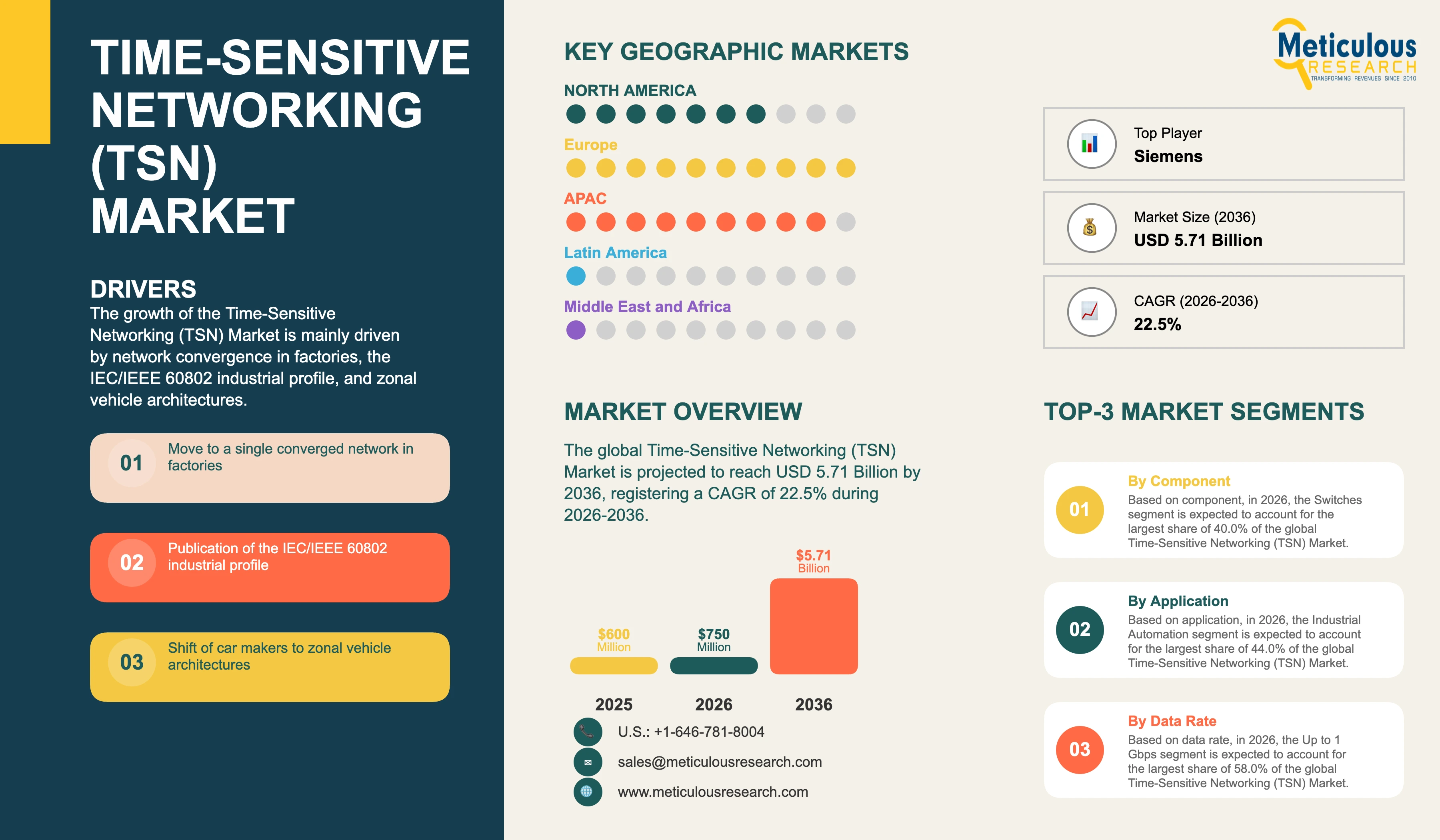
The global time-sensitive networking (TSN) market was valued at USD 600.0 million in 2025. This market is expected to reach USD 5.71 billion by 2036 from an estimated USD 750.0 million in 2026, registering a CAGR of 22.5% during the forecast period (2026-2036).
- Published
- Nov 2026
- Pages
- 245
- Format
- PDF + Excel
- Report ID
- MRICT - 1042607
- Base year
- 2025
- 2025 · BASELINE
- $600.0M
- 2036
- $5.71B
- CAGR 2026–2036
- 22.5%
2025 baseline · 2026–2036 forecast at 22.5% CAGR · hover a bar for the value
Key highlights
The IEC and IEEE published IEC/IEEE 60802:2026, the time-sensitive networking profile for industrial automation, on June 29, 2026. The 220-page standard selects the features, options, configurations, and protocols that switches, end devices, and networks must support to build interoperable TSN networks for industrial automation, according to the IEC and IEEE.
NXP and Quanta announced a deterministic zonal networking solution for software-defined vehicles in 2026, built on NXP S32 automotive processors and TSN-enabled SJA1110 switches, to give car makers predictable timing across zonal vehicle networks and reduce late-stage integration risk, according to Electronic Specifier.
At the TSN/A Conference 2026, Avnu Alliance presented its TSN profile testing and certification program covering professional audio and video (Milan), industrial automation (IEC/IEEE 60802), and aerospace (IEEE 802.1DP), and other speakers discussed 25 Gb/s TSN as a backbone for zonal architectures in autonomous vehicles, according to Computer & Automation.
Siemens relies on Ethernet-based TSN as the new foundation for PROFINET at the field level and OPC UA at the control level, and the TSN/A Conference 2026 included sessions on moving PROFINET to the IEC/IEEE 60802 profile while protecting the installed base and on aligning OPC UA FX with the profile, according to Siemens and Computer & Automation.
Marvell's Brightlane automotive Ethernet switch supports the latest TSN standards, including IEEE 802.1CB for data redundancy, along with MACsec security and dual-core lockstep processing, while Broadcom's Scorpio automotive switch offers 16 ports, of which up to six support 10 Gbps, for zonal and central computing architectures, according to Converge Digest and Futurum.
Industrial switch makers continue to launch TSN products, such as PLANET Technology's TSN-6325 industrial Layer 3 managed TSN switch with 10 Gbps ports and a switch fabric of up to 116 Gbps for use in temperatures from -40 to 75 degrees Celsius, according to the SPS exhibitor catalog. Together, these developments show that TSN is moving from standards work to commercial products in factories, vehicles, and other industries. More products are expected after the profile publication.
By component, switches account for the largest share of 40.0% in 2026, while controllers and processors register the highest CAGR.
By standard, IEEE 802.1Qbv (time-aware shaper) accounts for the largest share in 2026, while IEEE 802.1Qcc (stream reservation and configuration) registers the highest CAGR.
By data rate, up to 1 Gbps account for the largest share in 2026, while 2.5 Gbps to 10 Gbps register the highest CAGR.
By application, industrial automation accounts for the largest share of 44.0% in 2026, while automotive registers the highest CAGR.
By geography, Europe accounts for the largest share of 36.0% in 2026, while Asia-Pacific registers the highest CAGR of 26.3%.
Report summary
| Particulars | Details |
|---|---|
| Forecast Period | 2026-2036 |
| Base Year | 2025 |
| Estimated Year | 2026 |
| CAGR (Value) | 22.5% |
| Format | PDF, Excel & Cloud Portal · 245 pages |
| Market Size (Value) in 2025 | USD 600.0 million |
| Market Size (Value) in 2026 | USD 750.0 million |
| Market Size (Value) by 2036 | USD 5.71 billion |
| Largest Segment by Component (2026) | Switches (40.0%) |
| Largest Segment by Application (2026) | Industrial Automation (44.0%) |
| Largest Region (2026) | Europe (36.0%) |
| Fastest-Growing Region | Asia-Pacific (CAGR 26.3%) |
| Segments Covered | Component, Standard, Data Rate, Application, Geography |
| Countries Covered | Germany, U.K., France, Italy, Spain, Netherlands, Switzerland, Austria, Belgium, Sweden, Denmark, Norway, Finland, Poland, Czech Republic, Rest of Europe, China, Japan, South Korea, India, Taiwan, Australia, Singapore, Indonesia, Thailand, Malaysia, Vietnam, Philippines, New Zealand, Rest of Asia-Pacific, U.S., Canada, Brazil, Mexico, Argentina, Colombia, Chile, Peru, Rest of Latin America, Saudi Arabia, U.A.E., Israel, South Africa, Turkey, Egypt, Rest of Middle East & Africa |
| Key Companies | 16 companies and other companies |
Report overview
Segments covered: component, standard, data rate, application.
The growth of this market is mainly driven by the move of factories from many separate industrial networks to a single Ethernet network that can carry control, safety, video, and IT traffic together, the publication of the IEC/IEEE 60802 TSN profile for industrial automation in June 2026, the shift of car makers to zonal vehicle architectures that rely on high-speed Ethernet with predictable timing, the growing use of robots, motion control, and machine vision that need precise timing, and the support of major industrial protocols, such as PROFINET, OPC UA, and EtherNet/IP, for TSN. In addition, TSN is being adopted in power grids, aircraft, 5G mobile networks, and professional audio and video systems. However, the cost and effort of replacing existing industrial networks, the complexity of configuring TSN networks, and the long product cycles in industrial and automotive markets are expected to restrain the growth of this market to some extent.
Time-sensitive networking (TSN) is a set of IEEE 802.1 standards that add precise timing and guaranteed delivery to standard Ethernet. Ordinary Ethernet treats all data the same and cannot guarantee when a message will arrive, which is a problem for applications such as machine control, robot motion, vehicle braking, and safety systems that need data to arrive within a fixed time. TSN solves this problem through features such as shared time synchronization across all devices, scheduled time slots for critical traffic, the ability to interrupt long messages for urgent ones, and duplicate paths that protect against link failures. This allows critical control data and ordinary data, such as video and IT traffic, to share one network.
This report covers the global TSN market, including TSN-capable Ethernet switches, controllers and processors with built-in TSN functions, network interface cards and endpoint chips, and software and services, such as network configuration and management software, TSN software stacks, testing tools, and integration services. The market is analyzed by component, standard, data rate, application, and geography. Market size is measured on a revenue basis and includes the value of TSN-capable products sold for industrial, automotive, energy, aerospace, telecom, and audio-video applications. For products where TSN is one feature among many, such as automotive processors and industrial controllers, the market includes the share of value linked to TSN-capable networking functions.
TSN has been under development for more than a decade, but adoption has been slower than expected because industrial users needed a common profile that ensures equipment from different vendors works together. The publication of IEC/IEEE 60802:2026 in June 2026 is a major milestone, as it defines how TSN should be used in industrial automation, including which features devices must support, how networks are configured, and how devices describe their capabilities. Major industrial protocols, such as PROFINET, OPC UA FX, EtherNet/IP, and CC-Link IE TSN, are aligning with this profile, which is expected to speed up adoption in factories.
In the automotive industry, TSN is becoming a key technology for software-defined vehicles. Car makers are moving from dozens of separate electronic control units connected by slower networks to zonal architectures in which a few powerful central computers connect to zone controllers through high-speed Ethernet. These networks must carry camera and sensor data for driver assistance, as well as time-critical control messages, which requires TSN features. Chip makers, such as NXP, Marvell, Broadcom, Microchip, and Texas Instruments, offer automotive Ethernet switches and processors with TSN support, and speakers at the TSN/A Conference 2026 discussed 25 Gb/s TSN as a backbone for autonomous vehicles.
TSN is also being adopted in industries outside factories and vehicles that need reliable, precisely timed communication. Power utilities are using TSN in digital substations, aircraft makers are developing TSN networks for avionics under the IEEE 802.1DP profile, mobile operators use TSN features to carry 5G fronthaul traffic between radios and baseband units, and the professional audio and video industry uses TSN through the Milan profile for live sound and broadcast systems. Avnu Alliance runs certification programs for several of these profiles, which helps ensure that equipment from different vendors works together.
The TSN market is supplied by chip makers, industrial networking companies, automation vendors, and software and testing companies. Chip makers, such as NXP, Microchip, Analog Devices, Marvell, Broadcom, Texas Instruments, Intel, and Renesas, provide TSN switch chips, processors, and network controllers. Industrial networking and automation companies, such as Siemens, Cisco, Belden, Moxa, Phoenix Contact, B&R, and Rockwell Automation, build TSN switches, controllers, and devices for factories, while TTTech provides TSN software and network configuration tools.
In 2026, switches account for the largest share of the market by component, while controllers and processors are the fastest-growing component. IEEE 802.1Qbv (time-aware shaper) is the largest standard segment, while IEEE 802.1Qcc (stream reservation and configuration) is the fastest-growing standard. Networks running at up to 1 Gbps account for the largest share by data rate, while networks running at 2.5 Gbps to 10 Gbps grow fastest. Industrial automation is the largest application, while automotive is the fastest-growing application. Europe accounts for the largest share of the market, while Asia-Pacific is the fastest-growing region.
Over the forecast period, the TSN market is expected to grow rapidly as the IEC/IEEE 60802 profile drives adoption in factories, as zonal architectures spread across new vehicle models, and as TSN is built into more chips and devices by default. Growth is expected to be strongest in the automotive segment and in Asia-Pacific, where vehicle and electronics production is concentrated.
Industrial automation is expected to account for the largest share of 44.0% of the market in 2026, while automotive is projected to register the highest CAGR, driven by zonal and software-defined vehicle architectures.
Europe is expected to account for the largest share of 36.0% of the market in 2026, mainly due to its strong industrial automation industry, leading TSN vendors, and the shift of European car makers to new vehicle architectures.
Asia-Pacific is projected to register the highest CAGR of 26.3% during the forecast period, driven by large vehicle production, rapid adoption of zonal architectures in China, and a large and growing manufacturing base.
The report profiles 16 companies, including Siemens, Cisco, Belden, Moxa, Phoenix Contact, B&R (ABB), Rockwell Automation, NXP, Microchip, Analog Devices, Marvell, Broadcom, Texas Instruments, Intel, Renesas, and TTTech.
IEC/IEEE 60802 is the TSN profile for industrial automation, published in June 2026. It defines the TSN features, options, configurations, protocols, and management interfaces that switches, end devices, and networks must support so that equipment from different vendors can work together in factories.
Modern vehicles are moving to zonal architectures in which central computers connect to zone controllers through Ethernet. These networks carry large volumes of camera and sensor data and time-critical control messages, and TSN guarantees that critical messages arrive on time even when the network is busy.
Report infographic
Market dynamics
18 factors across 5 forcesMove to a single converged network in factories
Factories today often run several separate networks, such as different industrial fieldbuses for machines and drives, separate networks for safety systems, and an IT network for business systems. Each network needs its own equipment, cabling, and skills, and moving data between them is complex. TSN allows control, safety, video, and IT traffic to share one standard Ethernet network while guaranteeing that critical messages arrive on time. This reduces cabling and equipment costs, simplifies network management, and makes it easier to get data from machines for analytics and AI.
Industrial users and automation vendors see network convergence as a key step toward more flexible and data-driven factories. The IEEE has described TSN as an enabler of network convergence for industrial automation, Industry 4.0, and smart factories. As factories add more connected devices, cameras, and data-driven applications, the benefits of a single converged network become greater, which drives demand for TSN switches, controllers, and devices.
Publication of the IEC/IEEE 60802 industrial profile
One of the main barriers to TSN adoption in industry has been the lack of a common profile that defines which TSN features industrial devices must support and how they should be configured. Without such a profile, equipment from different vendors may not work together, and users are reluctant to invest. The IEC and IEEE published IEC/IEEE 60802:2026 on June 29, 2026, after several years of joint work. The standard defines TSN profiles for industrial automation, including features, options, defaults, protocols, and management interfaces for switches, end devices, and networks.
The publication of this profile gives automation vendors, chip makers, and users a clear target for product development and testing. Avnu Alliance has developed testing and certification for the profile, and major protocol organizations are aligning PROFINET, OPC UA FX, and other protocols with it. The profile is expected to speed up the launch of interoperable TSN products and encourage users to adopt TSN in new factories and upgrades.
Shift of car makers to zonal vehicle architectures
Car makers are redesigning vehicle electronics around software-defined architectures, in which a small number of powerful central computers run most vehicle functions and connect to zone controllers placed around the car. These zonal architectures reduce wiring weight and cost, simplify software updates, and allow new features to be added over the life of the vehicle. However, they require high-speed in-vehicle networks that can carry large volumes of sensor and camera data while guaranteeing timing for safety-critical control messages.
TSN provides the timing and reliability guarantees that zonal networks need on automotive Ethernet. Chip makers are offering automotive Ethernet switches with TSN support, such as Marvell's Brightlane and Broadcom's Scorpio, and NXP and Quanta introduced a deterministic zonal networking solution in 2026 based on TSN-enabled switches. As zonal architectures spread from premium to mainstream vehicles, the number of TSN-capable switches and processors per vehicle and the number of vehicles using them are expected to increase rapidly, which makes automotive the fastest-growing application in this market.
Growing use of robots, motion control, and machine vision
Modern factories use more robots, servo drives, motion control systems, and machine vision cameras, which need precise timing and synchronization to work together. For example, several axes of a machine must move in exact coordination, and vision systems must capture images at precise moments. TSN provides shared time synchronization across devices and guaranteed delivery of control messages, which supports these applications on standard Ethernet. The growth of automation in electronics, battery, automotive, and logistics industries is increasing demand for TSN-capable drives, controllers, and switches.
Industrial automation is the largest application in this market, and motion control and robotics are among its most important uses. Automation vendors are building TSN into new controllers, drives, and input-output systems, which increases the installed base of TSN-capable equipment over time.
Support for TSN in major industrial protocols
The major industrial communication protocols are adding TSN support, which makes it easier for users to adopt TSN without changing their software and engineering tools. Siemens uses TSN as the new foundation for PROFINET at the field level and OPC UA at the control level, the OPC Foundation is aligning OPC UA FX with the IEC/IEEE 60802 profile, and CC-Link IE TSN and EtherNet/IP are also adopting TSN. This support allows users to keep their existing protocols and investments while gaining the benefits of TSN, and it encourages automation vendors to build TSN into their products. Sessions at the TSN/A Conference 2026 on moving PROFINET to the IEC/IEEE 60802 profile while protecting the installed base show that vendors are planning gradual migration paths for their customers.
Table of contents
12 chapters · 179 sections · 245 pages · click to expandSegmental analysis
| Segment | Largest share (2026) | Fastest growth (2026–2036) |
|---|---|---|
| By Component | Switches | Controllers and processors |
| By Standard | IEEE 802.1Qbv (time-aware shaper) | IEEE 802.1Qcc (stream reservation and configuration) |
| By Data Rate | Up to 1 Gbps | 2.5 Gbps |
| By Application | Industrial automation | Automotive |
| Other segments | IEEE 802.1Qbv (time-aware shaper) | IEEE 802.1Qcc (stream reservation and configuration) |
By Component
- The switches segment is expected to account for the largest share of 40.0% of the global TSN market.
- The large share of this segment is mainly due to the central role of switches in TSN networks, which must schedule traffic, synchronize time, and manage data streams, the large number of TSN switches needed in factories, vehicles, substations, and telecom networks, and the higher value of switches compared with endpoint chips.
- Industrial TSN switches are supplied by Siemens, Cisco, Belden, Moxa, Phoenix Contact, and others, while automotive TSN switch chips are supplied by NXP, Marvell, Broadcom, and Microchip.
- However, the controllers and processors segment is projected to register the highest CAGR during the forecast period.
- The rapid growth of this segment is driven by the integration of TSN features into automotive processors and zone controllers for software-defined vehicles, the use of TSN-capable processors in industrial controllers, drives, and input-output systems, and the growing number of devices that need TSN at the endpoint as well as in the network.
- NXP, Texas Instruments, Renesas, Intel, Analog Devices, and Microchip are among the leading suppliers of TSN-capable processors and controllers.
- The network interface cards and endpoint chips segment includes TSN-capable Ethernet controllers and network cards for PCs, servers, and devices, while the software and services segment includes TSN configuration and management software, protocol stacks, testing tools, and integration services provided by companies such as TTTech.
- Each component plays a different role in a TSN network, and buyers often need all of them to work together.
- Switches manage traffic between devices, controllers and processors run the applications that send and receive time-critical data, network interface cards connect computers and devices to the network, and software tools plan, configure, and monitor the network.
- Vendors that can offer several of these components, or that work closely with partners, can make it easier for customers to build complete TSN systems.
By Standard
- The IEEE 802.1Qbv (time-aware shaper) segment is expected to account for the largest share of the global TSN market.
- The large share of this segment is mainly due to the central role of time-aware scheduling in guaranteeing delivery times for critical traffic, its use in almost all TSN applications, including industrial automation, automotive, and telecom, and its inclusion in the IEC/IEEE 60802 profile and automotive TSN products.
- The IEEE 802.1AS (time synchronization) segment is also large because all TSN networks need shared time across devices.
- However, the IEEE 802.1Qcc (stream reservation and configuration) segment is projected to register the highest CAGR during the forecast period.
- The rapid growth of this segment is driven by the need to simplify the configuration of TSN networks, the development of central configuration software and automatic tools, and the inclusion of management and configuration features in the IEC/IEEE 60802 profile.
- The IEEE 802.1CB (frame replication and elimination) segment includes features that send duplicate copies of messages over different paths to protect against failures, which are important in automotive, power, and safety applications, while the IEEE 802.1Qbu and 802.3br (frame preemption) segment includes features that allow urgent messages to interrupt long ones.
- The other standards segment includes additional TSN standards for filtering, policing, and security.
By Data Rate
- The up to 1 Gbps segment is expected to account for the largest share of the global TSN market.
- The large share of this segment is mainly due to the large installed base and wide use of 100 Mbps and 1 Gbps Ethernet in industrial devices, controllers, and drives, the use of 100 Mbps and 1 Gbps automotive Ethernet in many zone controllers and sensors, and the lower cost of devices at these speeds.
- Most current industrial TSN products are designed for these data rates.
- However, the 2.5 Gbps to 10 Gbps segment is projected to register the highest CAGR during the forecast period.
- The rapid growth of this segment is driven by the growing volume of camera and sensor data in vehicles and factories, the use of multi-gigabit links between zone controllers and central computers in software-defined vehicles, the need for higher-capacity backbones in converged factory networks, and the availability of multi-gigabit TSN switches from chip makers such as Broadcom and Marvell.
- The above 10 Gbps segment includes high-speed TSN links for telecom fronthaul and future autonomous vehicle backbones, such as the 25 Gb/s TSN networks discussed at the TSN/A Conference 2026.
By Application
- The industrial automation segment is expected to account for the largest share of 44.0% of the global TSN market.
- The large share of this segment is mainly due to the long history of TSN development for industrial automation, the push by automation vendors and users to converge factory networks, the publication of the IEC/IEEE 60802 profile, the support of PROFINET, OPC UA, EtherNet/IP, and CC-Link IE TSN for TSN, and the growing use of robots, motion control, and machine vision that need precise timing.
- Siemens, Rockwell Automation, B&R, Mitsubishi Electric, Phoenix Contact, Belden, and Moxa are among the leading suppliers of TSN products for industrial automation.
- However, the automotive segment is projected to register the highest CAGR during the forecast period.
- The rapid growth of this segment is driven by the shift of car makers to zonal and software-defined vehicle architectures, the growth of driver assistance and autonomous driving features that need high-bandwidth, time-critical networks, and the availability of automotive TSN switches and processors from NXP, Marvell, Broadcom, Microchip, and Texas Instruments.
- The power and energy segment includes digital substations and grid systems, the aerospace and defense segment includes avionics and military networks, and the telecommunications segment includes 5G fronthaul and transport networks.
- The professional audio-video and other applications segment includes live sound, broadcast, building automation, and medical equipment.
Other segments
- The IEEE 802.1Qbv (time-aware shaper) segment is expected to account for the largest share of the TSN market, while the IEEE 802.1Qcc (stream reservation and configuration) segment is projected to register the highest CAGR during the forecast period.
- The up to 1 Gbps segment is expected to account for the largest share of the TSN market, while the 2.5 Gbps to 10 Gbps segment is projected to register the highest CAGR during the forecast period.
Geographic analysis
Europe
Largest shareIn 2026, Europe is expected to account for the largest share of 36.0% of the global TSN market. The large share of this region is mainly due to the strong industrial automation industry in Germany, Austria, Italy, and other countries, the leading role of European companies, such as Siemens, Phoenix Contact, B&R, Belden's Hirschmann business, and TTTech, in developing TSN products and standards, the move of European car makers, such as BMW, Mercedes-Benz, and Volkswagen, to new vehicle electronics architectures, and the presence of major industrial trade fairs, such as SPS in Nuremberg and Hannover Messe, where TSN products are launched. The PROFINET and OPC UA communities, which are adding TSN support, are also strongly based in Europe. European research centers and industry groups have also played a leading role in TSN testbeds and interoperability testing for many years. Germany alone accounts for a large part of European demand, supported by its automotive, machinery, and electrical equipment industries.
Asia-Pacific
Fastest growthAsia-Pacific is projected to register the highest CAGR of 26.3% during the forecast period. The rapid growth of this region is mainly driven by the very large vehicle production in China, Japan, South Korea, and India, the rapid adoption of software-defined and zonal architectures by Chinese car makers, the large and growing manufacturing base in electronics, batteries, and automotive components, the strong position of Japanese automation vendors, such as Mitsubishi Electric, which supports CC-Link IE TSN, and government programs that support smart manufacturing. Taiwan and South Korea are also important centers for semiconductor and electronics production, which use advanced automation that benefits from TSN. China is also home to fast-growing industrial automation suppliers that are adding TSN to their controllers and drives.
North America
North America accounts for a significant share of the market, supported by the presence of leading TSN chip makers, such as Texas Instruments, Microchip, Marvell, Broadcom, Intel, and Analog Devices, and networking and automation companies, such as Cisco and Rockwell Automation. U.S. car makers are adopting zonal architectures, and investments in new factories for semiconductors, batteries, and electric vehicles are creating demand for modern industrial networks. The aerospace and defense industry in the U.S. is also an important user of deterministic networks.
Latin America
Latin America and the Middle East & Africa account for smaller shares of the market but offer growth opportunities. In Latin America, automotive and manufacturing plants in Mexico and Brazil are expected to adopt TSN as global car makers and suppliers introduce new vehicle platforms and production lines.
Middle East & Africa
In the Middle East, investments in new industrial cities, power grids, and oil and gas facilities in Saudi Arabia and the U.A.E. are expected to create demand for TSN in automation and energy applications. Growth in these regions, which are currently at an early stage of TSN adoption, is expected to accelerate later in the forecast period as TSN products become more widely available and as global automation vendors expand their offerings.
Competitive landscape
The global TSN market is moderately consolidated, with the top five players estimated to account for about 45% of the market in 2025. The market includes semiconductor companies, industrial networking and automation vendors, and software and testing companies, many of which also take part in TSN standards work at the IEEE and IEC.
NXP, Microchip, Analog Devices, Marvell, Broadcom, Texas Instruments, Intel, and Renesas are leading suppliers of TSN switch chips, processors, and network controllers for industrial and automotive markets. Siemens, Cisco, Belden, Moxa, Phoenix Contact, B&R (ABB), and Rockwell Automation offer TSN switches, controllers, and devices for industrial automation, often as part of wider automation portfolios. TTTech, based in Austria, provides TSN software, configuration tools, and integration services, and has been active for many years in TSN standards development for industrial and automotive applications.
Companies in this market compete on compliance with TSN standards and profiles, certification results, performance and timing accuracy, port count and data rate, security features, functional safety certification, power use, price, software tools, documentation, and support. Key strategies include building TSN into standard chips and controllers at little extra cost, offering evaluation kits and reference designs, participating in standards development and certification programs, forming partnerships with car makers and automation vendors, and launching development platforms and reference designs.
Recent competitive activity in the TSN market has focused on product launches, partnerships, and certification work. NXP and Quanta introduced a deterministic zonal networking solution in 2026, industrial switch makers, such as PLANET Technology, launched new TSN switches, and vendors presented interoperability and migration solutions at the TSN/A Conference 2026 following the publication of the IEC/IEEE 60802 profile.
We expect competition to increase over the forecast period as the IEC/IEEE 60802 profile drives adoption in industrial automation and as zonal architectures create large volume opportunities in automotive. Chip makers with strong automotive and industrial portfolios and automation vendors with large installed bases are expected to be best positioned. New entrants, including Chinese chip makers and automation vendors, are expected to compete more strongly on price, especially in Asia-Pacific.
Some of the key players operating in the TSN market are Siemens AG, Cisco Systems, Inc., Belden Inc., Moxa Inc., Phoenix Contact GmbH & Co. KG, B&R Industrial Automation GmbH (ABB Ltd.), Rockwell Automation, Inc., NXP Semiconductors N.V., Microchip Technology Inc., Analog Devices, Inc., Marvell Technology, Inc., Broadcom Inc., Texas Instruments Incorporated, Intel Corporation, Renesas Electronics Corporation, and TTTech Industrial Automation AG, among others.
- —
The IEC and IEEE published the IEC/IEEE 60802 TSN profile for industrial automation in June 2026, NXP and Quanta introduced a deterministic zonal networking solution for vehicles, and Avnu Alliance presented TSN certification for industrial, audio-video, and aerospace profiles.
- Cisco
- Belden
- Moxa
- Phoenix Contact
- B&R (ABB)
- Rockwell Automation
Expert perspectives
The TSN market is entering a stronger growth phase after many years of standards development. The publication of the IEC/IEEE 60802 industrial profile in June 2026, after years of joint work by the IEC and IEEE, gives vendors and users a clear basis for interoperable products, and the shift of car makers to zonal architectures is creating large volume demand for TSN-capable switches and processors.
Over the forecast period, the market is expected to grow at a CAGR of 22.5%, from USD 750.0 million in 2026 to USD 5.71 billion in 2036. Growth will be driven by the adoption of TSN in new factories and upgrades, the spread of zonal architectures across vehicle models, the integration of TSN into standard chips and controllers at low added cost, and adoption in power, aerospace, telecom, and audio-video applications.
Among the market segments, switches are the largest component, while controllers and processors grow fastest. IEEE 802.1Qbv is the largest standard segment, while IEEE 802.1Qcc grows fastest. Networks at up to 1 Gbps are the largest data rate segment, while networks at 2.5 Gbps to 10 Gbps grow fastest, and industrial automation is the largest application, while automotive grows fastest. Europe is the largest region, and Asia-Pacific is the fastest-growing region at a CAGR of 26.3%.
In our view, the most important factor for the TSN market over the next five years will be the speed at which certified products based on the IEC/IEEE 60802 profile reach the market and are adopted in new factories. Users have waited for a common profile, and the availability of certified, interoperable products from several vendors will be key to their decisions. The automotive segment will provide the largest volume growth, but it depends on the timing of new vehicle platforms, which can shift by a year or more.
We also see ease of use as a key factor in how quickly TSN spreads beyond large companies. TSN networks are more complex to plan and configure than standard industrial Ethernet, and automatic configuration tools and training will be needed to make TSN accessible to typical plant engineers and system integrators. Vendors that offer simple configuration tools and strong support will win more business, especially among machine builders and system integrators.
Overall, we believe the TSN market will grow rapidly over the forecast period, with controllers and processors, IEEE 802.1Qcc, multi-gigabit data rates, automotive, and Asia-Pacific providing the fastest growth. Companies with broad TSN portfolios, strong standards participation, and close relationships with car makers and automation vendors will be best positioned to capture this growth.
Customer perspectives
Network Engineer - System Integrator, U.S.
Because configuring time slots by hand is hard, tools that set up the network automatically will make TSN much easier to sell to plants and to the engineers who run them.
“Now that the industrial TSN profile is published, we can design one network for motion, safety, and data. Our customers want fewer cables and easier access to machine data.”
“Our new zonal platform runs on Ethernet with TSN. We need guaranteed timing for control messages while carrying a lot of camera data.”
Frequently asked questions
The global TSN market was valued at USD 600.0 million in 2025, up from USD 480.0 million in 2024, and is estimated at USD 750.0 million in 2026. The market includes TSN-capable switches, controllers and processors, network interface cards and endpoint chips, and software and services.
Cite this report
Meticulous Research. (2026). Time-Sensitive Networking (TSN) Market - Global Opportunity Analysis and Industry Forecast (2026-2036) (Report No. MRICT - 1042607). Meticulous Market Research Pvt. Ltd. https://www.meticulousresearch.com/product/time-sensitive-networking-market-7290