eSIM Market (2026-2036)
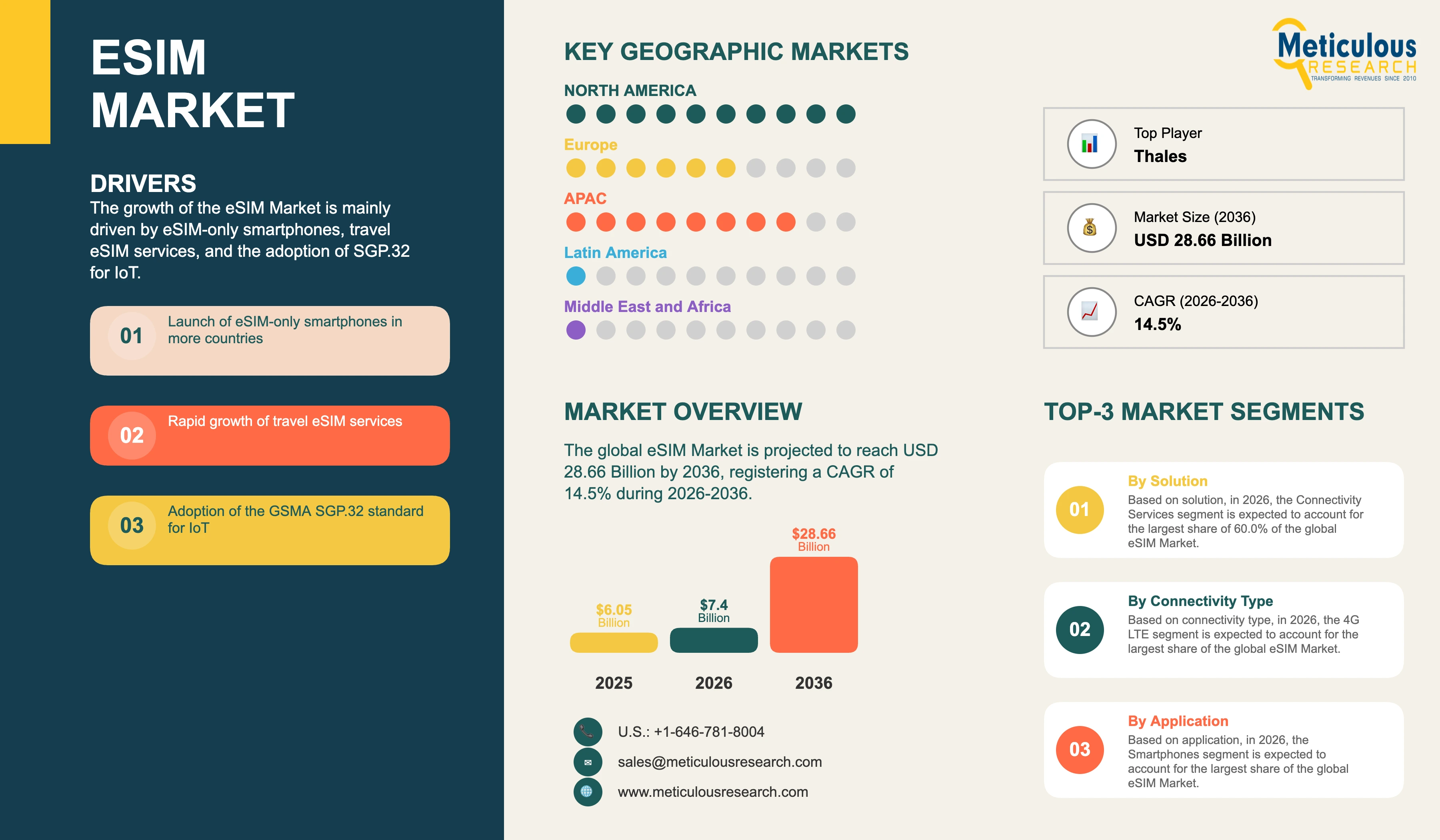
The global eSIM market was valued at USD 6.05 billion in 2025. This market is expected to reach USD 28.66 billion by 2036 from an estimated USD 7.40 billion in 2026, registering a CAGR of 14.5% during the forecast period (2026-2036).
- Published
- Nov 2026
- Pages
- 265
- Format
- PDF + Excel
- Report ID
- MRICT - 1042610
- Base year
- 2025
- 2025 · BASELINE
- $6.05B
- 2036
- $28.66B
- CAGR 2026–2036
- 14.5%
2025 baseline · 2026–2036 forecast at 14.5% CAGR · hover a bar for the value
Key highlights
Global eSIM smartphone penetration reached 5% of smartphone connections at the end of 2025 and is expected to reach 10% by the end of 2026 and double again in 2027, according to GSMA Intelligence, which expects eSIM smartphone connections to outnumber those on removable SIM cards by 2030. GSMA Intelligence projects 4.9 billion eSIM smartphone connections by 2030, or about 55% of all smartphone connections.
Apple's iPhone Air, launched in September 2025, is eSIM-only worldwide, including China, while the iPhone 17, iPhone 17 Pro, and iPhone 17 Pro Max are eSIM-only in markets such as the U.S., Canada, Japan, Mexico, Saudi Arabia, Bahrain, Kuwait, Oman, and Qatar, according to Apple and MacRumors. Google's Pixel 10 series is also eSIM-only in the U.S.
Thales reported that a North American operator with more than 80 million subscribers saw eSIM activation traffic multiply by five on the first day of an eSIM-only iPhone launch, according to the GSMA.
Travel eSIM provider Airalo surpassed 30 million customers in June 2026, after raising USD 220 million in 2025 at a valuation of more than USD 1 billion in a round led by CVC, according to Airalo and PhocusWire. Holafly's 2026 survey found that 31.1% of travelers intended to use an eSIM during their summer trips.
In April 2026, KORE and Kigen announced SGP.32-compliant IoT connectivity solutions, with commercial availability planned for late 2026, and floLIVE launched SGP.32 support across its global IoT network with Kigen in February 2026, according to KORE and Kigen.
Three in four mobile operators have launched domestic eSIM services for smartphones, and consumer awareness of eSIM rose from 25% in 2021 to 60% in 2025, according to GSMA Intelligence research presented in March 2026. These developments show that eSIM is moving from a niche feature to a mainstream way of connecting devices to mobile networks. Growing operator support and the new IoT standard are expected to widen eSIM use beyond smartphones and travel during the forecast period. Operators are also adding eSIM support across more devices.
By solution, connectivity services account for the largest share of 60.0% in 2026, while subscription management and provisioning platforms register the highest CAGR.
By connectivity type, 4G LTE accounts for the largest share in 2026, while 5G registers the highest CAGR.
By application, smartphones account for the largest share in 2026, while IoT and M2M devices register the highest CAGR.
By end-use industry, consumer electronics account for the largest share of 62.0% in 2026, while manufacturing and logistics register the highest CAGR.
By geography, North America accounts for the largest share of 38.0% in 2026, while Asia-Pacific registers the highest CAGR of 17.7%.
Report summary
| Particulars | Details |
|---|---|
| Base Year | 2025 |
| Estimated Year | 2026 |
| Forecast Period | 2026-2036 |
| Market Size in 2025 | USD 6.05 billion |
| Market Size in 2026 | USD 7.40 billion |
| Market Size by 2036 | USD 28.66 billion |
| CAGR (2026-2036) | 14.5% |
| Format | PDF, Excel & Cloud Portal · 265 pages |
| Largest Segment by Solution (2026) | Connectivity Services (60.0%) |
| Largest Segment by End-Use Industry (2026) | Consumer Electronics (62.0%) |
| Largest Region (2026) | North America (38.0%) |
| Fastest-Growing Region | Asia-Pacific (CAGR 17.7%) |
| Companies Profiled | 16 companies and other companies |
| Segments Covered | Solution, Connectivity Type, Application, End-Use Industry, Geography |
| Countries Covered | U.S., Canada, China, Japan, India, South Korea, Australia, Singapore, Indonesia, Thailand, Malaysia, Vietnam, Philippines, Taiwan, New Zealand, Rest of Asia-Pacific, Germany, U.K., France, Italy, Spain, Netherlands, Switzerland, Belgium, Sweden, Denmark, Norway, Austria, Poland, Ireland, Rest of Europe, Brazil, Mexico, Argentina, Colombia, Chile, Peru, Rest of Latin America, Saudi Arabia, U.A.E., Qatar, Kuwait, Israel, South Africa, Turkey, Rest of Middle East & Africa |
Report overview
Segments covered: solution, connectivity type, application, end-use industry.
The growth of this market is mainly driven by the launch of eSIM-only smartphones by Apple and Google in more countries, the rapid growth of travel eSIM services, the rising number of mobile operators that support eSIM, the adoption of the GSMA SGP.32 standard, which makes it easier to manage eSIMs in IoT devices, and the growing use of eSIM in wearables, connected cars, and industrial devices. In addition, eSIM allows device makers to save space inside devices and allows users to switch operators or add data plans without visiting a store, which is increasing consumer interest. However, limited eSIM support from some operators, difficult activation processes, consumer unfamiliarity in some markets, and concerns among operators about losing control of the customer relationship are expected to restrain the growth of this market to some extent.
An eSIM, or embedded SIM, is a SIM chip that is built into a device rather than inserted as a removable card. The eSIM chip, known as an eUICC, can store one or more operator profiles, which can be downloaded and changed remotely without replacing any hardware. This allows users to activate mobile service by scanning a QR code or using an app, switch operators, or add a travel data plan without visiting a store. For device makers, eSIM saves space, removes the SIM tray, and allows devices to be sold and connected anywhere in the world. The GSMA sets the technical standards for eSIM, including SGP.22 for consumer devices and SGP.32 for IoT devices.
This report covers the global eSIM market, including connectivity services delivered through eSIM, such as travel eSIM data plans and global IoT eSIM connectivity, eSIM hardware, such as eUICC chips and secure elements, and subscription management and provisioning platforms, such as remote SIM provisioning servers, eSIM IoT remote managers, and entitlement and activation platforms. The market is analyzed by solution, connectivity type, application, end-use industry, and geography. Market size is measured on a revenue basis. Revenue from standard mobile subscriptions sold by operators to their own customers is not included, even when those customers use eSIM.
eSIM adoption in smartphones has accelerated sharply since late 2025, after several years of slow progress outside the U.S. According to GSMA Intelligence, eSIM accounted for 5% of global smartphone connections at the end of 2025 and is expected to reach 10% by the end of 2026. Two events in late 2025 drove this acceleration. Apple launched the iPhone Air as an eSIM-only device worldwide and expanded eSIM-only iPhone 17 models to more countries, and Google made its Pixel 10 series eSIM-only in the U.S. When a large number of new phones can only use eSIM, operators must support eSIM activation, which drives investment in provisioning platforms.
The travel market has been one of the strongest sources of eSIM growth. Travelers can buy a local or regional data plan through an app before or during a trip and activate it immediately, which is often cheaper and more convenient than international roaming. Airalo surpassed 30 million customers in June 2026, and Holafly said it has sold more than 25 million eSIMs. GSMA Intelligence found that 71% of travelers are aware of eSIM. Airlines, travel agencies, banks, and hotel groups are also offering travel eSIMs to their customers, such as Cathay Pacific's partnership with Airalo, under which members earn Asia Miles for each eSIM purchased.
eSIM is also growing in IoT devices, such as smart meters, asset trackers, industrial sensors, connected cars, and payment terminals. Earlier eSIM standards for IoT were difficult to use, which limited adoption. The new GSMA SGP.32 standard allows companies to manage eSIM profiles across large numbers of IoT devices more easily and to switch connectivity providers without touching the devices. SGP.32 remained mostly at the pilot stage in 2025, but several connectivity providers and eSIM vendors, including KORE, floLIVE, Eseye, Onomondo, and Kigen, launched or announced SGP.32 services in 2026.
Operators have mixed views of eSIM. Most now support eSIM for smartphones, but some see it as a risk because it makes it easier for customers to switch providers and gives device makers more influence over customer activation. GSMA Intelligence has noted that operators are falling short on eSIM activation, even as consumer interest rises. In Europe, operators have expressed concern about eSIM-only phones, which has slowed the move to eSIM-only devices in the region. Regulators in some countries, including China, have also limited eSIM use for smartphones until recently.
In 2026, connectivity services account for the largest share of the market by solution, while subscription management and provisioning platforms are the fastest-growing solution. 4G LTE is the largest connectivity type, while 5G is the fastest-growing connectivity type. Smartphones are the largest application, while IoT and M2M devices are the fastest-growing application. Consumer electronics is the largest end-use industry, while manufacturing and logistics is the fastest-growing end-use industry. North America accounts for the largest share of the market, while Asia-Pacific is the fastest-growing region.
Over the forecast period, the eSIM market is expected to grow rapidly as more smartphones move to eSIM-only designs, travel eSIM services expand, IoT companies adopt SGP.32, and eSIM spreads to more device types. GSMA Intelligence expects eSIM to become the main way smartphones connect to mobile networks by 2030, and growth is expected to continue after that as IoT devices and connected cars adopt eSIM in large numbers.
Consumer electronics is expected to account for the largest share of 62.0% of the market in 2026, while manufacturing and logistics is projected to register the highest CAGR, driven by asset trackers, fleet devices, and the adoption of SGP.32.
North America is expected to account for the largest share of 38.0% of the market in 2026, mainly due to the early move to eSIM-only iPhones and Pixel phones in the U.S., strong operator support, and high eSIM adoption among smartphone users.
Asia-Pacific is projected to register the highest CAGR of 17.7% during the forecast period, driven by the gradual opening of eSIM in China, eSIM-only iPhones in Japan, growing operator support across the region, and large IoT device manufacturing.
The report profiles 16 companies, including Thales, Giesecke+Devrient, IDEMIA, Kigen, STMicroelectronics, Infineon, NXP, Valid, Workz, 1GLOBAL, KORE, Eseye, floLIVE, Semtech, Airalo, and Holafly.
According to GSMA Intelligence, eSIM accounted for 5% of global smartphone connections at the end of 2025, is expected to reach 10% by the end of 2026, and is projected to reach 4.9 billion connections, or about 55% of smartphone connections, by 2030.
SGP.32 is the GSMA's eSIM standard designed specifically for IoT devices, which often have no screen and limited power. It allows companies to manage eSIM profiles across large numbers of devices from a central platform and to switch connectivity providers over the air, which makes eSIM much easier to use in IoT and supports the fast growth of IoT and M2M applications.
An eSIM is a separate chip built into the device, while an iSIM places the SIM function inside the device's main processor or modem chip. iSIM saves more space and cost and is expected to expand the use of remote SIM provisioning in small IoT devices and wearables.
Report infographic
Market dynamics
18 factors across 5 forcesLaunch of eSIM-only smartphones in more countries
Smartphone makers are removing the physical SIM tray from more devices, which forces users and operators to use eSIM. Apple has sold eSIM-only iPhones in the U.S. since the iPhone 14 in 2022 and expanded eSIM-only iPhone 17 models to markets such as Canada, Japan, Mexico, Saudi Arabia, Bahrain, Kuwait, Oman, and Qatar in 2025. The iPhone Air is eSIM-only worldwide, including in China, where it is sold through China Unicom. Google's Pixel 10 series is also eSIM-only in the U.S. Removing the SIM tray gives device makers more space for batteries and other components.
Each eSIM-only phone launch drives a large and sudden increase in eSIM activations for operators. Thales reported that a North American operator with more than 80 million subscribers saw activation traffic multiply by five on the first day of an eSIM-only iPhone launch. As eSIM-only designs spread to more models and countries, operators must invest in provisioning and activation platforms, and eSIM hardware becomes standard in more devices. Industry reports suggest that Apple may extend eSIM-only iPhones to Europe in future models, which would be a major driver for the European market.
Rapid growth of travel eSIM services
Travel eSIM services allow travelers to buy local or regional data plans through an app and activate them immediately, often at a lower cost than international roaming. Airalo, the largest travel eSIM provider, surpassed 30 million customers in June 2026 and became the first eSIM company valued at more than USD 1 billion after raising USD 220 million in 2025. Holafly, Nomad, Saily, and many other providers compete in this market, and airlines, banks, travel agencies, and hotel groups are offering travel eSIMs to their customers.
Consumer demand for travel eSIM is growing quickly as more travelers learn about the option. Holafly's 2026 survey found that 31.1% of travelers intended to use an eSIM on their summer trips, and GSMA Intelligence found that 71% of travelers are aware of eSIM. Travel eSIM spending is concentrated among travelers from North America, Europe, and Asia, and growth is supported by the recovery and expansion of international travel. Travel eSIM is a major part of the connectivity services segment, which is the largest solution segment in this market.
Growing operator support for eSIM
More mobile operators are supporting eSIM for smartphones, which makes it easier for consumers to use. Three in four operators have launched domestic eSIM services for smartphones, according to GSMA Intelligence. Operators are also adding digital sign-up and activation through apps, which allows customers to join a network and activate service within minutes. Some operators now offer eSIM-only plans or digital brands that are only available through eSIM.
Operator support is important because consumers can only use eSIM if their operator supports it. As more operators invest in eSIM provisioning, entitlement servers, and digital sales channels, demand for subscription management platforms grows. Consumer awareness is also rising, from 25% in 2021 to 60% in 2025, according to GSMA Intelligence surveys, which supports further adoption.
Adoption of the GSMA SGP.32 standard for IoT
The GSMA SGP.32 standard is designed to make eSIM easier to use in IoT devices, which often have no screen, limited power, and limited network access. SGP.32 allows companies to manage eSIM profiles across large numbers of devices from a central platform, known as an eSIM IoT remote manager, and to switch connectivity providers over the air without visiting each device. This allows device makers to build a single product for global markets and choose local connectivity after the device is shipped.
SGP.32 moved from pilots toward commercial use in 2026. floLIVE launched SGP.32 support across its global IoT network with Kigen in February 2026, KORE and Kigen announced an SGP.32 portfolio for late 2026, and Eseye added SGP.32 to its platforms in April 2026. The IoT community IoT Stars ran the first independent, public, multi-vendor test of SGP.32 in April 2026, migrating live devices between connectivity providers over the air. The adoption of SGP.32 is a key reason why IoT and M2M devices are the fastest-growing application in this market.
Growing use of eSIM in wearables and connected cars
eSIM is well suited for small devices, such as smartwatches, fitness trackers, and tablets, where space is limited and a removable SIM card is impractical. Most cellular smartwatches already use eSIM, and laptops and tablets with cellular connectivity increasingly use eSIM as well. Car makers use eSIM to connect vehicles for navigation, emergency calls, software updates, and in-car services, and eSIM allows them to build one vehicle for many markets and choose local connectivity later. As the number of connected cars and wearables grows, demand for eSIM hardware, connectivity, and management platforms grows with it.
Table of contents
12 chapters · 172 sections · 265 pages · click to expandSegmental analysis
| Segment | Largest share (2026) | Fastest growth (2026–2036) |
|---|---|---|
| By Solution | Connectivity services | Large share of this |
| By Connectivity Type | 4G LTE | Rapid growth of this |
| By Application | Smartphones | IoT and M2M devices |
| By End-Use Industry | Consumer electronics | Manufacturing and logistics |
| Other segments | Smartphones | IoT and M2M devices |
By Solution
- The connectivity services segment is expected to account for the largest share of 60.0% of the global eSIM market.
- The large share of this segment is mainly due to the rapid growth of travel eSIM services, which allow travelers to buy data plans through apps, the large customer bases of providers such as Airalo and Holafly, the growing use of global eSIM connectivity for IoT devices, connected cars, and wearables, and the recurring nature of connectivity revenue compared with one-time hardware sales.
- Travel eSIM providers, IoT connectivity providers, such as KORE, Eseye, floLIVE, and 1GLOBAL, and other specialist providers are the main participants in this segment.
- However, the subscription management and provisioning platforms segment is projected to register the highest CAGR during the forecast period.
- The rapid growth of this segment is driven by the need for operators to support large numbers of eSIM activations as eSIM-only smartphones spread, the adoption of SGP.32 eSIM IoT remote managers by IoT companies, the growing use of entitlement servers that allow eSIM on wearables and tablets, and the move by platform providers to cloud-based services.
- Thales, G+D, IDEMIA, Kigen, and Valid are among the leading providers of eSIM platforms.
- The eSIM hardware segment includes eUICC chips and secure elements supplied by companies such as STMicroelectronics, Infineon, and NXP, along with eSIM operating systems from SIM vendors.
- Pricing differs widely across the three solution segments. eSIM hardware is a low-cost component, and prices per unit are expected to fall as volumes grow.
- Provisioning platforms are usually sold through license and per-activation fees or as cloud services, which provide recurring revenue for vendors.
- Travel eSIM data plans are sold at prices that are often well below operator roaming charges, which has helped them win customers quickly.
- We expect platform vendors to win more cloud-based contracts from smaller operators that cannot run their own systems.
By Connectivity Type
- ESIM Market Analysis by Connectivity Type
- The 4G LTE segment is expected to account for the largest share of the global eSIM market.
- The large share of this segment is mainly due to the large number of smartphones, wearables, connected cars, and IoT devices that still connect mainly over 4G LTE networks, the wide coverage of 4G networks in almost every country, which makes 4G the main option for travel eSIM data plans in many destinations, and the use of 4G in many cellular IoT devices, such as payment terminals, routers, and fleet trackers.
- Many travel eSIM plans are still sold as 4G plans, especially in emerging markets in Africa, Latin America, and parts of Asia.
- However, the 5G segment is projected to register the highest CAGR during the forecast period.
- The rapid growth of this segment is driven by the growing share of 5G smartphones, which almost all support eSIM, the expansion of 5G coverage and roaming agreements that allow travel eSIM providers to offer 5G data plans, the use of 5G in connected cars and industrial devices, and the expected growth of 5G RedCap devices for wearables and IoT.
- The LPWA (LTE-M and NB-IoT) segment includes low-power IoT devices, such as smart meters, sensors, and asset trackers, which are among the main targets of the SGP.32 standard.
- LPWA eSIM demand is expected to grow strongly with smart meter and asset tracking projects.
- The 4G LTE segment is expected to account for the largest share of the eSIM market, while the 5G segment is projected to register the highest CAGR during the forecast period.
By Application
- The smartphones segment is expected to account for the largest share of the global eSIM market.
- The large share of this segment is mainly due to the very large number of smartphones in use worldwide, the launch of eSIM-only iPhones and Pixel phones in more markets, the support for eSIM in most new flagship and mid-range smartphones, the growing use of eSIM for travel data plans, and the rising number of operators that support eSIM activation.
- GSMA Intelligence expects eSIM smartphone connections to outnumber those on removable SIM cards by 2030, which means smartphones will remain the main source of eSIM demand throughout the forecast period.
- However, the IoT and M2M devices segment is projected to register the highest CAGR during the forecast period.
- The rapid growth of this segment is driven by the adoption of the GSMA SGP.32 standard, the growing number of cellular IoT devices, such as smart meters, asset trackers, and industrial sensors, the need to manage connectivity for devices deployed across many countries, and the availability of smaller and lower-cost eSIM form factors.
- The wearables segment includes smartwatches and other wearable devices, most of which already use eSIM for cellular connections.
- The tablets and laptops segment includes cellular-connected tablets and PCs, while the connected cars segment includes vehicles that use eSIM for navigation, emergency calls, software updates, and in-car services.
By End-Use Industry
- The consumer electronics segment is expected to account for the largest share of 62.0% of the global eSIM market.
- The large share of this segment is mainly due to the large number of smartphones, wearables, tablets, and laptops that use eSIM, the launch of eSIM-only smartphones by Apple and Google, the rapid growth of travel eSIM services used on consumer devices, and the support for eSIM by most major device makers, including Apple, Samsung, Google, and Xiaomi.
- Consumer electronics also account for most eSIM activations handled by operator provisioning platforms.
- However, the manufacturing and logistics segment is projected to register the highest CAGR during the forecast period.
- The rapid growth of this segment is driven by the growing use of cellular-connected asset trackers, fleet management devices, industrial sensors, and machinery, the need to manage connectivity for devices that move across borders, and the adoption of SGP.32, which allows companies to change connectivity providers remotely.
- The automotive and transportation segment includes car makers and transport companies that use eSIM in vehicles, the energy and utilities segment includes smart meters and grid equipment, which often stay in the field for 15 years or more, and the healthcare segment includes connected medical devices and remote patient monitoring equipment.
- The retail and other industries segment includes payment terminals, vending machines, digital signage, and security systems.
Other segments
- The smartphones segment is expected to account for the largest share of the eSIM market, while the IoT and M2M devices segment is projected to register the highest CAGR during the forecast period.
Geographic analysis
North America
Largest shareIn 2026, North America is expected to account for the largest share of 38.0% of the global eSIM market. The large share of this region is mainly due to the early move to eSIM-only iPhones in the U.S. in 2022, which was extended to Canada with the iPhone 17, the launch of eSIM-only Pixel phones in the U.S., the high level of eSIM adoption among U.S. smartphone users, which GSMA Intelligence expects to pass 50% by 2027, the strong support for eSIM by U.S. and Canadian operators, and the large number of travelers from the region who use travel eSIM services. The region is also home to major IoT connectivity providers, such as KORE, and large connected car programs. Mexico is one of the markets where iPhone 17 models are eSIM-only, and operators in Brazil and other Latin American countries are adding eSIM support.
Asia-Pacific
Fastest growthAsia-Pacific is projected to register the highest CAGR of 17.7% during the forecast period. The rapid growth of this region is mainly driven by the gradual opening of eSIM for smartphones in China, where the iPhone Air is sold as an eSIM-only device through China Unicom, the launch of eSIM-only iPhone 17 models in Japan, the growing number of operators supporting eSIM in India, South Korea, Australia, and Southeast Asia, the very large number of smartphones and IoT devices in the region, and the rapid growth of international travel within Asia. The region is also a major center for IoT device manufacturing, which supports demand for eSIM hardware and SGP.32 solutions, as device makers in China, Taiwan, and Southeast Asia build products for global markets.
Europe
Europe accounts for a significant share of the market, supported by the wide availability of eSIM on smartphones, strong operator support in countries such as the U.K., Germany, France, and Austria, the large number of travelers who use travel eSIM services when leaving the EU, and the presence of leading eSIM vendors, such as Thales, G+D, IDEMIA, Kigen, and STMicroelectronics. Holafly found that eSIM use among European travelers is lower inside the EU due to free roaming but more than doubles when they travel outside the EU. Industry reports suggest that eSIM-only iPhones may come to Europe in future models, which would accelerate adoption and increase demand for provisioning platforms in the region.
Latin America
Latin America and the Middle East & Africa account for smaller shares of the market but offer growth opportunities.
Middle East & Africa
In the Middle East, Saudi Arabia, Bahrain, Kuwait, Oman, and Qatar are among the markets with eSIM-only iPhone 17 models, and the region's large travel and tourism sector supports demand for travel eSIM. In Africa, eSIM adoption is at an early stage but is expected to grow as smartphone use and operator support increase. Travel eSIM providers already cover most countries in these regions, and growth in tourism to the Middle East is expected to support demand for travel eSIMs.
Competitive landscape
The global eSIM market is moderately fragmented, with the top five players estimated to account for about 40% of the market in 2025. The market includes eSIM hardware and operating system vendors, which have long supplied SIM cards to operators, subscription management platform providers, chip makers, IoT connectivity providers, and travel eSIM providers.
Thales, Giesecke+Devrient, IDEMIA, Kigen, and Valid are leading suppliers of eSIM operating systems and subscription management platforms for operators and IoT companies. STMicroelectronics, Infineon, and NXP are major suppliers of eUICC chips and secure elements. In IoT connectivity, KORE, Eseye, floLIVE, 1GLOBAL, and Semtech (Sierra Wireless) offer eSIM-based connectivity and management services, while Airalo and Holafly are leading travel eSIM providers with millions of customers worldwide. Workz provides eSIM and SIM solutions for operators, and Onomondo offers SGP.32-based IoT connectivity with Kigen.
Companies in this market compete on security, scale, compliance with GSMA standards and certifications, ease of activation, platform reliability and scale, global coverage, price, and the quality of customer support. Key strategies include developing SGP.32 and iSIM solutions, forming partnerships between eSIM vendors and connectivity providers, expanding travel eSIM coverage and partnerships with airlines and banks, and investing in stronger security, including post-quantum cryptography.
Recent competitive activity in the eSIM market has focused on SGP.32 launches, funding rounds, and partnerships with operators, airlines, and IoT companies. floLIVE launched SGP.32 support with Kigen in February 2026, KORE and Kigen announced an SGP.32 portfolio in April 2026, Eseye added SGP.32 to its platforms, Airalo partnered with Cathay Pacific, and Kigen opened access to its IoT eSIM Starter Kit with more than 13 connectivity partners in July 2026.
We expect competition to increase as eSIM becomes the main way smartphones and many other devices connect to mobile networks. Platform providers with large-scale, secure, and proven systems and IoT connectivity providers that fully support SGP.32 are expected to gain share, while travel eSIM providers will compete on price and partnerships. Consolidation among travel eSIM providers and IoT connectivity providers is also likely, as larger companies seek scale and broader coverage. Chip makers that offer iSIM are expected to become more important competitors in the hardware segment.
Some of the key players operating in the eSIM market are Thales Group, Giesecke+Devrient GmbH, IDEMIA Secure Transactions, Kigen (UK) Limited, STMicroelectronics N.V., Infineon Technologies AG, NXP Semiconductors N.V., Valid S.A., Workz Group, 1GLOBAL, KORE Group Holdings, Inc., Eseye Limited, floLIVE Ltd., Semtech Corporation, Airalo, and Holafly, among others.
- —
Airalo surpassed 30 million customers in June 2026, KORE and Kigen announced an SGP.32 IoT portfolio in April 2026, floLIVE launched SGP.32 support in February 2026, and Apple's iPhone Air launched as an eSIM-only device worldwide.
- Thales Group
- Giesecke+Devrient GmbH
- IDEMIA Secure Transactions
- Kigen (UK) Limited
- STMicroelectronics N.V.
- Infineon Technologies AG
- NXP Semiconductors N.V.
- Valid S.A.
- Workz Group
- 1GLOBAL
- KORE Group Holdings, Inc.
- Eseye Limited
- Semtech Corporation
- Airalo
- Holafly
Expert perspectives
The eSIM market has entered a period of rapid growth, driven by eSIM-only smartphones, travel eSIM services, and new IoT standards. GSMA Intelligence expects eSIM's share of smartphone connections to double in 2026 and double again in 2027, and eSIM smartphone connections are expected to outnumber removable SIM connections by 2030. The travel eSIM market has grown into a large business in only a few years, and IoT companies are beginning to adopt the new SGP.32 standard.
Over the forecast period, the market is expected to grow at a CAGR of 14.5%, from USD 7.40 billion in 2026 to USD 28.66 billion in 2036. Growth will be driven by the spread of eSIM-only devices to more brands and countries, the expansion of travel and business eSIM services, the adoption of SGP.32 for IoT, and the growing use of eSIM in wearables, connected cars, and industrial devices.
Among the market segments, connectivity services are the largest solution, while subscription management and provisioning platforms grow fastest. 4G LTE is the largest connectivity type, while 5G grows fastest. Smartphones are the largest application, while IoT and M2M devices grow fastest, and consumer electronics is the largest end-use industry, while manufacturing and logistics grows fastest. North America is the largest region, and Asia-Pacific is the fastest-growing region at a CAGR of 17.7%.
In our view, the most important single factor for the eSIM market over the next five years will be the pace at which device makers move to eSIM-only smartphones outside North America. If Apple extends eSIM-only iPhones to Europe and more Asian markets, and if Android makers follow, eSIM adoption will accelerate sharply, and operators will need to invest heavily in provisioning platforms and digital activation.
We also see SGP.32 as a major turning point for the IoT part of the market. By making it easier to manage connectivity across large device fleets, SGP.32 removes one of the main barriers to eSIM adoption in IoT. Security, activation quality, and operator support remain important risks, and companies that address them well will gain customer trust. We also expect operators to become more active in travel and business eSIM, which will increase competition with specialist travel eSIM providers but also expand the overall market.
Overall, we believe the eSIM market will grow rapidly over the forecast period, with subscription management platforms, 5G, IoT and M2M devices, manufacturing and logistics, and Asia-Pacific providing the fastest growth. Companies with secure, scalable platforms, broad partnerships with operators and device makers, and strong SGP.32 solutions will be best positioned to capture this growth.
Customer perspectives
Customers in the eSIM market include mobile operators that need provisioning platforms to activate eSIM devices, device makers that buy eSIM hardware and services, consumers and business travelers who buy travel eSIM plans, and IoT companies, car makers, utilities, and logistics firms that need connectivity for their devices. Operators focus on reliable and secure activation, the ability to handle large spikes in demand during device launches, and the cost of platforms, while device makers focus on space savings, global connectivity, and ease of setup for users. Travelers focus on price, coverage, ease of installation, and customer support, while IoT companies focus on the ability to change connectivity providers remotely, long device life, global coverage, and the total cost of managing connectivity across large fleets. All customers place importance on security and compliance with GSMA standards.
Head of Digital Channels - Mobile Operator, U.S.
When eSIM-only phones launch, our activation traffic jumps in a single day. Our provisioning platform has to handle that without any failures.
This comment explains why North America accounts for 38.0% of the market and why subscription management and provisioning platforms are the fastest-growing solution.
This comment explains why connectivity services account for 60.0% of the market and why consumer electronics accounts for 62.0% of the market.
This comment explains why IoT and M2M devices are the fastest-growing application, why manufacturing and logistics is the fastest-growing end-use industry, and why Asia-Pacific is the fastest-growing region.
“I buy a data plan in the app before I land and switch it on at the airport. It costs much less than roaming and saves a lot of time.”
“Our trackers are sold all over the world. With the new eSIM standard, we can choose local networks after shipping instead of building different versions.”
Frequently asked questions
The global eSIM market was valued at USD 6.05 billion in 2025, up from USD 4.90 billion in 2024, and is estimated at USD 7.40 billion in 2026. The market includes eSIM connectivity services, eSIM hardware, and subscription management and provisioning platforms.
Cite this report
Meticulous Research. (2026). eSIM Market - Global Opportunity Analysis and Industry Forecast (2026-2036) (Report No. MRICT - 1042610). Meticulous Market Research Pvt. Ltd. https://www.meticulousresearch.com/product/esim-market-7293