U.S. Power Transformer Market (2026-2036)
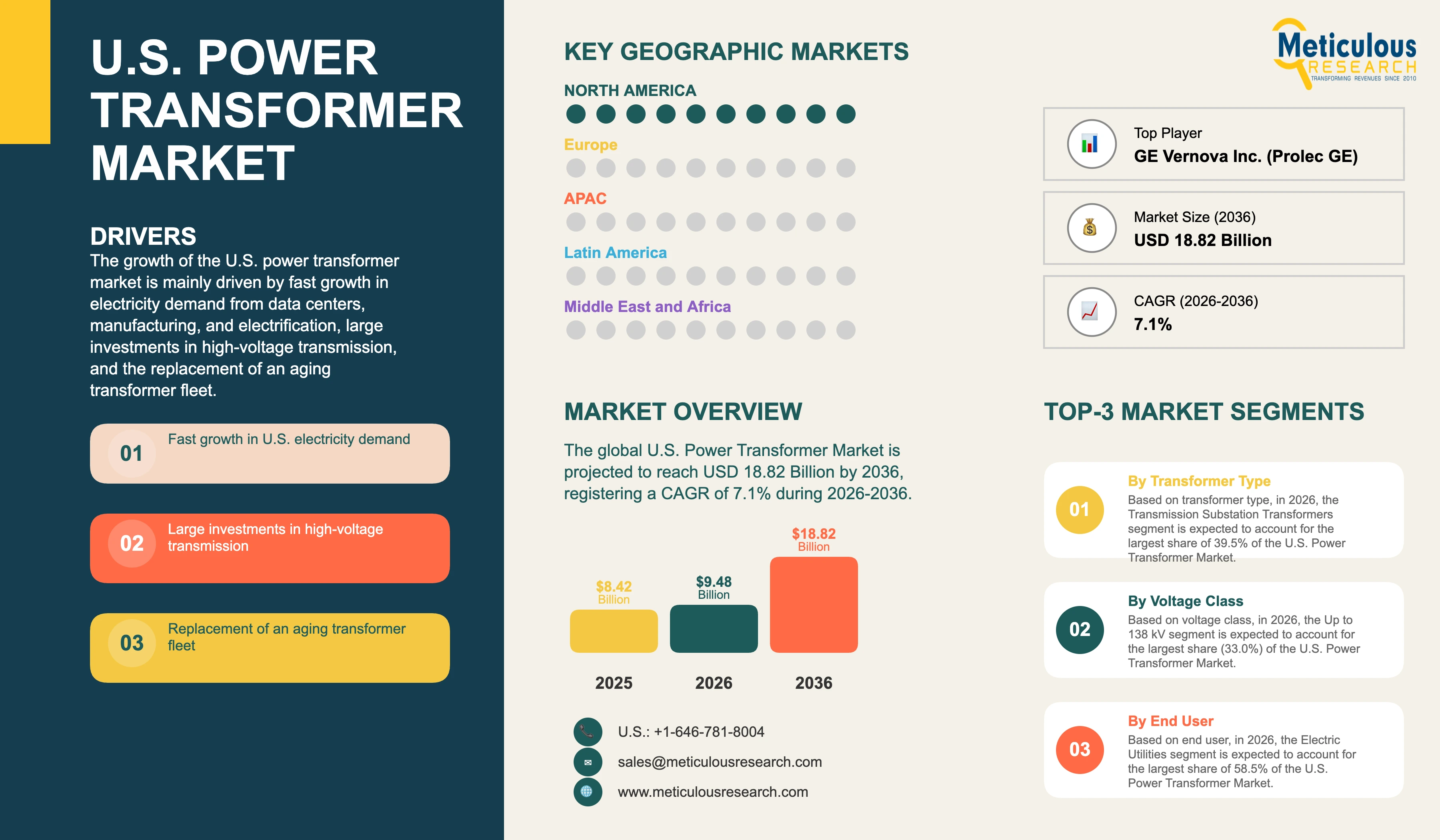
U.S. Power Transformer Market Size The U.S. power transformer market was valued at USD 8.42 billion in 2025. This market is expected to reach USD 18.82 billion by 2036 from an estimated USD 9.48 billion in 2026, registering a CAGR of 7.1% during the forecast period (2026-2036). In terms of volume, the
- Published
- Nov 2026
- Pages
- 197
- Format
- PDF + Excel
- Report ID
- MREP - 1042511
- Base year
- 2025
- 2025 · BASELINE
- $8.42B
- 2036
- $18.82B
- CAGR 2026–2036
- 7.1%
2025 baseline · 2026–2036 forecast at 7.1% CAGR · hover a bar for the value
Key highlights
Industry and government estimates indicate that imports supply roughly 80% of U.S. power transformer demand, and lead times for large power transformers have stretched to between two and four years, with extra-high-voltage units taking up to five years.
GE Vernova completed its acquisition of the remaining 50% of Prolec GE on 2 February 2026 for USD 5.275 billion, adding about 10,000 employees and seven manufacturing sites in the Americas, including five in the U.S.
Hitachi Energy broke ground in June 2026 on a USD 457 million large power transformer factory in South Boston, Virginia, part of more than USD 1 billion in U.S. investments, which it describes as the nation's largest facility for large power transformers when it opens in 2028.
Siemens Energy announced about USD 1 billion of U.S. investments in 2026, including USD 421 million for its North Carolina factory to expand large power transformer capacity, and Virginia Transformer announced a new factory in Muscle Shoals, Alabama, in May 2026.
Hyosung HICO announced a USD 157 million expansion of its Memphis plant in November 2025, raising capacity by 50% and making it the only U.S. facility dedicated to 765 kV transformers, while HD Hyundai Electric is building a second Alabama plant to raise extra-high-voltage capacity by about 50%.
The Public Utility Commission of Texas approved three 765 kV import paths into the Permian Basin in April 2025, introducing a new voltage class to the ERCOT grid, and the ERCOT board later endorsed further 765 kV backbone projects.
HVDC converter transformers are the fastest-growing transformer type, transformers above 345 kV are the fastest-growing voltage class, and data centers are the fastest-growing end user.
By transformer type, transmission substation transformers account for the largest share of 39.5% in 2026, while HVDC converter transformers register the highest CAGR.
By voltage class, transformers rated up to 138 kV account for the largest share in 2026, while transformers above 345 kV register the highest CAGR.
By insulation type, mineral oil-immersed transformers account for the largest share in 2026, while ester fluid-filled transformers register the highest CAGR.
By supply source, imported transformers account for the larger share in 2026, while domestically manufactured transformers register the higher CAGR.
By end user, electric utilities account for the largest share of 58.5% in 2026, while data centers register the highest CAGR.
Texas and Virginia are the leading state markets, supported by ERCOT's 765 kV transmission program, rapid load growth, and the largest concentration of data centers in the country in Northern Virginia.
Report summary
| Particulars | Details |
|---|---|
| Base Year | 2025 |
| Estimated Year | 2026 |
| Forecast Period | 2026-2036 |
| Market Size in 2025 (Value) | USD 8.42 billion |
| Market Size in 2026 (Value) | USD 9.48 billion |
| Market Size by 2036 (Value) | USD 18.82 billion |
| CAGR (Value, 2026-2036) | 7.1% |
| Format | PDF, Excel & Cloud Portal · 197 pages |
| Market Size in 2026 (Volume) | 6,547 units |
| Market Size by 2036 (Volume) | 11,478 units |
| CAGR (Volume, 2026-2036) | 5.8% |
| Largest Segment by Transformer Type (2026) | Transmission Substation Transformers (39.5%) |
| Largest Segment by End User (2026) | Electric Utilities (58.5%) |
| Leading State Markets | Texas, Virginia, Georgia, Arizona, and Ohio |
| Companies Profiled | 12 companies and other companies |
| Segments Covered | Transformer Type, Voltage Class, Insulation Type, Supply Source, End User |
| Geographic Scope | United States |
Report overview
Segments covered: transformer type, voltage class, insulation type, supply source, end user.
Power transformers change electricity from one voltage to another so that it can be generated, transmitted over long distances, and delivered to homes and businesses efficiently. In this report, power transformers include liquid-filled and dry-type units rated above 10 MVA, such as generator step-up transformers at power plants, transmission and autotransformers in high-voltage substations, distribution substation transformers that step voltage down for local networks, industrial and specialty transformers, and HVDC converter transformers. Large power transformers are among the most critical and expensive pieces of equipment on the grid, often custom-built for a specific site, and they can operate for 40 years or more.
The U.S. power transformer market is going through a period of exceptional demand and tight supply. After many years of flat electricity consumption, U.S. demand is now rising quickly as hyperscale and AI data centers, new manufacturing plants for semiconductors, batteries, and other products, and the electrification of transport and buildings add load. Utilities and grid operators are planning large investments in new transmission lines and substations, while developers are connecting large amounts of solar, wind, battery storage, and gas-fired generation, each of which needs generator step-up and substation transformers.
Supply has struggled to keep up with this demand, as industry and government estimates indicate that imports supply roughly 80% of U.S. power transformer needs, mainly from Mexico, South Korea, Europe, and other countries, and domestic manufacturing capacity for large power transformers is limited. Lead times for large power transformers have stretched to between two and four years, and extra-high-voltage units can take up to five years. Prices have also risen sharply because of higher costs for grain-oriented electrical steel, copper, and labor, and because demand has outpaced factory capacity. This imbalance has turned transformers into one of the main constraints on new grid connections in the U.S.
Manufacturers are responding with a wave of investment in U.S. production, as GE Vernova completed its acquisition of the remaining stake in Prolec GE in February 2026, giving it full control of five U.S. transformer plants, Hitachi Energy is building what it describes as the largest large power transformer factory in the U.S. in South Boston, Virginia, and Siemens Energy is expanding its North Carolina transformer plant. Hyosung HICO and HD Hyundai Electric are expanding their plants in Tennessee and Alabama, Virginia Transformer is building a new plant in Alabama, and WEG, Pennsylvania Transformer Technology, and others are adding capacity. Most of these projects will come online between 2026 and 2029, so imports are expected to remain important in the near term.
The grid itself is changing in ways that increase transformer demand, as Texas has approved its first 765 kV transmission lines to serve the Permian Basin and to strengthen the ERCOT grid, and other regions, including PJM and MISO, are planning extra-high-voltage lines to move power over long distances. HVDC projects are also moving forward to connect remote wind and solar resources and to link regional grids. These projects require large, high-value transformers that only a few manufacturers can build, which supports growth in the value of the market. Interconnection of new generation and large loads also requires many new substations at 138 kV and 345 kV, which adds to demand across voltage classes.
At the same time, a large part of the existing U.S. transformer fleet is old, with many units installed in the 1970s and 1980s now at or beyond their expected life. Utilities must replace these units to maintain reliability, and they are also buying spare transformers to reduce the risk of long outages if a unit fails, given the long lead times for new equipment. Grid resilience programs, including federal funding for grid upgrades and spare transformer sharing initiatives, add further demand. Utilities also face stricter reliability standards and more extreme weather, which increase the value of having spare units and more robust equipment. Long lead times also encourage utilities to order earlier.
Manufacturers are investing in new and expanded U.S. factories, including GE Vernova's acquisition of Prolec GE, Hitachi Energy's new Virginia plant, Siemens Energy's North Carolina expansion, Hyosung HICO's Memphis expansions, HD Hyundai Electric's second Alabama plant, and Virginia Transformer's new Alabama plant.
Transmission substation transformers are expected to account for the largest share of 39.5% of the market in 2026, while HVDC converter transformers are projected to register the highest CAGR.
Transformers above 345 kV are projected to register the highest CAGR, while transformers up to 138 kV hold the largest share in 2026.
Texas and Virginia are the leading state markets, supported by ERCOT's 765 kV transmission program, rapid load growth, and large data center clusters, followed by Georgia, Arizona, Ohio, and other states with strong data center, manufacturing, and generation growth.
The report profiles 12 companies, including GE Vernova Inc. (Prolec GE), Hitachi Energy Ltd., Siemens Energy AG, HD Hyundai Electric Co., Ltd., and Hyosung Heavy Industries Corporation. The top five players account for an estimated 52.5% of the market in 2025.
Report infographic
Market dynamics
15 factors across 5 forcesFast growth in U.S. electricity demand from data centers, manufacturing, and electrification
U.S. electricity demand is growing at its fastest pace in decades, as hyperscale and AI data centers require hundreds of megawatts at single sites, new factories for semiconductors, batteries, steel, and other products are being built across the country, and electric vehicles, heat pumps, and industrial electrification are adding load. Utilities in many regions have sharply raised their load forecasts, and grid operators are planning large amounts of new generation and transmission to serve this growth.
Each new data center campus, factory, or generation project needs power transformers to connect to the grid, often at high voltages. Large data center campuses may require their own high-voltage substations with several large transformers, and utilities serving them must expand upstream substations and transmission. LS Electric, for example, announced a USD 312 million contract in November 2025 to supply 525 kV extra-high-voltage transformers for a large data center project in the southeastern U.S. This demand is the main reason for the current transformer shortage and a key driver of market growth through 2036.
Large investments in high-voltage transmission
Utilities and grid operators are investing heavily in new transmission lines and substations to connect new generation, relieve congestion, and serve load growth. Texas regulators approved three 765 kV import paths into the Permian Basin in April 2025, introducing a new voltage class to the ERCOT grid, and the ERCOT board has since endorsed further 765 kV backbone projects. PJM, MISO, and other grid operators are also planning large regional and interregional transmission projects, including new extra-high-voltage lines.
New transmission requires large transmission substation transformers and autotransformers, often at 345 kV, 500 kV, or 765 kV, which are among the highest-value units in the market. Hyosung HICO's Memphis plant is the only U.S. facility dedicated to 765 kV transformers, and HD Hyundai Electric is adding capacity for units rated up to 765 kV in Alabama, reflecting the strong demand for extra-high-voltage equipment. Transmission investment is expected to remain high over the forecast period, supporting demand for large power transformers. Federal efforts to speed up transmission permitting and interregional planning could add further demand if they succeed.
Replacement of an aging transformer fleet
Much of the U.S. transformer fleet was installed during the grid expansion of the 1960s to 1980s, and a large share of units are now at or beyond their typical design life of around 40 years. Older transformers are more likely to fail, and a failure can cause long outages, especially when replacement units take years to build. Utilities are therefore increasing planned replacements, using condition monitoring to identify units at risk, and buying spare transformers to protect against failures.
Replacement demand provides a steady base of orders that is less dependent on new load growth. It also creates opportunities for manufacturers to supply modern, more efficient units with digital monitoring and environmentally friendly insulating fluids. Federal and state grid resilience programs, along with industry efforts to share spare transformers among utilities, further support replacement and spare purchases. Replacement units are often larger than the original equipment, as utilities size them for future load growth, which raises the value of each order.
Connection of new renewable, storage, and gas-fired generation
Large amounts of new generation are being connected to the U.S. grid, including utility-scale solar, onshore and offshore wind, battery storage, and new gas-fired plants built to meet rising demand and replace retiring coal units. Each of these projects requires generator step-up transformers or collector substation transformers to connect to the transmission grid, and large projects often need several units. Demand for generator step-up transformers has grown sharply in recent years, and these units have some of the longest lead times in the market.
Interconnection queues in the U.S. contain very large volumes of proposed generation and storage, and even if only part of this capacity is built, it will require a large number of transformers. Developers are increasingly ordering transformers early, before projects are fully approved, to secure manufacturing slots, which supports order books at manufacturers. The growth of gas-fired generation to serve data centers is also adding demand for large generator step-up transformers. Battery storage projects, which are being built at large scale in Texas, California, and Arizona, also need step-up transformers to connect to the grid.
Table of contents
12 chapters · 97 sections · 197 pages · click to expandSegmental analysis
| Segment | Largest share (2026) | Fastest growth (2026–2036) |
|---|---|---|
| By Transformer Type | Electric utilities | Data centers |
By Transformer Type
- Electric utilities are expected to account for the largest share of 58.5% of the market in 2026, while data centers are projected to register the highest CAGR.
Geographic analysis
North America
Fastest growthThe U.S. power transformer market was valued at USD 8.42 billion in 2025. This market is expected to reach USD 18.82 billion by 2036 from an estimated USD 9.48 billion in 2026, registering a CAGR of 7.1% during the forecast period (2026-2036). In terms of volume, the U.S. power transformer market is expected to reach 11,478 units by 2036 from an estimated 6,547 units in 2026, registering a CAGR of 5.8% during the forecast period (2026-2036). The growth of this market is mainly driven by the fastest growth in U.S. electricity demand in decades, led by data centers, manufacturing reshoring, and electrification, large investments in new high-voltage transmission lines, including the first 765 kV networks in Texas, the replacement of an aging fleet of transformers installed decades ago, and the connection of large volumes of new solar, wind, battery storage, and gas-fired generation to the grid. However, factors such as long manufacturing lead times and limited domestic production capacity, together with volatile prices for grain-oriented electrical steel, copper, and other materials, are expected to restrain the growth of this market to some extent. Demand for power transformers is spread across the U.S., but it is strongest in states with rapid load growth, large transmission programs, and concentrations of data centers, manufacturing, and new generation. Southern states, led by Texas and Virginia, account for a large part of current demand, as utilities there respond to data center growth, new factories, oil and gas activity, and population growth, and as Texas builds out its first 765 kV transmission network under ERCOT's Permian Basin Reliability Plan and Strategic Transmission Expansion Plan. Texas is the largest single state market, supported by the ERCOT grid's rapid load growth, the Permian Basin Reliability Plan and 765 kV transmission program, very large solar, wind, and battery storage development, and growing numbers of data centers. Virginia hosts the largest concentration of data centers in the world in Northern Virginia, which drives large substation and transmission investments by Dominion Energy and others. Georgia, the Carolinas, Tennessee, and Alabama are also seeing strong growth from data centers and new factories. The South is also home to many new transformer factories, including Hitachi Energy's Virginia plant, Hyosung HICO's Memphis plant, HD Hyundai Electric's Alabama plants, Siemens Energy's North Carolina plant, and Virginia Transformer's new Alabama plant. Western states are also important markets, supported by strong growth in data centers in Arizona, Nevada, Oregon, and Washington, large solar and battery storage projects in California, Arizona, and Nevada, and transmission projects to move renewable energy across the region. Wildfire risk and grid hardening programs in California and other western states also drive transformer replacement and new substation investments. Interregional transmission projects connecting wind and solar resources in the Mountain West with demand centers on the West Coast also require large transformers. In the Midwest, MISO's long-range transmission projects, wind and solar development, data center growth in Ohio, Illinois, and Iowa, and new manufacturing plants support demand. In the Northeast, aging infrastructure replacement, offshore wind connections, state clean energy programs, and PJM transmission projects in Pennsylvania and New Jersey drive investment. Data center growth is also spreading to Pennsylvania, Ohio, and other states in PJM, adding to demand in these regions. Utilities in these regions are also upgrading older substations in dense urban areas, where space limits and fire safety rules favor compact and ester-filled designs. These upgrades support steady replacement demand across older cities. Demand from data centers, transmission projects, and new generation has risen faster than manufacturing capacity, and about 80% of supply depends on imports. Large power transformers are custom-built and require specialized materials, skilled labor, and testing, so lead times have stretched to two to four years and up to five years for extra-high-voltage units. U.S. Power Transformer Market Size Geographic Analysis
Competitive landscape
The U.S. power transformer market is served by a mix of global manufacturers with U.S. and Mexican plants, South Korean exporters with growing U.S. production, and domestic manufacturers. GE Vernova became one of the largest suppliers after completing its acquisition of Prolec GE in February 2026, gaining five U.S. plants and a broad portfolio of power and distribution transformers. Hitachi Energy and Siemens Energy are major suppliers of large and extra-high-voltage transformers and are investing heavily in new U.S. capacity.
South Korean manufacturers have become important suppliers to U.S. utilities, as HD Hyundai Electric operates a plant in Montgomery, Alabama, where it marked its 1,000th extra-high-voltage transformer in 2026, and is building a second plant, while Hyosung HICO operates a large plant in Memphis, Tennessee, that is being expanded for 765 kV units. LS Electric is expanding its U.S. operations and has won large contracts for extra-high-voltage transformers. Other suppliers include WEG, Mitsubishi Electric Power Products, Toshiba, Virginia Transformer, Pennsylvania Transformer Technology, and exporters from Turkey and other countries, such as Astor Enerji. WEG and Virginia Transformer have both expanded U.S. production of medium and large power transformers, and domestic manufacturers often compete on shorter lead times for standard designs.
The top five players are estimated to account for 52.5% of the market in 2025, reflecting the strong positions of GE Vernova (Prolec GE), Hitachi Energy, Siemens Energy, HD Hyundai Electric, and Hyosung. Competition is centered on delivery times, manufacturing capacity, extra-high-voltage capability, price, and service support, and manufacturers with available capacity have strong pricing power in the current market. Utilities increasingly evaluate suppliers on their U.S. footprint and track record of on-time delivery, which favors manufacturers that are investing in local production.
Manufacturers use several strategies to grow in this market, including building and expanding U.S. factories, acquiring other manufacturers, signing long-term framework agreements with utilities and data center developers, and expanding service and digital monitoring offerings. As new capacity comes online between 2026 and 2029, competition is expected to intensify, and buyers may gain more negotiating power.
Some of the key players operating in the U.S. power transformer market are GE Vernova Inc. (Prolec GE), Hitachi Energy Ltd., Siemens Energy AG, HD Hyundai Electric Co., Ltd., Hyosung Heavy Industries Corporation (Hyosung HICO), LS Electric Co., Ltd., WEG S.A., Mitsubishi Electric Power Products, Inc., Toshiba Energy Systems & Solutions Corporation, Virginia Transformer Corp., Pennsylvania Transformer Technology, LLC, and Astor Enerji A.S., among others.
- —
GE Vernova completed its USD 5.275 billion acquisition of the remaining stake in Prolec GE in February 2026, Hitachi Energy broke ground on its South Boston, Virginia, factory in June 2026, Siemens Energy announced USD 421 million for its North Carolina transformer plant, and Virginia Transformer announced a new Alabama plant in May 2026. Together, these investments will add significant domestic manufacturing capacity over the coming years.
- WEG
- Mitsubishi Electric Power Products
- Toshiba
- Virginia Transformer
- Pennsylvania Transformer Technology
Expert perspectives
The U.S. power transformer market has moved from a stable replacement market to one of the tightest equipment markets in the energy sector. The combination of rapid load growth, large transmission investments, new generation, and an aging fleet has created demand that far exceeds domestic manufacturing capacity, resulting in long lead times and higher prices. This situation is expected to persist in the near term, as new factories take several years to reach full output.
The wave of investment in U.S. manufacturing, led by GE Vernova, Hitachi Energy, Siemens Energy, Hyosung HICO, HD Hyundai Electric, and Virginia Transformer, will gradually improve supply and raise the share of domestically manufactured units. As capacity increases from 2027 onward, lead times are expected to ease somewhat, but demand from data centers and transmission will keep the market strong through the forecast period.
HVDC converter transformers are the fastest-growing transformer type, transformers above 345 kV are the fastest-growing voltage class, and data centers are the fastest-growing end user. Ester fluid-filled transformers are the fastest-growing insulation type, and domestically manufactured transformers are growing faster than imports. Texas and Virginia remain the most important state markets, led by transmission expansion and data center growth.
The main swing factors are the pace of data center and AI-related load growth, which could rise or fall depending on technology and investment trends, the speed of transmission permitting and construction, and trade policy, which affects the cost and availability of imported transformers and materials. Volume is expected to grow more slowly than value, as the mix shifts toward larger, higher-voltage units. Policy decisions on tariffs and domestic content could also change the balance between imported and domestically built units faster than expected.
For buyers, the key decision is how to secure supply in a tight market. Utilities and developers that plan purchases early, use standardized designs, and sign long-term agreements with manufacturers will be better placed to meet their project schedules. For manufacturers, the challenge is to expand capacity quickly while maintaining quality and managing material and workforce constraints. Manufacturers that over-expand may face pricing pressure later in the decade if demand growth slows, so disciplined investment will be important.
Overall, growth in this market rests on the structural rise in U.S. electricity demand and the need to expand and renew the grid. Manufacturers that combine U.S. production capacity, extra-high-voltage capability, and reliable delivery are expected to capture most of this growth. Supply constraints are expected to ease gradually as new U.S. factories ramp up production through the decade.
Customer perspectives
Vice President of Transmission Planning - investor-owned utility, Texas
We used to order a large autotransformer and get it in about a year. Now we are reserving factory slots three years ahead and buying spares just to protect the system. The 765 kV build-out means we need equipment that only a handful of plants can make.
Long lead times and large transmission programs are driving utility demand for transmission substation transformers, which hold 39.5% of the market, and making electric utilities the largest end user at 58.5%. Texas's 765 kV program is also one of the largest sources of demand for extra-high-voltage transformers in the country.
Director of Power Infrastructure - hyperscale data center developer, U.S.
Power is the gating item for every new campus, and the transformer is often the longest lead piece. We now buy high-voltage transformers ourselves and hand them to the utility, because waiting in line would push our projects out by years.
Direct purchasing by data center developers and their very large power needs are making data centers the fastest-growing end user, and they are supporting demand for higher-voltage substation transformers.
Procurement Manager - renewable energy developer, Arizona
For our solar and storage projects, the main transformer can decide whether we hit our in-service date. We are signing framework agreements with manufacturers that have U.S. plants, even at a higher price, because certainty of delivery matters more.
The value placed on reliable delivery is supporting the faster growth of domestically manufactured transformers and generator step-up transformers for new generation projects across the country.
Frequently asked questions
The market was valued at USD 8.42 billion in 2025 and USD 7.35 billion in 2024, and is estimated at USD 9.48 billion in 2026.
Cite this report
Meticulous Research. (2026). U.S. Power Transformer Market - Global Opportunity Analysis and Industry Forecast (2026-2036) (Report No. MREP - 1042511). Meticulous Market Research Pvt. Ltd. https://www.meticulousresearch.com/product/us-power-transformer-market-7194