Africa Solar Mini-Grids Market (2026-2036)
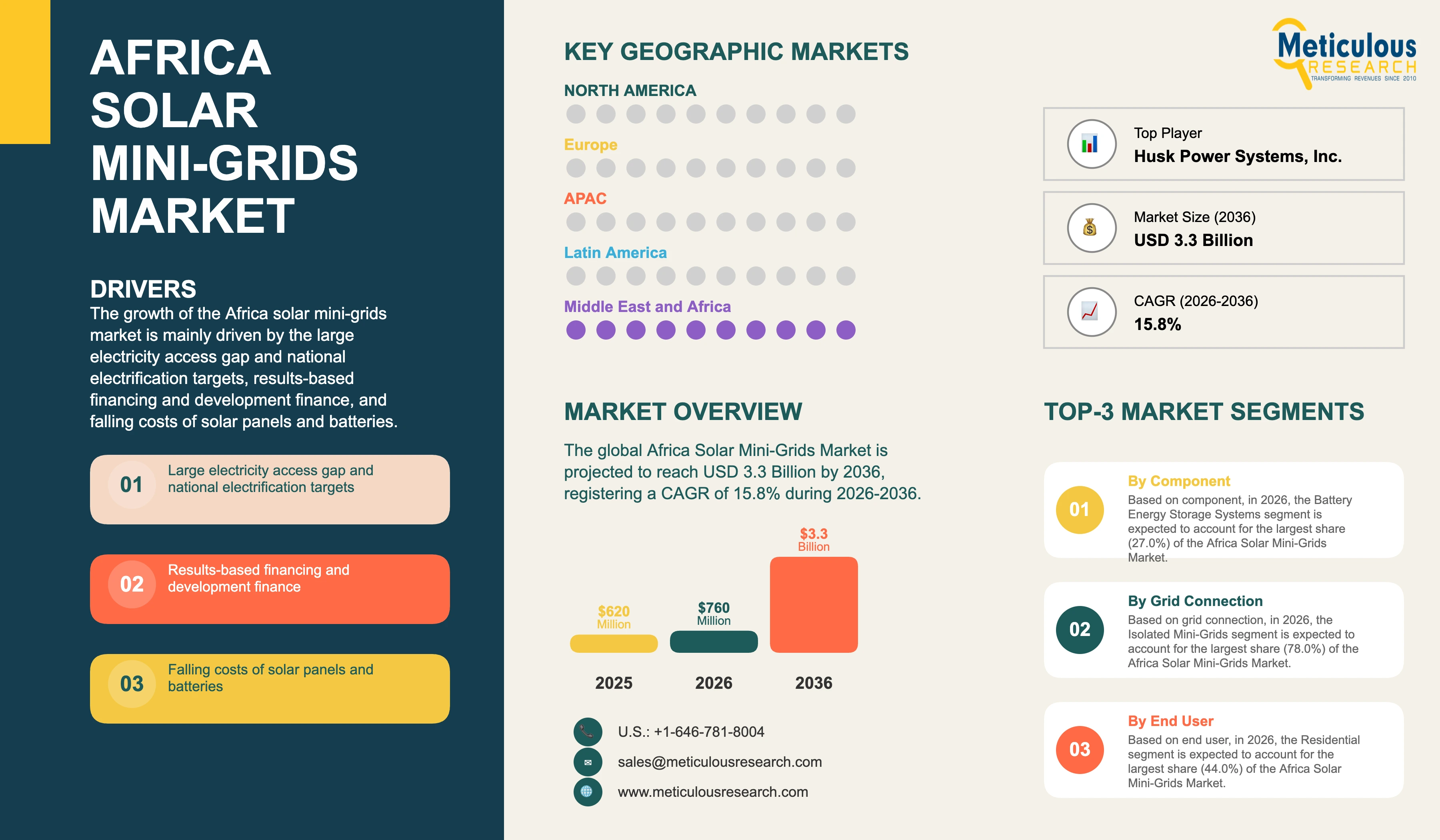
The Africa solar mini-grids market was valued at USD 620.0 million in 2025. This market is expected to reach USD 3.30 billion by 2036 from an estimated USD 760.0 million in 2026, registering a CAGR of 15.8% during the forecast period (2026-2036).
- Published
- Nov 2026
- Pages
- 205
- Format
- PDF + Excel
- Report ID
- MREP - 1042508
- Base year
- 2025
- 2025 · BASELINE
- $620.0M
- 2036
- $3.30B
- CAGR 2026–2036
- 15.8%
2025 baseline · 2026–2036 forecast at 15.8% CAGR · hover a bar for the value
Key highlights
Mission 300, launched by the World Bank Group and the African Development Bank in 2024, aims to connect 300 million people in Africa to electricity by 2030, with about half expected to be reached through grid expansion and the rest through off-grid solutions such as mini-grids and solar home systems; the two banks reported in June 2026 that more than 50 million people had been connected across 40 countries since the launch.
The World Bank Group and the African Development Bank had committed close to USD 15 billion directly to Mission 300 projects as of June 2026, with a further USD 4.5 billion mobilized in co-financing from partners.
Nigeria's USD 750 million Distributed Access through Renewable Energy Scale-up project, financed by the World Bank and implemented by the Rural Electrification Agency, aims to deliver solar mini-grids and standalone solar systems to about 17.5 million Nigerians, and its Minimum Subsidy Tender for interconnected mini-grids signed its first developer contracts in May 2026.
Independent analysis by ODI of the World Bank's June 2026 project report found that the Nigerian project had commissioned 67 isolated mini-grids and over one million solar home systems, showing that mini-grid deployment is accelerating but still at an early stage relative to targets.
Mini-grid developers, such as Husk Power Systems, Engie Energy Access, PowerGen Renewable Energy, Nuru, and Virtuitis Solaris, are scaling portfolios across Nigeria, East Africa, and the Democratic Republic of the Congo, with some developers planning hundreds of new mini-grids each.
Zafiri, an investment vehicle launched under Mission 300 with initial capitalization from the World Bank Group and the African Development Bank, is expected to scale to about USD 1 billion to support distributed renewable energy companies and reach about 30 million people.
By component, battery energy storage systems account for the largest share of 27.0% in 2026, while operation and maintenance services register the highest CAGR.
By grid connection, isolated mini-grids account for the largest share in 2026, while grid-interconnected mini-grids register the higher CAGR.
By configuration, solar-plus-storage mini-grids account for the largest share in 2026 and register the higher CAGR.
By end user, residential customers account for the largest share of 44.0% in 2026, while productive use registers the highest CAGR.
By country, Nigeria accounts for the largest share of 26.0% in 2026, while the Democratic Republic of the Congo registers the highest CAGR of 21.0%.
Report summary
| Particulars | Details |
|---|---|
| Forecast Period | 2026-2036 |
| Base Year | 2025 |
| Estimated Year | 2026 |
| CAGR (Value) | 15.8% |
| Format | PDF, Excel & Cloud Portal · 205 pages |
| Market Size (Value) in 2025 | USD 620.0 million |
| Market Size (Value) in 2026 | USD 760.0 million |
| Market Size (Value) in 2036 | USD 3.30 billion |
| Largest Segment by Component (2026) | Battery Energy Storage Systems (27.0%) |
| Largest Segment by End User (2026) | Residential (44.0%) |
| Largest Country (2026) | Nigeria (26.0%) |
| Fastest-Growing Country | Democratic Republic of the Congo (CAGR 21.0%) |
| Segments Covered | Component, Grid Connection, Configuration, Capacity, End User, and Country |
| Countries Covered | Nigeria, Kenya, Tanzania, Democratic Republic of the Congo, Ethiopia, Uganda, Zambia, Sierra Leone, Madagascar, and Rest of Africa |
| Key Companies | Husk Power Systems, Engie Energy Access, PowerGen, Nuru, Winch Energy, Equatorial Power, Havenhill Synergy, Rubitec Solar, Virtuitis Solaris, Arnergy, SMA, Victron Energy, Huawei Digital Power, and Schneider Electric |
Report overview
Segments covered: component, grid connection, configuration, capacity, end user.
The growth of this market is mainly driven by the very large number of people in Africa without access to electricity, particularly in rural areas far from national grids, large electrification programs such as Mission 300, led by the World Bank Group and the African Development Bank, results-based financing and subsidy programs that support private mini-grid developers, the falling cost of solar panels and lithium-ion batteries, which makes solar mini-grids cheaper than diesel generation and grid extension in many areas, and growing demand for reliable power for businesses, farms, health centers, and schools. However, factors such as the high upfront cost of mini-grids and limited access to affordable finance, low electricity demand and ability to pay in many rural communities, regulatory and tariff uncertainty, currency risk, and the risk of the national grid arriving in mini-grid areas are expected to restrain the growth of this market to some extent.
A solar mini-grid is a small electricity generation and distribution system that uses solar photovoltaic panels, usually combined with batteries and sometimes a backup diesel generator, to supply electricity to a community, town, business cluster, or institution through a local distribution network. Mini-grids typically range from a few kilowatts to several hundred kilowatts or more and serve from a few dozen to several thousand customers. They can operate independently of the national grid, known as isolated mini-grids, or be connected to the grid, known as interconnected mini-grids, to improve reliability in areas where grid supply is weak.
This market covers the revenue generated from solar and solar-hybrid mini-grid systems and services in Africa, measured in value. It includes battery energy storage systems, solar PV modules, distribution networks and smart meters, inverters and controllers, balance of system components, installation and engineering, procurement, and construction services, and operation and maintenance services, for isolated and grid-interconnected mini-grids of all capacities serving residential, commercial, productive use, public institution, telecom, and other customers. It is segmented by component, grid connection, configuration, capacity, end user, and country. Revenue from electricity sales by mini-grid operators, solar home systems, standalone solar products, and utility-scale solar plants is not included.
Africa has the largest electricity access gap in the world, with most of the people without electricity living in sub-Saharan Africa, many in rural areas far from the national grid where grid extension is very expensive. Solar mini-grids have become one of the main solutions for these areas, because they can provide reliable electricity for households, businesses, and public services at a lower cost than extending the grid or using diesel generators, and they can be built quickly. The World Bank and other development partners estimate that a large share of new electricity connections in Africa by 2030 will come from off-grid solutions, including mini-grids.
Most mini-grids in Africa are built and operated by private developers, which finance the systems with a combination of equity, debt, and grants or subsidies, and recover their costs by selling electricity to customers, usually through prepaid smart meters and mobile money payments. Because rural customers often have low incomes and consume little electricity, tariffs that fully recover costs can be high, and many projects depend on subsidies, such as results-based grants per connection, to be viable. Governments, development finance institutions, and donors provide much of this support through programs such as Mission 300, Nigeria's Distributed Access through Renewable Energy Scale-up project, and other national electrification programs.
The cost of solar mini-grids has fallen significantly over the past decade, mainly because of lower prices for solar panels and lithium-ion batteries, improvements in system design, standardized and modular designs, and remote monitoring. Lithium iron phosphate batteries have largely replaced lead-acid batteries in new mini-grids, offering longer life and better performance. Smart meters and digital platforms allow operators to manage customers, collect payments, and monitor systems remotely, which reduces operating costs.
Mini-grids are increasingly designed to support productive uses of electricity, such as grain milling, agro-processing, cold storage, welding, water pumping, and small manufacturing, which increase electricity demand, improve the economics of mini-grids, and create local economic development. Developers also serve anchor customers, such as telecom towers, health centers, schools, and businesses, which provide stable demand.
Mini-grids also offer advantages over solar home systems, which provide small amounts of power to individual households. Mini-grids can supply larger loads, such as motors, refrigeration, and machinery, which are needed for businesses and public services, and they can provide a service similar to grid electricity. As a result, solar home systems and mini-grids are increasingly seen as complementary, with solar home systems serving very dispersed households and mini-grids serving villages, towns, and business clusters.
Over the forecast period, the Africa solar mini-grids market is expected to grow rapidly, supported by Mission 300 and national electrification programs, falling costs, improved financing, and growing demand for productive use and interconnected mini-grids. Growth will depend on the availability of affordable finance, regulatory frameworks that protect mini-grid investments, and the ability of developers to scale their operations profitably.
Report infographic
Market dynamics
17 factors across 5 forcesLarge electricity access gap and national electrification targets
Hundreds of millions of people in sub-Saharan Africa still lack access to electricity, according to the World Bank, and most of them live in rural areas where extending the national grid is slow and expensive. Governments across Africa have set targets to achieve universal electricity access, and many have adopted national electrification plans that include mini-grids as a key solution for areas that are too far from the grid or too sparsely populated for grid extension to be economical.
Mission 300, launched by the World Bank Group and the African Development Bank in 2024, aims to connect 300 million people to electricity by 2030, with about half of these connections expected to come from off-grid solutions, including mini-grids and solar home systems. Under Mission 300, many countries have prepared national energy compacts that set out plans and reforms to expand access, including mini-grid programs. Nigeria accounts for the largest share of the market by country, supported by its large unelectrified population and the Distributed Access through Renewable Energy Scale-up project.
National energy compacts typically include commitments to improve regulatory frameworks for mini-grids, to set cost-reflective tariffs or provide subsidies, to streamline licensing, and to integrate mini-grids into national electrification plans, which improves the investment climate for developers. Countries that have prepared compacts include Nigeria, Tanzania, Zambia, Malawi, Madagascar, Côte d'Ivoire, and many others.
Results-based financing and development finance
Development finance institutions and donors provide large amounts of funding for mini-grids in Africa, through results-based grants that pay developers per connection, concessional loans, guarantees, and equity investments. Programs such as the World Bank's Distributed Access through Renewable Energy Scale-up project in Nigeria, the Rural Electrification Agency's earlier Nigeria Electrification Project, the Africa Minigrids Program supported by the Global Environment Facility and UNDP, and national programs in Kenya, Tanzania, Zambia, Sierra Leone, and other countries reduce the cost of mini-grids for developers and customers.
The World Bank Group and the African Development Bank had committed close to USD 15 billion directly to Mission 300 projects as of June 2026, and new investment vehicles, such as Zafiri, are expected to provide equity and other finance to distributed renewable energy companies. This funding is expected to support rapid growth in the number of mini-grids built over the forecast period.
Falling costs of solar panels and batteries
The cost of solar panels has fallen dramatically over the past decade, and the cost of lithium-ion batteries has also declined, which has made solar mini-grids much cheaper to build and operate. Solar mini-grids with batteries can now provide electricity at a lower cost than diesel generators in many areas, particularly as diesel prices and transport costs in remote areas are high. Lower equipment costs also reduce the subsidy needed per connection, which allows funding programs to reach more people with the same budget.
Battery energy storage systems are the largest cost component of most solar mini-grids, because batteries are needed to supply power at night and during cloudy periods, and they account for the largest share of the market by component. Continued declines in battery costs and improvements in battery life are expected to support the shift from solar-diesel hybrid systems to solar-plus-storage systems.
Demand for reliable power for businesses and public services
Businesses, farms, health centers, schools, and telecom towers in rural Africa need reliable electricity to operate, and many currently depend on expensive and polluting diesel generators. Mini-grids can provide cheaper and more reliable power, which supports economic activity, jobs, and public services in rural areas. Productive uses of electricity, such as milling, agro-processing, cold storage, and irrigation, are a key focus of developers and funders, because they increase demand and income in communities.
Health facilities and schools are also important users, as reliable electricity is needed for medical equipment, vaccine refrigeration, lighting, and digital learning, and programs such as Sierra Leone's solar mini-grids for health centers show how mini-grids can support public services. Productive use is the fastest-growing end user in this market.
Telecom towers in rural areas are another important anchor load, as tower operators want to replace diesel generators with solar power to reduce fuel costs and theft, and some mini-grid developers build systems that supply both towers and surrounding communities.
Table of contents
13 chapters · 111 sections · 205 pages · click to expandSegmental analysis
| Segment | Largest share (2026) | Fastest growth (2026–2036) |
|---|---|---|
| By Component | Battery energy storage systems | Operation and maintenance services |
| By Grid Connection | Isolated mini-grids | — |
| By Configuration | Solar-plus-storage mini-grids | — |
| By Capacity | 50 kW to 250 kW | Above 250 kW |
| By End User | Residential | Productive use |
By Component
- Africa Solar Mini-Grids Market Analysis by Component
- The battery energy storage systems segment is expected to account for the largest share of 27.0% of the market.
- The large share of this segment is mainly due to the need for batteries to supply electricity at night and during cloudy periods, the high cost of batteries relative to other components, and the shift from solar-diesel hybrid systems to solar-plus-storage systems that rely more heavily on storage.
- Most new mini-grids in Africa now use lithium iron phosphate batteries, which offer longer life, deeper discharge, and lower maintenance than lead-acid batteries, and battery suppliers from China dominate the market.
- Battery systems are often supplied with battery management systems and integrated with inverters and controllers from companies such as SMA, Victron Energy, Huawei, and Schneider Electric.
- Battery sizing is critical to mini-grid design, as developers must balance the cost of storage against the need for reliable supply and the risk of unused capacity.
- Battery replacement over the 20-year life of a mini-grid is also a significant cost, which supports demand for operation and maintenance services.
- Battery energy storage systems are expected to remain the largest component over the forecast period.
- However, the operation and maintenance services segment is projected to register the highest CAGR during the forecast period.
- The rapid growth of this segment is driven by the growing installed base of mini-grids and the need for professional operation, monitoring, and maintenance.
- Solar PV modules, distribution networks and smart meters, inverters and controllers, installation and EPC services, and balance of system make up the rest of the market.
- Solar PV modules are the second-largest component, and module prices have fallen sharply in 2024 and 2025 in recent years because of large production capacity in China, which reduces the cost of mini-grids.
- Distribution networks, poles, cables, service connections, and smart meters are a significant cost, particularly for mini-grids serving dispersed customers, and smart prepaid meters are essential for collecting payments and managing customers.
- Inverters, charge controllers, and energy management systems manage the flow of power between solar panels, batteries, generators, and customers, while installation and EPC services cover the design and construction of mini-grids.
- Operation and maintenance services are growing rapidly as the number of operating mini-grids increases and as developers outsource maintenance or use remote monitoring services.
By Grid Connection
- Africa Solar Mini-Grids Market Analysis by Grid Connection
- The isolated mini-grids segment is expected to account for the largest share of the market, due to their use in remote communities without grid access.
- However, the grid-interconnected mini-grids segment is projected to register the higher CAGR during the forecast period, driven by programs to improve power supply in grid-connected but underserved areas.
- Isolated mini-grids serve communities that have no access to the national grid and are expected to remain the main form of mini-grid in Africa throughout the forecast period, particularly in rural areas of the Democratic Republic of the Congo, Ethiopia, Madagascar, and other countries with low grid coverage.
- Grid-interconnected mini-grids serve communities that are connected to the grid but receive poor service, and they are expected to grow rapidly in Nigeria and other countries with large distribution networks and frequent outages.
By Configuration
- Africa Solar Mini-Grids Market Analysis by Configuration
- The solar-plus-storage mini-grids segment is expected to account for the largest share of the market and is projected to register the higher CAGR, driven by falling battery costs and the desire to reduce diesel use.
- Solar-diesel hybrid mini-grids remain important for larger systems and areas with high seasonal demand.
- Solar-plus-storage mini-grids rely on solar panels and batteries to supply all or most of the electricity, sometimes with a small backup generator, and they avoid fuel costs and emissions.
- Solar-diesel hybrid mini-grids combine solar generation with diesel generators, which reduces the battery capacity needed and provides backup during long periods of low solar output, and they remain common for larger systems and for converting existing diesel mini-grids.
By Capacity
- Africa Solar Mini-Grids Market Analysis by Capacity
- The 50 kW to 250 kW segment is expected to account for the largest share of the market, as this size range suits most rural communities and larger villages with a mix of household and business demand.
- However, the above 250 kW segment is projected to register the highest CAGR, driven by larger mini-grids for towns, interconnected systems, and productive use clusters.
- Small mini-grids of up to 50 kW serve small villages and are often supported by results-based grants per connection, while mini-grids of 50 kW to 250 kW serve larger villages and small towns with mixed residential and commercial demand.
- Large mini-grids above 250 kW, including systems of several megawatts, serve towns, industrial clusters, markets, and interconnected systems, and their growth reflects the shift toward larger projects that achieve better economics.
By End User
- Africa Solar Mini-Grids Market Analysis by End User
- The residential segment is expected to account for the largest share of 44.0% of the market.
- The large share of this segment is mainly due to the large number of households connected to mini-grids, which form most of the customer base for mini-grid developers, and the focus of electrification programs on household connections.
- Households use mini-grid electricity for lighting, phone charging, televisions, fans, and refrigerators, and increasingly for electric cooking appliances, and their consumption tends to grow over time as they acquire appliances.
- Results-based grants are often linked to the number of household connections, which supports this segment, and electrification programs measure their success mainly by the number of people and households connected.
- Residential customers are expected to remain the largest end user over the forecast period.
- However, the productive use segment is projected to register the highest CAGR during the forecast period.
- The rapid growth of this segment is driven by programs that combine mini-grids with agricultural processing and small business equipment.
- Commercial, public institutions, and telecom and other end users make up the rest of the market.
- Commercial customers, such as shops, restaurants, and small businesses, consume more electricity than households and are important for mini-grid revenue.
- Productive use customers, such as mills, agro-processors, welders, and irrigation users, have the highest demand and are a focus of developers and funders.
- Public institutions, such as health centers, schools, and government offices, provide stable demand, while telecom towers and other customers serve as anchor loads.
Geographic analysis
Middle East & Africa
Largest shareIn 2026, Nigeria is expected to account for the largest share of 26.0% of the Africa solar mini-grids market. The large share of this country is mainly due to its large unelectrified population, its well-developed mini-grid regulations, strong government and donor support through the Rural Electrification Agency and the World Bank-financed Distributed Access through Renewable Energy Scale-up project, and the presence of many active mini-grid developers. Nigeria has one of the most active mini-grid sectors in Africa, with developers such as Husk Power Systems, Havenhill Synergy, Rubitec Solar, Virtuitis Solaris, Arnergy, and many others building isolated and interconnected mini-grids. The Distributed Access through Renewable Energy Scale-up project aims to deliver solar mini-grids and standalone solar systems to about 17.5 million people, and its tenders for interconnected mini-grids are expected to expand the market significantly. Nigeria is expected to remain the largest market throughout the forecast period. Nigeria's large population living in grid-connected areas with poor supply also makes it the leading market for interconnected mini-grids, which are being developed in partnership with electricity distribution companies under the Distributed Access through Renewable Energy Scale-up project and earlier programs, and private investors have committed significant capital to Nigerian mini-grid developers. The Democratic Republic of the Congo is projected to register the highest CAGR of 21.0% during the forecast period. Growth is driven by its very large unelectrified population, large urban and peri-urban mini-grid projects, and support under Mission 300. Kenya, Tanzania, Ethiopia, Uganda, Zambia, Sierra Leone, and Madagascar are other important markets, supported by national programs and development finance. Kenya and Tanzania have long-established mini-grid sectors, supported by clear regulations, government programs, and active developers, such as PowerGen and Engie Energy Access, and Tanzania has one of the largest numbers of mini-grids in East Africa. Ethiopia has a large unelectrified rural population and is developing mini-grid programs with development partners, while Uganda and Zambia have mini-grid programs supported by results-based financing. Sierra Leone has built solar mini-grids for communities and health centers with international support, and Madagascar has active private developers and a large access gap. The rest of Africa includes Mozambique, Malawi, Niger, Benin, Togo, Côte d'Ivoire, Senegal, Burkina Faso, Mali, Chad, and other countries with growing mini-grid programs, many of them supported by the African Development Bank's Desert to Power initiative, the World Bank, and bilateral partners.
Competitive landscape
The Africa solar mini-grids market is fragmented, with mini-grid developers and operators, equipment manufacturers, EPC contractors, and digital platform providers. Leading companies include Husk Power Systems, Engie Energy Access, PowerGen Renewable Energy, Nuru, Winch Energy, Equatorial Power, Havenhill Synergy, Rubitec Solar, Virtuitis Solaris, Arnergy, SMA Solar Technology, Victron Energy, Huawei Digital Power, and Schneider Electric.
Developers compete mainly on access to finance, cost of construction and operation, site selection, customer management, productive use strategies, and relationships with governments and funders. Equipment suppliers compete on price, reliability, warranties, local service, and technical support, and on how well their products perform in very hot, dusty, and remote conditions with limited maintenance.
Specialist mini-grid developers, such as Husk Power Systems, Engie Energy Access, PowerGen, Nuru, Winch Energy, Equatorial Power, Havenhill Synergy, Rubitec Solar, Virtuitis Solaris, and Arnergy, build and operate mini-grids, often across several countries, and some have raised large amounts of equity and debt from impact investors and development finance institutions to expand their portfolios. Equipment suppliers, such as SMA Solar Technology, Victron Energy, Huawei Digital Power, and Schneider Electric, provide inverters, controllers, and energy management systems, while Chinese manufacturers supply most solar modules and batteries. Digital platform providers supply metering, payment, and monitoring software, and EPC contractors build mini-grids for developers, utilities, and governments.
The top five players are estimated to account for 22.0% of the Africa solar mini-grids market in 2025, reflecting the fragmented nature of the market, with many small developers operating a few sites each and a handful of larger developers operating portfolios of dozens or hundreds of mini-grids across several countries.
Players use several strategies to grow in this market, including winning government tenders and results-based grants, raising equity and debt, expanding portfolios across countries, standardizing designs, and partnering with utilities and productive use businesses.
Competition is expected to center on scale, cost, and finance, and developers with large portfolios and strong financing are expected to gain share, and consolidation is expected as larger developers acquire smaller ones and as investors back platforms that can operate across several countries.
Some of the key players operating in the Africa solar mini-grids market are Husk Power Systems, Inc., Engie Energy Access, PowerGen Renewable Energy, Nuru SASU, Winch Energy Limited, Equatorial Power, Havenhill Synergy Limited, Rubitec Solar Limited, Virtuitis Solaris Limited, Arnergy Solar Limited, SMA Solar Technology AG, Victron Energy B.V., Huawei Digital Power Technologies Co., Ltd., and Schneider Electric SE.
- —
Mission 300 reported more than 50 million people connected by June 2026, Nigeria's DARES project signed its first interconnected mini-grid contracts in May 2026, and Zafiri was launched to finance distributed renewable energy companies.
- Husk Power Systems
- Engie Energy Access
- PowerGen
- Nuru
- Winch Energy
- Equatorial Power
- Havenhill Synergy
- Rubitec Solar
- Virtuitis Solaris
- Arnergy
- SMA
- Victron Energy
- Huawei Digital Power
- Schneider Electric
Expert perspectives
Solar mini-grids are becoming a central part of Africa's electrification strategy, supported by Mission 300, national programs, and falling costs, and they are increasingly recognized as the least-cost option for a large share of the people who still lack electricity. The market is still at an early stage relative to the size of the access gap, and its growth will depend on finance, regulation, and the ability of developers to scale.
Over the forecast period, the market is expected to grow at about 15.8% per year, supported by development finance, tenders, productive use, and interconnected mini-grids, with growth expected to accelerate after 2026 as large programs move into construction.
Battery energy storage systems are the largest component, while operation and maintenance services grow fastest. Isolated mini-grids remain dominant, while interconnected mini-grids grow faster. Residential customers are the largest end user, while productive use grows fastest.
Nigeria remains the largest market, while the Democratic Republic of the Congo is the fastest-growing country at a CAGR of 21.0%. The main swing factors are finance, currency risk, regulation, and subsidy programs.
For developers, the key priorities are reducing costs, increasing demand through productive use, and securing long-term finance. For governments, the priorities are stable regulation, timely subsidy payments, and clear rules for grid arrival.
The most important factor for the market over the next few years is the speed at which Mission 300 commitments and national programs translate into mini-grids on the ground. Large programs, such as Nigeria's Distributed Access through Renewable Energy Scale-up project, have taken time to move from preparation to construction, and independent reviews have shown that deployment is still at an early stage relative to targets. As tenders are awarded and grants disbursed, construction is expected to accelerate from 2026 onward.
Finance and currency risk are the second key factor for the market, because developers need affordable, long-term finance in local currency to scale, and new instruments, such as Zafiri, blended finance facilities, and local currency guarantees, are expected to help. Upside could come from faster disbursement of funds, rapid growth of productive use, and strong interconnected mini-grid programs, while risks include currency crises, regulatory changes, and delays in subsidy payments.
Over the long term, mini-grids are expected to become part of integrated, more resilient electricity systems in Africa, connected to national grids where they arrive, and supporting local economic development.
Overall, solar mini-grids are expected to play a major role in closing Africa's electricity access gap over the forecast period, alongside grid expansion and solar home systems.
Customer perspectives
Managing Director - mini-grid developer, Nigeria
The results-based grants and tenders have made it possible to build at scale for the first time. Our challenge now is financing in naira and building demand from productive users such as millers and cold storage operators.
This explains why Nigeria accounts for 26.0% of the market.
Chairperson - farmers' cooperative, Kenya
Since the mini-grid arrived, we mill our maize and cool our milk locally instead of using expensive diesel generators or traveling to town, and our members earn more because less produce is wasted.
This explains why productive use is the fastest-growing end user.
Program Manager - development finance institution, East Africa
Battery costs have fallen enough that most new mini-grids we finance are solar-plus-storage, with little or no diesel backup. Batteries are still the biggest cost item, so their price and lifetime drive project economics.
This explains why batteries account for 27.0% of the market.
Director - rural electrification agency, Democratic Republic of the Congo
Our access gap is enormous, and mini-grids are the fastest way to bring power to towns far from the grid. Mission 300 has brought new funding and investor interest.
This large unmet need and new funding explain why the Democratic Republic of the Congo is the fastest-growing country in this market.
Health Facility Manager - rural clinic, Sierra Leone
With reliable solar power we can store vaccines safely and deliver babies at night with proper light.
Health centers, schools, and other public institutions are important anchor customers for community mini-grids across Africa. They provide stable daytime demand.
Frequently asked questions
The market was valued at USD 620.0 million in 2025 and USD 520.0 million in 2024, and is estimated at USD 760.0 million in 2026.
Cite this report
Meticulous Research. (2026). Africa Solar Mini-Grids Market - Global Opportunity Analysis and Industry Forecast (2026-2036) (Report No. MREP - 1042508). Meticulous Market Research Pvt. Ltd. https://www.meticulousresearch.com/product/africa-solar-mini-grids-market-7191