Brushless DC Motor Market (2026-2036)
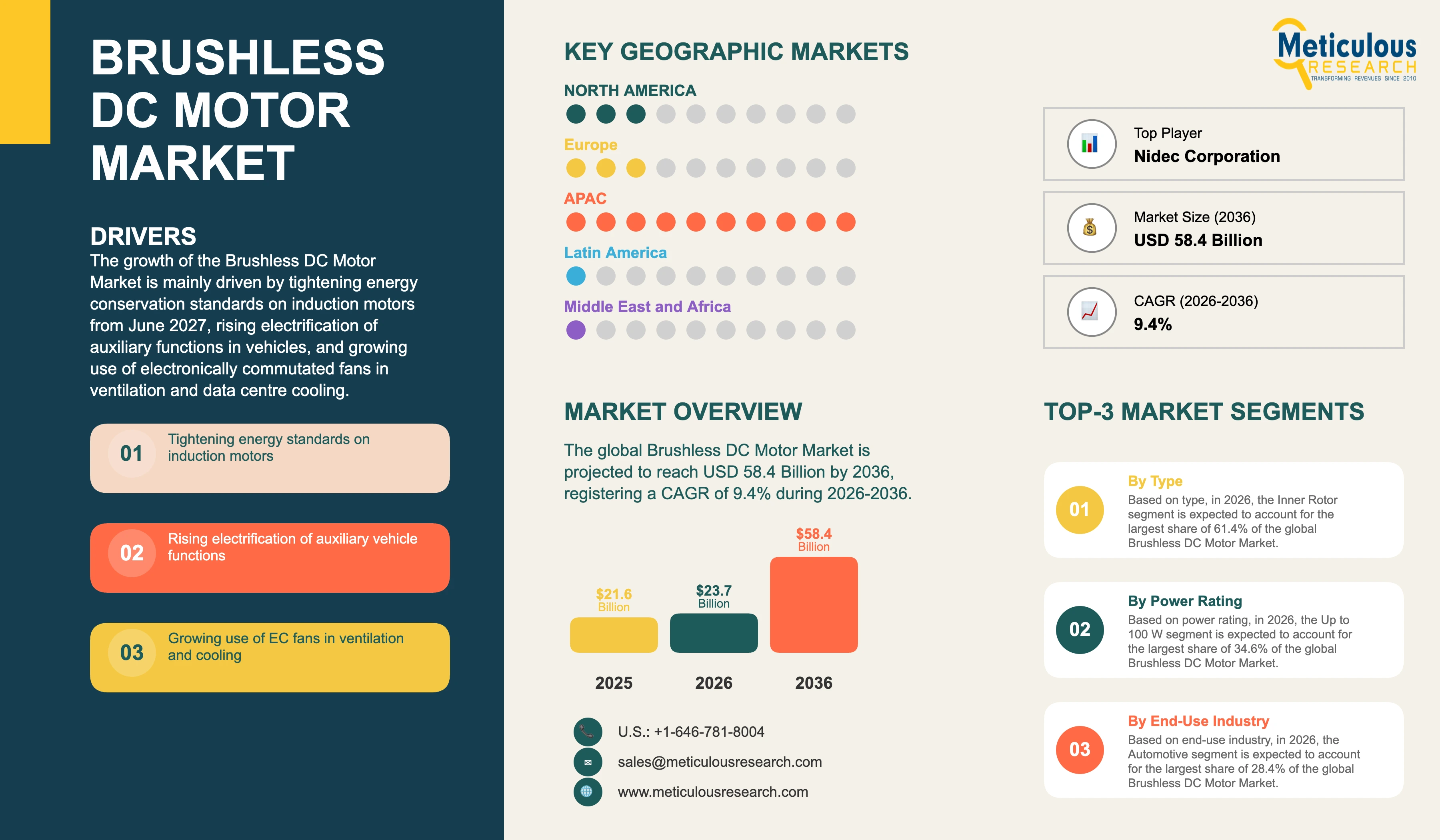
The global brushless DC motor market was valued at USD 21.60 billion in 2025. This market is expected to reach USD 58.40 billion by 2036 from an estimated USD 23.70 billion in 2026, registering a CAGR of 9.4% during the forecast period (2026-2036).
- Published
- Nov 2026
- Pages
- 261
- Format
- PDF + Excel
- Report ID
- MREP - 1042466
- Base year
- 2025
- 2025 · BASELINE
- $21.60B
- 2036
- $58.40B
- CAGR 2026–2036
- 9.4%
2025 baseline · 2026–2036 forecast at 9.4% CAGR · hover a bar for the value
Key highlights
Energy conservation standards in United States Tables 8 to 10 apply to motors manufactured from 1 June 2027, tightening the requirement on the induction motors that brushless DC machines displace.
Those standards tables apply to single-speed induction motors with a cage rotor and exclude inverter-only motors, so a brushless DC motor supplied for inverter operation is not covered by them.
IEC TS 60034-30-2:2016 is a technical specification rather than a standard and carries a stability date of 2026, with no successor published.
That specification covers machines operating on a sinusoidal fundamental current, which leaves trapezoidally commutated brushless DC motors outside the only published IE-code framework for variable speed machines.
Motors above 10 kW are the fastest-growing power rating at a CAGR of 11.4%, driven by traction and industrial duty.
Outer rotor machines grow faster than inner rotor machines at a CAGR of 10.0%, carried by fan and blower applications in ventilation and cooling.
The average selling price falls from USD 11.18 per unit in 2026 to USD 9.97 per unit by 2036 as small motor volumes build and drive electronics integrate further.
Asia-Pacific accounts for more than half the market in 2026 and is also the fastest-growing region, reflecting both manufacture and consumption in the same countries.
By type, inner rotor machines account for the largest share of 61.4% in 2026, while outer rotor machines register the higher CAGR.
By power rating, motors up to 100 W account for the largest share of 34.6%, while motors above 10 kW register the highest CAGR.
By voltage, motors up to 24 V account for the largest share of 41.8%, while motors above 48 V register the highest CAGR of 10.4%.
By end-use industry, automotive accounts for the largest share of 28.4%, while aerospace and defence registers the highest CAGR of 10.8%.
By geography, Asia-Pacific accounts for the largest share of 56.4% in 2026 and the highest CAGR of 9.8%.
Report summary
| Particulars | Details |
|---|---|
| Forecast Period | 2026-2036 |
| Base Year | 2025 |
| Estimated Year | 2026 |
| CAGR (Value) | 9.4% by value and 10.7% by volume |
| Format | PDF, Excel & Cloud Portal · 261 pages |
| Market Size (Value) in 2025 | USD 21.60 billion (1.92 billion units) |
| Market Size (Value) in 2026 | USD 23.70 billion (2.12 billion units) |
| Market Size (Value) by 2036 | USD 58.40 billion (5.86 billion units) |
| Average Selling Price | USD 11.18 per unit in 2026 to USD 9.97 per unit by 2036 |
| Largest Segment by Type (2026) | Inner rotor (61.4%) |
| Fastest-Growing Segment by Type | Outer rotor (CAGR 10.0%) |
| Largest and Fastest-Growing Region | Asia-Pacific (56.4% share, CAGR 9.8%) |
| Key Companies | 17 companies and other companies |
| Segments Covered | Type, Power Rating, Voltage, End-Use Industry, Geography |
| Countries Covered | China, Japan, South Korea, Taiwan, India, Australia, Rest of Asia-Pacific, Germany, Italy, France, U.K., Spain, Sweden, Rest of Europe, U.S., Canada, Brazil, Mexico, Argentina, Rest of Latin America, Saudi Arabia, U.A.E., South Africa, Rest of Middle East & Africa |
Report overview
Segments covered: type, power rating, voltage, end-use industry.
The growth of this market is mainly driven by the tightening of energy conservation standards on induction motors from June 2027, the rising electrification of auxiliary functions in vehicles that previously ran from belts or hydraulics, the growing use of electronically commutated fans in building ventilation and data centre cooling, and the expanding content of precision motors in medical devices, robotics and handheld tools. However, factors such as the absence of a published efficiency class framework covering trapezoidally commutated machines, the exposure of permanent magnet designs to rare earth price and supply conditions, the higher unit cost against brushed and induction alternatives at small power ratings, and the requirement for drive electronics and control expertise that many motor buyers do not hold are expected to restrain the growth of this market to some extent.
In volume terms, shipments are expected to reach 5.86 billion units by 2036 from an estimated 2.12 billion units in 2026 and 1.92 billion units in 2025, registering a CAGR of 10.7% during the forecast period, with the average selling price declining from USD 11.18 per unit to USD 9.97 per unit as volumes in small fan, pump and appliance motors build and as integrated drive electronics move to higher levels of silicon integration.
Volume grows faster than value because the units added over the forecast are weighted toward motors below 100 watts priced in single digits rather than toward the traction and industrial ratings priced in hundreds, which lowers the blended price while prices within each rating band hold.
A brushless DC motor replaces the mechanical commutator of a brushed machine with electronic commutation, which removes the wearing contact, raises efficiency across the speed range and makes speed and torque controllable without a mechanical intermediary. The cost of that is drive electronics and control, so a buyer is purchasing a motor and a controller together whether or not they are supplied as one part, and the competitive question in this market is who carries the electronics and the control expertise.
Subpart B of Part 431 of Title 10 of the Code of Federal Regulations sets energy conservation requirements for electric motors, defining an electric motor as a machine that converts electrical power into rotational mechanical power, and applying its standards tables to single-speed induction motors with a cage rotor, and the standards tables exclude component sets, liquid-cooled motors, submersible motors and inverter-only motors, Table 5 covers NEMA Design A and Design B and IEC Design N motors manufactured from 1 June 2016 to 1 June 2027, and Tables 8 to 10 apply to motors manufactured from 1 June 2027. A brushless DC motor is inverter-driven and is not a single-speed cage-rotor induction machine, so it falls outside those tables while the induction motors it competes against face a tighter requirement from 1 June 2027. Equipment makers reviewing a design against that date reach the same conclusion repeatedly, which is that switching the motor technology resolves the compliance question rather than merely improving the figure.
IEC TS 60034-30-2:2016, Rotating electrical machines, Part 30-2: Efficiency classes of variable speed AC motors (IE-code), published on 8 December 2016 as version 1.0 with a stability date of 2026 specifies efficiency classes for variable speed rotating electrical machines not covered by IEC 60034-30-1, applies to machines designed to operate on a sinusoidal fundamental current and not designed for direct on-line operation, and gives permanent magnet synchronous machines with or without additional reluctance torque, sinusoidal reluctance synchronous machines and synchronous machines with DC field windings as its examples. Classification under that framework is therefore available to sinusoidally driven permanent magnet machines and not to the trapezoidal commutation that gives the brushless DC motor its name, and the specification is a technical specification rather than an International Standard with a stability date of 2026. Efficiency in this market is consequently a supplier claim measured on a supplier test rather than a classified figure a buyer can compare, which favours suppliers selling a verified motor and drive package over those selling a motor alone.
Automotive demand has shifted from a small number of large motors to a large number of small ones. Functions that previously ran from the engine through belts or hydraulics, including coolant pumps, oil pumps, cooling fans, compressors, steering assistance and brake actuation, now run from independently controlled motors because an electrified powertrain has no belt to drive them and because running a pump only when it is needed saves energy the vehicle cannot spare. Content per vehicle rises on that basis irrespective of traction motor decisions.
Building ventilation and data centre cooling have become the second large volume application. An electronically commutated fan replaces an alternating current motor with an inlet damper or a belt drive, holds its efficiency at part load where the equipment actually operates, and reports its own speed and power to a building management system. Retrofit of installed air handling units is a larger opportunity than new equipment because the fan assembly can be changed without replacing the unit around it.
High energy density designs use neodymium iron boron magnets with heavy rare earth additions for temperature stability, and both the material and its processing are concentrated in a small number of countries. Suppliers have responded with reduced heavy rare earth formulations, ferrite designs at the low end and switched reluctance or wound field alternatives at the top end, none of which match the power density of the magnet machine they replace, so magnet supply remains the structural exposure of this market.
Supply divides between motor specialists that sell a motor with integrated electronics, large diversified industrial groups that reach customers through existing channels, and tier one automotive suppliers that build motors into assemblies rather than selling them. No single supplier holds a double-digit share of the whole market because the applications have little in common technically, and positions are held application by application rather than across the market.
Asia-Pacific, with a 56.4% share in 2026 valued at USD 13,366.8 million.
Asia-Pacific, at a CAGR of 9.8%, ahead of North America at 9.0%.
Europe accounts for 18.6% of the market in 2026, valued at USD 4,408.2 million, at a CAGR of 8.8%, led by Germany, Italy, France and the Nordic countries.
The Middle East & Africa accounts for 3.4% in 2026, valued at USD 805.8 million, at a CAGR of 9.2%, and Latin America for 4.2%, valued at USD 995.4 million, at a CAGR of 8.6%.
The report profiles 17 companies, including Nidec Corporation, ebm-papst Mulfingen GmbH & Co. KG, Johnson Electric Holdings Limited, MinebeaMitsumi Inc. and Regal Rexnord Corporation. The top five players account for an estimated 36.2% of the market in 2026.
Up to 24 V, with a 41.8% share in 2026 valued at USD 9,906.6 million.
Above 48 V, at a CAGR of 10.4%, valued at USD 6,067.2 million in 2026.
Automotive, with a 28.4% share in 2026 valued at USD 6,730.8 million, at a CAGR of 10.2%.
Aerospace and defence, at a CAGR of 10.8%, valued at USD 1,279.8 million in 2026.
Report infographic
Market dynamics
15 factors across 5 forcesTightening energy conservation standards on the induction motors being displaced
Energy conservation standards tables applying to motors manufactured from 1 June 2027 raise the requirement on single-speed induction motors with a cage rotor, while inverter-only motors sit outside those tables altogether. An equipment maker facing a redesign to meet the new figure compares the cost of a higher efficiency induction motor against the cost of changing technology, and the brushless machine frequently wins because it resolves the compliance question rather than improving a number inside it. Design decisions taken now carry through the production life of the equipment.
Efficiency regulation in other jurisdictions has the same direction and a similar effect on specification, which means a product sold internationally is designed once to the strictest requirement. That removes the option of keeping an induction design for some markets and switching for others, and it concentrates the switching decision rather than spreading it across regions and years, and it brings forward demand that would otherwise arrive gradually.
Rising electrification of auxiliary functions in vehicles
Coolant pumps, oil pumps, cooling fans, compressors, steering assistance, brake actuation and thermal management valves have moved from belt and hydraulic drive to independently controlled motors, because an electrified powertrain has no belt to drive them and because operating a pump only when needed recovers energy a vehicle cannot afford to waste. Each function adds a motor with its own controller, so content per vehicle rises whether or not the vehicle carries a traction motor. The same logic applies to hybrid and combustion platforms being refreshed.
Thermal management on battery electric platforms has pushed the count higher still, with multiple pumps and fans managing battery, cabin and power electronics loops independently. Motors in this duty run continuously at part load rather than intermittently at full load, which is the operating condition where the efficiency advantage of electronic commutation is largest, and it is why the automotive segment grows faster than the market as a whole despite a mature vehicle production base.
Growing use of electronically commutated fans in ventilation and data centre cooling
An electronically commutated fan replaces an alternating current motor with a damper or belt drive, holds efficiency at the part load at which ventilation equipment actually spends most of its operating hours, and reports speed and power consumption to a building management system without additional instrumentation. Operators measure the saving in metered consumption rather than in rated efficiency, and the measured figure is what supports the premium. Data centre cooling has reinforced the demand because fan power is a direct and visible component of facility overhead.
Retrofit is the larger part of the opportunity because a fan assembly can be exchanged within an existing air handling unit without replacing the unit or the ductwork around it. The addressable base is therefore the installed stock of equipment rather than annual new equipment sales, and the work is performed during routine maintenance rather than as a capital project.
Expanding precision motor content in medical devices, robotics and handheld tools
Surgical tools, infusion and dialysis pumps, laboratory automation, prosthetics, collaborative robot joints and professional cordless tools all require controlled speed and torque in a small envelope with predictable life, and electronic commutation delivers that where a brushed motor would wear and a stepper would lack smoothness. Prices per unit in these applications are a multiple of appliance motor prices because the specification includes feedback, sterilisation compatibility or duty cycle guarantees rather than only output.
Battery operation has widened the application further, since a motor running from a cell benefits directly from efficiency in runtime rather than in energy cost. Tool and device makers specify the motor to a runtime target, which converts an efficiency difference into a product specification the customer can see, and that visibility supports a price per unit several times that of a commodity motor of the same output, and it is why medical and tool applications contribute more to value than to unit volume.
Table of contents
12 chapters · 135 sections · 261 pages · click to expandSegmental analysis
| Segment | Largest share (2026) | Fastest growth (2026–2036) |
|---|---|---|
| By Type | Inner rotor | Faster growth of outer rotor machines |
| By Power Rating | Up to 100 W | Rapid growth of this |
| By Voltage | Up to 24 V | Rapid growth of this |
| By End-Use Industry | Automotive | Rapid growth of this |
By Type
- Brushless DC Motor Market Analysis by Type
- The inner rotor segment is expected to account for the largest share of 61.4% of the global brushless DC motor market, valued at USD 14,551.8 million.
- The large share of this segment is mainly due to the low inertia of a rotating inner member, which suits the rapid acceleration and precise control required in servo drives, robotics, power tools, medical devices and automotive actuation, and to a construction that dissipates heat through the outer stator and housing.
- Outer rotor machines, valued at USD 9,148.2 million in 2026 and accounting for a share of 38.6%, grow at a CAGR of 10.0% against 9.0% for inner rotor machines.
- The faster growth of outer rotor machines is attributed to a rotating outer member whose inertia smooths running at constant speed and whose geometry carries fan blades or a pump impeller directly, which makes it the configuration of choice in ventilation, cooling and circulation duty where the application volume is growing fastest.
- Configuration in this market follows the driven load rather than the preference of the motor buyer, so the type mix moves with the application mix rather than with any change in the relative merits of the two constructions.
- Inner rotor machines, with a 61.4% share in 2026 valued at USD 14,551.8 million.
- Outer rotor machines, at a CAGR of 10.0%, valued at USD 9,148.2 million in 2026.
By Power Rating
- Brushless DC Motor Market Analysis by Power Rating
- The up to 100 W segment is expected to account for the largest share of 34.6% of the market, valued at USD 8,200.2 million.
- The large share of this segment is mainly due to unit volumes in cooling fans, small pumps, appliances, office equipment and personal devices, where a single product may carry several motors and annual shipments run into hundreds of millions.
- The 100 W to 1 kW segment accounts for 29.8%, valued at USD 7,062.6 million, covering power tools, larger pumps, ventilation fans and automotive auxiliaries.
- The 1 kW to 10 kW segment accounts for 22.4%, valued at USD 5,308.8 million, growing at a CAGR of 10.2% on industrial and light traction duty.
- However, the above 10 kW segment, valued at USD 3,128.4 million in 2026 and accounting for a share of 13.2%, is projected to register the highest CAGR of 11.4% during the forecast period.
- The rapid growth of this segment is attributed to light electric vehicles, industrial handling equipment, off-highway machinery and marine propulsion, and to value per unit two orders of magnitude above small motor prices, which allows a modest unit volume to move segment revenue materially.
- Rating also determines who the customer is, with the smallest bands sold to high volume consumer and appliance makers and the largest sold to vehicle and machinery builders through engineering-led relationships, so the rating bands behave as separate businesses with different margins, different sales cycles and different competitive sets within the same market, which is why supplier share differs sharply between them.
- Up to 100 W, with a 34.6% share in 2026 valued at USD 8,200.2 million.
- Above 10 kW, at a CAGR of 11.4%, valued at USD 3,128.4 million in 2026.
By Voltage
- Brushless DC Motor Market Analysis by Voltage
- The up to 24 V segment is expected to account for the largest share of 41.8% of the market, valued at USD 9,906.6 million.
- The large share of this segment is mainly due to the 12 V automotive electrical system and to battery-operated devices and tools, where the cell count fixes the voltage and the motor is designed to it.
- The 24 V to 48 V segment accounts for 32.6%, valued at USD 7,726.2 million, growing at a CAGR of 9.8% on industrial equipment, light electric vehicles and 48 V automotive subsystems.
- However, the above 48 V segment, valued at USD 6,067.2 million in 2026 and accounting for a share of 25.6%, is projected to register the highest CAGR of 10.4% during the forecast period.
- The rapid growth of this segment is attributed to traction and industrial duty where higher voltage reduces current and therefore conductor mass and resistive loss for a given output, and to the drive electronics required at those voltages carrying a larger share of system value.
- Voltage is set by the supply the application already has rather than by motor design, so the voltage mix follows battery architecture decisions taken elsewhere in the product, and the shift upward in voltage tracks the move to 48 V subsystems and traction packs rather than any motor-level preference.
- Each voltage band also carries its own drive electronics content, which is why value does not move in proportion to unit shipments across the three bands.
By End-Use Industry
- Brushless DC Motor Market Analysis by End-Use Industry
- The automotive segment is expected to account for the largest share of 28.4% of the market, valued at USD 6,730.8 million, growing at a CAGR of 10.2%.
- The large share of this segment is mainly due to the electrification of coolant and oil pumps, cooling fans, compressors, steering assistance, brake actuation and thermal valves, each of which adds an independently controlled motor and raises content per vehicle whether or not the vehicle carries a traction motor.
- Consumer electronics and appliances account for 22.6%, valued at USD 5,356.2 million, growing at the slowest rate in the market at 7.8% as the conversion from brushed motors in that sector is already substantially complete and growth there now tracks appliance and device shipments rather than technology substitution.
- HVAC and building equipment accounts for 16.8%, valued at USD 3,981.6 million, and industrial automation and robotics for 13.4%, valued at USD 3,175.8 million.
- Medical devices account for 7.6%, valued at USD 1,801.2 million, at prices per unit a multiple of appliance motor prices.
- However, the aerospace and defence segment, valued at USD 1,279.8 million in 2026 and accounting for a share of 5.4%, is projected to register the highest CAGR of 10.8% during the forecast period.
- The rapid growth of this segment is attributed to electrically actuated flight controls, environmental systems and uncrewed platforms replacing hydraulic and pneumatic functions, and to qualification requirements that support prices no other industry here would accept.
- Energy, agriculture and other industries account for 5.8%, valued at USD 1,374.6 million, in pumping, irrigation and small renewable installations where the motor replaces an engine-driven or induction-driven function, and where continuous duty allows the efficiency gain to be recovered quickly against the higher purchase price.
- Industry mix in this market therefore reflects where a motor runs enough hours for electronic commutation to pay, which is why continuous-duty applications convert ahead of intermittent ones.
Geographic analysis
Asia-Pacific
Largest shareIn 2026, Asia-Pacific is expected to account for the largest share of 56.4% of the global brushless DC motor market, valued at USD 13,366.8 million, and is also projected to register the highest CAGR of 9.8% during the forecast period. The large share and rapid growth of this region are mainly due to the location of appliance, consumer electronics, vehicle and industrial equipment manufacture in the same countries that consume the output, and to a magnet and component supply chain adjacent to motor assembly. China holds the largest national position in both manufacture and consumption, Japan contributes the deepest precision motor supplier base, and South Korea, Taiwan and India contribute growing assembly volume. Regional magnet and lamination supply also shortens lead times relative to European and North American assembly, which reinforces the concentration.
Europe
Europe accounts for 18.6% of the market in 2026, valued at USD 4,408.2 million, at a CAGR of 8.8%. Germany, Italy, France and the Nordic countries lead, with demand concentrated in building ventilation, industrial automation, premium appliances and automotive auxiliaries. Efficiency requirements applied through building and equipment regulation have made electronically commutated fans the reference specification in commercial ventilation, which gives the region a higher share of outer rotor machines than its overall share of the market.
North America
North America accounts for 17.4% of the market in 2026, valued at USD 4,123.8 million, at a CAGR of 9.0%. Demand in the United States is led by commercial HVAC, data centre cooling, medical devices, aerospace and industrial equipment, and the tightening of energy conservation standards on induction motors from June 2027 is being reflected in equipment redesign decisions taken now. Canada contributes a smaller base weighted toward building equipment and resource industry applications, where seasonal operation, remote sites and high transport cost favour a motor that holds efficiency at part load and reports its own condition without added instrumentation on site.
Latin America
Latin America accounts for 4.2% of the market in 2026, valued at USD 995.4 million, at a CAGR of 8.6%, with Brazil and Mexico carrying most of the activity on the strength of appliance and vehicle component manufacture for domestic and export markets.
Middle East & Africa
The Middle East & Africa accounts for 3.4%, valued at USD 805.8 million, at a CAGR of 9.2%, concentrated in Saudi Arabia, the United Arab Emirates and South Africa where building cooling load is high and new commercial construction specifies current-generation ventilation equipment from the outset.
Competitive landscape
Motor specialists selling a motor with integrated electronics, diversified industrial groups reaching customers through existing channels, and tier one automotive suppliers building motors into assemblies rather than selling them divide this market between them. No supplier holds a double-digit share of the whole market, because a ventilation fan motor, a surgical tool motor and a traction motor share a commutation principle and almost nothing else, and positions are therefore held application by application. Share analysis at the level of the whole market understates how concentrated individual applications are.
Competition in the high volume applications runs on cost and on the integration of drive electronics, where scale in magnetics, winding automation and silicon purchasing decides the outcome and the largest suppliers hold a structural advantage. In precision and regulated applications it runs on qualification, feedback accuracy, acoustic behaviour and life data, where a smaller specialist with an established approval can hold a position against a far larger competitor for the production life of the device.
The absence of a class framework for trapezoidally commutated machines shapes how suppliers compete on efficiency. A figure measured on a supplier test cannot be placed against a competing figure on a tender sheet, so suppliers demonstrate performance in the customer application instead, and those able to supply and substantiate a complete motor and drive package convert that into price. Suppliers selling bare motors compete closer to component terms.
Vertical integration into magnets and drive silicon has become a point of difference as rare earth supply conditions have tightened. Suppliers holding magnet capability or long-term supply arrangements can quote with more certainty than those buying on the open market, and that certainty rather than price has decided several large automotive and appliance awards.
Some of the key players operating in the brushless DC motor market are Nidec Corporation, ebm-papst Mulfingen GmbH & Co. KG, Johnson Electric Holdings Limited, MinebeaMitsumi Inc., Regal Rexnord Corporation, AMETEK, Inc., ABB Ltd, maxon international ltd., Allient, Inc., Oriental Motor Co., Ltd., Shinano Kenshi Co., Ltd., Moog Inc., Zhongshan Broad-Ocean Motor Co., Ltd., Wolong Electric Group Co., Ltd., Mabuchi Motor Co., Ltd., Sanyo Denki Co., Ltd., and Denso Corporation, among others.
- —
Energy conservation standards tables applying to motors manufactured from 1 June 2027 tighten the requirement on single-speed cage-rotor induction motors while excluding inverter-only motors, and IEC TS 60034-30-2:2016 remains the only published IE-code framework for variable speed machines, with a stability date of 2026.
- Nidec Corporation
- Johnson Electric Holdings Limited
- MinebeaMitsumi Inc.
- Regal Rexnord Corporation
- AMETEK, Inc.
- ABB Ltd
- Allient, Inc.
- Oriental Motor Co., Ltd.
- Shinano Kenshi Co., Ltd.
- Moog Inc.
- Zhongshan Broad-Ocean Motor Co., Ltd.
- Wolong Electric Group Co., Ltd.
- Mabuchi Motor Co., Ltd.
- Sanyo Denki Co., Ltd.
- Denso Corporation
Expert perspectives
Growth in this market comes from substitution rather than from new demand, and the substitution is being timed by regulation applied to the technology being replaced rather than to brushless machines themselves. Energy conservation standards tables taking effect on 1 June 2027 apply to single-speed cage-rotor induction motors and exclude inverter-only motors, so an equipment maker facing a redesign compares a higher efficiency induction motor against a change of technology, and the change frequently settles the question outright. What limits the pace is not the attraction of the motor but the drive electronics and control capability the buyer has to acquire with it.
A buyer that previously specified a motor and a contactor now needs power electronics, control tuning and electromagnetic compatibility work, so spending follows the integrated assembly rather than the motor, and suppliers that furnish the motor, the drive and the firmware as one qualified unit take responsibility for the figure the customer specifies. That is also the only way an efficiency claim can be substantiated while trapezoidally commutated machines sit outside the published IE-code framework, so the integrated route carries both the engineering and the commercial advantage.
Positions in this market are won application by application and not across it. Scale in magnetics, winding automation and silicon purchasing decides the high volume duties, while qualification, acoustic behaviour and life data decide the precision and regulated ones, and a specialist with an approval in place holds ground against a much larger competitor for the production life of the device. A supplier entering should choose the application before the technology.
The market reaches USD 58.40 billion by 2036 from USD 23.70 billion in 2026, and unit shipments grow faster than value because the units added are weighted toward motors below 100 watts rather than toward traction and industrial ratings, so the falling blended price reflects mix and not price erosion inside any rating band. Automotive growth of 10.2% rests on auxiliary and thermal functions that electrify on every powertrain type, which makes it less exposed to the pace of electric vehicle adoption than the traction motor market. Consumer electronics and appliances grow slowest at 7.8% because the conversion from brushed motors there is largely finished. Rare earth supply conditions are the largest swing factor in the forecast, since a sustained magnet price movement changes motor cost within a quarter and shifts the crossover against ferrite and reluctance alternatives.
Growth in this market rests on a technology change that equipment makers have already decided to make, and it is paced by the engineering capacity to integrate drives rather than by motor manufacturing capacity. Suppliers that carry the electronics and substantiate the performance will take a disproportionate share of the increase.
Customer perspectives
Director of Engineering - commercial HVAC equipment manufacturer, North America
The 2027 date forced the review, and once we opened it the induction route was the more expensive way to get compliant. We switched the platform rather than uprate the motor, because the decision carries for the production life of the unit.
Energy conservation standards applying to induction motors from 1 June 2027 do not reach inverter-driven machines, so a compliance review frequently resolves as a change of motor technology rather than as an uprated induction motor, and the decision carries for the production life of the equipment rather than for one model year.
Head of Purchasing - appliance manufacturer, Europe
Two suppliers quote efficiency and I cannot put the numbers side by side, because there is no class for what they are selling. So we test in our own product and buy from whoever brings the drive and stands behind the result.
The absence of a published efficiency class for trapezoidally commutated machines means efficiency is a supplier measurement rather than a comparable figure, which moves the decision toward suppliers able to supply and substantiate a complete motor and drive package, and it is why integrated assemblies rather than bare motors have become the reference product in high volume applications.
Vice President of Product - portable medical device company, Asia-Pacific
Our specification is runtime from one charge and noise in a ward at night, not efficiency on a bench. We pay several times the price of a commodity motor because those two things are what the clinician notices.
Medical and battery-operated applications convert an efficiency difference into a product specification the end user experiences, which supports prices per unit a multiple of appliance motor prices and makes medical devices a disproportionate contributor to value relative to the unit volume they represent in this market as a whole.
Frequently asked questions
The market was valued at USD 21.60 billion in 2025 and USD 19.80 billion in 2024, and is estimated at USD 23.70 billion in 2026.
Cite this report
Meticulous Research. (2026). Brushless DC Motor Market - Global Opportunity Analysis and Industry Forecast (2026-2036) (Report No. MREP - 1042466). Meticulous Market Research Pvt. Ltd. https://www.meticulousresearch.com/product/brushless-dc-motor-market-7149