Tungsten Market (2026-2036)
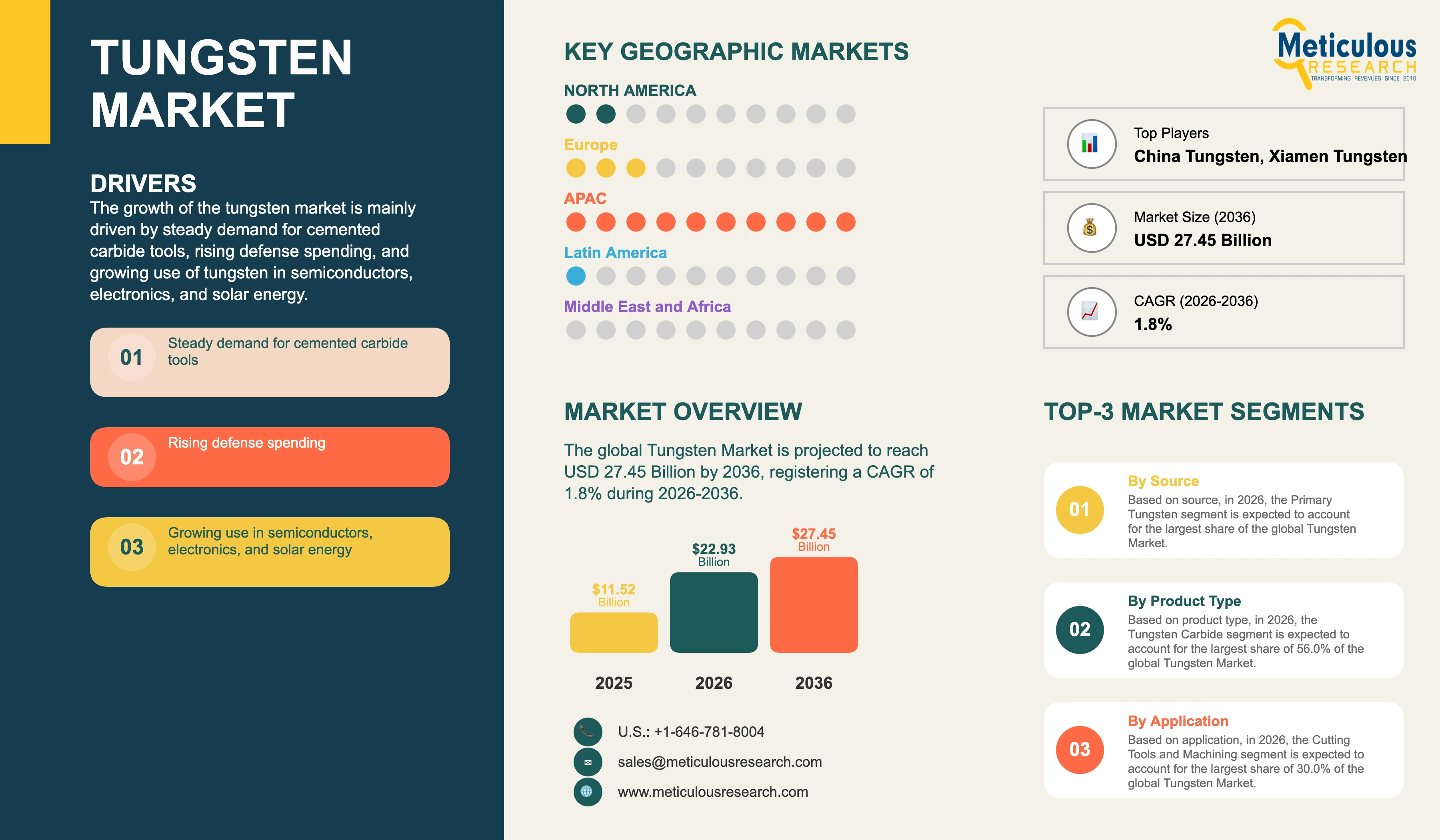
The global tungsten market was valued at USD 11.52 billion in 2025. This market is expected to reach USD 27.45 billion by 2036 from an estimated USD 22.93 billion in 2026, registering a CAGR of 1.8% during the forecast period (2026-2036). In terms of volume, this market is expected to reach 183.0 thousand tons of contained tungsten by 2036 from an estimated 131.0 thousand tons in 2026, registering a CAGR of 3.4% during the forecast period.
- Published
- Nov 2026
- Pages
- 278
- Format
- PDF + Excel
- Report ID
- MRCHM - 1042513
- Base year
- 2025
- 2025 · BASELINE
- $11.52B
- 2036
- $27.45B
- CAGR 2026–2036
- 1.8%
2025 baseline · 2026–2036 forecast at 1.8% CAGR · hover a bar for the value
Key highlights
According to the U.S. Geological Survey (USGS), global tungsten mine production was about 85,000 tons of contained tungsten in 2025, of which China produced about 67,000 tons, or roughly 79% of the total, followed by Vietnam, Kazakhstan, Russia, North Korea, Bolivia, and Rwanda.
China placed several tungsten products, including ammonium paratungstate (APT) and tungsten oxides, under export controls in February 2025, cut its mining quotas, and announced in December 2025 that only 15 companies would be allowed to export tungsten in 2026 and 2027.
Chinese domestic APT prices reached a record of about 1, 515,000 yuan per ton on 12 March 2026, more than double the level at the start of the year, before falling about 67% to around 500,000 yuan per ton by mid-October 2026 as end-use demand weakened.
European APT prices rose from the mid-USD 300s per metric ton unit before China's export controls to a peak of about USD 3,320 per metric ton unit in 2026, reflecting the severe shortage of tungsten available outside China.
Secondary tungsten recovered from scrap supplies about one-third of global demand, and recycling is growing as high prices make scrap collection more profitable and governments support recycling to reduce dependence on China.
China's imports of tungsten concentrates reached a record of 3, 227 tons in June 2026, as Chinese processors sought more raw material from Vietnam, Kazakhstan, Rwanda, Bolivia, and other countries. Imports remained well above 2025 levels in the following months, including a 73.1% year-on-year increase in September 2026.
No commercial tungsten mine has operated in the U.S. since 2015, and U.S. defense procurement rules restrict tungsten from China and certain other countries, with broader restrictions taking effect from January 2027.
New supply outside China is ramping up, including Almonty Industries' Sangdong mine in South Korea and Jiaxin International's Boguty mine in Kazakhstan, which targets production of about 10,900 tons of tungsten concentrate in 2026.
By source, primary tungsten accounts for the largest share in 2026, while secondary tungsten registers the highest CAGR.
By product type, tungsten carbide accounts for the largest share of 56.0% in 2026, while tungsten mill products register the highest CAGR.
By application, cutting tools and machining account for the largest share of 30.0% in 2026, while electronics and semiconductors register the highest CAGR.
By geography, Asia-Pacific accounts for the largest share of 63.0% in 2026, while North America registers the highest CAGR of 3.4%.
Report summary
| Particulars | Details |
|---|---|
| Base Year | 2025 |
| Estimated Year | 2026 |
| Forecast Period | 2026-2036 |
| Market Size in 2025 | USD 11.52 billion |
| Market Size in 2026 | USD 22.93 billion |
| Market Size by 2036 | USD 27.45 billion |
| CAGR (2026-2036), Value | 1.8% |
| Format | PDF, Excel & Cloud Portal · 278 pages |
| Market Volume (2026 to 2036) | 131.0 thousand tons to 183.0 thousand tons of contained tungsten (CAGR 3.4%) |
| Largest Segment by Product Type (2026) | Tungsten Carbide (56.0%) |
| Largest Segment by Application (2026) | Cutting Tools and Machining (30.0%) |
| Largest Region (2026) | Asia-Pacific (63.0%) |
| Fastest-Growing Region | North America (CAGR 3.4%) |
| Segments Covered | Source, Product Type, Application, and Geography |
| Geographic Scope | Asia-Pacific, Europe, North America, Latin America, and Middle East and Africa |
| Key Companies Profiled | China Tungsten High-Tech Materials, Xiamen Tungsten, Chongyi Zhangyuan Tungsten, Guangdong Xianglu Tungsten, Masan High-Tech Materials, Plansee Group, Sandvik, Mitsubishi Materials, Kennametal, A.L.M.T., Almonty Industries, Jiaxin International, EQ Resources, and Buffalo Tungsten |
Report overview
Segments covered: source, product type, application.
The growth of this market is mainly driven by steady demand for cemented carbide cutting and wear tools from the automotive, aerospace, machinery, and mining industries, rising defense spending, growing use of tungsten in semiconductors, electronics, and solar wafer cutting wire, and efforts by the U.S., Europe, Japan, and South Korea to build tungsten supply chains outside China. However, China's export controls and mining quotas, extreme price volatility, and the substitution of tungsten in some applications when prices are high are expected to restrain the growth of this market to some extent. The value of the market is expected to grow more slowly than volume because tungsten prices reached record levels in early 2026 and are expected to settle at lower, but still historically high, levels over the forecast period.
Tungsten is a dense, hard metal with the highest melting point of all metals, at about 3,422 degrees Celsius, and a density similar to that of gold. When combined with carbon to form tungsten carbide, it creates one of the hardest materials known, second only to diamond among widely used industrial materials. Because of these properties, tungsten is used in cutting tools, drilling and mining tools, wear parts, high-speed and tool steels, superalloys, armor-piercing ammunition, radiation shielding, electrical contacts, semiconductors, lighting, and many other applications where no other material performs as well.
This market covers the global consumption of tungsten in its main products, measured in value and in thousand tons of contained tungsten, including tungsten carbide powder and cemented carbide, ferrotungsten and other steel additives, tungsten mill products such as wire, rods, sheets, and plates, tungsten heavy alloys, and tungsten chemicals and oxides. It includes tungsten produced from mined ore and tungsten recovered from scrap, and is segmented by source, product type, application, and geography.
Tungsten is mined mainly from two minerals, wolframite and scheelite, which are concentrated at the mine and then processed into ammonium paratungstate, the main intermediate product traded in the market. APT is converted into tungsten oxides, tungsten metal powder, and tungsten carbide powder, which are then used to make cemented carbide tools, mill products, alloys, and chemicals. China dominates every stage of this supply chain, producing about 79% of the world's mined tungsten and about 85% of its APT, and it is also the world's largest consumer of tungsten. Ferrotungsten and tungsten melting base are produced directly from concentrates or scrap for the steel industry, while scrap is recycled through chemical and direct processes into APT and powders that re-enter the supply chain.
For many years, low Chinese prices made it difficult for mines outside China to compete, and many closed, including the last commercial tungsten mines in the U.S. This left most countries heavily dependent on Chinese supply, which became a serious concern when China introduced export controls on tungsten products in February 2025, cut its mining quotas, and limited the number of approved exporters. As inventories outside China ran down, buyers competed for scarce material, and prices rose to record levels in early 2026. Prices of tungsten concentrates outside China moved close to the price of APT at the tightest point in the market, which is very unusual and showed how severe the shortage had become. Many tool makers raised their prices several times during 2025 and 2026 to pass on higher raw material costs, and some customers delayed orders or reduced inventories.
Prices then fell sharply in the second half of 2026, as high prices reduced demand from tool makers and other users, Chinese processors increased imports of concentrates, and some inventories were released. Chinese domestic APT prices fell by about two-thirds from their March peak by mid-October 2026, while prices outside China remained much higher because of export controls. Even after this decline, prices remain well above the levels seen before 2025. The market is therefore expected to start the forecast period with prices that are much higher than in the past decade, which supports investment in new supply and recycling but also encourages users to reduce tungsten consumption where possible.
Over the forecast period, tungsten demand is expected to grow steadily, supported by manufacturing and machining, mining and infrastructure, defense, semiconductors, solar energy, and new technologies such as nuclear fusion. On the supply side, new mines and expansions in South Korea, Kazakhstan, Australia, Vietnam, Spain, Portugal, Austria, and North America, along with more recycling, are expected to gradually reduce dependence on China. Governments in the U.S., the EU, Japan, and South Korea have listed tungsten as a critical or strategic material and are supporting new supply through funding, offtake agreements, and stockpiling. These policies are expected to gradually reshape where tungsten is mined, processed, and recycled.
Report infographic
Market dynamics
15 factors across 5 forcesSteady demand for cemented carbide tools
Cemented carbide, made by bonding tungsten carbide grains with cobalt or nickel, is the most important use of tungsten, accounting for well over half of total consumption. Cemented carbide tools are used for turning, milling, drilling, and cutting metals in the automotive, aerospace, machinery, energy, electronics, and general engineering industries, and they are also used as wear parts in pumps, valves, seals, and dies. Because they last much longer and cut much faster than steel tools, carbide tools are essential for modern manufacturing.
Demand for cemented carbide tools grows with industrial production, particularly in machinery, automotive, and aerospace manufacturing, and with the shift to harder and more demanding materials, such as titanium alloys, superalloys, and composites, that require high-performance tools. Leading tool makers, such as Sandvik, Kennametal, Mitsubishi Materials, Sumitomo Electric, Kyocera, Iscar, and many Chinese producers, are among the largest users of tungsten. Tungsten carbide accounts for the largest share of the market by product type. Growth in manufacturing in India, Southeast Asia, and Mexico, along with reshoring of manufacturing in North America and Europe, is expected to support demand for carbide tools over the forecast period.
Rising defense spending
Tungsten is used in many defense applications, including armor-piercing ammunition and kinetic energy penetrators, tungsten heavy alloys for fragmentation munitions and counterweights, armor, missile components, and high-temperature parts in rocket and jet engines. Defense spending has risen sharply in Europe, the U.S., and Asia because of the war in Ukraine and other geopolitical tensions, and governments are rebuilding ammunition stocks and expanding defense production.
Defense agencies are also working to secure tungsten supply from outside China. U.S. defense procurement rules restrict tungsten from China and certain other countries, and broader restrictions taking effect from January 2027 are expected to increase demand for tungsten from other sources. European governments are also expanding ammunition production capacity, which requires large volumes of tungsten heavy alloys and other tungsten products, and several European defense companies have signed new supply agreements for tungsten. Defense and aerospace is one of the fastest-growing applications in this market, and tungsten heavy alloys are one of the fastest-growing product types.
Growing use in semiconductors, electronics, and solar energy
Tungsten is used in semiconductor manufacturing to form the contacts and connections between transistors and metal layers in chips, and it is deposited from tungsten hexafluoride gas and sputtering targets. As chips become more complex, with more layers and three-dimensional structures in memory and logic devices, the amount of tungsten used per wafer increases. Tungsten is also used in electronics, such as electrical contacts, heat sinks, and vibration motors in mobile phones.
In solar energy, fine tungsten wire is increasingly used as the core of diamond wire for cutting silicon wafers, replacing high-carbon steel wire because it is stronger and allows thinner wire and less silicon waste. This has become a significant new source of tungsten demand in China, the world's largest producer of solar wafers. Electronics and semiconductors form the fastest-growing application in this market, and tungsten mill products, including wire, are the fastest-growing product type. Growth in AI chips, data center hardware, and memory production is expected to support tungsten demand in semiconductors over the forecast period.
Efforts to build supply chains outside China
China's export controls and the record prices of 2026 have pushed governments and companies in the U.S., Europe, Japan, and South Korea to invest in tungsten supply outside China. Governments are supporting new mines, processing plants, and recycling through grants, loans, offtake agreements, and stockpiling, and many users are signing long-term contracts with non-Chinese suppliers to secure supply.
New and expanded mines, such as Almonty Industries' Sangdong mine in South Korea, Jiaxin International's Boguty mine in Kazakhstan, EQ Resources' operations in Australia, and Masan High-Tech Materials' Nui Phao mine in Vietnam, are expected to add supply outside China. Processing and recycling capacity is also being expanded in Europe, the U.S., and Japan. These efforts are expected to support investment across the tungsten supply chain and contribute to the fast growth of North America in this market. Users are also increasingly asking for proof of origin for tungsten in their supply chains, which supports demand for traceable supply from these new sources. This trend is expected to continue.
Table of contents
11 chapters · 128 sections · 278 pages · click to expandSegmental analysis
| Segment | Largest share (2026) | Fastest growth (2026–2036) |
|---|---|---|
| By Source | Primary tungsten | Secondary tungsten |
| By Product Type | Tungsten carbide | Tungsten mill products |
| By Application | Cutting tools and machining | Electronics and semiconductors |
By Source
- The primary tungsten segment is expected to account for the largest share of the market.
- The large share of this segment is mainly due to the large volume of tungsten produced from mined wolframite and scheelite ores, which are concentrated and processed into APT and other products, mainly in China.
- Primary tungsten production is concentrated in China, which accounts for about 79% of world mine output, followed by Vietnam, Kazakhstan, Russia, North Korea, Bolivia, Rwanda, Australia, Austria, Spain, and Portugal.
- China's mining quotas limit domestic production, and Chinese processors have increased imports of concentrates from other countries, with imports reaching a record in June 2026.
- Outside China, Masan High-Tech Materials' Nui Phao mine in Vietnam is one of the largest producers, and new mines, such as Sangdong in South Korea and Boguty in Kazakhstan, are expected to add significant supply.
- Declining ore grades in Chinese mines and stricter environmental rules are increasing production costs, which supports higher long-term prices.
- Primary tungsten is expected to remain the largest source over the forecast period, although its share will decline as recycling grows.
- Mine supply outside China is also expected to become more diverse, with new production in Kazakhstan, South Korea, Australia, and Europe reducing the concentration of supply in a single country over time.
- However, many of these projects depend on prices remaining high enough to cover their higher operating costs, and some may be delayed if prices fall further from 2026 levels.
- However, the secondary tungsten segment is projected to register the highest CAGR during the forecast period.
- The rapid growth of this segment is driven by high tungsten prices, which make scrap collection and recycling more profitable, the expansion of recycling capacity by tool makers and processors, government policies that support recycling to reduce dependence on China, and buy-back programs for used carbide tools.
- Recycled tungsten is also attractive to customers seeking to lower the carbon footprint of their products and to secure supply that is not affected by Chinese export controls.
By Product Type
- The tungsten carbide segment is expected to account for the largest share of 56.0% of the market.
- The large share of this segment is mainly due to the wide use of cemented carbide in cutting tools, drilling and mining tools, and wear parts across the manufacturing, mining, oil and gas, and construction industries.
- Tungsten carbide powder is produced by reacting tungsten metal powder with carbon at high temperatures, and it is then mixed with cobalt or nickel binders, pressed, and sintered to make cemented carbide parts.
- Cutting inserts, end mills, drills, and other tools for metal machining are the largest use, followed by mining and drilling tools, such as rock drill bits and tunnel boring cutters, and wear parts, such as dies, nozzles, seals, and valve components.
- Leading carbide tool makers, including Sandvik, Kennametal, Mitsubishi Materials, Sumitomo Electric, Kyocera, Iscar, Ceratizit, and Chinese producers such as Xiamen Tungsten and China Tungsten High-Tech Materials, are among the largest users of tungsten.
- High prices in 2026 encouraged tool makers to increase recycling and reduce carbide use per tool, but demand for high-performance tools continues to grow.
- Tungsten carbide is expected to remain the largest product type over the forecast period.
- Mining and construction tools, such as tunnel boring machine cutters and road milling picks, are also important uses of tungsten carbide, and demand from these sectors is supported by infrastructure investment in India, Southeast Asia, the Middle East, and Africa.
- However, the tungsten mill products segment is projected to register the highest CAGR during the forecast period.
- The rapid growth of this segment is driven by demand for fine tungsten wire for solar wafer cutting, tungsten products for semiconductors and electronics, and rods, sheets, and plates for high-temperature furnaces and fusion research.
- Ferrotungsten and steel additives, tungsten heavy alloys, tungsten chemicals and oxides, and other products make up the rest of the market.
- Tungsten heavy alloys are also among the faster-growing product types, supported by defense demand for penetrators, fragmentation munitions, and counterweights.
- Ferrotungsten and steel additives are mainly used to make high-speed steels, tool steels, and heat-resistant alloys, and their demand grows more slowly because steelmakers can substitute molybdenum in some grades.
- Tungsten chemicals and oxides are used in catalysts, pigments, and electrochromic glass.
- Demand for these products is expected to grow steadily with industrial production.
By Application
- The cutting tools and machining segment is expected to account for the largest share of 30.0% of the market.
- The large share of this segment is mainly due to the essential role of cemented carbide tools in machining metals and other materials in the automotive, aerospace, machinery, energy, and general engineering industries.
- Almost every machined metal part, from engine components and gears to aircraft structures and medical implants, is produced using carbide cutting tools.
- The shift to harder materials, such as titanium alloys, superalloys, and hardened steels, and to faster machining processes increases the demand for high-performance carbide tools with advanced coatings and geometries.
- Automotive production, including electric vehicles, which require machining of motor housings, battery components, and transmissions, aerospace production, which is growing strongly with aircraft order backlogs, and general machinery production are the main sources of demand.
- Tool makers are also expanding services, such as tool regrinding and recycling programs, which help customers reduce costs.
- Cutting tools and machining are expected to remain the largest application over the forecast period.
- Machine tool investment in India, Southeast Asia, and Mexico is also creating new demand for carbide tools as manufacturing shifts to these countries.
- Growth in aircraft production is particularly important, because aerospace parts made from titanium and nickel superalloys require large amounts of carbide tooling per part.
- Medical device manufacturing, electronics production, and mold and die making are also important users of carbide tools.
- However, the electronics and semiconductors segment is projected to register the highest CAGR during the forecast period.
- The rapid growth of this segment is driven by the increasing use of tungsten in advanced logic and memory chips, AI hardware, and electronic components.
- Mining, oil and gas, and construction tools, steel and superalloys, defense and aerospace, solar photovoltaic and energy, and lighting, chemicals, and other applications make up the rest of the market.
Geographic analysis
Asia-Pacific
Largest shareIn 2026, Asia-Pacific is expected to account for the largest share of 63.0% of the global tungsten market. The large share of this region is mainly due to China's dominant position as the world's largest producer and consumer of tungsten, along with large markets in Japan, South Korea, India, and Vietnam. China uses tungsten in cemented carbide tools, steel, mill products, solar wafer cutting wire, electronics, and many other applications, and it is home to the world's largest tungsten producers, such as China Tungsten High-Tech Materials, Xiamen Tungsten, and Jiangxi-based processors. Its domestic market is supplied by local mines and growing imports of concentrates, and its prices are much lower than those outside China because of export controls. Japan has a large tool-making and electronics industry, with companies such as Mitsubishi Materials, Sumitomo Electric, A.L.M.T., and Kyocera, while South Korea is developing domestic tungsten production through Almonty's Sangdong mine and has large semiconductor and automotive industries. Vietnam is a major tungsten producer through Masan High-Tech Materials, and India is one of the fastest-growing tungsten markets in the region. Asia-Pacific is expected to remain the dominant region throughout the forecast period. China's growing imports of concentrates from Vietnam, Kazakhstan, Myanmar, and other countries are also making Asia-Pacific the main center of tungsten trade.
North America
Fastest growthNorth America is projected to register the highest CAGR of 3.4% during the forecast period. Growth is driven by rising defense spending, U.S. defense procurement rules that restrict tungsten from China, reshoring of manufacturing, aerospace production, and government support for new mines, processing, and recycling in the U.S. and Canada. Exploration and development of tungsten deposits in the U.S. and Canada has also increased, supported by high prices and government funding, and processors such as Global Tungsten & Powders and Kennametal are expanding recycling and powder production in the region.
Europe
Europe holds a significant share of the market, supported by its large tool-making, automotive, aerospace, and defense industries, and by tungsten mines and processing in Austria, Spain, Portugal, and other countries. Europe is also a major center for tungsten recycling and powder production, with companies such as Plansee, Ceratizit, Wolfram Bergbau und Hütten, and H.C. Starck Tungsten operating large plants in Austria, Germany, and Luxembourg.
Latin America
Latin America and the Middle East and Africa hold smaller shares, although Bolivia, Brazil, and Rwanda are important sources of tungsten concentrates.
Competitive landscape
The tungsten market is moderately concentrated, with Chinese producers accounting for most of the world's mining and processing and a small number of companies outside China producing concentrates, APT, powders, and carbide. Leading Chinese companies include China Tungsten High-Tech Materials, part of China Minmetals, Xiamen Tungsten, Chongyi Zhangyuan Tungsten, and Guangdong Xianglu Tungsten. Leading companies outside China include Masan High-Tech Materials, Plansee Group, Sandvik, Mitsubishi Materials, Kennametal, A.L.M.T., and Almonty Industries.
Many tungsten companies are vertically integrated, combining mining, processing, powder production, and tool making, while others focus on specific stages of the supply chain. Chinese producers benefit from access to domestic resources and large processing capacity, while companies outside China compete on product quality, technical support, recycling, and the ability to offer secure, non-Chinese supply to customers in defense, aerospace, and other sensitive industries.
The top five players are estimated to account for 32.0% of the tungsten market in 2025, reflecting the large number of Chinese processors and tool makers and the role of recycling. Concentration is much higher in mining and APT production, where China controls most of the capacity.
Players use several strategies to grow in this market, including developing new mines and processing plants, acquiring tungsten producers and recyclers, expanding recycling and buy-back programs, signing long-term offtake agreements, and developing high-performance products for semiconductors, solar, defense, and fusion. Mitsubishi Materials' acquisition of H.C. Starck Tungsten and Sandvik's ownership of Wolfram Bergbau und Hütten are examples of vertical integration by tool makers. New producers, such as Almonty Industries, Jiaxin International, and EQ Resources, are expanding mine output outside China.
Competition is expected to center on access to secure raw material supply, recycling capacity, cost, product quality, and the ability to meet the traceability and sourcing requirements of defense and aerospace customers. Companies that can offer non-Chinese tungsten at competitive prices are expected to gain market share outside China, while Chinese producers are expected to remain dominant in the global market. Recent investment and acquisition activity shows that supply security has become a key factor in competition. Tool makers with strong recycling networks have a cost advantage.
Some of the key players operating in the tungsten market are China Tungsten High-Tech Materials Co., Ltd., Xiamen Tungsten Co., Ltd., Chongyi Zhangyuan Tungsten Co., Ltd., Guangdong Xianglu Tungsten Co., Ltd., Masan High-Tech Materials Corporation, Plansee Group, Sandvik AB, Mitsubishi Materials Corporation, Kennametal Inc., A.L.M.T. Corp., Almonty Industries Inc., Jiaxin International Resources Investment Limited, EQ Resources Limited, and Buffalo Tungsten Inc.
- —
China limited tungsten exporters to 15 companies for 2026 and 2027, APT prices reached record highs in March 2026 before falling sharply, China's concentrate imports hit a record in June 2026, and new mines outside China, such as Sangdong in South Korea, are ramping up.
- China Tungsten High-Tech Materials
- Xiamen Tungsten
- Chongyi Zhangyuan Tungsten
- Guangdong Xianglu Tungsten
- Masan High-Tech Materials
- Plansee Group
- Sandvik
- Mitsubishi Materials
- Kennametal
- A.L.M.T
- Almonty Industries
- Jiaxin International
- EQ Resources
- Buffalo Tungsten
Expert perspectives
The tungsten market has gone through a dramatic change since China introduced export controls in 2025. Prices rose to record levels in early 2026 as buyers outside China competed for scarce material, then fell sharply in China in the second half of the year as demand weakened and imports of concentrates increased. Prices outside China remain much higher than before 2025, and the market is now divided between Chinese and non-Chinese supply chains with very different prices.
Over the forecast period, tungsten volume is expected to grow at about 3.4% per year, supported by machining, mining, defense, semiconductors, and solar energy. Value is expected to grow more slowly, at about 1.8% per year, because 2026 prices were exceptionally high and are expected to settle at lower levels as new supply outside China and recycling grow. However, prices are expected to remain well above pre-2025 levels because of export controls, mining quotas, declining ore grades, and the higher costs of production outside China.
Secondary tungsten is the fastest-growing source, tungsten mill products are the fastest-growing product type, and electronics and semiconductors is the fastest-growing application, reflecting the importance of recycling and high-technology uses. Primary tungsten, tungsten carbide, and cutting tools and machining remain the largest segments.
Asia-Pacific remains the dominant region, while North America is the fastest-growing region at a CAGR of 3.4%, supported by defense spending and efforts to build a domestic supply chain. The main swing factors are China's export and quota policies, the pace of new supply outside China, defense spending, industrial production, and the extent of substitution and recycling.
For tungsten users, the key decisions are how to secure supply from diverse sources, how much to invest in recycling, and how to manage price risk through contracts and inventories. For producers outside China, success depends on bringing new mines and processing plants into production at competitive costs and securing long-term contracts with customers who value supply security. Government support is likely to remain important for these projects. Users that invest early in recycling, diversified supply, and long-term contracts are expected to be in a stronger position if supply disruptions occur again. New supply from Kazakhstan, South Korea, and Australia, together with more recycling, should help to reduce prices outside China from their 2026 peaks, although the gap between Chinese and non-Chinese prices is likely to remain while export controls are in place.
Overall, tungsten is expected to remain a critical material for manufacturing, defense, and technology, with its market shaped as much by geopolitics and government policy as by industrial demand over the forecast period.
Customer perspectives
Higher tungsten prices have also made recycling more important for tool makers, which supports the fast growth of secondary tungsten in this market.
Strong demand from carbide tool makers is why tungsten carbide accounts for 56.0% of the market and cutting tools and machining account for 30.0%.
Supply Chain Director - Defense contractor, U.S.
New sourcing rules mean we cannot use Chinese tungsten in our products. We are qualifying suppliers in South Korea, Vietnam, Europe, and North America and building inventories to cover the transition.
Defense customers are also prepared to pay higher prices for traceable tungsten from allied countries, which supports investment in new mines and processing outside China.
Defense sourcing requirements and rising defense spending are among the main reasons North America is the fastest-growing region in this market.
High-purity tungsten products for semiconductors command higher prices than standard products, which makes this application attractive for producers.
Growing use of tungsten in advanced chips is why electronics and semiconductors form the fastest-growing application in this market.
“When China restricted exports, our tungsten costs more than tripled within months. We have doubled our efforts on carbide recycling and signed contracts with new mines outside China, but supply remains our biggest risk.”
“Every new generation of memory and logic chips uses more tungsten in contacts and interconnects. We need very high-purity materials, and we are working with suppliers to make sure our supply is secure and traceable.”
Frequently asked questions
The market was valued at USD 11.52 billion in 2025 and USD 7.25 billion in 2024, and is estimated at USD 22.93 billion in 2026, reflecting record tungsten prices in early 2026.
The market is expected to reach USD 27.45 billion by 2036, supported by demand from cutting tools, mining tools, defense, semiconductors, and solar energy.
The market is expected to register a CAGR of 1.8% from 2026 to 2036 in value terms and 3.4% in volume terms, with volume rising from 131.0 thousand tons in 2026 to 183.0 thousand tons of contained tungsten in 2036.
Tungsten prices reached record levels in early 2026 after China introduced export controls, and they are expected to settle at lower, but still historically high, levels as new supply outside China and recycling grow, which reduces value growth compared with volume growth.
Growth is driven by steady demand for cemented carbide tools, rising defense spending, growing use of tungsten in semiconductors, electronics, and solar energy, and efforts to build supply chains outside China.
China's export controls and mining quotas and substitution at high prices restrain growth, while extreme price volatility and long lead times and limited processing capacity outside China remain key challenges.
Key opportunities include tungsten recycling, new mines and processing outside China, nuclear fusion and advanced energy technologies, and growth in India and Southeast Asia.
According to the USGS, China produced about 67,000 tons of the world's estimated 85,000 tons of mined tungsten in 2025, or about 79%, and it accounts for about 85% of global APT production.
Chinese domestic APT prices reached a record of about 1,515,000 yuan per ton in March 2026 and then fell by about 67% by mid-October, while prices outside China peaked at about USD 3,320 per metric ton unit and remained well above pre-2025 levels.
Major producers outside China include Masan High-Tech Materials in Vietnam, Sandvik's Wolfram Bergbau und Hütten in Austria, Almonty Industries in South Korea and Portugal, Jiaxin International in Kazakhstan, and EQ Resources in Australia.
Secondary tungsten recovered from scrap is projected to register the highest CAGR, while primary tungsten holds the largest share.
Tungsten carbide is expected to account for the largest share of 56.0% of the market in 2026, while tungsten mill products are projected to register the highest CAGR.
Cutting tools and machining are expected to account for the largest share of 30.0% of the market in 2026, while electronics and semiconductors are projected to register the highest CAGR.
Asia-Pacific is expected to account for the largest share of 63.0% of the market in 2026, led by China.
North America is projected to register the highest CAGR of 3.4% during the forecast period.
The report profiles 14 companies, including China Tungsten High-Tech Materials, Xiamen Tungsten, Masan High-Tech Materials, Plansee Group, Sandvik, and Mitsubishi Materials. The top five players account for an estimated 32.0% of the market in 2025.
China limited tungsten exporters to 15 companies for 2026 and 2027, APT prices reached record highs in March 2026 before falling sharply, China's concentrate imports hit a record in June 2026, and new mines outside China, such as Sangdong in South Korea, are ramping up.
Cite this report
Meticulous Research. (2026). Tungsten Market - Global Opportunity Analysis and Industry Forecast (2026-2036) (Report No. MRCHM - 1042513). Meticulous Market Research Pvt. Ltd. https://www.meticulousresearch.com/product/tungsten-market-7196