Trenchless Pipe Rehabilitation Market (2026-2036)
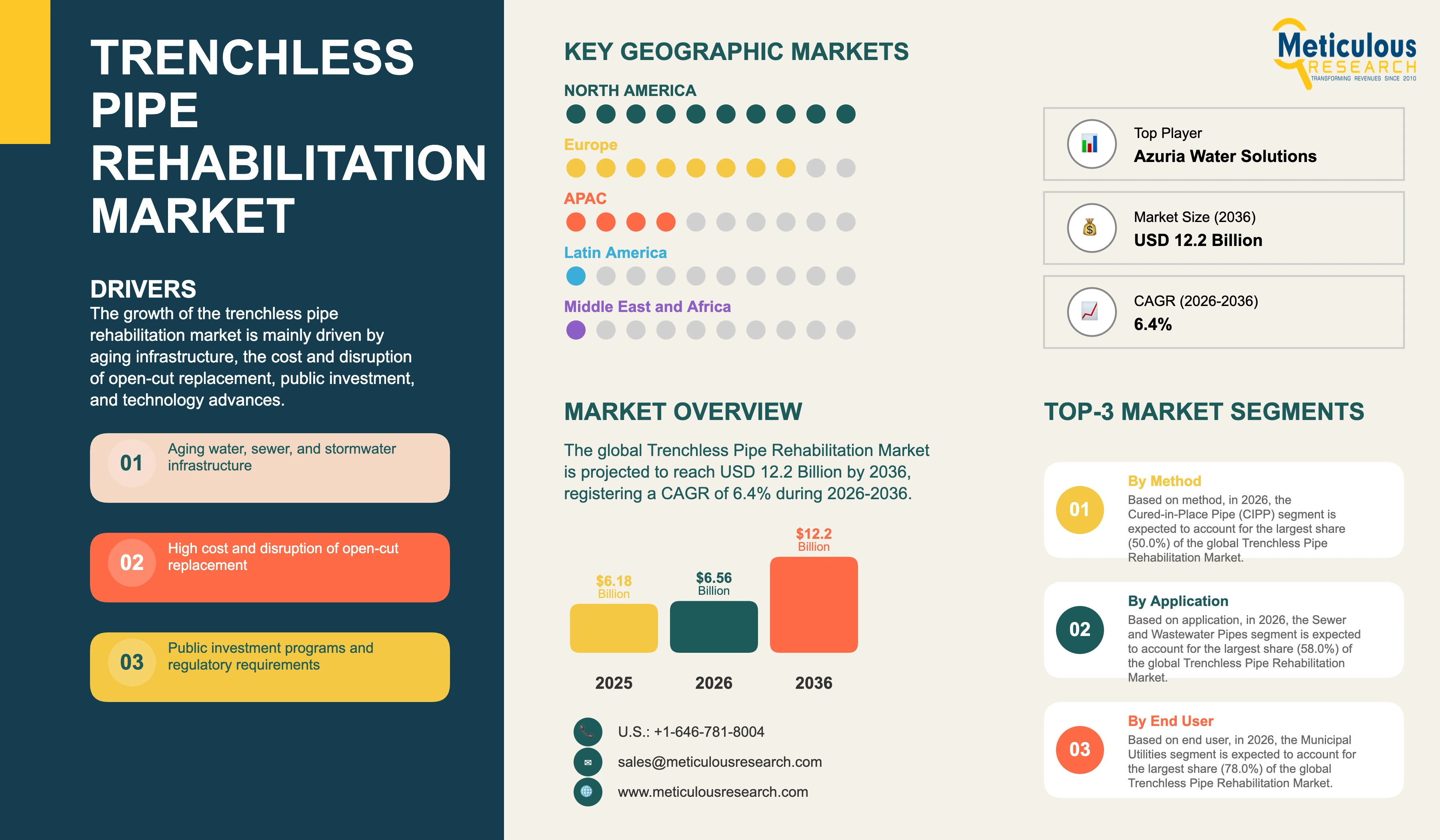
The global trenchless pipe rehabilitation market was valued at USD 6.18 billion in 2025. This market is expected to reach USD 12.20 billion by 2036 from an estimated USD 6.56 billion in 2026, registering a CAGR of 6.4% during the forecast period (2026-2036).
- Published
- Nov 2026
- Pages
- 248
- Format
- PDF + Excel
- Report ID
- MRCHM - 1042557
- Base year
- 2025
- 2025 · BASELINE
- $6.18B
- 2036
- $12.20B
- CAGR 2026–2036
- 6.4%
2025 baseline · 2026–2036 forecast at 6.4% CAGR · hover a bar for the value
Key highlights
The American Society of Civil Engineers (ASCE) 2025 Report Card for America's Infrastructure kept the grades for drinking water at C-, wastewater at D+, and stormwater at D, unchanged from 2021, and estimated that the investment gap for wastewater and stormwater will grow to more than USD 690 billion by 2044 if current trends continue, highlighting the scale of pipe rehabilitation needs in the U.S.
Vortex Companies, a trenchless water and sewer infrastructure specialist, announced the acquisitions of Mainlining America, a provider of water main rehabilitation including large-diameter lining and pipe bursting, and Germany-based BKP, known for its Berolina-Liner UV-cured CIPP technology, in April 2026, followed by the acquisition of Municipal Pipe Tool Company, a member of the CIPP Corp. installer network, in June 2026.
Azuria Water Solutions, the parent of Insituform, acquired Waterline Renewal Technologies in February 2026, adding trenchless product brands such as Perma-Liner Industries, LMK Technologies, and LightRay for CIPP lateral lining and UV curing, and also acquired Infrastructure Systems, a pipeline rehabilitation contractor in Indiana and Kentucky.
Insituform Technologies won several sewer rehabilitation contracts from the Los Angeles County Sanitation Districts in 2026, including a contract of about USD 2.5 million awarded in February 2026 to rehabilitate trunk sewers of 21 to 27 inches in diameter using CIPP liners and a contract of about USD 3.1 million awarded in May 2026 for main trunk sewer rehabilitation.
The ASCE 2025 Report Card noted that average collection system failures for combined water utilities increased from 2 to 3.3 per 100 miles of pipe, and ASCE's drinking water and wastewater discussion cited about 240,000 water main breaks per year in the U.S., showing the continued deterioration of underground pipe networks.
By method, cured-in-place pipe (CIPP) accounts for the largest share of 50.0% in 2026, while spray-in-place pipe and coatings register the highest CAGR.
By application, sewer and wastewater pipes account for the largest share of 58.0% in 2026, while potable water pipes register the highest CAGR.
By pipe diameter, small diameter (up to 18 inches) accounts for the largest share in 2026, while large diameter (above 36 inches) registers the highest CAGR.
By end user, municipal utilities account for the largest share in 2026, while residential and commercial buildings register the highest CAGR.
By geography, North America accounts for the largest share of 42.0% in 2026, while Asia-Pacific registers the highest CAGR of 8.9%.
Report summary
| Particulars | Details |
|---|---|
| Forecast Period | 2026-2036 |
| Base Year | 2025 |
| Estimated Year | 2026 |
| CAGR (Value) | 6.4% |
| Format | PDF, Excel & Cloud Portal · 248 pages |
| Market Size (Value) in 2025 | USD 6.18 billion |
| Market Size (Value) in 2026 | USD 6.56 billion |
| Market Size (Value) by 2036 | USD 12.20 billion |
| Largest Segment by Method (2026) | Cured-in-Place Pipe (50.0%) |
| Largest Segment by Application (2026) | Sewer and Wastewater Pipes (58.0%) |
| Largest Region (2026) | North America (42.0%) |
| Fastest-Growing Region | Asia-Pacific (CAGR 8.9%) |
| Key Companies | 14 companies and other companies |
| Segments Covered | Method, Application, Pipe Diameter, End User, Geography |
| Countries Covered | U.S., Canada, Germany, U.K., France, Netherlands, Sweden, Denmark, Norway, Italy, Spain, Poland, Switzerland, Belgium, Austria, Rest of Europe, Japan, China, Australia, New Zealand, South Korea, Singapore, Hong Kong, Malaysia, India, Rest of Asia-Pacific, Brazil, Mexico, Chile, Colombia, Rest of Latin America, Saudi Arabia, U.A.E., Qatar, Israel, South Africa, Rest of Middle East & Africa |
Report overview
Segments covered: method, application, pipe diameter, end user.
The growth of this market is mainly driven by the aging of water, sewer, and stormwater pipe networks in North America, Europe, and parts of Asia-Pacific, the high cost and disruption of open-cut pipe replacement in urban areas, large public investment programs for water and wastewater infrastructure, regulatory pressure to reduce sewer overflows, infiltration, and drinking water losses, the proven performance of cured-in-place pipe (CIPP) and other trenchless methods, the growing use of ultraviolet-cured liners and structural lining for pressure pipes, and the lower carbon footprint of trenchless rehabilitation compared with excavation. However, factors such as constrained municipal budgets, limited suitability of some methods for severely deteriorated or undersized pipes, shortages of skilled crews, and concerns about emissions and chemical exposure during installation are expected to restrain the growth of this market to some extent.
Trenchless pipe rehabilitation refers to methods that repair, reline, or replace existing underground pipes without digging continuous trenches along the pipe route. These methods use existing manholes, access pits, or small excavations to insert new liners or pipes, which greatly reduces surface disruption, traffic impacts, restoration costs, and project duration compared with open-cut replacement. The main methods include cured-in-place pipe (CIPP), pipe bursting, sliplining, spray-in-place pipe and coatings, spiral wound and close-fit lining, and lateral and point repair systems. This report covers rehabilitation materials, liners, equipment, and installation services for sewer and wastewater, potable water, stormwater, and gas and industrial pipes, across pipe diameters, end users, and regions. New pipe installation by horizontal directional drilling and microtunneling is excluded. The market is measured on a revenue basis.
Many water and sewer networks in developed countries were built several decades ago, and a large share of pipes are now reaching or exceeding their design life. Deteriorated pipes cause leaks, main breaks, sewer overflows, infiltration and inflow of groundwater and stormwater into sewers, sinkholes, and service interruptions. Replacing these pipes by excavation is expensive and highly disruptive, especially in dense urban areas, where pipes lie under roads, buildings, and other utilities. Trenchless rehabilitation offers a faster, lower-cost, and less disruptive alternative for many pipes.
Cured-in-place pipe is the most widely used trenchless rehabilitation method around the world, and in this method a flexible liner made of felt or glass fiber and impregnated with resin is inserted into the host pipe by inversion or pulling in, then cured using hot water, steam, or ultraviolet light to form a new, jointless pipe within the old one. CIPP is used for sewer mains, laterals, stormwater pipes, and increasingly for pressure pipes. Ultraviolet-cured glass fiber liners have grown quickly because they cure faster, use less energy, and offer high strength with thinner walls.
Pipe bursting replaces an old pipe by breaking it apart and pulling a new pipe, usually high-density polyethylene, into its place, which allows the pipe size to be maintained or increased. Sliplining inserts a smaller new pipe into the existing pipe, and it is commonly used for large-diameter pipes and culverts. Spray-in-place pipe and coatings apply cementitious, epoxy, or polyurea linings to the inside of pipes and structures, and they are widely used for water mains, manholes, and large-diameter sewers. Spiral wound lining uses a profiled strip wound into a pipe inside the host pipe, while close-fit lining reduces the diameter of a polyethylene pipe temporarily so that it can be inserted and then expanded. Lateral and point repair systems address service connections and localized defects.
Sewer and wastewater pipes account for the largest share of the market, since sewers are the main application for CIPP and have experienced significant deterioration and regulatory pressure to reduce overflows and infiltration. Potable water pipes are a fast-growing application, supported by structural lining technologies for pressure pipes, water loss reduction programs, and lead and aging pipe replacement programs. Stormwater pipes and culverts, and gas and industrial pipes account for smaller shares.
Municipal utilities are the main customers, accounting for most of the market, while residential and commercial building owners use trenchless methods for building drains and service laterals, and industrial facilities use them for process and utility pipes. Small-diameter pipes up to 18 inches account for the largest share, since most of the length of sewer and water networks consists of small pipes.
The market includes integrated trenchless contractors, liner and resin manufacturers, equipment suppliers, and specialized installers. Leading companies include Azuria Water Solutions (Insituform), Vortex Companies, Per Aarsleff, Michels, SAERTEX multiCom, IMPREG, Sekisui Chemical, Trelleborg, Sanexen, Primus Line, HammerHead Trenchless, TT Technologies, Nu Flow Technologies, and RELINEEUROPE.
Over the forecast period, the trenchless pipe rehabilitation market is expected to grow steadily, supported by aging infrastructure, public investment programs, regulatory requirements, and technology improvements. North America is expected to remain the largest market, while Asia-Pacific is expected to grow fastest as China, Japan, Australia, and other countries invest in renewing their pipe networks.
Water main breaks are our biggest operational and customer service problem, so we are expanding our structural lining program to renew mains without excavating entire streets.
Many sewers built in the 1960s and 1970s are now failing, and cities prefer trenchless methods because traffic and space constraints make open-cut work very difficult.
North America is expected to account for the largest share of 42.0% of the market in 2026, mainly due to large and aging sewer and water networks, regulatory requirements, public funding, and the presence of leading trenchless companies.
Asia-Pacific is projected to register the highest CAGR of 8.9% during the forecast period, driven by aging sewers in Japan, urban pipe renewal in China, rehabilitation programs in Australia, and rapid urbanization.
The report profiles 14 companies, including Azuria Water Solutions (Insituform), Vortex Companies, Per Aarsleff, Michels, SAERTEX multiCom, IMPREG, Sekisui Chemical, Trelleborg, Sanexen, Primus Line, HammerHead Trenchless, TT Technologies, Nu Flow Technologies, and RELINEEUROPE.
Report infographic
Market dynamics
19 factors across 5 forcesAging water, sewer, and stormwater infrastructure
Aging pipe networks are the main driver of the trenchless rehabilitation market. In the U.S., the ASCE 2025 Report Card graded drinking water at C-, wastewater at D+, and stormwater at D, and it highlighted continued deterioration, including an increase in collection system failures for combined water utilities from 2 to 3.3 per 100 miles of pipe. Many sewer pipes in the U.S. and Europe are made of clay, concrete, brick, and other materials that crack, corrode, and develop root intrusion and joint failures over time, while older water mains made of cast iron and asbestos cement are prone to breaks and leaks.
Similar challenges exist in Europe, Japan, Australia, and other developed regions, where large parts of the networks were built in the twentieth century. As pipes deteriorate, utilities must rehabilitate or replace them to avoid service failures, environmental damage, and higher operating costs. The scale of the need means that rehabilitation programs will continue for decades, providing a long-term pipeline of work for trenchless contractors and suppliers.
In many cities, pipes are also undersized for current populations and climate conditions, which increases the need for methods such as pipe bursting that allow capacity to be increased.
High cost and disruption of open-cut replacement
Open-cut replacement requires excavating along the entire length of the pipe, which involves road closures, traffic diversions, utility conflicts, restoration of pavements and landscaping, and disruption to residents and businesses. In dense urban areas, these indirect costs can be very large, and open-cut work may not be feasible under buildings, railways, rivers, and major roads. Trenchless rehabilitation typically requires only small excavations or none at all, and it can be completed much faster, often within a day for a sewer segment.
Studies by utilities and industry groups have generally found that trenchless methods offer lower total project costs for many urban pipes, especially when social and environmental costs are included. As cities become denser and more sensitive to disruption, trenchless rehabilitation is increasingly the preferred approach.
Trenchless methods also reduce the volume of excavated material and truck movements, which lowers carbon emissions and supports sustainability goals of utilities and cities.
Public investment programs and regulatory requirements
Large public investment programs provide much of the funding for pipe rehabilitation in developed countries. In the U.S., federal infrastructure funding has increased support for water and wastewater projects through state revolving funds, and the U.S. Environmental Protection Agency's needs surveys have identified hundreds of billions of dollars of investment needs for drinking water and wastewater systems over the next two decades. In the U.K., water companies are delivering their largest-ever investment programs for the 2025 to 2030 period, including significant spending on sewer and water network improvements.
Regulatory requirements are another important driver of rehabilitation spending, since consent decrees and regulations requiring utilities to reduce sanitary and combined sewer overflows often include extensive sewer rehabilitation programs to reduce infiltration and inflow. Drinking water loss reduction targets and lead service line replacement programs also increase pipe work, and trenchless methods are used where suitable.
Advances in CIPP, UV curing, and pressure pipe lining
Technology improvements have expanded the range of pipes that can be rehabilitated using trenchless methods. Ultraviolet-cured glass fiber liners offer faster curing, lower energy use, reduced emissions, and higher strength, and they have gained significant share in Europe and North America. Structural liners for pressure pipes, including CIPP and close-fit systems designed for water mains, allow utilities to rehabilitate drinking water pipes without excavation. Robotic cutters, improved inspection cameras, and lateral reinstatement tools make installations faster and more reliable.
Companies continue to invest in new technologies, as shown by Vortex's acquisition of BKP, a German producer of UV-cured CIPP liners, and Azuria's acquisition of Waterline Renewal Technologies, which includes UV curing and lateral lining products.
Growth of potable water main rehabilitation and water loss reduction
Utilities are under pressure to reduce drinking water losses and main breaks, and rehabilitation of water mains is a growing application for trenchless methods. Structural lining, spray-in-place linings, and pipe bursting allow utilities to renew water mains with minimal disruption, and they can be combined with water loss reduction programs and smart network monitoring. Vortex's acquisition of Mainlining America in April 2026 reflects growing demand for water main rehabilitation services.
Table of contents
12 chapters · 155 sections · 248 pages · click to expandSegmental analysis
| Segment | Largest share (2026) | Fastest growth (2026–2036) |
|---|---|---|
| By Method | Small diameter (up to 18 inches) | Large diameter (above 36 inches) |
By Method
- The small diameter (up to 18 inches) segment is expected to account for the largest share of the trenchless pipe rehabilitation market, while the large diameter (above 36 inches) segment is projected to register the highest CAGR during the forecast period.
- The municipal utilities segment is expected to account for the largest share of the trenchless pipe rehabilitation market, while the residential and commercial buildings segment is projected to register the highest CAGR during the forecast period.
Geographic analysis
North America
Largest shareIn 2026, North America is expected to account for the largest share of 42.0% of the global trenchless pipe rehabilitation market. The large share of this region is mainly due to large and aging sewer and water networks in the U.S. and Canada, poor ASCE grades for water infrastructure, regulatory requirements and consent decrees related to sewer overflows, federal and state funding for water infrastructure, and the presence of leading trenchless companies such as Azuria Water Solutions (Insituform), Vortex Companies, Michels, Sanexen, Nu Flow, HammerHead Trenchless, and TT Technologies. The U.S. is the largest market in the region, with active rehabilitation programs in large cities such as Los Angeles, New York, and Chicago, followed by Canada, where municipalities in Ontario, Quebec, and British Columbia have active water main and sewer lining programs.
Asia-Pacific
Fastest growthAsia-Pacific is projected to register the highest CAGR of 8.9% during the forecast period. The rapid growth of this region is mainly driven by aging sewer networks in Japan, renewal of urban pipe networks and sewer overflow reduction programs in China, rehabilitation programs in Australia and New Zealand, rapid urbanization, and growing awareness of trenchless methods. Sekisui Chemical's SPR spiral wound technology is widely used in Japan and other countries. Japan, China, Australia, South Korea, Singapore, Hong Kong, Malaysia, and India are important markets, and Singapore and Hong Kong have been early adopters of trenchless methods because of their dense urban environments.
Europe
Europe accounts for a significant share of the global market, supported by aging networks, very high population density in cities, strict environmental regulations, large investment programs by water companies in the U.K., and strong adoption of UV-cured CIPP. Germany, the U.K., France, the Netherlands, the Nordic countries, Italy, Spain, Poland, and Switzerland are important markets, and leading European companies active in the region include Per Aarsleff, SAERTEX multiCom, IMPREG, RELINEEUROPE, Primus Line, and Trelleborg. Belgium and Austria are also important markets.
Latin America
Latin America and the Middle East & Africa account for smaller shares of the market but are expected to grow steadily, supported by urbanization, high water losses, water loss reduction programs, and infrastructure investment in Brazil, Mexico, Chile, Colombia, Saudi Arabia, the U.A.E., Qatar, South Africa, and Israel. In the Gulf countries, severe corrosion of concrete sewer pipes caused by hydrogen sulfide and high temperatures creates demand for lining and coating solutions.
Competitive landscape
The global trenchless pipe rehabilitation market is fragmented, with the top five players estimated to account for about 25% of the market in 2025. The market includes integrated trenchless contractors that both manufacture liners and install them, liner and resin manufacturers, equipment and tool suppliers, and many regional and local installers.
Azuria Water Solutions, which operates Insituform, is one of the largest trenchless rehabilitation companies, with CIPP manufacturing and installation, and it expanded in 2026 by acquiring Waterline Renewal Technologies and Infrastructure Systems. Vortex Companies has built a global platform through acquisitions, including Mainlining America, BKP, and Municipal Pipe Tool Company in 2026, and it offers CIPP liners, UV curing equipment, coatings, and installation services. Michels is a major North American infrastructure contractor with trenchless rehabilitation capabilities, and Sanexen offers Aqua-Pipe structural lining for drinking water mains.
In Europe, Per Aarsleff is a leading pipe rehabilitation contractor, and SAERTEX multiCom, IMPREG, and RELINEEUROPE are leading manufacturers of UV-cured glass fiber liners. Primus Line offers flexible high-pressure liners for water and gas pipes, and Trelleborg offers pipe seals and rehabilitation solutions. Sekisui Chemical offers SPR spiral wound lining and other rehabilitation technologies, while HammerHead Trenchless and TT Technologies supply pipe bursting and trenchless equipment, and Nu Flow Technologies offers lining systems for building pipes.
Companies in this market compete on technology and product performance, installation quality and speed, cost, crew capacity, safety, geographic coverage, and relationships with utilities and engineers. Key strategies include acquisitions of contractors and product companies, development of UV-cured and styrene-free products, expansion into water main rehabilitation, investment in robotics and inspection, and partnerships with utilities through long-term framework contracts.
The market is consolidating as larger companies acquire regional contractors and product manufacturers, and we expect this trend to continue, driven by private equity investment and the need for scale and integrated capabilities.
Smaller regional contractors remain important in the market, especially for local municipal work, and many operate as licensees or installers of products supplied by larger manufacturers, which allows them to offer proven technologies without large investments in manufacturing.
Some of the key players operating in the trenchless pipe rehabilitation market are Azuria Water Solutions (Insituform Technologies, LLC), Vortex Companies, Per Aarsleff Holding A/S, Michels Corporation, SAERTEX multiCom GmbH, IMPREG GmbH, Sekisui Chemical Co., Ltd., Trelleborg AB, Sanexen Environmental Services Inc., Primus Line GmbH, HammerHead Trenchless, TT Technologies, Inc., Nu Flow Technologies, and RELINEEUROPE GmbH, among others.
- —
Vortex Companies acquired Mainlining America and BKP in April 2026 and Municipal Pipe Tool Company in June 2026, Azuria Water Solutions acquired Waterline Renewal Technologies in February 2026, and Insituform won trunk sewer CIPP contracts from the Los Angeles County Sanitation Districts in 2026.
- Mainlining America
- BKP
- Municipal Pipe Tool Company in 2026
Expert perspectives
Trenchless pipe rehabilitation has become a mainstream method for renewing water, sewer, and stormwater pipes, and its role is expected to grow as networks age and cities seek to minimize disruption. The market is supported by long-term infrastructure needs, regulatory requirements, and technology improvements.
Over the forecast period, the market is expected to grow at a CAGR of 6.4%, from USD 6.56 billion in 2026 to USD 12.20 billion in 2036. Growth will be supported by aging infrastructure, the cost and disruption of open-cut replacement, public investment and regulation, technology advances, and water main rehabilitation.
CIPP remains the largest method, while spray-in-place pipe and coatings grow fastest. Sewer and wastewater pipes are the largest application, while potable water pipes grow fastest. Small-diameter pipes are the largest segment, while large-diameter pipes grow fastest. Municipal utilities are the largest end user, while residential and commercial buildings grow fastest. North America is the largest region, and Asia-Pacific is the fastest-growing region at a CAGR of 8.9%.
In our view, the most important structural shift in the market is the expansion from gravity sewer lining into pressure pipe and water main rehabilitation, which opens a large new market. Companies that develop reliable structural lining technologies for water mains and build the service capabilities needed for water main projects will capture significant growth.
We also expect UV-cured glass fiber liners to continue gaining share from traditional hot water and steam curing, supported by faster installation, lower emissions, and improving cost competitiveness.
Consolidation is rapidly reshaping the trenchless rehabilitation industry, as private equity-backed platforms such as Vortex and Azuria acquire contractors and product companies. This consolidation can bring greater scale, technology investment, and broader service offerings, but it also requires careful integration and quality management.
Funding remains the key uncertainty for the trenchless pipe rehabilitation market, because while the need for pipe rehabilitation is very large, the pace of investment depends on utility budgets, rate increases, and public funding. We expect steady growth in the market over the forecast period, with some year-to-year variability linked to funding cycles and economic conditions.
Finally, we believe that digital inspection, artificial intelligence, and asset management will increase the efficiency of rehabilitation programs and help utilities target the right pipes at the right time, which will support greater use of trenchless methods.
Overall, we expect trenchless pipe rehabilitation to account for a growing share of total pipe renewal spending, as utilities seek to renew more pipe with limited budgets and minimal disruption to communities.
Customer perspectives
Engineering Manager - municipal sewer utility, U.S.
We line most of our deteriorated sewers with CIPP because it costs far less than digging up our streets, and we can rehabilitate a block in a day with minimal complaints from residents.
Frequently asked questions
The global trenchless pipe rehabilitation market was valued at USD 6.18 billion in 2025, up from USD 5.85 billion in 2024, and is estimated at USD 6.56 billion in 2026. The market includes CIPP, pipe bursting, sliplining, spray-in-place pipe and coatings, spiral wound and close-fit lining, and lateral and point repair systems.
Cite this report
Meticulous Research. (2026). Trenchless Pipe Rehabilitation Market - Global Opportunity Analysis and Industry Forecast (2026-2036) (Report No. MRCHM - 1042557). Meticulous Market Research Pvt. Ltd. https://www.meticulousresearch.com/product/trenchless-pipe-rehabilitation-market-7240