Permanent Magnets Market (2026-2036)
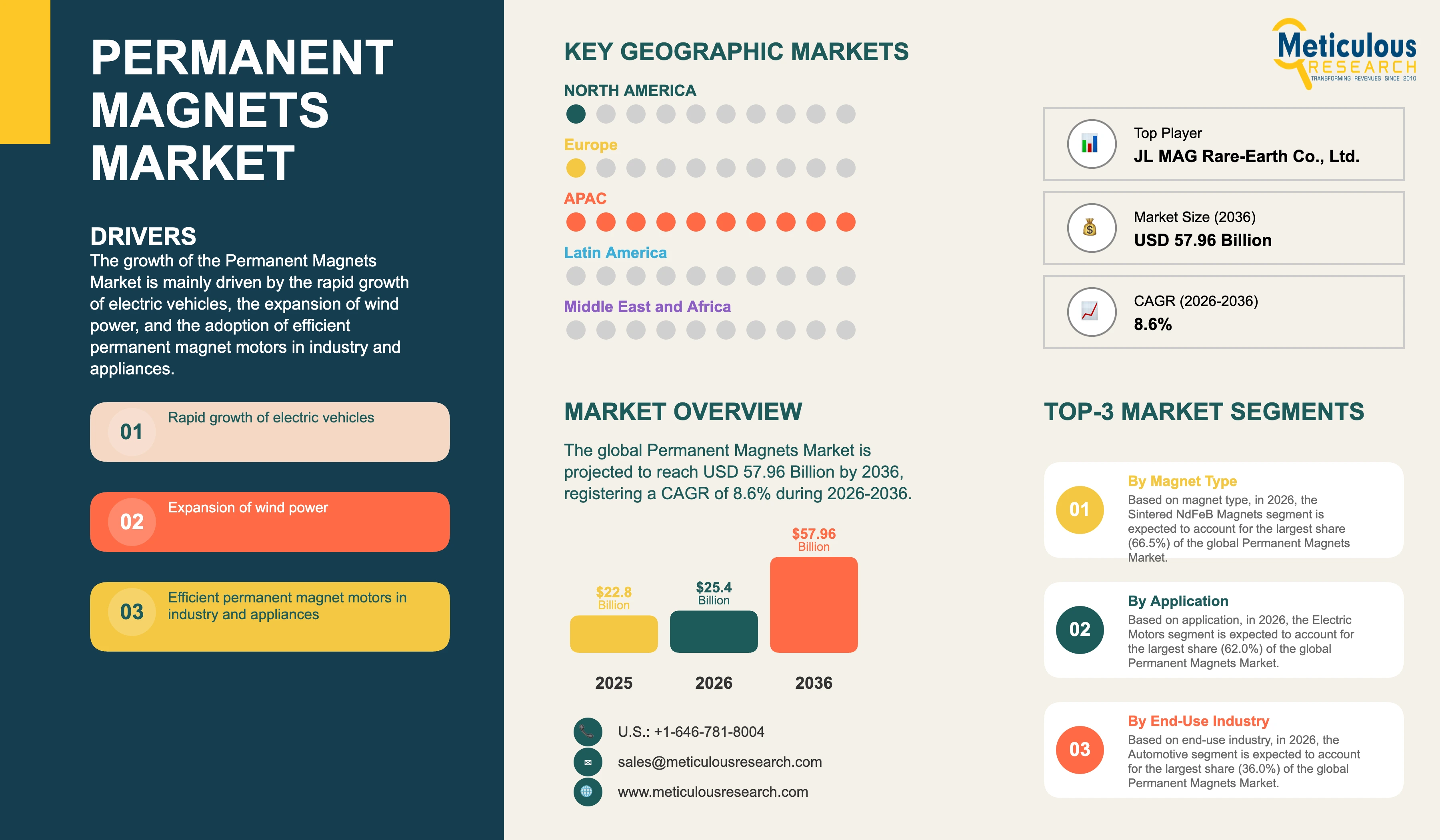
The global permanent magnets market was valued at USD 22.80 billion in 2025. This market is expected to reach USD 57.96 billion by 2036 from an estimated USD 25.40 billion in 2026, registering a CAGR of 8.6% during the forecast period (2026-2036). In terms of volume, this market is expected to reach 2.96 million tons by 2036 from an estimated 1.75 million tons in 2026, registering a CAGR of 5.4% during the forecast period.
- Published
- Nov 2026
- Pages
- 298
- Format
- PDF + Excel
- Report ID
- MRCHM - 1042476
- Base year
- 2025
- 2025 · BASELINE
- $22.80B
- 2036
- $57.96B
- CAGR 2026–2036
- 8.6%
2025 baseline · 2026–2036 forecast at 8.6% CAGR · hover a bar for the value
Key highlights
China accounted for about 60% of global mined production of magnet rare earths, about 91% of refined output, and about 94% of global sintered permanent magnet production in 2024, according to the International Energy Agency.
China expanded its export controls on rare earths and rare earth magnets during 2025, first on seven heavy rare earths and related magnets in April and then to more elements and extraterritorial rules in October, before agreeing to a one-year suspension of the October measures in November 2025 that is due to expire in November 2026.
The U.S. Department of Defense agreed in July 2025 to invest in MP Materials, set a price floor of USD 110 per kg for NdPr oxide, and buy all output from MP's planned 10X magnet facility for ten years, and a similar NdPr price floor was agreed with Lynas Rare Earths in March 2026.
JL MAG Rare-Earth, one of the world's largest NdFeB magnet producers, reported 2025 revenue of RMB 7.72 billion and magnetic material sales of 25,282 tons, up 21.25%, and is building a 20,000-ton-per-year project that will lift its capacity to 60,000 tons.
NdPr oxide prices nearly doubled over seven months to about USD 125 per kg in February 2026 as China's export controls tightened supply, before easing while remaining above pre-control levels.
MP Materials produced a record 917 metric tons of NdPr oxide in the first quarter of 2026, up 63% year-over-year, and is targeting commercial magnet sales from its Texas magnet facility in the second half of 2026, while its planned 10X facility targets about 10,000 tons per year of magnet capacity by 2028.
Ningbo Yunsheng sold 14, 197 tons of finished NdFeB magnets in 2025, up 10%, and had 26,000 tons per year of rough NdFeB magnet capacity and 10,000 tons per year of grain boundary diffusion capacity by the end of 2025.
Sintered NdFeB magnets are the fastest-growing magnet type, sensors and actuators are the fastest-growing application, and industrial and robotics is the fastest-growing end-use industry.
By magnet type, sintered NdFeB magnets account for the largest share of 66.5% in 2026 and also register the highest CAGR.
By application, electric motors account for the largest share in 2026, while sensors and actuators register the highest CAGR.
By end-use industry, automotive accounts for the largest share of 36.0% in 2026, while industrial and robotics registers the highest CAGR.
By geography, Asia-Pacific accounts for the largest share of 78.0% in 2026, while North America registers the highest CAGR of 11.4%.
Report summary
| Particulars | Details |
|---|---|
| Forecast Period | 2026-2036 |
| Base Year | 2025 |
| Estimated Year | 2026 |
| CAGR (Value) | 8.6% |
| Format | PDF, Excel & Cloud Portal · 298 pages |
| Market Size (Value) in 2025 | USD 22.80 billion |
| Market Size (Value) in 2026 | USD 25.40 billion |
| Market Size (Value) by 2036 | USD 57.96 billion |
| Market Volume (2026 to 2036) | 1.75 million tons to 2.96 million tons (CAGR 5.4%) |
| Largest Segment by Magnet Type (2026) | Sintered NdFeB Magnets (66.5%) |
| Largest Segment by End-Use Industry (2026) | Automotive (36.0%) |
| Largest Region (2026) | Asia-Pacific (78.0%) |
| Fastest-Growing Region | North America (CAGR 11.4%) |
| Segments Covered | Magnet Type, Application, End-Use Industry, and Geography |
| Countries Covered | Asia-Pacific, Europe, North America, and Rest of the World |
| Key Companies | JL MAG, Zhong Ke San Huan, Ningbo Yunsheng, Zhenghai, DMEGC, Shin-Etsu Chemical, Proterial, TDK, Daido Steel, VAC, Neo Performance Materials, MP Materials, Arnold Magnetic Technologies, and Niron Magnetics |
Report overview
Segments covered: magnet type, application, end-use industry.
The growth of this market is mainly driven by the rapid growth of electric vehicles, which use high-performance rare earth magnets in their traction motors, the expansion of wind power, the growing use of efficient permanent magnet motors in industrial equipment and home appliances, and new demand from industrial and humanoid robots. However, factors such as the concentration of rare earth mining, refining, and magnet production in China, China's export controls on rare earths and magnets, and the volatility of rare earth prices are expected to restrain the growth of this market to some extent.
Permanent magnets are materials that produce a lasting magnetic field without needing an electric current, and they are essential components of electric motors, generators, sensors, actuators, speakers, and many other devices. The main types are neodymium-iron-boron (NdFeB) magnets, which are the strongest and are made by sintering or bonding, ferrite magnets, which are low-cost and widely used in appliances and conventional motors, samarium cobalt (SmCo) magnets, which perform well at high temperatures and are used in aerospace and defense, and aluminum-nickel-cobalt (AlNiCo) magnets, which are used in sensors and instruments. This market covers the sale of finished permanent magnets of all these types, measured by their value and weight, and excludes rare earth oxides, metals, and alloys sold before magnet production.
NdFeB magnets account for most of the value of the market because of their very high magnetic strength, which allows smaller, lighter, and more efficient motors and generators. They are used in electric vehicle traction motors, wind turbine generators, industrial servo motors, robots, hard disk drives, smartphones, and inverter air conditioners. NdFeB magnets contain the light rare earths neodymium and praseodymium, and high-temperature grades also contain heavy rare earths such as dysprosium and terbium, which makes their supply chain closely linked to rare earth mining and refining. The price of NdFeB magnets therefore moves closely with the prices of NdPr oxide and heavy rare earths, which have been very volatile in recent years.
Ferrite magnets, made from iron oxide and strontium or barium carbonate, account for most of the volume of the market because they are cheap and do not use rare earths. They are used in small motors for cars, appliances, and power tools, as well as loudspeakers and other products. Although ferrite magnets are much weaker than NdFeB magnets, they remain important for cost-sensitive applications and are also being considered as alternatives to rare earth magnets in some motors to reduce supply risks. Ferrite magnet production is also concentrated in China, although Japan, South Korea, India, and other countries also produce ferrite magnets for local markets.
The magnet supply chain is highly concentrated in China, which accounted for about 94% of global sintered permanent magnet production in 2024, along with most rare earth refining. China's magnet industry includes large producers such as JL MAG, Beijing Zhong Ke San Huan, Ningbo Yunsheng, and Yantai Zhenghai, and Chinese NdFeB output has grown rapidly to serve domestic electric vehicle, wind, appliance, and electronics demand. Outside China, the main producers are Japanese companies such as Shin-Etsu Chemical, Proterial, TDK, and Daido Steel, Germany's VAC, and a small number of newer producers in the U.S., Europe, and South Korea. Japanese producers hold important patents and technical expertise in high-performance and low-heavy-rare-earth magnets, which gives them a strong position with automakers and electronics companies.
Supply chain security has become a major policy concern since China's export controls on rare earths and magnets in 2025 disrupted production at some automotive and industrial companies outside China and pushed up prices for NdPr and heavy rare earths. In response, the U.S., the EU, Japan, and other countries are supporting new mining, refining, and magnet production outside China, such as MP Materials' magnet plants in Texas, VAC's plant in South Carolina, Neo Performance Materials' plant in Estonia, and other projects, often backed by government funding, price floors, and long-term offtake agreements. Japan has also built up stockpiles and diversified its rare earth supply through investments in Lynas and other projects since China restricted exports to Japan in 2010.
Demand is expected to grow strongly over the forecast period, led by electric vehicles, wind power, efficient industrial motors, and robotics. Humanoid robots, in particular, could become a large new source of demand for NdFeB magnets because each robot uses many small, high-performance motors and actuators. At the same time, magnet makers and automakers are working to reduce the use of heavy rare earths through grain boundary diffusion and other technologies and to develop rare-earth-free motors and magnets, which could change the mix of demand over time. Value growth is expected to outpace volume growth because high-value NdFeB magnets are growing faster than lower-value ferrite magnets.
NdFeB magnets, which are much more expensive per kilogram than ferrite magnets, are growing faster than ferrite, so the mix of the market is shifting toward higher-value products.
Magnet users are qualifying suppliers outside China, signing long-term contracts, holding more inventory, reducing heavy rare earth content through grain boundary diffusion, and developing motors that use fewer or no rare earths, such as ferrite-assisted and externally excited motors.
Humanoid robots use dozens of high-performance motors and actuators, each of which relies on NdFeB magnets. If humanoid robots reach large-scale production over the forecast period, they could become one of the largest new sources of NdFeB demand, supporting the fast growth of the industrial and robotics segment.
Sintered NdFeB magnets are expected to account for the largest share of 66.5% of the market in 2026 and are also projected to register the highest CAGR.
Sensors and actuators are projected to register the highest CAGR, driven by robotics and automation, while electric motors hold the largest share.
Automotive is expected to account for the largest share of 36.0% of the market in 2026, while industrial and robotics is projected to register the highest CAGR.
Asia-Pacific is expected to account for the largest share of 78.0% of the market in 2026.
North America is projected to register the highest CAGR of 11.4% during the forecast period, supported by government-backed domestic magnet production.
The report profiles 14 companies, including JL MAG Rare-Earth, Beijing Zhong Ke San Huan, Ningbo Yunsheng, Shin-Etsu Chemical, Proterial, and TDK. The top five players account for an estimated 21.5% of the market in 2025.
Report infographic
Market dynamics
15 factors across 5 forcesRapid growth of electric vehicles
Electric vehicles are the largest and fastest-growing source of demand for high-performance NdFeB magnets. Most battery electric and hybrid vehicles use permanent magnet synchronous motors, which offer high efficiency and power density, and each vehicle typically uses one to two kilograms or more of NdFeB magnets in its traction motor, along with many smaller magnets in other motors and sensors. China's new energy vehicle production reached very high levels in 2025, with market penetration of more than half of new car sales.
As electric vehicle sales continue to grow in China, Europe, North America, and emerging markets, demand for NdFeB magnets is expected to rise strongly. Conventional vehicles also use many small ferrite and NdFeB magnets in motors for windows, seats, pumps, and steering, and advanced driver assistance systems add more sensors. Automotive is the largest end-use industry in this market. Every major automaker now has electric vehicle programs that depend on secure magnet supply, which makes magnets a strategic purchasing priority. Automakers are also signing long-term supply agreements with magnet producers outside China to secure supply. Electric two-wheelers and three-wheelers, which are very popular in China, India, and Southeast Asia, also use permanent magnet motors and add significant demand.
Expansion of wind power
Wind turbines, particularly direct-drive and medium-speed turbines used offshore, use large permanent magnet generators that contain hundreds of kilograms or more of NdFeB magnets per megawatt. As countries expand wind power to meet climate targets, demand for these magnets is growing, especially for large offshore turbines of 10 MW and more.
China is the largest wind market and installed very large amounts of new wind capacity in 2025, while Europe, the U.S., and other regions are expanding offshore wind. Although some onshore turbines use gearboxes and induction generators that require fewer magnets, the growth of offshore wind is expected to support strong demand for large NdFeB magnets. Energy is an important end-use industry in this market. Chinese turbine makers, such as Goldwind, use permanent magnet direct-drive designs widely, which supports large domestic magnet demand. Wind turbine makers are also among the most active buyers seeking magnet supply outside China. Each large offshore turbine can require several tons of NdFeB magnets, which makes wind one of the most magnet-intensive applications per unit.
Adoption of efficient permanent magnet motors in industry and appliances
Permanent magnet motors are more efficient than traditional induction motors, and tighter energy efficiency rules for motors and appliances in China, Europe, the U.S., and other regions are encouraging their use. Inverter air conditioners, refrigerator compressors, washing machines, pumps, fans, elevators, and industrial servo motors increasingly use permanent magnet motors to save energy.
China's large appliance industry, which produces hundreds of millions of air conditioners each year, is a major consumer of NdFeB and ferrite magnets, and energy-efficient elevators and industrial motors add further demand. As efficiency standards rise worldwide, demand for magnets in these applications is expected to grow steadily. Home appliances and industrial applications together account for a large share of the market. Variable speed drives combined with permanent magnet motors are increasingly used in pumps and fans in buildings and factories. Higher-efficiency motor classes in Europe and other regions are also accelerating this shift. Appliance makers in China, Japan, and South Korea are among the largest buyers of both NdFeB and ferrite magnets.
Growth of industrial and humanoid robots
Industrial robots, collaborative robots, and humanoid robots use many servo motors and actuators that rely on high-performance NdFeB magnets for compact size and precise control. China's industrial robot output rose 28% in 2025 to more than 773,000 units, and many companies are developing humanoid robots that each use dozens of motors and actuators.
If humanoid robots reach large-scale production over the forecast period, they could become one of the largest new sources of NdFeB demand. Magnet makers such as JL MAG are already targeting robotics customers and developing magnetic components for robot actuators. Industrial and robotics is the fastest-growing end-use industry in this market, and sensors and actuators are the fastest-growing application. Drones, automated warehouses, and other automation systems add further demand. Several automakers and technology companies have announced plans to produce humanoid robots at scale later in the decade, which could significantly increase magnet demand.
Table of contents
11 chapters · 122 sections · 298 pages · click to expandGeographic analysis
Asia-Pacific
Largest shareIn 2026, Asia-Pacific is expected to account for the largest share of 78.0% of the global permanent magnets market. The large share of this region is mainly due to China's dominant position in rare earth refining and magnet production, the very large electric vehicle, appliance, electronics, and wind industries in China, and the strong magnet industry in Japan. China is by far the largest producer and consumer of permanent magnets, with about 94% of global sintered magnet production in 2024 and the world's largest electric vehicle, wind, appliance, and electronics industries. Chinese NdFeB output has grown rapidly, with industry estimates placing 2025 production at about 340,000 to 350,000 tons, and leading producers such as JL MAG, Zhong Ke San Huan, Ningbo Yunsheng, and Zhenghai continue to add capacity. Japan is the largest magnet producer outside China, with Shin-Etsu Chemical, Proterial, TDK, and Daido Steel supplying high-performance magnets to automakers and electronics companies, and it has invested in diversifying rare earth supply. South Korea, India, Vietnam, and Thailand are also growing as magnet users and, in some cases, producers. Asia-Pacific is expected to remain the dominant region over the forecast period, although its share will decline as new capacity is built in North America and Europe. India is also emerging as an important market, supported by its electric two-wheeler industry and new government incentives for domestic rare earth magnet production. China introduced export controls on seven heavy rare earths and related magnets in April 2025 and expanded them in October 2025, before suspending the October measures for one year from November 2025. The controls disrupted production at some companies outside China, raised prices, and accelerated investment in alternative supply chains.
North America
Fastest growthNorth America is projected to register the highest CAGR of 11.4% during the forecast period. Growth is driven by government support for domestic magnet production, including the U.S. Department of Defense's agreement with MP Materials, new plants by VAC, Arnold Magnetic Technologies, Niron Magnetics, and others, and growing demand from electric vehicles, defense, wind, and robotics. Apple's agreement with MP Materials to buy recycled rare earth magnets made in the U.S. also adds commercial demand for domestic production.
Europe
Europe holds a smaller share of the market, supported by VAC in Germany, Neo Performance Materials' plant in Estonia, and demand from automakers, wind turbine makers, and industrial companies, along with the EU's Critical Raw Materials Act.
Latin America
The Rest of the World includes Latin America and the Middle East and Africa, where demand is smaller. European automakers and wind turbine makers are among the largest buyers seeking non-Chinese magnet supply, and the EU is supporting new rare earth processing and magnet projects.
Competitive landscape
The permanent magnets market is moderately fragmented, with a large number of Chinese producers and a smaller group of Japanese, European, and U.S. producers. Leading Chinese NdFeB producers include JL MAG Rare-Earth, Beijing Zhong Ke San Huan, Ningbo Yunsheng, and Yantai Zhenghai Magnetic Material, while Hengdian Group DMEGC is a major producer of ferrite and rare earth magnets. Outside China, Shin-Etsu Chemical, Proterial, TDK, Daido Steel, and VAC are leading producers of high-performance magnets.
New entrants and expanding producers outside China, such as MP Materials, Neo Performance Materials, Arnold Magnetic Technologies, and Niron Magnetics, are building capacity with support from governments and customers. Rare earth producers, such as MP Materials and Lynas, are integrating downstream, while magnet makers are integrating upstream into alloys and recycling and downstream into components.
The top five players are estimated to account for 21.5% of the market in 2025, reflecting the large number of magnet producers in China and the separate ferrite and rare earth magnet segments. Concentration is higher in high-performance NdFeB magnets for electric vehicles and wind, where a smaller number of producers have the scale, technology, and customer qualifications needed. Qualification processes with automakers can take several years, which gives established suppliers a strong advantage. Chinese producers are also expanding overseas, with plants or partnerships in Southeast Asia, Mexico, and Europe, to serve customers outside China.
Producers use several strategies to grow in this market, including expanding capacity, developing low-heavy-rare-earth and high-temperature grades, signing long-term supply agreements with automakers and wind turbine makers, integrating across the supply chain, investing in recycling, and expanding into magnetic components. Producers outside China are using government support and customer partnerships to build new plants. Competition is expected to center on cost, magnet performance, supply security, heavy rare earth reduction, and the ability to supply customers outside China. Supply chain origin is becoming an important factor in customer decisions, particularly for defense and automotive buyers in the U.S. and Europe. U.S. defense rules that restrict the use of Chinese-origin magnets in defense systems from 2027 are also increasing demand for non-Chinese supply.
Some of the key players operating in the permanent magnets market are JL MAG Rare-Earth Co., Ltd., Beijing Zhong Ke San Huan High-Tech Co., Ltd., Ningbo Yunsheng Co., Ltd., Yantai Zhenghai Magnetic Material Co., Ltd., Hengdian Group DMEGC Magnetics Co., Ltd., Shin-Etsu Chemical Co., Ltd., Proterial, Ltd., TDK Corporation, Daido Steel Co., Ltd., VAC Group, Neo Performance Materials Inc., MP Materials Corp., Arnold Magnetic Technologies, and Niron Magnetics, Inc.
- —
The U.S. Department of Defense agreed to an NdPr price floor and offtake with MP Materials and later with Lynas, China suspended its expanded export controls for one year from November 2025, NdPr prices peaked at about USD 125 per kg in February 2026, and JL MAG reported record 2025 sales of 25,282 tons.
- JL MAG
- Zhong Ke San Huan
- Ningbo Yunsheng
- Zhenghai
- DMEGC
- Shin-Etsu Chemical
- Proterial
- TDK
- Daido Steel
- VAC
- Neo Performance Materials
- MP Materials
- Arnold Magnetic Technologies
- Niron Magnetics
Expert perspectives
The permanent magnets market is growing strongly on the back of electric vehicles, wind power, efficient motors, and robotics, but it is also at the center of global supply chain and geopolitical concerns. China's control of rare earth refining and magnet production, and its willingness to use export controls, has turned magnets into a strategic material, and governments are now investing heavily to build alternative supply chains.
Over the forecast period, the market is expected to become more diversified, but China will remain dominant. New capacity in the U.S., Europe, Japan, South Korea, and India will reduce dependence on China for some customers, particularly in defense and automotive, but it will take many years and significant government support to reach meaningful scale. Prices will remain sensitive to Chinese policy, and the expiry or renewal of China's suspended export controls in November 2026 is a key near-term factor.
Sintered NdFeB magnets hold the largest share and register the highest CAGR among magnet types, sensors and actuators are the fastest-growing application, and industrial and robotics is the fastest-growing end-use industry, reflecting the growth of automation and humanoid robots. Automotive and electric motors remain the largest segments.
Asia-Pacific remains the dominant region, while North America is the fastest-growing region at a CAGR of 11.4%. The main swing factors are Chinese export policy, the pace of electric vehicle and wind growth, the commercialization of humanoid robots, rare earth prices, and the success of new magnet plants outside China. Technologies that reduce or eliminate rare earth use could also shift demand between magnet types. The growth of magnet recycling could also become an important source of supply outside China in the second half of the forecast period. Demand from humanoid robots is the largest upside risk to the forecast.
For magnet users, the key decision is how to balance cost and supply security, through dual sourcing, long-term contracts, inventory, and designs that use fewer rare earths. For producers outside China, success depends on securing raw materials, achieving competitive costs, and winning long-term contracts with automakers and other customers. Producers that combine integrated supply chains, advanced technology, and strong customer relationships are expected to capture most of the growth. Early commitment to long-term supply agreements will be important, as new capacity outside China is often reserved by anchor customers before it starts production.
Overall, growth in this market rests on electrification, automation, and renewable energy, while its structure will be shaped by supply chain diversification and government policy. Producers with secure rare earth supply are expected to benefit most.
Customer perspectives
The importance of magnets to electric vehicles is why automotive accounts for 36.0% of the market and why sintered NdFeB magnets account for 66.5%. Supply security is now as important as cost in automakers' sourcing decisions.
The growth of industrial and humanoid robots is driving the fast growth of the industrial and robotics segment and of sensors and actuators, with China's large magnet industry and robot production supporting Asia-Pacific's 78.0% share.
Program Manager - Defense contractor, U.S.
For defense systems, we need magnets from a secure supply chain, and that means domestic or allied sources. Government-backed plants and price floors have finally made that possible at scale.
Government support for domestic magnet production is driving rapid growth in North America, the fastest-growing region at a CAGR of 11.4%. Defense and automotive buyers are expected to be the main early customers for new U.S. capacity. Long-term contracts and government support are expected to make domestic magnets more competitive over time. Buyers are also asking for full traceability of rare earth origin.
“The 2025 export controls showed us how exposed we were, so we now qualify magnet suppliers outside China for every new motor program and design our motors to use as little heavy rare earth as possible.”
“A humanoid robot needs dozens of high-performance actuators, and every one of them depends on NdFeB magnets. As we move toward volume production, magnet supply is one of the first things we secure.”
Frequently asked questions
The market was valued at USD 22.80 billion in 2025 and USD 20.60 billion in 2024, and is estimated at USD 25.40 billion in 2026.
Cite this report
Meticulous Research. (2026). Permanent Magnets Market - Global Opportunity Analysis and Industry Forecast (2026-2036) (Report No. MRCHM - 1042476). Meticulous Market Research Pvt. Ltd. https://www.meticulousresearch.com/product/permanent-magnets-market-7159