Recycled Polyolefins Market (2026-2036)
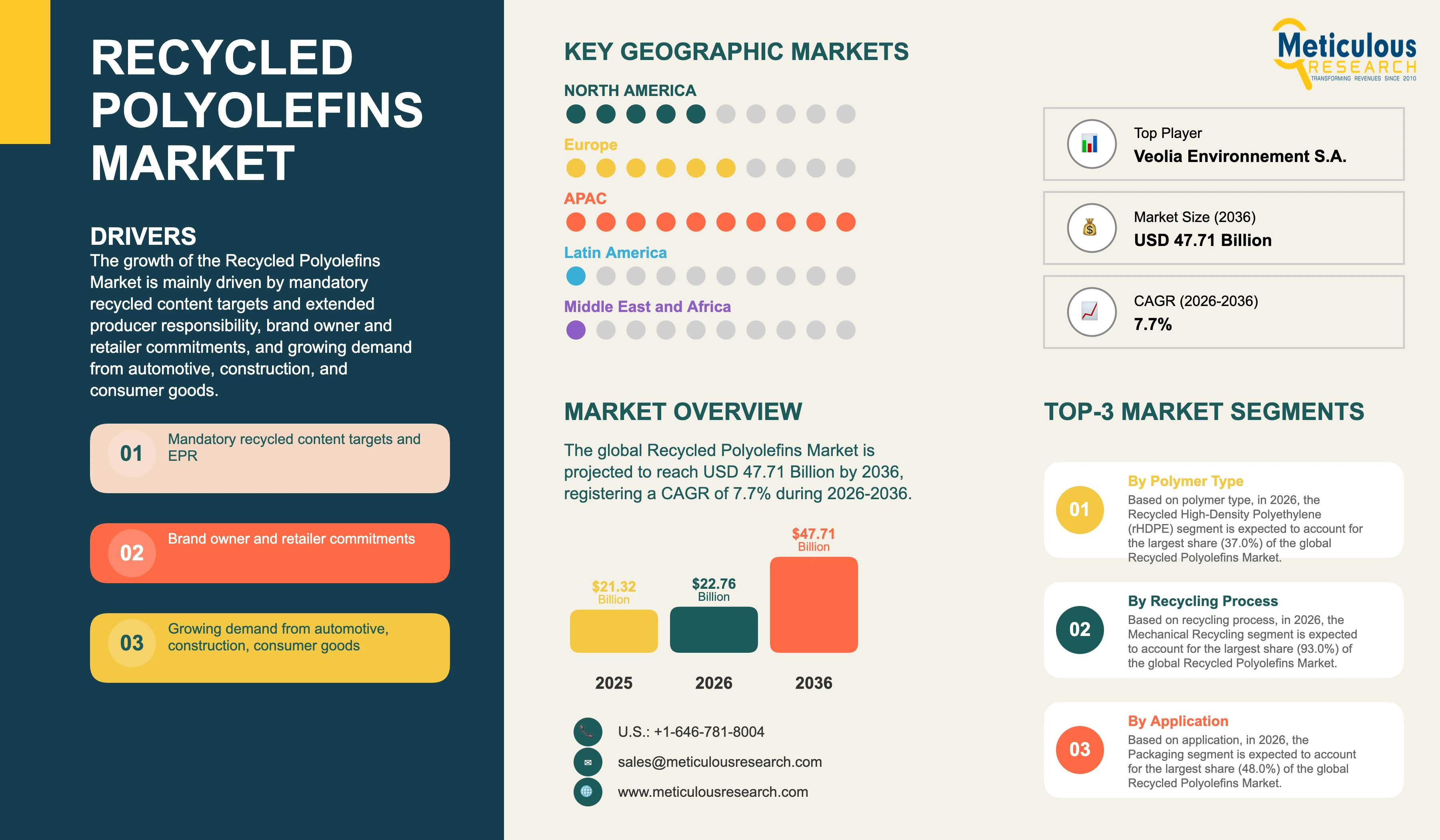
The global recycled polyolefins market was valued at USD 21.32 billion in 2025. This market is expected to reach USD 47.71 billion by 2036 from an estimated USD 22.76 billion in 2026, registering a CAGR of 7.7% during the forecast period (2026-2036). In terms of volume, this market is expected to reach 41.48 million tons by 2036 from an estimated 22.10 million tons in 2026, registering a CAGR of 6.5% during the forecast period.
- Published
- Nov 2026
- Pages
- 268
- Format
- PDF + Excel
- Report ID
- MRCHM - 1042472
- Base year
- 2025
- 2025 · BASELINE
- $21.32B
- 2036
- $47.71B
- CAGR 2026–2036
- 7.7%
2025 baseline · 2026–2036 forecast at 7.7% CAGR · hover a bar for the value
Key highlights
World plastics production reached about 430.9 million tons in 2024, according to Plastics Europe's Plastics the Fast Facts 2025, and post-consumer recycled plastics still account for less than one-tenth of global production, which shows the large potential for growth in recycled polyethylene and polypropylene worldwide.
Plastics Europe reported that circular plastics, including recycled and bio-based plastics, remained at about 15% of European plastics production in 2024, and that Europe's share of global plastics production fell to about 12%, as European producers and recyclers faced high costs and competition from low-priced imports.
The EU Packaging and Packaging Waste Regulation applies from August 2026 and sets minimum recycled content targets for plastic packaging from 2030, including targets for contact-sensitive packaging made from materials other than PET and higher targets for other plastic packaging, which will require large volumes of recycled polyethylene and polypropylene.
The EU's proposed End-of-Life Vehicles Regulation includes requirements for recycled plastic content in new vehicles, a share of which must come from recycled end-of-life vehicles, which is expected to increase demand for automotive-grade recycled polypropylene.
The U.K. Plastic Packaging Tax applies to plastic packaging with less than 30% recycled content, and several U.S. states, including California, Oregon, Colorado, Maine, and Minnesota, have adopted extended producer responsibility laws for packaging, which are expected to increase funding for collection and recycling and demand for recycled polyolefins.
Major petrochemical companies, such as LyondellBasell, Dow, SABIC, ExxonMobil, TotalEnergies, and Borealis, have invested in mechanical and chemical recycling capacity and offer recycled and circular polyolefin grades, such as LyondellBasell's CirculenRevive, SABIC's TRUCIRCLE, and Borealis' Borcycle.
PureCycle Technologies has developed a solvent-based purification process to produce ultra-pure recycled polypropylene, and it operates a commercial plant in Ironton, Ohio, showing the development of new technologies for high-quality recycled polypropylene.
By polymer type, recycled high-density polyethylene accounts for the largest share of 37.0% in 2026, while recycled polypropylene registers the highest CAGR.
By recycling process, mechanical recycling accounts for the largest share in 2026, while chemical and advanced recycling register the higher CAGR.
By source, post-consumer recycled polyolefins account for the largest share in 2026 and register the higher CAGR.
By application, packaging accounts for the largest share of 48.0% in 2026, while automotive registers the highest CAGR.
By geography, Asia-Pacific accounts for the largest share of 44.0% in 2026, while Europe registers the highest CAGR of 9.0%.
Report summary
| Particulars | Details |
|---|---|
| Forecast Period | 2026-2036 |
| Base Year | 2025 |
| Estimated Year | 2026 |
| CAGR (Value) | 7.7% |
| Format | PDF, Excel & Cloud Portal · 268 pages |
| Market Size (Value) in 2025 | USD 21.32 billion |
| Market Size (Value) in 2026 | USD 22.76 billion |
| Market Size (Value) in 2036 | USD 47.71 billion |
| Market Volume (2026 to 2036) | 22.10 million tons to 41.48 million tons (CAGR 6.5%) |
| Largest Segment by Polymer Type (2026) | Recycled HDPE (37.0%) |
| Largest Segment by Application (2026) | Packaging (48.0%) |
| Largest Region (2026) | Asia-Pacific (44.0%) |
| Fastest-Growing Region | Europe (CAGR 9.0%) |
| Segments Covered | Polymer Type, Recycling Process, Source, Application, and Geography |
| Countries Covered | Asia-Pacific, Europe, North America, Latin America, and Middle East and Africa |
| Key Companies | Veolia, SUEZ, Borealis, LyondellBasell, Dow, SABIC, ExxonMobil, TotalEnergies, PureCycle Technologies, KW Plastics, ALPLA Group, Biffa, Envision Plastics, and Remondis |
Report overview
Segments covered: polymer type, recycling process, source, application.
The growth of this market is mainly driven by mandatory recycled content targets and extended producer responsibility rules for packaging, particularly the EU Packaging and Packaging Waste Regulation, voluntary recycled content commitments by consumer goods companies and retailers, rising demand for recycled plastics in automotive, construction, and consumer goods, investment in improved collection, sorting, and food-grade mechanical recycling, and the development of chemical and advanced recycling technologies that can produce virgin-quality polyolefins from mixed plastic waste. However, factors such as competition from low-priced virgin polyethylene and polypropylene, inconsistent quality and supply of plastic waste, the difficulty of recycling flexible and multilayer packaging, and the high cost of chemical recycling are expected to restrain the growth of this market to some extent. Value is expected to grow faster than volume, because higher-value food-grade and chemically recycled grades are expected to grow faster than standard recycled resins.
Polyolefins, mainly polyethylene and polypropylene, are the most widely used plastics in the world, accounting for roughly half of global plastics production. They are used in packaging films, bottles, containers, caps and closures, crates, pipes, automotive parts, household goods, agricultural films, and many other products. Recycled polyolefins are produced by collecting, sorting, washing, and processing used polyethylene and polypropylene products and production scrap into recycled resins, which can then be used to make new products.
This market covers the global sales of recycled polyolefin resins, including recycled high-density polyethylene, recycled polypropylene, and recycled low-density and linear low-density polyethylene, measured in value and volume. It includes recycled polyolefins produced through mechanical recycling and through chemical and advanced recycling, from post-consumer and post-industrial sources, used in packaging, building and construction, consumer goods, automotive, agriculture, and other applications. It is segmented by polymer type, recycling process, source, application, and geography. Recycled PET, recycled PVC, and other recycled plastics, as well as virgin polyolefins produced with mass-balance attribution of bio-based feedstock, are not included.
Most recycled polyolefins are produced by mechanical recycling, in which plastic waste is sorted by polymer type and color, shredded, washed, and melted into pellets. Mechanical recycling is relatively low in cost and energy use, but the quality of the recycled resin depends on the quality of the waste input, and contamination, mixed polymers, additives, and odor can limit its use in demanding applications, such as food packaging. Chemical and advanced recycling processes, such as pyrolysis, gasification, and solvent-based purification, can process mixed and contaminated plastic waste into feedstock for new polymers or purified resins, producing polyolefins with properties similar to virgin material, but these processes are more expensive and are still being scaled up.
Recycled HDPE is mainly produced from bottles and rigid containers, such as milk, detergent, and personal care bottles, and is used in non-food bottles, pipes, crates, and household goods. Recycled polypropylene comes from rigid packaging, caps, automotive parts, and other products, and is used in automotive components, household goods, crates, and packaging. Recycled LDPE and LLDPE come mainly from films, such as stretch wrap, shopping bags, and agricultural films, and are used in films, refuse bags, and construction products. Commercial and industrial films are easier to recycle than mixed household films, which are often contaminated and multilayer.
The economics of recycled polyolefins depend on the price of virgin resins, the cost of collecting and processing waste, and the price premium that brand owners are willing to pay for recycled content. When virgin prices are low, as they have been in recent years due to large new petrochemical capacity in China, the U.S., and the Middle East, recycled resins can become uncompetitive, which has led to closures of some recycling plants in Europe. Regulations that mandate recycled content are therefore important, as they create demand that does not depend only on price.
Recycled polyolefin prices vary widely by grade and quality, as natural-colored and food-grade recycled HDPE and polypropylene can sell at prices close to or above virgin resin, while mixed-color and lower-quality grades sell at large discounts. This difference means that investment in better sorting, washing, and decontamination can significantly increase the value of recycled output, and it explains why value growth in the market is expected to exceed volume growth as higher-quality grades gain share.
Regulation is reshaping the market, as the EU Packaging and Packaging Waste Regulation sets minimum recycled content targets for plastic packaging from 2030, extended producer responsibility schemes are expanding in Europe, the U.S., and other regions, and many countries have introduced plastic packaging taxes on packaging with low recycled content, such as the U.K.'s Plastic Packaging Tax. Consumer goods companies and retailers have also set voluntary targets for recycled content, although some have scaled back or delayed their targets because of limited supply of high-quality recycled resins.
Over the forecast period, the recycled polyolefins market is expected to grow strongly, supported by regulation, investment in collection, sorting, and recycling, food-grade and chemical recycling, and demand from packaging, automotive, and construction. Growth is expected to be particularly strong in Europe, where regulation is most advanced, while Asia-Pacific remains the largest region by volume.
Report infographic
Market dynamics
17 factors across 5 forcesMandatory recycled content targets and extended producer responsibility
Governments are increasingly requiring packaging and other products to include recycled plastics. The EU Packaging and Packaging Waste Regulation, which applies from August 2026, sets minimum recycled content targets for plastic packaging from 2030 and higher targets from 2040, covering both contact-sensitive packaging, such as food packaging, and other packaging. These targets will require large volumes of recycled polyethylene and polypropylene, including food-grade recycled resins that are currently in short supply.
Extended producer responsibility schemes, which make producers responsible for the cost of collecting and recycling their packaging, are expanding in Europe, Canada, several U.S. states, such as California, Oregon, and Colorado, and countries in Asia, Latin America, and Africa. These schemes increase funding for collection and recycling infrastructure and often reward packaging that is recyclable and contains recycled content. Plastic packaging taxes, such as the U.K. Plastic Packaging Tax on packaging with less than 30% recycled content, also create a financial incentive to use recycled plastics. Packaging accounts for the largest share of the market by application.
The regulation also requires packaging to be designed for recycling by 2030, with recyclability performance grades that will affect extended producer responsibility fees, which is expected to increase the share of mono-material polyethylene and polypropylene packaging that can be recycled into high-quality resins. In addition, deposit return systems for beverage containers, which are being introduced across EU member states, will improve the collection of HDPE and polypropylene bottles and caps in some countries.
Brand owner and retailer commitments
Many consumer goods companies, retailers, and packaging users have set targets to increase the use of recycled plastics in their packaging and products, as part of their sustainability strategies and commitments, such as those under the Ellen MacArthur Foundation's Global Commitment. Companies in household and personal care, food and beverages, and retail are among the largest buyers of recycled HDPE and polypropylene for bottles, tubs, and containers.
These commitments create demand for high-quality recycled resins and encourage long-term supply contracts between brand owners and recyclers, which support investment in recycling capacity. Some companies have revised their targets because of supply shortages and higher costs, but the overall direction toward higher recycled content remains clear, supported by regulation.
Retailers are also increasing recycled content in their private-label packaging, carrier bags, and transport packaging, such as crates and pallets, which uses large volumes of recycled HDPE and polypropylene. Consumers increasingly expect products to use recycled packaging, and recycled content claims are used in marketing, although regulators are tightening rules on environmental claims to prevent misleading statements.
Growing demand from automotive, construction, and consumer goods
Recycled polyolefins are increasingly used in durable products, such as automotive parts, pipes, building products, furniture, appliances, and household goods. Automakers use recycled polypropylene in interior and under-hood parts, such as wheel arch liners, battery covers, and trim, and the EU's proposed End-of-Life Vehicles Regulation would require a minimum share of recycled plastic in new vehicles. Construction applications, such as pipes, drainage products, and plastic lumber, use large volumes of recycled HDPE and polypropylene.
Durable applications can often accept recycled resins with lower color and odor requirements than packaging, which makes them an important outlet for mechanically recycled polyolefins. Automotive is the fastest-growing application in this market.
Construction applications are particularly important for lower-grade recycled polyolefins, as pipes, cable ducts, drainage products, geomembranes, and plastic lumber can use mixed-color recycled resins. Public procurement policies that favor recycled materials in infrastructure projects are expected to support this demand, and the long life of construction products means that recycled plastics are kept out of waste streams for decades.
Investment in collection, sorting, and recycling technology
Recycling companies, waste management companies, and petrochemical producers are investing in better collection systems, advanced sorting facilities that use near-infrared and AI-based technologies, washing and decontamination processes, and new recycling plants. Improved sorting allows recyclers to separate polyethylene and polypropylene by grade and color, which increases the quality and value of recycled resins, and decontamination technologies allow the production of food-grade recycled polyolefins.
Petrochemical companies, such as LyondellBasell, Borealis, Dow, SABIC, ExxonMobil, and TotalEnergies, have acquired mechanical recyclers and invested in chemical recycling plants, which brings capital, technical expertise, and customer relationships to the recycling industry. Recycled polypropylene is the fastest-growing polymer type in this market, supported by new technologies for high-quality recycled polypropylene.
Digital technologies, such as AI-based optical sorting, robotic picking, and digital watermarks printed on packaging, allow recyclers to separate packaging by polymer, color, and use, including separating food from non-food packaging, which is essential for producing food-grade recycled polyolefins. Investment in these technologies is increasing in Europe, North America, and Japan.
Table of contents
12 chapters · 127 sections · 268 pages · click to expandSegmental analysis
| Segment | Largest share (2026) | Fastest growth (2026–2036) |
|---|---|---|
| By Polymer Type | Recycled high-density polyethylene | Recycled polypropylene |
| By Recycling Process | Mechanical recycling | — |
| By Source | Post-consumer | — |
| By Application | Packaging | Automotive |
By Polymer Type
- Recycled Polyolefins Market Analysis by Polymer Type
- The recycled high-density polyethylene segment is expected to account for the largest share of 37.0% of the market.
- The large share of this segment is mainly due to the well-established collection and recycling of HDPE bottles and containers, such as milk, detergent, and personal care bottles, which provide a relatively clean and consistent source of waste, and the wide use of recycled HDPE in non-food bottles, pipes, crates, and household goods.
- HDPE bottles are among the most recycled plastic packaging products in many countries, supported by curbside collection and deposit systems, and natural-colored HDPE from milk bottles is particularly valuable because it can be used in a wide range of applications.
- Recyclers such as KW Plastics, Envision Plastics, Veolia, Biffa, and ALPLA produce recycled HDPE for bottles and other products, and food-grade recycled HDPE is produced in a few countries, such as the U.K., for milk bottles.
- Recycled HDPE is also widely used in construction products, such as pipes and drainage systems, where it can replace virgin material, and in crates, pallets, and bins, which can themselves be recycled again at the end of their life.
- Deposit return systems and improved curbside collection in Europe are expected to increase the supply of clean HDPE bottles over the forecast period.
- Recycled HDPE is expected to remain the largest polymer type over the forecast period.
- However, the recycled polypropylene segment is projected to register the highest CAGR during the forecast period.
- The rapid growth of this segment is driven by improved sorting of polypropylene packaging, new purification technologies, and demand from automotive and packaging.
- Recycled LDPE and LLDPE make up the rest of the market.
- Recycled polypropylene is produced from rigid packaging, such as tubs, trays, cups, and caps, and from crates and pallets, as well as from automotive parts and household goods, and its quality has historically been limited by mixed colors, odors, and contamination from food residues.
- New sorting technologies, washing processes, and purification technologies, such as PureCycle's solvent-based process, are improving the quality of recycled polypropylene and opening new applications, including food packaging.
- Recycled LDPE and LLDPE are produced mainly from commercial and industrial films and increasingly from household films, and they are used in refuse bags, construction films, agricultural films, and new packaging films, including stretch films with recycled content.
By Recycling Process
- Recycled Polyolefins Market Analysis by Recycling Process
- The mechanical recycling segment is expected to account for the largest share of the market, due to its lower cost, established infrastructure, and wide use for HDPE, polypropylene, and film recycling.
- However, the chemical and advanced recycling segment is projected to register the higher CAGR during the forecast period, driven by investment by petrochemical companies, demand for food-grade and virgin-quality recycled polyolefins, and the ability to process mixed and flexible plastic waste.
- Mechanical recycling will remain the main route for recycled polyolefins throughout the forecast period, as it is lower in cost and energy use and is well suited to clean, sorted waste such as bottles, rigid containers, and commercial films.
- Chemical and advanced recycling will complement mechanical recycling by processing waste that cannot be recycled mechanically to a high quality, and by producing food-grade and virgin-quality polyolefins for demanding applications.
- The share of chemical recycling is expected to increase significantly from a small base as large plants come online in Europe, the U.S., and Asia.
By Source
- Recycled Polyolefins Market Analysis by Source
- The post-consumer segment is expected to account for the largest share of the market and is projected to register the higher CAGR, driven by regulations that set targets for post-consumer recycled content and by growing collection of household and commercial packaging waste.
- The post-industrial segment includes production scrap and offcuts, which are cleaner but more limited in supply.
- Post-consumer recycled polyolefins come from household and commercial waste, such as bottles, containers, films, and caps, collected through curbside collection, deposit systems, drop-off points, and commercial waste services.
- They are the focus of recycled content regulations and brand commitments, which generally require post-consumer content, and their supply depends on collection rates and sorting infrastructure.
- Post-industrial recycled polyolefins come from production scrap, such as trimmings, off-specification material, and rejects from converters and manufacturers, which are clean and consistent but limited in volume, and much of this material is already recycled within factories or sold directly to compounders.
By Application
- Recycled Polyolefins Market Analysis by Application
- The packaging segment is expected to account for the largest share of 48.0% of the market.
- The large share of this segment is mainly due to the large use of recycled HDPE and polypropylene in bottles, containers, closures, and crates, the use of recycled LDPE and LLDPE in films and bags, and recycled content requirements and commitments that focus on packaging.
- Packaging users, such as household and personal care, food and beverage, and retail companies, are the largest buyers of high-quality recycled polyolefins, and the EU Packaging and Packaging Waste Regulation and plastic packaging taxes are expected to increase demand further.
- Food-grade recycled polyolefins are a growing part of this segment.
- Packaging is expected to remain the largest application over the forecast period.
- Within packaging, rigid packaging, such as bottles, containers, closures, and crates, accounts for most recycled polyolefin use, because rigid packaging is easier to collect and recycle into high-quality resins.
- Flexible packaging is a large potential source and outlet for recycled polyethylene, and its use is expected to grow as film collection and recycling improve and as mono-material designs are adopted.
- However, the automotive segment is projected to register the highest CAGR during the forecast period.
- The rapid growth of this segment is driven by recycled content requirements for vehicles, automakers' sustainability targets, and improved quality of recycled polypropylene compounds for interior and exterior parts.
- Building and construction, consumer goods, agriculture, and other applications make up the rest of the market.
- Building and construction is the second-largest application, using recycled HDPE and polypropylene in pipes, ducts, drainage systems, and plastic lumber, while consumer goods, such as household products, furniture, toys, and appliances, use recycled polypropylene and HDPE.
- Agriculture uses recycled polyethylene in films, irrigation pipes, and containers, and agricultural films are also an important source of recyclable waste through dedicated collection schemes.
Geographic analysis
Asia-Pacific
Largest shareIn 2026, Asia-Pacific is expected to account for the largest share of 44.0% of the global recycled polyolefins market. The large share of this region is mainly due to the large volume of plastic waste and recycling capacity in China, the large plastics processing industries in China, India, and Southeast Asia, and the wide use of recycled polyolefins in construction products, household goods, and non-food packaging. China has a large domestic recycling industry with thousands of recyclers, and it has developed standards and policies to support high-quality recycling since banning imports of plastic waste in 2018. India has introduced recycled content targets for plastic packaging and extended producer responsibility, and Japan, South Korea, and Australia have well-developed collection systems. Southeast Asian countries, such as Indonesia, Thailand, Vietnam, and the Philippines, are developing recycling capacity, supported by investment from international companies, consumer goods firms, and development finance institutions. Asia-Pacific is expected to remain the largest region throughout the forecast period.
Europe
Fastest growthEurope is projected to register the highest CAGR of 9.0% during the forecast period. Growth is driven by the EU Packaging and Packaging Waste Regulation, recycled content targets for vehicles, plastic packaging taxes, and investment in food-grade and chemical recycling. In Europe, Germany, France, Italy, the U.K., Spain, and the Netherlands are the largest markets, with well-developed collection systems, extended producer responsibility schemes, and large recycling companies, such as Veolia, SUEZ, Remondis, Biffa, and Borealis' recycling operations. However, European recyclers have faced difficult conditions due to low virgin prices and high energy costs, and the Packaging and Packaging Waste Regulation is expected to create the demand needed to support investment.
North America
North America holds a significant share, supported by state extended producer responsibility laws and brand commitments, while Latin America and the Middle East and Africa are growing from smaller bases, led by Brazil, Mexico, Chile, Turkey, Saudi Arabia, and South Africa, where new extended producer responsibility rules and investment by petrochemical companies are expected to increase recycling capacity. In North America, the U.S. has a large recycling industry for HDPE bottles, with companies such as KW Plastics and Envision Plastics, and state extended producer responsibility laws and brand commitments are expected to increase supply and demand. Canada is implementing extended producer responsibility for packaging in several provinces, led by Ontario, British Columbia, and Quebec, which is improving collection of household packaging.
Competitive landscape
The recycled polyolefins market is fragmented, with waste management and recycling companies, petrochemical producers, packaging companies with recycling operations, specialist recyclers, and chemical recycling technology developers. Leading companies include Veolia, SUEZ, Borealis, LyondellBasell, Dow, SABIC, ExxonMobil, TotalEnergies, PureCycle Technologies, KW Plastics, ALPLA Group, Biffa, Envision Plastics, and Remondis.
Companies compete mainly on the quality, color, odor, and batch-to-batch consistency of recycled resins, food-grade capability, access to waste supply, price, scale, geographic coverage, and long-term relationships with brand owners. Petrochemical companies benefit from technical expertise and customer relationships, while waste management companies benefit from control of waste collection and sorting.
Large waste management companies, such as Veolia, SUEZ, Remondis, and Biffa, control collection and sorting and operate large recycling plants in Europe and other regions. Petrochemical companies, such as Borealis, LyondellBasell, Dow, SABIC, ExxonMobil, and TotalEnergies, produce recycled and circular polyolefin grades through mechanical recycling subsidiaries and chemical recycling plants. Specialist recyclers, such as KW Plastics and Envision Plastics, focus on HDPE and polypropylene recycling in North America and supply major consumer goods brands, while ALPLA, a packaging producer, operates recycling plants to supply its own packaging operations, and PureCycle Technologies focuses on ultra-pure recycled polypropylene.
The top five players are estimated to account for 9.0% of the recycled polyolefins market in 2025, reflecting the large number of small and regional recyclers, particularly in Asia-Pacific, where thousands of small recyclers serve local converters, and the fact that many recyclers serve only their own country or region.
Players use several strategies to grow in this market, including acquiring recyclers, building food-grade and chemical recycling capacity, signing offtake agreements with brand owners, investing in advanced sorting, and partnering across the value chain. Borealis' acquisitions of mechanical recyclers, such as mtm plastics and Ecoplast, and LyondellBasell's investments in mechanical and chemical recycling in Europe and the U.S. are examples of these strategies.
Competition is expected to center on quality, food-grade capacity, waste supply, and cost. Companies with secure waste supply, advanced technology, and long-term customer contracts are expected to gain share, and further consolidation is expected as petrochemical and waste management companies acquire smaller recyclers to gain capacity and technology.
Some of the key players operating in the recycled polyolefins market are Veolia Environnement S.A., SUEZ, Borealis AG, LyondellBasell Industries N.V., Dow Inc., SABIC, Exxon Mobil Corporation, TotalEnergies SE, PureCycle Technologies, Inc., KW Plastics, ALPLA Group, Biffa, Envision Plastics, and Remondis SE and Co. KG.
- —
The EU Packaging and Packaging Waste Regulation began to apply in August 2026, petrochemical companies expanded recycled polyolefin grades and chemical recycling, and several European recyclers reduced capacity due to low virgin prices.
- Veolia
- SUEZ
- Borealis
- LyondellBasell
- Dow
- SABIC
- ExxonMobil
- TotalEnergies
- PureCycle Technologies
- KW Plastics
- ALPLA Group
- Biffa
- Envision Plastics
- Remondis
Expert perspectives
The recycled polyolefins market is entering a period of regulation-driven growth, particularly in Europe, where recycled content targets for packaging and vehicles will create large new demand. At the same time, low virgin resin prices and limited supply of high-quality waste remain significant challenges.
Over the forecast period, volume is expected to grow at about 6.5% per year and value at about 7.7% per year, as food-grade and chemically recycled grades grow faster than standard recycled resins. Growth will depend on investment in collection, sorting, and recycling, on the enforcement of recycled content rules, and on the relationship between recycled and virgin resin prices, which will continue to affect recyclers' margins and buyers' choices in markets without mandatory targets. We expect Europe and North America to see the strongest investment in food-grade and chemical recycling, and Asia-Pacific to see the largest volume growth in mechanical recycling.
Recycled HDPE remains the largest polymer type, while recycled polypropylene grows fastest. Mechanical recycling remains dominant, while chemical recycling grows faster. Packaging is the largest application, while automotive grows fastest.
Asia-Pacific remains the largest region, while Europe is the fastest-growing region at a CAGR of 9.0%. The main swing factors are virgin resin prices, regulation, and the pace of chemical recycling scale-up.
For recyclers, the key priorities are securing waste supply, improving quality, investing in food-grade capacity, and signing long-term contracts. For brand owners, the priority is securing enough recycled content to meet regulatory and voluntary targets, which is leading to more long-term contracts and investment partnerships with recyclers and to greater use of mono-material packaging designs.
The most important factor for the market over the next few years is whether recycled content mandates in Europe and other regions are implemented and enforced as planned, as these will create demand that does not depend on the price of virgin resins. Strong enforcement, combined with investment in collection and sorting, could lead to a period of rapid growth and tight supply of high-quality recycled polyolefins, while weak enforcement or delays could leave recyclers exposed to low virgin prices.
Chemical recycling is the second key factor for the market, because if large plants succeed technically and economically, they could significantly increase the supply of food-grade and virgin-quality recycled polyolefins from waste that is not recycled today, but costs, energy use, and regulatory treatment remain uncertain.
Overall, recycled polyolefins are expected to become a much larger share of polyolefin use over the forecast period, although virgin polyolefins will continue to account for most supply, supported by regulation and investment across the value chain.
Customer perspectives
Packaging Procurement Director - household products company, Europe
The recycled content targets mean we need far more food-grade and high-quality recycled polypropylene and HDPE than is available in Europe today. We are signing long-term contracts and co-investing with recyclers to secure supply before 2030.
Strong packaging demand driven by EU regulation explains why packaging accounts for 48.0% of the market and why Europe is the fastest-growing region.
Senior Materials Engineer - automaker, Germany
We are increasing recycled polypropylene in interior and under-hood parts, such as wheel arch liners and trim, and new EU rules will require more recycled content in our vehicles. We need consistent quality and reliable supply.
Rising recycled content requirements and automakers' own sustainability targets explain why automotive is the fastest-growing application in this market.
Plant Manager - HDPE and polypropylene recycler, U.S.
Clean, well-sorted HDPE bottles remain our most reliable feedstock, and natural HDPE from milk bottles sells at a good premium. When virgin prices fall, it becomes hard to compete without recycled content rules that guarantee demand.
This experience shows why recycled HDPE accounts for 37.0% of the market and why recycled content regulation is critical for recyclers' investment decisions.
Sustainability Director - petrochemical company, Middle East
Our customers in packaging and automotive want recycled and circular polyolefins that perform like virgin resin. We are investing in both mechanical and chemical recycling, often with partners, to meet that demand.
Large investments by petrochemical companies support the rapid growth of chemical and advanced recycling, the faster-growing recycling process in this market.
Frequently asked questions
The market was valued at USD 21.32 billion in 2025 and USD 20.99 billion in 2024, and is estimated at USD 22.76 billion in 2026, with volume of about 22.10 million tons in 2026.
Cite this report
Meticulous Research. (2026). Recycled Polyolefins Market - Global Opportunity Analysis and Industry Forecast (2026-2036) (Report No. MRCHM - 1042472). Meticulous Market Research Pvt. Ltd. https://www.meticulousresearch.com/product/recycled-polyolefins-market-7155