rPET Market (2026-2036)
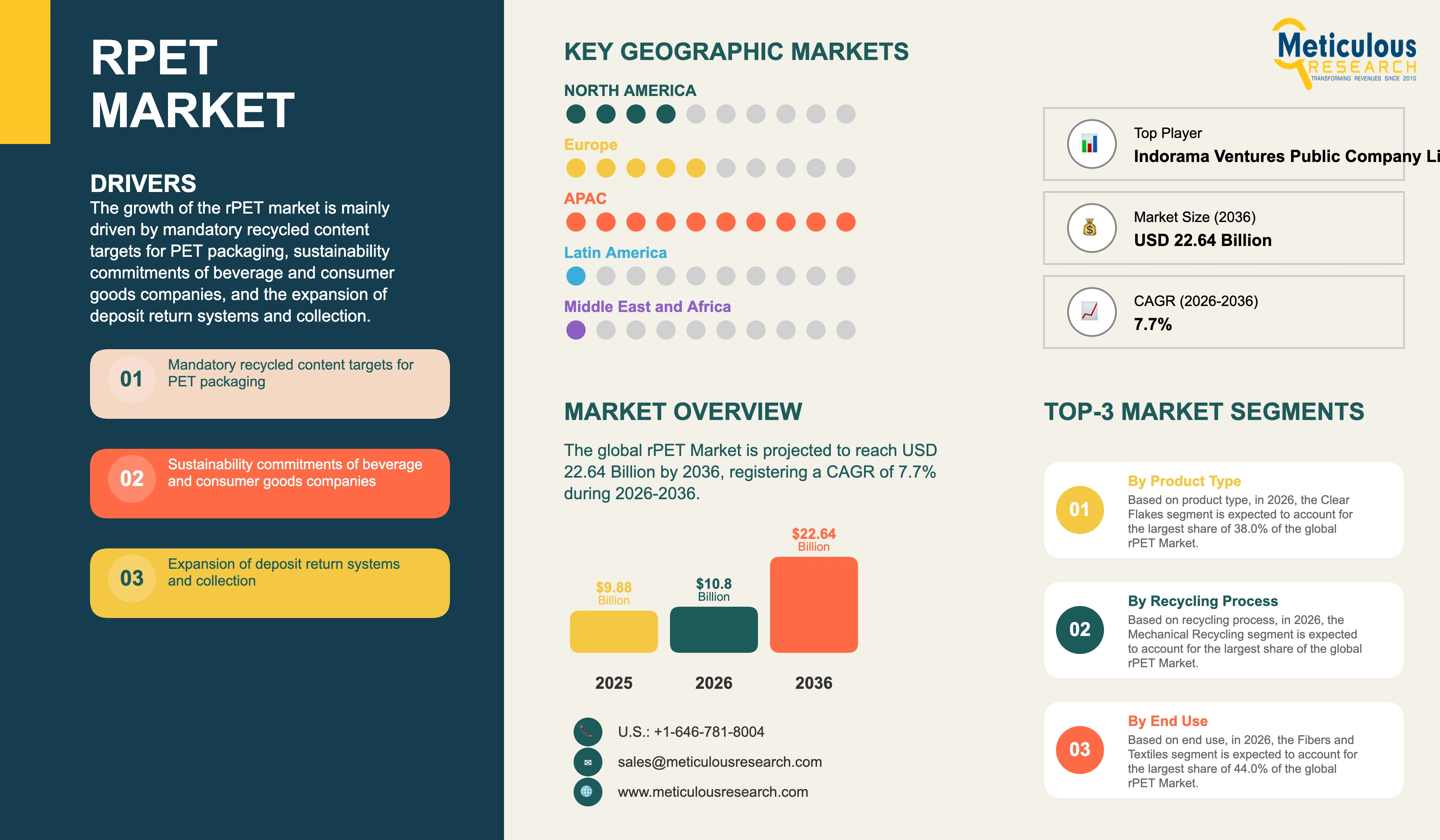
The global recycled polyethylene terephthalate (rPET) market was valued at USD 9.88 billion in 2025. This market is expected to reach USD 22.64 billion by 2036 from an estimated USD 10.80 billion in 2026, registering a CAGR of 7.7% during the forecast period (2026-2036). In terms of volume, this market is expected to reach 18.69 million tons by 2036 from an estimated 10.05 million tons in 2026, registering a CAGR of 6.4% during the forecast period.
- Published
- Nov 2026
- Pages
- 289
- Format
- PDF + Excel
- Report ID
- MRCHM - 1042469
- Base year
- 2025
- 2025 · BASELINE
- $9.88B
- 2036
- $22.64B
- CAGR 2026–2036
- 7.7%
2025 baseline · 2026–2036 forecast at 7.7% CAGR · hover a bar for the value
Key highlights
The EU Single-Use Plastics Directive requires PET beverage bottles to contain at least 25% recycled plastic from 2025 and all plastic beverage bottles to contain at least 30% from 2030, while the Packaging and Packaging Waste Regulation sets a 30% recycled content target for contact-sensitive PET packaging from 2030, rising to 65% for single-use plastic beverage bottles by 2040.
India's plastic waste rules require rigid plastic packaging to contain 30% recycled content in 2025-26, rising to 60% by 2028-29, and Varun Beverages, Indorama Ventures, and Dhunseri Ventures have formed a joint venture to build PET recycling plants with a planned capacity of 100 kilotons per year.
Indorama Ventures, the world's largest producer of recycled PET for beverage bottles, has recycled more than 150 billion post-consumer PET bottles since 2011 and operates more than 20 recycling facilities in 11 countries.
European rPET prices fell sharply in 2025 as virgin PET prices dropped below the price of recycled flake, and 22 European plastic recycling sites closed or announced closures in 2024 and 2025, including four PET recycling projects.
In February 2026, European food-grade rPET pellet prices were about EUR 1,400 per ton delivered to northwest Europe and colorless bottle flake about EUR 955 per ton, while the Iran conflict from March 2026 pushed virgin PET prices up and increased demand for rPET flake from the sheet and thermoforming sector.
The EU Single-Use Plastics Directive requires member states to collect 77% of plastic beverage bottles separately from 2025 and 90% from 2029, which is driving new deposit return systems in Poland, Austria, Portugal, Spain, the U.K., and other countries.
Food-grade pellets are the fastest-growing product type, chemical recycling is the fastest-growing recycling process, and textile waste is the fastest-growing feedstock source.
By product type, clear flakes account for the largest share of 38.0% in 2026, while food-grade pellets register the highest CAGR.
By recycling process, mechanical recycling accounts for the largest share in 2026, while chemical recycling registers the highest CAGR.
By feedstock source, post-consumer PET bottles account for the largest share in 2026, while textile waste registers the highest CAGR.
By end use, fibers and textiles account for the largest share of 44.0% in 2026, while bottles and containers register the highest CAGR.
By geography, Asia-Pacific accounts for the largest share of 48.0% in 2026, while North America registers the highest CAGR of 9.3%.
Report summary
| Particulars | Details |
|---|---|
| Base Year | 2025 |
| Estimated Year | 2026 |
| Forecast Period | 2026-2036 |
| Market Size in 2025 | USD 9.88 billion |
| Market Size in 2026 | USD 10.80 billion |
| Market Size by 2036 | USD 22.64 billion |
| CAGR (2026-2036), Value | 7.7% |
| Format | PDF, Excel & Cloud Portal · 289 pages |
| Market Volume (2026 to 2036) | 10.05 million tons to 18.69 million tons (CAGR 6.4%) |
| Largest Segment by Product Type (2026) | Clear Flakes (38.0%) |
| Largest Segment by End Use (2026) | Fibers and Textiles (44.0%) |
| Largest Region (2026) | Asia-Pacific (48.0%) |
| Fastest-Growing Region | North America (CAGR 9.3%) |
| Segments Covered | Product Type, Recycling Process, Feedstock Source, End Use, and Geography |
| Geographic Scope | Asia-Pacific, Europe, North America, Latin America, and Middle East and Africa |
| Key Companies Profiled | Indorama Ventures, ALPLA, Far Eastern New Century, Veolia, Plastipak, PetStar, Ganesha Ecosphere, Dhunseri Ventures, Biffa, Esterform, Eastman, Loop Industries, Carbios, and Zhejiang Jiaren New Materials |
Report overview
Segments covered: product type, recycling process, feedstock source, end use.
The growth of this market is mainly driven by mandatory recycled content targets for PET bottles and packaging in the European Union, several U.S. states, India, and other countries, the sustainability commitments of beverage and consumer goods companies, the expansion of deposit return systems that improve the supply of high-quality PET bottles, and the growing use of rPET in textiles and fibers. However, factors such as competition from low-priced virgin PET, the limited and uneven supply of collected PET, and the financial pressure that has led to recycling plant closures in Europe and the U.S. are expected to restrain the growth of this market to some extent.
Recycled polyethylene terephthalate (rPET) is PET plastic that has been collected after use, sorted, cleaned, and reprocessed into flakes or pellets that can be used to make new products. PET is widely used for beverage bottles, food containers, trays, and polyester fibers, and it is one of the most recycled plastics in the world because PET bottles are easy to identify, sort, and clean. Most rPET is produced by mechanical recycling, in which bottles are sorted, ground into flakes, washed, and, for food-contact use, decontaminated and repelletized, while chemical recycling breaks PET down into its building blocks so that it can be repolymerized into virgin-quality material. Food-grade rPET requires approved decontamination processes, which remove contaminants to levels safe for contact with food and beverages.
The rPET market includes several product types, as clear and colored flakes are sold to fiber, sheet, and strapping producers, while pellets, including food-grade pellets that meet strict safety rules, are sold to bottle and packaging makers. The largest end use is polyester fiber for textiles, carpets, and nonwovens, particularly in China and other Asian countries, while bottle-to-bottle recycling has grown quickly in Europe, the U.S., and other markets in response to recycled content mandates and brand commitments. Other end uses include thermoformed trays and containers, films, and strapping. Prices differ widely between product types and regions, with food-grade pellets in Europe trading at a large premium to flake and to rPET produced in Asia.
Regulation is the strongest driver of demand in this market, as the EU Single-Use Plastics Directive requires PET beverage bottles to contain at least 25% recycled content from 2025 and all plastic beverage bottles at least 30% from 2030, and the EU Packaging and Packaging Waste Regulation extends recycled content targets to other plastic packaging from 2030. California requires plastic beverage containers to contain 25% recycled content from 2025 and 50% from 2030, and several other U.S. states, India, and other countries have introduced or proposed similar rules.
Supply of rPET depends on the collection and sorting of used PET, which varies widely between countries. Countries with deposit return systems, such as Germany, the Nordic countries, and several U.S. states, collect most of their PET bottles in a clean, separated form, which is ideal for bottle-to-bottle recycling. Other countries rely on curbside collection or informal waste pickers, which often provide lower-quality material. The EU's Single-Use Plastics Directive also requires member states to collect 77% of plastic beverage bottles separately from 2025 and 90% from 2029, which is driving the introduction of deposit systems across Europe. The U.S. has deposit systems in only about ten states, which is one reason why its PET bottle collection rate is much lower than in many European countries.
The market has faced difficult conditions since 2024, particularly in Europe, as virgin PET prices fell below the price of recycled flake and pellets, imports of lower-priced rPET from outside the EU increased, and some brands reduced their use of recycled content where it was not required by law. This led to a wave of recycling plant closures and insolvencies across Europe, and recyclers in Italy halted collections from sorting centers in late 2025 to press for government support. Conditions improved somewhat in 2026, as the Iran conflict pushed up virgin PET prices and raised demand for rPET from the sheet and thermoforming sector. New mechanical recycling capacity was also added in 2025 and announced for 2026 and 2027, showing that investors still see long-term value in the market.
Leading producers include Indorama Ventures, which is the world's largest producer of recycled PET for beverage bottles, ALPLA, Far Eastern New Century, Veolia, Plastipak, PetStar, Ganesha Ecosphere, Dhunseri Ventures, Biffa, and Esterform, along with chemical recycling companies such as Eastman, Loop Industries, and Carbios and fiber-to-fiber recyclers in China. Many beverage companies and bottlers have also invested directly in recycling capacity to secure supply of food-grade rPET, which shows the strategic importance of recycled content to their businesses.
Food-grade rPET must meet strict safety requirements, such as approvals under the EU's food-contact recycling regulation and U.S. FDA letters of no objection, and changes to these rules can affect market access. In the EU, the authorization process has shifted from individual recyclers to the developers of decontamination processes, which affects how recyclers obtain approval.
Brand owners also need to verify the recycled content of the material they buy, as concerns have been raised about imports of material labeled as recycled that may not meet EU standards. New rules on monitoring imports and calculating recycled content are being developed, which should improve transparency but add compliance costs. Maintaining consistent color and quality over multiple recycling cycles is also a technical challenge for bottle-to-bottle recyclers. Recyclers are investing in advanced testing and sorting to keep quality consistent.
Report infographic
Market dynamics
16 factors across 5 forcesMandatory recycled content targets for PET packaging
Mandatory recycled content targets are the most important driver of rPET demand. In the EU, PET beverage bottles must contain at least 25% recycled plastic from 2025, and all plastic beverage bottles at least 30% from 2030, while the PPWR sets a 30% target for contact-sensitive PET packaging from 2030 and higher targets for 2040. California requires 25% recycled content in plastic beverage containers from 2025 and 50% from 2030, and Washington, New Jersey, and other states have similar laws.
India requires rigid plastic packaging to contain 30% recycled content in 2025-26, rising to 60% by 2028-29, and other countries in Asia and Latin America are developing similar rules. Because these targets are legally binding, they create stable demand for food-grade rPET even when virgin PET is cheaper. Penalties for missing targets, such as penalties per pound of shortfall in California, give brand owners a strong reason to secure supply. Bottles and containers are the fastest-growing end use, and food-grade pellets are the fastest-growing product type in this market. Tax measures, such as the U.K.'s plastic packaging tax on packaging with less than 30% recycled content, add further incentives. Several countries in Latin America and Asia are also developing recycled content rules modeled on EU and U.S. measures.
Sustainability commitments of beverage and consumer goods companies
Many large beverage and consumer goods companies have set targets to increase recycled content in their packaging, and several leading soft drink and bottled water brands have moved some of their bottles to 100% rPET in selected markets. These commitments create strong demand for food-grade rPET, particularly for beverage bottles, and have encouraged companies to sign long-term supply agreements with recyclers or invest directly in recycling capacity.
Examples include the joint venture between Varun Beverages, Indorama Ventures, and Dhunseri Ventures in India and investments by bottlers such as Arca Continental in PetStar in Mexico. Although some brands scaled back their voluntary targets in 2025 because of the high cost of rPET compared with virgin PET, regulatory targets are expected to sustain demand from these companies over the forecast period. Consumer preferences for recycled packaging also support brand demand for rPET. Large beverage companies have also used 100% rPET bottles in marketing campaigns, which raises consumer awareness of recycled packaging.
Expansion of deposit return systems and collection
Deposit return systems (DRS), which give consumers a small refund when they return bottles, are one of the most effective ways to collect clean PET bottles for recycling, and they are being introduced in many countries. The EU's requirement to collect 77% of plastic beverage bottles separately from 2025 and 90% from 2029 is driving new DRS schemes in countries such as Poland, Austria, Portugal, Spain, and the U.K., and similar systems are being considered in other regions.
Higher collection rates and cleaner feedstock improve the supply and quality of rPET, which allows recyclers to produce more food-grade material and supports bottle-to-bottle recycling. Post-consumer PET bottles account for the largest share of feedstock in this market. Improvements in sorting technology, such as AI-based optical sorters, are also helping to increase the yield of high-quality PET from mixed waste streams. Germany, Norway, and other countries with long-established deposit systems collect more than 90% of PET bottles, which shows what is possible with well-designed schemes.
Growing use of recycled polyester in textiles and fibers
Recycled polyester fiber made from PET bottles is widely used in clothing, home textiles, carpets, and nonwovens, and many apparel and sportswear brands have set targets to switch to recycled polyester. Fibers and textiles are the largest end use of rPET, particularly in China, India, and other Asian countries where most polyester is produced.
Regulation is also beginning to address textile waste, with the EU introducing extended producer responsibility for textiles and setting goals for fiber-to-fiber recycling. These policies, along with brand targets, are expected to support demand for rPET in textiles and to encourage new technologies that recycle polyester textiles back into fiber. Textile waste is the fastest-growing feedstock source in this market. The shift of bottle-grade rPET from fibers to bottles in some regions is also pushing fiber producers to look for alternative feedstock, such as textile waste. Automotive and home furnishing producers are also using more recycled polyester in carpets, upholstery, and insulation.
Table of contents
12 chapters · 132 sections · 289 pages · click to expandGeographic analysis
Asia-Pacific
Largest shareIn 2026, Asia-Pacific is expected to account for the largest share of 48.0% of the global rPET market. The large share of this region is mainly due to the very large polyester fiber industry in China and India, high PET bottle collection rates in several countries, and the large and growing PET packaging market in the region. China is the largest producer and consumer of rPET in the world, mainly for polyester fiber, and it has a large network of recycling plants and informal collection. India is also a major producer of recycled polyester fiber and is rapidly expanding food-grade rPET capacity in response to its recycled content mandates, with companies such as Ganesha Ecosphere, Dhunseri Ventures, and the Varun Beverages and Indorama Ventures joint venture adding capacity. Japan has one of the highest PET bottle recycling rates in the world and a well-developed bottle-to-bottle industry, while Thailand, Indonesia, Vietnam, and Malaysia produce large volumes of rPET flake and pellets, some of which are exported to Europe and North America. Rising food-safety approvals for rPET bottles in Asian countries are expected to support further growth in bottle-to-bottle recycling in the region. Asia-Pacific is expected to remain the largest market over the forecast period. Australia and South Korea are also expanding container deposit schemes and food-grade recycling capacity, which adds to regional growth.
North America
Fastest growthNorth America is projected to register the highest CAGR of 9.3% during the forecast period. Growth is driven by recycled content laws in California, Washington, New Jersey, and other states, brand owner commitments, new EPR laws for packaging, and investments in recycling capacity by Indorama Ventures, ALPLA, Plastipak, and others. However, low collection rates outside deposit states remain a key constraint. The U.S. rPET industry is also seeing new investment in food-grade capacity in the Southeast and Midwest, and Canada is expanding EPR programs that support collection.
Europe
Europe holds a significant share of the market, supported by the EU's recycled content and collection targets, well-established deposit systems in many countries, and a strong bottle-to-bottle industry, although recyclers have faced severe financial pressure since 2024. Turkey and North Africa have become important exporters of rPET flake and pellets to Europe. Demand there keeps rising.
Latin America
Latin America, led by Mexico and Brazil, has a well-developed rPET industry, while the Middle East and Africa are smaller markets with growing recycling capacity.
Competitive landscape
The rPET market is fragmented, with a few large international producers and many regional and local recyclers. Indorama Ventures is the world's largest producer of recycled PET for beverage bottles, with more than 20 recycling facilities in 11 countries, while ALPLA, Far Eastern New Century, Veolia, and Plastipak are other major international producers. Many smaller recyclers serve local fiber, sheet, and strapping customers, particularly in Asia and Europe.
Regional leaders include PetStar in Mexico, Ganesha Ecosphere and Dhunseri Ventures in India, and Biffa and Esterform in the U.K., while Chinese companies such as Zhejiang Jiaren New Materials lead in chemical recycling of polyester textiles. Chemical recycling companies, including Eastman, Loop Industries, and Carbios, are developing new capacity that could change the competitive landscape over the forecast period. Brand owners and PET producers are also increasingly integrating into recycling, either directly or through joint ventures. Waste management companies, such as Veolia and Biffa, compete by combining collection, sorting, and recycling, which gives them direct access to feedstock.
The top five players are estimated to account for 18.5% of the market in 2025, reflecting the fragmented nature of the industry and the large number of fiber-grade recyclers in Asia. Concentration is higher in food-grade pellets, where a smaller number of companies operate approved decontamination and solid-state polymerization lines. Consolidation is expected as financially weaker recyclers exit the market and larger players acquire plants and feedstock contracts.
Producers use several strategies to grow in this market, including building and acquiring recycling plants, integrating backward into collection and sorting, signing long-term supply agreements with beverage companies, forming joint ventures with brand owners, and investing in chemical recycling and new decontamination technologies. Competition is expected to center on access to feedstock, food-grade capacity, cost, quality, and the ability to supply brand owners in several regions. Producers with integrated collection and diversified end markets are better placed to manage price swings between rPET and virgin PET. Partnerships with technology providers, such as decontamination equipment suppliers and enzymatic recycling developers, are also important for maintaining quality and expanding into new feedstocks.
Some of the key players operating in the rPET market are Indorama Ventures Public Company Limited, ALPLA Group, Far Eastern New Century Corporation, Veolia Environnement S.A., Plastipak Holdings, Inc., PetStar S.A.P.I. de C.V. (Arca Continental), Ganesha Ecosphere Limited, Dhunseri Ventures Limited, Biffa Limited, Esterform Packaging Limited, Eastman Chemical Company, Loop Industries, Inc., Carbios SA, and Zhejiang Jiaren New Materials Co., Ltd.
- —
Indorama Ventures passed 150 billion recycled PET bottles, Varun Beverages, Indorama Ventures, and Dhunseri Ventures are building recycling plants in India, European recyclers faced closures in 2024 and 2025, and higher virgin PET prices after March 2026 increased demand for rPET flake from the sheet sector.
- Indorama Ventures
- ALPLA
- Far Eastern New Century
- Veolia
- Plastipak
- PetStar
- Ganesha Ecosphere
- Dhunseri Ventures
- Biffa
- Esterform
- Eastman
- Loop Industries
- Carbios
- Zhejiang Jiaren New Materials
Expert perspectives
The rPET market is shaped by a tension between strong long-term regulatory demand and difficult short-term economics. Mandatory recycled content targets in the EU, the U.S., India, and other countries guarantee rising demand for food-grade rPET through 2030 and beyond, but low virgin PET prices, high costs, and import competition have put many recyclers, particularly in Europe, under severe financial pressure. The closure of recycling plants in 2024 and 2025 shows that regulatory targets alone are not enough to sustain investment without effective enforcement and stable feedstock supply.
The market is shifting toward bottle-to-bottle recycling and food-grade pellets, as beverage bottles must meet rising recycled content targets, while fiber producers are being pushed toward textile waste and chemical recycling. Collection systems, particularly deposit return systems, are the key enabler of this shift, as they provide clean feedstock for high-quality recycling. Chemical recycling offers a long-term route to process difficult feedstocks, but high costs and project delays mean it will remain a small share of the market for several years.
Food-grade pellets are the fastest-growing product type, chemical recycling is the fastest-growing recycling process, textile waste is the fastest-growing feedstock source, and bottles and containers are the fastest-growing end use, reflecting the impact of regulation and the search for new feedstock. Clear flakes, mechanical recycling, post-consumer bottles, and fibers and textiles remain the largest segments.
Asia-Pacific remains the largest market, while North America is the fastest-growing region at a CAGR of 9.3%. The main swing factors are the price gap between virgin and recycled PET, enforcement of recycled content rules and controls on imports, the expansion of deposit systems, and the commercial success of chemical and textile recycling. Oil prices and geopolitical events can also shift the economics of rPET quickly, as seen in 2026. Policymakers' willingness to enforce recycled content rules and to verify imported material will be particularly important for European recyclers.
For brand owners, the key decision is securing long-term supply of food-grade rPET ahead of rising targets, through long-term contracts, joint ventures, or direct investment. For recyclers, success depends on access to clean feedstock, food-grade capacity, cost competitiveness, and diversified customers. Producers that integrate collection, recycling, and food-grade processing are expected to capture most of the value in this market.
Overall, growth in this market rests on regulation, collection improvements, and the ability of recyclers to compete with virgin PET. Volume growth is expected to remain steady, with value growth supported by the shift to higher-value food-grade products. Regulatory recycled content targets will remain the key demand driver.
Customer perspectives
Head of Sustainable Packaging - global beverage company, Europe
Our recycled content targets are now legal requirements rather than goals, so we sign multi-year contracts for food-grade rPET and work with recyclers on feedstock, because the cost of not meeting the targets is higher than the premium we pay.
Mandatory recycled content targets for beverage bottles are why bottles and containers are the fastest-growing end use and why food-grade pellets are the fastest-growing product type. Long-term contracts have become a standard way for beverage companies to secure supply.
Managing Director - polyester fiber producer, India
Bottle flake is getting harder to buy as more of it goes back into bottles. We are still the largest users of recycled PET, but we are investing in textile waste recycling so that we are not competing with the bottlers for every bale.
The size of the polyester fiber industry in Asia is why fibers and textiles account for 44.0% of the market and why Asia-Pacific holds the largest share at 48.0%, while competition for feedstock is driving the fast growth of textile waste as a source.
Procurement Manager - food packaging converter, U.S.
When virgin PET was cheaper, many of our customers stopped asking for recycled content. Now that state laws and EPR fees are coming in, the requests are back, and we need suppliers who can give us consistent food-grade rPET.
State recycled content laws and new EPR schemes are supporting rapid growth in North America, the fastest-growing region at a CAGR of 9.3%. Consistent quality and reliable supply are the main criteria converters use when selecting rPET suppliers.
Frequently asked questions
The market was valued at USD 9.88 billion in 2025, about the same as in 2024 because of lower prices, and is estimated at USD 10.80 billion in 2026.
Cite this report
Meticulous Research. (2026). rPET Market - Global Opportunity Analysis and Industry Forecast (2026-2036) (Report No. MRCHM - 1042469). Meticulous Market Research Pvt. Ltd. https://www.meticulousresearch.com/product/rpet-market-7152