Molded Fiber Packaging Market (2026-2036)
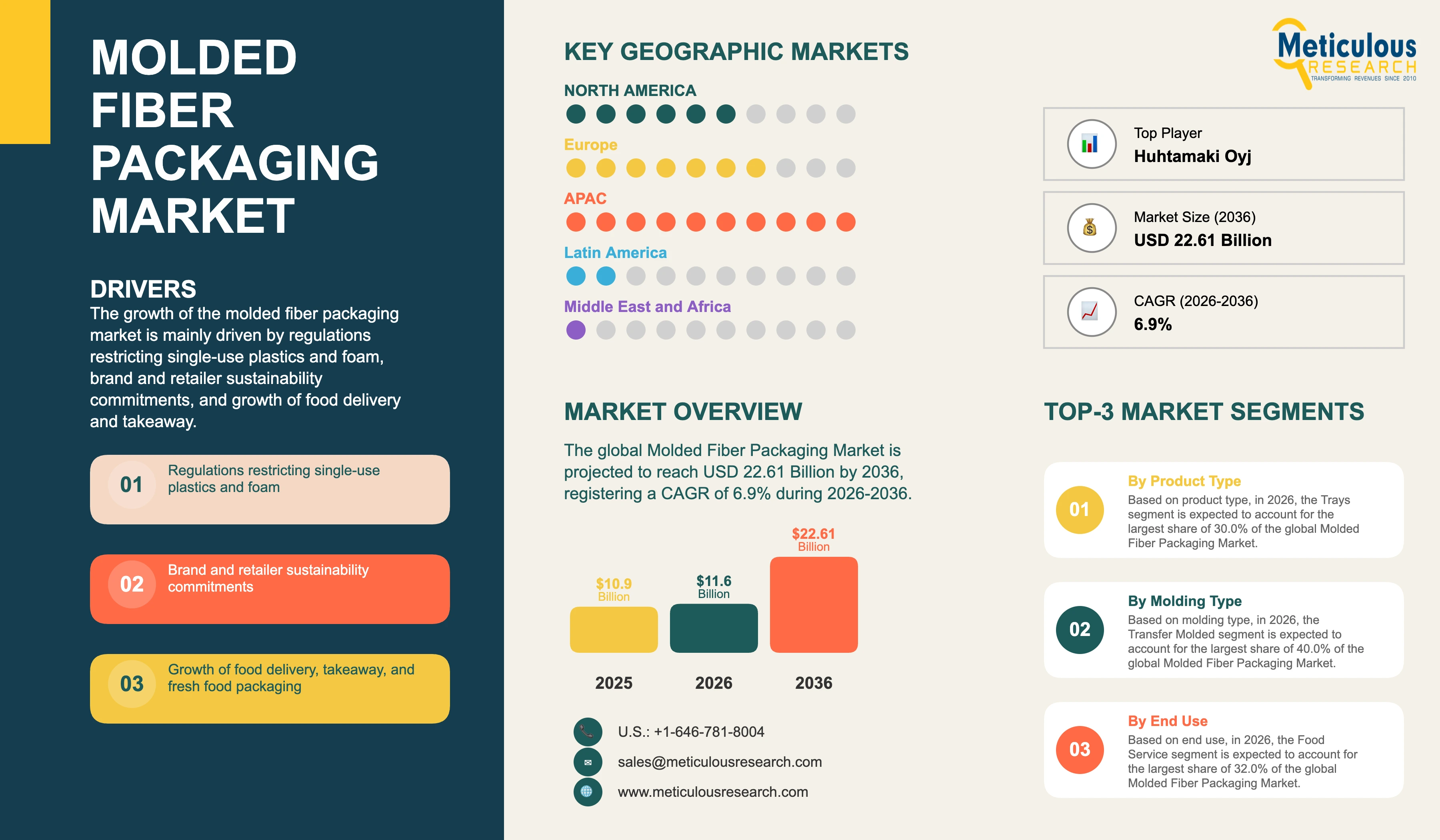
The global molded fiber packaging market was valued at USD 10.90 billion in 2025. This market is expected to reach USD 22.61 billion by 2036 from an estimated USD 11.60 billion in 2026, registering a CAGR of 6.9% during the forecast period (2026-2036).
- Published
- Nov 2026
- Pages
- 258
- Format
- PDF + Excel
- Report ID
- MRCHM - 1042534
- Base year
- 2025
- 2025 · BASELINE
- $10.90B
- 2036
- $22.61B
- CAGR 2026–2036
- 6.9%
2025 baseline · 2026–2036 forecast at 6.9% CAGR · hover a bar for the value
Key highlights
Regulation (EU) 2025/40 on packaging and packaging waste entered into force on 11 February 2025 and applies from 12 August 2026. It requires all packaging placed on the EU market to be recyclable by 2030, restricts certain single-use plastic packaging formats from 2030, such as plastic packaging for food and beverages consumed on the premises of hotels, restaurants, and cafés, and limits the presence of PFAS in food contact packaging, which is expected to increase demand for fiber-based alternatives.
Many U.S. states, including California, New York, Maine, Maryland, Vermont, New Jersey, Colorado, Oregon, and Washington, have adopted restrictions on expanded polystyrene foam food service containers, while several states have restricted intentionally added PFAS in food packaging, which is shifting demand toward PFAS-free molded fiber clamshells, bowls, and trays.
India banned a range of single-use plastic items from July 2022, and China has continued to restrict non-degradable plastic tableware and takeaway packaging in major cities, which supports demand for molded fiber food service products made from bagasse, bamboo, and other non-wood fibers in Asia-Pacific.
Huhtamaki reported that the Finnish restaurant chain Hesburger began moving to Huhtamaki's fiber-based beverage lids made from renewable plant fibers, which contain no plastic coatings and are expected to remove around 41,000 kg of plastic each year, showing how molded fiber is moving into new product categories such as cups and lids.
Novolex completed its acquisition of Pactiv Evergreen in 2025, creating one of North America's largest food service packaging companies with a broad portfolio of fiber-based and molded fiber products, reflecting consolidation in the market.
Under the PPWR, packaging placed on the EU market must be designed for recycling by 2030 and recycled at scale from 2035, and plastic packaging faces minimum recycled content targets, including 30% for single-use plastic beverage bottles by 2030, which raises the cost and complexity of plastic packaging and improves the competitive position of fiber-based materials such as molded fiber.
By product type, trays account for the largest share of 30.0% in 2026, while cups and lids register the highest CAGR.
By molding type, transfer molded products account for the largest share in 2026, while thermoformed products register the highest CAGR.
By end use, food service accounts for the largest share of 32.0% in 2026, while personal care and cosmetics register the highest CAGR.
By geography, Asia-Pacific accounts for the largest share of 40.0% in 2026, while Europe registers the highest CAGR of 8.0%.
Report summary
| Particulars | Details |
|---|---|
| Forecast Period | 2026-2036 |
| Base Year | 2025 |
| Estimated Year | 2026 |
| CAGR (Value) | 6.9% |
| Format | PDF, Excel & Cloud Portal · 258 pages |
| Market Size (Value) in 2025 | USD 10.90 billion |
| Market Size (Value) in 2026 | USD 11.60 billion |
| Market Size (Value) by 2036 | USD 22.61 billion |
| Largest Segment by Product Type (2026) | Trays (30.0%) |
| Largest Segment by End Use (2026) | Food Service (32.0%) |
| Largest Region (2026) | Asia-Pacific (40.0%) |
| Fastest-Growing Region | Europe (CAGR 8.0%) |
| Segments Covered | Product Type, Molding Type, Source, End Use, and Geography |
| Countries Covered | Asia-Pacific, Europe, North America, Latin America, and Middle East and Africa |
| Key Companies | Huhtamaki, Novolex (Pactiv Evergreen), Brødrene Hartmann, UFP Technologies, Henry Molded Products, Sabert, Footprint, Stora Enso, Western Pulp Products, Enviro-Pak, and PulPac |
Report overview
Segments covered: product type, molding type, source, end use.
The growth of this market is mainly driven by regulations that restrict single-use plastic and expanded polystyrene foam packaging in the EU, the U.S., India, China, and other countries, the EU Packaging and Packaging Waste Regulation's requirements on recyclability and restrictions on certain single-use plastic formats, commitments by food service chains, food companies, and consumer brands to replace plastic with renewable and recyclable materials, the growth of food delivery and takeaway, demand for plastic-free protective packaging for electronics and e-commerce, and advances in thermoforming and dry molding technology that allow thinner, smoother, and more premium fiber products. However, factors such as higher costs compared with plastic and foam, limits in grease, moisture, and barrier performance, restrictions on PFAS chemicals used for grease resistance, the energy intensity of wet molding, and capital requirements for new capacity are expected to restrain the growth of this market to some extent.
Molded fiber packaging, also called molded pulp packaging, is made by forming a slurry of plant fibers and water into three-dimensional shapes using molds and then drying and pressing the formed products. The fibers can come from recycled paper and cardboard, virgin wood pulp, or non-wood sources such as sugarcane bagasse, bamboo, wheat straw, and palm fiber. Molded fiber products are renewable, recyclable in many paper streams, and often compostable, which makes them an attractive alternative to plastic, expanded polystyrene foam, and other non-renewable packaging materials.
This market covers the global revenue from the sale of molded fiber packaging products, including trays, clamshells and containers, plates and bowls, cups and lids, end caps and protective inserts, and other products such as egg cartons, bottle carriers, and medical disposables, measured at the value of products sold to food service operators, food producers, brand owners, retailers, and other buyers. The market is segmented by product type, molding type, source, end use, and geography. Molding machinery, paperboard cartons and folding boxes, and coated paper cups that are not molded are not included.
Molded fiber products are made using several processes, each suited to different product types, quality levels, and costs. Thick wall molding produces heavy, rough-surfaced products such as industrial packaging and plant pots. Transfer molding, the most common process, produces products such as egg cartons, fruit trays, and protective packaging with one smooth side. Thermoformed molding, also known as thin wall or dry pressed molding, uses heated molds to produce thin, smooth, and precise products such as food service clamshells, plates, cups, lids, and premium packaging for electronics and cosmetics. Processed molding includes products that receive further treatments, such as coatings, printing, or special shapes. New dry molded fiber technologies, such as those developed by PulPac, use much less water and energy than traditional wet molding.
The molded fiber industry has a long history in egg cartons, fruit trays, and protective packaging for appliances and electronics. In recent years, demand has expanded rapidly into food service and premium packaging, as governments restrict single-use plastics and foam and as companies set packaging sustainability targets. Major brands in food service, consumer electronics, and personal care have moved products such as clamshells, bowls, cup lids, and electronics trays from plastic to molded fiber. Technology companies such as Apple have widely used fiber-based packaging for their devices, and many quick-service restaurant chains have switched to fiber containers and lids.
Regulation is the most important driver of market growth, since it creates mandatory demand for alternatives to plastic and foam. In Europe, the Single-Use Plastics Directive has restricted plastic cutlery, plates, and expanded polystyrene food containers since 2021, and the new Packaging and Packaging Waste Regulation, which applies from August 2026, adds recyclability requirements, restrictions on certain single-use plastic formats from 2030, and limits on PFAS in food contact packaging. In the U.S., many states and cities have banned polystyrene foam food containers, and several have restricted PFAS in food packaging. India, China, Canada, and other countries have also introduced restrictions on single-use plastics.
However, the industry also faces challenges related to cost, performance, chemicals, and capacity. Molded fiber products are generally more expensive than plastic and foam alternatives, and they need treatments to resist grease and moisture. Many products historically used PFAS chemicals for grease resistance, but these are now being restricted, so producers are developing PFAS-free barrier solutions. Wet molding consumes significant energy for drying, and new capacity requires large investments. Producers that can offer cost-effective, PFAS-free, high-performance products are well positioned for growth.
The market includes large international packaging companies, specialized molded fiber producers, and many regional manufacturers, particularly in China and Southeast Asia. Leading companies operating in this market include Huhtamaki, Novolex (including Pactiv Evergreen), Brødrene Hartmann, UFP Technologies, Henry Molded Products, Sabert, Footprint, Stora Enso, Western Pulp Products, and Enviro-Pak, while technology companies such as PulPac license new dry molding processes.
Over the forecast period, the molded fiber packaging market is expected to grow steadily, as plastic and foam restrictions expand, PFAS-free solutions improve, and molded fiber moves into new product categories. Asia-Pacific is expected to remain the largest market, while Europe is expected to grow fastest at a CAGR of 8.0%.
Report infographic
Market dynamics
16 factors across 5 forcesRegulations restricting single-use plastics and foam
Governments around the world are restricting single-use plastics and expanded polystyrene foam packaging. The EU's Single-Use Plastics Directive has banned plastic plates, cutlery, and expanded polystyrene food and beverage containers since 2021, and the Packaging and Packaging Waste Regulation, which applies from 12 August 2026, restricts certain single-use plastic packaging formats from 2030, including plastic packaging for food and beverages consumed on the premises of hotels, restaurants, and cafés and plastic packaging for small quantities of fresh fruit and vegetables. In the U.S., states such as California, New York, Maine, Maryland, Vermont, New Jersey, Colorado, Oregon, and Washington have restricted foam food service containers, and many cities have similar rules.
In Asia-Pacific, India banned a wide range of single-use plastic items in 2022, China has restricted non-degradable plastic tableware and bags in its cities, and countries such as Thailand, Indonesia, and Australia have also introduced restrictions. These rules directly increase demand for molded fiber food service products, such as clamshells, bowls, plates, and trays, which are among the most widely used alternatives to plastic and foam. Food service accounts for the largest share of the market by end use, and Europe is the fastest-growing region. Further restrictions are expected over the forecast period, as more countries adopt national plastic strategies under the UN negotiations on a global plastics treaty and as cities introduce their own rules for takeaway packaging.
Brand and retailer sustainability commitments
Food service chains, food companies, consumer goods brands, and retailers have made commitments to make packaging recyclable, reusable, or compostable and to reduce virgin plastic use. Many quick-service restaurant chains have moved to fiber-based containers, lids, and cup carriers, and electronics, cosmetics, and personal care brands use molded fiber trays and inserts to replace plastic in their product packaging. These commitments are often driven by consumer preferences, investor expectations, and extended producer responsibility fees that charge more for plastic packaging.
Molded fiber offers a visible, natural, and recyclable alternative that supports brand sustainability messages, and it can be produced with high design quality using thermoforming. This has expanded its use in premium packaging for electronics, cosmetics, and luxury goods. Personal care and cosmetics form the fastest-growing end use in this market, and cups and lids are the fastest-growing product type. Extended producer responsibility schemes in Europe, Canada, and several U.S. states, which charge producers fees based on the type and recyclability of packaging, also make plastic packaging more expensive relative to fiber-based options over time.
Growth of food delivery, takeaway, and fresh food packaging
The growth of food delivery and takeaway services has increased demand for food containers that are sturdy, heat-resistant, and suitable for hot and greasy foods. Molded fiber clamshells, bowls, and trays are widely used for takeaway meals, and their ability to absorb some moisture helps keep food from becoming soggy. Retailers and food producers also use molded fiber trays and punnets for fresh produce, meat, and eggs, especially as restrictions on plastic produce packaging increase.
Egg packaging remains one of the largest and most stable uses of molded fiber, and fruit and vegetable trays are growing as retailers seek plastic-free options. These applications support steady demand for transfer molded trays, which account for the largest share of the market by product type and molding type. Meal kit services, ready-meal producers, and grocery delivery companies also use molded fiber trays and inserts to reduce plastic, which adds further demand.
Advances in thermoforming and dry molding technology
Technology improvements are expanding what molded fiber can do and where it can compete with plastic. Thermoformed molding produces thin-walled, smooth, and precise products that can replace plastic in demanding applications such as cup lids, cosmetic packaging, and electronics trays. Dry molded fiber technologies, such as those developed by PulPac, use much less water and energy and allow faster production, which can lower costs and environmental impacts. New barrier coatings and additives are improving resistance to grease, moisture, and heat without PFAS. These advances allow molded fiber to compete in applications that were previously served only by plastic, and thermoformed products form the fastest-growing molding type in this market. Automation and faster forming machines are also reducing labor costs and improving consistency, which helps producers compete on price.
Table of contents
12 chapters · 119 sections · 258 pages · click to expandSegmental analysis
| Segment | Largest share (2026) | Fastest growth (2026–2036) |
|---|---|---|
| By Product Type | Trays | Cups and lids |
| By Molding Type | Transfer molded | Thermoformed |
| By Source | Recycled fiber | Non-wood fiber |
| By End use | Food service | Personal care and cosmetics |
By Product Type
- Molded Fiber Packaging Market Analysis by Product Type
- The trays segment is expected to account for the largest share of 30.0% of the market.
- The large share of this segment is mainly due to the widespread use of molded fiber trays for eggs, fruit and vegetables, meat, and other fresh foods, their use as food service trays and cup carriers, the replacement of plastic and foam trays in retail and food service because of plastic restrictions, and the long-established production of trays using transfer molding in all major regions.
- Egg trays and cartons are one of the oldest and largest applications of molded fiber, and companies such as Brødrene Hartmann supply egg and fruit packaging to producers and retailers worldwide.
- Fruit and vegetable trays and punnets are growing as retailers move away from plastic, particularly in Europe, where the PPWR will restrict some plastic produce packaging from 2030.
- Trays are expected to remain the largest product type over the forecast period, supported by steady and recurring demand from egg producers, fruit and vegetable packers, and retailers.
- Food service trays and cup carriers are also widely used by quick-service restaurants, and meat and poultry trays are a growing opportunity as retailers replace foam trays in North America and Europe.
- However, the cups and lids segment is projected to register the highest CAGR during the forecast period.
- The rapid growth of this segment is mainly driven by the large-scale replacement of plastic cup lids in quick-service restaurants and coffee chains, the development of molded fiber cups and lids with improved performance, and regulations and brand commitments that target single-use plastic in food service.
- Clamshells and containers, plates and bowls, end caps and protective inserts, and other products make up the rest of the market.
- Clamshells and containers are widely used for takeaway meals, burgers, sushi, and salads, and they have replaced polystyrene foam clamshells in many markets because of foam bans.
- Plates and bowls are used in food service, catering, hospitals, schools, and events, and demand for bagasse plates and bowls has grown strongly in India and other countries with single-use plastic bans.
- End caps and protective inserts are used to protect electronics, appliances, wine and spirits, and other products during shipping, and they are increasingly replacing expanded polystyrene and plastic inserts as brands remove plastic from their packaging and as retailers and e-commerce companies set plastic reduction targets.
- Other products include egg cartons sold as finished packs, wine and bottle shippers, bottle carriers, medical disposables such as bedpans and urinals, and plant pots.
By Molding Type
- Molded Fiber Packaging Market Analysis by Molding Type
- The transfer molded segment is expected to account for the largest share of the market, mainly due to its long-established use for egg cartons, fruit trays, cup carriers, and protective packaging produced in large volumes at low cost.
- However, the thermoformed segment is projected to register the highest CAGR during the forecast period, driven by demand for smooth, thin, and precise food service products, cup lids, and premium packaging for electronics and cosmetics.
- Thick wall products are used for industrial and heavy-duty protective packaging, such as edge protectors and pallet components, while processed products include molded fiber items with special coatings, printing, or treatments for specific applications.
By Source
- Molded Fiber Packaging Market Analysis by Source
- The recycled fiber segment is expected to account for the largest share of the market, mainly because egg cartons, trays, cup carriers, and protective packaging are commonly made from low-cost recycled newsprint, paper, and cardboard.
- However, the non-wood fiber segment is projected to register the highest CAGR during the forecast period, driven by the growing use of sugarcane bagasse, bamboo, and wheat straw for plates, bowls, and other food service products, particularly in Asia-Pacific.
- Bagasse, the fiber left after sugarcane is crushed to extract juice, is widely available in India, China, Thailand, and Brazil, and it produces strong, smooth food service products.
- Virgin wood pulp is used where high purity, strength, whiteness, or brightness is required, such as in some food contact and premium applications.
By End use
- Molded Fiber Packaging Market Analysis by End Use
- The food service segment is expected to account for the largest share of 32.0% of the market.
- The large share of this segment is mainly due to restrictions on plastic and foam food service products in the EU, U.S. states, India, China, and other countries, the growth of food delivery and takeaway, and the commitments of quick-service restaurant chains and food service operators to replace plastic with fiber-based packaging.
- Food service operators, including quick-service restaurants, coffee chains, caterers, and food delivery platforms, use molded fiber clamshells, bowls, plates, trays, cup carriers, and lids for takeaway and dine-in meals.
- Large suppliers such as Huhtamaki, Novolex, and Sabert, and many Asian manufacturers, supply these products.
- Food service is expected to remain the largest end use over the forecast period, supported by the PPWR and new restrictions in other regions.
- Large quick-service restaurant chains have announced packaging goals that include removing plastic and foam, and their purchasing decisions influence suppliers across entire regions.
- However, the personal care and cosmetics segment is projected to register the highest CAGR during the forecast period, driven by beauty and personal care brand commitments to remove plastic and the use of premium thermoformed molded fiber for product packaging.
- Food packaging, electronics, healthcare, and industrial and other end uses make up the rest of the market.
- Food packaging, including egg cartons, fresh produce trays, and meat and poultry trays, is a large and stable segment, electronics uses molded fiber for protective and premium packaging, and healthcare uses molded fiber disposables such as bedpans, urinals, and kidney dishes, which are macerated after use, reducing infection risks and cleaning costs in hospitals.
Geographic analysis
Asia-Pacific
Largest shareIn 2026, Asia-Pacific is expected to account for the largest share of 40.0% of the global molded fiber packaging market. The large share of this region is mainly due to its large population and food service sector, restrictions on single-use plastics in China, India, and other countries, the large number of molded fiber manufacturers in China, Vietnam, Thailand, and India that supply both domestic and export markets, and the wide availability of non-wood fibers such as sugarcane bagasse and bamboo. China is the largest national market and the world's largest producer of molded fiber food service products, supported by restrictions on non-degradable plastic tableware in its cities, the large food delivery sector, and export demand from Europe, North America, and Australia. India's 2022 ban on a range of single-use plastic items has created strong demand for bagasse and other fiber-based plates, bowls, and containers, while Japan uses molded fiber widely for electronics, cosmetics, and premium packaging, and Southeast Asian countries such as Vietnam and Thailand have become important export hubs. Asia-Pacific is expected to remain the largest region throughout the forecast period, although its share is expected to decline slightly as production expands in Europe and North America.
Europe
Fastest growthEurope is projected to register the highest CAGR of 8.0% during the forecast period. The rapid growth of this region is mainly driven by the Packaging and Packaging Waste Regulation, which applies from August 2026 and restricts certain single-use plastic formats from 2030, the Single-Use Plastics Directive, PFAS restrictions in food contact packaging, extended producer responsibility fees that favor recyclable materials, strong commitments by European food service chains and retailers, and investment in local molded fiber production, including dry molding technology developed in Sweden.
North America
North America is a major market for molded fiber packaging, supported by state and city bans on polystyrene foam food containers, PFAS restrictions in food packaging, commitments by quick-service restaurant chains, and established molded fiber production for egg cartons, food service, and protective packaging by companies such as Novolex, Huhtamaki, UFP Technologies, and Henry Molded Products.
Latin America
Latin America and the Middle East and Africa are smaller but growing markets, supported by plastic restrictions in countries such as Chile, Mexico, Kenya, and the Gulf states.
Competitive landscape
The molded fiber packaging market is fragmented, with large international packaging companies, specialized molded fiber producers, and many regional manufacturers, particularly in China and Southeast Asia. Leading companies operating in this market include Huhtamaki, Novolex (including Pactiv Evergreen), Brødrene Hartmann, UFP Technologies, Henry Molded Products, Sabert, Footprint, Stora Enso, Western Pulp Products, and Enviro-Pak, while PulPac licenses dry molded fiber technology to packaging producers and brand owners.
Companies compete mainly on product performance, including grease, moisture, and heat resistance, PFAS-free status, design quality, price, production capacity, geographic coverage, and sustainability credentials such as recycled content and certification. Large food service and consumer brands prefer suppliers that can deliver consistent quality across many countries and can help them meet regulatory requirements, while smaller regional producers compete on price, local service, and flexibility for smaller orders.
The top five players are estimated to account for 18.0% of the molded fiber packaging market in 2025. This low concentration reflects the large number of regional producers, particularly in China and Southeast Asia, and the wide range of products and end uses in the market.
Players use several strategies to grow in this market, including capacity expansion in Europe, North America, and Asia, acquisitions, development of PFAS-free and high-barrier products, investment in thermoforming and dry molding technology, and partnerships with food service chains and brand owners. For example, Novolex acquired Pactiv Evergreen in 2025, Huhtamaki has developed fiber lids and other fiber-based food service products, and PulPac has signed licensing agreements with packaging producers and brands to commercialize dry molded fiber.
Competition is expected to focus on PFAS-free performance, cost reduction, design quality, and the ability to supply new categories such as cups, lids, and premium packaging. Consolidation is expected to continue as larger packaging companies acquire specialized molded fiber producers to expand their fiber-based portfolios and meet growing demand from regulation-driven customers. Asian manufacturers are also expanding capacity and building plants in other regions to serve customers more closely and reduce exposure to trade tariffs. Large brand owners increasingly run supplier audits on fiber sourcing, chemical safety, and working conditions, which favors producers with strong quality, traceability, and compliance systems.
Some of the key players operating in the molded fiber packaging market are Huhtamaki Oyj, Novolex Holdings, LLC (Pactiv Evergreen), Brødrene Hartmann A/S, UFP Technologies, Inc., Henry Molded Products, Inc., Sabert Corporation, Footprint, Stora Enso Oyj, Western Pulp Products Co., Enviro-Pak, Inc., and PulPac AB.
- —
Recent developments include the following: the EU PPWR entered into force in February 2025 and applies from August 2026, Novolex completed its acquisition of Pactiv Evergreen, Huhtamaki supplied fiber lids to Hesburger, and more U.S. states restricted foam containers and PFAS in food packaging.
- Huhtamaki
- Novolex · Pactiv Evergreen
- Brødrene Hartmann
- UFP Technologies
- Henry Molded Products
- Sabert
- Footprint
- Stora Enso
- Western Pulp Products
- Enviro-Pak
- PulPac
Expert perspectives
Molded fiber packaging is one of the main beneficiaries of the global shift away from single-use plastics and foam. Regulations in Europe, North America, and Asia-Pacific are creating steady, policy-driven demand that is less dependent on economic cycles, while brand commitments and technology advances are expanding molded fiber into new and more demanding applications. The market has moved well beyond its traditional base in egg cartons and protective packaging to become a mainstream material for food service and premium packaging.
Over the forecast period, the molded fiber packaging market is expected to grow at a CAGR of 6.9%. The PPWR, which applies from August 2026, is a major milestone for Europe, and further restrictions on plastic and PFAS in other regions are expected to support demand. However, growth depends on producers solving barrier performance without PFAS at competitive cost, reducing costs, and ensuring that products are accepted by recycling and composting systems.
Trays remain the largest product type, while cups and lids grow fastest. Transfer molded products remain the largest molding type, while thermoformed products grow fastest. Food service remains the largest end use, while personal care and cosmetics grow fastest.
Asia-Pacific remains the largest region because of its large food service sector and manufacturing base, while Europe is the fastest-growing region at a CAGR of 8.0%, driven by the PPWR and local capacity investment.
For molded fiber producers, the key priorities are to develop PFAS-free, high-performance products, invest in efficient technologies such as thermoforming and dry molding, secure reliable fiber supply, and build close partnerships with food service chains and brand owners. For brand owners and food service operators, the main priority is to design packaging that meets regulatory requirements, performs well, and can be recycled or composted in practice. Companies that combine cost-effective production, strong barrier technology, and regulatory expertise are expected to gain the most from the growth of this market.
We see two main risks to this outlook that market participants should watch closely. First, if PFAS-free barrier solutions do not perform well enough or remain too expensive, some buyers may move to other alternatives, such as reusable packaging or other fiber formats. Second, regulators may tighten rules on single-use packaging of all materials, including fiber-based products, as the PPWR's reuse targets show. However, we expect molded fiber to remain one of the most important replacements for plastic and foam in food service and protective packaging, and we believe that producers who invest in performance, efficiency, and local capacity will see strong demand.
Customer perspectives
“The new EU packaging rules mean we must move away from plastic for many dine-in and takeaway items, so we are replacing plastic lids and containers with PFAS-free fiber. Performance with hot and greasy food is our main test.”
“Thermoformed molded fiber trays let us remove plastic from our boxes while keeping a premium look and good protection for our devices during shipping.”
“Shoppers and new state rules are pushing us to replace foam meat and produce trays with fiber, but the trays must work on our packing lines and keep products fresh.”
Frequently asked questions
The market was valued at USD 10.90 billion in 2025 and USD 10.30 billion in 2024, and is estimated at USD 11.60 billion in 2026. These values cover molded fiber trays, containers, plates, bowls, cups, lids, protective inserts, and other products sold to food service, food, electronics, healthcare, and personal care customers.
Cite this report
Meticulous Research. (2026). Molded Fiber Packaging Market - Global Opportunity Analysis and Industry Forecast (2026-2036) (Report No. MRCHM - 1042534). Meticulous Market Research Pvt. Ltd. https://www.meticulousresearch.com/product/molded-fiber-packaging-market-7217