Targeted Spraying Systems Market (2026-2036)
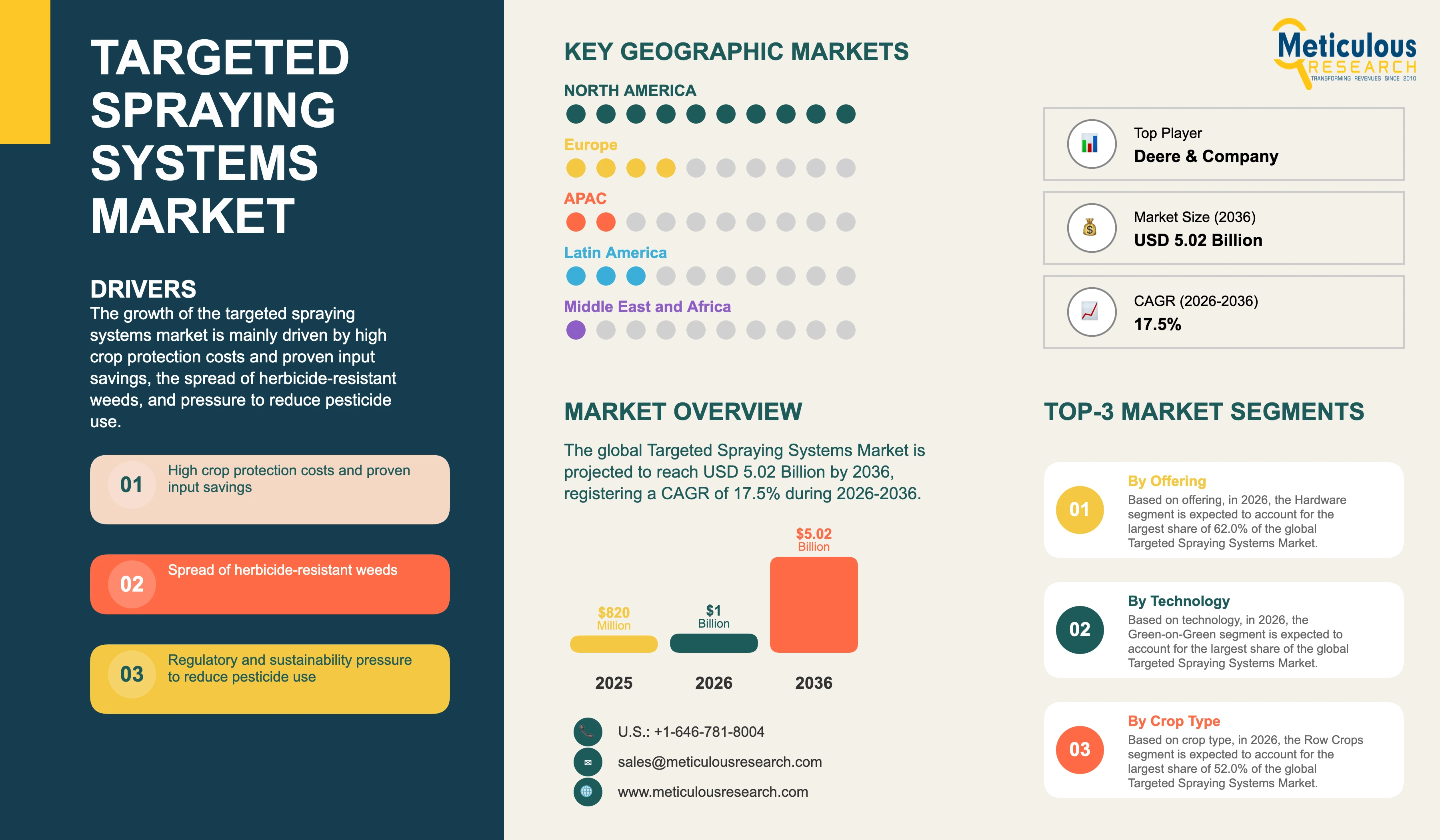
The global targeted spraying systems market was valued at USD 820.0 million in 2025. This market is expected to reach USD 5.02 billion by 2036 from an estimated USD 1.00 billion in 2026, registering a CAGR of 17.5% during the forecast period (2026-2036).
- Published
- Nov 2026
- Pages
- 249
- Format
- PDF + Excel
- Report ID
- MRAGR - 1042527
- Base year
- 2025
- 2025 · BASELINE
- $820.0M
- 2036
- $5.02B
- CAGR 2026–2036
- 17.5%
2025 baseline · 2026–2036 forecast at 17.5% CAGR · hover a bar for the value
Key highlights
John Deere reported that its See & Spray technology was used on more than 5 million acres in North America during the 2025 growing season, and that customers reduced non-residual herbicide use by an average of nearly 50%, saving nearly 31 million gallons of herbicide mix, even in a season with heavy rain and high weed pressure.
John Deere also reported that independent field studies in seven U.S. states found an average yield increase of 2 bushels per acre in soybean fields treated with See & Spray compared with broadcast spraying, with some trials showing gains of up to 4.8 bushels per acre, because targeted spraying reduced herbicide injury to the crop.
In 2025, John Deere introduced its Application Savings Guarantee, under which farmers pay a per-acre fee of USD 1 per fallow acre or USD 5 per in-crop acre only when the technology delivers measurable savings, showing a shift from one-time hardware sales to usage-based pricing in the targeted spraying market.
Herbicide resistance continues to spread, and the International Herbicide-Resistant Weed Database maintained by weed scientists lists more than 500 unique cases of herbicide-resistant weeds worldwide, which increases the cost and difficulty of weed control and encourages farmers to adopt technologies that allow more expensive and diverse herbicide programs to be applied only where weeds are present.
Many companies now offer or are developing targeted spraying systems, including John Deere's See & Spray, One Smart Spray from Bosch and BASF Digital Farming, Greeneye Technology, Ecorobotix, PTx Trimble's WeedSeeker, CNH's systems based on its acquisition of Augmenta, and drone-based spot spraying from companies such as DJI Agriculture and Precision AI.
John Deere reported that more than 1, 000 See & Spray machines were operating in North America in 2025, and that free software updates delivered during the season raised maximum operating speed to 15 miles per hour, added support for corn in 20-inch rows, and enabled spraying of weeds visible above the crop canopy.
By offering, the hardware segment accounts for the largest share of 62.0% in 2026, while the software and usage fees segment registers the highest CAGR.
By platform, self-propelled sprayers account for the largest share in 2026, while spraying drones register the highest CAGR.
By crop type, row crops account for the largest share of 52.0% in 2026, while specialty crops register the highest CAGR.
By geography, North America accounts for the largest share of 50.0% in 2026, while Latin America registers the highest CAGR of 22.2%.
Report summary
| Particulars | Details |
|---|---|
| Forecast Period | 2026-2036 |
| Base Year | 2025 |
| Estimated Year | 2026 |
| CAGR (Value) | 17.5% |
| Format | PDF, Excel & Cloud Portal · 249 pages |
| Market Size (Value) in 2025 | USD 820.0 million |
| Market Size (Value) in 2026 | USD 1.00 billion |
| Market Size (Value) by 2036 | USD 5.02 billion |
| Largest Segment by Offering (2026) | Hardware (62.0%) |
| Largest Segment by Crop Type (2026) | Row Crops (52.0%) |
| Largest Region (2026) | North America (50.0%) |
| Fastest-Growing Region | Latin America (CAGR 22.2%) |
| Segments Covered | Offering, Technology, Platform, Crop Type, and Geography |
| Countries Covered | North America, Europe, Asia-Pacific, Latin America, and Middle East and Africa |
| Key Companies | Deere & Company, CNH Industrial, PTx Trimble, One Smart Spray, Amazone, Agrifac, Weed-It, Greeneye Technology, Ecorobotix, Solinftec, Verdant Robotics, DJI Agriculture, XAG, and Precision AI |
Report overview
Segments covered: offering, technology, platform, crop type.
The growth of this market is mainly driven by the high cost of herbicides and other crop protection products, the spread of herbicide-resistant weeds that require more precise and diverse weed control, proven input savings and yield benefits from camera-based spot spraying, government policies and retailer requirements to reduce pesticide use, advances in computer vision, artificial intelligence, and nozzle control, and new business models such as pay-per-acre fees and retrofit kits that lower the cost of adoption. However, factors such as the high upfront cost of targeted spraying equipment, the weak farm equipment market in North America and Europe, variable savings under high weed pressure, the need for good connectivity and operator training, and limited crop and weed coverage for some systems are expected to restrain the growth of this market to some extent.
Targeted spraying systems, also called spot spraying or precision spraying systems, use sensors, cameras, and software to detect weeds or other targets in the field and apply herbicides or other crop protection products only where they are needed, instead of spraying the entire field. Each nozzle or section of the sprayer boom is controlled individually, so that it opens only when the system detects a target. This can greatly reduce the amount of chemicals used, lower input costs, reduce crop injury and environmental impacts, and allow farmers to use more effective or expensive products on the weeds that need them.
There are two main types of targeted spraying technology, which differ in what they can detect and where they can be used. Green-on-brown systems use optical sensors to detect green plants on bare soil, and they are used mainly for burndown and fallow applications before planting or after harvest. Green-on-green systems use cameras and artificial intelligence to distinguish weeds from crop plants in a growing crop, which is more technically difficult but opens much larger application opportunities. Map-based spot spraying uses weed maps created by drones or satellites to guide the sprayer. Targeted spraying can be installed on self-propelled sprayers, trailed and mounted sprayers, drones, and autonomous robots.
This market covers the global revenue from targeted spraying systems, including hardware such as cameras, sensors, onboard computers, individual nozzle control systems, and retrofit kits; software, licenses, and per-acre usage fees; and services such as installation, calibration, training, and agronomic support. It includes targeted spraying systems sold as factory options on new sprayers, as retrofit kits for existing sprayers, and as part of spraying drones and robots, counting only the value of the targeted spraying technology. It is segmented by offering, technology, platform, crop type, and geography. The base value of conventional sprayers, crop protection chemicals, and non-chemical weeding systems such as laser and mechanical weeders are not included.
Targeted spraying has moved from research to large-scale commercial use in the past few years. Green-on-brown systems such as WeedSeeker and Weed-It have been used for many years in fallow and burndown applications in Australia, the U.S., and other countries. Green-on-green systems became commercially available more recently, led by John Deere's See & Spray, which was launched in 2021 based on technology from Blue River Technology, and One Smart Spray from Bosch and BASF Digital Farming, which launched first in Brazil. Deere reported that See & Spray was used on more than 5 million acres in 2025 with nearly 50% savings in non-residual herbicides, which shows the technology's growing scale and proven value.
The economics of targeted spraying depend on herbicide prices, weed pressure, crop type, and the cost of the system. Savings are highest in fields with low to moderate weed pressure and when farmers use effective pre-emergence residual herbicides first, since targeted systems then spray fewer weeds in later passes. University research has shown that savings can vary widely between fields depending on weed density. Many farmers use the savings to apply more effective herbicide mixtures to the weeds that remain, which helps manage herbicide resistance.
The market is also changing its business models, as providers look for ways to make the technology affordable for more farmers. Instead of charging only for hardware, companies increasingly charge per-acre fees, subscriptions, or software licenses, and some offer guarantees linked to savings. Retrofit kits allow farmers to add targeted spraying to existing sprayers without buying a new machine, which is important during a weak equipment market. Spraying drones and small autonomous robots are also adding spot spraying capability, particularly for specialty crops and small farms in Asia and Latin America.
The market includes major equipment manufacturers, crop protection and technology joint ventures, sprayer makers, and specialized start-ups. Leading companies include Deere & Company, CNH Industrial, PTx Trimble, One Smart Spray (a joint venture of Bosch and BASF Digital Farming), Amazone, Agrifac (Exel Industries), Weed-It, Greeneye Technology, Ecorobotix, Solinftec, Verdant Robotics, DJI Agriculture, XAG, and Precision AI.
Over the forecast period, the targeted spraying systems market is expected to grow rapidly, driven by wider adoption in row crops, expansion into cereals, specialty crops, and new regions, falling hardware costs, and growth in software and usage-based revenue. North America is expected to remain the largest market, while Latin America is expected to grow fastest at a CAGR of 22.2%.
Spraying drones are widely used in China and Southeast Asia and are growing rapidly in Latin America and other regions. Adding spot spraying capability to drones, using weed maps or onboard cameras, allows targeted applications on small farms, steep terrain, and wet fields where ground sprayers cannot operate. Autonomous spraying robots offer precise treatment for high-value crops. Spraying drones are the fastest-growing platform in this market. Drone makers such as DJI Agriculture and XAG are adding features such as field mapping and variable-rate application, while companies such as Precision AI are developing drones that detect and spray individual weeds in row crops. As regulations for drone spraying become clearer in more countries, these platforms are expected to expand quickly, especially for small farms and difficult terrain.
Report infographic
Market dynamics
14 factors across 5 forcesHigh crop protection costs and proven input savings
Crop protection products are one of the largest input costs for farmers, and herbicide prices increased sharply in 2021 and 2022 before easing. Farmers facing lower crop prices and tight margins are looking for ways to reduce input costs without reducing yields. Targeted spraying offers a clear and measurable way to do this, since it applies herbicides only where weeds are present. John Deere reported that its customers reduced non-residual herbicide use by nearly 50% on average in 2025, saving nearly 31 million gallons of herbicide mix, and independent studies have found yield gains in soybeans because of reduced crop injury.
These proven savings make targeted spraying one of the precision agriculture technologies with the clearest return on investment. Large row crop farms and custom applicators, which spray very large areas each year, see the strongest returns, which is why row crops account for the largest share of the market by crop type and self-propelled sprayers account for the largest share by platform. As more farmers see results from neighbors and field days, adoption is expected to spread to medium-sized farms and other crops.
Spread of herbicide-resistant weeds
Herbicide-resistant weeds have become a serious problem in many farming regions, including the U.S., Brazil, Argentina, Canada, Australia, and Europe. The International Herbicide-Resistant Weed Database lists more than 500 unique cases of resistance worldwide, and weeds such as Palmer amaranth, waterhemp, kochia, and ryegrass have developed resistance to several herbicide groups. Managing resistance requires using multiple herbicide modes of action, more effective products, and better timing, which increases costs.
Targeted spraying allows farmers to apply more expensive and effective herbicide mixtures to the weeds that are present, at full label rates, without paying to spray the entire field. This makes advanced resistance management more affordable and helps protect the remaining effective herbicides. Agronomists and crop protection companies increasingly recommend combining residual herbicides with targeted post-emergence applications, which supports demand for targeted spraying systems. Seed and crop protection companies are also developing herbicide programs designed specifically for use with targeted spraying, which helps farmers get the best results from the technology.
Regulatory and sustainability pressure to reduce pesticide use
Governments, retailers, and food companies are pushing to reduce pesticide use and its environmental impacts. The EU's Farm to Fork Strategy set a target to reduce the use and risk of chemical pesticides by 50% by 2030, and although the proposed Sustainable Use Regulation was withdrawn in 2024, several member states have national reduction plans and stricter rules on spraying near water and sensitive areas. Food companies and retailers are also asking farmers to show reductions in pesticide use as part of sustainability programs, and some countries offer subsidies for precision spraying equipment.
Targeted spraying provides a way to reduce chemical use significantly while maintaining weed control and yields, which makes it attractive to policymakers, food companies, and farmers. It also reduces the risk of herbicide residues in soil and water and the exposure of non-target plants and insects. These factors support adoption in Europe and other regions with strong environmental policies, and specialty crops, which face strict residue and sustainability requirements, form the fastest-growing crop type in this market.
Advances in computer vision, AI, and nozzle control
Rapid improvements in cameras, onboard computing, and artificial intelligence have made it possible to detect small weeds in growing crops at high speed. John Deere reported that See & Spray can scan more than 2,500 square feet per second at speeds of up to 15 miles per hour and detect weeds as small as a quarter inch. Pulse-width modulation nozzle control systems allow each nozzle to switch on and off precisely. Software updates delivered over the air continue to improve detection accuracy, expand the number of crops supported, and add new features, such as spraying weeds above the crop canopy.
These advances are expanding targeted spraying from simple green-on-brown applications to in-crop green-on-green applications in corn, soybeans, cotton, cereals, vegetables, and other crops. Green-on-green systems account for the largest share of the market by technology and are also the fastest-growing technology. In addition, these improvements allow the technology to be used on drones and robots, opening new markets for small farms and specialty crops.
Table of contents
12 chapters · 113 sections · 249 pages · click to expandSegmental analysis
| Segment | Largest share (2026) | Fastest growth (2026–2036) |
|---|---|---|
| By Offering | Hardware | Software and usage fees |
| By Technology | Green-on-green | Green-on-green |
| By Platform | Self-propelled sprayers | Spraying drones |
| By Crop Type | Row crops | Specialty crops |
By Offering
- Targeted Spraying Systems Market Analysis by Offering
- The hardware segment is expected to account for the largest share of 62.0% of the market.
- The large share of this segment is mainly due to the high value of cameras, sensors, onboard processors, individual nozzle control systems, and wiring installed on targeted sprayers, the growing number of factory-installed systems on new self-propelled sprayers, the sale of retrofit kits for existing sprayers, and the integration of targeted spraying hardware into spraying drones and robots.
- Targeted spraying hardware has become more capable and robust, with high-resolution cameras mounted along the boom, powerful onboard computers that run AI models in real time, and pulse-width modulation nozzles that can switch on and off in milliseconds.
- Leading suppliers such as John Deere, One Smart Spray, Greeneye Technology, and Agrifac offer complete hardware packages, while companies such as Weed-It and PTx Trimble supply sensors for green-on-brown applications.
- Hardware is expected to remain the largest offering over the forecast period, supported by new sprayer sales as the equipment cycle recovers and by growing demand for retrofit kits.
- Hardware costs are expected to fall gradually as camera and computing components become cheaper, which will make targeted spraying affordable for more farms.
- However, the software and usage fees segment is projected to register the highest CAGR during the forecast period.
- The rapid growth of this segment is mainly driven by the shift to per-acre pricing, subscriptions, and savings guarantees, the growing number of acres covered by targeted spraying, and software features that add new crops, weeds, and applications over time.
- Services, including installation, calibration, operator training, and agronomic support, make up the rest of the market and are important for helping farmers achieve the best results.
- Dealers and technology providers increasingly offer agronomic planning services that help farmers design herbicide programs around targeted spraying, since savings depend heavily on effective early weed control.
By Technology
- Targeted Spraying Systems Market Analysis by Technology
- The green-on-green segment is expected to account for the largest share of the market.
- This segment's large share is mainly due to the rapid adoption of in-crop camera-based systems such as See & Spray and One Smart Spray, which can be used throughout the growing season and offer large herbicide savings in row crops.
- The green-on-green segment is also projected to register the highest CAGR during the forecast period, as AI models expand to more crops and weeds, detection accuracy improves, and retrofit systems become available for more sprayer brands.
- Green-on-brown systems remain important for fallow and burndown applications, especially in Australia, North America, and other regions with large areas of fallow or minimum tillage, and they are typically less expensive than green-on-green systems.
- Map-based spot spraying, which uses weed maps created by drones or satellites, is growing in regions where camera-based systems are not yet available and for drone applications.
- This approach allows farmers to use existing sprayers with section or nozzle control, although it is less precise than real-time detection.
By Platform
- Targeted Spraying Systems Market Analysis by Platform
- The self-propelled sprayers segment is expected to account for the largest share of the market, mainly because most targeted spraying systems in North America and Brazil are installed on large self-propelled sprayers used by large farms and custom applicators.
- However, the spraying drones segment is projected to register the highest CAGR during the forecast period, driven by the rapid adoption of drones in Asia and Latin America and the addition of spot spraying capability.
- Trailed and mounted sprayers are widely used in Europe and by medium-sized farms, and retrofit systems from companies such as One Smart Spray, Amazone, Greeneye Technology, and Agrifac are expanding targeted spraying on these platforms.
- Autonomous spraying robots, such as those from Ecorobotix, Solinftec, and Verdant Robotics, are used mainly in vegetables and other specialty crops, where precise treatment and labor savings are especially valuable.
- Ecorobotix's ARA system, for example, can treat individual plants in vegetables, sugar beets, and grassland with very small amounts of product, and Solinftec's Solix robot is used in row crops in Brazil and the U.S. These platforms are expected to grow quickly as labor shortages increase and as regulators accept their use.
By Crop Type
- Targeted Spraying Systems Market Analysis by Crop Type
- The row crops segment is expected to account for the largest share of 52.0% of the market.
- The large share of this segment is mainly due to the very large areas of corn, soybeans, and cotton in the U.S., Brazil, and Argentina, high herbicide use and resistance problems in these crops, and the early availability of commercial green-on-green systems for row crops, such as See & Spray and One Smart Spray.
- Row crop farmers in the U.S. Midwest, the Mississippi Delta, and the Great Plains, and in Brazil and Argentina, operate large fields and spray several times each season, so they can achieve large savings.
- Deere's See & Spray was first launched for corn, soybeans, and cotton, and independent studies have shown yield gains in soybeans.
- Row crops are expected to remain the largest crop type over the forecast period, supported by continued adoption in North and South America.
- Cotton growers in the U.S. South and Brazil are also strong adopters because of severe resistant weed problems, such as Palmer amaranth, and the high cost of controlling them.
- However, the specialty crops segment is projected to register the highest CAGR during the forecast period.
- The rapid growth of this segment is mainly driven by high chemical costs and labor costs in vegetables, fruit, and vineyards, strict residue and sustainability requirements from retailers, and the development of robots and precision sprayers designed for these crops.
- Cereals and oilseeds, such as wheat, barley, and canola, represent a large opportunity as green-on-green systems are adapted for narrow-row crops, while fallow and burndown applications remain an established use of green-on-brown technology.
Geographic analysis
Latin America
Fastest growthBrazil and Argentina have very large areas of soybeans, corn, cotton, and sugarcane, high herbicide use, and severe herbicide resistance problems, which make them ideal markets for targeted spraying. One Smart Spray first launched commercially in Brazil, and other companies are expanding in the region. Latin America is the fastest-growing region in this market. Large farms in Brazil often operate many self-propelled sprayers across tens of thousands of hectares, so even modest percentage savings result in large cost reductions, and the region's long growing season allows several spraying passes each year. Latin America is projected to register the highest CAGR of 22.2% during the forecast period. The rapid growth of this region is mainly driven by the very large soybean, corn, cotton, and sugarcane areas in Brazil and Argentina, high herbicide use and severe resistance problems, the early commercial launch of One Smart Spray in Brazil, the growing use of spraying drones, and the presence of agricultural technology companies such as Solinftec. Argentina's large no-till farms also use green-on-brown systems for fallow weed control, and adoption of green-on-green systems is expected to increase as more systems become available in the region. Latin America and other high-growth regions
Asia-Pacific
Australia, which has a long history of green-on-brown spot spraying in fallow, and Eastern Europe, with its large grain farms in Ukraine, Romania, and Poland, also offer strong growth potential. In India and Southeast Asia, drone service providers are beginning to offer targeted applications to small farmers, which could create a large new user base over time. Asia-Pacific is growing because of drone spot spraying in China and Southeast Asia, early adoption among large farms in Japan and South Korea, and long-established green-on-brown spraying in Australia, while the Middle East and Africa remains small. Geographic Analysis
North America
Largest shareIn 2026, North America is expected to account for the largest share of 50.0% of the global targeted spraying systems market. The large share of this region is mainly due to the large areas of corn, soybeans, cotton, and wheat in the U.S. and Canada, high adoption of precision agriculture and large self-propelled sprayers, severe herbicide resistance problems, and the early commercial launch of green-on-green systems such as John Deere's See & Spray, which was used on more than 5 million acres in 2025. The U.S. is the largest national market, supported by large row crop farms in the Corn Belt, cotton farms in the South, custom applicators, agricultural retailers, and strong dealer networks. Canada is an important market for both green-on-brown fallow spraying in the Prairies and green-on-green systems in canola, wheat, and pulses, and Canadian companies such as Precision AI are developing drone-based spot spraying. North America is expected to remain the largest region throughout the forecast period, although the weak equipment market has slowed sales of new sprayers in 2025 and 2026.
Europe
Europe is the second-largest region, driven by pesticide reduction policies, high chemical costs, and the presence of sprayer manufacturers such as Amazone and Agrifac. In Europe, Germany, France, the U.K., and the Netherlands are leading adopters of targeted spraying, supported by high chemical costs and environmental rules on spraying near water and sensitive areas.
Competitive landscape
The targeted spraying systems market includes major agricultural equipment manufacturers, crop protection and technology joint ventures, sprayer manufacturers, drone makers, and specialized start-ups. Leading companies include Deere & Company, CNH Industrial, PTx Trimble, One Smart Spray (Bosch BASF Smart Farming), Amazone, Agrifac (Exel Industries), Weed-It, Greeneye Technology, Ecorobotix, Solinftec, Verdant Robotics, DJI Agriculture, XAG, and Precision AI. Deere holds a leading position because of the large number of acres covered by See & Spray, its factory and retrofit offerings, and its strong dealer network.
Companies compete on detection accuracy, travel speed, herbicide savings, crop and weed coverage, compatibility with different sprayers, price and business model, and support. Equipment manufacturers benefit from factory integration and dealer networks, while independent providers compete by offering retrofit systems that work across sprayer brands and by focusing on specific crops or regions.
The top five players are estimated to account for 58.0% of the targeted spraying systems market in 2025. This high concentration reflects the strong position of a few major equipment manufacturers and technology providers in green-on-green and green-on-brown systems.
Players use several strategies to grow in this market, including launching new systems and retrofit kits, introducing per-acre pricing and guarantees, expanding crop and weed coverage through software updates, forming partnerships between equipment, technology, and crop protection companies, and acquiring start-ups. For example, CNH acquired Augmenta to strengthen its sensing and precision spraying capabilities, and Bosch and BASF combined their expertise in One Smart Spray. Ecorobotix has raised significant funding to expand its precision spraying robots.
Competition is expected to intensify steadily as more systems become available for different sprayer brands, crops, and regions, and as drone and robot makers add spot spraying capabilities. Companies that can deliver reliable savings across many crops and conditions, offer flexible pricing, and provide strong agronomic support are expected to gain market share. Crop protection companies such as BASF are also expected to play a larger role, since they can combine product recommendations with targeted application services and digital farming platforms.
Some of the key players operating in the targeted spraying systems market are Deere & Company, CNH Industrial N.V., PTx Trimble, Bosch BASF Smart Farming GmbH (One Smart Spray), AMAZONEN-WERKE H. Dreyer SE & Co. KG, Agrifac Machinery B.V. (Exel Industries), Rometron B.V. (Weed-It), Greeneye Technology Ltd., Ecorobotix SA, Solinftec, Verdant Robotics, Inc., SZ DJI Technology Co., Ltd. (DJI Agriculture), Guangzhou XAG Co., Ltd., and Precision AI Inc.
- —
Recent developments include the following: See & Spray was used on more than 5 million acres in 2025, John Deere introduced its Application Savings Guarantee with per-acre pricing, software updates added faster speeds and new crop support, and companies expanded retrofit and drone-based spot spraying.
- Deere & Company
- CNH Industrial
- PTx Trimble
- One Smart Spray
- Amazone
- Agrifac
- Weed-It
- Greeneye Technology
- Ecorobotix
- Solinftec
- Verdant Robotics
- DJI Agriculture
- XAG
- Precision AI
Expert perspectives
Targeted spraying is one of the most compelling precision agriculture technologies because it delivers clear, measurable savings on a major input cost while also supporting resistance management and sustainability goals. The technology has moved from niche green-on-brown fallow applications to large-scale in-crop use in row crops, with See & Spray alone covering more than 5 million acres in 2025, and many competing systems are now on the market.
Over the forecast period, the market is expected to grow at a CAGR of 17.5%, driven by wider adoption in row crops, expansion into cereals, specialty crops, and new regions, retrofit kits, and usage-based pricing. The weak equipment market slows factory-installed sales in the near term, but retrofit solutions and per-acre pricing help offset this, and we expect demand to accelerate as the equipment cycle recovers.
Hardware remains the largest offering, while software and usage fees grow fastest as pricing shifts to per-acre models. Green-on-green technology is both the largest and fastest-growing technology, self-propelled sprayers remain the largest platform, and drones grow fastest. Row crops remain the largest crop type, while specialty crops grow fastest.
North America remains the largest region because of its large row crop farms and early adoption, while Latin America is the fastest-growing region at a CAGR of 22.2%, driven by Brazil and Argentina.
For technology providers, the key priorities over the forecast period are to improve detection accuracy across more crops and weeds, offer retrofit options for many sprayer brands, provide flexible pricing linked to value, and support farmers with agronomic advice to maximize savings. For crop protection companies and agricultural retailers, targeted spraying is both a challenge, since it reduces product volumes, and an opportunity to sell higher-value products and services. We believe that targeted application will gradually become a standard feature on new sprayers in major markets, and that over time the technology will expand to fungicides, insecticides, and fertilizers, which would further increase its value to farmers.
We also see important risks for market participants that could slow growth in some years. Savings depend on good agronomy, and farmers who do not see expected results may slow adoption. Prices for herbicides could fall, which would reduce the financial benefit of targeted spraying, and the weak equipment market in North America and Europe could last longer than expected. However, the combination of herbicide resistance, environmental pressure, labor shortages, and improving technology makes us confident that targeted spraying will become a standard part of crop protection in most major farming regions.
Customer perspectives
Owner - 8,000-acre corn and soybean farm, U.S.
We added targeted spraying to our self-propelled sprayer two seasons ago and cut our post-emergence herbicide bill significantly. We use the savings to apply stronger mixes on the weeds that are there, which helps us deal with resistant waterhemp.
“Resistant weeds and high herbicide costs make spot spraying very attractive for our clients, and paying per hectare keeps the cost manageable. We spray tens of thousands of hectares each season, so even moderate savings add up quickly.”
“Precision spraying reduces our chemical use and residues, which our retailers now ask us to show, and it saves labor compared with hand weeding.”
Frequently asked questions
The market was valued at USD 820.0 million in 2025 and USD 660.0 million in 2024, and is estimated at USD 1.00 billion in 2026. These values cover targeted spraying hardware, software and usage fees, and services, excluding the base value of sprayers.
Cite this report
Meticulous Research. (2026). Targeted Spraying Systems Market - Global Opportunity Analysis and Industry Forecast (2026-2036) (Report No. MRAGR - 1042527). Meticulous Market Research Pvt. Ltd. https://www.meticulousresearch.com/product/targeted-spraying-systems-market-7210