Recirculating Aquaculture Systems (RAS) Market (2026-2036)
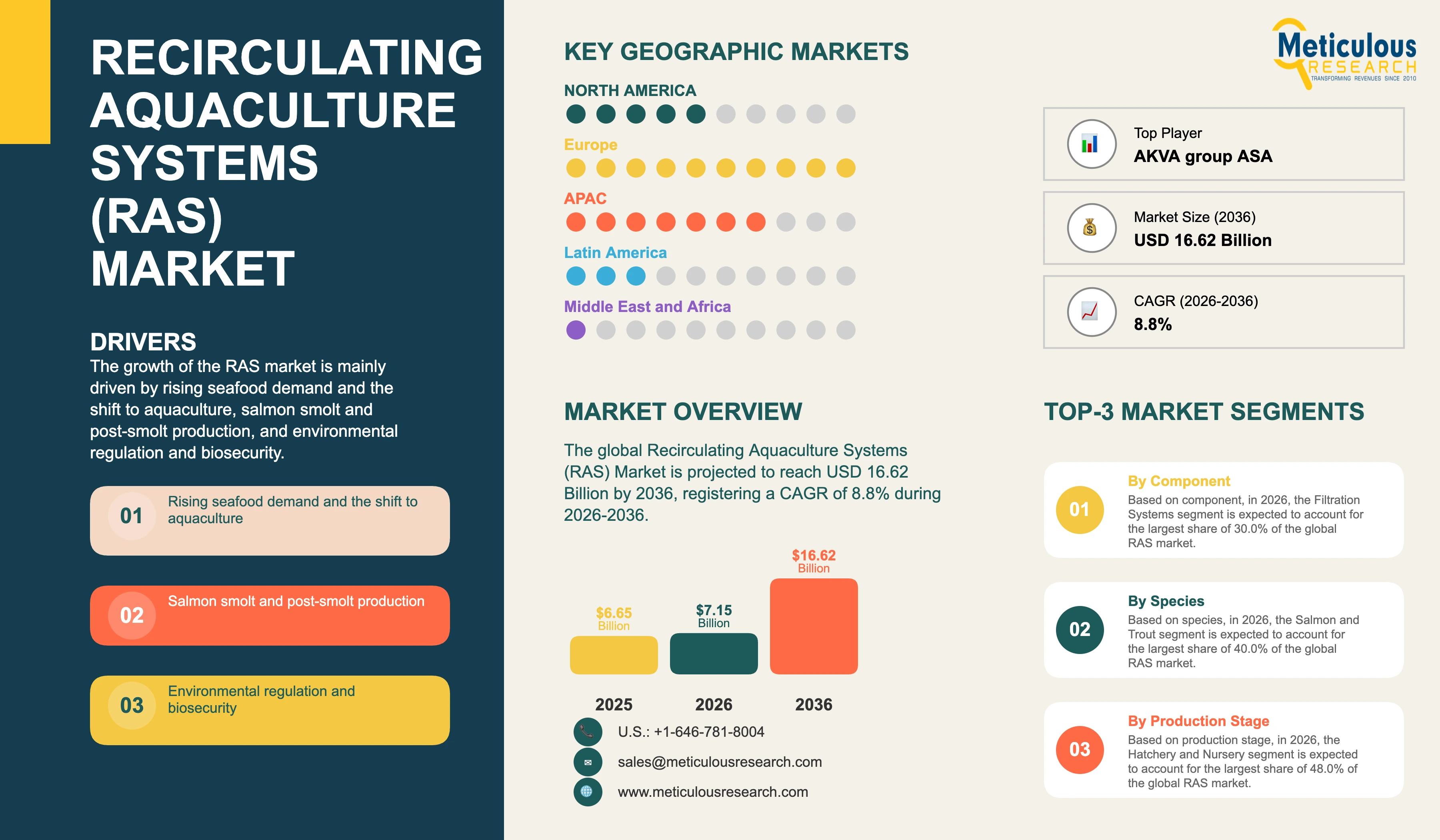
The global recirculating aquaculture systems (RAS) market was valued at USD 6.65 billion in 2025. This market is expected to reach USD 16.62 billion by 2036 from an estimated USD 7.15 billion in 2026, registering a CAGR of 8.8% during the forecast period (2026-2036).
- Published
- Nov 2026
- Pages
- 277
- Format
- PDF + Excel
- Report ID
- MRAGR - 1042532
- Base year
- 2025
- 2025 · BASELINE
- $6.65B
- 2036
- $16.62B
- CAGR 2026–2036
- 8.8%
2025 baseline · 2026–2036 forecast at 8.8% CAGR · hover a bar for the value
Key highlights
The Food and Agriculture Organization of the United Nations reported in The State of World Fisheries and Aquaculture 2024 that global aquaculture production reached a record 130.9 million tonnes in 2022, and that for the first time aquaculture produced more aquatic animals than capture fisheries, accounting for 51% of the 185 million tonnes of aquatic animals produced.
FAO also projected that aquatic animal production will increase by about 10% to reach 205 million tonnes by 2032, with most of the growth coming from aquaculture, while capture fisheries have remained broadly stable since the late 1980s, which shows the long-term need for more efficient and controllable farming systems.
Nordic Aqua Partners, which operates a fully integrated commercial-scale RAS farm for Atlantic salmon in Ningbo, China, began harvesting from Stage 1 in April 2024 and transferred the first fish into its Stage 2 grow-out units in October 2025, and it reported that China's imports of fresh Atlantic salmon grew 48% in 2025 to a record level, highlighting demand for locally produced fresh salmon.
Atlantic Sapphire, which operates a large land-based RAS salmon farm in Florida, became the first land-based salmon farm in the U.S. to achieve Aquaculture Stewardship Council certification in early 2025, while the ASC has adapted its standards to cover the growing number of RAS operations.
In Norway, Chile, and other salmon-producing countries, salmon farmers have invested heavily in RAS hatcheries and post-smolt facilities that keep fish on land for longer before transfer to sea, reducing time in ocean pens and exposure to sea lice and disease, which has made hatchery and nursery production the largest application of RAS technology.
Canada's federal government decided to transition salmon farming in coastal British Columbia away from open-net pens, setting a ban on open-net pen salmon farming in the province from mid-2029, which is expected to encourage investment in closed containment and land-based RAS facilities in the region.
By component, filtration systems account for the largest share of 30.0% in 2026, while monitoring and control systems register the highest CAGR.
By species, salmon and trout account for the largest share in 2026, while shrimp register the highest CAGR.
By production stage, hatchery and nursery systems account for the largest share of 48.0% in 2026, while grow-out systems register the highest CAGR.
By geography, Europe accounts for the largest share of 38.0% in 2026, while Asia-Pacific registers the highest CAGR of 10.8%.
Report summary
| Particulars | Details |
|---|---|
| Base Year | 2025 |
| Estimated Year | 2026 |
| Forecast Period | 2026-2036 |
| Market Size in 2025 | USD 6.65 billion |
| Market Size in 2026 | USD 7.15 billion |
| Market Size by 2036 | USD 16.62 billion |
| CAGR (2026-2036) | 8.8% |
| Format | PDF, Excel & Cloud Portal · 277 pages |
| Largest Segment by Component (2026) | Filtration Systems (30.0%) |
| Largest Segment by Production Stage (2026) | Hatchery and Nursery (48.0%) |
| Largest Region (2026) | Europe (38.0%) |
| Fastest-Growing Region | Asia-Pacific (CAGR 10.8%) |
| Segments Covered | Component, Species, Production Stage, and Geography |
| Geographic Scope | Europe, Asia-Pacific, North America, Latin America, and Middle East and Africa |
| Key Companies Profiled | AKVA group, Billund Aquaculture, Veolia (Krüger Kaldnes), AquaMaof, ScaleAQ, Inter Aqua Advance, Alpha Aqua, PR Aqua, Nofitech, FREA Aquaculture Solutions, Pentair Aquatic Eco-Systems, Xylem, Innovasea, Clewer Aquaculture, and Aquaculture Systems Technologies |
Report overview
Segments covered: component, specy, production stage.
The growth of this market is mainly driven by rising global demand for seafood and the shift of production from capture fisheries to aquaculture, the growing use of RAS for salmon smolt and post-smolt production to reduce sea lice, disease, and mortality in ocean pens, limits on new open-net pen licenses and stricter environmental rules in major producing countries, the push to produce fresh fish close to consumers in markets such as China, the U.S., Japan, and the Middle East, water scarcity and food security goals, and advances in filtration, oxygenation, and monitoring technology. However, factors such as high capital and operating costs, the technical and biological risks of large-scale RAS facilities, the failure or delay of several high-profile land-based grow-out projects, high energy consumption, and limited access to financing are expected to restrain the growth of this market to some extent.
Recirculating aquaculture systems (RAS) are land-based fish and shrimp farming systems in which water is continuously cleaned and reused rather than discharged after a single pass. In a typical RAS, water flows from the fish tanks through mechanical filters that remove solid waste, biological filters that convert toxic ammonia into less harmful nitrate, degassing units that remove carbon dioxide, oxygenation systems, and disinfection systems such as ultraviolet light or ozone, before returning to the tanks. Sensors and control systems monitor water quality, temperature, oxygen, and fish behavior, allowing farmers to control conditions closely. Modern RAS can reuse more than 90% of their water each day, which reduces water use and allows farms to be located close to markets.
This market covers the global revenue from the sale of recirculating aquaculture systems and related components and services, including filtration systems, aeration and oxygenation systems, pumps and piping, tanks and raceways, water treatment and disinfection systems, monitoring and control systems, and design, engineering, installation, and commissioning services. It is segmented by component, species, production stage, and geography, with geography based on the location of RAS installations. The value of fish and shrimp produced in RAS facilities, feed, fish health products, land, and general construction of buildings are not included.
Aquaculture has become the main source of growth in global seafood supply. FAO reported that aquaculture produced 130.9 million tonnes in 2022 and overtook capture fisheries as the main producer of aquatic animals for the first time, while capture fisheries have remained broadly stable for decades. Demand for seafood continues to rise with population growth, higher incomes, and interest in healthy protein. However, traditional aquaculture in ponds and open-net pens faces limits, including disease, sea lice, escapes, environmental impacts, competition for coastal space, and the effects of climate change on water temperatures. RAS allows farmers to control the farming environment, protect fish from disease and predators, reduce environmental impacts, and produce fish close to consumers.
The salmon industry is the largest user of RAS technology and has driven much of its technical development over the past two decades. In Norway, Chile, the Faroe Islands, Scotland, Iceland, and Canada, salmon farmers use RAS hatcheries to produce smolts, and many have built post-smolt facilities that keep fish on land until they reach larger sizes before transfer to sea pens. This reduces the time fish spend at sea, lowers mortality and sea lice treatment costs, and allows companies to produce more fish within limited sea licenses. Large salmon producers such as Mowi, SalMar, Lerøy, Grieg Seafood, and Cermaq have invested heavily in these facilities, which has made hatchery and nursery production the largest application of RAS.
Land-based grow-out of salmon and other species to market size is the next stage of RAS development. Companies such as Atlantic Sapphire in the U.S., Nordic Aqua Partners in China, and several projects in Japan, the Middle East, and Europe are farming Atlantic salmon to harvest size in RAS facilities. However, the sector has faced challenges. Several large projects have experienced biological problems, construction delays, cost overruns, and financing difficulties, and some have been cancelled or downsized. These experiences have made investors more cautious and have increased the focus on proven technology, experienced suppliers, and phased development.
RAS is also used for many other species, which broadens the market beyond salmon and supports demand in more regions. Shrimp farming in RAS is growing in the U.S., Europe, and Asia, where it allows fresh, local production without antibiotics. Species such as rainbow trout, barramundi, yellowtail, sea bass, sea bream, tilapia, sturgeon, and eels are also farmed in RAS, along with ornamental fish and research facilities. In Asia-Pacific, China and Japan are investing in land-based salmon and other high-value species, and Southeast Asian countries are adopting RAS for shrimp hatcheries and nurseries.
The market includes specialized RAS technology suppliers and engineering companies, water treatment companies, and aquaculture equipment manufacturers. Leading suppliers include AKVA group, Billund Aquaculture, Veolia's Krüger Kaldnes, AquaMaof, ScaleAQ, Inter Aqua Advance, Alpha Aqua, PR Aqua, Nofitech, and FREA Aquaculture Solutions, along with component suppliers such as Pentair Aquatic Eco-Systems, Xylem, Innovasea, and Clewer Aquaculture. Many suppliers provide turnkey projects that include design, equipment, installation, and biological support.
Over the forecast period, the RAS market is expected to grow steadily, driven by continued investment in salmon smolt and post-smolt facilities, gradual growth of land-based grow-out, rising adoption in Asia-Pacific and the Middle East, and growth in shrimp and other species. Europe is expected to remain the largest market, while Asia-Pacific is expected to grow fastest at a CAGR of 10.8%.
Advanced sensors, automation, artificial intelligence, and digital twins can help RAS operators monitor water quality and fish health, predict problems, optimize feeding, and reduce energy use. Energy-efficient pumps, heat recovery, renewable energy integration, and better system design can lower operating costs. Suppliers that offer these technologies can improve the economics of RAS and win both new projects and retrofits. Lower energy use also helps producers meet sustainability expectations from retailers and investors, and it reduces exposure to volatile electricity prices, which have become a major concern for operators in Europe since 2022. Monitoring and control systems are the fastest-growing component segment in this market. Retrofitting existing RAS facilities with new sensors, automation, and energy-efficient equipment is also a growing opportunity, since many older hatcheries and farms need upgrades to improve performance, reduce energy use, and meet new environmental rules. Suppliers that can combine equipment with software and remote support services can build recurring revenue from their installed base.
Based on the location of installations, Europe is expected to account for the largest share of 38.0% of the market in 2026, mainly due to salmon post-smolt investment in Norway and the presence of leading RAS suppliers.
Asia-Pacific is projected to register the highest CAGR of 10.8% during the forecast period, driven by land-based salmon in China and Japan and shrimp RAS in Southeast Asia.
The report profiles 15 companies, including AKVA group, Billund Aquaculture, Veolia (Krüger Kaldnes), AquaMaof, ScaleAQ, Inter Aqua Advance, Alpha Aqua, PR Aqua, Nofitech, FREA Aquaculture Solutions, Pentair Aquatic Eco-Systems, Xylem, Innovasea, Clewer Aquaculture, and Aquaculture Systems Technologies. The top five players account for an estimated 30.0% of the market in 2025.
Report infographic
Market dynamics
14 factors across 5 forcesRising seafood demand and the shift to aquaculture
Global demand for seafood continues to grow, supported by population growth, rising incomes, urbanization, and the health benefits of fish and shellfish. FAO reported that global apparent consumption of aquatic animal foods reached 162.5 million tonnes in 2021, and it projects that aquatic animal production will rise to about 205 million tonnes by 2032. Since capture fisheries have been broadly stable for decades, most of this growth must come from aquaculture. At the same time, traditional aquaculture faces limits on suitable sites, water availability, disease, and environmental impacts, which encourages producers and governments to invest in more controlled and efficient systems such as RAS.
RAS allows aquaculture to expand in places where traditional farming is not possible, such as inland areas, deserts, cities, and regions with limited water resources. It also allows countries that import most of their seafood, such as the U.S., China, Japan, and the Gulf countries, to produce fresh fish locally, which supports food security and reduces dependence on imports and air freight. These factors support long-term demand for RAS equipment and services. Governments in China, Japan, Singapore, Saudi Arabia, and the UAE have identified domestic aquaculture as a priority for food security, and several provide subsidies, land, or financing for modern aquaculture facilities.
Salmon smolt and post-smolt production
The salmon industry is the largest driver of RAS demand, both for juvenile production and for land-based grow-out. Salmon farmers in Norway, Chile, Scotland, the Faroe Islands, Iceland, and Canada increasingly use RAS hatcheries to produce larger and healthier smolts, and many are building post-smolt facilities that keep fish on land for longer before transfer to sea. Larger post-smolts spend less time in sea pens, which reduces exposure to sea lice and disease, lowers mortality, and allows companies to increase production within their existing sea licenses. Norway's strict sea lice rules and limits on production growth under its traffic light system have made post-smolt investment especially attractive.
Large salmon producers such as Mowi, SalMar, Lerøy, Grieg Seafood, Cermaq, and Bakkafrost have built or expanded large RAS smolt and post-smolt facilities, often worth tens of millions of dollars each, and these investments are expected to continue over the forecast period. Hatchery and nursery systems account for the largest share of the market by production stage, and salmon and trout account for the largest share by species.
Environmental regulation and biosecurity
Governments in many producing countries have tightened rules on open-net pen aquaculture because of concerns about sea lice, disease transmission to wild fish, escapes, nutrient pollution, and conflicts with other coastal users. Canada has decided to transition away from open-net pen salmon farming in British Columbia, and other countries have limited new sea licenses or introduced taxes and fees on sea-based production. These rules encourage producers to move part of their production onto land, where RAS allows tight control of waste, escapes, and disease.
Biosecurity is another important driver, particularly for species and regions affected by repeated disease outbreaks. Disease outbreaks have caused large losses in shrimp farming in Asia and Latin America and in salmon farming in Chile and Norway. RAS allows farmers to control water quality and keep pathogens out, which reduces the need for antibiotics and chemical treatments. This is particularly important for shrimp hatcheries and nurseries, which supply post-larvae to pond farms. Retailers and consumers are also increasingly interested in seafood produced without antibiotics and with low environmental impact, which supports demand for fish and shrimp from RAS farms and helps producers earn premium prices.
Local production of fresh seafood near consumers
Many large seafood markets depend on imports that are flown or shipped long distances. RAS allows companies to produce fresh salmon, shrimp, trout, and other species close to major cities, which reduces transport costs, carbon emissions from air freight, and supply chain risks, and allows producers to deliver fresher products. Nordic Aqua Partners in China, Atlantic Sapphire in the U.S., and projects in Japan, Singapore, Saudi Arabia, and the UAE are examples of this trend. Grow-out systems are the fastest-growing production stage, and Asia-Pacific is the fastest-growing region. Local production also allows producers to sell fresh, never-frozen fish with a longer shelf life, which retailers and restaurants value, and it reduces exposure to trade disruptions, tariffs, and air freight costs.
Table of contents
11 chapters · 116 sections · 277 pages · click to expandSegmental analysis
| Segment | Largest share (2026) | Fastest growth (2026–2036) |
|---|---|---|
| By Component | Filtration systems | Monitoring and control systems |
| By Specy | Salmon and trout | Shrimp |
| By Production Stage | Hatchery and nursery | The |
By Component
- The filtration systems segment is expected to account for the largest share of 30.0% of the market.
- The large share of this segment is mainly due to the central role of mechanical and biological filtration in every RAS, the large size and cost of drum filters, moving bed biofilters, fixed bed biofilters, protein skimmers, and degassing units in large salmon smolt and post-smolt facilities, and the need to upgrade and expand filtration as producers increase biomass and fish size.
- Mechanical filters, such as drum filters supplied by companies such as Hydrotech (Veolia) and others, remove solid waste from the water, while biological filters use bacteria to convert ammonia into nitrate.
- The performance of these filters determines water quality, fish health, and the amount of water that can be reused, so producers invest heavily in high-quality filtration.
- Leading RAS suppliers such as AKVA group, Billund Aquaculture, Krüger Kaldnes, and AquaMaof design their own filtration systems.
- Filtration is expected to remain the largest component over the forecast period, supported by new facilities and upgrades.
- However, the monitoring and control systems segment is projected to register the highest CAGR during the forecast period.
- The rapid growth of this segment is mainly driven by the need to monitor water quality, oxygen, carbon dioxide, and fish behavior continuously, the adoption of automation and AI to reduce risks and labor, and the integration of digital tools in new and existing facilities.
- Aeration and oxygenation systems, pumps and piping, tanks and raceways, water treatment and disinfection systems, and design, installation, and services make up the rest of the market.
- Aeration and oxygenation systems are critical because fish in high-density RAS need a constant supply of oxygen, and many facilities use pure oxygen and oxygen cones to maintain levels.
- Pumps move very large volumes of water through the system every hour and account for much of the facility's energy use, so energy-efficient pumps from suppliers such as Xylem and Pentair are in high demand.
- Tanks and raceways range from small hatchery tanks to very large grow-out tanks holding thousands of cubic metres of water, while water treatment and disinfection systems, such as UV and ozone, protect fish from pathogens.
- Design, installation, and services are an important part of every project, since the success of a RAS depends on correct design, careful commissioning, and ongoing support.
By Specy
- The salmon and trout segment is expected to account for the largest share of the market.
- This segment's large share is mainly due to heavy investment in RAS hatcheries and post-smolt facilities by salmon producers in Norway, Chile, the Faroe Islands, Iceland, Scotland, and Canada, the high value of salmon, which can support the cost of RAS, the growth of land-based salmon grow-out projects in the U.S., China, Japan, and Europe, and the established use of RAS for rainbow trout farming in Denmark and other countries.
- Atlantic salmon is among the most valuable farmed finfish species traded internationally, and producers invest heavily to improve survival and growth.
- RAS hatcheries are now the standard way to produce salmon smolts in most major producing countries, and post-smolt facilities are becoming more common.
- Land-based grow-out projects, such as those of Atlantic Sapphire and Nordic Aqua Partners, also add demand for large RAS systems.
- Salmon and trout are expected to remain the largest species segment over the forecast period, supported by ongoing post-smolt investment in Norway and growing land-based projects in Asia and North America.
- However, the shrimp segment is projected to register the highest CAGR during the forecast period.
- This segment's growth is mainly driven by demand for disease-free shrimp hatcheries and nurseries in Asia and Latin America, the development of indoor shrimp farms that produce fresh, antibiotic-free shrimp close to consumers in the U.S., Europe, Japan, and the Middle East, and improvements in shrimp RAS technology.
- Tilapia, other finfish such as sea bass, sea bream, barramundi, yellowtail, and sturgeon, and catfish and other species make up the rest of the market.
- Shrimp is projected to register the highest CAGR during the forecast period, driven by disease-free hatcheries and indoor farms near consumers, while salmon and trout remain the largest species segment.
By Production Stage
- The hatchery and nursery segment is expected to account for the largest share of 48.0% of the market.
- The large share of this segment is mainly due to the widespread use of RAS in salmon smolt and post-smolt production, shrimp hatcheries and nurseries, and hatcheries for many other species, where controlled conditions improve survival, growth, and quality, and where the value of each fish justifies the cost of RAS.
- Hatchery and nursery systems are a proven use of RAS with clear economic benefits, since healthier and larger juveniles improve results in the next stage of farming.
- Salmon producers such as Mowi, SalMar, Lerøy, Grieg Seafood, Cermaq, and Bakkafrost have invested in many large smolt and post-smolt facilities, and shrimp producers are adopting RAS nurseries to improve post-larvae quality and reduce disease.
- Because juvenile production requires smaller water volumes than grow-out, RAS costs per unit are more manageable, and the risks are better understood.
- Hatchery and nursery is expected to remain the largest production stage over the forecast period, supported by steady replacement and expansion of salmon and shrimp hatcheries worldwide.
- However, the grow-out segment is projected to register the highest CAGR during the forecast period.
- The rapid growth of this segment is mainly driven by land-based salmon and shrimp projects near major consumer markets in China, Japan, the U.S., Europe, and the Middle East, improvements in RAS technology and operating experience, and demand for fresh, locally produced seafood.
- Research, ornamental, and other uses, such as university and government research facilities, public aquariums, and ornamental fish farms, make up the rest of the market.
- Research facilities play an important role in developing new species, breeding programs, and RAS technologies, and they often serve as reference sites for suppliers.
Geographic analysis
Middle East & Africa
Countries in the Middle East, such as Saudi Arabia and the UAE, have limited freshwater and coastal resources and import most of their seafood. As part of their food security strategies, these countries are investing in RAS facilities for salmon, shrimp, sea bream, and other species. Government support, available capital, and strong demand for fresh fish create opportunities for RAS suppliers in the region. Saudi Arabia has set targets to increase domestic aquaculture production significantly as part of its Vision 2030 program and national fisheries strategy, and the UAE has supported land-based salmon and other RAS projects. These projects often require turnkey delivery, local operator training, and long-term technical support, which favors experienced suppliers with strong references. Middle East and food security investment Geographic Analysis
Europe
Largest shareIn 2026, Europe is expected to account for the largest share of 38.0% of the global RAS market. The large share of this region is mainly due to the large investment in salmon smolt and post-smolt facilities in Norway, the Faroe Islands, Scotland, and Iceland, the presence of leading RAS suppliers in Norway and Denmark, strict environmental regulation of sea-based farming, and established RAS production of trout, eel, pikeperch, and other species in Denmark, the Netherlands, and other countries. Norway is the largest national market in Europe because its salmon industry has invested heavily in post-smolt facilities to reduce sea lice and increase production within limited sea licenses. Denmark is home to many leading RAS suppliers, such as Billund Aquaculture, Inter Aqua Advance, and Alpha Aqua, and has a long history of RAS trout farming. Iceland and the Faroe Islands are also investing in large smolt and land-based facilities. Europe is expected to remain the largest region throughout the forecast period, supported by continued salmon investment and new land-based projects.
Asia-Pacific
Fastest growthAsia-Pacific is projected to register the highest CAGR of 10.8% during the forecast period. The rapid growth of this region is mainly driven by land-based salmon projects in China and Japan, strong demand for fresh salmon in China, where Nordic Aqua Partners reported that fresh Atlantic salmon imports grew 48% in 2025, the adoption of RAS for shrimp hatcheries and nurseries in Vietnam, Thailand, Indonesia, and India, government support for aquaculture modernization in China, and RAS barramundi and other species in Australia and Singapore.
North America
North America is a significant market, supported by land-based salmon and trout farms in the U.S. and Canada, indoor shrimp farms, and Canada's transition away from open-net pen salmon farming in British Columbia.
Latin America
Latin America is driven mainly by salmon smolt facilities in Chile and growing shrimp hatchery investment in Ecuador, while the Middle East and Africa is growing quickly because of food security investments in Saudi Arabia and the UAE. In the U.S., several land-based salmon, trout, steelhead, and shrimp projects are in operation or development, and Chile's salmon industry has invested in RAS hatcheries to improve smolt quality and reduce disease, especially in response to water scarcity and algal bloom risks.
Competitive landscape
The RAS market is fragmented, with many specialized suppliers, engineering companies, and component manufacturers. Leading companies include turnkey RAS suppliers such as AKVA group, Billund Aquaculture, Veolia's Krüger Kaldnes, AquaMaof, ScaleAQ, Inter Aqua Advance, Alpha Aqua, PR Aqua, Nofitech, and FREA Aquaculture Solutions, as well as component and technology suppliers such as Pentair Aquatic Eco-Systems, Xylem, Innovasea, Clewer Aquaculture, and Aquaculture Systems Technologies.
Companies compete on project track record, biological performance, system reliability, energy efficiency, capital and operating costs, project delivery, and after-sales support. Because RAS failures can cause large fish losses, buyers place great weight on proven references, experienced engineering teams, and biological support. Many suppliers offer turnkey projects that include design, equipment, installation, commissioning, and training, and some provide long-term service agreements, spare parts, and performance guarantees.
The top five players are estimated to account for 30.0% of the RAS market in 2025. This moderate concentration reflects the presence of a few large turnkey suppliers alongside many smaller regional companies and component specialists.
Players use several strategies to grow in this market, including turnkey project delivery, long-term service agreements, partnerships with salmon producers and investors, acquisitions to expand technology portfolios, and expansion into Asia-Pacific and the Middle East. For example, AKVA group supplied the RAS technology for Nordic Aqua Partners' salmon farm in China, and several suppliers have formed partnerships with Middle Eastern investors for food security projects.
Competition is expected to focus on proven biological performance, energy efficiency, digital monitoring, and the ability to share project risk with customers. After the setbacks of several large land-based projects, buyers are expected to favor suppliers with strong references and financial strength, which may lead to consolidation among smaller suppliers. Leading suppliers are also investing in research facilities and partnerships with universities to test new designs and improve biological performance, and they increasingly use digital platforms to monitor customer systems remotely and provide support. Companies that can show strong results across many species and regions are expected to win the largest projects and long-term service contracts with producers and investors.
Some of the key players operating in the RAS market are AKVA group ASA, Billund Aquaculture A/S, Veolia Water Technologies (Krüger Kaldnes AS), AquaMaof Aquaculture Technologies Ltd., ScaleAQ AS, Inter Aqua Advance A/S, Alpha Aqua A/S, PR Aqua Ltd., Nofitech AS, FREA Aquaculture Solutions, Pentair Aquatic Eco-Systems, Inc., Xylem Inc., Innovasea Systems Inc., Clewer Aquaculture Oy, and Aquaculture Systems Technologies, LLC.
- —
Recent developments include the following: Nordic Aqua Partners transferred fish into its first Stage 2 grow-out unit in China in October 2025, Atlantic Sapphire achieved ASC certification in early 2025, salmon producers continued to invest in large post-smolt facilities in Norway and other countries, and Canada confirmed its transition away from open-net pen salmon farming in British Columbia.
- AKVA group
- Billund Aquaculture
- Veolia (Krüger Kaldnes)
- AquaMaof
- ScaleAQ
- Inter Aqua Advance
- Alpha Aqua
- PR Aqua
- Nofitech
- FREA Aquaculture Solutions
- Pentair Aquatic Eco-Systems
- Xylem
- Innovasea
- Clewer Aquaculture
- Aquaculture Systems Technologies
Expert perspectives
The RAS market is supported by a strong long-term trend: aquaculture must supply most of the growth in global seafood demand, and traditional farming systems face increasing environmental, biological, and regulatory limits. RAS offers a way to grow production in a controlled, biosecure, and resource-efficient way, and it has become essential to the salmon industry's hatchery and post-smolt production.
Over the forecast period, the RAS market is expected to grow at a CAGR of 8.8%. Growth is expected to come mainly from continued investment in salmon smolt and post-smolt facilities, shrimp hatcheries and nurseries, and a gradual expansion of land-based grow-out projects. The setbacks of several large grow-out projects in Europe and North America have made investors more cautious, so we expect grow-out growth to come from phased, well-financed projects with experienced operators rather than from very large single investments.
Filtration systems remain the largest component, while monitoring and control systems grow fastest. Salmon and trout remain the largest species segment, while shrimp grows fastest. Hatchery and nursery remains the largest production stage, while grow-out grows fastest as land-based projects mature.
Europe remains the largest region because of its salmon industry and leading suppliers, while Asia-Pacific is the fastest-growing region at a CAGR of 10.8%, driven by China, Japan, and Southeast Asian shrimp production.
For RAS technology suppliers, the key priorities are to prove biological performance through reference projects, reduce energy use and operating costs, offer strong digital monitoring and support, and share risk with customers through guarantees and service agreements. For fish producers and investors, the priority is to start with proven applications, build operating experience, secure reliable energy and water supplies, and expand in phases as performance is proven. Companies that combine engineering expertise with biological know-how and financial strength are expected to gain the most from the growth of this market.
We also see the Asia-Pacific and Middle East markets as the most important sources of new demand outside the salmon industry. In these regions, food security goals, strong demand for fresh seafood, and government support are creating new projects for salmon, shrimp, and other species. However, these projects often lack local RAS experience, so suppliers that provide training, remote monitoring, and long-term support will have an advantage. Over time, as more projects succeed and operating costs fall, we expect RAS to become a mainstream production method for a wider range of species, not only for juvenile salmon, and suppliers with broad species experience and strong support capabilities will benefit most.
Customer perspectives
Hatchery Manager - salmon producer, Norway
Our new post-smolt RAS facility lets us put bigger, healthier fish into the sea, which shortens the sea phase and reduces lice treatments. Water quality and stable operation are everything, so we choose suppliers with proven references.
Chief Operating Officer - land-based salmon farm, Asia
Fresh salmon grown near our customers sells at a premium and avoids long air freight, but we need very reliable systems and strong monitoring, because a single water quality problem can affect a whole tank of fish.
Director - shrimp hatchery, Southeast Asia
Disease outbreaks used to wipe out whole batches, but our RAS nursery keeps water clean and stable, so we can sell healthy post-larvae to pond farmers.
Frequently asked questions
The market was valued at USD 6.65 billion in 2025 and USD 6.20 billion in 2024, and is estimated at USD 7.15 billion in 2026. These values cover RAS components, equipment, and design, installation, and services.
Cite this report
Meticulous Research. (2026). Recirculating Aquaculture Systems (RAS) Market - Global Opportunity Analysis and Industry Forecast (2026-2036) (Report No. MRAGR - 1042532). Meticulous Market Research Pvt. Ltd. https://www.meticulousresearch.com/product/recirculating-aquaculture-systems-ras-market-7215