Agricultural Cold Storage Market (2026-2036)
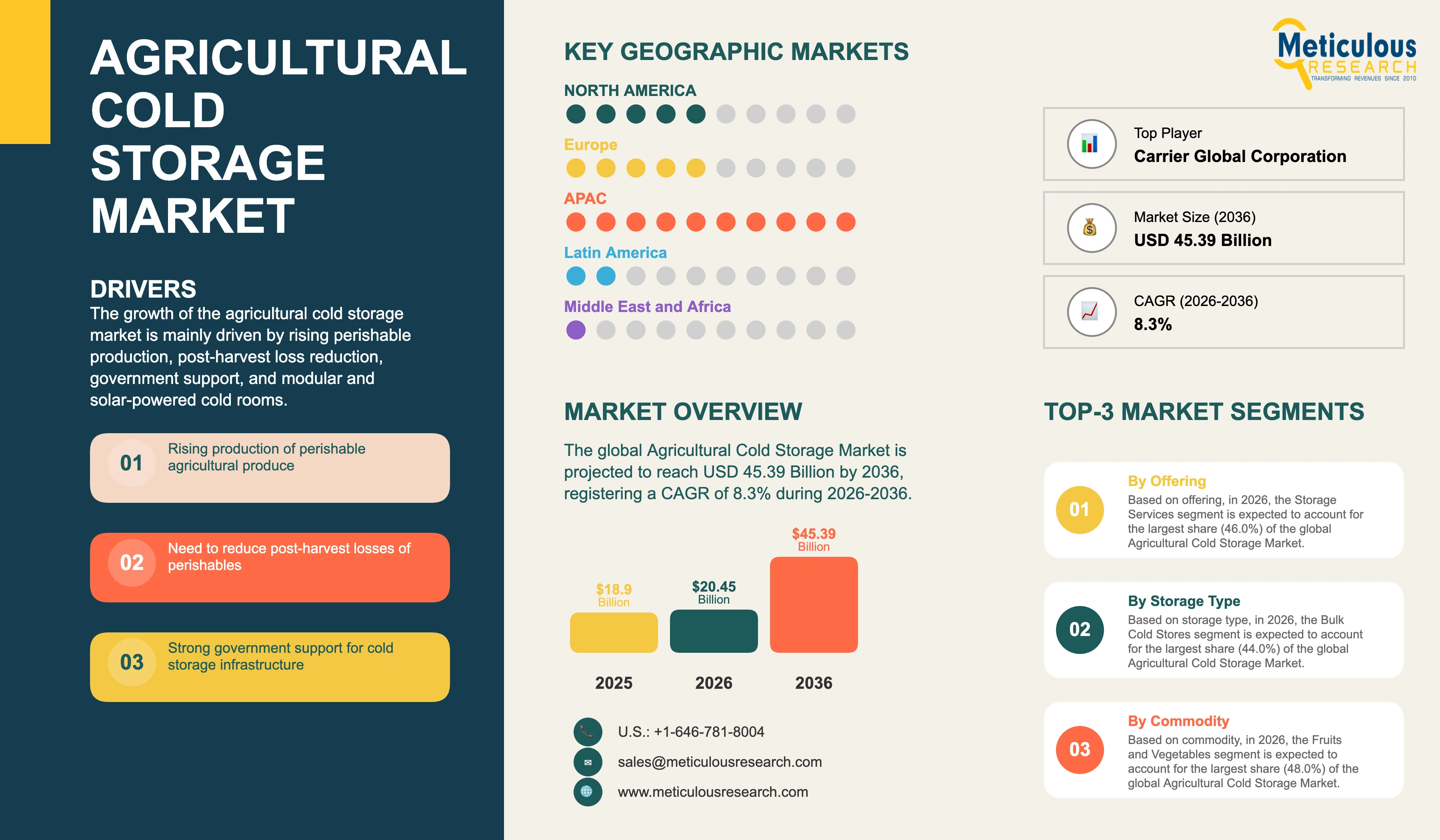
The global agricultural cold storage market was valued at USD 18.90 billion in 2025. This market is expected to reach USD 45.39 billion by 2036 from an estimated USD 20.45 billion in 2026, registering a CAGR of 8.3% during the forecast period (2026-2036).
- Published
- Nov 2026
- Pages
- 266
- Format
- PDF + Excel
- Report ID
- MRAGR - 1042600
- Base year
- 2025
- 2025 · BASELINE
- $18.90B
- 2036
- $45.39B
- CAGR 2026–2036
- 8.3%
2025 baseline · 2026–2036 forecast at 8.3% CAGR · hover a bar for the value
Key highlights
According to the Press Information Bureau (PIB) of the Government of India, India had 8,815 cold storages with a combined capacity of 402.18 lakh metric tonnes (about 40.22 million tonnes) as of June 30, 2025, and the National Centre for Cold-chain Development (NCCD) projects that the country's cold storage capacity will reach about 440 lakh metric tonnes by 2031, making India one of the largest agricultural cold storage markets in the world.
The Global Cold Chain Alliance (GCCA) reported in its most recent global capacity report that refrigerated warehouse capacity worldwide reached 719 million cubic meters across 51 countries, with the U.S., India, and China as the three largest country markets, and India's capacity is dominated by agricultural cold stores used mainly for potatoes, fruits, and vegetables.
On June 30, 2026, the Foundation for Partnership Initiatives in the Niger Delta (PIND) and ColdHubs commissioned a solar-powered cold storage and ice-making facility at Swali Market in Bayelsa State, Nigeria, powered by a 44 kWp solar photovoltaic system with 240 kWh of battery storage, showing how off-grid cold rooms are expanding agricultural cold storage access for farmers and traders.
The Associated Press reported in June 2026 that pay-per-use solar cold storage providers such as SoKo Fresh in Kenya allow smallholder farmers to pay based on the weight of produce stored, since many farmers cannot afford the roughly USD 30,000 upfront cost of their own solar-powered cold storage unit, supporting the growth of cooling-as-a-service models in Africa.
The International Institute of Refrigeration (IIR) published a new edition of its guide on recommendations for chilled storage of perishable produce in November 2026, reflecting continued efforts to improve storage practices, temperature settings, and energy efficiency for fruits and vegetables in cold storage.
By offering, storage services account for the largest share of 46.0% in 2026, while monitoring, controls, and software registers the highest CAGR.
By storage type, bulk cold stores account for the largest share of 44.0% in 2026, while modular and solar-powered cold rooms register the highest CAGR.
By commodity, fruits and vegetables account for the largest share in 2026, while fish and seafood registers the highest CAGR.
By temperature range, chilled accounts for the larger share in 2026, while frozen registers the higher CAGR.
By geography, Asia-Pacific accounts for the largest share of 44.0% in 2026, while Asia-Pacific registers the highest CAGR of 9.9%.
Report summary
| Particulars | Details |
|---|---|
| Base Year | 2025 |
| Estimated Year | 2026 |
| Forecast Period | 2026-2036 |
| Market Size in 2025 | USD 18.90 billion |
| Market Size in 2026 | USD 20.45 billion |
| Market Size by 2036 | USD 45.39 billion |
| CAGR (2026-2036) | 8.3% |
| Format | PDF, Excel & Cloud Portal · 266 pages |
| Largest Segment by Offering (2026) | Storage Services (46.0%) |
| Largest Segment by Storage Type (2026) | Bulk Cold Stores (44.0%) |
| Largest Region (2026) | Asia-Pacific (44.0%) |
| Fastest-Growing Region | Asia-Pacific (CAGR 9.9%) |
| Companies Profiled | 14 companies and other companies |
| Segments Covered | Offering, Storage Type, Commodity, Temperature Range, Geography |
| Countries Covered | China, India, Japan, South Korea, Australia, New Zealand, Vietnam, Thailand, Indonesia, Philippines, Pakistan, Bangladesh, Rest of Asia-Pacific, U.S., Canada, Spain, Italy, Poland, France, Netherlands, Germany, Belgium, U.K., Greece, Portugal, Rest of Europe, Mexico, Brazil, Chile, Peru, Argentina, Colombia, Ecuador, Rest of Latin America, South Africa, Kenya, Nigeria, Ghana, Ethiopia, Morocco, Egypt, Saudi Arabia, U.A.E., Rest of Middle East & Africa |
Report overview
Segments covered: offering, storage type, commodity, temperature range.
The growth of this market is mainly driven by rising production and consumption of fruits, vegetables, dairy, meat, and seafood, the need to reduce high post-harvest losses of perishable produce, strong government support for cold storage infrastructure in India, China, and other developing countries, the growth of horticulture exports that require pre-cooling and temperature-controlled storage close to farms, the spread of controlled atmosphere storage for long-term fruit storage, the development of modular and solar-powered cold rooms for smallholder farmers, and the adoption of energy-efficient refrigeration, natural refrigerants, and remote monitoring systems. However, factors such as high capital and energy costs, unreliable electricity supply in rural areas, low utilization of some existing facilities, and regulatory pressure on high global warming potential refrigerants are expected to restrain the growth of this market to some extent.
Agricultural cold storage refers to temperature-controlled facilities and systems used to store perishable agricultural produce close to where it is grown, collected, or packed, before it moves into processing, wholesale, retail, or export supply chains. It includes bulk cold stores for potatoes, onions, fruits, and vegetables, controlled atmosphere stores for apples, pears, and other fruits, pre-cooling and packhouse cold rooms, ripening chambers for bananas, mangoes, and avocados, milk chilling and dairy cold rooms at collection centers, cold stores for meat, poultry, and fish at landing and processing points, and modular and solar-powered cold rooms at farms and rural markets. This report covers storage services provided by agricultural cold store operators, refrigeration systems and equipment, insulated structures and construction, and monitoring, controls, and software, across storage types, commodities, temperature ranges, and regions. Large urban and port-based public refrigerated warehouses and refrigerated transport services are analyzed in the separate cold chain logistics report. The market is measured on a revenue basis.
Agricultural cold storage plays a central role in reducing post-harvest losses, stabilizing prices, and allowing farmers to sell their produce over longer periods. Fresh fruits and vegetables can deteriorate within a few days at ambient temperatures in hot climates, but proper cooling and storage can extend their life to several weeks or months. For example, solar-powered cold rooms operated by ColdHubs in Nigeria have been reported to extend the shelf life of fresh produce from about two days to around three weeks. Long-term storage of crops such as potatoes, apples, and onions also allows producers and traders to supply markets throughout the year.
Storage services account for the largest share of the market because, in many countries, especially India, agricultural cold stores are operated as businesses that charge farmers and traders rent for storing their produce, typically per bag, crate, or tonne for a season. India's agricultural cold storage capacity is heavily concentrated in potato-growing states, and a large share of capacity is used for potatoes, while capacity for multi-commodity storage of fruits and vegetables is growing. In other regions, cold storage is more often owned and operated by growers, packhouses, cooperatives, and exporters, and value is generated mainly through equipment and construction.
Refrigeration systems and equipment, including compressors, condensing units, evaporators, controls, and complete refrigeration plants, form the second-largest part of the market. Ammonia-based systems are widely used in large cold stores, while smaller cold rooms use packaged refrigeration units. Regulatory pressure to phase down hydrofluorocarbon refrigerants is driving adoption of natural refrigerants such as ammonia, carbon dioxide, and hydrocarbons, as well as low global warming potential synthetic refrigerants. Insulated panels, doors, flooring, and construction services are needed for new facilities and upgrades, while monitoring, controls, and software help operators manage temperature, humidity, atmosphere, and energy use.
Bulk cold stores are the largest storage type, followed by controlled atmosphere stores, which are widely used for apples, pears, and kiwifruit in North America, Europe, China, Chile, New Zealand, and South Africa. Pre-cooling and packhouse cold rooms are essential for export horticulture, since rapid removal of field heat after harvest greatly improves shelf life. Ripening chambers allow controlled ripening of bananas, mangoes, avocados, and other fruits. Modular and solar-powered cold rooms are a small but fast-growing segment, serving smallholder farmers and rural markets in areas with unreliable electricity.
Fruits and vegetables are the largest commodity group, followed by dairy, meat and poultry, fish and seafood, and flowers, seeds, and other products. Chilled storage accounts for most of the market, since most fresh produce is stored above freezing temperatures, while frozen storage is used for meat, fish, and frozen fruits and vegetables.
The market includes refrigeration equipment manufacturers, insulated panel suppliers, controlled atmosphere technology providers, cold room and cold storage contractors, agricultural cold storage operators, and off-grid cooling providers. Leading companies include Carrier, Daikin, GEA, Danfoss, BITZER, Copeland, Mayekawa, Kingspan, Blue Star, Isolcell, Van Amerongen, Ecozen, ColdHubs, and InspiraFarms, along with thousands of local cold storage operators and contractors.
Over the forecast period, the agricultural cold storage market is expected to grow steadily, supported by government programs, horticulture growth, export demand, the shift to multi-commodity and controlled atmosphere storage, and the spread of solar-powered and modular cold rooms. Asia-Pacific is expected to remain the largest and fastest-growing region, supported by India and China.
Asia-Pacific is expected to account for the largest share of 44.0% of the market in 2026, mainly due to very large production of perishables in China and India, a large installed base of agricultural cold stores, and strong government programs.
Asia-Pacific is also projected to register the highest CAGR of 9.9% during the forecast period, driven by new capacity, modernization, horticulture and seafood exports, and rising urban demand for fresh food.
The report profiles 14 companies, including Carrier, Daikin, GEA, Danfoss, BITZER, Copeland, Mayekawa, Kingspan, Blue Star, Isolcell, Van Amerongen, Ecozen, ColdHubs, and InspiraFarms.
Report infographic
Market dynamics
18 factors across 5 forcesRising production of perishable agricultural produce
Global production of fruits, vegetables, milk, meat, and fish continues to grow, supported by population growth, rising incomes, urbanization, and changing diets that include more fresh and protein-rich foods. India, for example, produces very large volumes of horticulture crops and milk, and it is one of the world's largest producers of fruits, vegetables, and dairy. China is the world's largest producer of fruits and vegetables, and production in Southeast Asia, Africa, and Latin America is also growing.
As production grows, the need for cold storage close to farms and collection points also grows, since perishable produce must be cooled quickly and stored properly to avoid losses and to allow orderly marketing. Seasonal harvests of crops such as potatoes, onions, apples, and mangoes create large peaks in supply that must be stored to supply markets throughout the year and to avoid price collapses at harvest time.
Changing diets in emerging markets, including higher consumption of fresh fruits, vegetables, dairy, and meat, also increase demand for cold storage, since these foods require temperature control at every stage of the supply chain, starting at the farm.
Need to reduce post-harvest losses of perishables
Post-harvest losses of perishable produce remain high, especially in developing countries where cooling at the farm and market level is limited, and the FAO estimates that 13.3% of food produced globally was lost between harvest and retail in 2023, with fruits and vegetables among the food groups with the highest losses, and losses are much higher in regions with limited cold storage. Lack of cold storage is one of the main causes of losses of fruits and vegetables in hot climates, and estimates suggest that up to 40% of food produced in some African countries is lost between harvest and market.
Governments, development agencies, and the private sector increasingly see agricultural cold storage as one of the most effective ways to reduce these losses, increase farmer incomes, and improve food security, which supports investment in new capacity and upgrades.
Cold storage also allows farmers to store produce and sell when prices are better, rather than selling everything at harvest when prices are lowest, which increases farm incomes and encourages further investment.
Strong government support for cold storage infrastructure
Governments in many countries provide subsidies, low-interest loans, and other support for agricultural cold storage. In India, programs such as the Mission for Integrated Development of Horticulture, the National Horticulture Board's capital investment subsidy scheme, the Pradhan Mantri Kisan SAMPADA Yojana, and the Agriculture Infrastructure Fund support construction, expansion, and modernization of cold storages, pack houses, and ripening chambers. According to the PIB, India had 8,815 cold storages with 40.22 million tonnes of capacity as of June 2025, and the NCCD projects capacity of about 44 million tonnes by 2031.
China supports rural cold chain and storage facilities at the production end as part of its agricultural modernization and rural revitalization policies, and many countries in Africa, Southeast Asia, and Latin America provide funding for cold storage at aggregation and market centers, often supported by development banks and donor programs.
Growth of horticulture exports and controlled atmosphere storage
Exports of fresh fruits and vegetables from Latin America, Africa, Asia, and Southern Europe are growing, and exporters must cool and store produce close to farms to meet the quality standards of importing countries. Pre-cooling and packhouse cold rooms are essential for export crops such as berries, grapes, avocados, cherries, mangoes, and citrus. At the same time, controlled atmosphere storage is expanding for apples, pears, kiwifruit, and other crops, as growers seek to extend storage life and supply markets over longer periods with fewer chemical treatments.
Investment in controlled atmosphere storage is strong in China, Chile, New Zealand, South Africa, Poland, Italy, and other fruit-producing countries, supported by growing domestic and export demand.
Spread of modular, solar-powered, and energy-efficient cold rooms
Modular cold rooms and solar-powered cold storage units are making cold storage accessible to smallholder farmers and rural markets that are not served by large cold stores. Companies such as ColdHubs in Nigeria, SoKo Fresh in Kenya, Ecozen in India, and InspiraFarms in East Africa offer solar-powered or modular cold rooms, often under pay-per-use models that allow farmers to rent space by the crate or by weight. Falling costs of solar panels, batteries, and efficient compressors are improving the economics of these solutions, and development agencies and impact investors are supporting their expansion.
Table of contents
12 chapters · 164 sections · 266 pages · click to expandSegmental analysis
| Segment | Largest share (2026) | Fastest growth (2026–2036) |
|---|---|---|
| By Offering | Fruits and vegetables | Fish and seafood |
By Offering
- The fruits and vegetables segment is expected to account for the largest share of the agricultural cold storage market, while the fish and seafood segment is projected to register the highest CAGR during the forecast period.
- The chilled segment is expected to account for the larger share of the agricultural cold storage market, while the frozen segment is projected to register the higher CAGR during the forecast period.
Geographic analysis
Asia-Pacific
Largest shareIn 2026, Asia-Pacific is expected to account for the largest share of 44.0% of the global agricultural cold storage market. Asia-Pacific is also projected to register the highest CAGR of 9.9% during the forecast period, supported by continued investment in both new and modernized facilities. The large share and rapid growth of this region are mainly driven by very large production of fruits, vegetables, dairy, meat, and fish in China and India, a large installed base of agricultural cold stores, strong government programs that fund new capacity and modernization, growing horticulture and seafood exports, and rising demand for fresh food in cities. According to the PIB, India had 8,815 cold storages with 40.22 million tonnes of capacity as of June 2025, and China continues to invest heavily in rural cold storage at the production end. Vietnam, Thailand, Indonesia, the Philippines, Pakistan, Bangladesh, Japan, South Korea, Australia, and New Zealand are also important markets, with growing investment in pack houses, controlled atmosphere stores, and seafood cold storage.
North America
North America accounts for a significant share of the market, supported by large production and long-term storage of potatoes, apples, pears, and other crops, wide use of controlled atmosphere storage, large dairy and meat production, and investment in energy-efficient refrigeration and natural refrigerants. The U.S. is the largest market in the region, with major storage clusters in Washington, Idaho, Michigan, and California, followed by Canada.
Europe
Europe accounts for a significant share of the market, supported by large fruit and vegetable production in Spain, Italy, Poland, France, the Netherlands, Germany, and Belgium, long-term controlled atmosphere storage of apples and pears, and strict EU F-gas rules that drive adoption of natural refrigerants and modernization of existing facilities. The U.K., Greece, and Portugal are also important markets, supported by fruit and vegetable production and modernization of older facilities.
Latin America
Latin America accounts for a growing share of the market, supported by large exports of fruits, vegetables, meat, and seafood from Mexico, Brazil, Chile, Peru, Argentina, Colombia, and Ecuador, which require pre-cooling, packhouse cold rooms, and frozen storage.
Middle East & Africa
The Middle East & Africa accounts for a smaller share, but it is growing rapidly, supported by solar-powered and pay-per-use cold rooms in Nigeria, Kenya, Ghana, and Ethiopia, export horticulture in South Africa, Morocco, Egypt, and Kenya, and investment in food security infrastructure in Saudi Arabia and the U.A.E.
Competitive landscape
The global agricultural cold storage market is highly fragmented, with the top five players estimated to account for less than 15% of the market in 2025. The market includes refrigeration equipment manufacturers, insulated panel suppliers, controlled atmosphere technology providers, cold room and cold storage contractors, thousands of local cold storage operators, and off-grid cooling providers.
In refrigeration equipment, Carrier, Daikin, GEA, Danfoss, BITZER, Copeland, and Mayekawa supply compressors, condensing units, evaporators, controls, and complete refrigeration systems for cold stores of all sizes, and many offer natural refrigerant systems. Kingspan supplies insulated panels and building envelopes for cold storage, and Blue Star supplies cold rooms and refrigeration systems for agricultural cold storage in India. Isolcell and Van Amerongen provide controlled atmosphere and dynamic controlled atmosphere systems for fruit storage.
In off-grid and modular cold storage, which is one of the fastest-growing parts of the market, Ecozen offers solar-powered cold rooms and related solutions in India, ColdHubs operates solar-powered walk-in cold rooms in Nigeria under a pay-per-use model, and InspiraFarms supplies modular cold rooms and pack houses for agricultural exporters in Africa. Storage services are provided mainly by thousands of local, regional, and cooperative cold storage operators, especially in India and China.
The market is fragmented because agricultural cold storage is built and operated locally, close to production areas, and many facilities are owned by individual entrepreneurs, cooperatives, and growers. Equipment and construction markets are more concentrated, with global refrigeration companies competing with regional manufacturers and contractors.
In India and China, a large number of domestic refrigeration manufacturers and cold storage contractors compete on price, while international companies focus on large projects, energy-efficient systems, and natural refrigerant technology.
Companies compete on energy efficiency, reliability, refrigerant technology, cost, service and maintenance networks, local presence, and the ability to deliver complete projects. Key strategies include product launches of natural refrigerant and energy-efficient systems, partnerships with contractors and developers, expansion in emerging markets, and new business models such as cooling-as-a-service.
We expect consolidation among cold storage contractors and operators in some markets, and growing partnerships between equipment manufacturers, solar companies, and service providers to deliver integrated off-grid solutions.
Some of the key players operating in the agricultural cold storage market are Carrier Global Corporation, Daikin Industries, Ltd., GEA Group AG, Danfoss A/S, BITZER SE, Copeland, Mayekawa Mfg. Co., Ltd., Kingspan Group plc, Blue Star Limited, Isolcell S.p.A., Van Amerongen, Ecozen Solutions Pvt. Ltd., ColdHubs Limited, and InspiraFarms, among others.
- —
ColdHubs and PIND commissioned a solar-powered cold storage and ice-making facility in Nigeria in June 2026, pay-per-use solar cold storage providers expanded in Kenya and other African countries, and the IIR published a new edition of its guide on chilled storage of perishable produce in November 2026.
- Carrier Global Corporation
- Daikin Industries, Ltd.
- GEA Group AG
- Danfoss A/S
- BITZER SE
- Copeland
- Mayekawa Mfg. Co., Ltd.
- Kingspan Group plc
- Blue Star Limited
- Isolcell S.p.A
- Van Amerongen
- Ecozen Solutions Pvt. Ltd.
- ColdHubs Limited
- InspiraFarms
Expert perspectives
Agricultural cold storage is a critical but often underdeveloped part of food supply chains, especially in developing countries, where lack of cooling close to farms is one of the main causes of post-harvest losses. The market is supported by long-term trends in food production, diets, trade, and food security policies.
Over the forecast period, the market is expected to grow at a CAGR of 8.3%, from USD 20.45 billion in 2026 to USD 45.39 billion in 2036. Growth will be supported by rising production of perishables, post-harvest loss reduction, government programs, horticulture exports, controlled atmosphere storage, and modular and solar-powered cold rooms.
Storage services remain the largest offering, while monitoring, controls, and software grow fastest. Bulk cold stores are the largest storage type, while modular and solar-powered cold rooms grow fastest. Fruits and vegetables are the largest commodity, while fish and seafood grow fastest. Chilled storage is the largest temperature range, while frozen storage grows faster. Asia-Pacific is both the largest and the fastest-growing region, with a CAGR of 9.9%.
In our view, the most important change in the market is the shift from large, single-commodity cold stores toward a more distributed network of smaller, multi-commodity, and solar-powered facilities closer to farms. This shift is driven by the needs of smallholder farmers, export horticulture, and government programs focused on reducing losses, and it creates opportunities for new business models and technologies.
Energy costs and refrigerant rules are major long-term issues for the agricultural cold storage industry, and operators that invest in efficient, natural refrigerant systems and renewable energy will reduce costs and regulatory risk, while those with old, inefficient systems may face rising costs and the need for expensive retrofits.
Utilization is the key economic factor for agricultural cold storage, since revenue depends on how much space is used and for how long, and facilities that can store multiple commodities, offer value-added services, and connect farmers to markets will achieve better returns than single-commodity facilities with seasonal demand.
Government programs that support multi-commodity and integrated facilities are therefore important for the long-term health of the market.
Finally, we believe that digital tools will play a growing role in the market, allowing operators to manage facilities remotely, reduce energy use, offer storage-linked financing, and provide transparency to farmers and buyers.
Overall, we expect the agricultural cold storage market to remain one of the most important areas of investment in agricultural infrastructure, supported by food security, climate, and export priorities in both developed and developing countries.
Customer perspectives
Cold Storage Owner - potato and multi-commodity cold store, India
Most of our capacity is still used for potatoes, but we have added chambers for fruits and vegetables and installed remote monitoring so that we can use the store throughout the year and reduce power costs.
Vegetable Trader - rural market, Nigeria
I pay a small daily fee for each crate in the solar cold room, and my tomatoes and peppers now last for weeks instead of a few days.
Operations Manager - fruit exporter, Chile
We pre-cool our cherries within hours of harvest and keep them in controlled conditions until they are loaded, because quality in Asia depends on what we do at the packhouse.
Frequently asked questions
The global agricultural cold storage market was valued at USD 18.90 billion in 2025, up from USD 17.50 billion in 2024, and is estimated at USD 20.45 billion in 2026. The market includes storage services, refrigeration systems and equipment, insulated structures and construction, and monitoring, controls, and software for agricultural cold storage.
Cite this report
Meticulous Research. (2026). Agricultural Cold Storage Market - Global Opportunity Analysis and Industry Forecast (2026-2036) (Report No. MRAGR - 1042600). Meticulous Market Research Pvt. Ltd. https://www.meticulousresearch.com/product/agricultural-cold-storage-market-7283