Grain Storage Systems Market (2026-2036)
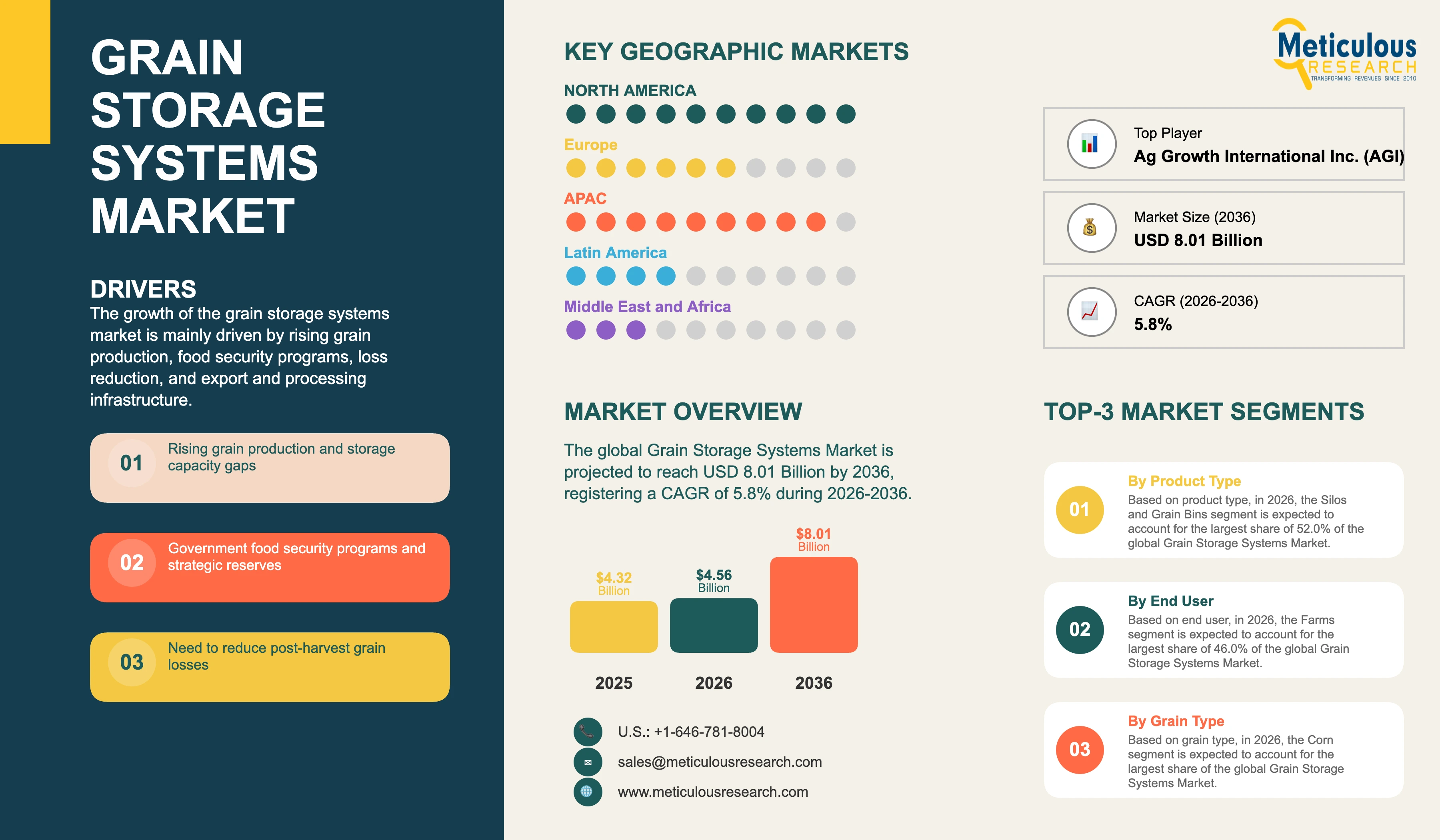
The global grain storage systems market was valued at USD 4.32 billion in 2025. This market is expected to reach USD 8.01 billion by 2036 from an estimated USD 4.56 billion in 2026, registering a CAGR of 5.8% during the forecast period (2026-2036).
- Published
- Nov 2026
- Pages
- 245
- Format
- PDF + Excel
- Report ID
- MRAGR - 1042584
- Base year
- 2025
- 2025 · BASELINE
- $4.32B
- 2036
- $8.01B
- CAGR 2026–2036
- 5.8%
2025 baseline · 2026–2036 forecast at 5.8% CAGR · hover a bar for the value
Key highlights
According to the U.S. Department of Agriculture's National Agricultural Statistics Service (NASS), U.S. on-farm grain storage capacity reached 13.6 billion bushels on December 1, 2025, up less than 1% from the previous year, while off-farm commercial storage capacity totaled 11.9 billion bushels across 7,844 facilities, and analysis by farmdoc daily at the University of Illinois found that on-farm capacity utilization reached a record 80% after the very large 2025 corn crop, highlighting the need for new storage investment.
Ag Growth International (AGI) reported 2025 revenue of CAD 1.42 billion, with Commercial segment revenue rising 34% on the back of large international projects, especially in Brazil, while Farm segment revenue declined 32% amid soft crop prices and trade uncertainty in North America, showing the contrast between international project demand and weaker North American farm spending.
India's Ministry of Cooperation reported that, as of July 2026, godown construction had been completed in 313 Primary Agricultural Credit Societies (PACS) under the World's Largest Grain Storage Plan in the Cooperative Sector, creating more than 1.80 lakh metric tonnes of storage capacity, with 1,012 cooperative societies identified for the plan and the Food Corporation of India (FCI) providing nine-year hiring assurance for eligible godowns.
According to the Press Information Bureau (PIB) of the Government of India, the total covered and cover-and-plinth storage capacity available with the FCI and state agencies for central pool foodgrains stood at 917.83 lakh metric tonnes as of July 1, 2025, while India had about 3 million tonnes of operational silo capacity across 48 locations, indicating a large opportunity to shift from traditional storage to modern silos.
Grain & Protein Technologies, which serves customers in more than 100 countries through brands including GSI, Cumberland, AP, Tecno, and Cimbria, launched the GSI Select IS 3i enclosed belt conveyor for high-capacity grain handling in February 2026, while the Grain Marketing Board in Zimbabwe started operations at the Mutare smart grain silo project in October 2025 as the second of 14 planned national storage sites.
By product type, silos and grain bins account for the largest share of 52.0% in 2026, while grain monitoring and smart management systems register the highest CAGR.
By end user, farms account for the largest share of 46.0% in 2026, while government and strategic reserve agencies register the highest CAGR.
By grain type, corn accounts for the largest share in 2026, while rice registers the highest CAGR.
By geography, North America accounts for the largest share of 32.0% in 2026, while Asia-Pacific registers the highest CAGR of 7.4%.
Report summary
| Particulars | Details |
|---|---|
| Base Year | 2025 |
| Estimated Year | 2026 |
| Forecast Period | 2026-2036 |
| Market Size in 2025 | USD 4.32 billion |
| Market Size in 2026 | USD 4.56 billion |
| Market Size by 2036 | USD 8.01 billion |
| CAGR (2026-2036) | 5.8% |
| Format | PDF, Excel & Cloud Portal · 245 pages |
| Largest Segment by Product Type (2026) | Silos and Grain Bins (52.0%) |
| Largest Segment by End User (2026) | Farms (46.0%) |
| Largest Region (2026) | North America (32.0%) |
| Fastest-Growing Region | Asia-Pacific (CAGR 7.4%) |
| Companies Profiled | 16 companies and other companies |
| Segments Covered | Product Type, End User, Grain Type, Geography |
| Countries Covered | U.S., Canada, China, India, Australia, Indonesia, Vietnam, Thailand, Philippines, Bangladesh, Pakistan, Japan, South Korea, Rest of Asia-Pacific, France, Germany, Ukraine, Poland, Romania, Spain, U.K., Hungary, Italy, Bulgaria, Russia, Rest of Europe, Brazil, Argentina, Mexico, Paraguay, Uruguay, Rest of Latin America, Saudi Arabia, Egypt, Morocco, Algeria, Turkey, Nigeria, Ethiopia, Kenya, South Africa, Rest of Middle East & Africa |
Report overview
Segments covered: product type, end user, grain type.
The growth of this market is mainly driven by rising global grain production and the need for adequate storage capacity, government programs to build modern grain storage and strategic reserves for food security, the need to reduce post-harvest losses caused by moisture, insects, rodents, and fungal growth, the replacement of traditional warehouses and bag storage with steel silos in developing countries, growing grain exports from South America, Eastern Europe, and other regions that require large commercial and port storage, increasing on-farm storage among farmers seeking marketing flexibility, and the adoption of grain conditioning, aeration, and smart monitoring technologies. However, factors such as the high capital cost of storage and handling systems, cyclical farm incomes and crop prices, rising steel prices, and safety risks associated with grain storage are expected to restrain the growth of this market to some extent.
Grain storage systems are structures and equipment used to store, preserve, and handle cereal grains, oilseeds, and pulses after harvest. They include steel silos and grain bins, such as flat-bottom silos, hopper silos, and corrugated farm bins, grain conditioning systems for drying, aeration, and cooling, grain handling and conveying equipment such as bucket elevators, chain and belt conveyors, augers, and spreaders, silo bags and hermetic storage solutions, and grain monitoring and smart management systems that measure temperature, moisture, carbon dioxide, and grain levels. This report covers grain storage systems across product types, end users, grain types, and regions, and it includes systems for farms, commercial grain handlers, processors, ports, and government and strategic reserve agencies. Traditional warehouses and general-purpose buildings are excluded. The market is measured on a revenue basis, based on sales of systems and equipment.
Grain storage is essential for food security and for the efficient functioning of grain markets. Grains are harvested once or twice a year but consumed throughout the year, and they must be stored safely for months or even years. Proper storage protects grain from moisture, insects, rodents, birds, and fungal growth, maintains quality and nutritional value, and allows farmers, traders, and governments to manage supply and prices. Poor storage is a major cause of post-harvest losses, especially in developing countries, where grain is often stored in bags, traditional structures, or open cover-and-plinth storage.
Silos and grain bins are the largest product type because they form the core of every storage facility, and corrugated galvanized steel silos and bins are the most common type of modern grain storage, offering large capacity, durability, and relatively low cost per tonne. Flat-bottom silos are used for large-volume, long-term storage, while hopper silos allow easier unloading and are used for shorter-term storage and processing. Concrete silos are used at some ports and large terminals. Grain conditioning systems, including dryers, aeration fans, and grain coolers, are essential to bring grain to safe moisture and temperature levels and maintain its condition during storage.
Grain handling and conveying equipment moves grain into and out of storage and between storage, processing, and transport. Silo bags, which are large plastic bags used to store grain in the field, are widely used in Argentina, Brazil, and other countries as a flexible, low-cost storage solution, while hermetic bags and containers are used by smallholder farmers in Africa and Asia. Grain monitoring and smart management systems use temperature cables, moisture sensors, carbon dioxide sensors, level sensors, and software to monitor grain condition remotely and automate aeration and drying.
The main end users are farms, which install on-farm storage to gain marketing flexibility and handle harvest peaks, commercial grain handlers, processors, and ports, which operate elevators, terminals, and processing plants, and government and strategic reserve agencies, which store grain for food security programs and emergency reserves. Corn is the largest grain type by storage demand, followed by wheat, rice, soybeans and other oilseeds, and other grains.
The structure of grain storage differs widely between regions, which affects the mix of products sold in each market. In the U.S., Canada, and Australia, a large share of capacity is located on farms, while in Brazil, Russia, and many developing countries most storage is commercial or government-owned. In India, government agencies store very large volumes of wheat and rice for the public distribution system, mostly in conventional warehouses and cover-and-plinth storage, which creates a large opportunity for modernization.
The market includes global grain storage and handling companies, regional silo manufacturers, conditioning and monitoring specialists, and storage bag manufacturers. Leading companies include AGI, Grain & Protein Technologies (GSI), CTB (Brock), Sukup Manufacturing, Behlen, Sioux Steel, Chief Agri/Industrial, SCAFCO, Symaga, Silos Córdoba, Prado Silos, Kepler Weber, Bühler, FAMSUN, Ipesa, and GrainPro.
Over the forecast period, the grain storage systems market is expected to grow steadily, supported by rising grain production, food security investments, replacement of traditional storage, export infrastructure, and adoption of smart monitoring. Asia-Pacific is expected to be the fastest-growing region, supported by large government programs in India, China, and Southeast Asia, while North America remains the largest region.
North America is expected to account for the largest share of 32.0% of the market in 2026, mainly due to very large grain production, the largest on-farm and commercial storage capacity in the world, and the presence of leading manufacturers.
Asia-Pacific is projected to register the highest CAGR of 7.4% during the forecast period, driven by government programs to modernize grain storage in India and China, rice storage investments, and growing grain processing and imports.
The report profiles 16 companies, including AGI, Grain & Protein Technologies (GSI), CTB (Brock), Sukup, Behlen, Sioux Steel, Chief Agri/Industrial, SCAFCO, Symaga, Silos Córdoba, Prado Silos, Kepler Weber, Bühler, FAMSUN, Ipesa, and GrainPro.
Report infographic
Market dynamics
18 factors across 5 forcesRising grain production and storage capacity gaps
Global grain production continues to grow, supported by higher yields, expanded planted areas in some regions, and growing demand for food, animal feed, and biofuels. Record crops in the U.S., Brazil, India, and other countries have increased the need for storage capacity, and in many regions storage capacity has not kept pace with production. In the U.S., NASS data show that on-farm storage capacity was 13.6 billion bushels and off-farm capacity was 11.9 billion bushels on December 1, 2025, both up less than 1% from a year earlier, while the 2025 corn crop was a record. Farmdoc daily found that on-farm capacity utilization reached a record 80%, and that growth in U.S. grain storage capacity had largely stopped in recent years.
In India, foodgrain production reached a record 353.96 million tonnes in 2024-25, according to the PIB, and storage capacity remains below total production, with a large share of government storage still in conventional warehouses and cover-and-plinth storage. Brazil's grain production has grown much faster than its storage capacity, leaving a significant storage gap and creating demand for both farm and commercial storage.
Storage gaps lead to grain being stored in temporary piles, bags, or open areas, which increases losses and quality problems, and they force farmers to sell at harvest when prices are lowest. Closing these gaps is a major source of demand for grain storage systems.
Government food security programs and strategic reserves
Governments in many countries are investing in modern grain storage to strengthen food security, build strategic reserves, and reduce losses. India's World's Largest Grain Storage Plan in the Cooperative Sector aims to create decentralized storage at the level of Primary Agricultural Credit Societies, and, as of July 2026, godowns had been completed in 313 societies with more than 1.80 lakh metric tonnes of capacity, according to the Ministry of Cooperation. India is also expanding its network of modern steel silos under public-private partnership models.
Countries in the Middle East, North Africa, and sub-Saharan Africa, which rely heavily on grain imports, are building strategic grain reserves and modern storage to reduce vulnerability to supply disruptions and price spikes. Zimbabwe's Grain Marketing Board, for example, started operations at the Mutare smart grain silo project in October 2025 as part of 14 planned national storage sites, and Bangladesh has completed steel silo projects for wheat storage. China continues to invest in modern grain reserve facilities and storage technologies.
Recent global disruptions to grain trade and prices have reinforced the importance of food security, encouraging more governments to invest in strategic reserves and storage infrastructure.
Need to reduce post-harvest grain losses
Post-harvest losses of grain remain high in many developing countries, caused by poor drying, inadequate storage, insect infestation, rodents, and mold. The FAO estimates that 13.3% of food produced globally was lost between harvest and retail in 2023, and losses of cereals and pulses during storage can be significant where grain is stored in bags, traditional structures, or open storage. Modern silos, conditioning systems, and hermetic storage greatly reduce these losses, protect grain quality, and reduce the need for chemical fumigation.
Mycotoxin contamination caused by fungal growth in poorly stored grain is a serious food safety concern, and buyers and regulators increasingly require grain to meet strict quality standards, which encourages investment in proper drying, aeration, and monitoring.
Growing grain exports and commercial infrastructure
Grain exports from Brazil, Argentina, Ukraine, Russia, Australia, Canada, and the U.S. require large commercial storage and handling infrastructure at inland elevators, processing plants, and ports. Brazil in particular has invested heavily in grain storage and logistics as its soybean and corn exports have grown, and companies such as AGI and Kepler Weber have benefited from large Brazilian projects. AGI reported that its Commercial segment revenue rose 34% in 2025, driven mainly by international projects, especially in Brazil.
Investment in grain processing, such as ethanol plants, feed mills, flour mills, and oilseed crushing plants, also creates demand for storage and handling systems, as processors need to store raw materials and maintain steady supplies.
Adoption of on-farm storage and smart grain management
Farmers increasingly invest in on-farm storage to gain marketing flexibility, handle harvest peaks, reduce delays at commercial elevators, and capture better prices by selling later in the season. On-farm storage is especially important in North America, Europe, Australia, and Argentina. At the same time, farmers and commercial operators are adopting smart grain management systems that monitor grain temperature and moisture and automate aeration and drying, which reduces spoilage, energy costs, and labor, and improves safety by reducing the need to enter bins.
Table of contents
11 chapters · 162 sections · 245 pages · click to expandSegmental analysis
| Segment | Largest share (2026) | Fastest growth (2026–2036) |
|---|---|---|
| By Product Type | Silos and grain bins | Grain monitoring and smart management systems |
| By End User | Farms | Government and strategic reserve agencies |
| By Grain Type | Corn | Rice |
| Other segments | Corn | Rice |
By Product Type
- Grain Storage Systems Market Analysis by Product Type
- The silos and grain bins segment is expected to account for the largest share of 52.0% of the global grain storage systems market.
- The large share of this segment is mainly due to the central role of silos and bins in grain storage, the high value of steel structures compared with other components, demand for new storage capacity from farms, commercial handlers, and governments, the replacement of traditional storage with modern steel silos in developing countries, and large commercial and port projects in South America, Eastern Europe, Africa, and Asia.
- Silos and bins include corrugated farm bins, flat-bottom silos, hopper silos, and large commercial silos.
- Steel silos dominate this segment due to their durability, relatively low cost per tonne, ease of construction, and ability to be combined with aeration and monitoring systems.
- Flat-bottom silos are preferred for large, long-term storage, while hopper silos are used where frequent unloading is needed.
- Leading manufacturers continue to introduce larger and stronger silos and improved sealing to meet the needs of large farms and commercial operators.
- Demand for silos and bins varies significantly by region and by type of customer.
- In North America, demand comes mainly from replacement and expansion of farm bins and commercial elevators, and it fluctuates with farm incomes.
- In Brazil, Africa, the Middle East, and Asia, demand comes mainly from new commercial, port, and government projects, which are larger and less dependent on farm cycles.
- Leading manufacturers are therefore expanding their international businesses to balance cyclical demand in North America.
- Aging infrastructure is another important source of demand in developed markets, since many farm bins and commercial elevators in North America and Europe were built several decades ago, and replacing or upgrading them with larger, safer, and more efficient structures will provide steady demand over the forecast period.
- However, the grain monitoring and smart management systems segment is projected to register the highest CAGR during the forecast period.
- The rapid growth of this segment is driven by the need to reduce spoilage and energy costs, the shortage of farm labor, safety concerns, the availability of wireless sensors and cloud-based software, and the ability to retrofit monitoring systems to the large installed base of bins and silos.
- Grain conditioning systems form the second-largest segment, supported by drying and aeration needs for corn, rice, and other high-moisture crops, while grain handling and conveying equipment and silo bags and hermetic storage account for the remaining share.
By End User
- Grain Storage Systems Market Analysis by End User
- The farms segment is expected to account for the largest share of 46.0% of the global grain storage systems market.
- The large share of this segment is mainly due to the large on-farm storage capacity in North America, Europe, Australia, Argentina, and Brazil, farmers' need to handle harvest peaks and gain marketing flexibility, the replacement and expansion of aging farm bins, and the wide range of farm storage, drying, and handling products offered by manufacturers.
- In the U.S., on-farm storage capacity of 13.6 billion bushels exceeds off-farm commercial capacity, according to NASS.
- Farm demand for storage is cyclical and depends on crop prices, farm incomes, and interest rates, but over the long term, larger farms, bigger harvests, and the value of marketing flexibility support continued investment.
- On-farm storage is also growing in Brazil, where farmers have historically relied on commercial storage but are increasingly investing in their own facilities, supported by government credit programs for farm storage.
- However, the government and strategic reserve agencies segment is projected to register the highest CAGR during the forecast period.
- The rapid growth of this segment is driven by food security concerns, government programs to modernize storage and build strategic reserves in India, China, the Middle East, Africa, and Southeast Asia, and public-private partnership models that finance large silo projects.
- Commercial grain handlers, processors, and ports account for a large share, supported by export infrastructure and processing investments.
- Commercial grain handlers and cooperatives operate inland elevators that receive grain from farmers, while processors such as flour mills, feed mills, ethanol plants, and oilseed crushers need storage to maintain steady supplies, and port terminals require large storage and high-capacity handling for export and import.
- Investment in these facilities is strongly linked to grain trade flows and processing capacity, and it is growing strongly in Brazil, Eastern Europe, Africa, and Asia over the forecast period.
By Grain Type
- Grain Storage Systems Market Analysis by Grain Type
- The corn segment is expected to account for the largest share of the global grain storage systems market.
- The large share of this segment is mainly due to the very large global production of corn, which is the world's largest grain crop by volume, its storage and drying requirements, which are higher than those of many other grains because corn is often harvested at high moisture, and the large storage investments in the U.S., Brazil, Argentina, Ukraine, and China, which are major corn producers.
- Corn is used for food, animal feed, and ethanol, which require large storage and handling capacity.
- The record 2025 U.S. corn crop of more than 17 billion bushels and growing corn production in Brazil, where second-crop corn has expanded rapidly, have increased demand for corn storage and drying capacity.
- However, the rice segment is projected to register the highest CAGR during the forecast period.
- The rapid growth of this segment is driven by government investment in modern rice storage in India, Southeast Asia, Bangladesh, and Africa, the replacement of traditional rice storage with silos and hermetic storage, and growing rice procurement for food security programs.
- Wheat accounts for a large share of the market, supported by storage in Europe, Russia, Ukraine, India, Australia, and North America, while soybeans and other oilseeds and other grains account for the remaining share.
- Storage requirements differ by grain type, which influences equipment choices across the market.
- Corn and rice often need drying before storage, wheat is usually harvested at lower moisture, and oilseeds such as soybeans and canola require careful aeration to avoid heating and quality loss.
- These differences affect the mix of silos, conditioning equipment, and monitoring systems used for each grain, and leading manufacturers offer specific products, designs, and control settings for different crops and climates.
Other segments
- The corn segment is expected to account for the largest share of the grain storage systems market, while the rice segment is projected to register the highest CAGR during the forecast period.
Geographic analysis
North America
Largest shareIn 2026, North America is expected to account for the largest share of 32.0% of the global grain storage systems market. The large share of this region is mainly due to very large grain production in the U.S. and Canada, the largest on-farm and commercial storage capacity in the world, continued replacement and expansion of farm bins and commercial elevators, wide adoption of grain conditioning and smart monitoring systems, and the presence of leading manufacturers such as AGI, Grain & Protein Technologies, CTB, Sukup, Behlen, Sioux Steel, Chief, and SCAFCO. According to NASS, U.S. on-farm capacity was 13.6 billion bushels and off-farm capacity was 11.9 billion bushels on December 1, 2025. However, farm demand weakened in 2025 due to soft crop prices and trade uncertainty. The U.S. is the largest market in the region, followed by Canada. Mexico, Paraguay, and Uruguay are also important markets.
Asia-Pacific
Fastest growthAsia-Pacific is projected to register the highest CAGR of 7.4% during the forecast period. The rapid growth of this region is mainly driven by large government programs to modernize grain storage in India and China, India's cooperative grain storage plan and expansion of steel silos, investment in rice storage in Southeast Asia and Bangladesh, growing grain processing, and rising imports of grain that require port and commercial storage. China, India, Indonesia, Vietnam, Thailand, the Philippines, Bangladesh, Pakistan, and Australia are important markets, and Australia has a large export-oriented grain storage and handling industry.
Europe
Europe accounts for a significant share of the market, supported by large grain production in France, Germany, Poland, Romania, Spain, and the U.K., replacement of older storage, and investment in grain storage and export infrastructure in Ukraine and other Eastern European countries. Leading European manufacturers such as Symaga, Silos Córdoba, Prado Silos, and Bühler serve both European and international markets. Hungary, Italy, and Bulgaria are also important markets.
Latin America
Latin America accounts for a significant share of the market, supported by rapid growth in grain production and exports from Brazil and Argentina, a large storage gap in Brazil, investment in farm and commercial storage, and the wide use of silo bags in Argentina.
Middle East & Africa
The Middle East & Africa accounts for a smaller share, but it is growing, supported by strategic grain reserves and port storage in Saudi Arabia, Egypt, Morocco, Algeria, and Turkey, and modern storage projects and hermetic storage in Nigeria, Ethiopia, Kenya, Zimbabwe, and South Africa.
Competitive landscape
The global grain storage systems market is moderately fragmented, with the top five players estimated to account for about 30% of the market in 2025. The market includes global grain storage and handling companies, regional silo manufacturers, grain conditioning and monitoring specialists, processing equipment companies that supply storage as part of turnkey projects, and storage bag manufacturers.
AGI is one of the largest companies in the market, with farm and commercial storage, handling, conditioning, and grain management products, and it reported 2025 revenue of CAD 1.42 billion. Grain & Protein Technologies, which owns the GSI, Cumberland, AP, Tecno, and Cimbria brands, is a global leader in grain storage, conditioning, handling, and smart grain management, and CTB's Brock brand is another major U.S. supplier. Sukup Manufacturing, Behlen, Sioux Steel, Chief Agri/Industrial, and SCAFCO are important North American manufacturers.
In Europe, Symaga, Silos Córdoba, and Prado Silos are leading silo manufacturers with strong export businesses in Africa, the Middle East, Latin America, and Asia, and Bühler supplies large storage and handling projects as part of its grain processing solutions. Kepler Weber is the leading grain storage company in Brazil, and FAMSUN is a major Chinese supplier of grain storage and processing projects. Ipesa supplies silo bags in Argentina and other markets, and GrainPro supplies hermetic storage solutions.
Companies compete on product quality and durability, capacity range, price, engineering and project management capabilities, dealer networks, after-sales service, integration of conditioning and monitoring systems, and financing support. Key strategies include product launches of larger silos, high-capacity handling equipment, and smart monitoring systems, expansion in international markets, especially Brazil, Africa, the Middle East, and Asia, and partnerships with governments and project developers.
Competition from low-cost regional manufacturers, especially from Turkey and China, is increasing in export markets, which puts pressure on prices for standard silos and encourages leading companies to differentiate through technology, engineering, and service.
Dealer networks remain very important in the farm segment, since farmers rely on local dealers for design, installation, and service.
We expect continued consolidation, as larger companies acquire regional manufacturers and technology providers to broaden their product portfolios and geographic reach.
Some of the key players operating in the grain storage systems market are Ag Growth International Inc. (AGI), Grain & Protein Technologies (GSI), CTB, Inc. (Brock), Sukup Manufacturing Co., Behlen Mfg. Co., Sioux Steel Company, Chief Agri/Industrial, SCAFCO Grain Systems Co., Symaga S.A., Silos Córdoba, Prado Silos, Kepler Weber S.A., Bühler AG, FAMSUN, Ipesa, and GrainPro, Inc., among others.
- —
AGI reported 2025 Commercial segment revenue growth of 34% on international projects, GSI launched the Select IS 3i enclosed belt conveyor in February 2026, India's cooperative grain storage plan reached 1.80 lakh metric tonnes of completed capacity by July 2026, and Zimbabwe opened the Mutare smart grain silo in October 2025.
- Grain & Protein Technologies (GSI)
- CTB, Inc. · Brock
- Sukup Manufacturing Co.
- Behlen Mfg. Co.
- Sioux Steel Company
- Chief Agri/Industrial
- SCAFCO Grain Systems Co.
- Symaga S.A.
- Silos Córdoba
- Prado Silos
- Kepler Weber S.A.
- Bühler AG
- FAMSUN
- Ipesa
- GrainPro, Inc.
Expert perspectives
Grain storage is fundamental infrastructure for food security, and demand for grain storage systems is supported by long-term growth in grain production, government food security programs, and the need to reduce losses. The market is cyclical in developed countries, where farm investment depends on crop prices, but structural growth in developing countries provides a strong long-term foundation.
Over the forecast period, the market is expected to grow at a CAGR of 5.8%, from USD 4.56 billion in 2026 to USD 8.01 billion in 2036. Growth will be supported by rising grain production, government programs and strategic reserves, loss reduction, export and processing infrastructure, on-farm storage, and smart monitoring.
Silos and grain bins remain the largest product type, while grain monitoring and smart management systems grow fastest. Farms are the largest end user, while government and strategic reserve agencies grow fastest. Corn is the largest grain type, while rice grows fastest. North America is the largest region, and Asia-Pacific is the fastest-growing region at a CAGR of 7.4%.
In our view, the grain storage systems market is going through a period of contrasting regional conditions. In North America, farm demand was weak in 2025 due to soft crop prices and trade uncertainty, but record crops and very high storage utilization point to a need for new capacity once farm incomes recover. In Brazil, India, Africa, and other emerging markets, structural storage gaps and government programs support strong project demand.
Smart monitoring and automation will become increasingly important for all types of customers, since they help operators reduce spoilage, energy use, and labor, and improve safety. We expect these technologies to become standard in new installations and to be widely retrofitted to existing storage.
For manufacturers, success will depend on balancing exposure to cyclical farm markets with international project business, managing steel costs, and executing large projects efficiently. Companies with strong engineering, dealer networks, and digital offerings are best positioned.
We also expect leading manufacturers to focus more on aftermarket parts, service, retrofits, and upgrades, which provide more stable and higher-margin revenue than new equipment sales.
Finally, we believe that government-led storage programs in India and other countries will create one of the largest opportunities for grain storage systems over the next decade, especially for steel silos, mechanized handling, and monitoring systems.
Overall, we expect the grain storage systems market to grow at a steady pace over the forecast period, with strong project demand in emerging markets offsetting slower and more cyclical farm demand in developed regions.
Customer perspectives
Corn and Soybean Farmer - Iowa, U.S.
After the record crop, our bins were full and the elevator was backed up. We are planning another bin with a monitoring system so that we can store longer and sell when prices improve.
“We are moving more of our wheat and rice into steel silos and cooperative godowns, because conventional storage leads to higher losses and handling costs.”
“Storage capacity has not kept up with production, so we are building large silo complexes with high-capacity handling for export corridors.”
Frequently asked questions
The global grain storage systems market was valued at USD 4.32 billion in 2025, up from USD 4.18 billion in 2024, and is estimated at USD 4.56 billion in 2026. The market includes silos and grain bins, grain conditioning systems, grain handling and conveying equipment, silo bags and hermetic storage, and grain monitoring and smart management systems.
Cite this report
Meticulous Research. (2026). Grain Storage Systems Market - Global Opportunity Analysis and Industry Forecast (2026-2036) (Report No. MRAGR - 1042584). Meticulous Market Research Pvt. Ltd. https://www.meticulousresearch.com/product/grain-storage-systems-market-7267