Post-Harvest Loss Solutions Market (2026-2036)
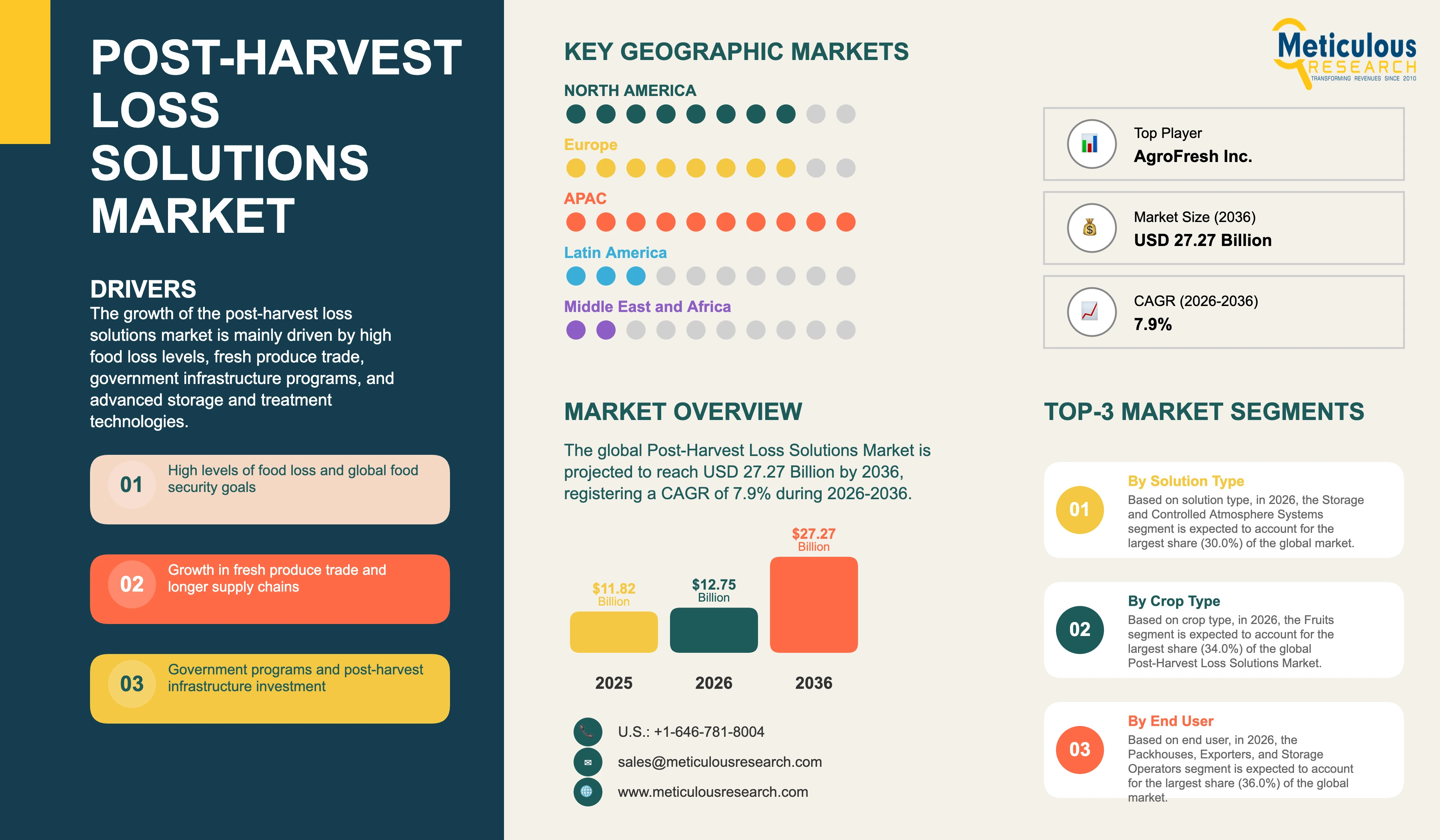
The global post-harvest loss solutions market was valued at USD 11.82 billion in 2025. This market is expected to reach USD 27.27 billion by 2036 from an estimated USD 12.75 billion in 2026, registering a CAGR of 7.9% during the forecast period (2026-2036).
- Published
- Nov 2026
- Pages
- 278
- Format
- PDF + Excel
- Report ID
- MRAGR - 1042566
- Base year
- 2025
- 2025 · BASELINE
- $11.82B
- 2036
- $27.27B
- CAGR 2026–2036
- 7.9%
2025 baseline · 2026–2036 forecast at 7.9% CAGR · hover a bar for the value
Key highlights
According to the FAO, the share of food lost globally after harvest on farms and during transport, storage, wholesale, and processing was 13.3% in 2023, up slightly from 13.0% in 2015 when global monitoring began, with losses of 23.0% in sub-Saharan Africa and 10.0% in Northern America and Europe, showing that progress toward the United Nations Sustainable Development Goal target 12.3 remains slow.
AgroFresh, a global provider of post-harvest freshness solutions, showcased SmartFresh Sheets at Fruit Attraction 2026 in Madrid in October 2026, a new application format for its 1-MCP ethylene management technology that was shortlisted for the event's innovation awards, and it also presented the Harvista Intelligence Dashboard developed with Aerobotics to support harvest and storage decisions.
AgroFresh announced a 6% global price adjustment and a temporary 3% energy and logistics surcharge effective March 31, 2026, citing rising global energy costs and supply chain disruptions, which shows how input and logistics costs affect suppliers of post-harvest treatments.
Apeel Sciences, the developer of plant-based edible coatings for fresh produce, reported in mid-2026 that it had cut application costs significantly through automated packhouse application systems and was preparing new post-harvest products, including Zero MI, a treatment designed to reduce fungal decay in citrus and avocados, as part of its shift toward suppliers and international markets.
According to the Press Information Bureau (PIB) of the Government of India, India had 8,815 cold storages with a combined capacity of 40.22 million tonnes as of June 30, 2025, while an ASSOCHAM report in 2026 estimated India's annual post-harvest losses at about USD 18.5 billion, highlighting the large opportunity for storage, handling, and preservation solutions in Asia-Pacific.
In Nigeria, ColdHubs and the Foundation for Partnership Initiatives in the Niger Delta (PIND) commissioned a solar-powered cold storage and ice-making facility in Bayelsa State on June 30, 2026, powered by a 44 kWp solar system with 240 kWh of battery storage, an example of the pay-per-use, off-grid post-harvest solutions spreading across Africa.
By solution type, storage and controlled atmosphere systems account for the largest share of 30.0% in 2026, while monitoring and digital quality solutions register the highest CAGR.
By crop type, fruits account for the largest share of 34.0% in 2026, while vegetables register the highest CAGR.
By end user, packhouses, exporters, and storage operators account for the largest share in 2026, while farmers and cooperatives register the highest CAGR.
By geography, Asia-Pacific accounts for the largest share of 33.0% in 2026, while Asia-Pacific registers the highest CAGR of 9.4%.
Report summary
| Particulars | Details |
|---|---|
| Forecast Period | 2026-2036 |
| Base Year | 2025 |
| Estimated Year | 2026 |
| CAGR (Value) | 7.9% |
| Format | PDF, Excel & Cloud Portal · 278 pages |
| Market Size in 2025 | USD 11.82 billion |
| Market Size in 2026 | USD 12.75 billion |
| Market Size by 2036 | USD 27.27 billion |
| Largest Segment by Solution Type (2026) | Storage and Controlled Atmosphere Systems (30.0%) |
| Largest Segment by Crop Type (2026) | Fruits (34.0%) |
| Largest Region (2026) | Asia-Pacific (33.0%) |
| Fastest-Growing Region | Asia-Pacific (CAGR 9.4%) |
| Segments Covered | Solution Type, Crop Type, End User, Geography |
| Countries Covered | China, India, Japan, South Korea, Australia, New Zealand, Indonesia, Thailand, Vietnam, Philippines, Pakistan, Bangladesh, Rest of Asia-Pacific, U.S., Canada, Spain, Italy, France, Netherlands, Germany, Poland, Belgium, U.K., Greece, Portugal, Rest of Europe, Mexico, Peru, Chile, Brazil, Colombia, Ecuador, Argentina, Rest of Latin America, South Africa, Kenya, Morocco, Egypt, Nigeria, Ethiopia, Turkey, Saudi Arabia, U.A.E., Rest of Middle East & Africa |
| Key Companies | 14 companies and other companies |
Report overview
Segments covered: solution type, crop type, end user.
The growth of this market is mainly driven by the high level of food lost between harvest and retail, which the Food and Agriculture Organization (FAO) estimates at 13.3% of global food production, growing pressure on governments and food companies to meet the United Nations target of reducing food loss, rising exports of fresh fruits and vegetables that require longer storage and transit life, strong adoption of ethylene management, controlled atmosphere storage, and edible coatings by packhouses and exporters, government programs that fund storage and post-harvest infrastructure in India, Africa, and other developing regions, the spread of low-cost hermetic storage and solar-powered cooling for smallholder farmers, and the growing use of sensors, analytics, and digital quality tools across fresh produce supply chains. However, factors such as the high upfront cost of storage and handling infrastructure, limited access to finance and electricity among smallholder farmers, regulatory restrictions on post-harvest chemicals, and fragmented supply chains in developing countries are expected to restrain the growth of this market to some extent.
Post-harvest loss refers to the reduction in the quantity or quality of food between harvest and the point at which it reaches retail. Losses occur during harvesting, threshing, drying, sorting, packing, storage, transport, and wholesale handling, and they are caused by physical damage, moisture, temperature, pests, rodents, fungal and bacterial decay, ripening and senescence, and poor handling. Post-harvest loss solutions are the products, systems, and services used to prevent or reduce these losses. This report covers storage and controlled atmosphere systems, post-harvest treatments and coatings, protective and modified atmosphere packaging, drying, sorting, and handling equipment, and monitoring and digital quality solutions, across crop types, end users, and regions. Large-scale grain silos, general refrigerated warehousing, and cold chain transport services are analyzed in separate reports and are included here only where they are sold as post-harvest solutions at farm, aggregation, and packhouse level. The market is measured on a revenue basis.
Food loss remains a large global problem that affects food security, farm incomes, and the environment, and the FAO estimates that 13.3% of food produced was lost between harvest and retail in 2023, with fruits and vegetables showing the highest losses among food groups, and the FAO has also estimated the value of food lost each year at about USD 400 billion. Losses are highest in sub-Saharan Africa, least developed countries, and small island developing states, where storage, cooling, drying, and transport infrastructure is limited, but they are also significant in developed countries, especially for perishable produce that must travel long distances to reach consumers. Reducing these losses improves food security, raises farmer incomes, reduces greenhouse gas emissions, and makes better use of land, water, and energy.
Storage and controlled atmosphere systems form the largest part of the market. These include controlled atmosphere and dynamic controlled atmosphere storage rooms, which reduce oxygen and control carbon dioxide to slow ripening, ethylene scrubbers, pre-cooling systems, on-farm and packhouse cold rooms, solar-powered cold rooms, and improved storage structures for crops such as potatoes, onions, and grains. Controlled atmosphere storage is widely used for apples and pears in North America, Europe, and China, allowing fruit to be stored for many months and sold throughout the year.
Post-harvest treatments and coatings include fungicides and biological treatments applied in packhouses, sprout inhibitors for potatoes, ethylene action inhibitors such as 1-methylcyclopropene (1-MCP), waxes, and edible coatings that reduce water loss and slow ripening. AgroFresh's SmartFresh, which uses 1-MCP to block the ripening effect of ethylene in climacteric fruit, is one of the most widely used post-harvest technologies, while companies such as Apeel Sciences have introduced plant-based edible coatings, and Hazel Technologies offers ethylene-control sachets and packaging solutions.
Protective and modified atmosphere packaging includes hermetic storage bags for grains and pulses, which cut off oxygen and kill insects without chemicals, crates and liners that reduce physical damage, and modified atmosphere packaging that controls the gas composition around fresh produce during storage and transport. Drying, sorting, and handling equipment includes grain and produce dryers, solar dryers, threshers, cleaning and grading machines, optical sorters, and packhouse lines that remove damaged produce before it spoils good produce. Monitoring and digital quality solutions include temperature and humidity sensors, gas sensors, storage monitoring software, ripeness and quality scanners, and analytics platforms that help operators make better decisions about storage, ripening, and sales timing.
The main end users are packhouses, exporters, and storage operators, which handle large volumes of fruits, vegetables, and other crops and invest in storage systems, treatments, and packhouse equipment; farmers and cooperatives, which use on-farm storage, drying equipment, hermetic bags, and shared cold rooms; retailers and distributors, which use coatings, ripening control, and monitoring to reduce shrink; and food processors, which need consistent raw material quality.
The market includes post-harvest treatment companies, storage and controlled atmosphere technology providers, packaging and hermetic storage companies, sorting and processing equipment manufacturers, cold chain monitoring companies, and off-grid cooling providers. Leading companies include AgroFresh, Apeel Sciences, Hazel Technologies, UPL (Decco), JBT Marel, Syngenta, Isolcell, Van Amerongen, Storage Control Systems, GrainPro, Ecozen, TOMRA, Bühler, and Sensitech.
Over the forecast period, the post-harvest loss solutions market is expected to grow steadily, supported by food security goals, growing fresh produce trade, government investment in storage infrastructure, climate pressures that make storage and drying more difficult, and new technologies such as digital quality monitoring, biological treatments, and solar-powered cooling. Asia-Pacific is expected to remain the largest and fastest-growing region, supported by large agricultural production in China and India and strong government programs.
Asia-Pacific is expected to account for the largest share of 33.0% of the market in 2026, mainly due to very large agricultural production in China and India, high post-harvest losses, and strong government programs for storage and post-harvest infrastructure.
Asia-Pacific is also projected to register the highest CAGR of 9.4% during the forecast period, driven by government investment, growing horticulture exports, and rising adoption of storage, treatment, and monitoring solutions.
The report profiles 14 leading companies, including AgroFresh, Apeel Sciences, Hazel Technologies, UPL (Decco), JBT Marel, Syngenta, Isolcell, Van Amerongen, Storage Control Systems, GrainPro, Ecozen, TOMRA, Bühler, and Sensitech.
Report infographic
Market dynamics
18 factors across 5 forcesHigh levels of food loss and global food security goals
Food loss between harvest and retail remains high despite years of attention. According to the FAO, the share of food lost after harvest was 13.3% in 2023, slightly higher than the 13.0% recorded in 2015, and losses reached 23.0% in sub-Saharan Africa and 19.9% in least developed countries. The United Nations Sustainable Development Goal target 12.3 calls for reducing food losses along production and supply chains, including post-harvest losses, by 2030, and many governments, development agencies, and food companies have adopted their own targets in line with this goal. The African Union has also committed to halving post-harvest losses on the continent.
These goals are increasingly backed by funding programs, development finance, and corporate commitments, which support investment in storage, drying, cooling, packaging, and training. Food security concerns have also increased after recent disruptions to global food trade and prices, encouraging countries to reduce losses as a way to increase available food supply without expanding farmland.
Food loss also has a significant environmental impact, since the land, water, energy, and inputs used to grow lost food are wasted, and the FAO and UNEP estimate that food loss and waste account for about 8% to 10% of global greenhouse gas emissions, and reducing losses is increasingly seen as a climate action. This link to climate goals is attracting additional funding from climate finance programs and sustainability-focused investors.
Growth in fresh produce trade and longer supply chains
Global trade in fresh fruits and vegetables has grown steadily, as consumers in developed and emerging markets demand year-round availability of fresh produce, and as exporting countries in Latin America, Africa, and Asia expand production of high-value crops such as avocados, berries, grapes, citrus, cherries, and bananas. Longer supply chains, including sea freight over several weeks, require produce to stay fresh for longer, which increases demand for ethylene management, coatings, controlled atmosphere storage, modified atmosphere packaging, and temperature monitoring.
Exporters must also meet strict quality standards from importing countries and retailers, and losses during transit can turn a profitable shipment into a loss. Packhouses and exporters therefore invest heavily in post-harvest technologies that protect quality and reduce rejections. Retailers also pressure suppliers to reduce shrink and food waste, which further supports adoption.
The shift from air freight to sea freight for some perishable products, driven by cost and sustainability goals, is another important factor, since sea freight requires longer storage life and more effective post-harvest treatments and packaging.
Government programs and investment in post-harvest infrastructure
Governments in many countries are investing in storage, cold chain, drying, and processing infrastructure to reduce post-harvest losses and support farmer incomes. India has several programs, including the Agriculture Infrastructure Fund, the Pradhan Mantri Kisan SAMPADA Yojana, and the Mission for Integrated Development of Horticulture, which provide financing and subsidies for cold storages, pack houses, ripening chambers, and warehouses. According to the PIB, India had 8,815 cold storages with a combined capacity of 40.22 million tonnes as of June 2025.
In Africa, governments, development banks, and donor programs support hermetic storage, solar-powered cooling, drying, and aggregation centers, and organizations such as PIND are partnering with companies such as ColdHubs to build solar-powered cold storage in local markets. China continues to invest in rural cold chain and storage infrastructure as part of its rural revitalization policies, and Latin American countries are supporting post-harvest infrastructure for export crops.
Adoption of advanced treatments, coatings, and controlled atmosphere technologies
Packhouses and exporters are increasingly adopting advanced post-harvest technologies that extend storage and shelf life. Ethylene management technologies such as 1-MCP are widely used in apples, pears, and other fruits, and new application formats, such as AgroFresh's SmartFresh Sheets showcased at Fruit Attraction 2026, make these technologies easier to use in smaller lots and in transit. Dynamic controlled atmosphere storage, which adjusts oxygen levels based on the fruit's response, allows longer storage with less use of chemicals.
Edible coatings, biological treatments, and residue-free solutions are also growing, as retailers and consumers push for fewer synthetic chemical residues, and as regulators restrict some traditional post-harvest fungicides. Companies such as Apeel Sciences, Hazel Technologies, and AgroFresh continue to develop new products, while biological control companies develop microbial treatments for post-harvest decay.
Rising use of digital monitoring and data-driven storage management
Sensors, connected monitoring systems, and analytics platforms are helping storage operators, packhouses, exporters, and retailers track temperature, humidity, gas levels, ripeness, and quality in real time. These tools allow operators to detect problems early, adjust storage conditions, plan sales and shipments based on remaining storage life, and reduce losses. AgroFresh's FreshCloud platform and its Harvista Intelligence Dashboard developed with Aerobotics, and Apeel's RipeTrack platform, are examples of digital tools that combine data and analytics with post-harvest treatments. The falling cost of sensors and connectivity is making these tools available to smaller operators as well.
Table of contents
11 chapters · 171 sections · 278 pages · click to expandSegmental analysis
| Segment | Largest share (2026) | Fastest growth (2026–2036) |
|---|---|---|
| By Solution Type | Packhouses, exporters, and storage operators | Farmers and cooperatives |
By Solution Type
- The packhouses, exporters, and storage operators segment is expected to account for the largest share of the post-harvest loss solutions market, while the farmers and cooperatives segment is projected to register the highest CAGR during the forecast period.
Geographic analysis
Asia-Pacific
Largest shareIn 2026, Asia-Pacific is expected to account for the largest share of 33.0% of the global post-harvest loss solutions market. Asia-Pacific is also projected to register the highest CAGR of 9.4% during the forecast period. The large share and rapid growth of this region are mainly driven by very large agricultural production in China and India, high post-harvest losses, strong government programs that fund storage, cold chain, and post-harvest infrastructure, growing horticulture exports from China, Vietnam, Thailand, the Philippines, and Australia, and rising use of controlled atmosphere storage and post-harvest treatments. According to the PIB, India had 8,815 cold storages with 40.22 million tonnes of capacity as of June 2025, and an ASSOCHAM report estimated India's annual post-harvest losses at about USD 18.5 billion. Indonesia, Japan, South Korea, Pakistan, Bangladesh, and New Zealand are also important markets, with growing use of hermetic storage, drying equipment, and packhouse technologies.
North America
North America accounts for a significant share of the market, supported by large production and long-term storage of apples, pears, potatoes, and other crops, wide use of controlled atmosphere storage, 1-MCP, fungicides, and coatings, strong presence of post-harvest technology companies such as AgroFresh, Apeel Sciences, and Hazel Technologies, and large imports of fresh produce from Latin America that require post-harvest protection. The U.S. is the largest market in the region, followed by Canada.
Europe
Europe accounts for a significant share of the market, supported by large fruit and vegetable production in Spain, Italy, France, the Netherlands, Poland, Germany, and Belgium, long-term apple and pear storage, strong presence of controlled atmosphere technology providers such as Isolcell and Van Amerongen, and large imports of fresh produce. However, strict EU regulations on post-harvest chemicals are pushing growers and packhouses toward controlled atmosphere storage, biological treatments, and residue-free solutions. The U.K., Greece, Portugal, and Turkey are also important markets.
Latin America
Latin America accounts for a growing share of the market, supported by large exports of avocados, berries, grapes, citrus, bananas, and cherries from Mexico, Peru, Chile, Brazil, Colombia, Ecuador, and Argentina, which require extensive post-harvest treatment, packaging, and cold chain management for long sea shipments.
Middle East & Africa
The Middle East & Africa accounts for a smaller share, but it has high post-harvest losses and strong growth potential, supported by hermetic storage, solar-powered cooling, and export horticulture in Kenya, South Africa, Morocco, Egypt, Nigeria, Ethiopia, Saudi Arabia, and the U.A.E.
Competitive landscape
The global post-harvest loss solutions market is fragmented, with the top five players estimated to account for about 25% of the market in 2025. The market includes post-harvest treatment and coating companies, controlled atmosphere and storage technology providers, packaging and hermetic storage companies, sorting, drying, and processing equipment manufacturers, monitoring and digital quality providers, and off-grid cooling companies.
AgroFresh is a leading provider of post-harvest solutions, with SmartFresh 1-MCP technology, Pace International post-harvest products, harvest and storage tools, and the FreshCloud digital platform. UPL's Decco business offers post-harvest fungicides, coatings, and application equipment, while JBT Marel supplies coatings and packhouse equipment for fresh produce, and Syngenta offers post-harvest crop protection products. Apeel Sciences offers plant-based edible coatings and is expanding into new post-harvest treatments, and Hazel Technologies offers ethylene-control sachets and packaging solutions.
In storage technology, Isolcell, Van Amerongen, and Storage Control Systems provide controlled atmosphere and dynamic controlled atmosphere systems, gas analyzers, and ethylene control equipment. GrainPro supplies hermetic storage bags and containers for grains, pulses, coffee, and cocoa, and Ecozen provides solar-powered cold rooms and other solutions for farmers in India. TOMRA and Bühler supply optical sorting, drying, and processing equipment, and Sensitech provides temperature monitoring and visibility solutions for perishable supply chains.
The market is fragmented because post-harvest losses occur across many crops, stages, and regions, and different solutions are needed for each. Many local and regional companies supply storage structures, dryers, packaging, and treatments, especially in developing countries, and start-ups are developing new technologies in coatings, sensors, and off-grid cooling.
Development agencies and non-governmental organizations also play an important role in some markets, funding and distributing technologies such as hermetic bags and solar dryers, which shapes competition in these regions.
Companies compete on product effectiveness, crop-specific expertise, regulatory approvals, cost, service and technical support, integration of products and digital tools, and access to growers, packhouses, and exporters. Key strategies include product launches, new application formats, acquisitions, partnerships with technology and data companies, expansion in emerging markets, and collaborations with development agencies and governments.
We expect continued consolidation among post-harvest treatment and technology companies, and growing partnerships between treatment providers, storage technology companies, and digital platforms to offer integrated solutions.
Some of the key players operating in the post-harvest loss solutions market are AgroFresh Inc., Apeel Sciences, Hazel Technologies, Inc., UPL Ltd. (Decco), JBT Marel Corporation, Syngenta Group, Isolcell S.p.A., Van Amerongen, Storage Control Systems, Inc., GrainPro, Inc., Ecozen Solutions Pvt. Ltd., TOMRA Systems ASA, Bühler AG, and Sensitech Inc., among others.
- —
AgroFresh showcased SmartFresh Sheets and the Harvista Intelligence Dashboard at Fruit Attraction 2026, Apeel Sciences prepared new post-harvest treatments such as Zero MI after cutting application costs, and ColdHubs and PIND commissioned a solar-powered cold storage and ice-making facility in Nigeria in June 2026.
- AgroFresh Inc.
- Apeel Sciences
- Hazel Technologies, Inc.
- UPL Ltd. · Decco
- JBT Marel Corporation
- Syngenta Group
- Isolcell S.p.A
- Van Amerongen
- Storage Control Systems, Inc.
- GrainPro, Inc.
- Ecozen Solutions Pvt. Ltd.
- TOMRA Systems ASA
- Bühler AG
- Sensitech Inc.
Expert perspectives
Post-harvest losses remain one of the most important and least solved problems in global food systems. The FAO's data showing that losses have not fallen since 2015 indicates that much more investment and adoption are needed, and this creates a large and long-term market for post-harvest solutions.
Over the forecast period, the market is expected to grow at a CAGR of 7.9%, from USD 12.75 billion in 2026 to USD 27.27 billion in 2036. Growth will be supported by food security goals, fresh produce trade, government infrastructure programs, advanced treatments and storage technologies, digital monitoring, and off-grid solutions for smallholders.
Storage and controlled atmosphere systems remain the largest solution type, while monitoring and digital quality solutions grow fastest. Fruits are the largest crop type, while vegetables grow fastest. Packhouses, exporters, and storage operators are the largest end user, while farmers and cooperatives grow fastest. Asia-Pacific is both the largest and the fastest-growing region, with a CAGR of 9.4%.
In our view, the market is moving in two directions at once. In developed markets and export supply chains, growth is driven by advanced, data-driven, and residue-free solutions that extend storage life and reduce shrink. In developing markets, growth is driven by low-cost, decentralized solutions such as hermetic bags, solar dryers, and solar-powered cold rooms, often delivered through pay-per-use and cooperative models. Companies need different strategies and business models for each.
Regulatory changes will be a major factor shaping the market over the forecast period, because as governments restrict synthetic post-harvest chemicals, demand for controlled atmosphere storage, biological treatments, and coatings will grow, but companies must invest in registrations and build trust with consumers and retailers.
Financing is the key to reaching smallholder farmers, who account for a large share of losses in developing regions, and we expect blended finance, government subsidies, carbon and climate finance, and service-based models to play an increasingly important role in scaling post-harvest solutions in Africa and South Asia, and companies that can work with these funding sources will have an advantage.
Finally, we believe that digital monitoring will become a standard part of post-harvest management, since it allows operators to measure losses, prove the value of solutions, and make better decisions, which will also improve data on food losses at the national and global levels.
Overall, we expect the post-harvest loss solutions market to grow faster than general agricultural equipment and input markets, since post-harvest loss reduction is supported by food security, climate, and trade priorities at the same time.
Customer perspectives
Packhouse Manager - apple and pear exporter, Europe
Controlled atmosphere storage and ethylene management let us sell our apples for ten months of the year, and we now monitor every room remotely so we can act before quality drops.
Cooperative Leader - vegetable farmers' cooperative, India
Before we had a pack house and cold room, we had to sell tomatoes on the same day at any price. Now our members can grade, store, and sell when the price is better.
Quality Director - fresh produce importer, U.S.
We ask our suppliers for shelf-life data and real-time temperature records on every shipment, because losses in transit directly affect our margins.
Frequently asked questions
The global post-harvest loss solutions market was valued at USD 11.82 billion in 2025, up from USD 10.95 billion in 2024, and is estimated at USD 12.75 billion in 2026, supported by rising investment in storage and treatment technologies.
Cite this report
Meticulous Research. (2026). Post-Harvest Loss Solutions Market - Global Opportunity Analysis and Industry Forecast (2026-2036) (Report No. MRAGR - 1042566). Meticulous Market Research Pvt. Ltd. https://www.meticulousresearch.com/product/post-harvest-loss-solutions-market-7249