Farm Equipment Telematics Market (2026-2036)
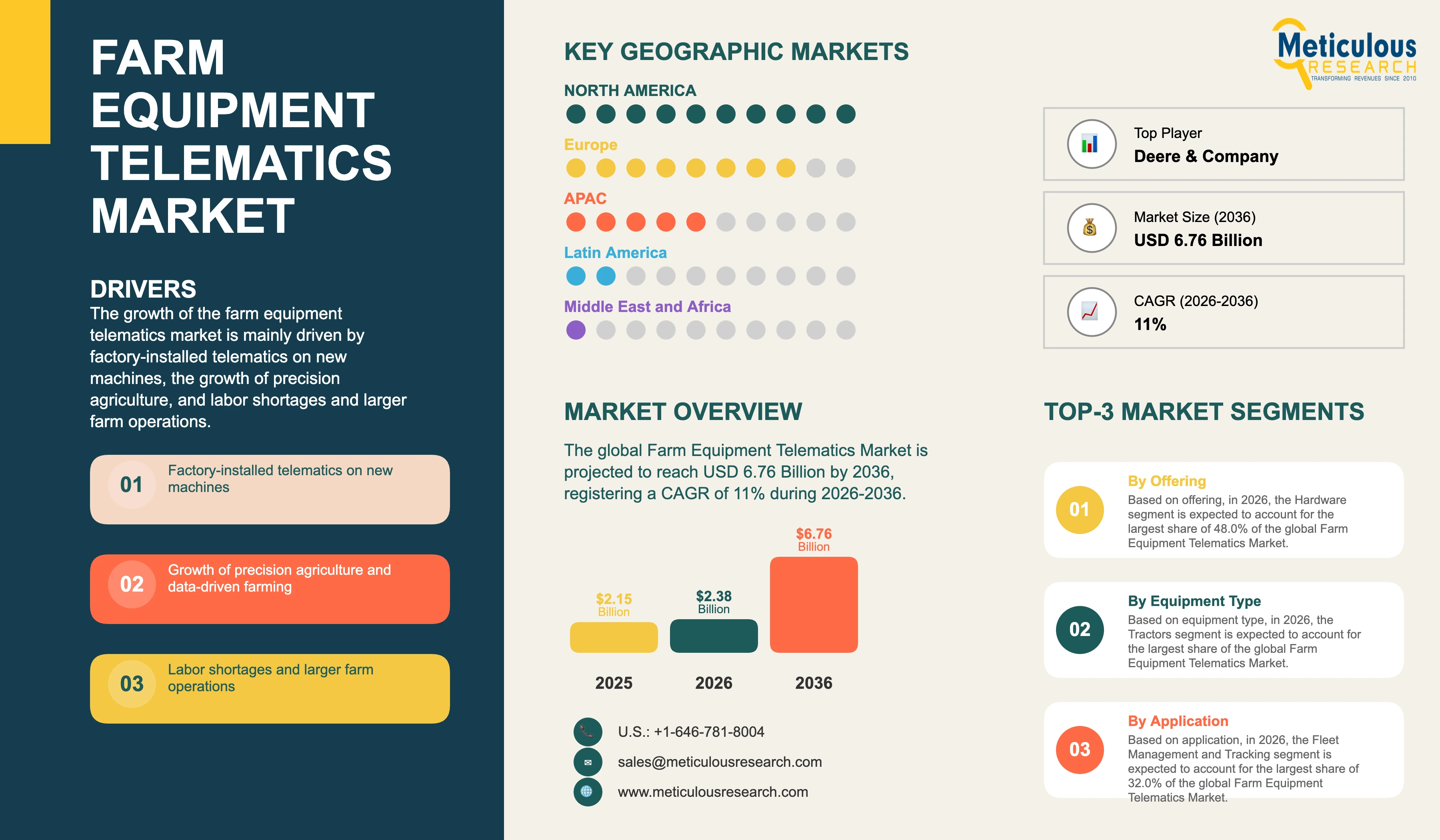
The global farm equipment telematics market was valued at USD 2.15 billion in 2025. This market is expected to reach USD 6.76 billion by 2036 from an estimated USD 2.38 billion in 2026, registering a CAGR of 11.0% during the forecast period (2026-2036).
- Published
- Nov 2026
- Pages
- 299
- Format
- PDF + Excel
- Report ID
- MRAGR - 1042540
- Base year
- 2025
- 2025 · BASELINE
- $2.15B
- 2036
- $6.76B
- CAGR 2026–2036
- 11.0%
2025 baseline · 2026–2036 forecast at 11.0% CAGR · hover a bar for the value
Key highlights
Deere & Company reported at its December 2025 Investor Day that it had more than 1 million connected machines and about 500 million engaged acres on its John Deere Operations Center platform, with a target of 600 million engaged acres by 2030, and in its third quarter of fiscal 2026 it reported more than 1.2 million connected machines and more than 520 million engaged acres.
John Deere made its JDLink connectivity service available to customers at no additional charge, which removed a cost barrier for connecting machines and increased the flow of machine and agronomic data into its Operations Center, showing how leading manufacturers are using telematics to build wider digital ecosystems.
According to the Association of Equipment Manufacturers' Ag Tractor and Combine Report released in January 2026, U.S. sales of two-wheel-drive tractors fell 9.2% in 2025, four-wheel-drive tractor sales fell 41.6%, and combine sales fell 35.6%, which shows the weak equipment cycle that is slowing new factory-installed telematics units in the near term.
The EU Data Act, which applies from September 2025, gives users of connected products, including farm machinery, rights to access and share the data generated by their equipment, which is expected to encourage data portability and support third-party telematics and farm management services in Europe.
AGCO and Trimble formed the PTx Trimble joint venture in 2024 to provide mixed-fleet precision agriculture and connectivity solutions, reflecting a wider shift toward brand-agnostic technology that can connect machines from different manufacturers on the same farm.
Deere reported that its See & Spray targeted spraying technology was used on more than 5 million acres in 2025 and reduced non-residual herbicide use by nearly 50% on average, with usage-based fees that depend on machine connectivity, which shows how telematics is enabling new pay-per-use business models in agriculture and creating recurring revenue for manufacturers and their dealer networks.
By offering, the hardware segment accounts for the largest share of 48.0% in 2026, while the software and subscriptions segment registers the highest CAGR.
By equipment type, tractors account for the largest share in 2026, while sprayers register the highest CAGR.
By application, fleet management and tracking accounts for the largest share of 32.0% in 2026, while agronomic data management registers the highest CAGR.
By geography, North America accounts for the largest share of 40.0% in 2026, while Asia-Pacific registers the highest CAGR of 14.6%.
Report summary
| Particulars | Details |
|---|---|
| Base Year | 2025 |
| Estimated Year | 2026 |
| Forecast Period | 2026-2036 |
| Market Size in 2025 | USD 2.15 billion |
| Market Size in 2026 | USD 2.38 billion |
| Market Size by 2036 | USD 6.76 billion |
| CAGR (2026-2036) | 11.0% |
| Format | PDF, Excel & Cloud Portal · 299 pages |
| Largest Segment by Offering (2026) | Hardware (48.0%) |
| Largest Segment by Application (2026) | Fleet Management and Tracking (32.0%) |
| Largest Region (2026) | North America (40.0%) |
| Fastest-Growing Region | Asia-Pacific (CAGR 14.6%) |
| Segments Covered | Offering, Equipment Type, Installation Type, Application, and Geography |
| Geographic Scope | North America, Europe, Asia-Pacific, Latin America, and Middle East and Africa |
| Key Companies Profiled | Deere & Company, CNH Industrial, AGCO, CLAAS, Kubota, Mahindra & Mahindra, SDF, Yanmar, PTx Trimble, Topcon Agriculture, Farmers Edge, and Fieldin |
Report overview
Segments covered: offering, equipment type, installation type, application.
The growth of this market is mainly driven by the rising share of new tractors, combines, and sprayers sold with factory-installed telematics, the growth of precision agriculture and the need to move machine and agronomic data automatically to farm management platforms, labor shortages and the need to manage larger fleets with fewer operators, the use of remote diagnostics and predictive maintenance to reduce costly downtime, the development of autonomous and semi-autonomous machines, and improving rural connectivity through cellular and satellite networks. However, factors such as the weak farm equipment sales cycle in North America and Europe, the cost of subscriptions for smaller farms, limited connectivity in many rural areas, concerns about data ownership and right to repair, and the lack of interoperability between mixed fleets are expected to restrain the growth of this market to some extent.
Farm equipment telematics refers to systems that collect data from tractors, combines, sprayers, planters, and other agricultural machines and transmit it over cellular, satellite, or other wireless networks to cloud platforms, where farmers, fleet managers, dealers, and manufacturers can view and use it. A telematics system typically includes a telematics control unit or modem installed on the machine, connections to the machine's controllers and displays, a connectivity subscription, and software that shows machine location, status, fuel use, engine hours, alerts, and work records. Many systems also transfer agronomic data, such as planting, application, and yield maps, to farm management platforms.
This market covers the global revenue from farm equipment telematics hardware, software and subscriptions, and services. Hardware includes telematics control units, modems, gateways, and related sensors installed on agricultural machines, either at the factory or as aftermarket kits. Software and subscriptions include connectivity plans, fleet management and diagnostics software, and data transfer services, while services include installation, integration, dealer remote support, and data management services. The market is segmented by offering, equipment type, installation type, application, and geography. Guidance and auto-steer systems, displays, variable-rate controllers, and standalone farm management software that is not linked to machine telematics are not included.
Telematics has become a standard feature on many large agricultural machines, especially in North America, Europe, Australia, and large farming regions of South America. Leading manufacturers such as John Deere, CNH, AGCO, CLAAS, and Kubota install telematics on most of their high-horsepower tractors, combines, and self-propelled sprayers, and they use telematics to connect machines to their digital platforms, such as John Deere Operations Center, CNH's FieldOps, AGCO's FarmerCore and Fendt Connect, and CLAAS connect. Deere reported more than 1 million connected machines in 2025, which shows how widely telematics has been adopted in large-scale farming.
Telematics supports several important uses for farmers, dealers, and manufacturers across the machine life cycle. Farmers and fleet managers use it to track machine location, coordinate operators, monitor fuel and engine hours, and plan logistics during busy seasons such as harvest. Dealers and manufacturers use remote diagnostics to identify faults, plan service visits, update software, and reduce downtime. Telematics also moves agronomic data from machines to farm management software automatically, which supports precision farming, documentation for sustainability programs, and regulatory reporting. In addition, telematics is a foundation for autonomous and semi-autonomous machines, which require reliable connectivity and remote monitoring.
The market has been affected by the weak farm equipment cycle since 2024. Lower crop prices, higher interest rates, and high machine prices have reduced sales of new tractors and combines in North America and Europe. The Association of Equipment Manufacturers reported that U.S. combine sales fell 35.6% and four-wheel-drive tractor sales fell 41.6% in 2025. Because most telematics hardware is installed on new machines, this downturn has slowed hardware growth. However, recurring revenue from subscriptions, software, and services has continued to grow, supported by the large installed base of connected machines and the growth of aftermarket and retrofit solutions.
Data ownership and access have become important issues for farmers, regulators, and the industry. Farmers want control over the data generated by their machines and the ability to repair their own equipment, and in January 2025 the U.S. Federal Trade Commission sued Deere over repair restrictions. In Europe, the EU Data Act gives users of connected products the right to access and share their data. These developments are encouraging manufacturers to provide more open data access through application programming interfaces and data-sharing platforms such as agrirouter, which supports the growth of mixed-fleet and third-party telematics solutions.
The market includes original equipment manufacturers, precision agriculture technology companies, and independent telematics providers. OEMs such as Deere & Company, CNH Industrial, AGCO, CLAAS, Kubota, Mahindra & Mahindra, SDF, and Yanmar offer factory-installed telematics, while companies such as PTx Trimble, Topcon Agriculture, Farmers Edge, and Fieldin offer mixed-fleet and aftermarket solutions.
Over the forecast period, the farm equipment telematics market is expected to grow steadily, supported by the recovery of equipment sales, the increasing value of software and subscriptions, and rising adoption in Asia-Pacific and Latin America. North America is expected to remain the largest market, while Asia-Pacific is expected to grow fastest at a CAGR of 14.6%.
Remote diagnostics lets us see fault codes, check machine settings, and fix many problems before the technician arrives, which saves our customers valuable time in busy seasons.
This comment explains why equipment dealers in Europe and elsewhere strongly support telematics and why remote diagnostics and predictive maintenance continue to grow.
Telematics helps us track rented tractors across many villages, plan bookings, monitor operator use, and bill farmers accurately based on the work actually done.
This comment explains why Asia-Pacific is the fastest-growing region and why low-cost telematics for machine sharing and custom hiring is an important opportunity for providers.
Report infographic
Market dynamics
16 factors across 5 forcesFactory-installed telematics on new machines
Leading equipment manufacturers now install telematics as standard on most new high-horsepower tractors, combines, self-propelled sprayers, and forage harvesters, and many are extending factory-installed telematics to mid-range tractors and smaller machines. Manufacturers see telematics as essential for connecting customers to their digital platforms, supporting dealer service, and enabling future features such as autonomy and remote software updates. John Deere's decision to offer JDLink connectivity at no additional charge, and similar moves by other OEMs to bundle connectivity with new machines, have increased the share of new machines that are connected.
As older machines are replaced over time, the share of the global fleet with telematics is expected to rise steadily, even if new equipment sales remain below their recent peak. Factory-installed systems account for the larger share of the market by installation type, and tractors, which are the largest category of farm machines, account for the largest share by equipment type. Manufacturers in India, China, and other emerging markets are also starting to offer telematics on mid-range tractors and harvesters, which is expanding the addressable market beyond large commercial farms. In addition, telematics is increasingly used by OEMs to monitor warranty claims, product quality, and machine usage patterns, which helps them improve design and service and gives them strong reasons to connect every new machine.
Growth of precision agriculture and data-driven farming
Farmers are using more precision agriculture technologies, such as guidance, section control, variable-rate application, and yield mapping, to improve efficiency and reduce input costs. These technologies generate large amounts of data, and telematics allows this data to move automatically from machines to farm management software without manual transfers using USB drives. Deere reported about 500 million engaged acres on its Operations Center platform in fiscal 2025, which shows how widely farmers are using connected data.
Food companies, retailers, and sustainability programs are also asking farmers for records of field operations, input use, and practices such as reduced tillage and cover cropping, which telematics can capture automatically. Agronomic data management is the fastest-growing application in this market, and software and subscriptions form the fastest-growing offering. Agricultural retailers and agronomists also use telematics data to create prescriptions and review field results with farmers, which further increases the value of connected machines for farmers. Government programs and sustainability schemes that reward practices such as reduced tillage and precise input use also rely on accurate, automatically recorded machine data.
Labor shortages and larger farm operations
Farms in North America, Europe, Australia, and other regions face shortages of skilled operators, and farm operations are becoming larger and more complex. Telematics helps farm managers coordinate machines and operators across many fields, monitor work progress in real time, share guidance lines and prescriptions remotely, and reduce time spent on logistics. During harvest, telematics allows grain carts, trucks, and combines to work together more efficiently.
Large farms, contractors, and agricultural service providers that run fleets of machines from different brands are among the strongest adopters of telematics, since they gain the most from better coordination and reduced idle time. Fleet management and tracking accounts for the largest share of the market by application. Telematics also allows less experienced operators to work effectively by receiving guidance lines, settings, and instructions from farm managers remotely, which reduces the impact of labor shortages and helps new or seasonal operators become productive more quickly.
Remote diagnostics and predictive maintenance
Machine downtime during planting and harvest can be very costly for farmers, since delays reduce yields and increase labor costs. Telematics allows dealers and manufacturers to monitor machine health remotely, receive fault codes and alerts, diagnose problems before a technician visits, and plan repairs with the right parts. Predictive maintenance tools use machine data to identify problems before they cause failures. Remote software updates also allow manufacturers to fix issues and add features without a dealer visit.
Dealers are using telematics-based remote support to serve more customers with fewer technicians, which is important because of technician shortages. Remote diagnostics and predictive maintenance are expected to grow steadily as manufacturers and dealers expand their connected support programs. Some manufacturers also offer service contracts that include remote monitoring, which creates recurring revenue for dealers and reduces unplanned repair costs and downtime for farmers.
Table of contents
12 chapters · 111 sections · 299 pages · click to expandGeographic analysis
North America
Largest shareIn 2026, North America is expected to account for the largest share of 40.0% of the global farm equipment telematics market. The large share of this region is mainly due to the large size of farms in the U.S. and Canada, the high share of high-horsepower tractors, combines, and sprayers with factory-installed telematics, high adoption of precision agriculture, strong dealer networks that use remote diagnostics, and the presence of leading manufacturers and technology companies. The U.S. is the largest national market, supported by large row-crop farms in the Midwest and Great Plains, high use of connected machines, and the launch of autonomy and targeted spraying technologies. Canada has large grain and oilseed farms that use telematics extensively. North America is expected to remain the largest region throughout the forecast period, although the weak equipment cycle has slowed hardware sales in 2025 and 2026.
Europe
Europe is the second-largest region, supported by high farm mechanization, the presence of manufacturers such as CLAAS, AGCO, CNH, and SDF, and strong adoption in Germany, France, the U.K., and the Nordic countries. The EU Data Act and the Common Agricultural Policy's focus on precision farming and environmental documentation are expected to support telematics growth, especially for mixed-fleet and data services.
Asia-Pacific
Fastest growthAsia-Pacific is projected to register the highest CAGR of 14.6% during the forecast period. The rapid growth of this region is mainly driven by rising farm mechanization in India, China, and Southeast Asia, the introduction of telematics on tractors and harvesters by manufacturers such as Mahindra, Kubota, and Yanmar, the growth of custom hiring and machine rental services, government programs that support digital agriculture, and the high use of telematics on large farms in Australia.
Latin America
Latin America is growing because of large grain, oilseed, and sugarcane operations in Brazil and Argentina, which use large fleets and benefit from telematics for logistics and maintenance, although connectivity remains a challenge in remote areas.
Middle East & Africa
The Middle East and Africa remains small but growing, supported by large commercial farms in South Africa and investment in food security projects in the Gulf. In Africa, telematics is also used by tractor-sharing and machinery-hire services that rent machines to smallholders, which could expand adoption among smallholder farmers over time.
Competitive landscape
The farm equipment telematics market is led by major agricultural equipment manufacturers that install telematics on their machines and connect them to their digital platforms. Leading companies include Deere & Company, CNH Industrial, AGCO, CLAAS, Kubota, Mahindra & Mahindra, SDF Group, and Yanmar, along with precision agriculture and telematics technology companies such as PTx Trimble, Topcon Agriculture, Farmers Edge, and Fieldin. Deere holds a clear leading position because of its large installed base of connected machines and its John Deere Operations Center platform, while CNH has built its FieldOps platform and expanded its technology portfolio through acquisitions such as Raven Industries.
Companies compete on the size of their installed base, integration with machine systems and farm management platforms, data quality, connectivity options, dealer support, mixed-fleet compatibility, and price. OEMs benefit from factory installation, close integration with machine controllers, and dealer networks that use telematics for service, while independent providers compete on brand-agnostic compatibility, aftermarket installation, and specialized software for particular crops or farm types.
The top five players are estimated to account for 58.0% of the farm equipment telematics market in 2025. This relatively high concentration reflects the strong position of major OEMs that install telematics on most of their large machines and connect them to their own platforms.
Players use several strategies to grow in this market, including bundling connectivity with new machines, expanding digital platforms and subscription services, acquiring precision agriculture technology companies, forming joint ventures, and partnering with cellular and satellite connectivity providers. For example, AGCO and Trimble formed the PTx Trimble joint venture in 2024 to offer mixed-fleet precision agriculture and connectivity solutions, and several OEMs have announced satellite connectivity options for their machines.
Competition is expected to focus increasingly on software, data services, autonomy, and open data access over the forecast period, as hardware becomes more standardized and connectivity becomes bundled. Independent providers, particularly those serving specialty crops and mixed fleets, are expected to benefit from the EU Data Act and right to repair developments, while OEMs are expected to strengthen their platforms by adding analytics, AI assistants, and integrations with third-party tools to keep farmers engaged.
Some of the key players operating in the farm equipment telematics market are Deere & Company, CNH Industrial N.V., AGCO Corporation, CLAAS KGaA mbH, Kubota Corporation, Mahindra & Mahindra Ltd., SDF S.p.A., Yanmar Holdings Co., Ltd., PTx Trimble, Topcon Agriculture (Topcon Positioning Systems, Inc.), Farmers Edge Inc., and Fieldin Inc.
- —
Recent developments include the following: Deere passed 1.2 million connected machines and 520 million engaged acres, the EU Data Act began to apply in September 2025, the FTC sued Deere over repair restrictions in January 2025, and AGCO and Trimble launched the PTx Trimble joint venture for mixed-fleet technology. Deere also reported that its See & Spray technology was used on more than 5 million acres in 2025.
- Deere & Company
- CNH Industrial
- AGCO
- CLAAS
- Kubota
- Mahindra & Mahindra
- SDF
- Yanmar
- PTx Trimble
- Topcon Agriculture
- Farmers Edge
- Fieldin
Expert perspectives
Farm equipment telematics has moved from a premium option to a standard feature on most large agricultural machines, and it has become the backbone of manufacturers' digital strategies. Although the weak equipment cycle has slowed hardware growth in 2025 and 2026, the large installed base of connected machines and the growth of software, subscriptions, and data services provide a stable foundation for the market. We expect the equipment cycle to recover gradually during the forecast period, which will support hardware demand again.
Over the forecast period, the market is expected to grow at a CAGR of 11.0%, supported by rising software and subscription revenue, the extension of telematics to mid-range and smaller machines, autonomy and remote operation, and fast adoption in Asia-Pacific and Latin America. The value of the market is expected to shift gradually from hardware toward software, analytics, and services, as connectivity becomes bundled with new machines and as farmers make more use of their data.
Hardware remains the largest offering because of factory installation of telematics units on new machines, while software and subscriptions grow fastest. Tractors remain the largest equipment type, while sprayers grow fastest as targeted spraying and application records become more important. Fleet management and tracking remains the largest application, while agronomic data management grows fastest.
North America remains the largest region because of its large farms and high adoption of connected machines, while Asia-Pacific is the fastest-growing region at a CAGR of 14.6%, driven by mechanization in India, China, and Southeast Asia.
For manufacturers, the priority is to grow engaged users and recurring digital revenue while addressing farmer concerns about data ownership, privacy, and right to repair. For independent providers, the opportunity lies in mixed-fleet and aftermarket solutions, specialty crops, and emerging markets. For dealers, telematics is becoming central to service, parts planning, and customer support. We believe that companies that offer open, easy-to-use platforms that work across brands and deliver clear economic value to farmers will gain the most as the market grows.
We also see important risks that market participants must manage carefully over the next few years. A longer equipment downturn would delay hardware growth, and stricter rules on data access or right to repair could change how manufacturers earn digital revenue. At the same time, these changes could expand the market by giving farmers more choice and encouraging new services. Overall, we expect telematics to become as standard on farm machines as it already is on commercial trucks and construction equipment, with value increasingly coming from data, software, and services rather than from the connection itself.
Customer perspectives
Buyers and users of farm equipment telematics include large farms, agricultural contractors, equipment dealers, rental operators, and agricultural service providers. They assess solutions on ease of use, data reliability, connectivity coverage, compatibility with mixed fleets, integration with farm management software, and cost. Their comments show why fleet management leads demand and why software and data services are growing fastest.
Farm Manager - 12,000-acre grain operation, U.S.
We track every machine in real time during harvest so we can move grain carts and trucks where they are needed, and our planting and yield data goes straight to our farm software. We run more than one brand, so we want all our machines in one view.
This explains why fleet management and tracking accounts for 32.0% of the market, why North America accounts for 40.0% of the market, and why mixed-fleet solutions are in growing demand.
Frequently asked questions
The market was valued at USD 2.15 billion in 2025 and USD 1.95 billion in 2024, and is estimated at USD 2.38 billion in 2026. These values cover telematics hardware, software and subscriptions, and services for tractors, combines, sprayers, and other agricultural machines.
Cite this report
Meticulous Research. (2026). Farm Equipment Telematics Market - Global Opportunity Analysis and Industry Forecast (2026-2036) (Report No. MRAGR - 1042540). Meticulous Market Research Pvt. Ltd. https://www.meticulousresearch.com/product/farm-equipment-telematics-market-7223