Floating Storage and Regasification Units (FSRU) Market (2026-2036)
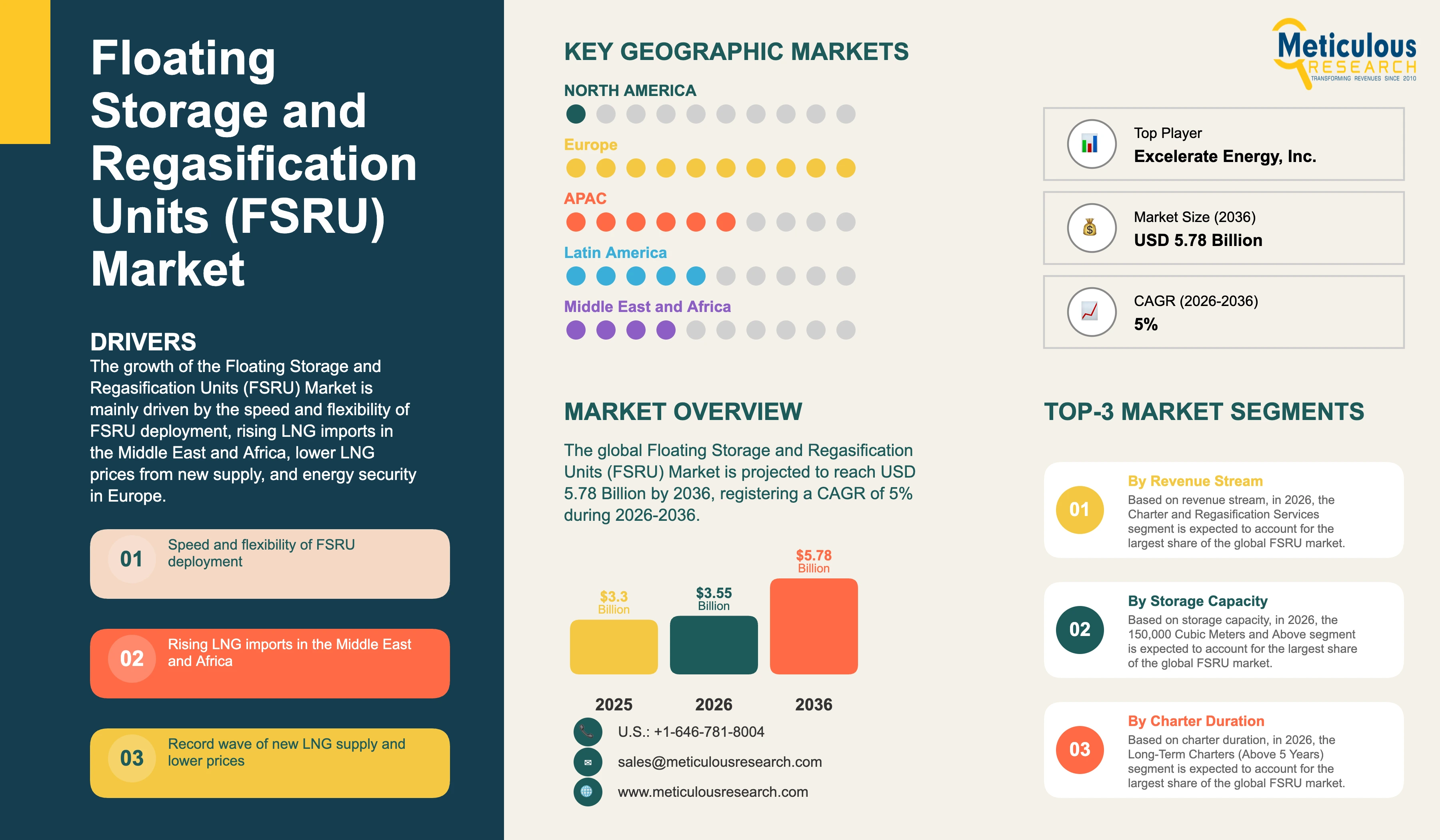
The global floating storage and regasification units (FSRU) market was valued at USD 3.30 billion in 2025. This market is expected to reach USD 5.78 billion by 2036 from an estimated USD 3.55 billion in 2026, registering a CAGR of 5.0% during the forecast period (2026-2036).
- Published
- Nov 2026
- Pages
- 265
- Format
- PDF + Excel
- Report ID
- MREP - 1042709
- Base year
- 2025
- 2025 · BASELINE
- $3.30B
- 2036
- $5.78B
- CAGR 2026–2036
- 5.0%
2025 baseline · 2026–2036 forecast at 5.0% CAGR · hover a bar for the value
Key highlights
According to the Gas Exporting Countries Forum, the global FSRU fleet reached a record 50 operational units by early 2026, with a combined regasification capacity of 197 Mtpa, and FSRUs now account for approximately 20% of global regasification capacity. Typical FSRUs offer regasification capacity of 0.5 to 5 Mtpa per vessel.
Europe prioritized floating units to ensure energy security after 2022, bringing 46 Mtpa of FSRU capacity online within five years, according to the Gas Exporting Countries Forum.
Höegh Evi signed a 10-year time charter with Egypt's EGAS to deploy the Hoegh Gandria, converted from an LNG carrier, as an FSRU at the Port of Sumed from the fourth quarter of 2026, with peak regasification capacity of up to 1 billion standard cubic feet per day. New Fortress Energy also signed a five-year charter for the Energos Winter FSRU at Egypt's Damietta terminal.
Excelerate Energy reported record 2025 results and raised its 2026 adjusted EBITDA guidance to USD 515 million to USD 545 million, driven by its contracted FSRU portfolio, with its newbuild FSRU (Hull 3407) costing about USD 370 million and its integrated Iraq LNG import terminal expected to start operations in the third quarter of 2026.
DNV expects LNG carrier conversions to dominate FSRU fleet growth in the coming years, because conversions of older vessels are significantly faster and generally less capital-intensive than newbuilds, while FSRU providers have remained cautious about speculative new orders.
Egypt had only one operational FSRU, the Hoegh Galleon at Ain Sokhna, in mid-2025, but it added further units, including the Energos Eskimo and Energos Winter, to meet summer import needs, and it procured around 150 LNG cargoes through the summer of 2026.
Daily FSRU charter rates in Asia-Pacific range from about USD 80, 000 to more than USD 120,000, according to industry fleet data, and charter rates have remained resilient as near-term FSRU availability has tightened.
By revenue stream, charter and regasification services account for the largest share of 62.0% in 2026, while LNG carrier conversions register the highest CAGR.
By storage capacity, 150, 000 cubic meters and above accounts for the larger share of 58.0% in 2026, while below 150,000 cubic meters register the higher CAGR.
By charter duration, long-term charters (above 5 years) accounts for the larger share in 2026, while short- and medium-term charters (up to 5 years) registers the higher CAGR.
By geography, Europe accounts for the largest share of 38.0% in 2026, while Middle East & Africa registers the highest CAGR of 8.8%.
Report summary
| Particulars | Details |
|---|---|
| Base Year | 2025 |
| Estimated Year | 2026 |
| Forecast Period | 2026-2036 |
| Market Size in 2025 | USD 3.30 billion |
| Market Size in 2026 | USD 3.55 billion |
| Market Size by 2036 | USD 5.78 billion |
| CAGR (2026-2036) | 5.0% |
| Format | PDF, Excel & Cloud Portal · 265 pages |
| Largest Segment by Revenue Stream (2026) | Charter and Regasification Services (62.0%) |
| Largest Segment by Storage Capacity (2026) | 150,000 Cubic Meters and Above |
| Largest Region (2026) | Europe (38.0%) |
| Fastest-Growing Region | Middle East & Africa (CAGR 8.8%) |
| Companies Profiled | 13 companies and other companies |
| Segments Covered | Revenue Stream, Storage Capacity, Charter Duration, Geography |
| Countries Covered | Germany, Netherlands, Italy, Finland, France, Greece, Turkey, Rest of Europe, Bangladesh, Pakistan, India, Indonesia, Philippines, Australia, Rest of Asia-Pacific, Brazil, Argentina, Colombia, Chile, Jamaica, Rest of Latin America, Egypt, Iraq, Jordan, Kuwait, Ghana, Rest of Middle East & Africa, Puerto Rico, Mexico, Rest of North America |
Report overview
Segments covered: storage capacity, charter duration.
The growth of this market is mainly driven by the speed and flexibility of FSRUs as LNG import solutions for new and existing importers, the record wave of new LNG supply coming online between 2025 and 2030, which is expected to lower LNG prices and attract new buyers, rising LNG imports in Egypt, Iraq, and other Middle Eastern and African countries facing declining domestic gas production, growing gas-to-power demand in South and Southeast Asia and Latin America, Europe's continued reliance on floating terminals for energy security, and the large pool of older LNG carriers that can be converted into FSRUs at lower cost and faster than newbuilds. However, factors such as the higher long-term operating costs of FSRUs compared with onshore terminals, the replacement of some European FSRUs by permanent onshore terminals, the financial and credit risks of emerging-market counterparties, and limited shipyard capacity for newbuilds and conversions are expected to restrain the growth of this market to some extent.
A floating storage and regasification unit is a specialized vessel that receives LNG from carriers, stores it in cryogenic cargo tanks, and regasifies it on board before sending the gas ashore through a jetty or subsea pipeline into the local gas network or a power plant. FSRUs can be built as new vessels or converted from existing LNG carriers, and they are usually moored at a jetty, in a protected harbor, or offshore at a buoy. They provide most of the functions of an onshore LNG import terminal, but they can be deployed much faster and with lower upfront investment by the host country. Modern FSRUs typically have storage capacities of about 125,000 to 180,000 cubic meters and can send out several hundred million to more than one billion standard cubic feet of gas per day.
This report covers global revenue from FSRUs, including charter and regasification services provided by FSRU owners and operators, newbuild FSRU construction, conversions of LNG carriers into FSRUs, and jetty, mooring, and onshore interface infrastructure built to support FSRU deployment. Onshore LNG regasification terminals, small-scale LNG import facilities, floating storage units without regasification, and LNG carriers are excluded from the scope of this report, as they are covered in separate studies. Revenue is measured as annual charter and service revenue earned by FSRU owners and operators, plus annual spending on newbuild and conversion projects and on related marine interface infrastructure.
The global FSRU fleet has grown rapidly over the past decade as new countries began importing LNG. The Gas Exporting Countries Forum reports that the fleet reached a record 50 operational units by early 2026, with a combined regasification capacity of 197 Mtpa, and that FSRUs now account for approximately 20% of global regasification capacity. Each FSRU typically offers 0.5 to 5 Mtpa of regasification capacity, which suits medium-sized markets and power projects. Onshore terminals, by contrast, often provide higher throughput and much larger storage, which is why the two solutions tend to serve different types of markets.
FSRUs are particularly attractive for new LNG importers, countries with uncertain or seasonal demand, and countries that need import capacity quickly. Europe relied heavily on FSRUs after the loss of Russian pipeline gas in 2022, bringing 46 Mtpa of FSRU capacity online within five years, and countries such as Egypt, Bangladesh, Pakistan, Brazil, Argentina, and Jamaica use FSRUs as their main import terminals. The ability to relocate FSRUs to new markets when they are no longer needed reduces long-term risk for both owners and users. A single FSRU can serve several countries over its lifetime, which spreads its capital cost across multiple contracts.
Most FSRUs are owned by specialized companies that charter them to national gas companies, utilities, and power developers under long-term time charters, typically lasting 5 to 20 years. Charter rates vary with vessel size, regasification capacity, contract length, and market conditions, and industry data show daily rates of about USD 80,000 to more than USD 120,000 in Asia-Pacific. Some owners, such as Excelerate Energy, also provide integrated services that include LNG supply, terminal operation, and onshore infrastructure. Charter contracts usually include performance guarantees on availability and send-out, and owners are responsible for operating and maintaining the vessels.
The market includes FSRU owners and operators, shipyards that build and convert FSRUs, and suppliers of regasification modules and related equipment. Leading companies include Excelerate Energy, Höegh Evi, BW LNG, New Fortress Energy, Energos Infrastructure, Mitsui O.S.K. Lines (Kinetics LNG), Karpowership, Exmar, HD Hyundai Heavy Industries, Samsung Heavy Industries, Hanwha Ocean, Seatrium, and Wärtsilä.
Over the forecast period, the FSRU market is expected to grow steadily, supported by new importers in Asia, the Middle East, Africa, and Latin America, lower LNG prices resulting from new supply, and the conversion of older LNG carriers into FSRUs. Growth will be partly offset by the replacement of some European FSRUs by onshore terminals and by competition from onshore terminals in large, stable markets, but redeployment of European units to other regions will support charter activity.
Our domestic gas production has declined while demand for power keeps rising, especially in summer. FSRUs allowed us to add import capacity quickly, and long-term charters give us the security of supply we need for the coming decade.
This comment explains why the Middle East & Africa is the fastest-growing region and why charter and regasification services account for 62.0% of the market. It also shows the value of quick deployment for countries facing sudden gas shortages.
Floating terminals helped us replace Russian pipeline gas in a remarkably short time. Some units will be replaced by onshore terminals, but others will remain part of our supply mix for years.
This comment explains why Europe accounts for 38.0% of the market and why long-term charters remain the largest charter duration segment in the market. It also reflects the role of FSRUs in energy security.
Converting older steam turbine LNG carriers into FSRUs lets us meet new demand faster and at lower cost than ordering newbuilds. Customers want capacity quickly, and conversions deliver that.
This comment shows why LNG carrier conversions are the fastest-growing revenue stream and why smaller FSRUs below 150,000 cubic meters are growing quickly.
Industry fleet data show daily FSRU charter rates in Asia-Pacific of about USD 80,000 to more than USD 120,000, depending on vessel size, capacity, contract length, and market conditions.
Europe is expected to account for the largest share of 38.0% of the market in 2026, mainly due to the rapid deployment of FSRUs after 2022 and long-term charters for energy security.
The Middle East & Africa is projected to register the highest CAGR of 8.8% during the forecast period, driven by Egypt's growing LNG imports, Iraq's first import terminal, and new gas-to-power projects in Africa.
The report profiles 13 companies, including Excelerate Energy, Inc., Höegh Evi Ltd., BW LNG, New Fortress Energy Inc., Energos Infrastructure, Mitsui O.S.K. Lines, Ltd. (Kinetics LNG), Karpowership, Exmar NV, HD Hyundai Heavy Industries Co., Ltd., Samsung Heavy Industries Co., Ltd., Hanwha Ocean Co., Ltd., Seatrium Limited, and Wärtsilä Corporation.
In 2026, the long-term charters (above 5 years) segment is expected to account for the larger share of the FSRU market, while the short- and medium-term charters (up to 5 years) segment is projected to register the higher CAGR during the forecast period.
Report infographic
Market dynamics
16 factors across 5 forcesSpeed and flexibility of FSRU deployment
FSRUs can be deployed much faster than onshore terminals, often within 12 to 24 months compared with three to five years or more for onshore terminals, and they require less onshore land and lower upfront investment by host countries. This makes them the preferred solution for countries that need import capacity urgently, such as European countries after 2022 and Egypt after its domestic gas production declined.
FSRUs can also be relocated when they are no longer needed, which reduces the risk of stranded assets and allows owners to redeploy vessels to new markets as demand changes. The Hoegh Galleon, for example, served as Egypt's interim LNG import terminal from 2024 and is scheduled to relocate to Australia's Port Kembla terminal in 2027. This flexibility is valuable in a market where demand can change quickly due to new domestic gas discoveries, price changes, or policy shifts. Owners also benefit because a vessel can earn revenue in several markets over a service life of 30 years or more. For host countries, FSRUs also shift much of the technical, construction, and financial risk of terminal construction and operation to experienced owners, which is attractive for governments and utilities with limited LNG experience.
Rising LNG imports in the Middle East and Africa
Several countries in the Middle East and Africa have become LNG importers or increased their imports as domestic gas production has declined and demand for power and industry has grown. Egypt moved from being a net LNG exporter to a major importer, and it has signed multiple FSRU charters, including a 10-year charter with Höegh Evi for the Hoegh Gandria from the fourth quarter of 2026 and a five-year charter with New Fortress Energy for the Energos Winter at Damietta.
Iraq is developing its first LNG import terminal with Excelerate Energy at a total estimated cost of USD 520 million to USD 550 million, which is expected to start operations in the third quarter of 2026, and Jordan, Kuwait, and other countries also use floating or near-shore import solutions. In Africa, countries such as Ghana, Senegal, and South Africa are developing FSRU-based import projects to supply gas-fired power plants.
These new and growing importers are expected to be among the fastest-growing sources of FSRU demand over the forecast period, supported by long-term charter agreements with national gas companies. Egypt, which had only one operational FSRU in mid-2025, added several more units within about a year, showing how quickly demand can develop in markets facing gas shortages.
Record wave of new LNG supply and lower prices
More than 330 billion cubic meters per year of new LNG export capacity is expected to come online between 2025 and 2030, mainly from the U.S. and Qatar, according to the International Energy Agency. This new supply is expected to lower LNG prices and make LNG more affordable for price-sensitive buyers in South and Southeast Asia, Africa, and Latin America, many of which will use FSRUs as their first import terminals.
Lower LNG prices could also increase demand from existing FSRU-based importers such as Bangladesh, Pakistan, and Brazil, which have reduced imports during periods of high prices. Higher utilization of existing FSRUs and the need for additional capacity in these markets would support charter activity and new deployments. Bangladesh, Pakistan, and other South Asian importers have reduced imports during price spikes in the past, so lower prices could significantly raise utilization of their existing FSRUs.
Energy security in Europe
European countries rapidly expanded their import capacity after 2022, mainly through FSRUs, and these units continue to play an important role in Europe's gas supply. Germany, the Netherlands, Italy, Finland, Estonia, France, Greece, and other countries have deployed FSRUs, and many of these vessels are operating under long-term charters. Turkey and Croatia also use FSRUs as key parts of their gas supply infrastructure.
Although some European FSRUs will be replaced by onshore terminals, such as in Germany, others are expected to remain in service for many years, particularly in countries where onshore terminals are not planned. European demand for FSRUs therefore provides a stable base for the market, and units released from Europe can be redeployed to other regions. Several European FSRUs are on long-term charters running well into the 2030s, which secures revenue for their owners.
Table of contents
11 chapters · 130 sections · 265 pages · click to expandSegmental analysis
| Segment | Largest share (2026) | Fastest growth (2026–2036) |
|---|---|---|
| Other segments | Charter and regasification services | LNG carrier conversions |
| By Storage Capacity | 150,000 cubic meters and above | Below 150,000 cubic meters |
| By Charter Duration | Long-term charters (above 5 years) | Short- and medium-term charters (up |
Other segments
- The charter and regasification services segment is expected to account for the largest share of 62.0% of the global FSRU market.
- The large share of this segment is mainly attributed to the long-term time charter model used for almost all FSRUs, under which owners earn daily charter revenue for vessel hire, crew, maintenance, and regasification services over contracts of 5 to 20 years, the size of the operating fleet of about 50 units, and resilient charter rates as FSRU availability has tightened.
- Charter revenue provides stable and predictable cash flows for FSRU owners.
- Daily charter rates depend on vessel size, regasification capacity, technical specifications, contract length, and the credit quality of the charterer, and they have remained resilient as near-term availability has tightened.
- As the fleet grows and more units are recontracted, this segment is expected to grow steadily, supported by new deployments in the Middle East, Africa, and Asia.
- However, the LNG carrier conversions segment is projected to register the highest CAGR during the forecast period.
- The rapid growth of this segment is primarily driven by the large pool of older LNG carriers that are becoming less competitive in shipping, the lower cost and shorter delivery times of conversions compared with newbuilds, and strong demand for FSRUs in new markets such as Egypt and other Middle Eastern and African countries.
- Höegh Evi's conversion of the Hoegh Gandria and Excelerate's planned conversion are examples of this trend.
- Conversion projects typically involve installing regasification modules, high-pressure pumps, mooring systems, and new control systems on existing LNG carriers, which creates work for shipyards and equipment suppliers.
- Meanwhile, the newbuild FSRU construction and jetty, mooring, and onshore interface infrastructure segments are expected to witness steady growth, supported by the construction of new purpose-built FSRUs by Korean shipyards and the jetties, mooring systems, and pipeline connections needed for new FSRU projects in emerging markets.
- FSRUs below 150, 000 cubic meters are projected to register the highest CAGR, driven by conversions of older LNG carriers and demand from smaller markets.
By Storage Capacity
- The 150,000 cubic meters and above segment is expected to account for the largest share of the global FSRU market.
- The large share of this segment is mainly attributed to the preference for large FSRUs in Europe and other large markets, where larger storage capacity provides greater supply security and allows the vessel to receive full cargoes from large LNG carriers, and the use of large purpose-built newbuild FSRUs with high regasification capacity.
- Most newbuild FSRUs delivered in recent years have storage capacities of about 170, 000 cubic meters.
- Large FSRUs generally command higher charter rates and are preferred for long-term deployments in major markets such as Germany, Italy, Brazil, and Egypt.
- They can also store enough LNG to provide several days of supply, which improves supply security.
- However, the below 150,000 cubic meters segment is projected to register the highest CAGR during the forecast period.
- The rapid growth of this segment is primarily driven by the conversion of older, smaller LNG carriers into FSRUs, the suitability of smaller FSRUs for emerging markets and power projects with lower demand, and the lower charter rates of smaller units, which make them more affordable for price-sensitive buyers.
- Many of the converted FSRUs now entering service fall into this size range.
- Smaller FSRUs are also well suited to island markets and for projects where port conditions limit vessel size.
By Charter Duration
- The long-term charters (above 5 years) segment is expected to account for the largest share of the global FSRU market.
- The large share of this segment is mainly attributed to the preference of FSRU owners and lenders for long-term contracts that provide stable revenue and support financing, and the willingness of national gas companies and utilities to commit to long-term charters for strategic import infrastructure.
- Examples include Höegh Evi's 10-year charter with EGAS for the Hoegh Gandria and many European FSRU charters.
- Long-term charters are especially important for newbuild FSRUs, which require long contracts to justify their investment.
- Lenders financing FSRUs typically require charters with creditworthy counterparties that cover a large part of the vessel's financing period.
- However, the short- and medium-term charters (up to 5 years) segment is projected to register the highest CAGR during the forecast period.
- The rapid growth of this segment is primarily driven by the need for interim import capacity in countries building onshore terminals, seasonal and emergency demand, such as in Egypt during summer peaks, and the increasing redeployment of FSRUs between markets.
- New Fortress Energy's five-year charter for the Energos Winter in Egypt is an example of a medium-term charter.
- Short-term charters also allow new importers to test LNG demand before committing to long-term infrastructure, and they give owners opportunities to earn higher rates during periods of tight supply.
Geographic analysis
Europe
Largest shareIn 2026, Europe is expected to account for the largest share of 38.0% of the global FSRU market. The large share of this region is mainly due to the rapid deployment of FSRUs after 2022 to replace Russian pipeline gas, which brought 46 Mtpa of FSRU capacity online within five years, the long-term charters signed for many of these units in Germany, the Netherlands, Italy, Finland, Estonia, France, and Greece, and Europe's continued focus on energy security. Europe's large fleet of FSRUs provides a stable base of charter revenue for owners such as Höegh Evi, Excelerate Energy, BW LNG, and Energos Infrastructure. Growth in Europe is expected to be slow over the forecast period, however, and Europe's share of the market is expected to decline, as onshore terminals replace some floating units and gas demand declines.
Asia-Pacific
Asia-Pacific is the second-largest regional market, supported by FSRUs in Bangladesh, Pakistan, India, Indonesia, the Philippines, Australia, and other countries, and by new projects in Vietnam, Sri Lanka, and other emerging markets. Lower LNG prices are expected to increase demand from price-sensitive buyers in South and Southeast Asia over the forecast period. The Hoegh Galleon's planned move to Australia's Port Kembla import terminal in 2027 also shows that FSRUs are being used in developed markets in the region.
Middle East & Africa
Fastest growthThe Middle East & Africa is projected to register the highest CAGR of 8.8% during the forecast period. The rapid growth of this region is mainly due to sharply rising LNG imports in Egypt, which has signed several FSRU charters, Iraq's first LNG import terminal with Excelerate Energy, which is expected to start operations in 2026, growing import needs in Jordan, Kuwait, and other countries, and new FSRU-based gas-to-power projects in Ghana, Senegal, South Africa, and other African countries. Egypt, which relied on a single FSRU in mid-2025, has become one of the fastest-growing FSRU markets in the world.
Latin America
Latin America accounts for a significant share of the global market, with FSRUs in Brazil, Uruguay, Argentina, Colombia, Chile, Jamaica, and other countries supplying natural gas for power generation and industry. Brazil is the largest FSRU market in Latin America by number of units, with several units supplying gas-fired power plants that balance hydropower generation.
North America
North America accounts for a small share of the market, mainly through FSRUs in Puerto Rico and Mexico.
Competitive landscape
The global FSRU market is relatively concentrated among a small number of specialized owners, with the top five players estimated to account for about 65% of the market in 2025. The market is led by a small number of specialized FSRU owners and operators with large fleets, together with shipyards that build and convert FSRUs and suppliers of regasification equipment.
Excelerate Energy, Höegh Evi, BW LNG, New Fortress Energy, and Energos Infrastructure are among the largest FSRU owners and operators in the world, with fleets deployed in Europe, the Middle East, Asia, and the Americas. Mitsui O.S.K. Lines, through its joint venture Kinetics LNG with Karpowership, has expanded its fleet to 11 operational and converted units, and Exmar operates FSRUs and other floating LNG and gas assets.
HD Hyundai Heavy Industries, Samsung Heavy Industries, and Hanwha Ocean in South Korea are the leading builders of newbuild FSRUs, while Seatrium and other yards carry out conversions. Wärtsilä and other specialized companies supply regasification modules, cargo handling systems, and related equipment. Chinese and Singaporean shipyards are also increasingly active in FSRU conversions and newbuilds, offering competitive prices and delivery times. Engineering and mooring specialists provide jetty, buoy, and subsea interface systems for FSRU projects. Classification societies such as DNV also play an important role in approving conversions, new designs, and life extensions.
FSRU owners compete mainly on fleet availability, vessel capability, operational reliability, safety record, charter rates, project execution experience, and the ability to offer integrated services. Key strategies include acquiring and converting older LNG carriers into modern FSRUs, securing long-term charters with national gas companies, offering integrated LNG supply and terminal services, redeploying vessels to growing markets, and developing next-generation FSRU designs.
Over the forecast period, the competitive landscape is expected to remain concentrated, with established owners benefiting from fleet scale, operating experience, and relationships with national gas companies. Owners with available vessels, conversion candidates, and strong balance sheets will be best positioned to capture new demand in emerging markets. Further consolidation among smaller FSRU owners is quite possible as larger players seek to expand their fleets.
Some of the key players operating in the FSRU market are Excelerate Energy, Inc., Höegh Evi Ltd., BW LNG, New Fortress Energy Inc., Energos Infrastructure, Mitsui O.S.K. Lines, Ltd. (Kinetics LNG), Karpowership, Exmar NV, HD Hyundai Heavy Industries Co., Ltd., Samsung Heavy Industries Co., Ltd., Hanwha Ocean Co., Ltd., Seatrium Limited, and Wärtsilä Corporation, among others.
- —
Höegh Evi signed a 10-year charter with EGAS for the Hoegh Gandria, New Fortress Energy chartered the Energos Winter to Egypt, Excelerate Energy reported record 2025 results and prepared its Iraq terminal and newbuild FSRU, and the global fleet reached a record 50 units.
- Excelerate Energy, Inc.
- Höegh Evi Ltd.
- BW LNG
- New Fortress Energy Inc.
- Energos Infrastructure
- Mitsui O.S.K. Lines, Ltd. (Kinetics LNG)
- Karpowership
- Exmar NV
- HD Hyundai Heavy Industries Co., Ltd.
- Samsung Heavy Industries Co., Ltd.
- Hanwha Ocean Co., Ltd.
- Seatrium Limited
- Wärtsilä Corporation
Expert perspectives
The FSRU market is entering a period of steady growth, supported by new LNG importers, lower LNG prices from the record wave of new supply, and the conversion of older LNG carriers. We see FSRUs as the preferred import solution for medium-sized and emerging markets that need capacity quickly and flexibly, and we expect the fleet to keep growing mainly through conversions.
Over the full forecast period, the FSRU market is expected to grow at a CAGR of 5.0%, from USD 3.55 billion in 2026 to USD 5.78 billion in 2036. Growth will be supported by rising imports in the Middle East and Africa, gas-to-power projects in Asia and Latin America, Europe's continued use of FSRUs, and conversions, while the replacement of some European FSRUs by onshore terminals, higher long-term costs compared with onshore terminals, counterparty risks, and shipyard constraints will moderate growth.
In terms of segments, charter and regasification services remain the largest revenue stream, while LNG carrier conversions grow fastest. FSRUs of 150,000 cubic meters and above remain the largest storage segment, while smaller units grow fastest. Long-term charters remain the largest charter segment, while short- and medium-term charters grow fastest. Europe remains the largest region, while the Middle East & Africa grows fastest at a CAGR of 8.8%.
For FSRU owners and operators, the key priorities over the forecast period are to secure long-term charters with creditworthy counterparties, to manage the redeployment of European units, to pursue conversions that add capacity quickly and at lower cost, and to offer integrated solutions for new importers. For shipyards and equipment suppliers, conversion work and next-generation designs offer the best growth opportunities over the forecast period. Managing counterparty and currency risk in emerging markets will remain essential for owners over the forecast period.
We expect the release of some European FSRUs as onshore terminals come online to be absorbed by demand in the Middle East, Africa, Asia, and Latin America, supported by lower LNG prices. In our view, Egypt, Iraq, other Middle Eastern countries, and South and Southeast Asian markets will be the most important sources of new demand over the next five years.
We also expect FSRU charter rates to remain relatively stable and firm over the next few years, supported by supply discipline among FSRU owners and limited newbuild orders, although rates could soften if more European units are released than new markets can absorb. In our view, owners with diversified fleets and integrated offerings are best placed to manage this risk.
Customer perspectives
Buyers of FSRU services include national gas companies, utilities, independent power developers, LNG traders, and industrial gas users. Their decisions depend mainly on speed of deployment, charter cost, vessel capacity, operational reliability, contract flexibility, and the experience of the FSRU owner.
Frequently asked questions
The global FSRU market was valued at USD 3.30 billion in 2025, up from USD 3.05 billion in 2024, and is estimated at USD 3.55 billion in 2026. The market includes charter and regasification services, newbuild construction, LNG carrier conversions, and jetty, mooring, and onshore interface infrastructure.
The global FSRU market is expected to reach USD 5.78 billion by 2036, supported by new importers, lower LNG prices, Europe's continued use of FSRUs, and conversions of older LNG carriers.
The market is expected to register a CAGR of 5.0% from 2026 to 2036, reflecting steady growth in charter activity and new deployments.
The Gas Exporting Countries Forum reports that the global FSRU fleet reached a record 50 operational units by early 2026, with a combined regasification capacity of 197 Mtpa, accounting for about 20% of global regasification capacity.
Market growth is mainly driven by the speed and flexibility of FSRU deployment, rising LNG imports in the Middle East and Africa, the record wave of new LNG supply and lower prices, and energy security in Europe.
Higher long-term operating costs than onshore terminals and the replacement of European FSRUs by onshore terminals restrain growth, while counterparty and financing risks and limited shipyard capacity are key challenges.
Key opportunities include the conversion of older LNG carriers into FSRUs, gas-to-power projects in emerging markets, integrated terminal services and LNG supply, and next-generation and multi-purpose FSRUs.
Charter and regasification services are expected to account for the largest share of 62.0% of the market in 2026, while LNG carrier conversions are projected to register the highest CAGR.
FSRUs below 150,000 cubic meters are projected to register the highest CAGR, driven by conversions of older LNG carriers and demand from smaller markets.
Industry fleet data show daily FSRU charter rates in Asia-Pacific of about USD 80,000 to more than USD 120,000, depending on vessel size, capacity, contract length, and market conditions.
Europe is expected to account for the largest share of 38.0% of the market in 2026, mainly due to the rapid deployment of FSRUs after 2022 and long-term charters for energy security.
The Middle East & Africa is projected to register the highest CAGR of 8.8% during the forecast period, driven by Egypt's growing LNG imports, Iraq's first import terminal, and new gas-to-power projects in Africa.
The report profiles 13 companies, including Excelerate Energy, Inc., Höegh Evi Ltd., BW LNG, New Fortress Energy Inc., Energos Infrastructure, Mitsui O.S.K. Lines, Ltd. (Kinetics LNG), Karpowership, Exmar NV, HD Hyundai Heavy Industries Co., Ltd., Samsung Heavy Industries Co., Ltd., Hanwha Ocean Co., Ltd., Seatrium Limited, and Wärtsilä Corporation.
Höegh Evi signed a 10-year charter with EGAS for the Hoegh Gandria, New Fortress Energy chartered the Energos Winter to Egypt, Excelerate Energy reported record 2025 results and prepared its Iraq terminal and newbuild FSRU, and the global fleet reached a record 50 units.
In 2026, the long-term charters (above 5 years) segment is expected to account for the larger share of the FSRU market, while the short- and medium-term charters (up to 5 years) segment is projected to register the higher CAGR during the forecast period.
Cite this report
Meticulous Research. (2026). Floating Storage and Regasification Units (FSRU) Market - Global Opportunity Analysis and Industry Forecast (2026-2036) (Report No. MREP - 1042709). Meticulous Market Research Pvt. Ltd. https://www.meticulousresearch.com/product/floating-storage-regasification-units-market-7392