Ballast Tank Coatings Market (2026-2036)
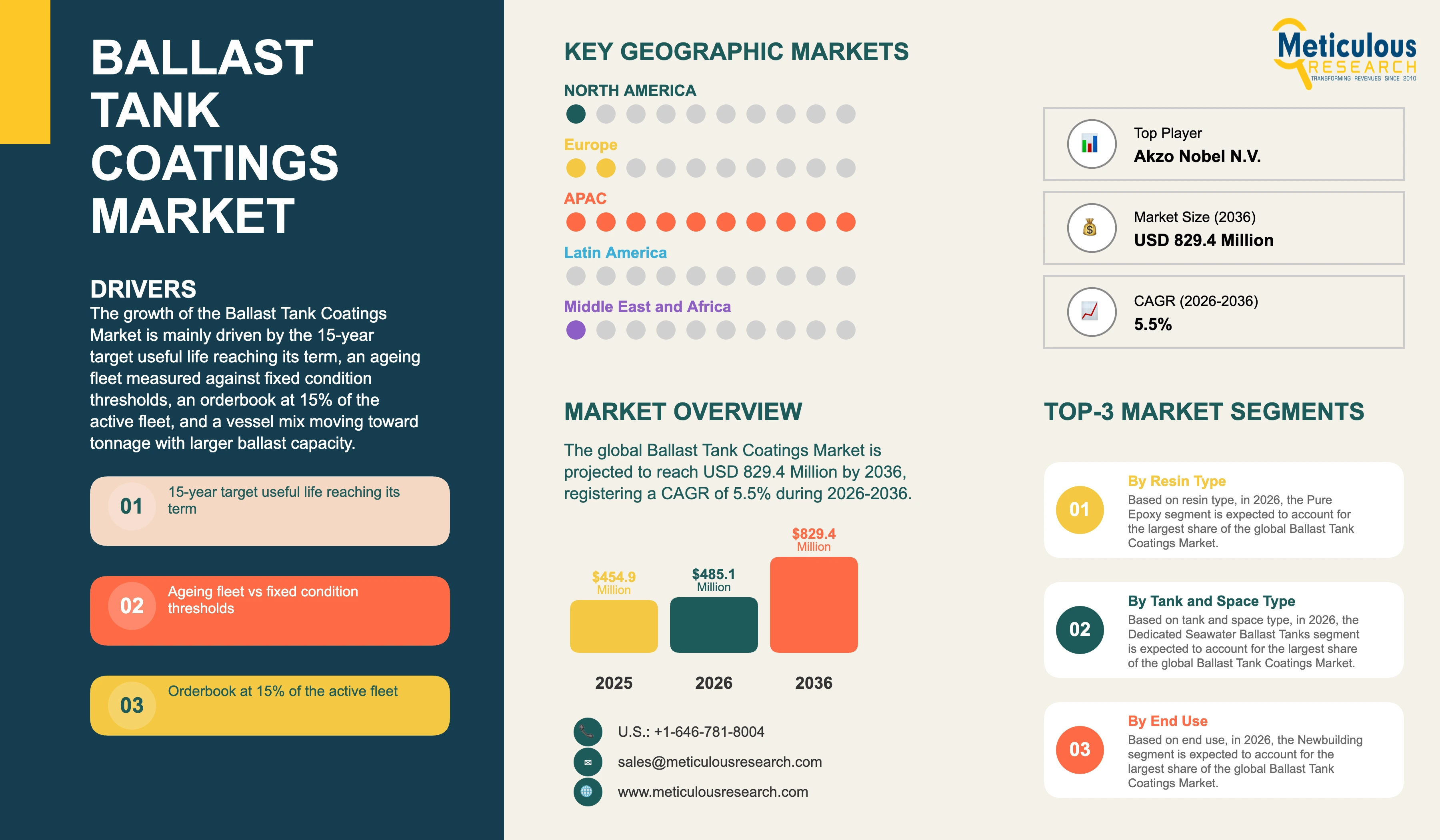
The ballast tank coatings market is valued at USD 485.1 million in 2026 and is projected to reach USD 829.4 million by 2036, at a CAGR of 5.5% during the forecast period. The market was valued at USD 454.9 million in 2025 and at USD 429.9 million in 2024.
- Published
- Nov 2026
- Pages
- 248
- Format
- PDF + Excel
- Report ID
- MRCHM - 1042797
- Base year
- 2025
- 2024 · HISTORICAL
- $429.9M
- 2036
- $829.4M
- CAGR 2026–2036
- 5.5%
2024–2025 baseline · 2026–2036 forecast at 5.5% CAGR · hover a bar for the value
Key highlights
This market measures protective coatings applied to ballast tanks, cargo oil tanks, double-side skin spaces, void spaces and other internal tanks of commercial ships, taken at the coating manufacturer gate on a tonne basis as supplied, across newbuilding and repair work.
Excluded are ballast water treatment systems, external hull antifouling and foul release coatings, deck and superstructure finishes, cathodic protection anodes and impressed current systems, abrasive blast media and application equipment, and linings for shore-based storage tanks.
The performance standard for protective coatings for dedicated seawater ballast tanks was adopted as resolution MSC.215(82) on 8 December 2006 and took effect on 1 July 2008 with the amendments to SOLAS regulations II-1/3-2 and XII/6.
That standard applies to dedicated seawater ballast tanks in all ship types of 500 gross tonnage and above and to double-side skin spaces in bulk carriers of 150 metres in length and upwards.
It sets a target useful life of 15 years from initial application, during which the coating is to remain in the condition with minor spot rusting as defined in resolution A.744(18).
It requires epoxy-based systems at a nominal dry film thickness of 320 microns under the 90/10 rule, applied as a minimum of two stripe coats and two spray coats with a light-coloured top coat.
Primary surface preparation is to Sa 2½ with a profile of 30 to 75 microns, and St 3 is permitted on small damage up to 2% of the area.
Edges are rounded to a minimum radius of 2 millimetres or ground in three passes, soluble salts are limited to 50 milligrams a square metre, and dust must meet a quantity rating of 1 for size classes 3, 4 and 5.
Work is not to proceed at relative humidity above 85% or with the steel less than 3 degrees Celsius above the dew point.
A Coating Technical File carrying the type approval certificate, the technical data sheet, shipyard application records and inspection reports is kept on board for the life of the ship.
Coating condition is graded at survey as good at spot rusting below 3% of area, fair at 3% to below 20% breakdown with hard scale below 10%, and poor at 20% or more breakdown, 10% or more hard scale or 50% or more edge and weld rusting.
A tank cannot be rated better than the lowest rating of any area under consideration or critical structural area within it.
Guidance from the American Bureau of Shipping sets ballast tank repair at 250 microns for medium-term work targeting 10 years and 320 microns for long-term work, with soluble salts allowed up to 80 milligrams a square metre.
The same guidance puts crude oil tank repair at 250 microns short-term, 280 microns medium-term and 320 microns long-term, and states that where hard scale is not removed the service life is 1 to 2 years regardless of coating type.
The United Nations Conference on Trade and Development recorded the world fleet at about 2.44 billion dead-weight tons across about 112,500 commercial vessels as at 1 January 2025, with capacity growth of 3.4% in 2024 against a 5.1% average for 2005 to 2024.
Average fleet age reached 12.6 years on a gross-tonnage-weighted basis in 2024, up 3.2% in a year, and 22.2 years on a vessel-count basis, up 1.8%.
Deliveries in 2024 totalled 71.7 million gross tons, of which China accounted for 54.6%, the Republic of Korea 28.0% and Japan 12.6%, and China held 63.7% of the global orderbook by gross tonnage at the start of 2025.
The orderbook stood at 15% of the active fleet in early 2025 against 12.3% a year earlier, with liquefied natural gas carriers at 51.3% of fleet gross tonnage on order against 10% for bulk carriers.
Report summary
| Particulars | Details |
|---|---|
| Base Year | 2025 |
| Actual Years | 2024-2025 |
| Forecast Period | 2026-2036 |
| Market Size in 2024 | USD 429.9 million |
| Market Size in 2025 | USD 454.9 million |
| Market Size in 2026 | USD 485.1 million |
| Market Size in 2036 | USD 829.4 million |
| Value CAGR (2026-2036) | 5.5% |
| Format | PDF, Excel & Cloud Portal · 248 pages |
| Volume in 2025 | 86.00 kilotons |
| Volume in 2026 | 89.50 kilotons |
| Volume in 2036 | 128.00 kilotons |
| Volume CAGR (2026-2036) | 3.6% |
| Average Selling Price, 2026 | USD 5,420 per tonne |
| Average Selling Price, 2036 | USD 6,480 per tonne |
| Units | Value in USD million; volume in kilotons of coating as supplied; price in USD per tonne |
| Measurement Basis | Protective coatings applied to ballast tanks, cargo oil tanks, double-side skin spaces, void spaces and other internal tanks of commercial ships, taken at the coating manufacturer gate on a tonne basis as supplied, across newbuilding and repair work |
| Historical Value Growth | Value grew at 6.2% a year between 2024 and 2026 against volume growth of 3.8% a year and price growth of 2.3% a year; the forecast of 5.5% is below that historical rate because the 2024 ordering surge delivers into the first half of the forecast period and because repair work takes a rising share of coated area at a lower specified film thickness |
| Price Mix Note | Average selling price rises 1.8% a year across the forecast period, below the historical 2.3%, because maintenance and repair in drydock grows fastest among end uses at 6.4% and is specified at 250 microns for a medium-term target against 320 microns at newbuilding, with St 3 preparation permitted on coating rated fair and soluble salts allowed up to 80 milligrams a square metre against 50 |
| Regulatory Basis | The performance standard for protective coatings for dedicated seawater ballast tanks in all types of ships and double-side skin spaces of bulk carriers was adopted as IMO resolution MSC.215(82) on 8 December 2006 and took effect on 1 July 2008 with the amendments to SOLAS regulations II-1/3-2 and XII/6; it applies to dedicated seawater ballast tanks in all ship types of 500 gross tonnage and above and to double-side skin spaces in bulk carriers of 150 metres in length and upwards |
| Specification Basis | Target useful life of 15 years from initial application in the condition with minor spot rusting as defined in resolution A.744(18); epoxy-based systems at a nominal dry film thickness of 320 microns under the 90/10 rule; a minimum of two stripe coats and two spray coats with a light-coloured top coat; primary blasting to Sa 2½ at a 30 to 75 micron profile; edges rounded to a minimum 2 millimetre radius or ground in three passes; soluble salts no higher than 50 milligrams a square metre of sodium chloride equivalent; dust quantity rating of 1 for size classes 3, 4 and 5; no work above 85% relative humidity or with steel less than 3 degrees Celsius above the dew point; a Coating Technical File carried for the life of the ship |
| Condition Rating Basis | Coating condition is graded good at spot rusting below 3% of area with edge and weld rusting below 20%, fair at 3% to below 20% breakdown with hard scale below 10% and edge and weld rusting of 20% to below 50%, and poor at 20% or more breakdown, 10% or more hard scale or 50% or more edge and weld rusting; a tank cannot be rated better than the lowest rating of any area under consideration or critical structural area within it |
| Survey Trigger Note | Demand is triggered by coating condition at survey rather than by an interval the owner sets: a tanker over five years old whose hard coating was found in less than good condition goes to annual internal examination, as does a bulk carrier whose coating was found poor; at the intermediate survey a vessel aged 5 to 10 years has at least three representative tanks examined, extended if poor coating is found, and from 10 years every ballast tank is surveyed regardless of condition; crew inspection is recommended at least annually on vessels over six years old |
| Repair Specification Basis | American Bureau of Shipping guidance sets ballast tank repair at a nominal dry film thickness of 250 microns for medium-term repair targeting 10 years and 320 microns for long-term repair targeting more than 10 years, with Sa 2½ required on poor coating and St 3 or Sa 2½ permitted on fair coating and soluble salts allowed up to 80 milligrams a square metre; crude oil tank repair runs 250 microns short-term, 280 microns medium-term and 320 microns long-term; where hard scale is not removed the service life is 1 to 2 years regardless of coating type |
| Fleet Basis | The United Nations Conference on Trade and Development recorded the world fleet at about 2.44 billion dead-weight tons across about 112,500 commercial vessels of at least 100 gross tons as at 1 January 2025, with capacity growth of 3.4% in 2024 against a 5.1% average for 2005 to 2024; average age reached 12.6 years gross-tonnage-weighted, up 3.2%, and 22.2 years by vessel count, up 1.8% |
| Newbuilding Basis | Deliveries in 2024 totalled 71.7 million gross tons with vessel count up 8.8% and gross tonnage up nearly 10% on 2023; by delivered gross tonnage China held 54.6%, the Republic of Korea 28.0% and Japan 12.6%; container ships accounted for 41.3% of delivered gross tonnage, bulk carriers 26.6% and gas carriers 12.2%; China took 74.4% of contracted gross tonnage in 2024 and held 63.7% of the global orderbook by gross tonnage at the start of 2025 |
| Orderbook Basis | The orderbook stood at 15% of the active fleet in early 2025 against 12.3% at the start of 2024 and 11.1% at the start of 2023, with newbuild tonnage ordered in 2024 up more than 50% and the orderbook growing 10.2%; by share of active fleet gross tonnage, liquefied natural gas carriers stood at 51.3%, container ships at 24.6%, bulk carriers at 10% and oil tankers at 7.5% |
| Corporate Development Note | Akzo Nobel N.V. and Axalta Coating Systems Ltd. agreed an all-share merger of equals to be named Axanzo, approved by shareholders of both companies on 5 August 2026, with the companies continuing to operate independently until a closing expected in early 2027; the current legal entity name is used in this report |
| Overlap Note | Linings for shore-based storage tanks are counted in the Tank Lining Coatings Market title and external hull coatings in the Foul Release Coatings Market title, so those titles are non-additive with this one on the products they share |
| Exclusions | Ballast water treatment and management systems; external hull antifouling and foul release coatings; deck, superstructure and cargo hold finishes; cathodic protection anodes and impressed current systems; abrasive blast media, dehumidification and application equipment; coating inspection instruments; linings for shore-based storage tanks; naval vessels below 500 gross tonnage and inland craft outside the mandatory scope |
| Segments: Resin Type | Pure Epoxy; Modified Epoxy; Surface-Tolerant Epoxy Mastic; Glass Flake and Other Resin Types |
| Segments: Tank and Space Type | Dedicated Seawater Ballast Tanks; Cargo Oil Tanks; Double-Side Skin Spaces; Void Spaces and Cofferdams; Fresh Water and Other Tanks |
| Segments: End Use | Newbuilding; Maintenance and Repair in Drydock; Afloat and Voyage Repair |
| Segments: Vessel Type | Bulk Carriers; Oil Tankers; Container Ships; Gas Carriers; General Cargo and Other Vessel Types |
| Largest Segment by Resin Type, 2026 | Pure Epoxy, at 58.0% |
| Fastest-Growing Segment by Resin Type | Surface-Tolerant Epoxy Mastic, at 8.4% |
| Slowest-Growing Segment by Resin Type | Pure Epoxy, at 4.6% |
| Largest Segment by Tank and Space Type, 2026 | Dedicated Seawater Ballast Tanks, at 52.0% |
| Fastest-Growing Segment by Tank and Space Type | Void Spaces and Cofferdams, at 7.2% |
| Largest Segment by End Use, 2026 | Newbuilding, at 61.0% |
| Fastest-Growing Segment by End Use | Maintenance and Repair in Drydock, at 6.4% |
| Largest Segment by Vessel Type, 2026 | Bulk Carriers, at 28.0% |
| Fastest-Growing Segment by Vessel Type | Gas Carriers, at 7.8% |
| Slowest-Growing Segment by Vessel Type | Bulk Carriers, at 4.6% |
| Largest Region, 2026 | Asia-Pacific, at 72.0% |
| Fastest-Growing Region | Middle East & Africa, at 6.4% |
| Fastest-Growing Country | China, at 6.4% |
| Slowest-Growing Country | U.S., at 4.2% |
| Regions Covered | Asia-Pacific; Europe; Middle East & Africa; North America; Latin America |
| Countries Covered | China; South Korea; Japan; Singapore; India; Germany; Netherlands; Italy; Poland; U.S.; U.A.E.; Brazil |
| Key Players | Akzo Nobel N.V.; Hempel A/S; Jotun A/S; PPG Industries, Inc.; Chugoku Marine Paints, Ltd.; Nippon Paint Holdings Co., Ltd.; KCC Corporation; Kansai Paint Co., Ltd.; The Sherwin-Williams Company |
| Top Five Share, 2026 | 62.5% |
| Profiled Companies Share, 2026 | 79.0% |
| Currency | USD |
Report overview
Market value is measured in in USD million; volume in kilotons of coating as supplied; price in USD per tonne. Segments covered: resin type, tank and space type, end use, vessel type.
The growth of this market is mainly driven by the 15-year target useful life set by the International Maritime Organization performance standard reaching its term on the first compliant ships, a world fleet whose gross-tonnage-weighted average age reached 12.6 years in 2024, an orderbook standing at 15% of the active fleet in early 2025, and survey rules that place a tank under annual internal examination once its coating falls below good condition. However, factors such as a specification fixed by regulation rather than by the supplier, newbuilding concentrated in three countries, repair work specified at lower film thickness and looser salt limits than newbuilding, and fleet capacity growth of 3.4% against a twenty-year average of 5.1% are expected to restrain the growth of this market to some extent.
A ballast tank is the harshest corrosion environment on a commercial ship. It is alternately full of aerated seawater and empty and humid, warmed on one side by cargo or fuel and chilled on the other by the sea, inaccessible for inspection and impossible to repair without taking the vessel out of service. Nothing else on a hull combines that duty with that inaccessibility, which is why the coating specification is written by regulation rather than left to the buyer.
Resolution MSC.215(82), adopted on 8 December 2006 and in effect from 1 July 2008, sets the terms. A 15-year target useful life, epoxy-based systems at a nominal dry film thickness of 320 microns under the 90/10 rule, two stripe coats and two spray coats, a light-coloured top coat, primary blasting to Sa 2½ at a 30 to 75 micron profile, soluble salts no higher than 50 milligrams a square metre and edges rounded to a 2 millimetre radius.
Environmental control during application is specified as tightly as the film itself, with work prohibited above 85% relative humidity or with the steel less than 3 degrees Celsius above the dew point, and surface temperature, humidity and dew point recorded. A Coating Technical File carrying the type approval, the data sheet, yard application records and inspection reports stays on board for the life of the ship.
What that produces commercially is a coating with no room for product differentiation. Every approved system is an epoxy applied at the same thickness to the same surface standard with the same number of coats, verified against the same records, so the supplier competes on price, on ability to serve a yard at newbuilding rate, and on inspection and technical support rather than on the properties of the paint.
The named demand driver for this title is vessel maintenance intervals, and the interval is not something an owner sets. Coating work is triggered by condition at a classification survey, graded good at spot rusting below 3% of area with edge and weld rusting below 20%, fair at 3% to below 20% breakdown, and poor at 20% or more breakdown, 10% or more hard scale or 50% or more edge and weld rusting, with a tank rated no better than its worst area.
Deterioration shortens the inspection cycle rather than generating a scheduled purchase. A tanker over five years old whose hard coating was found in less than good condition goes to annual internal examination, and a bulk carrier whose coating was found poor does the same. At the intermediate survey a vessel aged 5 to 10 years has at least three representative tanks examined, extended if poor coating is found, and from 10 years every ballast tank is surveyed regardless of condition.
Where the driver does hold is in the arithmetic of the standard itself. The 15-year target useful life ran from 1 July 2008, so the first ships built to the standard reached the end of that term from 2023, and the ships delivered through the following four years follow them. That is a maintenance wave fixed by regulation and by date rather than by any decision taken on a vessel.
Fleet age reinforces it. The United Nations Conference on Trade and Development put the gross-tonnage-weighted average age of the world fleet at 12.6 years in 2024, up 3.2% in a single year, and at 22.2 years on a vessel-count basis across about 112,500 commercial vessels and about 2.44 billion dead-weight tons as at 1 January 2025.
Repair work nonetheless arrives on cheaper terms than newbuilding. American Bureau of Shipping guidance puts medium-term ballast tank repair at a nominal dry film thickness of 250 microns against 320 microns at newbuilding, permits St 3 preparation rather than Sa 2½ where the coating is rated fair, and allows soluble salts up to 80 milligrams a square metre against 50 at newbuilding.
That is the reason the blended price in this market rises only 1.8% a year while maintenance and repair in drydock grows fastest among end uses at 6.4%. A rising share of the coated area is specified thinner, prepared to a lower standard and bought against a repair budget rather than a newbuilding contract.
Newbuilding still carries the volume, at 61.0% of this market in 2026, and it is bought by very few organisations. Deliveries in 2024 totalled 71.7 million gross tons, of which China accounted for 54.6%, the Republic of Korea 28.0% and Japan 12.6%, and China took 74.4% of contracted gross tonnage that year and held 63.7% of the orderbook by gross tonnage at the start of 2025.
A specification written by the International Maritime Organization and purchased by a handful of Asian yards leaves a coating supplier negotiating annual volume agreements against a fixed technical requirement, which gives the supplier some influence over throughput and almost none over price.
The orderbook gives the near-term volume a firm floor, standing at 15% of the active fleet in early 2025 against 12.3% a year earlier and 11.1% at the start of 2023, with newbuild tonnage ordered in 2024 up more than 50% on the previous year.
Vessel mix within that orderbook shifts the demand profile rather than its size. Liquefied natural gas carriers stood at 51.3% of fleet gross tonnage on order in early 2025 and container ships at 24.6%, against bulk carriers at 10% and oil tankers at 7.5%, which is why gas carriers grow fastest among vessel types at 7.8% and bulk carriers slowest at 4.6%.
Product development within the fixed specification has moved to application economics rather than to protection. Solvent-free epoxy primers applied with standard equipment have been placed on ballast tanks since 2020, reducing solvent emissions from tank coating work by up to 90%, and surface-tolerant epoxy mastics have taken the repair position where surface preparation cannot reach the newbuilding standard.
Asia-Pacific holds 72.0% of this market in 2026 because newbuilding and the larger repair yards sit there together, with China, the Republic of Korea, Japan and Singapore carrying most of the work. The Middle East & Africa grows fastest at 6.4% on drydock repair capacity serving the tanker and bulk trades, from the second-smallest regional base.
Report infographic
Market dynamics
17 factors across 5 forcesThe 15-Year Target Useful Life Reaching Its Term
The performance standard took effect on 1 July 2008 with a target useful life of 15 years from initial application, so the first ships built to it reached the end of that term from 2023 and the tonnage delivered through the following years follows in sequence.
Reaching the end of a target life does not condemn a coating, but it removes the presumption that the tank will pass, and a coating found below good condition commits the vessel to annual internal examination of that tank until it is restored.
Maintenance and repair in drydock holds 31.0% of this market in 2026 and grows fastest among end uses at 6.4%, against 5.2% for newbuilding and 4.4% for afloat and voyage repair.
An Ageing Fleet Measured Against Fixed Condition Thresholds
The gross-tonnage-weighted average age of the world fleet reached 12.6 years in 2024, up 3.2% in a single year, and the vessel-count average reached 22.2 years, up 1.8%, across about 112,500 commercial vessels of at least 100 gross tons.
Survey scope widens with age irrespective of condition, since a vessel aged 5 to 10 years has at least three representative ballast tanks examined at the intermediate survey while from 10 years every ballast tank is surveyed, so the number of tanks inspected rises faster than the fleet does.
Crew inspection of ballast tanks is recommended at least annually on vessels over six years old, which brings deterioration to the attention of the owner between class surveys and moves repair planning forward.
An Orderbook at 15% of the Active Fleet
The orderbook stood at 15% of the active fleet in early 2025 against 12.3% at the start of 2024 and 11.1% at the start of 2023, with newbuild tonnage ordered in 2024 up more than 50% on the previous year and the global orderbook growing 10.2%.
Deliveries in 2024 totalled 71.7 million gross tons with vessel count up 8.8% and gross tonnage up nearly 10% on 2023, and every one of those hulls carries ballast tanks coated to the full specification before delivery.
Newbuilding accordingly holds the largest end use share of this market in 2026 at 61.0%, and the orderbook puts a firm floor under that volume through the first half of the forecast period.
Vessel Mix Moving Toward Tonnage with Larger Ballast Capacity
Liquefied natural gas carriers stood at 51.3% of fleet gross tonnage on order in early 2025 and container ships at 24.6%, against bulk carriers at 10% and oil tankers at 7.5%, so the fastest fleet renewal is in the segments with the most complex internal structure.
Gas carriers record the highest vessel type CAGR in this market at 7.8% and container ships follow at 6.8%, while bulk carriers grow slowest at 4.6% despite holding the largest vessel type share at 28.0% in 2026.
Container ships accounted for 41.3% of delivered gross tonnage in 2024, bulk carriers 26.6% and gas carriers 12.2%, which establishes the near-term newbuild coating mix ahead of the orderbook working through.
Ballast capacity itself rises with the shift, since a container ship carries ballast against widely varying container loadings and a gas carrier combines ballast tanks with extensive void and cofferdam structure, so coated area per gross ton is higher than on the bulk tonnage being replaced.
Table of contents
12 chapters · 134 sections · 248 pages · click to expandSegmental analysis
| Segment | Largest share (2026) | Fastest growth (2026–2036) |
|---|---|---|
| By Resin Type | Pure epoxy | Surface-tolerant epoxy mastic |
| By Tank and Space Type | Dedicated seawater ballast tanks | Void spaces and cofferdams |
| By End use | Newbuilding | Maintenance and repair in drydock |
| By Vessel Type | Bulk carriers | Gas carriers |
By Resin Type
- Ballast Tank Coatings Analysis by Resin Type
- This market is segmented into pure epoxy, modified epoxy, surface-tolerant epoxy mastic, and glass flake and other resin types.
- Pure epoxy is expected to account for the largest share of this market in 2026 and is also the slowest-growing resin type.
- The performance standard requires epoxy-based systems, and a two-pack amine-cured pure epoxy at a nominal dry film thickness of 320 microns is the default against which every type approval is written, so the segment carries the whole mandatory newbuilding scope and grows only as hulls are delivered.
- Modified epoxy holds the second position and grows close to the market rate, used where cure at low steel temperature, a shorter recoat window or improved edge retention is needed to hold yard throughput without departing from the approved film.
- Surface-tolerant epoxy mastic is projected to register the highest CAGR among resin types during the forecast period.
- Repair is carried out in a tank that cannot be blasted to newbuilding standard, and the survey guidance recognises that by permitting St 3 preparation on coating rated fair and soluble salts up to 80 milligrams a square metre, so a system formulated for those conditions grows with the repair share rather than with the fleet.
- Glass flake and other resin types, including zinc silicate and polyurethane systems, grow above the market rate from the smallest base, specified in cargo oil tanks and in spaces outside the mandatory epoxy scope where abrasion or chemical duty governs.
By Tank and Space Type
- Ballast Tank Coatings Analysis by Tank and Space Type
- This market is segmented into dedicated seawater ballast tanks, cargo oil tanks, double-side skin spaces, void spaces and cofferdams, and fresh water and other tanks.
- Dedicated seawater ballast tanks are expected to hold the largest share of this market in 2026 and are also the slowest-growing tank and space type.
- The mandatory scope reaches every ship of 500 gross tonnage and above, which gives the segment the whole newbuilding fleet, and the fixed 320 micron specification leaves growth to hull deliveries and to the repair cycle rather than to specification change.
- Cargo oil tanks hold the second position and grow above the market rate, carrying their own performance standard and a separate set of repair tiers at 250 microns short-term, 280 microns medium-term and 320 microns long-term, with crude oil cargo and inert gas duty rather than seawater immersion setting the requirement.
- Double-side skin spaces grow close to the market rate, reaching bulk carriers of 150 metres in length and upwards under the same standard as ballast tanks, and the segment follows bulk carrier newbuilding, which stood at 10% of fleet gross tonnage on order in early 2025 against 51.3% for liquefied natural gas carriers.
- Void spaces and cofferdams are projected to register the highest CAGR among tank and space types during the forecast period, lying outside the mandatory scope so that the specification is agreed between the owner and the class society, which allows a supplier to sell on service life and application cost rather than against a fixed film.
- Fresh water and other tanks grow above the market rate on the smallest base, where potable water approval rather than corrosion duty governs the choice and solvent-free epoxy has been the established position for over two decades.
By End use
- Ballast Tank Coatings Analysis by End Use
- This market is segmented into newbuilding, maintenance and repair in drydock, and afloat and voyage repair.
- Newbuilding is expected to account for the largest share of this market in 2026.
- Every hull delivered carries ballast tanks coated to the full specification before handover, deliveries in 2024 reached 71.7 million gross tons with vessel count up 8.8%, and the orderbook at 15% of the active fleet in early 2025 puts a firm floor under that volume through the first half of the forecast period.
- Maintenance and repair in drydock is projected to register the highest CAGR among end uses during the forecast period.
- The 15-year target useful life ran from 1 July 2008 so the first compliant ships reached its term from 2023, fleet age reached 12.6 years on a gross-tonnage-weighted basis in 2024, and a coating found below good condition commits the tank to annual internal examination until restored.
- Afloat and voyage repair holds the smallest share and grows slowest, confined to patch work and touch-up within the limits of what can be prepared and applied without docking, and recognised in the guidance as maintenance at manufacturer-recommended thickness rather than as a repair tier with a service life target.
By Vessel Type
- Ballast Tank Coatings Analysis by Vessel Type
- This market is segmented into bulk carriers, oil tankers, container ships, gas carriers, and general cargo and other vessel types.
- Bulk carriers are expected to hold the largest share of this market in 2026 and are also the slowest-growing vessel type.
- The segment carries both dedicated ballast tanks and the double-side skin spaces that the standard brings into scope at 150 metres and upwards, which gives it the largest coated area per hull, but bulk carriers stood at only 10% of fleet gross tonnage on order in early 2025.
- Oil tankers hold the second position and grow close to the market rate, combining ballast tank work with cargo oil tank coating, and carrying the tightest survey regime since a tanker over five years old whose hard coating was found in less than good condition goes to annual internal examination.
- Container ships grow above the market rate, having accounted for 41.3% of delivered gross tonnage in 2024 and 24.6% of fleet gross tonnage on order in early 2025, with ballast capacity driven by stability requirements across widely varying container loadings.
- Gas carriers are projected to register the highest CAGR among vessel types during the forecast period, standing at 51.3% of fleet gross tonnage on order for liquefied natural gas carriers in early 2025 and 12.2% of delivered gross tonnage in 2024, with complex internal structure and high newbuilding value per hull.
- General cargo and other vessel types, including offshore support, ferries, car carriers and smaller tonnage, grow below the market rate on a fragmented fleet in which much of the tonnage sits below the thresholds that bring the mandatory specification into effect.
Geographic analysis
Asia-Pacific
Largest shareAsia-Pacific is expected to account for the largest share of this market in 2026. Deliveries in 2024 totalled 71.7 million gross tons, of which China accounted for 54.6%, the Republic of Korea 28.0% and Japan 12.6%, so 95.2% of newbuilding coating was bought in the region, and the larger repair yards sit alongside the building yards. China holds the largest country position and is the fastest-growing country in this market, having taken 74.4% of contracted gross tonnage in 2024 and holding 63.7% of the global orderbook by gross tonnage at the start of 2025, so its share of newbuilding coating rises further across the forecast period. South Korea and Japan hold substantial but slower positions, Singapore carries repair and conversion work, and India grows on shipbuilding and recycling-related activity.
Europe
Europe holds the second regional position and grows below the market rate. Newbuilding is confined largely to specialised tonnage, so the regional position rests on repair, conversion and on the technical and inspection functions of the coating suppliers, with Germany, the Netherlands and Italy carrying the specialised yards and Poland the larger repair capacity.
Middle East & Africa
Fastest growthThe Middle East & Africa is projected to register the highest CAGR among regions during the forecast period, with the U.A.E. the fastest-growing country outside Asia-Pacific. Repair follows drydock capacity on the trade routes rather than the flag or the owner, and the tanker and bulk trades through the Gulf generate docking demand where the capacity to take a vessel out of service exists.
North America
North America holds the smallest regional share and grows slowest, with the U.S. the slowest-growing country in this market, where commercial newbuilding is limited and the coated tonnage is concentrated in naval, offshore and inland work much of which sits outside the mandatory scope.
Latin America
Latin America grows close to the market rate, with Brazil the covered country on offshore support and tanker repair capacity, while the regional position depends on docking capacity rather than on any newbuilding base.
Competitive landscape
Competition in this market is between a small number of marine coatings groups holding type approvals against a specification none of them wrote. Every approved system is an epoxy applied at a nominal dry film thickness of 320 microns under the 90/10 rule over a surface prepared to Sa 2½, so the product is effectively standardised and the contest is over yard relationships, technical service and inspection capacity.
The top five participants in this market account for a combined share of 62.5% in 2026 and the companies profiled in this report account for 79.0%, a concentration that follows from the requirement to hold approvals, carry inspection staff at every major yard and support a Coating Technical File for the life of each vessel.
Service infrastructure rather than formulation is what sustains those positions, since the supplier is required to furnish the statement of compliance or type approval certificate, the technical data sheet and inspection reports that the yard places in the Coating Technical File, and to attend the tank during application and survey. A new entrant must reproduce that network before it can quote on a single hull.
The repair layer is contested differently, because the coating is sold into a docking package priced against days out of service and the specification is agreed on the vessel rather than at a yard framework level, which gives regional suppliers and surface-tolerant products a route in that the newbuilding layer does not offer.
Akzo Nobel N.V. and Axalta Coating Systems Ltd. agreed an all-share merger of equals to be named Axanzo, approved by shareholders of both companies on 5 August 2026, with the companies continuing to operate independently until a closing expected in early 2027 under an envisaged ticker of AXZ on the New York Stock Exchange and Euronext Amsterdam.
Some of the key players operating in the ballast tank coatings market are Akzo Nobel N.V., Hempel A/S, Jotun A/S, PPG Industries, Inc., Chugoku Marine Paints, Ltd., Nippon Paint Holdings Co., Ltd., KCC Corporation, Kansai Paint Co., Ltd., and The Sherwin-Williams Company, among others.
- Akzo Nobel N.V.
- Hempel A/S
- Jotun A/S
- PPG Industries, Inc.
- Chugoku Marine Paints, Ltd.
- Nippon Paint Holdings Co., Ltd.
- KCC Corporation
- Kansai Paint Co., Ltd.
- Sherwin-Williams Company
Expert perspectives
The named demand driver for this title is vessel maintenance intervals, and the interval is not a variable an owner controls. Coating work is triggered by condition at a classification survey, graded good below 3% spot rusting, fair from 3% to below 20% breakdown and poor at 20% or more, with a tank rated no better than its worst area, and deterioration shortens the inspection cycle rather than creating a scheduled purchase.
Where the driver holds is in the arithmetic of the standard. The performance standard took effect on 1 July 2008 with a 15-year target useful life, so the first compliant ships reached the end of that term from 2023 and the tonnage delivered through the following years follows in sequence, against a fleet whose gross-tonnage-weighted average age reached 12.6 years in 2024, up 3.2% in a single year.
That is a maintenance wave fixed by regulation and by date, and it is the reason maintenance and repair in drydock grows fastest among end uses at 6.4% while holding 31.0% of this market in 2026. Treating it as a response to owner maintenance planning would attribute to commercial choice what is in fact a survey trigger and a clock.
The wave also arrives on cheaper terms than the newbuilding it follows. Repair guidance puts medium-term ballast tank work at 250 microns against 320 microns at newbuilding, permits St 3 preparation where the coating is rated fair and allows soluble salts at 80 milligrams a square metre against 50, so the faster-growing end use carries the lower realised value per square metre.
Newbuilding keeps the volume at 61.0% of this market in 2026 and keeps the pricing power with the buyer. Deliveries in 2024 totalled 71.7 million gross tons, of which 95.2% was built in three countries, and China alone took 74.4% of contracted gross tonnage that year and held 63.7% of the orderbook at the start of 2025, so a fixed specification is purchased by very few organisations.
The positions worth holding therefore sit where the specification is not written for the supplier: surface-tolerant epoxy mastics for repair conditions at 8.4%, void spaces and cofferdams outside the mandatory scope at 7.2%, gas carrier newbuilding at 7.8% on an orderbook standing at 51.3% of liquefied natural gas carrier fleet tonnage, and drydock capacity in the Middle East & Africa at 6.4%.
Customer perspectives
A newbuilding yard buys to a specification it cannot vary and judges a coating on application behaviour, recoat window, cure at the steel temperatures available in the dock and the rate at which inspection can be cleared.
That buyer treats the coating supplier as a service organisation as much as a product supplier, because the statement of compliance, the technical data sheet and the inspection reports have to be furnished for the Coating Technical File that stays on board for the life of the ship.
A shipowner specifying a newbuilding is interested in what the coating does after the warranty, since a tank found below good condition commits the vessel to annual internal examination of that tank and the cost of that examination falls on the operator rather than the yard.
A repair yard sells tank coating inside a docking package priced against days out of service, so curing time, overcoat interval and the tolerance of the system to whatever surface can be achieved matter more than the unit price of the paint.
A superintendent planning a docking works backwards from the survey outcome, choosing a medium-term repair at 250 microns targeting 10 years or a long-term repair at 320 microns where the vessel will be held, and knows that unremoved hard scale gives 1 to 2 years regardless of what is applied.
A tanker operator carries the tightest regime, with intermediate surveys required above five years, special surveys on all tankers and annual internal examination wherever the hard coating was found in less than good condition at a previous survey.
Buyers outside the mandatory scope, in void spaces, cofferdams, fresh water tanks and smaller ships, negotiate on service life and application cost instead of against a fixed film, and are the only part of this market where product selection is genuinely open.
Across every buyer the purchase is of compliance and of docked days rather than of corrosion protection in the abstract, which is why price per tonne moves within a narrow band and why technical service capacity decides the allocation of volume.
Frequently asked questions
The market is valued at USD 485.1 million in 2026 and is projected to reach USD 829.4 million by 2036, at a CAGR of 5.5%. It was valued at USD 454.9 million in 2025 and USD 429.9 million in 2024.
It measures protective coatings applied to ballast tanks, cargo oil tanks, double-side skin spaces, void spaces and other internal tanks of commercial ships, at the coating manufacturer gate on a tonne basis as supplied, across newbuilding and repair. Excluded are ballast water treatment systems, external hull coatings, deck finishes, cathodic protection, blast media and application equipment, and shore-based storage tank linings.
Only in part. The interval is not set by the owner: work is triggered by coating condition at a classification survey, and deterioration shortens the inspection cycle rather than creating a scheduled purchase. Where the driver does hold is the 15-year target useful life running from 1 July 2008, which brings the first compliant ships to term from 2023.
Resolution MSC.215(82), adopted on 8 December 2006 and effective 1 July 2008, sets a 15-year target useful life, epoxy-based systems at 320 microns nominal dry film thickness under the 90/10 rule, two stripe coats and two spray coats, blasting to Sa 2½, soluble salts no higher than 50 milligrams a square metre and a Coating Technical File carried for the life of the ship.
Dedicated seawater ballast tanks in all ship types of 500 gross tonnage and above, and double-side skin spaces in bulk carriers of 150 metres in length and upwards. Void spaces, cofferdams, fresh water tanks and smaller ships are specified between the owner and the class society instead.
Good is spot rusting below 3% of area with edge and weld rusting below 20%; fair is 3% to below 20% breakdown; poor is 20% or more breakdown, 10% or more hard scale or 50% or more edge and weld rusting. A tanker over five years old found in less than good condition goes to annual internal examination of that tank, as does a bulk carrier found poor, and the cost falls on the operator.
American Bureau of Shipping guidance puts medium-term ballast tank repair at 250 microns targeting 10 years and long-term repair at 320 microns, permits St 3 or Sa 2½ preparation on fair coating, and allows soluble salts up to 80 milligrams a square metre against 50 at newbuilding. Where hard scale is not removed the service life is 1 to 2 years regardless of coating type.
Because the faster-growing end use is specified cheaper. Maintenance and repair in drydock grows at 6.4% against 5.2% for newbuilding and is applied at 250 microns rather than 320 microns, so the blended price rises 1.8% a year against 2.3% between 2024 and 2026.
The United Nations Conference on Trade and Development recorded about 2.44 billion dead-weight tons across about 112,500 commercial vessels of at least 100 gross tons as at 1 January 2025. Average age reached 12.6 years on a gross-tonnage-weighted basis, up 3.2% in a year, and 22.2 years by vessel count.
The orderbook stood at 15% of the active fleet in early 2025 against 12.3% at the start of 2024 and 11.1% at the start of 2023, with newbuild tonnage ordered in 2024 up more than 50%. Newbuilding holds 61.0% of this market in 2026 with a firm floor through the first half of the forecast period.
Severely. Of 71.7 million gross tons delivered in 2024, China accounted for 54.6%, the Republic of Korea 28.0% and Japan 12.6%, so 95.2% was bought in three countries. China took 74.4% of contracted gross tonnage in 2024 and held 63.7% of the global orderbook by gross tonnage at the start of 2025.
Surface-tolerant epoxy mastic, at 8.4% from a 13.5% share in 2026, against 4.6% for pure epoxy. Repair is carried out in a tank that cannot be blasted to newbuilding standard, so a system formulated for those conditions grows with the repair share rather than with the fleet.
Outside the mandatory scope. Void spaces and cofferdams grow fastest among tank and space types at 7.2% and fresh water and other tanks at 6.6%, because the specification there is agreed between the owner and the class society, which allows a supplier to sell on service life and application cost.
Gas carriers grow fastest at 7.8% and container ships at 6.8%, because liquefied natural gas carriers stood at 51.3% of fleet gross tonnage on order in early 2025 and container ships at 24.6%. Bulk carriers hold the largest share at 28.0% in 2026 but grow slowest at 4.6%.
Key players include Akzo Nobel N.V., Hempel A/S, Jotun A/S, PPG Industries, Inc., Chugoku Marine Paints, Ltd., Nippon Paint Holdings Co., Ltd., KCC Corporation, Kansai Paint Co., Ltd., and The Sherwin-Williams Company, among others. The top five hold an estimated 62.5% in 2026 and the profiled companies 79.0%.
The specification is written by regulation rather than by the supplier, purchasing is concentrated in three shipbuilding countries, and repair work, the faster-growing end use, is specified thinner and cheaper than newbuilding. Fleet capacity also grew 3.4% in 2024 against a 5.1% average for 2005 to 2024.
Cite this report
Meticulous Research. (2026). Ballast Tank Coatings Market - Global Opportunity Analysis and Industry Forecast (2026-2036) (Report No. MRCHM - 1042797). Meticulous Market Research Pvt. Ltd. https://www.meticulousresearch.com/product/ballast-tank-coatings-market-7480