Synbiotics Market (2026-2036)
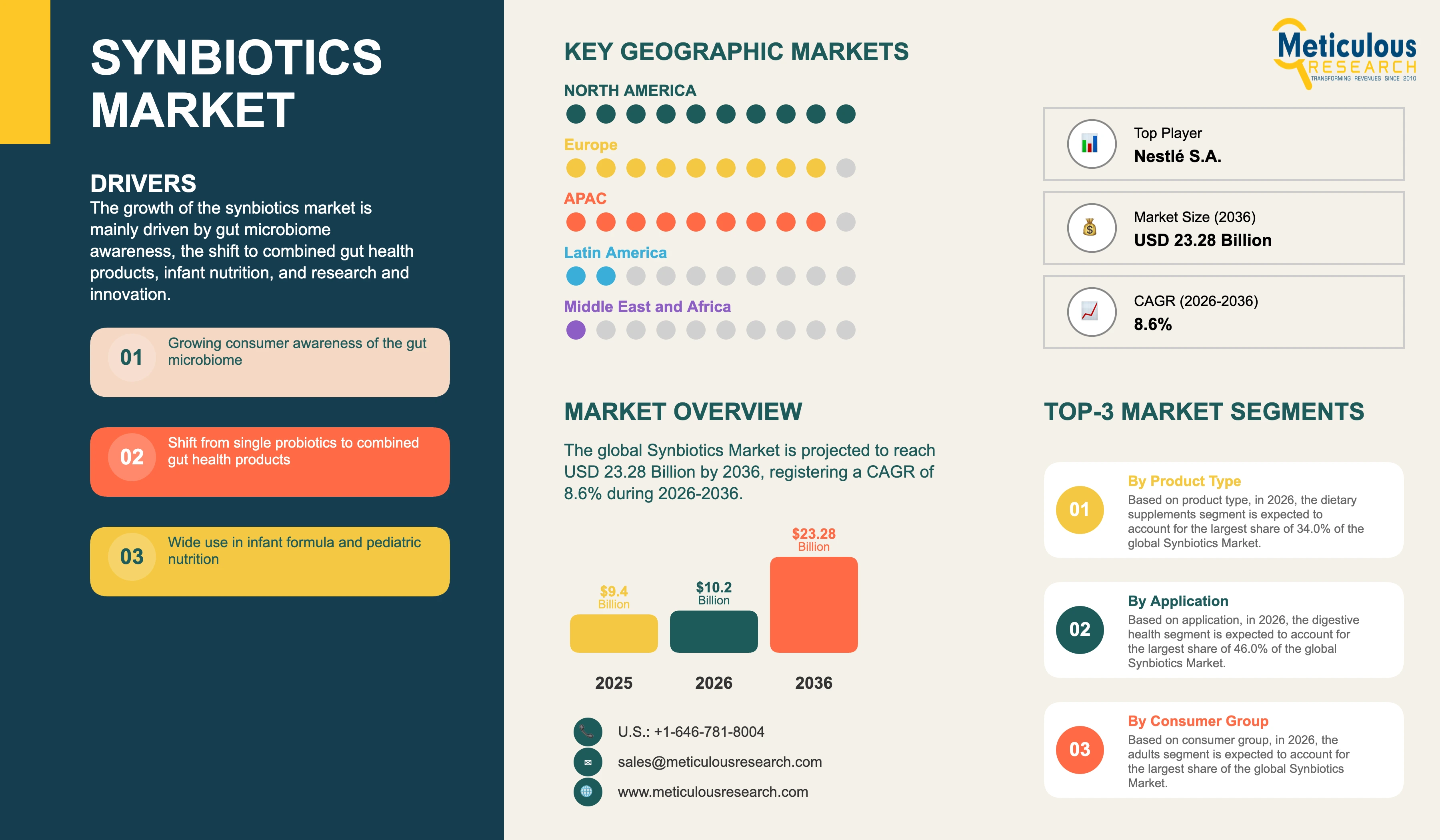
The global synbiotics market was valued at USD 9.40 billion in 2025. This market is expected to reach USD 23.28 billion by 2036 from an estimated USD 10.20 billion in 2026, registering a CAGR of 8.6% during the forecast period (2026-2036).
- Published
- Nov 2026
- Pages
- 281
- Format
- PDF + Excel
- Report ID
- MRFB - 1042558
- Base year
- 2025
- 2025 · BASELINE
- $9.40B
- 2036
- $23.28B
- CAGR 2026–2036
- 8.6%
2025 baseline · 2026–2036 forecast at 8.6% CAGR · hover a bar for the value
Key highlights
Seed Health launched its DS-01 Daily Synbiotic nationwide at Costco on November 9, 2026, in a 100-count pack, and the company stated that it is the number one gut health supplement brand in the U.S., while SPINS data cited by Seed showed DS-01 as the leading digestive health probiotic at Target and on Amazon, reflecting the move of premium synbiotic supplements from online channels into mass and club retail.
Seed's DS-01 combines 24 clinically studied probiotic strains with a prebiotic in a capsule-in-capsule ViaCap delivery system that is designed to protect the probiotics from stomach acid, and the company reported that in a clinical study published in the journal Nutrients, 72% of participants reported never or rarely experiencing bloating after taking the product.
The International Scientific Association for Probiotics and Prebiotics (ISAPP) published a consensus definition of synbiotics in 2020 as a mixture of live microorganisms and substrates selectively utilized by host microorganisms that confers a health benefit, separating complementary synbiotics from synergistic synbiotics, which has helped guide product development, labeling, and clinical research across supplement, food, and infant nutrition companies.
Seed expanded its synbiotic and microbiome portfolio with the launch of VS-01 in 2024 and its Co-Biotics range in 2025, showing how premium brands are building product families around the synbiotic concept for digestive, vaginal, and other areas of health, supported by direct-to-consumer subscriptions and growing retail distribution.
Major infant nutrition companies, including Nestlé, Danone, Abbott, and Reckitt's Mead Johnson Nutrition, continue to add probiotic strains and prebiotic ingredients, such as galacto-oligosaccharides and human milk oligosaccharides, to infant formula to support gut and immune development, making infant formula one of the largest uses of synbiotic combinations, especially in premium formula products sold in China and other Asia-Pacific markets.
By product type, dietary supplements account for the largest share of 34.0% in 2026, while functional beverages register the highest CAGR.
By application, digestive health accounts for the largest share of 46.0% in 2026, while metabolic and weight health registers the highest CAGR.
By consumer group, adults account for the largest share in 2026, while older adults register the highest CAGR.
By distribution channel, supermarkets and hypermarkets account for the largest share in 2026, while online retail registers the highest CAGR.
By geography, North America accounts for the largest share of 33.0% in 2026, while Asia-Pacific registers the highest CAGR of 10.4%.
Report summary
| Particulars | Details |
|---|---|
| Base Year | 2025 |
| Estimated Year | 2026 |
| Forecast Period | 2026-2036 |
| Market Size in 2025 | USD 9.40 billion |
| Market Size in 2026 | USD 10.20 billion |
| Market Size by 2036 | USD 23.28 billion |
| CAGR (2026-2036) | 8.6% |
| Format | PDF, Excel & Cloud Portal · 281 pages |
| Largest Segment by Product Type (2026) | Dietary Supplements (34.0%) |
| Largest Segment by Application (2026) | Digestive Health (46.0%) |
| Largest Region (2026) | North America (33.0%) |
| Fastest-Growing Region | Asia-Pacific (CAGR 10.4%) |
| Companies Profiled | 15 companies and other companies |
| Segments Covered | Product Type, Application, Consumer Group, Distribution Channel, Geography |
| Countries Covered | U.S., Canada, Germany, France, U.K., Italy, Spain, Netherlands, Belgium, Switzerland, Sweden, Denmark, Poland, Rest of Europe, China, Japan, India, South Korea, Australia, Indonesia, Thailand, Vietnam, Philippines, Rest of Asia-Pacific, Brazil, Mexico, Argentina, Colombia, Chile, Rest of Latin America, Saudi Arabia, U.A.E., Israel, Turkey, Egypt, South Africa, Rest of Middle East & Africa |
Report overview
Segments covered: product type, application, consumer group, distribution channel.
The growth of this market is mainly driven by growing consumer awareness of the gut microbiome and its links to digestion, immunity, metabolism, and mood, the shift from single-strain probiotics toward combined probiotic and prebiotic products that offer more complete gut support, the strong performance of premium synbiotic supplement brands, the wide use of synbiotic ingredients in infant formula, rising scientific and clinical research on synbiotics, the growing use of synbiotics in functional foods and beverages, and expanding retail and online distribution. However, factors such as strain-specific and inconsistent clinical evidence, high product prices, viability and stability challenges, and strict regulations on health claims are expected to restrain the growth of this market to some extent.
Synbiotics are products that combine live beneficial microorganisms, known as probiotics, with substrates that are selectively used by microorganisms in the gut, known as prebiotics. According to the ISAPP consensus definition, a synbiotic is a mixture of live microorganisms and substrates selectively utilized by host microorganisms that confers a health benefit on the host. Synbiotics may be complementary, where the probiotic and prebiotic each provide benefits independently, or synergistic, where the prebiotic is chosen to support the specific probiotic in the product. This report covers synbiotic dietary supplements, infant formula and pediatric nutrition, functional foods, functional beverages, and medical nutrition and other products across applications, consumer groups, and distribution channels. The market is measured on a sales value basis, covering products marketed with both probiotic and prebiotic components.
The idea behind synbiotics is that combining probiotics with prebiotics can improve the survival, colonization, and activity of beneficial microbes in the gut, and can support the growth of native beneficial bacteria. Common probiotic strains in synbiotic products include species of Lactobacillus, Lacticaseibacillus, Bifidobacterium, and Saccharomyces, while common prebiotics include inulin, fructo-oligosaccharides, galacto-oligosaccharides, human milk oligosaccharides, resistant starch, and polyphenol-rich plant extracts.
Synbiotics have become more important as consumer understanding of the gut microbiome has grown. Research has linked the gut microbiome to digestion, immune function, metabolism, weight, skin health, and mood, and consumers increasingly look for products that support gut health in a more complete way. As a result, many brands that once sold single probiotic products now offer combined products, and new brands have built their entire positioning around synbiotics.
Dietary supplements are the largest product category, led by premium capsule products such as Seed's DS-01 Daily Synbiotic, as well as probiotic and prebiotic combinations from established supplement brands. Infant formula and pediatric nutrition is another major category, since leading infant formula companies add probiotics and prebiotics, including human milk oligosaccharides, to infant formula to support gut and immune development in babies who are not exclusively breastfed. Functional foods, such as yogurts, fermented dairy, cereals, and snack bars, and functional beverages, such as fermented drinks, gut health sodas, and probiotic juices, are growing categories.
Digestive health is the main application, as consumers use synbiotics to support regularity, reduce bloating, and maintain overall gut comfort. Immune health, women's and urogenital health, metabolic and weight health, skin health, and mood are other important and growing applications, supported by research on the gut-immune, gut-skin, and gut-brain connections.
The scientific evidence for synbiotics has grown considerably over the past decade, but it remains complex, since benefits depend on the specific strains, prebiotic ingredients, doses, and study populations, and results from one product cannot be applied to all synbiotics. Clinical studies have shown benefits for some products in areas such as digestive symptoms, infant gut health, and metabolic markers, but many products on the market have limited direct clinical evidence, which creates opportunities for brands that invest in research and challenges for the category as a whole.
Product quality is also a key issue for the synbiotics market, because probiotics are live microorganisms that must survive manufacturing, storage, and passage through the stomach to provide benefits, and brands use technologies such as encapsulation, capsule-in-capsule delivery, freeze-drying, and moisture-controlled packaging to protect viability. Brands increasingly highlight strain-level identification, colony-forming unit counts at the end of shelf life, and third-party testing to build trust.
The market includes premium supplement brands, multinational food and nutrition companies, probiotic ingredient suppliers, and specialized microbiome companies. Leading companies include Nestlé, Danone, Abbott, Reckitt (Mead Johnson Nutrition), Seed Health, Novonesis, dsm-firmenich, Kerry Group, IFF, Probi, BioGaia, Pendulum Therapeutics, Yakult Honsha, Morinaga Milk Industry, and i-Health (Culturelle).
Over the forecast period, the synbiotics market is expected to grow steadily, supported by growing microbiome awareness, the shift from probiotics to more complete gut health products, research and innovation in strains and prebiotics, growth in functional foods and beverages, and expanding use among older adults and people with metabolic health goals. Asia-Pacific is expected to be the fastest-growing region, supported by strong traditions of fermented foods and growing supplement use.
We are adding prebiotic fiber and shelf-stable probiotic strains to our drinks because consumers want gut health benefits from products they already enjoy every day.
This comment explains why functional beverages are the fastest-growing product type and why Asia-Pacific is the fastest-growing region, where beverage companies are investing in gut health products.
North America is expected to account for the largest share of 33.0% of the market in 2026, mainly due to high gut health awareness, high supplement spending, and the presence of premium synbiotic brands and leading infant formula companies.
Asia-Pacific is projected to register the highest CAGR of 10.4% during the forecast period, driven by fermented food traditions, leading probiotic companies, large infant formula markets, rising incomes, and e-commerce.
The report profiles 15 companies, including Nestlé, Danone, Abbott, Reckitt (Mead Johnson Nutrition), Seed Health, Novonesis, dsm-firmenich, Kerry Group, IFF, Probi, BioGaia, Pendulum Therapeutics, Yakult Honsha, Morinaga Milk Industry, and i-Health (Culturelle).
Report infographic
Market dynamics
18 factors across 5 forcesGrowing consumer awareness of the gut microbiome
Consumer awareness of the gut microbiome has grown significantly over the past decade, supported by scientific research, media coverage, books, podcasts, and social media. Consumers increasingly understand that the gut microbiome plays a role not only in digestion but also in immunity, metabolism, weight, skin health, and mood, and many view gut health as the foundation of overall health. This awareness has driven demand for products that support the gut microbiome, including probiotics, prebiotics, fermented foods, fiber, and synbiotics.
Digestive discomfort, such as bloating, irregularity, and gas, is very common, and many consumers look for daily products to support gut comfort. Synbiotics are positioned as a more complete solution than probiotics alone, since they combine beneficial bacteria with prebiotic fibers that nourish them, which appeals to consumers who want to address their gut health more thoroughly.
Growing interest in personalized nutrition and microbiome testing has also increased consumer engagement with gut health. Consumers who test their gut microbiome or follow nutrition advice from functional medicine practitioners often look for synbiotic products that combine several types of gut support, and brands are developing products and educational content for these consumers.
Shift from single probiotics to combined gut health products
The probiotic market has evolved from single-strain or simple multi-strain products toward more sophisticated products that combine probiotics with prebiotics, postbiotics, and other ingredients. Brands have moved toward synbiotics to differentiate their products, to offer more complete gut support, and to respond to research suggesting that prebiotics can support the survival and activity of probiotics and native gut bacteria.
Premium brands such as Seed Health have built strong businesses around the synbiotic concept, and Seed's launch of DS-01 nationwide at Costco in November 2026 shows how synbiotic supplements are moving from online and specialty channels into mass retail. Established probiotic brands are also adding prebiotic ingredients to their products, and ingredient suppliers are developing ready-made synbiotic combinations for brands.
This shift is also supported by the growing popularity of fiber and prebiotic foods, as consumers become more aware of the importance of fiber for gut health and as fiber has become a popular wellness topic. Brands are combining probiotics with prebiotic fibers to address both trends in a single product.
Wide use in infant formula and pediatric nutrition
Infant formula is one of the most important uses of synbiotic combinations. Breast milk contains both beneficial bacteria and human milk oligosaccharides, which act as prebiotics, and infant formula manufacturers add probiotic strains and prebiotics such as galacto-oligosaccharides, fructo-oligosaccharides, and human milk oligosaccharides to formula to better support gut and immune development in formula-fed infants.
Leading companies such as Nestlé, Danone, Abbott, and Reckitt's Mead Johnson Nutrition have invested heavily in research on infant gut health and in synbiotic formulations, and premium formula products with probiotics and prebiotics have grown, especially in Asia-Pacific. Pediatric synbiotic supplements, such as drops and powders, are also used to support digestive comfort and immunity in children.
Continued research on the infant microbiome, including the role of Bifidobacterium and human milk oligosaccharides, is expected to support further innovation in infant formula and pediatric nutrition.
Rising research and innovation in strains and prebiotics
Research on the gut microbiome, probiotics, and prebiotics has increased significantly, and new strains, prebiotic ingredients, and delivery technologies are being developed. Ingredient companies such as Novonesis, dsm-firmenich, Kerry Group, and IFF invest in strain discovery, clinical research, and synbiotic formulations, and companies such as Pendulum Therapeutics have developed next-generation probiotic strains, such as Akkermansia muciniphila, combined with prebiotics for metabolic health.
Clinical research is expanding into new areas, such as metabolic health, women's health, skin health, and mood, which supports new product development and broader positioning. Delivery technologies, such as capsule-in-capsule systems, microencapsulation, and shelf-stable formats, improve product performance and allow synbiotics to be used in more formats.
Growth of functional foods and beverages
Consumers increasingly prefer to get health benefits from foods and beverages they already consume, and food and beverage companies are adding probiotics and prebiotics to yogurts, fermented dairy, cereals, snacks, juices, and sodas. Gut health sodas and fermented beverages have grown rapidly, and brands are combining prebiotic fiber with probiotics or postbiotics to create gut health positioning. Shelf-stable probiotic strains, such as spore-forming Bacillus strains, allow probiotics to be added to a wider range of foods and beverages, which supports the development of synbiotic products in new categories.
Table of contents
12 chapters · 162 sections · 281 pages · click to expandSegmental analysis
| Segment | Largest share (2026) | Fastest growth (2026–2036) |
|---|---|---|
| By Product Type | Dietary supplements | Functional beverages |
| By Application | Digestive health | Metabolic and weight health |
| By Consumer Group | Adults | Older adults |
| By Distribution Channel | Supermarkets and hypermarkets | Online retail |
| Other segments | Adults | Older adults |
By Product Type
- Synbiotics Market Analysis by Product Type
- The dietary supplements segment is expected to account for the largest share of 34.0% of the global synbiotics market.
- The large share of this segment is mainly due to the strong growth of premium synbiotic supplement brands such as Seed Health, the ability of supplements to deliver specific strains and prebiotics at clinically studied doses, the use of capsules, powders, and gummies that protect probiotic viability, and growing consumer awareness of synbiotic supplements through online education, social media, and retail.
- Supplements also allow brands to target specific health needs, such as digestive health, women's health, immune health, and metabolic health.
- Dietary supplements have benefited from the shift from basic probiotic products to more complete gut health products, and many established probiotic brands have added prebiotics to their formulas.
- Direct-to-consumer subscriptions and mass retail expansion, such as Seed's launch at Costco, are supporting further growth.
- Supplements are also the main format for clinical research on synbiotics in adults, which helps brands support claims.
- Supplements also allow brands to update formulations quickly as new research becomes available, and many brands now offer product families that include digestive, women's health, children's, and metabolic synbiotic supplements.
- Strong online and social media marketing has helped premium supplement brands build large customer bases, which has encouraged other brands to enter the category.
- However, the functional beverages segment is projected to register the highest CAGR during the forecast period.
- The rapid growth of this segment is driven by the popularity of gut health sodas and fermented drinks, consumer preference for getting health benefits from beverages they already consume, and the use of shelf-stable probiotic strains and prebiotic fibers in beverages.
- Infant formula and pediatric nutrition is the second-largest segment, supported by the wide use of probiotics and prebiotics, including human milk oligosaccharides, in infant formula, while functional foods such as yogurts, cereals, and bars, and medical nutrition and other products account for the remaining share.
By Application
- Synbiotics Market Analysis by Application
- The digestive health segment is expected to account for the largest share of 46.0% of the global synbiotics market.
- The large share of this segment is mainly due to the high prevalence of digestive discomfort, such as bloating, irregularity, and gas, the strong link between synbiotics and gut health in consumer understanding, the larger body of clinical evidence for digestive benefits compared with other applications, and the positioning of most synbiotic supplements and foods for digestive health.
- Digestive health is also the main application of synbiotics in infant formula and pediatric products.
- Consumers often start using synbiotics to address digestive symptoms, and brands use clinical results on bloating and regularity to support their products, as Seed has done with DS-01.
- Digestive health products are also widely recommended by pharmacists and are sold in all major channels.
- Synbiotic products are also commonly used during and after antibiotic treatment to help support the gut microbiome, and gastroenterologists and pharmacists may recommend specific products to patients with digestive complaints.
- However, the metabolic and weight health segment is projected to register the highest CAGR during the forecast period.
- The rapid growth of this segment is driven by growing research on the gut microbiome's role in metabolism and blood sugar control, the development of next-generation strains such as Akkermansia muciniphila, consumer interest in weight management, and the rapid growth of GLP-1 medication use, which has increased interest in gut health products that complement weight management.
- Immune health is another major application, while women's and urogenital health, skin, mood, and other applications are growing as research on the gut-skin and gut-brain connections develops.
- Digestive health is expected to account for the largest share of 46.0% of the market in 2026, while metabolic and weight health is projected to register the highest CAGR.
By Consumer Group
- Synbiotics Market Analysis by Consumer Group
- The adults segment is expected to account for the largest share of the global synbiotics market.
- The large share of this segment is mainly due to the large adult population using dietary supplements, high awareness of gut health among adults, the focus of premium synbiotic brands on adult consumers, and the wide range of adult health needs addressed by synbiotics, including digestive, immune, women's, metabolic, and skin health.
- Adults also purchase synbiotic foods and beverages, such as yogurts and gut health sodas.
- Adult consumers are also the main target of social media marketing and direct-to-consumer brands, and they are most likely to use microbiome testing and personalized nutrition services that recommend synbiotic products.
- However, the older adults segment is projected to register the highest CAGR during the forecast period.
- The rapid growth of this segment is driven by aging populations, changes in the gut microbiome with age, higher rates of digestive problems and medication use among older adults, and growing interest in healthy aging and immune support.
- Older adults also tend to follow advice from pharmacists and doctors, which supports demand for clinically studied synbiotic products.
- The infants and children segment accounts for a large share, supported by the use of probiotics and prebiotics in infant formula and pediatric supplements.
By Distribution Channel
- Synbiotics Market Analysis by Distribution Channel
- The supermarkets and hypermarkets segment is expected to account for the largest share of the global synbiotics market.
- The large share of this segment is mainly due to the sale of infant formula, yogurts, fermented dairy, functional foods, and beverages with synbiotic ingredients through supermarkets and hypermarkets, the expansion of supplement aisles in large retailers, and the convenience of buying gut health products during regular grocery shopping.
- Supermarkets and hypermarkets are especially important for infant formula and functional foods, which consumers buy regularly as part of their household shopping.
- Mass retailers and club stores are also increasing their ranges of synbiotic supplements, as shown by Seed's launch of DS-01 at Costco in November 2026, which brings premium supplements to a broader consumer base.
- However, the online retail segment is projected to register the highest CAGR during the forecast period.
- The rapid growth of this segment is driven by direct-to-consumer subscription models, the importance of online education for synbiotic products, the popularity of synbiotic supplements on Amazon and other marketplaces, social commerce, and cross-border e-commerce in Asia-Pacific, especially in China.
- Pharmacies and drugstores account for a significant share, supported by pharmacist recommendations and the sale of infant and digestive health products, while other channels include health food stores and practitioner channels.
Other segments
- The adults segment is expected to account for the largest share of the synbiotics market, while the older adults segment is projected to register the highest CAGR during the forecast period.
- The supermarkets and hypermarkets segment is expected to account for the largest share of the synbiotics market, while the online retail segment is projected to register the highest CAGR during the forecast period.
Geographic analysis
North America
Largest shareIn 2026, North America is expected to account for the largest share of 33.0% of the global synbiotics market. The large share of this region is mainly due to high consumer awareness of gut health and the microbiome, high spending on dietary supplements, the presence of premium synbiotic brands such as Seed Health and Pendulum Therapeutics, strong demand for probiotic and prebiotic supplements, foods, and beverages, the rapid growth of gut health sodas, and the presence of leading infant formula companies such as Abbott and Reckitt's Mead Johnson Nutrition. The U.S. is the largest market in the region, with strong growth in online and mass retail channels, while Canada also has strong demand for gut health products, supported by its natural health product licensing system.
Asia-Pacific
Fastest growthAsia-Pacific is projected to register the highest CAGR of 10.4% during the forecast period. The rapid growth of this region is mainly driven by long traditions of fermented foods and probiotic drinks in Japan, South Korea, and China, the presence of leading probiotic companies such as Yakult Honsha and Morinaga Milk Industry, large and premium infant formula markets in China and other countries, rising incomes, growing supplement use, and expanding e-commerce. China is the largest market in the region, followed by Japan, while India, South Korea, Australia, Indonesia, Thailand, Vietnam, and the Philippines are fast-growing markets.
Europe
Europe accounts for a significant share of the market, supported by strong demand for fermented dairy and infant formula, the presence of major companies such as Nestlé, Danone, Novonesis, dsm-firmenich, Probi, and BioGaia, and growing interest in gut health supplements in Germany, France, the U.K., Italy, Spain, the Netherlands, the Nordic countries, and Poland. However, EU restrictions on probiotic and health claims limit marketing of synbiotic products in the region. Belgium, Switzerland, and Austria are also important markets, with strong pharmacy channels for gut health products.
Latin America
Latin America and the Middle East & Africa account for smaller shares of the market. Brazil and Mexico are the largest markets in Latin America, supported by growing demand for functional dairy and supplements, while Argentina, Colombia, and Chile are emerging markets.
Middle East & Africa
In the Middle East & Africa, Saudi Arabia, the U.A.E., Israel, Turkey, Egypt, and South Africa have growing demand for synbiotic infant formula, supplements, and functional foods, supported by modern retail, pharmacy channels, and e-commerce, although regulatory requirements vary across countries.
Competitive landscape
The global synbiotics market is moderately fragmented, with the top five players estimated to account for about 35% of the market in 2025. The market includes multinational food and nutrition companies, infant formula manufacturers, premium supplement brands, probiotic and prebiotic ingredient suppliers, and specialized microbiome companies.
Nestlé, Danone, Abbott, and Reckitt's Mead Johnson Nutrition are leading players in infant formula and pediatric nutrition, with formulas containing probiotic strains and prebiotics, including human milk oligosaccharides. Nestlé and Danone also offer fermented dairy and functional foods with probiotics, and Nestlé Health Science sells gut health supplements. Yakult Honsha and Morinaga Milk Industry are leading probiotic companies in Asia-Pacific, with fermented drinks, supplements, and infant products.
Seed Health is a leading premium synbiotic supplement brand, with its DS-01 Daily Synbiotic sold online and through retailers such as Target and Costco. Pendulum Therapeutics offers next-generation synbiotic products for metabolic health, and i-Health's Culturelle offers probiotic products for adults and children.
Novonesis, dsm-firmenich, Kerry Group, IFF, Probi, and BioGaia supply probiotic strains, prebiotic ingredients, and synbiotic formulations to brands, and they invest heavily in strain discovery and clinical research. These suppliers play an important role in enabling food, beverage, and supplement brands to launch synbiotic products.
Ingredient suppliers increasingly offer clinically documented strains, prebiotic ingredients, and complete synbiotic formulations, as well as formulation support, stability testing, and regulatory documentation, which makes them important partners for brands of all sizes.
Companies compete on clinical evidence, strain and prebiotic selection, product quality and viability, delivery technology, brand strength, price, and distribution. Key strategies include clinical research, product launches, retail expansion, partnerships between brands and ingredient suppliers, acquisitions, and expansion in Asia-Pacific.
We expect continued consolidation, as large food and consumer health companies acquire fast-growing gut health brands and as ingredient suppliers combine their portfolios. Brands with strong clinical evidence and distribution are expected to gain share, while undifferentiated products may face increasing price competition.
Private-label probiotic and fiber products sold by large retailers are also growing, which increases competition in mass channels and puts pressure on brands to show clear differences in quality and evidence.
Some of the key players operating in the synbiotics market are Nestlé S.A., Danone S.A., Abbott Laboratories, Reckitt Benckiser Group plc (Mead Johnson Nutrition), Seed Health, Inc., Novonesis, dsm-firmenich, Kerry Group plc, International Flavors & Fragrances Inc. (IFF), Probi AB, BioGaia AB, Pendulum Therapeutics, Inc., Yakult Honsha Co., Ltd., Morinaga Milk Industry Co., Ltd., and i-Health, Inc. (Culturelle), among others.
- —
Seed Health launched DS-01 Daily Synbiotic nationwide at Costco in November 2026 and reported clinical results showing that 72% of participants rarely or never experienced bloating, while infant formula companies continue to expand the use of human milk oligosaccharides and probiotic strains in premium formula products.
- Nestlé S.A.
- Danone S.A.
- Abbott Laboratories
- Reckitt Benckiser Group plc (Mead Johnson Nutrition)
- Seed Health, Inc.
- Novonesis
- Kerry Group plc
- International Flavors & Fragrances Inc. (IFF)
- Probi AB
- BioGaia AB
- Pendulum Therapeutics, Inc.
- Yakult Honsha Co., Ltd.
- Morinaga Milk Industry Co., Ltd.
Expert perspectives
Synbiotics have moved from a scientific concept to an important part of the gut health market, supported by growing microbiome awareness and the success of premium synbiotic brands. The category now spans supplements, infant formula, functional foods, and beverages, and it is expected to keep growing as consumers look for more complete gut health solutions.
Over the forecast period, the market is expected to grow at a CAGR of 8.6%, from USD 10.20 billion in 2026 to USD 23.28 billion in 2036. Growth will be supported by microbiome awareness, the shift from probiotics to synbiotics, infant nutrition, research and innovation, functional foods and beverages, and growth in Asia-Pacific.
Dietary supplements remain the largest product type, while functional beverages grow fastest. Digestive health is the largest application, while metabolic and weight health grows fastest. Adults are the largest consumer group, while older adults grow fastest. Supermarkets and hypermarkets are the largest channel, while online retail grows fastest. North America is the largest region, and Asia-Pacific is the fastest-growing region at a CAGR of 10.4%.
In our view, clinical evidence will be the most important factor separating winners from the rest of the market. Consumers, healthcare professionals, and retailers are becoming more knowledgeable about gut health, and they increasingly look for products with specific strains, studied doses, and published results. Brands that invest in research and communicate clearly will be best positioned to defend premium prices.
Metabolic health is one of the most interesting growth areas, as research on next-generation strains and the gut-metabolism link develops and as GLP-1 medication use grows. However, companies must be careful not to make claims that go beyond the evidence or that suggest synbiotics can replace medical treatment.
The movement of premium synbiotic brands into mass retail, such as Seed's launch at Costco, will broaden the consumer base but may also increase price pressure. Brands will need to balance accessibility with premium positioning and maintain quality as they scale, since quality failures could damage trust in the whole category.
For ingredient suppliers, the growth of synbiotics creates opportunities to offer ready-made, clinically studied synbiotic combinations to food, beverage, and supplement brands, which can reduce development time and support claims. We expect demand for such combinations to grow, especially in functional beverages and foods.
Overall, we view synbiotics as a durable and growing category within the broader gut health market, supported by science and consumer demand, rather than a short-term trend, and we expect steady long-term demand across all major regions.
Customer perspectives
Wellness consumer, 38 - U.S.
I switched from a basic probiotic to a synbiotic because I wanted something with both the bacteria and the fiber, and I chose one that published its clinical study results.
This comment explains why dietary supplements account for 34.0% of the market, why adults are the largest consumer group, and why North America is the largest region. It also shows how clinical evidence influences purchase decisions in the premium segment, where consumers compare strains and published results.
This comment explains why digestive health accounts for 46.0% of the market and why pharmacies and drugstores remain an important channel, especially in Germany and the rest of Europe.
“Most customers who ask about probiotics have digestive complaints, such as bloating or irregularity, and they want products that are proven to work for those problems.”
Frequently asked questions
The global synbiotics market was valued at USD 9.40 billion in 2025, up from USD 8.65 billion in 2024, and is estimated at USD 10.20 billion in 2026, reflecting steady growth across supplements, infant nutrition, and functional foods. The market includes synbiotic dietary supplements, infant formula and pediatric nutrition, functional foods, functional beverages, and medical nutrition and other products.
Cite this report
Meticulous Research. (2026). Synbiotics Market - Global Opportunity Analysis and Industry Forecast (2026-2036) (Report No. MRFB - 1042558). Meticulous Market Research Pvt. Ltd. https://www.meticulousresearch.com/product/synbiotics-market-7241