Electrolyte Drinks Market (2026-2036)
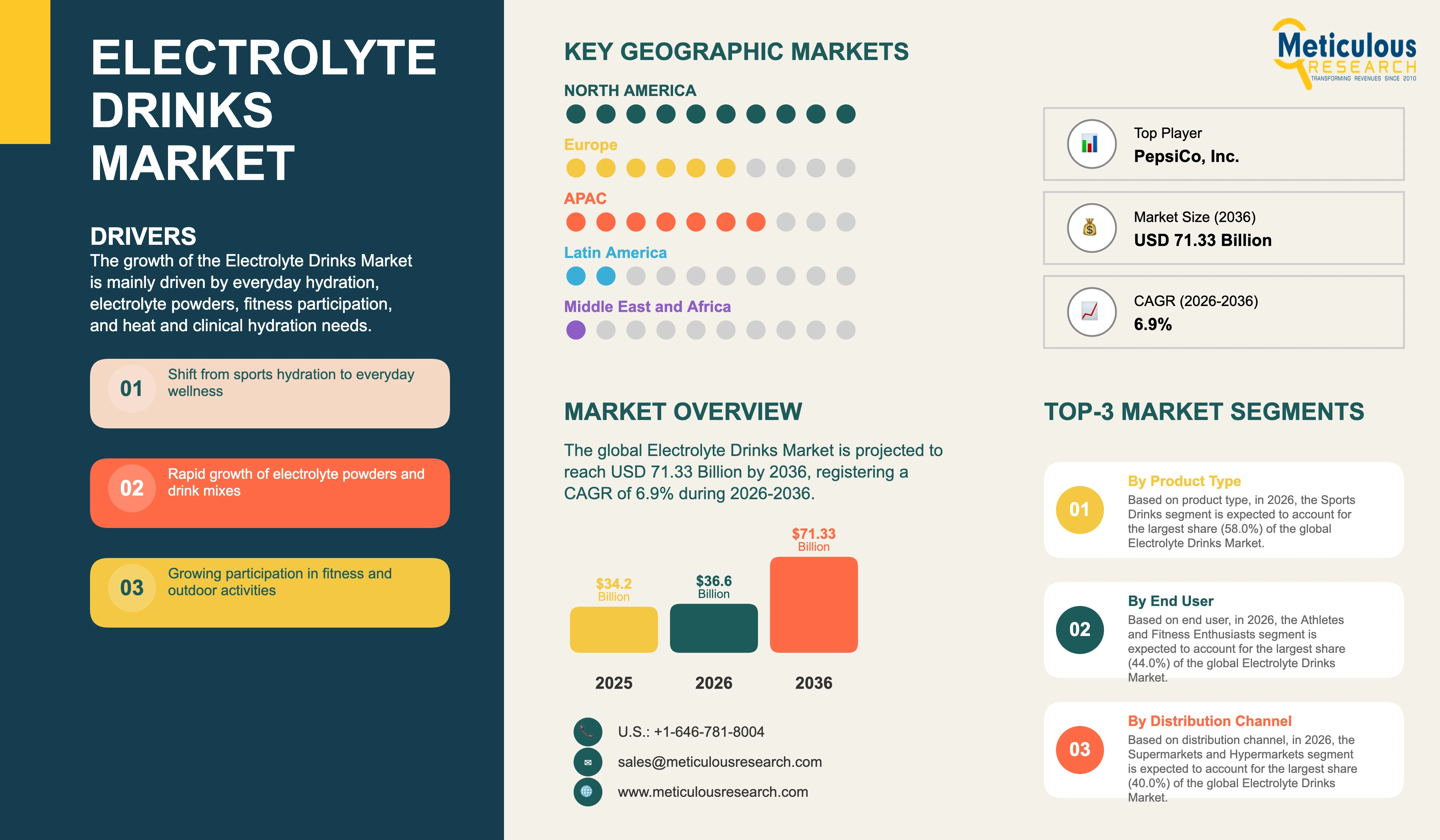
The global electrolyte drinks market was valued at USD 34.20 billion in 2025. This market is expected to reach USD 71.33 billion by 2036 from an estimated USD 36.60 billion in 2026, registering a CAGR of 6.9% during the forecast period (2026-2036).
- Published
- Nov 2026
- Pages
- 289
- Format
- PDF + Excel
- Report ID
- MRFB - 1042591
- Base year
- 2025
- 2025 · BASELINE
- $34.20B
- 2036
- $71.33B
- CAGR 2026–2036
- 6.9%
2025 baseline · 2026–2036 forecast at 6.9% CAGR · hover a bar for the value
Key highlights
According to Circana data reported by the Associated Press in April 2026, unit sales of sports drink mixes, such as powders from Liquid I.V., Skratch Labs, and Gatorade, rose nearly 20% in the year ending March 22, 2026, while bottled water sales were flat, and PepsiCo said that at least 150 brands have entered the hydration space in the past few years.
PepsiCo is repositioning Gatorade to reach non-athletes who want everyday hydration, and said Gatorade Lower Sugar, launched in March 2026 with 75% less sugar than the original, is one of the brand's biggest sellers in recent history, while a new Gatorade Longer Lasting product that combines glycerin and electrolytes is in development; Mintel research found that 60% of consumers who buy sports drinks are not athletes.
Electrolit, the Mexican rapid hydration brand distributed in the U.S. by Keurig Dr Pepper, grew sales by over 26% to USD 617.4 million in the 52 weeks ended July 3, 2025, according to Circana data reported by BevNET, and its maker is building a USD 400 million U.S. production facility, while sales of the celebrity-backed Prime fell 47.1% over the same period.
Circana data reported by CNN showed that U.S. sales of powdered hydration mixes have grown at double-digit rates for four consecutive years, including 20% growth in 2024 to become a USD 1.5 billion category, and Unilever's Liquid I.V. is on track to become a USD 1 billion brand, while Coca-Cola's BodyArmor Flash I.V. hydration drinks and powders generated USD 120 million in sales in their first year.
LMNT introduced a 12-ounce sparkling electrolyte drink with one gram of sodium per can and expanded into specialty retail, and other performance-focused brands are moving from online and specialty channels into mainstream retail, intensifying competition with established sports drink brands.
By product type, sports drinks account for the largest share of 58.0% in 2026, while electrolyte powders and drink mixes register the highest CAGR.
By formulation, regular accounts for the larger share in 2026, while low-sugar and zero-sugar registers the higher CAGR.
By end user, athletes and fitness enthusiasts account for the largest share of 44.0% in 2026, while everyday hydration and wellness consumers register the highest CAGR.
By distribution channel, supermarkets and hypermarkets account for the largest share in 2026, while online retail registers the highest CAGR.
By geography, North America accounts for the largest share of 38.0% in 2026, while Asia-Pacific registers the highest CAGR of 8.5%.
Report summary
| Particulars | Details |
|---|---|
| Base Year | 2025 |
| Estimated Year | 2026 |
| Forecast Period | 2026-2036 |
| Market Size in 2025 | USD 34.20 billion |
| Market Size in 2026 | USD 36.60 billion |
| Market Size by 2036 | USD 71.33 billion |
| CAGR (2026-2036) | 6.9% |
| Format | PDF, Excel & Cloud Portal · 289 pages |
| Largest Segment by Product Type (2026) | Sports Drinks (58.0%) |
| Largest Segment by End User (2026) | Athletes and Fitness Enthusiasts (44.0%) |
| Largest Region (2026) | North America (38.0%) |
| Fastest-Growing Region | Asia-Pacific (CAGR 8.5%) |
| Companies Profiled | 14 companies and other companies |
| Segments Covered | Product Type, Formulation, End User, Distribution Channel, Geography |
| Countries Covered | U.S., Canada, U.K., Germany, France, Spain, Italy, Netherlands, Sweden, Norway, Denmark, Poland, Belgium, Switzerland, Rest of Europe, Japan, China, India, South Korea, Australia, Indonesia, Thailand, Vietnam, Philippines, Malaysia, Singapore, Rest of Asia-Pacific, Mexico, Brazil, Argentina, Colombia, Chile, Peru, Rest of Latin America, Saudi Arabia, U.A.E., Egypt, South Africa, Nigeria, Rest of Middle East & Africa |
Report overview
Segments covered: product type, formulation, end user, distribution channel.
The growth of this market is mainly driven by the shift of hydration from a sports-only need to an everyday wellness habit, the rapid growth of electrolyte powders and drink mixes that are convenient, portable, and low in sugar, rising participation in fitness and outdoor activities, growing awareness of hydration needs during hot weather, illness, travel, and recovery, the reformulation of sports drinks toward low-sugar and zero-sugar options, the entry of many new brands and celebrity-backed products, and expanding distribution through e-commerce and mainstream retail. However, factors such as concerns about the sugar and sodium content of some products, scientific debate about whether non-athletes need electrolyte drinks, intense competition and price pressure, and regulatory scrutiny of health and hydration claims are expected to restrain the growth of this market to some extent.
Electrolyte drinks are beverages and drink mixes that contain minerals such as sodium, potassium, magnesium, calcium, and chloride, which help the body maintain fluid balance, nerve and muscle function, and hydration. They are used to replace fluids and electrolytes lost through sweat, illness, heat, and other causes. This report covers ready-to-drink sports drinks, electrolyte waters, oral rehydration solutions, electrolyte powders and drink mixes, and tablets and concentrates, sold in regular and low-sugar or zero-sugar formulations, through all distribution channels, and the market is measured on a sales value basis in U.S. dollars.
Sports drinks, such as Gatorade, Powerade, and BodyArmor, have long been the largest category, combining water, carbohydrates, and electrolytes to support athletes during and after exercise. Oral rehydration solutions, such as Pedialyte and products based on the World Health Organization's oral rehydration formula, were developed to treat dehydration from diarrhea and illness, especially in children and older adults. Electrolyte waters, which add minerals to water with little or no sugar, and electrolyte powders, tablets, and concentrates that consumers mix with water, have grown rapidly in recent years.
The market has changed significantly over the past decade, as hydration has moved from a sports and medical need into an everyday wellness habit. Consumers use electrolyte drinks for daily hydration, workouts, hot weather, travel, hangovers, illness, and general wellbeing, and social media trends have made hydration products part of daily routines. Mintel has found that most sports drink buyers are not athletes, and brands are repositioning their products for everyday consumers. Powder sticks, such as Liquid I.V., have become especially popular because they are convenient, portable, easy to store, and often lower in sugar than traditional sports drinks.
Consumer concern about sugar has led to strong growth in low-sugar and zero-sugar products. Gatorade has launched lower-sugar and zero-sugar versions, BodyArmor and Powerade offer zero-sugar options, and many new brands, such as LMNT, are sugar-free and high in sodium for people following low-carbohydrate diets or exercising intensely. At the same time, rapid hydration drinks with higher electrolyte levels, such as Electrolit, have grown quickly, especially among Hispanic consumers in the U.S. and consumers in Latin America.
The market has also seen a wave of new entrants, including startups, celebrity-backed brands, and large beverage companies launching new hydration lines. PepsiCo has said that at least 150 brands have entered the space in the last few years. Some of these brands have grown rapidly, while others, such as Prime, have seen sharp declines after initial success, showing the volatility of trend-driven products.
Ingredient and packaging choices are also changing, as brands are using natural flavors and sweeteners, adding vitamins and other functional ingredients, and offering recyclable or reduced-plastic packaging, including concentrates and powders that reduce the weight and volume of products shipped. These changes reflect consumer demand for cleaner labels and lower environmental impact, and they are reshaping product development and marketing across the market.
Regionally, North America is the largest market, supported by large sports drink and electrolyte powder categories in the U.S. Asia-Pacific is a major market, with strong demand for hydration drinks such as Pocari Sweat in Japan and other Asian countries, and fast growth in China, India, and Southeast Asia. Latin America is an important market for sports drinks and rapid hydration drinks, while Europe has a smaller but growing market for sports drinks and electrolyte products.
The market includes multinational beverage companies, consumer health companies, pharmaceutical companies, and specialized hydration brands. Leading companies include PepsiCo, The Coca-Cola Company, Abbott Laboratories, Unilever, Grupo Pisa, Otsuka Pharmaceutical, Suntory, Nestlé Health Science, Drink LMNT, Congo Brands, DripDrop, Skratch Labs, The Hydration Company, and Waterdrop.
Over the forecast period, the electrolyte drinks market is expected to grow steadily, as everyday hydration becomes a mainstream habit, as low-sugar and powder formats grow, as climate change increases the frequency of extreme heat, and as distribution expands in Asia-Pacific and other emerging markets.
Athletes and fitness enthusiasts are expected to account for the largest share of 44.0% of the market in 2026, while everyday hydration and wellness consumers are projected to register the highest CAGR as hydration becomes a daily habit.
North America is expected to account for the largest share of 38.0% of the market in 2026, mainly due to the very large U.S. sports drink market and the rapid growth of electrolyte powders and new hydration brands.
Asia-Pacific is projected to register the highest CAGR of 8.5% during the forecast period, driven by hot climates, the established Japanese hydration market, and rising incomes and sports participation in China, India, and Southeast Asia.
The report profiles 14 companies, including PepsiCo, Coca-Cola, Abbott, Unilever, Grupo Pisa, Otsuka, Suntory, Nestlé Health Science, Drink LMNT, Congo Brands, DripDrop, Skratch Labs, The Hydration Company, and Waterdrop.
Report infographic
Market dynamics
16 factors across 5 forcesShift from sports hydration to everyday wellness
Electrolyte drinks are no longer used only by athletes, as consumers increasingly use them for daily hydration, morning routines, work, travel, hot weather, recovery from illness and hangovers, and general wellness. Mintel research found that 60% of consumers who buy sports drinks are not athletes, and brands such as Liquid I.V. have grown by positioning themselves as wellness and daily hydration brands rather than sports drinks. PepsiCo is now marketing Gatorade to non-athletes and plans to label products that it says hydrate better or faster than water.
This shift has greatly expanded the potential consumer base for electrolyte drinks, from athletes and active people to a broad population that sees hydration as part of health and wellbeing. Social media trends, such as flavored water and hydration challenges, have reinforced the idea that people should drink more and that plain water can be improved with electrolytes and flavors. Consumers who do not enjoy plain water are also using electrolyte products to make water more appealing.
Older consumers are also adopting electrolyte drinks for daily hydration and to manage the effects of medications, and brands are developing products for specific occasions, such as morning hydration, travel, and sleep, which increases usage frequency.
The growing use of fitness trackers and smart water bottles that remind people to drink also supports this trend, as consumers become more aware of their daily fluid intake. Employers, schools, and healthcare providers increasingly promote hydration as part of wellbeing programs, which further normalizes the use of hydration products in daily life.
Rapid growth of electrolyte powders and drink mixes
Electrolyte powders and drink mixes, sold in single-serve sticks, tubs, and tablets, are one of the fastest-growing parts of the market. They are convenient, portable, and easy to store, they can be added to any water bottle, and they are often lower in sugar and cost per serving than ready-to-drink beverages. Circana data show that U.S. powdered hydration mixes have grown at double-digit rates for several years, and unit sales of sports drink mixes rose nearly 20% in the year ending March 2026.
Liquid I.V. has become one of the largest brands in the category and is on track to become a billion-dollar brand, while Gatorade, BodyArmor, Nuun, LMNT, DripDrop, and many others offer powders and tablets. Powders also suit e-commerce, retail multipacks, and subscription models, since they are light and inexpensive to ship. As more consumers adopt powders for daily hydration, this segment is expected to continue to outgrow ready-to-drink beverages.
Growing participation in fitness and outdoor activities
Participation in fitness, running, cycling, team sports, gym training, and outdoor activities has grown in many countries, supported by health awareness, social media, and fitness technology. Active consumers need to replace fluids and electrolytes lost through sweat, especially during long or intense exercise and in hot conditions, and they are the core users of sports drinks and performance hydration products worldwide.
High-sodium and performance-focused electrolyte products, such as LMNT and other performance brands, have grown among endurance athletes, CrossFit participants, and people following low-carbohydrate diets, while traditional sports drinks remain popular among team sports players and young consumers. The growth of youth sports and school athletics also supports demand.
Sports nutrition retailers, gyms, and race organizers also promote electrolyte products, and many endurance events now provide electrolyte drinks on the course, which introduces participants to specific brands, flavors, and formats.
Rising awareness of heat, illness, and clinical hydration needs
Climate change is increasing the frequency and intensity of heat waves in many regions, which raises the risk of dehydration and heat-related illness, especially among older adults, outdoor workers, and children. Public health agencies and employers increasingly promote hydration during hot weather, and electrolyte drinks are used to help people stay hydrated in these conditions.
Oral rehydration solutions are recommended for treating dehydration caused by diarrhea, vomiting, and other illnesses, and they are widely used for children, older adults, and travelers. Pediatricians and pharmacists commonly recommend products such as Pedialyte, and adult use of oral rehydration solutions has grown for hangovers, travel, and recovery from illness. Users of GLP-1 medications, which can cause gastrointestinal side effects and reduced fluid intake, are also a growing group of hydration consumers.
Table of contents
12 chapters · 159 sections · 289 pages · click to expandSegmental analysis
| Segment | Largest share (2026) | Fastest growth (2026–2036) |
|---|---|---|
| By Product Type | Sports drinks | Electrolyte powders and drink mixes |
By Product Type
- The regular segment is expected to account for the larger share of the electrolyte drinks market, while the low-sugar and zero-sugar segment is projected to register the higher CAGR during the forecast period.
- The supermarkets and hypermarkets segment is expected to account for the largest share of the electrolyte drinks market, while the online retail segment is projected to register the highest CAGR during the forecast period.
Geographic analysis
North America
Largest shareIn 2026, North America is expected to account for the largest share of 38.0% of the global electrolyte drinks market. The large share of this region is mainly due to the very large sports drink market in the U.S., led by Gatorade, Powerade, and BodyArmor, the rapid growth of electrolyte powders led by Liquid I.V., the popularity of oral rehydration solutions such as Pedialyte, the growth of rapid hydration drinks such as Electrolit, and the many new hydration brands launched in the U.S. Canada also has a well-developed market for sports drinks and electrolyte products. Hot summers in the southern U.S. and the large Hispanic population, which has embraced rapid hydration drinks, also support demand in the region.
Europe
Europe accounts for a significant share of the market, supported by sports drink brands such as Lucozade Sport, Powerade, and Isostar, and growing demand for electrolyte tablets and powders in the U.K., Germany, France, Spain, Italy, the Netherlands, and the Nordic countries. Sugar taxes and EU health claim rules shape the market, encouraging low-sugar products. Poland, Belgium, and Switzerland are also growing markets, and summer heat waves in southern Europe are increasing awareness of hydration needs.
Asia-Pacific
Fastest growthAsia-Pacific is projected to register the highest CAGR of 8.5% during the forecast period. The rapid growth of this region is mainly driven by hot climates in Southeast Asia, India, and Australia, the large and established hydration drink market in Japan, led by Pocari Sweat, rising incomes and sports participation in China, India, Indonesia, Thailand, Vietnam, and the Philippines, and the expansion of international and local brands. South Korea, Malaysia, and Singapore are also important markets for hydration drinks. India is a particularly large opportunity, with a hot climate, a large young population, and rising incomes, and both international and local brands are launching electrolyte drinks and powders there.
Latin America
Latin America is an important market, led by Mexico and Brazil, where sports drinks and rapid hydration drinks such as Electrolit are popular, and supported by Argentina, Colombia, Chile, and Peru.
Middle East & Africa
The Middle East & Africa have strong demand due to extreme heat, especially in Saudi Arabia, the U.A.E., and other Gulf countries, while South Africa, Egypt, and Nigeria are growing markets. Oral rehydration solutions are also widely used in Africa and South Asia to treat dehydration from diarrheal disease, supported by public health programs.
Competitive landscape
The global electrolyte drinks market is moderately consolidated, with the top five players estimated to account for about 55% of the market in 2025. The market includes multinational beverage companies, consumer health and pharmaceutical companies, and specialized hydration brands.
PepsiCo, with Gatorade, is the global market leader in sports drinks by a wide margin and has expanded into lower-sugar drinks, powders, and new hydration products. The Coca-Cola Company competes with Powerade and BodyArmor, including BodyArmor Flash I.V. Abbott Laboratories leads in oral rehydration solutions with Pedialyte, which is widely recommended by pediatricians, while Unilever's Liquid I.V. is a leader in electrolyte powders. Grupo Pisa's Electrolit has grown rapidly in the U.S. through its partnership with Keurig Dr Pepper, and Otsuka Pharmaceutical leads in Asia with Pocari Sweat, one of the best-known hydration brands in the region.
Suntory, through Lucozade Sport, is an important player in the U.K., Nestlé Health Science owns Nuun, and specialized brands such as Drink LMNT, DripDrop, Skratch Labs, The Hydration Company, and Waterdrop compete in powders, tablets, and performance hydration. Congo Brands' Prime has seen a sharp decline after rapid early growth.
The market is divided between a few very large companies that dominate sports drinks and oral rehydration solutions and a large number of smaller brands that compete mainly in powders, tablets, and premium electrolyte waters. Large companies benefit from distribution, marketing budgets, and bottling networks, while smaller brands rely on innovation, online sales, sponsorship of niche sports, and community marketing.
Companies in this market compete on taste, sugar content, electrolyte formulation, scientific claims, brand, price, convenience, and distribution. Key strategies adopted by these companies include launches of low-sugar and functional products, expansion into powders and new formats, partnerships with retailers and distributors, sponsorships, influencer marketing, acquisitions of fast-growing brands, and expansion in Asia-Pacific and Latin America.
We expect large beverage companies to continue to acquire, invest in, or partner with fast-growing hydration brands, and competition to remain intense as new brands continue to enter the market. Retailer private-label products are also expected to gain share in powders, where formulations are relatively easy to copy and consumers are price-sensitive.
Some of the key players operating in the electrolyte drinks market are PepsiCo, Inc., The Coca-Cola Company, Abbott Laboratories, Unilever PLC, Grupo Pisa (Electrolit), Otsuka Pharmaceutical Co., Ltd., Suntory Holdings Limited, Nestlé Health Science, Drink LMNT, Inc., Congo Brands, DripDrop Hydration, Inc., Skratch Labs, The Hydration Company (Hydralyte), and Waterdrop Microdrink GmbH, among others.
- —
PepsiCo repositioned Gatorade for everyday hydration and launched Gatorade Lower Sugar in 2026, U.S. sports drink mix unit sales rose nearly 20%, Electrolit grew sales by over 26% and is building a U.S. plant, and Unilever's Liquid I.V. moved toward USD 1 billion in annual sales.
- Drink LMNT
- DripDrop
- Skratch Labs
- Hydration Company
- Waterdrop
Expert perspectives
The global electrolyte drinks market is being transformed by the shift of hydration from a sports and medical need into an everyday wellness habit. This shift has greatly expanded the consumer base, created new product formats, and attracted many new brands, while forcing traditional sports drink brands to reformulate and reposition.
Over the forecast period, the market is expected to grow at a CAGR of 6.9%, from USD 36.60 billion in 2026 to USD 71.33 billion in 2036. Growth will be supported mainly by everyday hydration, powders and low-sugar products, fitness participation, heat-related hydration needs, and continued expansion in Asia-Pacific and Latin America.
Sports drinks remain the largest product type, while electrolyte powders and drink mixes grow fastest. Regular formulations account for the larger share, while low-sugar and zero-sugar formulations grow faster. Athletes and fitness enthusiasts are the largest end user, while everyday hydration and wellness consumers grow fastest. Supermarkets and hypermarkets remain the largest channel, while online retail grows fastest. North America remains the largest region, and Asia-Pacific is the fastest-growing region at a CAGR of 8.5%.
We expect the market to become increasingly segmented by need state, with products for performance, daily hydration, recovery, illness, and specific consumer groups. Brands that can support their claims with credible scientific evidence and build consumer trust will be better placed than trend-driven brands that rely mainly on marketing.
We expect powders and low-sugar products to account for a growing share of the market, while traditional full-sugar sports drinks grow more slowly. Ready-to-drink formats will remain important for convenience, chilled consumption, and impulse purchases, but powders will continue to gain share among everyday consumers who want flexible, low-cost hydration.
For established sports drink companies, the key priorities over the forecast period are to reduce sugar, expand into powders and functional products, and reach everyday consumers without losing their loyal core athlete base. For new brands, the main challenge is to build lasting loyalty and secure distribution in a crowded market.
In emerging markets, affordability will be critical, and we expect smaller packs, sachets, and lower-priced powders to drive adoption among consumers with limited budgets. Local manufacturing and partnerships with regional bottlers will help companies compete on price in these markets and respond quickly to local taste preferences.
We also expect climate change and rising average temperatures to increase awareness of heat-related dehydration, which could support long-term demand for hydration products, especially in hot regions and among the most vulnerable groups, such as older adults and outdoor workers.
Customer perspectives
Buyers of electrolyte drinks include athletes and fitness enthusiasts, everyday consumers, parents, older adults, patients, and retailers and foodservice operators. Their purchasing decisions depend mainly on taste, sugar content, electrolyte levels, convenience, price, brand trust, and perceived effectiveness.
Beverage Category Buyer - national grocery chain, U.S.
Sports drinks are still our biggest hydration category, but powders are where the growth is. We have added more shelf space for sticks and launched our own private-label electrolyte mix at a lower price.
This comment explains why sports drinks account for 58.0% of the market, why electrolyte powders and drink mixes are growing fastest, and why North America accounts for 38.0% of the market.
This comment explains why athletes and fitness enthusiasts account for 44.0% of the market and why low-sugar and zero-sugar formulations are growing faster.
This comment explains why everyday hydration and wellness consumers are the fastest-growing end user and why Asia-Pacific is the fastest-growing region.
Across these groups, consumers increasingly read labels to compare sugar, sodium, and ingredient lists, and they are willing to switch brands for better taste, lower sugar, or better value, which keeps competition intense.
“Our runners use high-sodium, low-sugar electrolyte products and tablets for long training sessions and races in the heat. Sugar-free options have become much more common, and athletes now compare sodium levels between brands.”
“I add an electrolyte stick to my water bottle every morning because plain water is boring and it helps in the hot weather, especially when I commute.”
Frequently asked questions
The global electrolyte drinks market was valued at USD 34.20 billion in 2025, up from USD 32.10 billion in 2024, and is estimated at USD 36.60 billion in 2026. The market includes all sports drinks, electrolyte waters, oral rehydration solutions, electrolyte powders and drink mixes, and tablets and concentrates.
Cite this report
Meticulous Research. (2026). Electrolyte Drinks Market - Global Opportunity Analysis and Industry Forecast (2026-2036) (Report No. MRFB - 1042591). Meticulous Market Research Pvt. Ltd. https://www.meticulousresearch.com/product/electrolyte-drinks-market-7274