Colostrum Supplements Market (2026-2036)
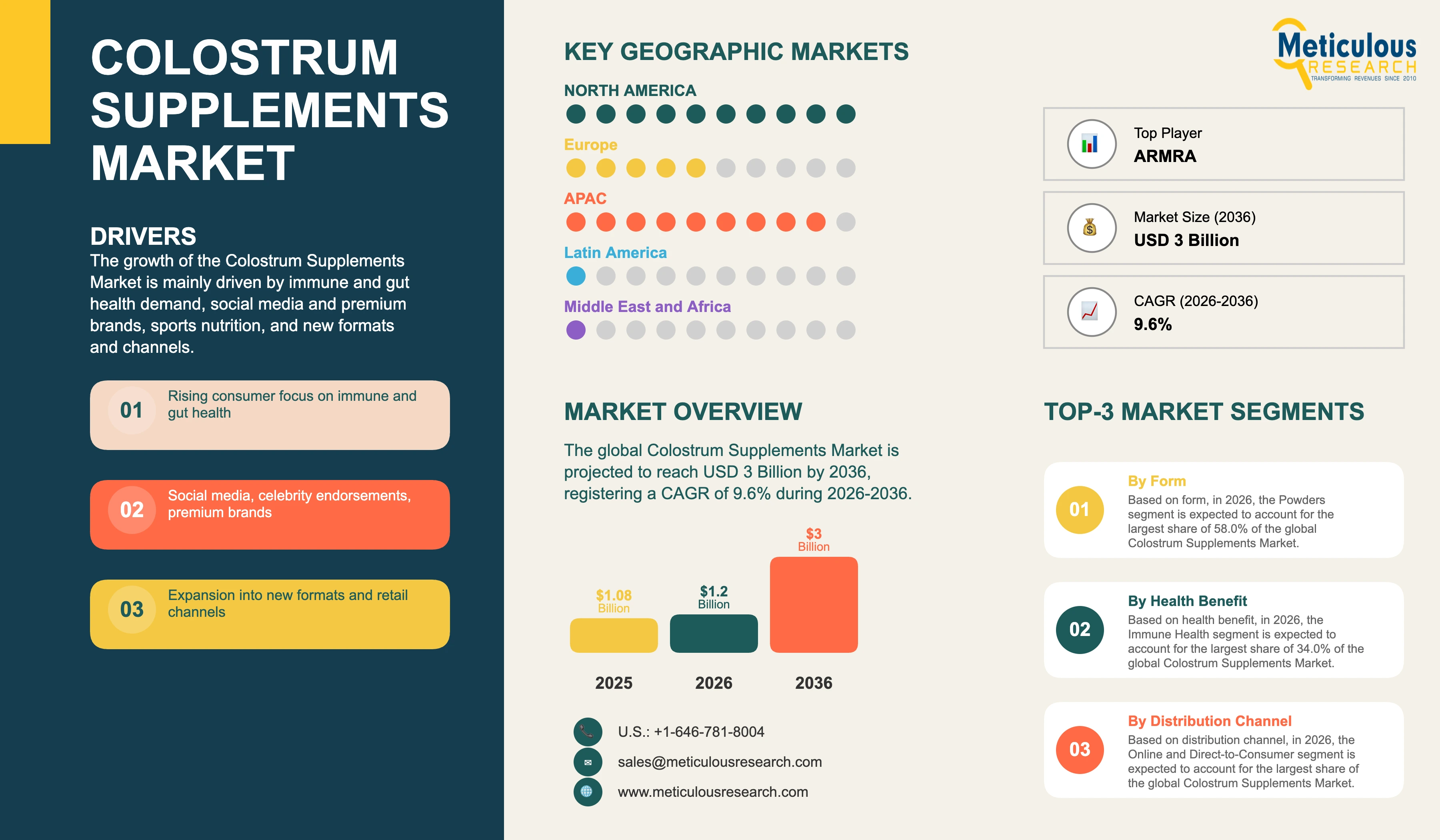
The global colostrum supplements market was valued at USD 1.08 billion in 2025. This market is expected to reach USD 3.00 billion by 2036 from an estimated USD 1.20 billion in 2026, registering a CAGR of 9.6% during the forecast period (2026-2036).
- Published
- Nov 2026
- Pages
- 253
- Format
- PDF + Excel
- Report ID
- MRFB - 1042594
- Base year
- 2025
- 2025 · BASELINE
- $1.08B
- 2036
- $3.00B
- CAGR 2026–2036
- 9.6%
2025 baseline · 2026–2036 forecast at 9.6% CAGR · hover a bar for the value
Key highlights
According to NielsenIQ data reported by The Hustle and others, U.S. retail sales of colostrum supplements reached more than USD 19 million in the 52 weeks ending January 2026, up more than 3,000% from about USD 612,000 two years earlier, as brands including ARMRA, Cowboy Colostrum, and Bloom Nutrition positioned bovine colostrum as a daily ritual for immunity, gut health, and skin.
Nutritional Outlook reported that colostrum sales in the U.S. hair, skin, and nails supplement category grew by 2,454.2% to just over USD 13 million in the mainstream multi-outlet channel, while collagen sales in the same category fell by 7.8%, showing colostrum's rapid rise as a beauty-from-within ingredient.
ARMRA, the physician-founded bovine colostrum brand, announced in July 2026 that it had expanded its retail footprint more than eight times in its second year of retail growth and surpassed 7,600 retail doors, including Sprouts Farmers Market, Erewhon, Walmart, and Whole Foods Market, and it launched a four-flavor ARMRA Colostrum Soda online on April 30, 2026, followed by a chainwide Sprouts launch beginning July 6, 2026.
Colostrum suppliers and brands report that demand has at times run ahead of supply, since colostrum is produced only in the first days after calving and must be collected after calves receive what they need, which makes sourcing, standardization of immunoglobulin content, and long-term supply security key competitive factors for brands and ingredient suppliers.
Asia-Pacific is a major and long-established market for colostrum supplements, with long-established demand for colostrum powders and tablets in China, Australia, New Zealand, Japan, South Korea, and Southeast Asia, and Australian and New Zealand dairy companies supply colostrum products to consumers across the region, often through pharmacies and cross-border e-commerce platforms that serve buyers in mainland China.
By form, powders account for the largest share of 58.0% in 2026, while ready-to-drink beverages and shots register the highest CAGR.
By health benefit, immune health accounts for the largest share of 34.0% in 2026, while hair, skin, and nails register the highest CAGR.
By source, bovine colostrum accounts for the larger share in 2026, while goat and other colostrum registers the higher CAGR.
By distribution channel, online and direct-to-consumer accounts for the largest share in 2026, while supermarkets and mass merchandisers register the highest CAGR.
By geography, North America accounts for the largest share of 38.0% in 2026, while Asia-Pacific registers the highest CAGR of 10.9%.
Report summary
| Particulars | Details |
|---|---|
| Base Year | 2025 |
| Estimated Year | 2026 |
| Forecast Period | 2026-2036 |
| Market Size in 2025 | USD 1.08 billion |
| Market Size in 2026 | USD 1.20 billion |
| Market Size by 2036 | USD 3.00 billion |
| CAGR (2026-2036) | 9.6% |
| Format | PDF, Excel & Cloud Portal · 253 pages |
| Largest Segment by Form (2026) | Powders (58.0%) |
| Largest Segment by Health Benefit (2026) | Immune Health (34.0%) |
| Largest Region (2026) | North America (38.0%) |
| Fastest-Growing Region | Asia-Pacific (CAGR 10.9%) |
| Companies Profiled | 13 companies and other companies |
| Segments Covered | Form, Health Benefit, Source, Distribution Channel, Geography |
| Countries Covered | U.S., Canada, China, Australia, New Zealand, Japan, South Korea, India, Indonesia, Thailand, Vietnam, Malaysia, Singapore, Rest of Asia-Pacific, Germany, U.K., Netherlands, France, Poland, Sweden, Norway, Denmark, Italy, Spain, Switzerland, Belgium, Rest of Europe, Brazil, Mexico, Argentina, Chile, Colombia, Rest of Latin America, Saudi Arabia, U.A.E., Israel, Turkey, South Africa, Rest of Middle East & Africa |
Report overview
Segments covered: form, health benefit, source, distribution channel.
The growth of this market is mainly driven by rising consumer interest in immune and gut health, the rapid popularity of bovine colostrum as a multi-benefit daily wellness supplement promoted through social media and celebrity endorsements, growing use of colostrum in sports nutrition for recovery and gut integrity, the expansion of colostrum products into new formats such as flavored powders, chewables, gummies, and ready-to-drink beverages, wider retail distribution of leading brands, and strong demand in Asia-Pacific, where colostrum has long been used in supplements for children and older adults. However, factors such as the limited and mixed clinical evidence for many claimed benefits, high prices, limited supply of high-quality colostrum, dairy allergy and lactose concerns, and regulatory restrictions on health claims are expected to restrain the growth of this market to some extent.
Colostrum is the first milk produced by mammals in the days immediately after giving birth. It is much richer than regular milk in immunoglobulins, especially IgG, lactoferrin, growth factors, and other bioactive proteins that help protect and develop the newborn's immune system and gut. Colostrum supplements are made mainly from bovine colostrum collected from dairy cows after calves have been fed, which is pasteurized, dried, and sold as powders, capsules, tablets, chewables, gummies, and beverages. This report covers colostrum supplements for human consumption across forms, health benefits, sources, and distribution channels, and it excludes colostrum used in infant formula ingredients, animal nutrition, and cosmetics. The market is measured on a sales value basis.
Colostrum has been used as a supplement for decades, especially in Asia-Pacific, New Zealand, Australia, and parts of Europe, where colostrum tablets and powders are commonly taken by children, older adults, and athletes to support immunity. In the U.S., colostrum was a small niche product until recently, when it became one of the fastest-growing supplement ingredients, driven by social media, celebrity endorsements, and new brands that positioned it as a single daily ritual for immunity, gut health, energy, and skin.
The scientific basis for colostrum supplements is strongest for gut health and sports-related applications. Studies have suggested that bovine colostrum may help maintain the gut barrier, reduce gut permeability during intense exercise, and support recovery, and some research has explored benefits for upper respiratory infections and immune markers. However, many of the broader claims made in consumer marketing, such as benefits for skin, hair, and overall vitality, are supported by limited evidence, and experts have cautioned that sales growth has outpaced the science.
Most published research uses doses, product grades, and study populations that differ from the products and consumers seen in mainstream retail, so brands and buyers need to read the evidence carefully. Where studies exist, they tend to focus on athletes, older adults, and people with specific gut conditions rather than on healthy everyday consumers, which is the group most premium brands now target.
Bovine colostrum dominates the market because dairy farms produce large volumes and because the immune proteins in bovine colostrum are similar to those in human colostrum. Goat colostrum and other sources serve smaller niches, including consumers who prefer goat dairy. Product quality depends on how colostrum is collected, how quickly it is processed, and how it is dried, and brands increasingly emphasize first-milking collection, low-heat processing, standardized immunoglobulin levels, and grass-fed or pasture-raised sourcing.
Powders are the largest form, since they deliver larger doses and can be mixed into water, smoothies, coffee, or food, and premium brands sell flavored and unflavored powders in jars and travel sticks. Capsules and tablets are widely used, especially in Asia-Pacific and for lower-dose products, while chewables, gummies, and ready-to-drink colostrum beverages are new and fast-growing formats designed to make colostrum easier and more enjoyable to consume.
Distribution of colostrum supplements has expanded rapidly over the past two years, and leading brands started with direct-to-consumer online sales and subscriptions and have moved into natural and specialty grocery chains, mass retailers, pharmacies, and club stores. Online marketplaces, social commerce, and influencer marketing remain central to brand building, while retail expansion makes colostrum available to a broader range of consumers.
The market includes premium direct-to-consumer brands, established supplement companies, dairy-based ingredient suppliers, and Asia-Pacific colostrum brands. Leading companies include ARMRA, Nestlé Health Science (Vital Proteins), Bloom Nutrition, Cowboy Colostrum, NOW Foods, Jarrow Formulas, New Image International, Good Health Products, PanTheryx, Sterling Technology, Ingredia, Mt. Capra Products, and Immune Tree.
Over the forecast period, the colostrum supplements market is expected to grow strongly, as consumer interest in immune and gut health continues, as brands expand distribution and launch new formats, as clinical research develops, and as demand grows in Asia-Pacific. However, growth may become more moderate in the U.S. after the initial surge, and long-term success will depend on evidence, quality, and supply.
North America is expected to account for the largest share of 38.0% of the market in 2026, mainly due to the very rapid growth of premium colostrum brands in the U.S. and expanding retail distribution.
Asia-Pacific is projected to register the highest CAGR of 10.9% during the forecast period, driven by long-established acceptance of colostrum, demand for immune products for children and older adults, and cross-border e-commerce.
The report profiles 13 companies, including ARMRA, Nestlé Health Science (Vital Proteins), Bloom Nutrition, Cowboy Colostrum, NOW Foods, Jarrow Formulas, New Image International, Good Health Products, PanTheryx, Sterling Technology, Ingredia, Mt. Capra Products, and Immune Tree.
Report infographic
Market dynamics
17 factors across 5 forcesRising consumer focus on immune and gut health
Consumer interest in immune health increased sharply during the COVID-19 pandemic and has remained high, while gut health has become one of the most important wellness topics, as research and media coverage link the gut microbiome and gut barrier to digestion, immunity, mood, and overall health. Colostrum appeals to both trends, since it contains immunoglobulins and lactoferrin associated with immune support and growth factors associated with gut barrier integrity.
Consumers are increasingly looking for natural, whole-food ingredients that can support several aspects of health at once, and colostrum is often marketed as a multi-benefit superfood. This positioning has helped colostrum stand out from single-benefit supplements and attract consumers who want to simplify their supplement routines.
Older adults, who face declining immunity with age, and parents seeking immune support for children are also important consumer groups, especially in Asia-Pacific, where colostrum has long been used for these purposes.
The growing popularity of gut microbiome testing, functional medicine practitioners, and wellness podcasts has also raised awareness of gut barrier function and leaky gut, which are topics that colostrum brands often address directly in their education and marketing. As consumers learn more about these topics, many look for products that go beyond probiotics, and colostrum is often presented as a complementary option that supports the gut lining rather than the gut bacteria.
Social media, celebrity endorsements, and premium brand building
Social media, influencers, and celebrities have played a central role in the rapid growth of colostrum in the U.S. Brands such as ARMRA have built strong communities through content about gut health, immunity, and beauty, and they have benefited from endorsements by well-known personalities. Colostrum has become a popular topic on social media platforms, with users sharing morning routines and product reviews.
This marketing has helped transform colostrum from an unfamiliar ingredient into a mainstream wellness trend in a short period, driving very rapid growth in retail sales. Premium pricing and strong brand identity have allowed leading brands to build profitable businesses and expand into retail. Mainstream supplement brands, such as Vital Proteins, have entered the category, which further increases awareness.
The speed of this growth is shown by NielsenIQ data, which found that U.S. tracked retail sales of colostrum supplements rose from about USD 612,000 to more than USD 19 million in two years. Fast-growing brands such as Cowboy Colostrum and Bloom Nutrition have used social media and creator partnerships to reach younger consumers, and the attention has encouraged retailers to give colostrum more shelf space and to add new brands.
Use in sports nutrition and recovery
Colostrum has a long history of use in sports nutrition, where it is taken to support recovery, gut integrity during intense exercise, and immune function in athletes who train heavily. Research has suggested that bovine colostrum may reduce exercise-induced gut permeability and support recovery, which has made it popular among endurance athletes, team sports players, and fitness enthusiasts.
Sports nutrition brands are adding colostrum to protein powders, recovery products, and standalone supplements, and sports retailers and online channels are expanding their colostrum ranges. The growing participation in fitness and endurance sports supports this demand.
Professional and collegiate sports teams, military research programs, and endurance athletes have studied or used colostrum for gut and immune support during heavy training, and these associations give the ingredient credibility among serious athletes. Hybrid fitness, running, cycling, and triathlon communities are also active on social media, where athletes share their supplement routines and help introduce colostrum to new consumers.
Expansion into new formats and retail channels
Brands are launching new colostrum formats, including flavored powders, single-serve travel sticks, chewables, gummies, and ready-to-drink beverages such as ARMRA's Colostrum Soda, which make colostrum easier to use and more appealing to new consumers. These formats also allow brands to enter new store sections, such as refrigerated beverages and snacks, and to reach consumers who do not use traditional supplements.
At the same time, leading brands are expanding from online and specialty channels into mass retail, grocery, pharmacies, and club stores, which greatly increases the number of consumers who can find colostrum products. ARMRA's expansion to more than 7,600 retail doors in 2026 is an example of how quickly distribution has grown.
Retail expansion also brings new consumers who would not seek out a premium online brand. Shoppers who see colostrum next to collagen, probiotics, and protein powders in grocery and mass stores can try it more easily, and smaller sizes, travel sticks, and lower-priced options help reduce the cost of a first purchase.
Table of contents
12 chapters · 154 sections · 253 pages · click to expandSegmental analysis
| Segment | Largest share (2026) | Fastest growth (2026–2036) |
|---|---|---|
| By Form | Immune health | Nails |
By Form
- Immune health is expected to account for the largest share of 34.0% of the market in 2026, while hair, skin, and nails is projected to register the highest CAGR.
- The bovine colostrum segment is expected to account for the larger share of the colostrum supplements market, while the goat and other colostrum segment is projected to register the higher CAGR during the forecast period.
- The online and direct-to-consumer segment is expected to account for the largest share of the colostrum supplements market, while the supermarkets and mass merchandisers segment is projected to register the highest CAGR during the forecast period.
Geographic analysis
North America
Largest shareIn 2026, North America is expected to account for the largest share of 38.0% of the global colostrum supplements market. The large share of this region is mainly due to the very rapid growth of colostrum supplements in the U.S., driven by premium brands such as ARMRA, Cowboy Colostrum, and Bloom Nutrition, high consumer spending on supplements, the influence of social media and celebrity endorsements, the entry of mainstream brands such as Vital Proteins, and expanding retail distribution. Canada also has growing demand for colostrum supplements. The U.S. has a large supply of bovine colostrum from its dairy industry. U.S. colostrum ingredient suppliers, such as PanTheryx and Sterling Technology, support both domestic brands and exports, and the large U.S. dairy herd provides a strong base for collection. The strong performance of U.S. brands has also encouraged colostrum launches in Canada.
Asia-Pacific
Asia-Pacific is the second-largest market and is projected to register the highest CAGR of 10.9% during the forecast period. The rapid growth of this region is mainly driven by long-established consumer acceptance of colostrum in China, Australia, New Zealand, Japan, South Korea, and Southeast Asia, strong demand for immune health products for children and older adults, rising incomes, and cross-border e-commerce. New Zealand and Australia are major producers and exporters of colostrum products, while China is one of the largest consuming markets. India, Indonesia, Thailand, Vietnam, and Malaysia are growing markets.
Europe
Europe accounts for a significant share of the market, supported by demand for colostrum supplements in Germany, the U.K., the Netherlands, France, Poland, the Nordic countries, Italy, and Spain, and the presence of colostrum ingredient suppliers such as Ingredia. EU restrictions on health claims limit marketing, but interest in gut health and sports nutrition supports growth. Switzerland and Belgium are also important markets. In Europe, colostrum is often sold through pharmacies, health food stores, and online retailers, and Nordic and German consumers are among the most active buyers of colostrum supplements in the region.
Latin America
Latin America and the Middle East & Africa account for smaller shares of the market. Brazil and Mexico are the largest markets in Latin America, supported by growing supplement use and dairy production, while Argentina, Chile, and Colombia are emerging markets.
Middle East & Africa
In the Middle East & Africa, Saudi Arabia, the U.A.E., Israel, Turkey, and South Africa have growing demand for colostrum supplements, mainly through pharmacies and e-commerce.
Competitive landscape
The global colostrum supplements market is fragmented, with the top five players estimated to account for about 30% of the market in 2025. The market includes premium direct-to-consumer brands, established supplement companies, colostrum ingredient suppliers, and Asia-Pacific colostrum brands.
ARMRA is one of the leading brands in the U.S., with premium bovine colostrum powders, travel sticks, and beverages, a strong direct-to-consumer business, and rapidly expanding retail distribution. Cowboy Colostrum and Bloom Nutrition are other fast-growing U.S. brands, while Nestlé Health Science's Vital Proteins has entered the category with colostrum products. NOW Foods, Jarrow Formulas, and Immune Tree offer colostrum supplements through natural and specialty channels.
In Asia-Pacific, New Image International and Good Health Products are well-known New Zealand colostrum brands, and many local and regional brands compete in China, Australia, and Southeast Asia. PanTheryx and Sterling Technology supply colostrum ingredients and products in the U.S., Ingredia supplies colostrum ingredients in Europe, and Mt. Capra Products offers goat colostrum products for consumers who prefer goat dairy.
The market is fragmented because colostrum is sold by many brands across different regions and channels, and because entry barriers are relatively low for brands that source colostrum from ingredient suppliers. However, securing reliable supply of high-quality colostrum, building brand trust, and investing in research are becoming more important as the market grows, which favors larger and better-capitalized companies.
Access to national retail distribution is another important competitive factor in this market, and brands that have secured space in national grocery and mass retailers have a large advantage over smaller online brands, and retailers tend to favor brands with strong marketing support and proven sales.
Companies compete on product quality, sourcing transparency, standardization, clinical evidence, brand strength, price, format, and distribution. Key strategies include product launches in new formats, retail expansion, influencer and celebrity marketing, investments in supply and processing, clinical research, and expansion in Asia-Pacific.
We expect consolidation as large supplement and consumer health companies acquire fast-growing colostrum brands or launch their own products, and as competition increases from private-label and lower-priced products.
Partnerships between brands and colostrum ingredient suppliers are also becoming more important, as brands try to secure long-term supply and consistent quality during periods of rapid demand growth.
Some of the key players operating in the colostrum supplements market are ARMRA, Nestlé Health Science (Vital Proteins), Bloom Nutrition, Cowboy Colostrum, NOW Foods, Jarrow Formulas, New Image International, Good Health Products Ltd., PanTheryx, Inc., Sterling Technology, Inc., Ingredia SA, Mt. Capra Products, and Immune Tree, among others.
- —
U.S. colostrum supplement sales grew more than 3,000% in two years to over USD 19 million in tracked retail, ARMRA expanded to more than 7,600 retail doors and launched its four-flavor Colostrum Soda in 2026, and colostrum grew rapidly in the U.S. hair, skin, and nails category while collagen sales declined.
- ARMRA
- Nestlé Health Science · Vital Proteins
- Bloom Nutrition
- Cowboy Colostrum
- NOW Foods
- Jarrow Formulas
- New Image International
- Good Health Products Ltd.
- PanTheryx, Inc.
- Sterling Technology, Inc.
- Ingredia SA
- Mt. Capra Products
- Immune Tree
Expert perspectives
Colostrum supplements have moved from a niche ingredient to one of the fastest-growing supplement categories in the U.S., while remaining an established category in Asia-Pacific. The combination of immune and gut health positioning, social media marketing, and new formats has created strong momentum.
Over the forecast period, the market is expected to grow at a CAGR of 9.6%, from USD 1.20 billion in 2026 to USD 3.00 billion in 2036. Growth will be supported by immune and gut health demand, new formats, retail expansion, sports nutrition, and growth in Asia-Pacific.
Powders remain the largest form of colostrum supplements, while ready-to-drink beverages and shots grow fastest. Immune health is the largest health benefit, while hair, skin, and nails grows fastest. Bovine colostrum dominates, while goat and other colostrum grows faster. Online and direct-to-consumer is the largest channel, while supermarkets and mass merchandisers grow fastest. North America is the largest region, and Asia-Pacific is the fastest-growing region at a CAGR of 10.9%.
We note that the very rapid growth seen in the U.S. in 2024 and 2025 is unlikely to continue at the same pace, and we expect growth to moderate as the category matures. Long-term success will depend on whether brands can retain customers through real benefits, credible evidence, and consistent quality, rather than relying on social media momentum alone.
In our view, the U.S. category is moving from an early hype phase to a more competitive phase, with more brands, more retail shelf space, and more price competition. Brands that cannot show clear benefits or differentiate on quality may struggle as consumers become more selective and as retailers reduce the number of brands they carry.
Supply of high-quality colostrum is a structural constraint, and companies that secure long-term supply partnerships with dairy farms and processors will have an advantage. Standardization of bioactive content and transparent sourcing will become important points of competition.
Asia-Pacific remains a large and steady market with strong cultural acceptance of colostrum, and we expect it to grow faster than North America over the forecast period. Companies that combine strong brands, evidence, and supply will be best positioned in both regions.
We also expect beverages and other convenient formats to become an important part of the category, since they make colostrum easier to try and help brands reach consumers outside the supplement aisle.
For new entrants, the opportunity lies mainly in differentiated formats, targeted products for athletes, older adults, and digestive health, and evidence-based positioning, since generic colostrum powders are likely to face increasing price competition.
Customer perspectives
Wellness consumer, 34 - U.S.
I replaced two of my supplements with a colostrum powder that I mix into my morning coffee. I chose a brand that explains how the colostrum is collected and tested.
This comment explains why powders account for 58.0% of the market, why online and direct-to-consumer is the largest channel, and why North America accounts for 38.0% of the market.
It also shows that consumers who replace several supplements with one product are willing to pay a premium, but expect clear information about sourcing and testing.
This comment explains why immune health accounts for 34.0% of the market and why Asia-Pacific is the fastest-growing region.
It also shows that colostrum is a familiar, trusted product in Australia and New Zealand, where it is sold through pharmacies and bought for family members in other Asia-Pacific countries.
Category Buyer - natural grocery chain, U.S.
Colostrum went from a few online brands to one of our fastest-growing supplement sets, and now we are adding colostrum drinks in the cooler.
This comment explains why supermarkets and mass merchandisers and ready-to-drink beverages and shots are the fastest-growing segments.
“Colostrum has been popular with our customers for years, especially parents and older people looking for immune support. Many buy it to send to family members in Asia.”
Frequently asked questions
The global colostrum supplements market was valued at USD 1.08 billion in 2025, up from USD 960 million in 2024, and is estimated at USD 1.20 billion in 2026. The market includes colostrum powders, capsules and tablets, chewables and gummies, ready-to-drink beverages, and other forms for human consumption.
Cite this report
Meticulous Research. (2026). Colostrum Supplements Market - Global Opportunity Analysis and Industry Forecast (2026-2036) (Report No. MRFB - 1042594). Meticulous Market Research Pvt. Ltd. https://www.meticulousresearch.com/product/colostrum-supplements-market-7277