Steer-by-Wire Systems Market (2026-2036)
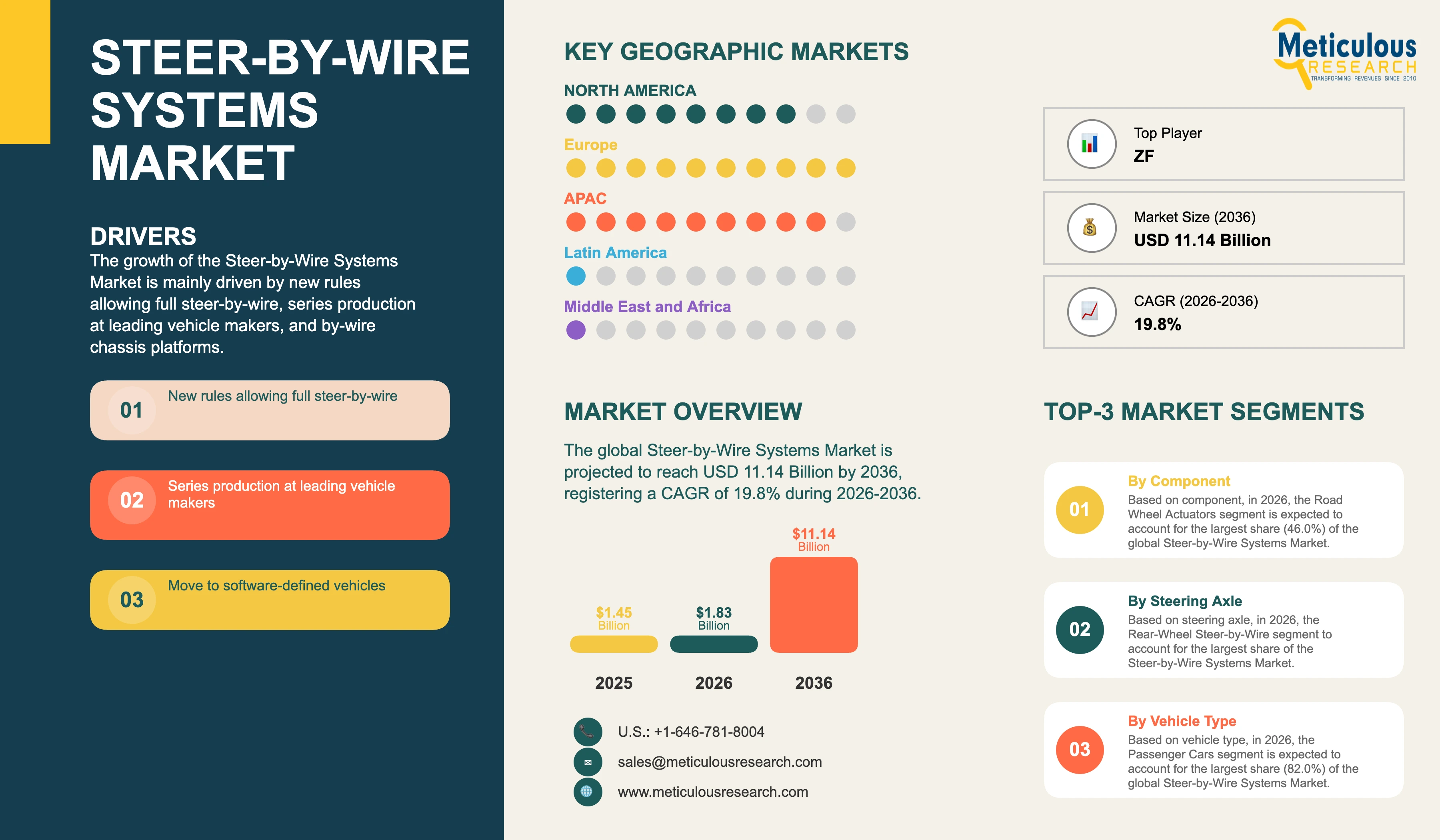
The global steer-by-wire systems market was valued at USD 1.45 billion in 2025. This market is expected to reach USD 11.14 billion by 2036 from an estimated USD 1.83 billion in 2026, registering a CAGR of 19.8% during the forecast period (2026-2036).
- Published
- Nov 2026
- Pages
- 271
- Format
- PDF + Excel
- Report ID
- MRAUTO - 1042854
- Base year
- 2025
- 2025 · BASELINE
- $1.45B
- 2036
- $11.14B
- CAGR 2026–2036
- 19.8%
2025 baseline · 2026–2036 forecast at 19.8% CAGR · hover a bar for the value
Key highlights
China has released a new national standard for vehicle steering systems, GB 17675-2025, which takes effect on July 1, 2026, and removes the long-standing requirement for a mechanical link between the steering wheel and the wheels, allowing full steer-by-wire systems, according to CarNewsChina and Gasgoo. Nio, BAIC, Xpeng, BYD, Geely, Xiaomi, and Huawei, as well as Toyota and Mercedes-Benz joint ventures in China, took part in drafting the standard.
ZF began series production of its steer-by-wire system for the Nio ET9 electric flagship in February 2025, with no mechanical connection between the steering wheel and the front wheels. ZF said it had another customer already in series production and had won further orders in America and Europe, according to ZF.
Mercedes-Benz announced in April 2025 that it will introduce steer-by-wire in production vehicles in 2026, and ZF confirmed in July 2025 that it will supply Mercedes-Benz with steer-by-wire technology starting in 2026, according to Wards Auto and ZF.
Vehicles already using steer-by-wire include the Tesla Cybertruck, the Nio ET9, the IM L6, and the Infiniti Q50, which was the first production car with steer-by-wire but kept a mechanical backup, according to CarNewsChina. Toyota and Lexus have also developed steer-by-wire systems with yoke-style steering controls for their electric models.
ZF announced a major order to supply almost five million vehicles from a leading global vehicle maker with its electromechanical brake-by-wire technology, showing how quickly by-wire chassis systems are moving into volume production, according to ZF. Steer-by-wire and brake-by-wire are often developed together as part of software-defined chassis platforms.
Rear-wheel steering systems, which use steer-by-wire actuators on the rear axle with no mechanical link to the steering wheel, are offered on many premium and electric vehicles from brands such as Porsche, Mercedes-Benz, Audi, BMW, and several Chinese electric vehicle makers. These systems make vehicles easier to park and more stable at high speeds and account for most steer-by-wire revenue today. Their use on large electric SUVs is growing as these vehicles become longer and heavier.
By component, road wheel actuators account for the largest share of 46.0% in 2026, while sensors and software registers the highest CAGR.
By steering axle, rear-wheel steer-by-wire accounts for the larger share in 2026, while front-wheel steer-by-wire registers the higher CAGR.
By vehicle type, passenger cars account for the largest share of 82.0% in 2026 and also register the highest CAGR.
By propulsion type, battery electric vehicles account for the largest share in 2026 and also register the highest CAGR.
By geography, Europe accounts for the largest share of 36.0% in 2026, while Asia-Pacific registers the highest CAGR of 24.3%.
Report summary
| Particulars | Details |
|---|---|
| Base Year | 2025 |
| Estimated Year | 2026 |
| Forecast Period | 2026-2036 |
| Market Size in 2025 | USD 1.45 billion |
| Market Size in 2026 | USD 1.83 billion |
| Market Size by 2036 | USD 11.14 billion |
| CAGR (2026-2036) | 19.8% |
| Format | PDF, Excel & Cloud Portal · 271 pages |
| Largest Segment by Component (2026) | Road Wheel Actuators (46.0%) |
| Largest Segment by Vehicle Type (2026) | Passenger Cars (82.0%) |
| Largest Region (2026) | Europe (36.0%) |
| Fastest-Growing Region | Asia-Pacific (CAGR 24.3%) |
| Companies Profiled | 11 companies and other companies |
| Segments Covered | Component, Steering Axle, Vehicle Type, Propulsion Type, Geography |
| Countries Covered | U.S., Canada, Germany, France, U.K., Italy, Spain, Sweden, Czech Republic, Hungary, Netherlands, Austria, Belgium, Rest of Europe, China, Japan, South Korea, India, Taiwan, Thailand, Australia, Indonesia, Malaysia, Rest of Asia-Pacific, Brazil, Mexico, Argentina, Chile, Colombia, Rest of Latin America, Saudi Arabia, U.A.E., Israel, Turkey, South Africa, Rest of Middle East & Africa |
Report overview
Segments covered: component, steering axle, vehicle type, propulsion type.
The market is at an early stage for front-axle steer-by-wire, which is only now entering series production at a handful of vehicle makers, while rear-axle steer-by-wire actuators used for rear-wheel steering are already established on many premium vehicles.
The growth of this market is mainly driven by new rules that allow steering systems without a mechanical connection, such as China's new national steering standard that takes effect in July 2026, the start of series production of front-axle steer-by-wire at Tesla, NIO, and Mercedes-Benz, the move by vehicle makers to software-defined vehicles and by-wire chassis platforms, the need for steering systems that support higher levels of automated driving, and the design freedom that steer-by-wire offers for vehicle interiors and new steering controls. In addition, the growing use of rear-wheel steering on electric SUVs and sedans is creating steady demand for rear-axle actuators. However, the high cost of redundant hardware and software, strict functional safety requirements, and driver and regulator concerns about removing the steering column are expected to restrain the growth of this market to some extent.
A steer-by-wire system replaces the mechanical connection between the steering wheel and the road wheels with electronic controls. Sensors measure the driver's steering input, an electronic control unit calculates the required steering angle, and one or more electric actuators turn the wheels. A separate feedback actuator at the steering wheel creates the feel of the road for the driver. Because there is no steering column linking the steering wheel to the steering gear, steer-by-wire systems must use redundant sensors, control units, power supplies, and communication paths to make sure the vehicle can still be steered if one part fails.
This report covers the global steer-by-wire systems market, including road wheel actuators, steering feedback actuators, electronic control units, and sensors and software, for front-axle and rear-axle steer-by-wire applications in passenger cars, commercial vehicles, and off-highway and special vehicles. The market is analyzed by component, steering axle, vehicle type, propulsion type, and geography. Conventional electric power steering systems with a mechanical steering column, hydraulic steering systems, and steering wheels and switches are not included.
Steer-by-wire technology has been in development for many years, but its use in production vehicles has been limited by safety rules and cost. The Infiniti Q50 introduced a steer-by-wire system in 2013 but kept a mechanical backup clutch. In recent years, the Tesla Cybertruck, the Nio ET9, and the IM L6 have introduced front-axle steer-by-wire without a mechanical backup, and Mercedes-Benz plans to launch steer-by-wire in 2026. Rear-wheel steering systems, which use steer-by-wire actuators on the rear axle, have been offered on premium vehicles for longer and are now common on large electric SUVs and sedans.
Regulation has been one of the main barriers to front-axle steer-by-wire in China, Europe, and other major markets. Many countries' rules required a mechanical connection between the steering wheel and the wheels, or made approval of systems without one difficult. China's new steering standard, GB 17675-2025, which takes effect on July 1, 2026, removes the requirement for a mechanical link and sets safety and functional requirements for steer-by-wire systems. Vehicle makers and suppliers expect this to speed up adoption in China, the world's largest car market, and to influence rules in other regions.
Steer-by-wire offers several benefits for vehicle makers and drivers, from easier parking to new cabin layouts. It allows the steering ratio to change with speed, so the vehicle is easy to maneuver when parking and stable on the highway. It removes the steering column, which frees space in the cabin, reduces noise and vibration, and improves crash safety. It also makes it possible to use new steering controls, such as yokes, and to retract or move the steering wheel during automated driving. For vehicle makers, steer-by-wire allows steering feel to be tuned through software rather than mechanical changes, which supports software-defined vehicles. It can also work with stability control to correct skids more quickly than a driver could.
The market is served mainly by established steering and chassis suppliers with long experience in electric power steering. ZF, Bosch, Nexteer, JTEKT, Schaeffler, HL Mando, Hitachi Astemo, thyssenkrupp, and Hyundai Mobis have developed steer-by-wire systems or rear-wheel steering actuators, and several have won series production contracts. Chinese suppliers, such as Bethel Automotive Safety Systems and Zhejiang Shibao, are developing steer-by-wire systems for Chinese vehicle makers. Some vehicle makers also develop key parts of steer-by-wire software in-house.
In 2026, road wheel actuators account for the largest share of the market by component, while sensors and software are the fastest-growing component. Rear-wheel steer-by-wire accounts for the larger share by steering axle, while front-wheel steer-by-wire is the faster-growing steering axle. Passenger cars are the largest vehicle type. Battery electric vehicles are the largest propulsion type and are also the fastest-growing propulsion type. Europe accounts for the largest share of the market, while Asia-Pacific is the fastest-growing region.
Over the forecast period, the market is expected to grow quickly from a small base as front-axle steer-by-wire moves from a few flagship models to more vehicles, especially in China after the new standard takes effect, and as rear-wheel steering spreads to more electric vehicles. Growth will depend on how quickly costs fall, how regulators in Europe, North America, and other regions treat steer-by-wire, and how drivers respond to the new steering feel and controls.
Passenger cars are expected to account for the largest share of 82.0% of the market in 2026 and are also projected to register the highest CAGR, driven by rear-wheel steering on premium vehicles and front-axle steer-by-wire on new electric models.
Europe is expected to account for the largest share of 36.0% of the market in 2026, mainly due to the wide use of rear-wheel steering on premium European vehicles, Mercedes-Benz's planned launch of steer-by-wire, and leading suppliers such as ZF, Bosch, and Schaeffler.
Asia-Pacific is projected to register the highest CAGR of 24.3% during the forecast period, driven by China's new steering standard from July 2026, series production on the Nio ET9 and IM L6, and fast adoption by Chinese electric vehicle makers.
The report profiles 11 companies: ZF, Bosch, Nexteer, JTEKT, Schaeffler, HL Mando, Hitachi Astemo, thyssenkrupp, Hyundai Mobis, Bethel Automotive Safety Systems, and Zhejiang Shibao. The market is highly concentrated among suppliers with series production experience.
Electric power steering uses an electric motor to assist the driver but keeps a mechanical steering column between the steering wheel and the wheels. Steer-by-wire removes this mechanical link and uses sensors, control units, and actuators to steer the wheels, with a feedback actuator to create steering feel.
In 2026, the rear-wheel steer-by-wire segment is expected to account for the larger share of the steer-by-wire systems market, while the front-wheel steer-by-wire segment is projected to register the higher CAGR during the forecast period.
Report infographic
Market dynamics
17 factors across 5 forcesNew rules allowing full steer-by-wire
Changes in regulation are removing one of the main barriers to steer-by-wire. China's new steering standard, GB 17675-2025, replaces the 2021 version on July 1, 2026, and removes the mandatory requirement for a mechanical link between the steering wheel and the wheels, according to CarNewsChina. The standard was drafted with input from major Chinese vehicle makers, including Nio, BAIC, Xpeng, BYD, Geely, Xiaomi, and Huawei, as well as Toyota and Mercedes-Benz joint ventures in China.
This change gives vehicle makers in the world's largest car market a clear path to approve and sell vehicles with full steer-by-wire. Nio reported that it was the first Chinese maker to obtain certification and deliver mass-produced vehicles with full steer-by-wire. International rules, such as the UNECE steering regulation, have also been updated in recent years to cover electronic steering systems, which supports the introduction of steer-by-wire in Europe and other regions. Clear rules reduce the risk for vehicle makers investing in new steering platforms.
Start of series production at leading vehicle makers
Front-axle steer-by-wire has moved from concept to series production in the last few years at vehicle makers in the U.S. and China. Tesla introduced steer-by-wire on the Cybertruck, and ZF began series production of its steer-by-wire system for the Nio ET9 in February 2025. ZF said it had another customer already in series production and had won further orders in America and Europe. Mercedes-Benz plans to introduce steer-by-wire in production vehicles in 2026, with ZF as supplier, according to ZF and Wards Auto.
The launch of steer-by-wire on high-profile vehicles helps prove the technology's safety and reliability, builds driver acceptance, and encourages other vehicle makers to follow. As suppliers move to higher production volumes, the cost of steer-by-wire systems is expected to fall, which will make the technology available on more models over the forecast period.
Move to software-defined vehicles and by-wire chassis
Vehicle makers are moving toward software-defined vehicles, in which key functions are controlled by central computers and can be updated over the air. In the chassis, this means replacing mechanical and hydraulic connections with electronic controls for steering, braking, and suspension. Steer-by-wire allows steering feel, ratio, and response to be changed through software, which lets vehicle makers offer different driving modes and tune the same hardware for different models.
Steer-by-wire is often developed together with brake-by-wire as part of integrated chassis platforms. ZF has announced a major order to supply almost five million vehicles with its brake-by-wire technology, which shows how quickly by-wire chassis systems are moving into volume production. As vehicle makers adopt by-wire braking, adding steer-by-wire becomes easier, as both systems share similar requirements for redundant electronics and software.
Need for steering systems that support automated driving
Automated driving systems need to control the steering precisely and reliably, especially at higher levels of automation where the driver may not be ready to take over. Steer-by-wire systems are designed with redundant sensors, control units, and actuators, which makes them well suited to automated driving. They also allow the steering wheel to stay still or retract when the vehicle is driving itself, which improves comfort and safety for the driver.
ZF says that the electronic connection between steering components supports the integration of automated driving functions up to Level 4 and beyond. As vehicle makers develop vehicles with advanced driver assistance and automated driving features, especially in China, the need for steer-by-wire systems is expected to grow. Robotaxis and other driverless vehicles, which may not have a steering wheel at all, will also need fully electronic steering.
Design freedom and better use of cabin space
Removing the steering column gives vehicle designers more freedom in the cabin. The steering wheel can be placed in different positions, replaced by a yoke or other controls, or folded away when not needed. The space freed in the footwell and dashboard can be used for storage, displays, or more legroom, and the same steering system can be used for left-hand and right-hand drive vehicles with fewer changes. Steer-by-wire also reduces noise and vibration in the cabin and improves crash safety by removing the steering column. These benefits are especially important for electric vehicles, where vehicle makers are redesigning interiors around large screens and new layouts, and for future vehicles designed for automated driving. Rear-wheel steering by wire also lets long electric sedans and SUVs turn as tightly as smaller cars, which makes large vehicles easier to use in cities.
Table of contents
12 chapters · 181 sections · 271 pages · click to expandSegmental analysis
| Segment | Largest share (2026) | Fastest growth (2026–2036) |
|---|---|---|
| By Component | Road wheel actuators | Sensors and software |
| By Steering Axle | — | Rapid growth of this |
| By Vehicle Type | Passenger cars | Passenger cars |
| By Propulsion Type | Battery electric vehicles | Battery electric vehicles |
| Other segments | Battery electric vehicles | — |
By Component
- Steer-by-Wire Systems Market Analysis by Component
- The road wheel actuators segment is expected to account for the largest share of 46.0% of the global steer-by-wire systems market.
- The large share of this segment is mainly due to the high value of the electric motors, gearboxes, and power electronics used to turn the wheels, the use of road wheel actuators in both front-axle and rear-axle steer-by-wire systems, the large number of rear-wheel steering actuators already fitted to premium and electric vehicles, and the need for redundant motor windings and control circuits in front-axle actuators to meet functional safety requirements.
- ZF, Bosch, Nexteer, JTEKT, Schaeffler, and HL Mando are among the leading suppliers of road wheel actuators.
- However, the sensors and software segment is projected to register the highest CAGR during the forecast period.
- The rapid growth of this segment is driven by the need for redundant steering angle, torque, and position sensors in front-axle steer-by-wire systems, the growing importance of software for steering feel, safety monitoring, and coordination with driver assistance systems, the ability of vehicle makers to offer new steering modes and features through over-the-air updates, and the integration of steer-by-wire into central vehicle software and by-wire chassis platforms.
By Steering Axle
- Steer-by-Wire Systems Market Analysis by Steering Axle
- The rear-wheel steer-by-wire segment is expected to account for the larger share of the global steer-by-wire systems market.
- The large share of this segment is mainly due to the wide use of rear-wheel steering on premium sedans, SUVs, and sports cars from brands such as Porsche, Mercedes-Benz, Audi, and BMW, the growing use of rear-wheel steering on large electric SUVs and sedans from European and Chinese brands, the fact that rear-wheel steering actuators have no mechanical link to the steering wheel and have been in series production for many years, and the lower safety and approval barriers for rear-axle systems compared with front-axle steer-by-wire.
- However, the front-wheel steer-by-wire segment is projected to register the higher CAGR during the forecast period.
- The rapid growth of this segment is driven by the start of series production at Tesla, Nio, and Mercedes-Benz, China's new steering standard, which removes the requirement for a mechanical link from July 2026, the move to software-defined vehicles and by-wire chassis platforms, and the need for steering systems that support automated driving and new cabin designs.
- Front-wheel steer-by-wire systems have much higher values than rear-wheel systems because they include steering feedback actuators and full redundancy across sensors, control units, and power supplies.
By Vehicle Type
- Steer-by-Wire Systems Market Analysis by Vehicle Type
- The passenger cars segment is expected to account for the largest share of 82.0% of the global steer-by-wire systems market.
- The large share of this segment is mainly due to the use of rear-wheel steering on many premium and electric passenger cars, the launch of front-axle steer-by-wire on passenger vehicles such as the Tesla Cybertruck, the Nio ET9, and the IM L6, the plans of Mercedes-Benz and Chinese vehicle makers to introduce steer-by-wire on more passenger models, and the strong interest of passenger car makers in software-defined vehicles, new cabin designs, and automated driving features that depend on electronic steering.
- The passenger cars segment is also projected to register the highest CAGR during the forecast period.
- The rapid growth of this segment is driven by the expected adoption of front-axle steer-by-wire by Chinese vehicle makers after the new national standard takes effect in July 2026, the planned launch of steer-by-wire by Mercedes-Benz and other European brands, the spread of rear-wheel steering to more electric SUVs and sedans, and the falling cost of steer-by-wire systems as production volumes increase.
By Propulsion Type
- Steer-by-Wire Systems Market Analysis by Propulsion Type
- The battery electric vehicles segment is expected to account for the largest share of the global steer-by-wire systems market.
- The large share of this segment is mainly due to the use of front-axle steer-by-wire on battery electric vehicles such as the Tesla Cybertruck and the Nio ET9, the wide use of rear-wheel steering on large electric SUVs and sedans, the fact that battery electric vehicles are built on new platforms designed for by-wire chassis systems and software-defined architectures, and the high-voltage electrical systems and backup power options in battery electric vehicles, which make it easier to support redundant steer-by-wire systems.
- The battery electric vehicles segment is also projected to register the highest CAGR during the forecast period.
- The rapid growth of this segment is driven by the growing share of battery electric vehicles in new vehicle sales, especially in China and Europe, the development of new electric vehicle platforms with integrated by-wire chassis systems, the strong interest of electric vehicle makers in software-defined features and new cabin designs, and the expected launch of steer-by-wire on more electric models after China's new steering standard takes effect in July 2026.
Other segments
- The battery electric vehicles segment is expected to account for the largest share of the steer-by-wire systems market, and it is also projected to register the highest CAGR during the forecast period.
Geographic analysis
Europe
Largest shareIn 2026, Europe is expected to account for the largest share of 36.0% of the global steer-by-wire systems market. The large share of this region is mainly due to the wide and long-standing use of rear-wheel steering on premium vehicles from European brands such as Porsche, Mercedes-Benz, Audi, and BMW, the planned launch of front-axle steer-by-wire by Mercedes-Benz in 2026 with ZF as supplier, the presence of leading steering suppliers, such as ZF, Bosch, Schaeffler, and thyssenkrupp, which have strong research and production capabilities in steer-by-wire, and the high share of premium and electric vehicles in European vehicle production. ZF has said that it won steer-by-wire orders in Europe in addition to its Nio contract.
Asia-Pacific
Fastest growthAsia-Pacific is projected to register the highest CAGR of 24.3% during the forecast period. The rapid growth of this region is mainly driven by China's new steering standard, GB 17675-2025, which removes the requirement for a mechanical link from July 1, 2026, the series production of front-axle steer-by-wire on the Nio ET9 and the IM L6, the fast adoption of new technology by Chinese electric vehicle makers, the development of local steer-by-wire systems by Chinese suppliers, such as Bethel and Zhejiang Shibao, and the presence of steering suppliers in Japan and South Korea, such as JTEKT, Hitachi Astemo, HL Mando, and Hyundai Mobis. Japanese vehicle makers, including Toyota and Lexus, are also developing steer-by-wire systems, and South Korea's Hyundai Mobis has shown steer-by-wire as part of its future chassis plans.
North America
North America accounts for a significant share of the market, supported by the use of front-axle steer-by-wire on the Tesla Cybertruck, the use of rear-wheel steering on premium and electric pickups, SUVs, and sedans, the presence of Nexteer, which has its headquarters and major engineering center in Michigan, and the interest of U.S. technology and robotaxi companies in fully electronic steering for driverless vehicles. ZF has also said that it won steer-by-wire orders in America. Regulatory approval of front-axle steer-by-wire under U.S. federal vehicle safety standards is expected to shape the pace of adoption in the region. Canada and Mexico add demand through vehicle and steering system production for the U.S. market, and several global steering suppliers operate plants in Mexico.
Latin America
Latin America and the Middle East & Africa account for small shares of the market, as steer-by-wire is currently limited to premium and electric vehicles that are mostly imported into these regions. Demand comes mainly from imported luxury SUVs and sedans from European and Japanese brands with rear-wheel steering and from a small number of electric vehicles with front-axle steer-by-wire. Over the forecast period, growing imports of Chinese electric vehicles into Brazil, Mexico, the Gulf countries, and other markets are expected to bring more vehicles with steer-by-wire to these regions. Mining, agriculture, and port operations in these regions also offer opportunities for steer-by-wire in off-highway and special vehicles, especially as these industries adopt automated machines.
Competitive landscape
The global steer-by-wire systems market is highly concentrated, as only a small number of suppliers have the technology, functional safety expertise, and production capacity needed for series production. Established steering suppliers hold the leading positions, while Chinese suppliers and some vehicle makers are developing their own systems.
ZF is one of the leading suppliers of steer-by-wire, with series production for the Nio ET9 since February 2025, another customer already in production, and a contract to supply Mercedes-Benz from 2026. Bosch, Nexteer, JTEKT, Schaeffler, HL Mando, Hitachi Astemo, thyssenkrupp, and Hyundai Mobis have also developed steer-by-wire systems or rear-wheel steering actuators and supply major vehicle makers. Chinese suppliers, such as Bethel Automotive Safety Systems and Zhejiang Shibao, are developing steer-by-wire systems for Chinese vehicle makers, and some vehicle makers develop steering software in-house. Because the number of companies with steer-by-wire in series production is small, the report profiles a focused set of companies.
Companies in this market compete on functional safety and redundancy, steering feel and performance, system cost, software capabilities, integration with other chassis systems and driver assistance, production capacity, and relationships with vehicle makers. Key strategies include winning series production contracts with leading vehicle makers, developing integrated by-wire chassis systems, building local production and engineering in China, partnering with vehicle makers on software, and reducing system cost through scale.
Recent competitive activity in the steer-by-wire systems market has focused on series production launches and new contracts. ZF began series production for the Nio ET9 in February 2025 and confirmed its supply contract with Mercedes-Benz in July 2025, while China's new steering standard, released in late 2025, has led many suppliers and vehicle makers to accelerate their steer-by-wire programs for the Chinese market.
We expect competition to increase over the forecast period as more vehicle makers adopt steer-by-wire and as Chinese suppliers bring lower-cost systems to market. Established suppliers with proven systems and functional safety expertise are expected to keep strong positions with global vehicle makers, while Chinese suppliers are expected to gain share with Chinese brands. Partnerships between suppliers and vehicle makers on software and integrated chassis systems are likely to become more common.
Some of the key players operating in the steer-by-wire systems market are ZF Friedrichshafen AG, Robert Bosch GmbH, Nexteer Automotive Group Limited, JTEKT Corporation, Schaeffler AG, HL Mando Corporation, Hitachi Astemo, Ltd., thyssenkrupp AG, Hyundai Mobis Co., Ltd., Bethel Automotive Safety Systems Co., Ltd., and Zhejiang Shibao Co., Ltd., among others.
- —
ZF began series production of steer-by-wire for the Nio ET9 in February 2025 and will supply Mercedes-Benz from 2026, and China released its new steering standard, GB 17675-2025, which allows full steer-by-wire from July 1, 2026.
- ZF Friedrichshafen AG
- Robert Bosch GmbH
- Nexteer Automotive Group Limited
- JTEKT Corporation
- Schaeffler AG
- HL Mando Corporation
- Hitachi Astemo, Ltd.
- Hyundai Mobis Co., Ltd.
- Bethel Automotive Safety Systems Co., Ltd.
- Zhejiang Shibao Co., Ltd.
Expert perspectives
The steer-by-wire systems market is at a turning point as front-axle systems move into series production. Rear-wheel steering by wire is already established on premium vehicles, and front-axle steer-by-wire without a mechanical backup has now entered series production at Tesla, Nio, and IM, with Mercedes-Benz to follow in 2026. China's new steering standard, which removes the requirement for a mechanical link from July 2026, is expected to speed up adoption in the world's largest car market.
Over the forecast period, the market is expected to grow at a CAGR of 19.8%, from USD 1.83 billion in 2026 to USD 11.14 billion in 2036. This high growth rate reflects the small size of front-axle steer-by-wire today and its expected spread to many more vehicles, especially electric vehicles in China and premium vehicles in Europe, as well as the continued growth of rear-wheel steering.
Among the market segments, road wheel actuators are the largest component, while sensors and software grow fastest. Rear-wheel steer-by-wire is the larger steering axle, while front-wheel steer-by-wire grows faster. Passenger cars are both the largest and the fastest-growing vehicle type, and battery electric vehicles are both the largest and the fastest-growing propulsion type. Europe is the largest region, and Asia-Pacific is the fastest-growing region at a CAGR of 24.3%.
In our view, regulation and cost will decide the pace of growth over the next five years. China's new standard gives a clear path for approval, and we expect Chinese vehicle makers to move quickly. In Europe and North America, approval paths and driver acceptance will shape adoption. Costs need to fall significantly for steer-by-wire to move beyond premium and high-end electric vehicles, which will depend on higher production volumes and simpler redundant designs. Sharing electronics with brake-by-wire systems could also help reduce costs.
We also see steer-by-wire as part of a wider shift to by-wire chassis and software-defined vehicles. Suppliers that can offer steering, braking, and suspension systems that work together under central software control will be best placed to win large contracts. Software for steering feel, safety, and integration with automated driving is expected to become a growing part of the value, which could also lead some vehicle makers to develop more of this software in-house.
Overall, we believe the steer-by-wire systems market will grow rapidly from a small base over the forecast period, with sensors and software, front-wheel steer-by-wire, passenger cars, battery electric vehicles, and Asia-Pacific providing the fastest growth. Companies with proven systems, strong functional safety and software capabilities, and close relationships with leading vehicle makers will be best positioned to capture this growth.
Customer perspectives
Customers in the steer-by-wire systems market include passenger car makers, especially makers of premium and electric vehicles, commercial vehicle makers, off-highway equipment makers, and developers of automated and driverless vehicles. Vehicle makers focus on functional safety and redundancy, steering feel, system cost, weight and packaging, software flexibility, and the ability to integrate steer-by-wire with brake-by-wire, suspension, and driver assistance systems. They also care about supplier experience with series production and approval in key markets. Commercial and off-highway vehicle makers focus on maneuverability, durability, and support for automated operation. As steer-by-wire moves into volume production, vehicle makers are also paying close attention to driver acceptance and how steering feel is described in early reviews.
This comment explains why Asia-Pacific is the fastest-growing region and why front-wheel steer-by-wire is the faster-growing steering axle.
This comment explains why Europe accounts for 36.0% of the market, why rear-wheel steer-by-wire is the larger steering axle, and why road wheel actuators account for 46.0% of the market.
Director of Software Engineering - Automotive Supplier, U.S.
In steer-by-wire, a growing part of the value is in software, from safety monitoring to steering feel and links to driver assistance. That is where vehicle makers want the most flexibility.
This comment explains why sensors and software are the fastest-growing component and why passenger cars account for 82.0% of the market.
“With the new national standard coming into force, we can now plan full steer-by-wire for our next platform. It lets us change steering feel in software and redesign the cabin.”
“Rear-wheel steering by wire is already standard on many of our large and electric models. Front-axle steer-by-wire is the next step, but it has to feel completely natural to our customers.”
Frequently asked questions
The global steer-by-wire systems market was valued at USD 1.45 billion in 2025, up from USD 1.18 billion in 2024, and is estimated at USD 1.83 billion in 2026. The market includes front-axle and rear-axle steer-by-wire systems and their actuators, control units, sensors, and software.
Cite this report
Meticulous Research. (2026). Steer-by-Wire Systems Market - Global Opportunity Analysis and Industry Forecast (2026-2036) (Report No. MRAUTO - 1042854). Meticulous Market Research Pvt. Ltd. https://www.meticulousresearch.com/product/steer-by-wire-systems-market-7537