Automotive Hot Stamping Market (2026-2036)
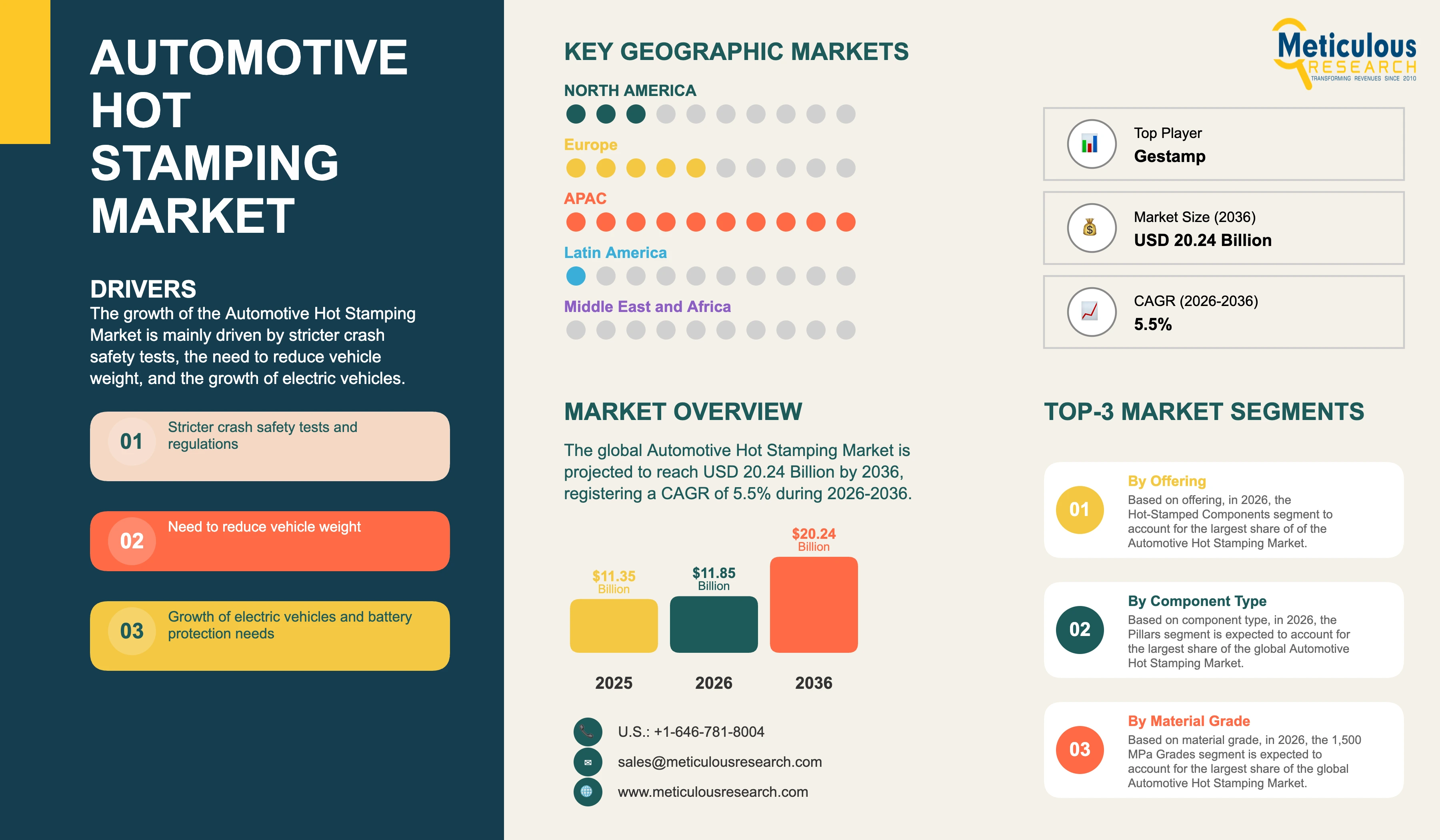
The global automotive hot stamping market was valued at USD 11.35 billion in 2025. This market is expected to reach USD 20.24 billion by 2036 from an estimated USD 11.85 billion in 2026, registering a CAGR of 5.5% during the forecast period (2026-2036).
- Published
- Nov 2026
- Pages
- 260
- Format
- PDF + Excel
- Report ID
- MRAUTO - 1042856
- Base year
- 2025
- 2025 · BASELINE
- $11.35B
- 2036
- $20.24B
- CAGR 2026–2036
- 5.5%
2025 baseline · 2026–2036 forecast at 5.5% CAGR · hover a bar for the value
Key highlights
Press hardening was first used in a car body by Saab in 1984, and Schuler delivered the first three hot stamping lines to Ford in the U.S. in 1993, according to Schuler. Production has since grown from about 3 million hot-stamped parts a year in 1987 to about 360 million a year by 2015, according to AutoForm, and has continued to rise in all major regions since then.
Hot-stamped parts make up a large share of the body in many modern cars. In some models, 20% to 40% of the body-in-white weight consists of press-hardened steel, and hot-formed boron steel makes up about 40% of the body weight of the Volvo XC90, according to Automotive Manufacturing Solutions.
Gestamp, the largest hot stamping supplier, reported revenue of €11.3 billion in 2025. The company has deployed 17 hot stamping lines in China, operates seven hot stamping lines among its 58 stamping lines in Brazil, and has opened a new Brazilian plant with an electric-furnace hot stamping line, the first of its kind in the region.
Large one-piece hot-stamped parts are becoming a major trend in body design. Gestamp is offering its Ges-Gigastamping family of large-format structural parts to vehicle makers in Europe, Japan, and India, while ArcelorMittal and AP&T are working together on Multi Part Integration (MPI) parts made from large laser-welded blanks, with AP&T SKY lines already in use at major electric vehicle makers in North America.
Electric vehicles are increasing the need for strong and light body structures that protect the battery. Global electric car sales grew by 20% to more than 20 million units in 2025, about one in four new cars sold, according to the IEA, and these vehicles use hot-stamped parts for side sills, cross members, and battery protection.
The market includes component makers, such as Gestamp, Magna, Benteler, Martinrea, Kirchhoff Automotive, voestalpine, H-One, and Lingyun Industrial, and equipment makers, such as Schuler, AP&T, AIDA, and Fagor Arrasate. Steel makers, such as ArcelorMittal, POSCO, Baosteel, and SSAB, supply the coated boron steel used in most hot-stamped parts.
By offering, hot-stamped components account for the larger share of 89.0% in 2026, while hot stamping equipment and tooling registers the higher CAGR.
By component type, pillars account for the largest share in 2026, while battery enclosure and protection parts register the highest CAGR.
By material grade, 1, 500 MPa grades account for the largest share in 2026, while 1,800 MPa grades and above registers the highest CAGR.
By propulsion type, internal combustion engine vehicles account for the largest share of 50.0% in 2026, while battery electric vehicles register the highest CAGR.
By geography, Asia-Pacific accounts for the largest share of 52.0% in 2026, while Asia-Pacific registers the highest CAGR of 6.5%.
Report summary
| Particulars | Details |
|---|---|
| Base Year | 2025 |
| Estimated Year | 2026 |
| Forecast Period | 2026-2036 |
| Market Size in 2025 | USD 11.35 billion |
| Market Size in 2026 | USD 11.85 billion |
| Market Size by 2036 | USD 20.24 billion |
| CAGR (2026-2036) | 5.5% |
| Format | PDF, Excel & Cloud Portal · 260 pages |
| Largest Segment by Offering (2026) | Hot-Stamped Components (89.0%) |
| Largest Segment by Propulsion Type (2026) | Internal Combustion Engine Vehicles (50.0%) |
| Largest Region (2026) | Asia-Pacific (52.0%) |
| Fastest-Growing Region | Asia-Pacific (CAGR 6.5%) |
| Companies Profiled | 12 companies and other companies |
| Segments Covered | Offering, Component Type, Material Grade, Propulsion Type, Geography |
| Countries Covered | U.S., Canada, Germany, Spain, France, Italy, U.K., Sweden, Czech Republic, Slovakia, Poland, Hungary, Romania, Portugal, Belgium, Rest of Europe, China, Japan, India, South Korea, Thailand, Indonesia, Malaysia, Vietnam, Taiwan, Australia, Rest of Asia-Pacific, Mexico, Brazil, Argentina, Colombia, Chile, Rest of Latin America, Turkey, Morocco, South Africa, Saudi Arabia, Egypt, Iran, Rest of Middle East & Africa |
Report overview
Segments covered: offering, component type, material grade, propulsion type.
Hot stamping, also called press hardening or hot forming, heats boron steel blanks to about 900 to 950°C, forms them in a cooled die, and quenches them in the same step to produce body parts with a tensile strength of 1,500 MPa or more. The market covers hot-stamped body and structural components and the hot stamping lines, furnaces, presses, and dies used to make them.
The growth of this market is mainly driven by stricter crash safety tests that call for stronger passenger cells, the need to reduce vehicle weight to cut emissions and extend electric vehicle range, the use of hot-stamped parts to protect battery packs in electric vehicles, the shift from many small parts to large one-piece door rings and integrated side structures, and the fast growth of vehicle production and hot stamping capacity in China and India. New steel grades of 1,800 MPa and above, along with ductile grades for crash zones, are also widening the range of parts that can be hot stamped. However, the high cost of hot stamping lines and the energy used by furnaces, together with competition from aluminum castings and cold-formed high-strength steel, are expected to restrain the growth of this market to some extent.
Automotive hot stamping is a forming process used to make very strong and light steel parts for vehicle bodies. A steel blank, usually made from 22MnB5 boron steel with an aluminum-silicon coating, is heated in a furnace until its structure changes, then moved quickly to a press where it is formed and cooled in a water-cooled die. The fast cooling turns the steel into martensite, which gives the finished part a tensile strength of about 1,500 MPa, three to four times that of conventional body steels. Because the steel is soft and easy to form when hot, complex shapes can be made in one step with little springback, which is difficult with cold-formed ultra-high-strength steel.
This report covers the global automotive hot stamping market, including hot-stamped components, such as A-pillars and B-pillars, roof rails, sills, cross members, bumper beams, door rings, door beams, tunnels, and battery protection parts, and hot stamping equipment and tooling, which includes furnaces, presses, transfer systems, dies, and laser trimming cells sold for automotive use. Hot-stamped components are valued at their selling price to vehicle makers, and parts made in-house by vehicle makers are valued at an estimated market price. The market is analyzed by offering, component type, material grade, propulsion type, and geography. Steel coil and blanks sold to stampers are not counted separately, as their value is included in the price of the finished parts.
Hot stamping has grown from a niche process into a standard method for making the safety cage of modern cars. Saab first used a press-hardened part in 1984, and for many years door beams were the main application. Over time, vehicle makers added bumper beams, pillars, roof rails, sills, tunnels, and cross members, and today many vehicles have 15 or more hot-stamped parts. In some models, press-hardened steel makes up 20% to 40% of the body-in-white weight, and the Volvo XC90 uses hot-formed boron steel for about 40% of its body weight.
Hot stamping offers a strong combination of crash strength, low weight, and design freedom. It allows vehicle makers to use thinner and lighter parts while meeting crash test requirements, such as the small overlap and side impact tests used by Euro NCAP, IIHS, and C-NCAP. It also allows several parts to be combined into one, as with laser-welded door rings that replace many stamped pieces with a single hot-stamped ring around the door opening. These benefits have made hot stamping a key tool for vehicle makers trying to improve safety and reduce weight at the same time.
The market is served by a mix of tier-1 body parts suppliers, vehicle makers with their own hot stamping lines, equipment makers, and steel suppliers. Gestamp is the largest supplier of hot-stamped parts, with lines in Europe, North America, South America, and Asia, and it also makes its own presses through Loire Gestamp. Other major suppliers include Magna, Benteler, Martinrea, Kirchhoff Automotive, voestalpine, H-One, and Lingyun Industrial, while Schuler, AP&T, AIDA, and Fagor Arrasate supply complete hot stamping lines. Steel makers, such as ArcelorMittal with its Usibor and Ductibor grades, work closely with stampers and vehicle makers on new materials and part designs.
Electric vehicles are changing how and where vehicle makers use hot stamping in the body. Battery packs are heavy and must be protected from side and underbody impacts, so electric vehicles need strong side sills, cross members, and battery frames. Hot-stamped steel offers a lower-cost alternative to aluminum extrusions for many of these parts. At the same time, the trend toward large one-piece parts, led by aluminum gigacasting, has led steel suppliers and stampers to develop large hot-stamped modules, such as Gestamp's Ges-Gigastamping parts and ArcelorMittal's MPI concept, which combine many parts into one.
In 2026, hot-stamped components account for the largest share of the market by offering, while hot stamping equipment and tooling is the faster-growing offering. Pillars account for the largest share by component type, while battery enclosure and protection parts are the fastest-growing component type. Grades of about 1,500 MPa account for the largest share by material grade, while grades of 1,800 MPa and above are the fastest-growing grade. Internal combustion engine vehicles are the largest propulsion type, while battery electric vehicles are the fastest-growing propulsion type. Asia-Pacific accounts for the largest share of the market and is also the fastest-growing region.
Market growth over the forecast period will depend on global vehicle production, the pace of new vehicle platform launches, the use of hot-stamped parts in electric vehicles, and progress in large one-piece parts and stronger steel grades. Hot stamping is also becoming more sustainable as suppliers move from gas furnaces to electric furnaces and use lower-carbon steel, which is important as vehicle makers set targets to cut emissions in their supply chains.
Internal combustion engine vehicles are expected to account for the largest share of 50.0% of the market in 2026, while battery electric vehicles are projected to register the highest CAGR, driven by the need to protect heavy battery packs.
Asia-Pacific is expected to account for the largest share of 52.0% of the market in 2026, mainly due to China's large vehicle production, high use of hot-stamped parts by Chinese vehicle makers, and large local hot stamping capacity.
Asia-Pacific is also projected to register the highest CAGR of 6.5% during the forecast period, driven by electric vehicle growth in China, rising safety standards in India, and expanding vehicle production in Southeast Asia.
The report profiles 12 companies, including Gestamp, Magna, Benteler, Martinrea, Kirchhoff Automotive, voestalpine, H-One, Lingyun Industrial, Schuler, AP&T, AIDA, and Fagor Arrasate.
Hot stamping heats boron steel blanks to about 930°C, forms them, and quenches them in a cooled die to produce parts with a strength of about 1,500 MPa. Vehicle makers use it to make strong and light safety cage parts that meet crash tests while reducing weight.
Electric vehicles need strong side sills, cross members, and battery frames to protect battery packs in crashes, which increases hot-stamped steel content per vehicle and creates demand for new battery protection parts.
Report infographic
Market dynamics
17 factors across 5 forcesStricter crash safety tests and regulations
Vehicle safety tests have become much tougher over the past two decades and continue to raise requirements. Tests such as the small overlap frontal test, the side pole impact test, and roof strength tests require a strong passenger cell that does not collapse in a crash. Euro NCAP, IIHS, C-NCAP, and other programs regularly update their tests, and vehicle makers design new models to achieve top ratings, which are important for sales. Hot-stamped parts are one of the most cost-effective ways to meet these tests, as they provide very high strength in key areas, such as the A-pillars, B-pillars, roof rails, and sills.
Many emerging markets are also adopting stricter safety rules, which is increasing the use of hot-stamped parts in lower-priced vehicles. For example, the Bharat NCAP program in India and updated rules in Latin America are leading vehicle makers to strengthen body structures in models built for these markets. As safety requirements spread to more countries and more vehicle segments, the number of hot-stamped parts per vehicle is expected to grow across the forecast period.
Need to reduce vehicle weight
Vehicle makers are under pressure to cut weight to meet fuel economy and carbon dioxide emission rules for combustion engine vehicles and to extend the driving range of electric vehicles. Hot-stamped steel allows thinner and lighter parts to be used while keeping or improving crash strength, which makes it one of the most effective ways to reduce body weight at a reasonable cost. Replacing conventional high-strength steel parts with hot-stamped parts can cut the weight of the affected parts by 20% to 30% or more.
Hot stamping also offers a lower-cost route to weight savings than aluminum or carbon fiber for many parts. Steel is cheaper than aluminum, and existing body shops are designed to join steel parts by spot welding. As a result, vehicle makers in all regions continue to increase the use of hot-stamped parts in new platforms, especially for high-volume models where cost is critical. This trend is expected to continue as emission rules tighten and electric vehicle makers look for every way to extend range.
Growth of electric vehicles and battery protection needs
Electric vehicles need strong body structures to protect the battery pack from side and underbody impacts, as damage to battery cells can lead to fire. Battery packs also add a lot of weight, which increases crash forces and the need for strong structures. Vehicle makers use hot-stamped parts for side sills, floor cross members, battery frames, and front and rear crash structures in electric vehicles, and many electric vehicles have more hot-stamped steel than similar combustion engine vehicles.
Global electric car sales grew by 20% to more than 20 million units in 2025, according to the IEA, and accounted for about one in four new cars sold worldwide. As electric vehicle production continues to grow, demand for hot-stamped battery protection parts and body structures is expected to grow faster than the overall market. Battery electric vehicles are the fastest-growing propulsion type in this market, and battery enclosure and protection parts are the fastest-growing component type.
Shift to large one-piece hot-stamped parts
Vehicle makers are increasingly replacing several separate parts with large one-piece hot-stamped parts made from laser-welded blanks. Door rings, which form a complete ring around the door opening, were first used by Honda on the Acura MDX and RDX and are now used on many vehicles. These parts reduce the number of parts, welds, and assembly steps, while improving crash strength and reducing weight. Larger integrated parts, such as complete side structures and rear floor frames, are now being developed.
Gestamp is offering its Ges-Gigastamping family of large-format hot-stamped parts to vehicle makers in Europe, Japan, and India, and ArcelorMittal and AP&T are working together on MPI parts made from very large laser-welded blanks, with AP&T SKY lines already in use at major electric vehicle makers in North America. These large parts require bigger presses and furnaces, which also supports demand for new hot stamping equipment. Door rings and integrated side structures are one of the fastest-growing component types in this market.
Expansion of vehicle production and hot stamping capacity in Asia
Asia-Pacific is the largest vehicle-producing region and the fastest-growing market for hot stamping. China produces more vehicles than any other country, and Chinese vehicle makers have increased their use of hot-stamped parts to meet tougher C-NCAP tests and to support exports to Europe and other markets with high safety standards. Many Chinese suppliers, such as Lingyun Industrial, have invested in new hot stamping lines, and Gestamp has deployed 17 hot stamping lines in China. India is also adding hot stamping capacity as vehicle makers respond to Bharat NCAP and growing demand for safer cars, and Gestamp is supplying battery boxes and large stampings to vehicle makers in India. Thailand, Indonesia, and Vietnam are building more vehicles, including electric vehicles from Chinese makers, which is creating new demand for hot-stamped parts in Southeast Asia.
Table of contents
12 chapters · 184 sections · 260 pages · click to expandSegmental analysis
| Segment | Largest share (2026) | Fastest growth (2026–2036) |
|---|---|---|
| By Offering | Pillars | Battery enclosure and protection parts |
By Offering
- The pillars segment is expected to account for the largest share of the automotive hot stamping market, while the battery enclosure and protection parts segment is projected to register the highest CAGR during the forecast period.
- The 1,500 MPa grades segment is expected to account for the largest share of the automotive hot stamping market, while the 1,800 MPa grades and above segment is projected to register the highest CAGR during the forecast period.
Geographic analysis
Asia-Pacific
Largest shareIn 2026, Asia-Pacific is expected to account for the largest share of 52.0% of the global automotive hot stamping market. The large share of this region is mainly due to China's position as the largest vehicle producer in the world, the high use of hot-stamped parts by Chinese vehicle makers to meet C-NCAP tests and to support exports, the fast growth of electric vehicle production in China, the large hot stamping capacity of local suppliers, such as Lingyun Industrial, and of global suppliers, such as Gestamp with 17 lines in China, and the large vehicle production of Japan, South Korea, and India. Japanese suppliers, such as H-One, and equipment makers, such as AIDA, also have a strong presence in the region. Asia-Pacific is also projected to register the highest CAGR of 6.5% during the forecast period. The rapid growth of this region is mainly driven by continued growth of electric vehicle production in China, the rising use of hot-stamped parts in India as vehicle makers respond to Bharat NCAP and demand for safer cars, the expansion of vehicle production in Thailand, Indonesia, Vietnam, and Malaysia, including by Chinese electric vehicle makers, and new investment in hot stamping lines across the region. Gestamp is supplying large stampings and battery boxes to vehicle makers in India, and many Chinese suppliers are expanding their capacity.
Europe
Europe accounts for a significant share of the market, supported by the long history of hot stamping in the region, the strict crash tests of Euro NCAP, the presence of leading suppliers, such as Gestamp, Benteler, Kirchhoff Automotive, and voestalpine, and equipment makers, such as Schuler, AP&T, and Fagor Arrasate, and the high use of hot-stamped steel in premium vehicles, such as the Volvo XC90. European vehicle makers are also leading the move to electric furnaces and low-carbon steel. However, slow vehicle production growth and high energy costs are expected to limit growth in Europe compared with Asia-Pacific.
North America
North America accounts for a large share of the market, supported by the production of large pickup trucks and SUVs that use many hot-stamped parts, the strict crash tests of IIHS, and the presence of Magna, Martinrea, Gestamp, and other suppliers. AP&T SKY lines for large integrated parts are already in use at major electric vehicle makers in North America.
Latin America
Latin America and the Middle East & Africa account for smaller shares, but growing vehicle production in Mexico, Brazil, Turkey, and Morocco and stricter safety rules are expected to support steady growth, as shown by Gestamp's new hot stamping plant in Brazil. Gestamp's sales in Brazil reached €677 million in 2025, up from €375 million in 2021, which reflects the growth of local vehicle production and demand for safer, lighter body parts.
Middle East & Africa
In the Middle East, new vehicle plants in Saudi Arabia and Turkey are expected to add further demand for hot-stamped parts over the forecast period, supported by local content rules.
Competitive landscape
The global automotive hot stamping market includes tier-1 suppliers of hot-stamped components, vehicle makers with their own hot stamping lines, and makers of hot stamping equipment. The components market is led by a few large global body parts suppliers, together with many regional suppliers in China, Japan, India, and Europe. The equipment market is more concentrated, with a small number of companies able to supply complete hot stamping lines.
Gestamp is the largest supplier of hot-stamped parts, with hot stamping lines in Europe, North America, South America, and Asia, and it reported revenue of €11.3 billion in 2025. Magna, through its Cosma body and chassis business, Benteler, Martinrea, Kirchhoff Automotive, and voestalpine are other major global suppliers. H-One is a key supplier to Japanese vehicle makers, and Lingyun Industrial is a leading Chinese supplier. Schuler, AP&T, AIDA, and Fagor Arrasate supply complete hot stamping lines, while Gestamp makes its own presses through Loire Gestamp.
Companies in this market compete on part quality and strength, cost per part, ability to make large and complex parts, engineering support for new vehicle programs, global plant networks close to vehicle plants, and the ability to reduce carbon emissions. Key strategies include investing in large-format hot stamping lines, developing integrated parts such as door rings and gigastamping parts, working with steel makers on new grades, moving to electric furnaces, and expanding in China, India, and other growth markets.
Recent competitive activity has focused on large integrated parts and capacity in growth markets. Gestamp is offering its Ges-Gigastamping parts to vehicle makers in Europe, Japan, and India and has opened a new plant in Brazil with an electric-furnace hot stamping line, while ArcelorMittal and AP&T are working together on MPI parts and large-format lines. Chinese suppliers continue to add hot stamping lines to serve local and export vehicle makers.
We expect competition to increase over the forecast period as Chinese suppliers expand abroad with Chinese vehicle makers, as aluminum casting suppliers compete for underbody parts, and as vehicle makers push for lower prices and lower emissions. Suppliers with large global networks, strong engineering skills, and the ability to make large integrated parts are expected to strengthen their positions.
Some of the key players operating in the automotive hot stamping market are Gestamp Automoción, S.A., Magna International Inc., Benteler International AG, Martinrea International Inc., Kirchhoff Automotive GmbH, voestalpine AG, H-One Co., Ltd., Lingyun Industrial Corporation Limited, Schuler Group GmbH (ANDRITZ), AP&T AB, AIDA Engineering, Ltd., and Fagor Arrasate S. Coop., among others.
- —
Gestamp introduced its Ges-Gigastamping parts to vehicle makers in Japan and India and opened a new plant in Brazil with an electric-furnace hot stamping line, while ArcelorMittal and AP&T are working together on large Multi Part Integration parts and lines.
- Gestamp Automoción, S.A.
- Magna International Inc.
- Benteler International AG
- Martinrea International Inc.
- Kirchhoff Automotive GmbH
- H-One Co., Ltd.
- Lingyun Industrial Corporation Limited
- Schuler Group GmbH (ANDRITZ)
- AP&T AB
- AIDA Engineering, Ltd.
- Fagor Arrasate S. Coop
Expert perspectives
Hot stamping has become one of the most important methods for making safe and light vehicle bodies. It allows vehicle makers to meet ever-stricter crash tests while cutting weight, and it is used in almost all modern passenger cars for the safety cage. The market is mature in Europe and North America but continues to grow, supported by electric vehicles, large one-piece parts, and growing vehicle production and safety standards in Asia.
Over the forecast period, the market is expected to grow at a CAGR of 5.5%, from USD 11.85 billion in 2026 to USD 20.24 billion in 2036. Growth will be driven by stricter crash tests, the need to reduce weight, the growth of electric vehicles and battery protection parts, the shift to large integrated parts, and the expansion of vehicle production and hot stamping capacity in Asia-Pacific.
Among the market segments, hot-stamped components are the larger offering, while equipment and tooling grow faster. Pillars are the largest component type, while battery enclosure and protection parts grow fastest. Grades of about 1,500 MPa are the largest material grade, while grades of 1,800 MPa and above grow fastest. Internal combustion engine vehicles are the largest propulsion type, while battery electric vehicles grow fastest. Asia-Pacific is both the largest and the fastest-growing region, at a CAGR of 6.5%.
In our view, the growth of electric vehicles is the most important factor shaping this market. Electric vehicles need strong structures to protect battery packs, and hot-stamped steel offers a cost-effective way to provide this protection. However, the choice between hot-stamped steel and aluminum castings and extrusions for underbody and battery parts will be important, and the outcome will vary by vehicle maker and region.
We also see large integrated hot-stamped parts as a key opportunity for the industry to compete with aluminum gigacasting. Suppliers that can make very large parts with consistent quality, using new grades and laser-welded blanks, are likely to win new business. At the same time, the move to electric furnaces and low-carbon steel will be important for winning business with vehicle makers that have strict supply chain emission targets.
Overall, we believe the automotive hot stamping market will grow steadily over the forecast period, with hot stamping equipment and tooling, battery enclosure and protection parts, grades of 1,800 MPa and above, battery electric vehicles, and Asia-Pacific providing the fastest growth. Companies with strong engineering skills, large-format capabilities, global plant networks, and lower-carbon production will be best positioned to capture this growth. Steady demand from vehicle programs that run for five to seven years also gives the market good visibility.
Customer perspectives
Customers in the automotive hot stamping market include vehicle makers that buy hot-stamped parts from suppliers, vehicle makers that run their own hot stamping lines, and tier-1 suppliers that buy hot stamping lines and dies. Vehicle makers focus on crash performance, weight, part cost, quality, ability to join parts in the body shop, and the carbon footprint of parts. Suppliers that buy equipment focus on line output, cycle time, uptime, energy use, and support from equipment makers. Both groups work closely with steel makers on new grades and with engineering teams on part design, as these decisions are made early in vehicle development. Vehicle makers also value suppliers that can support new programs in several regions with the same quality and engineering standards.
This comment explains why pillars are the largest component type and why hot-stamped components account for 89.0% of the market.
This comment explains why battery electric vehicles are the fastest-growing propulsion type, why battery enclosure and protection parts are the fastest-growing component type, and why Asia-Pacific is the fastest-growing region.
This comment explains why hot stamping equipment and tooling is the faster-growing offering and why grades of 1,800 MPa and above are the fastest-growing material grade.
“Every new platform we launch has more hot-stamped steel in the body than the last one. The B-pillar, roof rail, and sill are all hot stamped, and now we use door rings to bring them together into one part.”
“Battery protection is our top concern when we design for side impacts and pole tests. We use hot-stamped sills and cross members, and we are testing a hot-stamped battery frame to replace aluminum and cut cost.”
“Our new lines are larger and use electric furnaces, because customers want bigger integrated parts and lower carbon emissions. We are also testing 2,000 MPa steel for B-pillars.”
Frequently asked questions
The global automotive hot stamping market was valued at USD 11.35 billion in 2025, up from USD 10.90 billion in 2024, and is estimated at USD 11.85 billion in 2026. The market includes hot-stamped body and structural components and the hot stamping lines, furnaces, presses, and dies used to make them.
Cite this report
Meticulous Research. (2026). Automotive Hot Stamping Market - Global Opportunity Analysis and Industry Forecast (2026-2036) (Report No. MRAUTO - 1042856). Meticulous Market Research Pvt. Ltd. https://www.meticulousresearch.com/product/automotive-hot-stamping-market-7539