Automotive Wiring Harness Market (2026-2036)
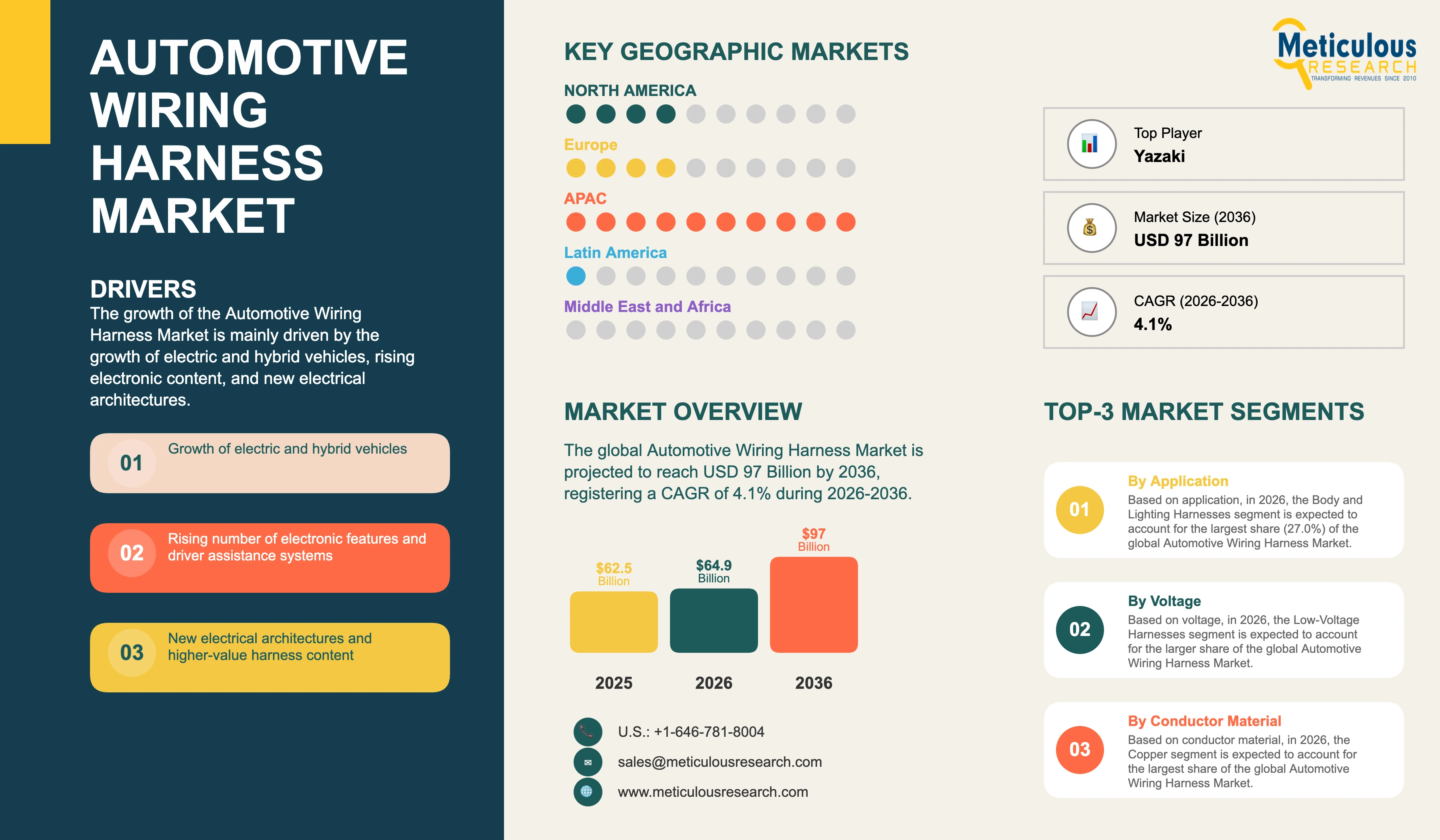
The global automotive wiring harness market was valued at USD 62.50 billion in 2025. This market is expected to reach USD 97.00 billion by 2036 from an estimated USD 64.90 billion in 2026, registering a CAGR of 4.1% during the forecast period (2026-2036).
- Published
- Nov 2026
- Pages
- 255
- Format
- PDF + Excel
- Report ID
- MRAUTO - 1042857
- Base year
- 2025
- 2025 · BASELINE
- $62.50B
- 2036
- $97.00B
- CAGR 2026–2036
- 4.1%
2025 baseline · 2026–2036 forecast at 4.1% CAGR · hover a bar for the value
Key highlights
Aptiv completed the spin-off of its Electrical Distribution Systems business, one of the world's largest wiring harness businesses, as a new publicly traded company called Versigent on April 1, 2026. Versigent guided 2026 revenue of USD 9.1 billion to USD 9.4 billion, according to Aptiv's fourth quarter 2025 earnings call, and the business grew revenue by 5% to USD 2.3 billion in the fourth quarter of 2025.
Luxshare-ICT completed the purchase of a 50.1% stake in Leoni AG and its Wiring Systems Division on July 10, 2025, while its subsidiary TIME Interconnect acquired 100% of Leoni's Automotive Cable Solutions division, according to Leoni. The deal gives a Chinese electronics group control of one of Europe's largest wiring harness makers.
Sumitomo Electric reported record net sales of ¥5, 110.2 billion for its fiscal year ended March 31, 2026, with steady growth in the sales of automotive wiring harnesses, according to the company. Yazaki and Sumitomo Electric are the two largest wiring harness makers in the world.
Global electric car sales grew by 20% to more than 20 million units in 2025, accounting for one in four new cars sold, according to the IEA. Each electric vehicle needs high-voltage harnesses for the battery, motor, inverter, charging system, and electric heating and cooling, which adds significant harness value per vehicle.
Vehicle makers are moving from distributed electrical architectures with many separate control units to zonal architectures with a few central computers and zone controllers. Tesla's Cybertruck introduced a 48-volt low-voltage system and a simplified wiring design, and other vehicle makers are planning similar changes, which will reduce wire length but increase the value of power and data cables.
Wiring harness production is highly labor-intensive and is concentrated in lower-cost countries close to vehicle plants, such as Mexico, Morocco, Tunisia, Romania, Serbia, the Philippines, Vietnam, and China. The war in Ukraine in 2022 disrupted harness supply from plants in Ukraine and halted vehicle production at some European plants, which led vehicle makers to diversify their harness supply.
By application, body and lighting harnesses account for the largest share of 27.0% in 2026, while battery and electric drive harnesses register the highest CAGR.
By voltage, low-voltage harnesses account for the larger share in 2026, while high-voltage harnesses register the higher CAGR.
By conductor material, copper accounts for the largest share in 2026, while aluminum registers the highest CAGR.
By vehicle type, passenger cars account for the largest share of 76.0% in 2026 and also register the highest CAGR.
By geography, Asia-Pacific accounts for the largest share of 53.0% in 2026, while Asia-Pacific registers the highest CAGR of 4.9%.
Report summary
| Particulars | Details |
|---|---|
| Forecast Period | 2026-2036 |
| Base Year | 2025 |
| Estimated Year | 2026 |
| CAGR (Value) | 4.1% |
| Format | PDF, Excel & Cloud Portal · 255 pages |
| Market Size (Value) in 2025 | USD 62.50 billion |
| Market Size (Value) in 2026 | USD 64.90 billion |
| Market Size (Value) by 2036 | USD 97.00 billion |
| Largest Segment by Application (2026) | Body and Lighting Harnesses (27.0%) |
| Largest Segment by Vehicle Type (2026) | Passenger Cars (76.0%) |
| Largest Region (2026) | Asia-Pacific (53.0%) |
| Fastest-Growing Region | Asia-Pacific (CAGR 4.9%) |
| Segments Covered | Application, Voltage, Conductor Material, Vehicle Type, Geography |
| Countries Covered | U.S., Canada, Germany, France, Spain, Italy, U.K., Czech Republic, Slovakia, Poland, Hungary, Romania, Serbia, Bulgaria, Sweden, Belgium, Rest of Europe, China, Japan, India, South Korea, Thailand, Indonesia, Vietnam, Philippines, Malaysia, Taiwan, Australia, Rest of Asia-Pacific, Mexico, Brazil, Argentina, Colombia, Chile, Rest of Latin America, Morocco, Tunisia, Turkey, South Africa, Egypt, Saudi Arabia, Rest of Middle East & Africa |
| Key Companies | 14 companies and other companies |
Report overview
Segments covered: application, voltage, conductor material, vehicle type.
An automotive wiring harness is an assembly of wires, cables, terminals, connectors, fuses, and protective covers that carries power and signals between the battery, electronic control units, sensors, actuators, lights, and other electrical parts of a vehicle. A modern car contains several kilometers of wire and more than a thousand connection points, which makes the harness one of the largest and most complex parts of the vehicle.
The growth of this market is mainly driven by the fast growth of electric and hybrid vehicles, which need high-voltage harnesses for the battery, motor, inverter, and charger, the rising number of electronic features, sensors, cameras, and driver assistance systems in vehicles, the move to new electrical architectures that need high-speed data cables and higher-value harnesses, stricter safety rules that require more electronic systems, and the growth of vehicle production in Asia-Pacific. In addition, the shift from copper to aluminum conductors and the use of more automation in harness production are changing the cost structure of the industry. However, high and volatile copper prices, the labor-intensive nature of harness assembly, and the move to zonal architectures that reduce wire length are expected to restrain the growth of this market to some extent.
The automotive wiring harness is the nervous system of a vehicle, carrying electrical power from the battery and alternator or DC-DC converter to every electrical load, and carrying signals and data between control units, sensors, and actuators. A harness is made of insulated copper or aluminum wires and cables, terminals crimped onto the wire ends, connectors that join harness sections and connect to devices, fuses and relays, and tapes, tubes, grommets, and clips that protect and fix the harness in the vehicle. Each vehicle has many harnesses, including the main body harness, engine and powertrain harnesses, cockpit harnesses, door, seat, and roof harnesses, and, in electric vehicles, high-voltage harnesses.
This report covers the global automotive wiring harness market, including low-voltage and high-voltage harness assemblies supplied to vehicle makers for passenger cars, light commercial vehicles, and heavy commercial vehicles and buses. The market is valued at the selling price of complete harness assemblies, which includes the value of wires, terminals, connectors, and other parts used in the harness. The market is analyzed by application, voltage, conductor material, vehicle type, and geography. Loose wires, cables, and connectors sold separately for the aftermarket or for uses outside harness assemblies are not included.
Wiring harnesses are designed specifically for each vehicle model and often for each version of a model, as different engine, trim, and feature options require different circuits. As a result, harness makers work closely with vehicle makers from the early stages of vehicle design, and contracts usually cover the full life of a vehicle program. Harnesses are bulky and hard to transport, and many are customized for each vehicle, so harness plants are often located close to vehicle plants or in nearby low-cost countries, and harnesses are delivered in the exact order in which vehicles are built.
Harness production is one of the most labor-intensive processes in the automotive industry. While wire cutting, stripping, and crimping are highly automated, the routing of wires on assembly boards, taping, and insertion of terminals into connectors are mostly done by hand. This is why harness makers have built large plants in Mexico, Central America, North Africa, Eastern Europe, and Asia, and why the industry employs hundreds of thousands of workers. Labor costs, copper prices, and the complexity of each harness are the main drivers of harness cost.
The industry is highly concentrated, with Yazaki and Sumitomo Electric holding the largest shares, followed by Versigent, the former Aptiv Electrical Distribution Systems business, Leoni, Lear, Furukawa Electric, Fujikura, and Motherson. Chinese harness makers, such as Kunshan Huguang and Tianhai Auto Electronics (THB), have grown quickly by serving Chinese vehicle makers, and Luxshare has gained a major position through its purchase of Leoni. Korean suppliers, such as Yura and Kyungshin, serve Hyundai and Kia, while European specialists, such as Kromberg & Schubert and Coroplast, serve premium vehicle makers.
The rise of electric vehicles and new electrical architectures is changing the harness business. Electric vehicles need high-voltage harnesses with thick, shielded orange cables and high-voltage connectors to carry hundreds of amps between the battery, inverter, motor, charger, and electric heating and cooling systems. At the same time, driver assistance systems, cameras, radars, and connected features require more high-speed data cables, such as automotive Ethernet and coaxial cables. Zonal architectures reduce the length of low-voltage wiring but need more complex power distribution and data cables, which shifts value within the harness.
In 2026, body and lighting harnesses account for the largest share of the market by application, while battery and electric drive harnesses are the fastest-growing application. Low-voltage harnesses account for the larger share by voltage, while high-voltage harnesses are the faster-growing voltage segment. Copper accounts for the largest share by conductor material, while aluminum is the fastest-growing conductor material. Passenger cars are the largest vehicle type and are also the fastest-growing vehicle type. Asia-Pacific accounts for the largest share of the market and is also the fastest-growing region.
Market growth over the forecast period will depend on global vehicle production, the pace of electric vehicle adoption, the number of electronic features in vehicles, and the speed of the move to zonal architectures. Copper prices will also affect harness prices, as many contracts pass copper cost changes on to vehicle makers. The growth of electric vehicles and high-voltage harnesses is expected to more than offset the reduction in low-voltage wire length from zonal architectures.
Passenger cars are expected to account for the largest share of 76.0% of the market in 2026 and are also projected to register the highest CAGR, driven by electric passenger cars and rising electronic content.
Asia-Pacific is expected to account for the largest share of 53.0% of the market in 2026, mainly due to very large vehicle production in China, Japan, India, and South Korea and China's position as the largest electric vehicle producer.
Asia-Pacific is also projected to register the highest CAGR of 4.9% during the forecast period, driven by electric vehicle growth in China, rising vehicle production in India, and expanding production in Southeast Asia.
The report profiles 14 companies, including Yazaki, Sumitomo Electric, Versigent, Leoni, Lear, Furukawa Electric, Fujikura, Motherson, Yura, Kyungshin, Kromberg & Schubert, Coroplast, Kunshan Huguang, and THB.
Zonal architectures will reduce the total length of low-voltage wiring, but they need more high-speed data cables and smart power distribution, shifting harness value toward these higher-value products rather than reducing the market.
Electric vehicles need high-voltage harnesses for the battery, motor, inverter, charger, and electric heating and cooling, which add significant value per vehicle and make high-voltage harnesses the faster-growing voltage segment.
Report infographic
Market dynamics
17 factors across 5 forcesGrowth of electric and hybrid vehicles
Electric and hybrid vehicles need high-voltage harnesses in addition to the low-voltage harnesses used in all vehicles. High-voltage harnesses connect the battery pack to the inverter, motor, onboard charger, DC-DC converter, charging inlet, electric compressor, and electric heater, and they use thick shielded cables and special high-voltage connectors that cost much more than standard wiring. The harness value in a battery electric vehicle can be much higher than in a similar combustion engine vehicle, mainly because of these high-voltage harnesses.
Global electric car sales grew by 20% to more than 20 million units in 2025, about one in four new cars sold worldwide, according to the IEA. As electric vehicle production continues to grow, demand for high-voltage harnesses is expected to grow much faster than the overall market. High-voltage harnesses are the faster-growing voltage segment in this market, and battery and electric drive harnesses are the fastest-growing application, as each new electric platform adds high-voltage content.
Rising number of electronic features and driver assistance systems
Modern vehicles contain more electronic features than ever before, including driver assistance systems, digital cockpits with large screens, connected services, electric seats and mirrors, advanced lighting, and many comfort and convenience features. Each of these features needs power and signal wiring, and many need high-speed data cables to carry camera and sensor data. Driver assistance systems, which use several cameras, radars, and ultrasonic sensors, are now standard in many new vehicles, partly due to safety rules in Europe and other regions.
The number of circuits and connection points in each vehicle has grown steadily, increasing the size, complexity, and value of wiring harnesses. Even lower-priced vehicles now include features that were once found only in premium vehicles. This trend is expected to continue as vehicle makers add more driver assistance features, larger screens, and software-based features. High-speed data cables, such as automotive Ethernet and coaxial cables, are becoming a growing part of harness value as data volumes rise.
New electrical architectures and higher-value harness content
Vehicle makers are moving from distributed electrical architectures, in which each function has its own control unit, to domain and zonal architectures, in which a few central computers and zone controllers manage functions in different areas of the vehicle. While zonal architectures can reduce the total length of wiring by grouping connections close to zone controllers, they require high-speed data backbones, smart power distribution, and more complex harness designs. Some vehicle makers are also moving from 12-volt to 48-volt low-voltage systems, as Tesla did with the Cybertruck, which allows thinner wires for the same power.
These changes shift harness value from simple low-voltage wires to higher-value data cables, power distribution parts, and integrated harness modules. Harness makers that can design and supply harnesses for zonal architectures, and that offer smart power distribution and high-speed data connections, are expected to capture more value per vehicle. The transition will take many years, as vehicle makers move new platforms to zonal designs one by one, which supports steady demand for harness engineering and new tooling.
Stricter vehicle safety and emission rules
Vehicle safety rules in many regions now require electronic safety systems, such as automatic emergency braking, lane keeping assistance, driver drowsiness warning, and tire pressure monitoring. The European Union's General Safety Regulation made many of these systems mandatory for new vehicles, and similar rules are being introduced in other regions. Each of these systems adds sensors, control units, and wiring to the vehicle, increasing harness content.
Emission rules are also pushing vehicle makers to adopt electric and hybrid powertrains and to use electric systems, such as electric power steering, electric water pumps, and start-stop systems, in combustion engine vehicles. These systems need additional wiring and higher power distribution capacity. As safety and emission rules become stricter in more countries, harness content per vehicle is expected to keep increasing across all vehicle types.
Growth of vehicle production in Asia-Pacific
Asia-Pacific is the largest vehicle-producing region, led by China, Japan, India, and South Korea, and it is also the fastest-growing market for wiring harnesses. China is the world's largest producer of electric vehicles, and Chinese vehicle makers, such as BYD, are adding many electronic and driver assistance features to their vehicles, which increases harness content. Chinese harness makers have grown quickly with these customers, and global makers, such as Yazaki, Sumitomo Electric, Versigent, and Leoni, have large plants in China. India's vehicle production is growing quickly, and harness makers such as Motherson are expanding capacity to serve local and export demand. Southeast Asian countries, such as Thailand, Indonesia, Vietnam, and the Philippines, are also growing as vehicle and harness production centers, supported by investment from Japanese and Chinese vehicle makers.
Table of contents
12 chapters · 175 sections · 255 pages · click to expandSegmental analysis
| Segment | Largest share (2026) | Fastest growth (2026–2036) |
|---|---|---|
| By Application | Body and lighting harnesses | Battery and electric drive harnesses |
By Application
- The low-voltage harnesses segment is expected to account for the larger share of the automotive wiring harness market, while the high-voltage harnesses segment is projected to register the higher CAGR during the forecast period.
- The copper segment is expected to account for the largest share of the automotive wiring harness market, while the aluminum segment is projected to register the highest CAGR during the forecast period.
Geographic analysis
Asia-Pacific
Largest shareIn 2026, Asia-Pacific is expected to account for the largest share of 53.0% of the global automotive wiring harness market. The large share of this region is mainly due to the very large vehicle production in China, Japan, India, and South Korea, China's position as the largest producer of electric vehicles, which need high-voltage harnesses, the high number of electronic features in vehicles made by Chinese vehicle makers, the presence of leading harness makers, such as Yazaki, Sumitomo Electric, Furukawa Electric, Fujikura, Yura, and Kyungshin, and the fast growth of Chinese harness makers, such as Kunshan Huguang and THB. Many global harness makers also have large production plants in China, Vietnam, the Philippines, and Thailand. Asia-Pacific is also projected to register the highest CAGR of 4.9% during the forecast period. The rapid growth of this region is mainly driven by continued growth of electric vehicle production in China, rising vehicle production and electronic content in India, where Motherson and other suppliers are expanding capacity, the growth of vehicle production in Thailand, Indonesia, and Vietnam, including by Chinese electric vehicle makers, and the adoption of new electrical architectures and 800-volt platforms by Chinese vehicle makers. Asia-Pacific also hosts much of the world's harness production for export to other regions, supported by lower labor costs and a large supply base for wires, terminals, and connectors.
Europe
Europe accounts for a significant share of the market, supported by the production of premium vehicles with a high number of electronic features, the strict safety rules of the European Union's General Safety Regulation, the growth of electric vehicles, and the presence of leading harness makers, such as Leoni, Kromberg & Schubert, and Coroplast. Much of the harness production for European vehicle plants takes place in Romania, Serbia, Bulgaria, Morocco, and Tunisia. However, slow growth of vehicle production in Western Europe is expected to limit market growth compared with Asia-Pacific. The war in Ukraine in 2022 also led vehicle makers to diversify harness supply across more countries, including North Africa, Turkey, and Asia, to reduce risk.
North America
North America accounts for a large share of the market, supported by the production of large pickup trucks and SUVs with high harness content, the presence of Versigent, Lear, Yazaki, and Sumitomo Electric, and large harness production in Mexico and Central America. Versigent grew its Electrical Distribution Systems revenue in North America by double digits in the fourth quarter of 2025, according to Aptiv.
Latin America
Latin America and the Middle East & Africa account for smaller shares, with growth supported by vehicle production in Brazil, Argentina, Turkey, Morocco, and South Africa, and by harness production in North Africa for export to Europe. Morocco and Tunisia host large plants run by Yazaki, Sumitomo Electric, Leoni, and other harness makers that supply European vehicle plants, and new Chinese vehicle plants in Turkey and Brazil are expected to create further local harness demand over the forecast period.
Competitive landscape
The global automotive wiring harness market is highly concentrated, with a small number of large global harness makers accounting for a large share of the market. These companies have long relationships with vehicle makers, large global production networks, and strong engineering capabilities. Regional players, especially in China, India, and Korea, serve local vehicle makers and are growing quickly. Harness makers compete for full vehicle programs, which often last five to seven years, so winning new platforms is critical.
Yazaki and Sumitomo Electric are the two largest harness makers in the world, with strong positions with Japanese and global vehicle makers. Versigent, which was spun off from Aptiv in April 2026, is a major supplier in North America, Europe, and China. Leoni, now majority-owned by Luxshare, is a leading supplier in Europe. Lear, through its E-Systems business, Furukawa Electric, Fujikura, Motherson, Yura, Kyungshin, Kromberg & Schubert, and Coroplast are other important suppliers, while Kunshan Huguang and THB are leading Chinese suppliers.
Companies in this market compete on cost, quality, engineering skills, global production networks, the ability to support complex vehicle programs, and capabilities in high-voltage and high-speed data harnesses. Key strategies include investing in high-voltage harness production, developing harnesses and power distribution for zonal architectures, automating production, expanding with Chinese vehicle makers, and building capacity in low-cost countries close to vehicle plants.
Recent competitive activity in the wiring harness market has focused on ownership changes and new capacity. Luxshare completed its purchase of a majority stake in Leoni in July 2025, Aptiv completed the spin-off of Versigent in April 2026, and Chinese harness makers have continued to expand. Harness makers are also adding high-voltage harness capacity and developing new products for zonal architectures with vehicle makers.
We expect competition to increase over the forecast period as Chinese harness makers expand abroad with Chinese vehicle makers, as zonal architectures change the value of harnesses, and as vehicle makers push for lower prices. Harness makers with strong high-voltage and data capabilities, automation, and global networks are expected to strengthen their positions, while smaller players may look for partners.
Some of the key players operating in the automotive wiring harness market are Yazaki Corporation, Sumitomo Electric Industries, Ltd., Versigent (formerly Aptiv Electrical Distribution Systems), LEONI AG, Lear Corporation, Furukawa Electric Co., Ltd., Fujikura Ltd., Samvardhana Motherson International Limited, Yura Corporation, Kyungshin Corporation, Kromberg & Schubert GmbH, Coroplast Group, Kunshan Huguang Auto Harness Co., Ltd., and Tianhai Auto Electronics Group Co., Ltd. (THB), among others.
- —
Luxshare-ICT completed the purchase of a 50.1% stake in Leoni in July 2025, Aptiv completed the spin-off of its Electrical Distribution Systems business as Versigent in April 2026, and Sumitomo Electric reported record sales with steady growth in wiring harnesses.
- Yazaki Corporation
- Sumitomo Electric Industries, Ltd.
- Versigent (formerly Aptiv Electrical Distribution Systems)
- LEONI AG
- Lear Corporation
- Furukawa Electric Co., Ltd.
- Fujikura Ltd.
- Samvardhana Motherson International Limited
- Yura Corporation
- Kyungshin Corporation
- Kromberg & Schubert GmbH
- Coroplast Group
- Kunshan Huguang Auto Harness Co., Ltd.
- Tianhai Auto Electronics Group Co., Ltd. (THB)
Expert perspectives
The automotive wiring harness market is large and mature, but it is going through major change. Electric vehicles, new electrical architectures, and the growth of electronic features are changing what harnesses do and where their value lies. At the same time, the industry is consolidating, with Luxshare's purchase of Leoni and Aptiv's spin-off of Versigent reshaping the competitive landscape.
Over the forecast period, the market is expected to grow at a CAGR of 4.1%, from USD 64.90 billion in 2026 to USD 97.00 billion in 2036. Growth will be driven by electric and hybrid vehicles, rising electronic content, new electrical architectures, stricter safety and emission rules, and vehicle production growth in Asia-Pacific.
Among the market segments, body and lighting harnesses are the largest application, while battery and electric drive harnesses grow fastest. Low-voltage harnesses are the larger voltage segment, while high-voltage harnesses grow faster. Copper is the largest conductor material, while aluminum grows fastest. Passenger cars are both the largest and the fastest-growing vehicle type. Asia-Pacific is both the largest and the fastest-growing region, at a CAGR of 4.9%.
In our view, the balance between the growth of high-voltage and data content and the reduction of low-voltage wire length from zonal architectures will be the key factor shaping this market. We believe that the growth of electric vehicles and electronic features will more than offset the reduction in wire length, but the value of harnesses will shift toward high-voltage cables, data cables, and smart power distribution. Harness makers that move early into these areas, and that offer engineering support for new architectures, will capture a larger share of vehicle maker spending on electrical systems.
We also see copper prices, labor costs, and trade policy as important risks for harness makers. Suppliers that invest in automation, aluminum conductors, and production in low-cost countries close to their customers are likely to manage these risks better. The entry of Chinese companies through Luxshare and the growth of Chinese harness makers will also increase price competition. At the same time, Chinese owners may help European and North American harness makers win business with Chinese vehicle makers that are building plants abroad, which could open new growth paths in Europe, Latin America, Southeast Asia, and the Middle East.
Overall, we believe the automotive wiring harness market will grow steadily over the forecast period, with battery and electric drive harnesses, high-voltage harnesses, aluminum conductors, passenger cars, and Asia-Pacific providing the fastest growth. Companies with strong high-voltage and data capabilities, automation, and global production networks will be best positioned to capture this growth.
Customer perspectives
“The body harness is still the biggest and most complex part we buy from harness makers. Every new feature adds circuits, and every trim level needs a different version.”
“Our new 800-volt platform needs more high-voltage harness content than our last one, and we are using aluminum for the battery cables to save weight and cost.”
“Zonal architecture will cut wire length in our next platform, but we will need more data cables and smart power distribution. Our harness supplier must also have backup plants.”
Frequently asked questions
The global automotive wiring harness market was valued at USD 62.50 billion in 2025, up from USD 60.80 billion in 2024, and is estimated at USD 64.90 billion in 2026. The market includes low-voltage and high-voltage harness assemblies for passenger cars and commercial vehicles.
Cite this report
Meticulous Research. (2026). Automotive Wiring Harness Market - Global Opportunity Analysis and Industry Forecast (2026-2036) (Report No. MRAUTO - 1042857). Meticulous Market Research Pvt. Ltd. https://www.meticulousresearch.com/product/automotive-wiring-harness-market-7540