Automotive Air Suspension Systems Market (2026-2036)
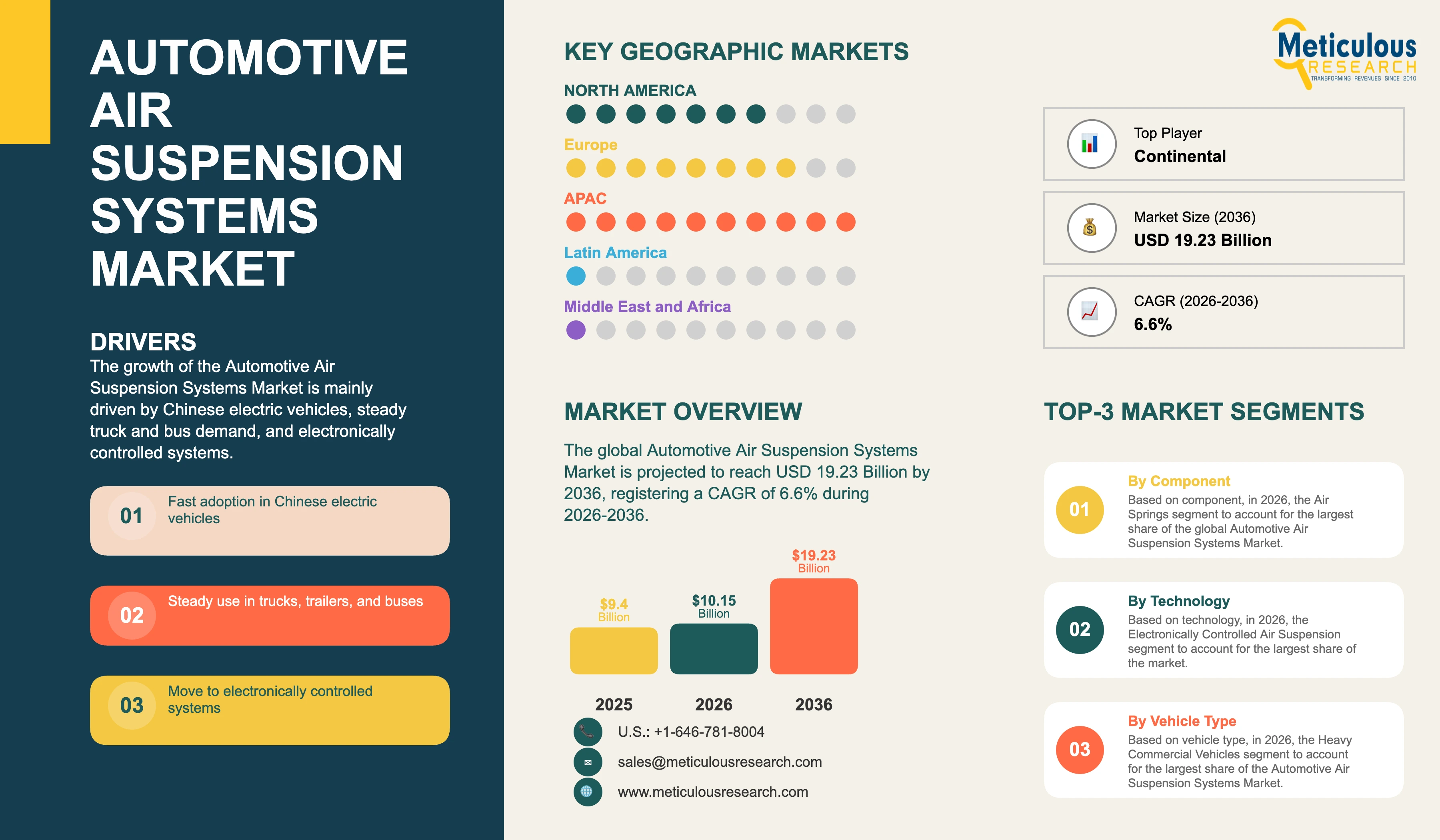
The global automotive air suspension systems market was valued at USD 9.40 billion in 2025. This market is expected to reach USD 19.23 billion by 2036 from an estimated USD 10.15 billion in 2026, registering a CAGR of 6.6% during the forecast period (2026-2036).
- Published
- Nov 2026
- Pages
- 270
- Format
- PDF + Excel
- Report ID
- MRAUTO - 1042853
- Base year
- 2025
- 2025 · BASELINE
- $9.40B
- 2036
- $19.23B
- CAGR 2026–2036
- 6.6%
2025 baseline · 2026–2036 forecast at 6.6% CAGR · hover a bar for the value
Key highlights
Chinese suppliers now lead the passenger car air suspension market in China. From January to November 2025, Tuopu Group installed 402,910 sets with a 37.2% share, KH Automotive Technologies installed 322,600 sets with a 29.8% share, and Baolong Automotive installed 237,493 sets with a 21.9% share, according to the Gasgoo Automotive Research Institute. The top three together held nearly 90% of the market.
Foreign suppliers Vibracoustic and Continental held a combined share of only 10.6% of China's passenger car air suspension market from January to November 2025, down from earlier years, according to Gasgoo. This shows how quickly local suppliers have taken share through lower costs and fast response to Chinese vehicle makers. Global suppliers are responding with lower-cost designs and new partnerships in China.
Air suspension is now offered on many Chinese electric SUVs and sedans from brands such as NIO, Li Auto, Xiaomi, Zeekr, Aito, and BYD's premium brands, often at prices far below those of European luxury vehicles. Many of these vehicles use dual-chamber air springs and continuous damping control for better comfort and handling.
In heavy commercial vehicles, air suspension is used on most heavy trucks, trailers, and buses in Europe and North America, as it protects cargo and drivers, keeps the vehicle level under different loads, and reduces damage to roads. Suppliers such as ZF, SAF-HOLLAND, Hendrickson, and Continental are leading providers of air suspension systems and air springs for these vehicles.
Electronically controlled air suspension systems are increasingly linked with cameras and driver assistance systems, allowing the vehicle to prepare the suspension for bumps and potholes ahead. Vehicle makers are also using air suspension to lower electric vehicles at highway speeds to reduce drag and extend driving range.
Suspension is becoming part of integrated by-wire chassis systems, together with steer-by-wire and brake-by-wire, as vehicle makers move toward software-defined vehicles. This is increasing the role of software, sensors, and control units in air suspension systems and creating opportunities for suppliers with strong electronics capabilities. Chinese vehicle makers are among the first to launch these integrated chassis systems in volume.
By component, air springs account for the largest share of 38.0% in 2026, while electronic control units and sensors register the highest CAGR.
By technology, electronically controlled air suspension accounts for the larger share in 2026 and also registers the higher CAGR.
By vehicle type, heavy commercial vehicles account for the largest share of 40.0% in 2026, while passenger cars register the highest CAGR.
By sales channel, OEM accounts for the larger share in 2026 and also registers the higher CAGR.
By geography, Asia-Pacific accounts for the largest share of 38.0% in 2026, while Asia-Pacific registers the highest CAGR of 8.6%.
Report summary
| Particulars | Details |
|---|---|
| Base Year | 2025 |
| Estimated Year | 2026 |
| Forecast Period | 2026-2036 |
| Market Size in 2025 | USD 9.40 billion |
| Market Size in 2026 | USD 10.15 billion |
| Market Size by 2036 | USD 19.23 billion |
| CAGR (2026-2036) | 6.6% |
| Format | PDF, Excel & Cloud Portal · 270 pages |
| Largest Segment by Component (2026) | Air Springs (38.0%) |
| Largest Segment by Vehicle Type (2026) | Heavy Commercial Vehicles (40.0%) |
| Largest Region (2026) | Asia-Pacific (38.0%) |
| Fastest-Growing Region | Asia-Pacific (CAGR 8.6%) |
| Companies Profiled | 15 companies and other companies |
| Segments Covered | Component, Technology, Vehicle Type, Sales Channel, Geography |
| Countries Covered | U.S., Canada, Germany, France, U.K., Italy, Spain, Sweden, Netherlands, Poland, Czech Republic, Belgium, Austria, Rest of Europe, China, Japan, South Korea, India, Thailand, Australia, Indonesia, Malaysia, Taiwan, Vietnam, Rest of Asia-Pacific, Brazil, Mexico, Argentina, Chile, Colombia, Rest of Latin America, Saudi Arabia, U.A.E., Turkey, Israel, South Africa, Egypt, Rest of Middle East & Africa |
Report overview
Segments covered: component, technology, vehicle type, sales channel.
Air suspension has long been standard on heavy trucks, trailers, and buses, and it is now spreading quickly from luxury cars into mid-priced electric SUVs and sedans, especially in China.
The growth of this market is mainly driven by the fast adoption of air suspension in Chinese electric vehicles, where local suppliers have cut system costs and made the technology available on mid-priced models, the steady use of air suspension on heavy trucks, trailers, buses, and coaches to protect cargo, improve ride comfort, and reduce road damage, the growing popularity of SUVs and large electric vehicles, which benefit from height adjustment to improve range and ride, and the move toward electronically controlled systems that work with driver assistance and other chassis controls. In addition, the growth of the aftermarket for replacement air springs and compressors is creating new demand. However, the higher cost and complexity of air suspension compared with steel springs, concerns about long-term reliability and repair costs, and price pressure in the Chinese market are expected to restrain the growth of this market to some extent.
An automotive air suspension system uses air springs, which are rubber bellows filled with compressed air, in place of or alongside steel coil or leaf springs to support the vehicle. A compressor and air supply unit provide compressed air, valves control the flow of air to each spring, and an electronic control unit uses height and other sensors to adjust the pressure in each spring. This allows the system to keep the vehicle level under different loads, change ride height, and adjust ride comfort. Many systems also include adjustable shock absorbers that work together with the air springs.
This report covers the global automotive air suspension systems market, including air springs, shock absorbers and dampers used with air suspension, air supply units, electronic control units and sensors, and valves, air tanks, and other parts, for passenger cars, light commercial vehicles, heavy commercial vehicles, and buses and coaches, sold to vehicle makers and in the aftermarket. The market is analyzed by component, technology, vehicle type, sales channel, and geography. Conventional steel spring suspensions, hydraulic and fully active suspensions without air springs, and suspensions for rail vehicles and industrial equipment are not included.
Air suspension has been used on heavy trucks, trailers, and buses for many decades, as it protects cargo and passengers, keeps the vehicle level when loads change, and reduces damage to roads. In many countries, heavy vehicles with air suspension are allowed to carry higher loads, which encourages its use. In passenger cars, air suspension was long limited to luxury vehicles from brands such as Mercedes-Benz, BMW, Audi, Porsche, and Land Rover, where it was offered for comfort and handling.
The market for passenger car air suspension has changed quickly since 2021, led by China. Chinese electric vehicle makers began offering air suspension on mid-priced SUVs and sedans, and local suppliers such as Tuopu Group, KH Automotive Technologies, and Baolong Automotive developed lower-cost air springs, compressors, and control systems. These suppliers now hold nearly 90% of China's passenger car air suspension market, according to Gasgoo, and are starting to supply vehicle makers outside China. Their rise has lowered the price of a complete passenger car air suspension system and changed how global vehicle makers think about the technology.
Electric vehicles are well suited to air suspension for several reasons linked to their weight, range, and price position. Their heavy batteries make ride comfort and load control more important, and lowering the vehicle at highway speeds reduces air drag and increases driving range. Air suspension also allows vehicle makers to offer a smooth ride and adjustable driving modes, which are important selling points for premium electric vehicles. Many new electric vehicle platforms are designed to allow both steel and air suspension, which makes it easier for vehicle makers to offer air suspension on more models.
The market is served by global suspension and chassis suppliers, specialist air spring makers, and fast-growing Chinese suppliers. Continental, Vibracoustic, ZF, thyssenkrupp Bilstein, Hitachi Astemo, HL Mando, BWI Group, and Tenneco supply passenger car air suspension parts and systems. ZF, SAF-HOLLAND, Hendrickson, and Continental are major suppliers of commercial vehicle air suspension. Tuopu Group, KH Automotive Technologies, Baolong Automotive, and Zhongding are leading Chinese suppliers, and Dunlop Systems and Components and Arnott are known for aftermarket air suspension parts.
In 2026, air springs account for the largest share of the market by component, while electronic control units and sensors are the fastest-growing component. Electronically controlled air suspension accounts for the larger share by technology and is also the faster-growing technology. Heavy commercial vehicles are the largest vehicle type, while passenger cars are the fastest-growing vehicle type. The OEM channel accounts for the larger share by sales channel and is also the faster-growing sales channel. Asia-Pacific accounts for the largest share of the market and is also the fastest-growing region.
Over the forecast period, the market is expected to grow strongly, supported by the spread of air suspension to more passenger car models, especially electric vehicles in China and later in other regions, steady demand from heavy commercial vehicles, and the growing role of electronics and software in suspension systems. Competition from Chinese suppliers is expected to lower system prices, which will support much wider adoption but also put pressure on supplier margins.
Heavy commercial vehicles are expected to account for the largest share of 40.0% of the market in 2026, while passenger cars are projected to register the highest CAGR, driven by the fast adoption of air suspension on Chinese electric vehicles.
Asia-Pacific is expected to account for the largest share of 38.0% of the market in 2026, mainly due to the fast adoption of air suspension on Chinese electric vehicles and the presence of leading Chinese suppliers.
Asia-Pacific is also projected to register the highest CAGR of 8.6% during the forecast period, driven by the spread of air suspension to more Chinese models, growing vehicle exports, and wider use on trucks and buses.
The report profiles 15 companies, including Continental, Vibracoustic, ZF, thyssenkrupp, Hitachi Astemo, HL Mando, BWI Group, Tenneco, Hendrickson, SAF-HOLLAND, Tuopu Group, KH Automotive Technologies, Baolong Automotive, Zhongding, and Dunlop Systems and Components.
Electric vehicles are heavy, and air suspension helps keep them level and comfortable under different loads. Lowering the vehicle at highway speeds also reduces air drag and extends driving range, and air suspension is an important selling point for premium electric vehicles.
Report infographic
Market dynamics
17 factors across 5 forcesFast adoption of air suspension in Chinese electric vehicles
China has become the main growth market for passenger car air suspension. Chinese electric vehicle makers, including NIO, Li Auto, Xiaomi, Zeekr, Aito, and BYD's premium brands, offer air suspension on many SUVs and sedans as a way to stand out in a crowded market. Local suppliers have reduced the cost of air suspension systems through local production of air springs, compressors, and control units, which has made the technology available on vehicles priced well below European luxury models.
According to the Gasgoo Automotive Research Institute, Tuopu Group, KH Automotive Technologies, and Baolong Automotive installed more than 960,000 air suspension sets in Chinese passenger vehicles from January to November 2025 and together held nearly 90% of the market. As more Chinese vehicle makers add air suspension to their models and as Chinese brands expand exports, demand for passenger car air suspension is expected to continue growing quickly.
Steady use of air suspension in heavy trucks, trailers, and buses
Air suspension is the standard choice for most heavy trucks, trailers, buses, and coaches in Europe and North America, and its use is growing in Asia-Pacific and Latin America. It protects cargo and drivers by giving a smoother ride, keeps the vehicle level when loads change, allows the vehicle to be raised or lowered for loading, and reduces damage to roads compared with steel leaf springs. In many countries, road rules allow heavier loads on vehicles with air suspension.
Demand from commercial vehicles depends on truck, trailer, and bus production, which varies with economic conditions, but the large fleet of vehicles with air suspension also creates steady demand for replacement air springs, valves, and compressors. The growth of electric buses and trucks, which carry heavy batteries, and the use of air suspension in delivery vans and coaches are expected to support demand in this segment.
Growing popularity of SUVs and large electric vehicles
SUVs and large electric vehicles continue to gain share in most major markets. These vehicles are heavy, and their weight changes significantly when they are loaded with passengers and luggage, which makes air suspension useful for keeping the vehicle level and comfortable. Air suspension can also raise SUVs for rough roads and lower them for easier entry, loading, and better stability at speed.
For electric vehicles, lowering the vehicle at highway speeds reduces air drag and extends driving range, which is an important benefit as drivers focus on range. Vehicle makers are designing new electric vehicle platforms to support air suspension, and many premium and mid-priced electric SUVs now offer it as standard or as an option. This trend is expected to support demand for passenger car air suspension in China, Europe, and North America.
Move to electronically controlled and predictive systems
Air suspension systems are becoming more advanced, with electronic control units that use height sensors, acceleration sensors, and data from other vehicle systems to adjust each air spring and shock absorber in real time. Many new systems use dual-chamber air springs, which can change stiffness, and continuous damping control shock absorbers. Some systems use cameras or navigation data to detect bumps and potholes ahead and prepare the suspension in advance.
These advanced systems offer better comfort and handling and can be linked with driver assistance and other chassis controls. They also increase the value of electronics, sensors, and software in each air suspension system, which supports market growth. Electronically controlled air suspension is both the larger and faster-growing technology segment, and electronic control units and sensors are the fastest-growing component.
Integration of suspension into by-wire chassis systems
Vehicle makers are moving toward software-defined vehicles, in which steering, braking, and suspension are controlled electronically and coordinated by central software. In this approach, suspension is often described as the third axis of the chassis, alongside steering and braking, as it controls how the vehicle moves up and down. Air suspension, with its ability to change height and stiffness under electronic control, fits well into these integrated chassis systems. As vehicle makers develop new electric vehicle platforms with by-wire steering and braking, they are also adding electronically controlled air suspension to improve comfort, handling, and safety. This trend is expected to increase demand for advanced air suspension systems and favor suppliers that can offer complete chassis systems and software.
Table of contents
12 chapters · 184 sections · 270 pages · click to expandSegmental analysis
| Segment | Largest share (2026) | Fastest growth (2026–2036) |
|---|---|---|
| By Component | Air springs | Electronic control units and sensors |
By Component
- The electronically controlled air suspension segment is expected to account for the larger share of the automotive air suspension systems market, and it is also projected to register the higher CAGR during the forecast period.
- The OEM segment is expected to account for the larger share of the automotive air suspension systems market, and it is also projected to register the higher CAGR during the forecast period.
Geographic analysis
Asia-Pacific
Largest shareIn 2026, Asia-Pacific is expected to account for the largest share of 38.0% of the global automotive air suspension systems market. The large share of this region is mainly due to the fast adoption of air suspension on Chinese electric SUVs and sedans, the presence of leading Chinese air suspension suppliers, such as Tuopu Group, KH Automotive Technologies, Baolong Automotive, and Zhongding, the very large vehicle production in China, Japan, South Korea, and India, and the large truck and bus fleets in the region. According to Gasgoo, Chinese suppliers installed more than 960,000 air suspension sets in Chinese passenger vehicles from January to November 2025, making China the world's largest market for passenger car air suspension. Japan and South Korea add demand from premium vehicles and from large truck and bus makers. Asia-Pacific is also projected to register the highest CAGR of 8.6% during the forecast period. The rapid growth of this region is mainly driven by the continued spread of air suspension to more Chinese passenger car models, the growth of Chinese vehicle exports, which carry air suspension systems to other markets, the growing use of air suspension on trucks and buses in China, India, and Southeast Asia as road rules and fleet standards improve, and the rising sales of premium and electric vehicles in Japan, South Korea, Australia, and other countries. The large number of vehicles with air suspension sold in China since 2021 is also expected to create a fast-growing aftermarket in the region.
North America
Europe and North America account for significant shares of the market, supported by the wide use of air suspension on heavy trucks, trailers, buses, and coaches, the long history of air suspension on luxury cars from brands such as Mercedes-Benz, BMW, Audi, Porsche, and Land Rover, and large aftermarkets for replacement parts. In North America, air suspension is also used on many pickups, large SUVs, and electric vehicles from brands such as Tesla, Lucid, Rivian, and Cadillac. Many leading suppliers, such as Continental, Vibracoustic, ZF, SAF-HOLLAND, Hendrickson, and thyssenkrupp Bilstein, are based in these regions, although they face growing competition from Chinese suppliers. Mexico is also attracting new plants from Chinese and global suppliers that serve North American vehicle makers.
Latin America
Latin America and the Middle East & Africa account for smaller shares of the market but offer growth opportunities. In Latin America, Brazil and Mexico have large truck, trailer, and bus industries, and the use of air suspension on commercial vehicles is growing.
Middle East & Africa
In the Middle East & Africa, demand comes mainly from heavy trucks, buses, and luxury SUVs, and harsh climates and rough roads increase the need for durable air springs and replacement parts. Growth in these regions depends on truck and bus production, road rules, and imports of vehicles with air suspension. Rising imports of Chinese electric SUVs into the Middle East and Latin America are expected to add new demand.
Competitive landscape
The global automotive air suspension systems market is moderately concentrated, with different groups of suppliers leading the passenger car and commercial vehicle segments. In passenger cars, Chinese suppliers lead the Chinese market, while global suppliers lead in Europe and North America. In commercial vehicles, a small number of global suppliers hold strong positions with truck, trailer, and bus makers.
Tuopu Group, KH Automotive Technologies, and Baolong Automotive together held nearly 90% of China's passenger car air suspension market from January to November 2025, according to Gasgoo, while Vibracoustic and Continental together held 10.6%. Continental and Vibracoustic are leading global suppliers of air springs and air suspension modules for passenger cars and commercial vehicles. ZF, which acquired WABCO, supplies electronically controlled air suspension and shock absorbers for cars and trucks. SAF-HOLLAND and Hendrickson are leading suppliers of air suspension systems for trucks and trailers. thyssenkrupp Bilstein, Hitachi Astemo, HL Mando, BWI Group, and Tenneco supply shock absorbers and air suspension modules, and Zhongding is a growing Chinese supplier of air springs and compressors.
Companies in this market compete on system cost, ride comfort and handling, reliability and durability, electronic control and software capabilities, the ability to supply complete systems or key components, development speed, local production, and support for vehicle makers. Key strategies include developing lower-cost and more advanced air springs, compressors, and control units, building plants close to customers in China, Mexico, and Europe, expanding exports, and forming partnerships with vehicle makers on new electric vehicle platforms.
Recent competitive activity in the automotive air suspension systems market has focused on capacity expansion and new customers. Chinese suppliers have expanded production capacity and won new business with Chinese and global vehicle makers, while global suppliers have launched new air spring and control products and adjusted their strategies in response to competition in China.
We expect competition to intensify over the forecast period as Chinese suppliers expand outside China and as global suppliers respond with lower-cost designs. Suppliers that can offer complete, cost-effective, and reliable electronically controlled air suspension systems, with strong software and integration capabilities, are expected to gain share. Consolidation and partnerships between Chinese and global suppliers are also likely.
Some of the key players operating in the automotive air suspension systems market are Continental AG, Vibracoustic SE, ZF Friedrichshafen AG, thyssenkrupp AG, Hitachi Astemo, Ltd., HL Mando Corporation, BWI Group, Tenneco Inc., Hendrickson USA, L.L.C., SAF-HOLLAND SE, Ningbo Tuopu Group Co., Ltd., KH Automotive Technologies Co., Ltd., Shanghai Baolong Automotive Corporation, Anhui Zhongding Sealing Parts Co., Ltd., and Dunlop Systems and Components Ltd., among others.
- —
From January to November 2025, Tuopu Group, KH Automotive Technologies, and Baolong Automotive held nearly 90% of China's passenger car air suspension market, according to Gasgoo, while Chinese suppliers expanded capacity and began supplying vehicle makers outside China.
- Continental AG
- Vibracoustic SE
- ZF Friedrichshafen AG
- Hitachi Astemo, Ltd.
- HL Mando Corporation
- BWI Group
- Tenneco Inc.
- Hendrickson USA
- L.L.C
- SAF-HOLLAND SE
- Ningbo Tuopu Group Co., Ltd.
- KH Automotive Technologies Co., Ltd.
- Shanghai Baolong Automotive Corporation
- Anhui Zhongding Sealing Parts Co., Ltd.
- Dunlop Systems and Components Ltd.
Expert perspectives
The automotive air suspension systems market is growing faster than most chassis component markets, driven mainly by the spread of air suspension to Chinese electric vehicles. Chinese suppliers have changed the market by cutting costs and making air suspension available on mid-priced vehicles, and they now lead the world's largest passenger car air suspension market. At the same time, heavy trucks, trailers, and buses continue to provide a large and steady base of demand.
Over the forecast period, the market is expected to grow at a CAGR of 6.6%, from USD 10.15 billion in 2026 to USD 19.23 billion in 2036. Growth will be driven by the spread of air suspension to more passenger car models in China and other regions, steady demand from commercial vehicles, the move to more advanced electronically controlled systems, and the growth of the aftermarket as vehicles with air suspension age.
Among the market segments, air springs are the largest component, while electronic control units and sensors grow fastest. Electronically controlled air suspension is both the larger and the faster-growing technology. Heavy commercial vehicles are the largest vehicle type, while passenger cars grow fastest. The OEM channel is both the larger and the faster-growing sales channel. Asia-Pacific is both the largest and the fastest-growing region, at a CAGR of 8.6%.
In our view, the most important question for the market is how quickly air suspension will spread to mid-priced vehicles outside China. Chinese vehicle makers are bringing vehicles with air suspension to export markets, and global vehicle makers will need to respond. If costs continue to fall, air suspension could become common on mid-priced electric SUVs worldwide, which would greatly increase the size of the passenger car segment. Exports of Chinese vehicles will be an early sign of how fast this happens.
We also see strong competition and price pressure as a key issue for suppliers. Chinese suppliers have taken most of the Chinese market and are now expanding abroad, which will put pressure on global suppliers to cut costs and offer more advanced systems. Suppliers with strong electronics and software capabilities are expected to capture more of the value as suspension becomes part of integrated by-wire chassis systems.
Overall, we believe the global automotive air suspension systems market will grow strongly over the forecast period, with electronic control units and sensors, electronically controlled systems, passenger cars, the OEM channel, and Asia-Pacific providing the fastest growth. Companies with low-cost and reliable products, strong electronics and software, and local production in key markets will be best positioned to capture this growth.
Customer perspectives
Customers in the automotive air suspension systems market include passenger car makers, truck, trailer, and bus makers, commercial vehicle fleet operators, parts distributors, workshops, and vehicle owners. Passenger car makers focus on ride comfort, handling, system cost, weight, packaging space, reliability, and the ability to integrate air suspension with other chassis and driver assistance systems. Truck, trailer, and bus makers focus on load capacity, durability, maintenance needs, and compliance with road rules. Fleet operators focus on the total cost of ownership, including the cost and frequency of replacing air springs and other parts. Vehicle owners value the comfort and adjustable ride height of air suspension but are concerned about repair costs as their vehicles age, which supports demand for lower-cost replacement parts.
This comment explains why passenger cars are the fastest-growing vehicle type and why Asia-Pacific accounts for 38.0% of the market.
This comment explains why heavy commercial vehicles account for 40.0% of the market and why air springs account for 38.0% of the market.
This comment explains why electronic control units and sensors are the fastest-growing component and why electronically controlled air suspension is the faster-growing technology.
“Our customers now expect air suspension on a mid-priced electric SUV. Local suppliers can deliver dual-chamber air springs and full control systems at a cost we could not get a few years ago.”
“Every truck and trailer in our fleet runs on air suspension, and we replace air springs as part of routine maintenance. Reliability and the cost of parts matter more to us than anything else.”
“The value in air suspension is moving into the control unit, the sensors, and the software. Our customers want suspension that works with the cameras and the rest of the chassis.”
Frequently asked questions
The global automotive air suspension systems market was valued at USD 9.40 billion in 2025, up from USD 8.65 billion in 2024, and is estimated at USD 10.15 billion in 2026. The market includes air springs, shock absorbers, air supply units, control units, sensors, and other parts for cars and commercial vehicles.
Cite this report
Meticulous Research. (2026). Automotive Air Suspension Systems Market - Global Opportunity Analysis and Industry Forecast (2026-2036) (Report No. MRAUTO - 1042853). Meticulous Market Research Pvt. Ltd. https://www.meticulousresearch.com/product/automotive-air-suspension-systems-market-7536