Automotive Brake Friction Materials Market (2026-2036)
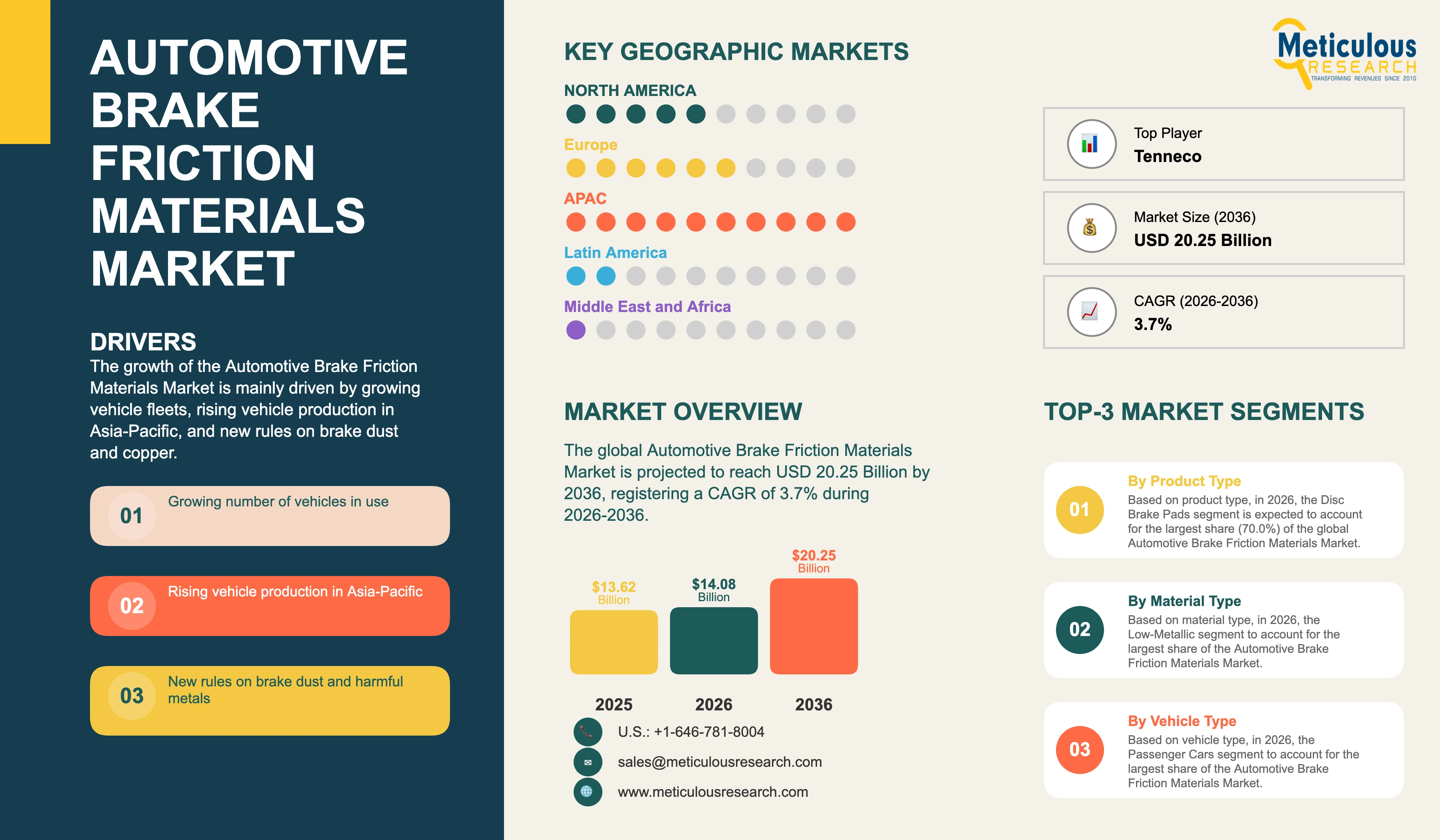
The global automotive brake friction materials market was valued at USD 13.62 billion in 2025. This market is expected to reach USD 20.25 billion by 2036 from an estimated USD 14.08 billion in 2026, registering a CAGR of 3.7% during the forecast period (2026-2036).
- Published
- Nov 2026
- Pages
- 266
- Format
- PDF + Excel
- Report ID
- MRAUTO - 1042852
- Base year
- 2025
- 2025 · BASELINE
- $13.62B
- 2036
- $20.25B
- CAGR 2026–2036
- 3.7%
2025 baseline · 2026–2036 forecast at 3.7% CAGR · hover a bar for the value
Key highlights
The EU's Euro 7 regulation sets the world's first limits on brake particle emissions (PM10) for cars and vans, at 3 mg/km for pure electric vehicles and 7 mg/km for most combustion engine, hybrid, and fuel cell vehicles, with 11 mg/km for large combustion engine vans, according to the European Parliament. S&P Global Mobility reports that these brake rules will take effect for new vehicles from November 2026, and a uniform limit of 3 mg/km is to apply to all vehicle types from 2035.
In the U.S., brake pads must contain less than 0.5% copper by weight from January 1, 2025, under the Better Brakes laws of Washington and California and the EPA's Copper-Free Brake Initiative, which the industry has applied nationwide. The Brake Manufacturers Council uses the LeafMark, with Level N showing compliance with the copper-free limit, according to the Washington State Department of Ecology.
Frasle Mobility, a leading Brazilian maker of friction materials, reported record 2025 net revenue of R$5.49 billion, up 38.5%, supported by its acquisition of Dacomsa in Mexico and growth in international markets, according to the company. Frasle reports leading shares in Brazil of 59% in brake linings for cars and 41% in brake pads for cars.
Akebono Brake Industry raised its full-year forecast for the fiscal year ending March 2026 to net sales of ¥159.4 billion, while reporting lower volumes in Europe and growth in China, according to The Brake Report. Japanese friction suppliers continue to restructure operations as automakers shift production and sourcing.
Testing company AVL has found that brake PM10 emissions on vehicles currently on the market range from about 6 mg/km to more than 20 mg/km, which means many existing pad formulas will need to change to meet Euro 7, according to Automotive World. Friction makers are developing low-dust and copper-free formulas and coated or hard-faced brake discs to meet the new limits.
Electric vehicles use regenerative braking, which reduces wear on friction brakes, and some automakers are developing new designs that move the brake into the electric drive unit to further reduce brake wear and dust, according to S&P Global Mobility. These trends are changing the mix of friction materials toward quieter, low-dust, and corrosion-resistant formulas.
By product type, disc brake pads account for the largest share of 70.0% in 2026 and also register the highest CAGR.
By material type, low-metallic accounts for the largest share in 2026, while ceramic registers the highest CAGR.
By vehicle type, passenger cars account for the largest share in 2026, while two-wheelers register the highest CAGR.
By sales channel, aftermarket accounts for the larger share of 66.0% in 2026, while OEM registers the higher CAGR.
By geography, Asia-Pacific accounts for the largest share of 43.0% in 2026, while Asia-Pacific registers the highest CAGR of 4.6%.
Report summary
| Particulars | Details |
|---|---|
| Base Year | 2025 |
| Estimated Year | 2026 |
| Forecast Period | 2026-2036 |
| Market Size in 2025 | USD 13.62 billion |
| Market Size in 2026 | USD 14.08 billion |
| Market Size by 2036 | USD 20.25 billion |
| CAGR (2026-2036) | 3.7% |
| Format | PDF, Excel & Cloud Portal · 266 pages |
| Largest Segment by Product Type (2026) | Disc Brake Pads (70.0%) |
| Largest Segment by Sales Channel (2026) | Aftermarket (66.0%) |
| Largest Region (2026) | Asia-Pacific (43.0%) |
| Fastest-Growing Region | Asia-Pacific (CAGR 4.6%) |
| Companies Profiled | 16 companies and other companies |
| Segments Covered | Product Type, Material Type, Vehicle Type, Sales Channel, Geography |
| Countries Covered | U.S., Canada, Germany, France, U.K., Italy, Spain, Poland, Czech Republic, Netherlands, Belgium, Sweden, Austria, Slovakia, Hungary, Romania, Rest of Europe, China, Japan, India, South Korea, Thailand, Indonesia, Australia, Malaysia, Vietnam, Philippines, Taiwan, Rest of Asia-Pacific, Brazil, Mexico, Argentina, Colombia, Chile, Rest of Latin America, Saudi Arabia, U.A.E., Turkey, Iran, Egypt, South Africa, Morocco, Rest of Middle East & Africa |
Report overview
Segments covered: product type, material type, vehicle type, sales channel.
Brake pads, shoes, and linings are wear parts that must be replaced several times during a vehicle's life, so demand comes both from new vehicle production and from the large and growing number of vehicles already on the road.
The growth of this market is mainly driven by the rising number of vehicles in use worldwide, which creates steady replacement demand, the growth of vehicle production in Asia-Pacific, especially in India and China, new rules that limit brake dust and harmful metals, such as the brake particle limits in the EU's Euro 7 regulation and the U.S. limits on copper in brake pads, and the need for new friction formulas for heavier electric vehicles. In addition, the shift toward ceramic and low-dust materials and the growth of two-wheeler and commercial vehicle fleets in emerging markets are creating new demand. However, longer pad life in electric and hybrid vehicles due to regenerative braking, pressure on prices in the aftermarket, and the rising cost of raw materials are expected to restrain the growth of this market to some extent.
Automotive brake friction materials are the wear parts in a vehicle's braking system that press against a brake disc or drum to create friction and slow the vehicle. They include disc brake pads, which are used on the front and often rear axles of most cars and light trucks, drum brake shoes, which are used on the rear axles of many smaller and lower-cost vehicles, and brake linings and blocks, which are used mainly on drum brakes in heavy trucks, buses, and trailers. Friction materials are made from a mix of fibers, fillers, friction modifiers, abrasives, lubricants, and resin binders, which are pressed and cured onto a steel backing plate or shoe.
This report covers the global automotive brake friction materials market, including disc brake pads, drum brake shoes, and brake linings and blocks for passenger cars, light commercial vehicles, heavy commercial vehicles, and two-wheelers, sold to vehicle makers and in the aftermarket. The market is analyzed by product type, material type, vehicle type, sales channel, and geography. Brake discs, drums, calipers, and other brake system parts, as well as friction materials for industrial machinery, railways, and aircraft, are not included.
Friction materials are grouped by their main ingredients, which decide how they perform, how much noise and dust they make, and how long they last. Low-metallic formulas contain some steel or other metal fibers and are widely used in Europe, where drivers expect strong braking at high speeds. Semi-metallic formulas contain more steel and are used where durability and heat resistance matter most, such as in trucks and heavy vehicles. Ceramic formulas use ceramic fibers and fillers to give quiet braking with very little dust and are popular in North America, Japan, and premium vehicles. Non-asbestos organic (NAO) formulas use organic fibers and fillers and are common in Asia and in lighter vehicles.
Demand for brake friction materials comes from two sources with very different buying patterns: new vehicle production and the replacement market. Vehicle makers buy friction materials as part of complete brake systems or directly from friction suppliers for new vehicles, while the aftermarket buys replacement pads, shoes, and linings through parts distributors, retailers, workshops, and fleet operators. Since brake pads on a typical passenger car need to be replaced every few years, the aftermarket accounts for the larger part of the market and provides stable demand even when new vehicle sales fall.
The market is served by global brake system suppliers, specialist friction material makers, and many regional producers. Global suppliers such as Tenneco through its Ferodo, Jurid, and Wagner brands, Brembo, Akebono, Nisshinbo, ITT, Bosch, ZF, Continental, ADVICS, and Hitachi Astemo supply both vehicle makers and the aftermarket. Frasle Mobility is a leading supplier in Latin America, while Brakes India, Rane, Sangsin, and Japan Brake Industrial are strong in their home markets. Many smaller producers in China and India compete mainly on price in the aftermarket.
Regulation is changing the materials used in brake pads in both North America and Europe, and other regions are watching these rules closely. In the U.S., the Better Brakes laws in Washington and California and the EPA's Copper-Free Brake Initiative have removed asbestos and heavy metals and limited copper to less than 0.5% by weight from 2025. In the EU, the Euro 7 regulation sets the first limits on brake particle emissions, measured using the new UN Global Technical Regulation No. 24. These rules are leading friction makers to develop new formulas and are favoring suppliers with strong research, testing, and production capabilities.
In 2026, disc brake pads account for the largest share of the market by product type and are also the fastest-growing product type. Low-metallic materials account for the largest share by material type, while ceramic materials are the fastest-growing material type. Passenger cars are the largest vehicle type, while two-wheelers are the fastest-growing vehicle type. The aftermarket accounts for the larger share by sales channel, while the OEM channel grows faster. Asia-Pacific accounts for the largest share of the market and is also the fastest-growing region.
Over the forecast period, the market is expected to grow steadily, supported by the growing number of vehicles on the road, rising vehicle production in Asia-Pacific, and the shift toward higher-value low-dust and copper-free formulas. The growth of electric vehicles, which use regenerative braking and wear out brake pads more slowly, will reduce replacement demand per vehicle over time, but heavier vehicle weights and new brake emission rules are expected to support demand for more advanced and higher-priced friction materials.
The aftermarket is expected to account for the largest share of 66.0% of the market in 2026, while the OEM channel is projected to register the higher CAGR, driven by rising vehicle production and new low-dust and electric vehicle-specific formulas.
Asia-Pacific is expected to account for the largest share of 43.0% of the market in 2026, mainly due to large vehicle production in China, Japan, India, and South Korea and very large vehicle and two-wheeler fleets.
Asia-Pacific is also projected to register the highest CAGR of 4.6% during the forecast period, driven by rising vehicle production and exports from China, fast growth of vehicle sales in India and Southeast Asia, and new two-wheeler braking rules.
The report profiles 16 companies, including Tenneco, Brembo, Akebono, Nisshinbo, ITT, Bosch, ZF, Continental, ADVICS, Hitachi Astemo, Frasle Mobility, Japan Brake Industrial, Sangsin, Brakes India, Rane, and Knorr-Bremse.
Euro 7 sets the first limits on brake particle emissions, at 3 mg/km for pure electric cars and vans and 7 mg/km for most other cars, with a uniform limit of 3 mg/km planned from 2035. Many existing pad formulas will need to change, which favors suppliers with low-dust technology.
Electric vehicles use regenerative braking, which greatly extends brake pad life and reduces replacement demand. However, they need quieter, low-dust, and corrosion-resistant pads with higher values, which supports market value as electric vehicles gain share.
Report infographic
Market dynamics
17 factors across 5 forcesGrowing number of vehicles in use
The number of vehicles on the road continues to grow worldwide, especially in Asia-Pacific, Latin America, and the Middle East & Africa. Every vehicle needs new brake pads, shoes, or linings several times during its life, so a larger and older vehicle fleet creates steady demand for replacement friction materials. In many countries, the average age of vehicles on the road has increased, as higher new vehicle prices lead drivers to keep their vehicles longer, which further supports aftermarket demand.
Commercial vehicle fleets, including trucks, buses, and delivery vans, use brakes more heavily than passenger cars and need more frequent replacement of pads and linings. The growth of e-commerce and urban delivery is increasing the number of light commercial vehicles in cities, where frequent stopping wears out brakes faster. Frasle Mobility noted that its aftermarket business remained resilient in 2025, supported by aging fleets and increased passenger transport activity.
Rising vehicle production in Asia-Pacific
Vehicle production in Asia-Pacific continues to grow, led by China and India, which are the world's largest producers of cars and two-wheelers, respectively. China has become the largest exporter of passenger cars, and its electric vehicle makers are expanding production for domestic and export markets. India's car, two-wheeler, and commercial vehicle markets are also growing, supported by rising incomes, road building, and government programs to support local manufacturing.
New vehicles need friction materials for their first set of brakes, and vehicle makers in the region are increasingly sourcing friction materials from local suppliers and from global suppliers with local plants. Akebono reported that its China sales grew 8% in the first nine months of its 2025 fiscal year, while sales in other regions were flat or lower. Growth in Asia-Pacific is expected to make the region both the largest and the fastest-growing market for brake friction materials over the forecast period.
New rules on brake dust and harmful metals
Governments are introducing new rules to reduce pollution from brakes, as brake dust is now one of the main sources of fine particles from road traffic. The EU's Euro 7 regulation sets the first limits on brake particle emissions for cars and vans, at 3 mg/km for pure electric vehicles and 7 mg/km for most other vehicles, according to the European Parliament. S&P Global Mobility reports that these rules will take effect for new vehicles from November 2026. Testing company AVL has found that brake emissions from many vehicles currently on the market range from about 6 mg/km to more than 20 mg/km, so many vehicles will need new pad formulas or new brake designs to comply.
In the U.S., brake pads must contain less than 0.5% copper by weight from January 2025, as copper from brake dust can harm fish and other aquatic life when it washes into rivers and streams. These rules are pushing friction makers to develop new copper-free and low-dust formulas, which often use more expensive materials and require more testing. As a result, the average value of friction materials per vehicle is expected to rise, especially for vehicles sold in Europe and North America.
Heavier vehicles and new braking needs of electric vehicles
Vehicles are becoming heavier, as SUVs gain share and as electric vehicles carry large and heavy batteries. Heavier vehicles need larger brakes and friction materials that can handle more heat and energy. Electric vehicles also have different braking needs, as their brakes are used less often due to regenerative braking. This can lead to corrosion of brake discs and uneven pad wear, and it makes brake noise more noticeable because electric vehicles are quieter than combustion engine vehicles.
Friction makers are developing new formulas for electric vehicles that give quiet braking, low dust, and good performance even when the brakes are used rarely. Many automakers now specify special pads for their electric models, and aftermarket suppliers are launching dedicated electric vehicle brake pad ranges. These products often have higher prices than standard pads, which supports market value even as the number of brake replacements per electric vehicle falls.
Growth of two-wheeler and commercial vehicle fleets in emerging markets
Two-wheelers are the main form of personal transport in India, Southeast Asia, and parts of Latin America and Africa. These vehicles use disc brakes and drum brakes with small pads and shoes that need regular replacement, and many countries now require better brakes on two-wheelers. India, for example, requires anti-lock braking systems or combined braking systems on new two-wheelers, which has increased the use of disc brakes. Commercial vehicle fleets are also growing in emerging markets as road freight and public transport expand. Trucks and buses use large amounts of brake linings and pads, and new rules for heavy vehicle braking and the growing use of disc brakes on trucks and buses are increasing demand for higher-value friction materials. Together, these trends make emerging markets an important source of growth for both vehicle makers and aftermarket suppliers.
Table of contents
12 chapters · 175 sections · 266 pages · click to expandSegmental analysis
| Segment | Largest share (2026) | Fastest growth (2026–2036) |
|---|---|---|
| By Product Type | Low-metallic | Ceramic |
By Product Type
- The low-metallic segment is expected to account for the largest share of the automotive brake friction materials market, while the ceramic segment is projected to register the highest CAGR during the forecast period.
- The passenger cars segment is expected to account for the largest share of the automotive brake friction materials market, while the two-wheelers segment is projected to register the highest CAGR during the forecast period.
Geographic analysis
Asia-Pacific
Largest shareIn 2026, Asia-Pacific is expected to account for the largest share of 43.0% of the global automotive brake friction materials market. The large share of this region is mainly due to the very large vehicle production in China, Japan, India, South Korea, and Thailand, the large and growing vehicle fleets in China, India, and Southeast Asia, the very large number of two-wheelers in use in India, Indonesia, Vietnam, and other countries, the presence of major friction suppliers, such as Akebono, Nisshinbo, ADVICS, Hitachi Astemo, Japan Brake Industrial, Sangsin, Brakes India, and Rane, and many local producers in China and India that serve both vehicle makers and the aftermarket. China's large exports of vehicles and auto parts also make it a major supplier of friction materials to other regions. Asia-Pacific is also projected to register the highest CAGR of 4.6% during the forecast period. The rapid growth of this region is mainly driven by rising vehicle production and exports from China, the fast growth of car, two-wheeler, and commercial vehicle sales in India and Southeast Asia, new rules requiring anti-lock or combined braking on two-wheelers, the growing number of vehicles reaching the age when brakes need replacement, and the growth of organized aftermarket channels. Akebono reported that its China sales grew 8% in the first nine months of its 2025 fiscal year, while sales in other regions were flat or lower. India's two-wheeler fleet and its fast-growing car market are expected to make it one of the most important sources of new demand in the region.
North America
Europe and North America account for significant shares of the market, supported by large and aging vehicle fleets, high average values of friction materials, and strict rules on brake emissions and materials. In North America, brake pads must contain less than 0.5% copper from 2025, and the large fleet of trucks and SUVs supports demand for heavy-duty and ceramic pads. Many leading friction suppliers, such as Tenneco, Brembo, ITT, Bosch, ZF, and Continental, are based in these regions.
Europe
In Europe, the Euro 7 brake particle limits, which take effect for new vehicles from November 2026, are leading vehicle makers and friction suppliers to develop new low-dust formulas. Germany, France, Italy, and the U.S. are among the largest individual country markets, supported by high average values of pads and large aftermarkets.
Latin America
Latin America and the Middle East & Africa account for smaller shares of the market but offer growth opportunities as vehicle fleets grow and age. In Latin America, Brazil and Mexico are major vehicle producers and have large aftermarkets, and Frasle Mobility strengthened its position in Mexico through the acquisition of Dacomsa in 2025.
Middle East & Africa
In the Middle East & Africa, Saudi Arabia, Turkey, South Africa, and Egypt have growing vehicle fleets, and hot climates and heavy use of commercial vehicles increase brake wear. Growth in these regions is supported by the expansion of organized aftermarket channels, although price competition from low-cost imports remains strong.
Competitive landscape
The global automotive brake friction materials market is moderately fragmented, with a mix of global suppliers and many regional producers. A group of global suppliers serves vehicle makers and the aftermarket across many regions, while many regional and local producers, especially in China and India, compete mainly in the aftermarket. The OEM channel is more concentrated than the aftermarket, as vehicle makers require extensive testing and approval before buying from a new supplier.
Tenneco, through its Ferodo, Jurid, and Wagner brands, is one of the largest friction suppliers in the aftermarket. Brembo is a leader in premium and performance brakes, while Akebono and Nisshinbo are major Japanese suppliers to vehicle makers in Japan, North America, and other regions. ITT supplies brake pads to many European vehicle makers through its Motion Technologies business. Bosch, ZF, Continental, ADVICS, and Hitachi Astemo supply brake systems and friction materials to vehicle makers and the aftermarket. Frasle Mobility, which reported record 2025 net revenue of R$5.49 billion, is a leading supplier in Latin America, while Brakes India, Rane, Sangsin, and Japan Brake Industrial are strong in their home markets. Knorr-Bremse is a major supplier of brakes for commercial vehicles.
Companies in this market compete on braking performance, noise, dust, and wear, compliance with rules on materials and emissions, approval by vehicle makers, vehicle coverage in the aftermarket, brand strength, distribution, and price. Key strategies include developing low-dust, copper-free, and electric vehicle-specific formulas, building local production in fast-growing markets, acquiring regional suppliers and brands, and expanding aftermarket product ranges and distribution.
Recent competitive activity in the automotive brake friction materials market has focused on acquisitions, new formulas, and restructuring. Frasle Mobility acquired Dacomsa in Mexico in 2025, friction suppliers have launched new copper-free and electric vehicle-specific pad ranges, and Akebono and other suppliers have restructured operations to improve profitability.
We expect competition to increase over the forecast period as the Euro 7 brake particle limits raise the technical requirements for friction materials and as Chinese and Indian suppliers expand into export markets. Suppliers with strong research and testing capabilities and approved formulas for Euro 7 are expected to gain share with vehicle makers, while branded aftermarket suppliers with broad vehicle coverage and strong distribution are expected to benefit from growing vehicle fleets. Consolidation among smaller suppliers is likely to continue.
Some of the key players operating in the automotive brake friction materials market are Tenneco Inc., Brembo N.V., Akebono Brake Industry Co., Ltd., Nisshinbo Holdings Inc., ITT Inc., Robert Bosch GmbH, ZF Friedrichshafen AG, Continental AG, ADVICS Co., Ltd., Hitachi Astemo, Ltd., Frasle Mobility S.A., Japan Brake Industrial Co., Ltd., Sangsin Brake Co., Ltd., Brakes India Private Limited, Rane Brake Lining Limited, and Knorr-Bremse AG, among others.
- —
Frasle Mobility reported record 2025 net revenue of R$5.49 billion after acquiring Dacomsa in Mexico, U.S. brake pads moved to less than 0.5% copper from January 2025, and the Euro 7 brake particle limits will take effect for new vehicles from November 2026.
- Tenneco Inc.
- Brembo N.V.
- Akebono Brake Industry Co., Ltd.
- Nisshinbo Holdings Inc.
- ITT Inc.
- Robert Bosch GmbH
- ZF Friedrichshafen AG
- Continental AG
- ADVICS Co., Ltd.
- Hitachi Astemo, Ltd.
- Frasle Mobility S.A.
- Japan Brake Industrial Co., Ltd.
- Sangsin Brake Co., Ltd.
- Brakes India Private Limited
- Rane Brake Lining Limited
- Knorr-Bremse AG
Expert perspectives
The automotive brake friction materials market is a large and stable market that depends mainly on replacement demand from the growing number of vehicles on the road. It is now going through important changes, as new rules on brake dust and copper, the growth of electric vehicles, and heavier vehicles are changing the materials and designs used in brake pads. These changes are raising the technical requirements and average values of friction materials, especially in Europe and North America, where rules are the strictest.
Over the forecast period, the market is expected to grow at a CAGR of 3.7%, from USD 14.08 billion in 2026 to USD 20.25 billion in 2036. Growth will be driven by rising vehicle production and growing fleets in Asia-Pacific, steady aftermarket demand worldwide, the shift to higher-value low-dust and copper-free formulas, and the growth of two-wheeler and commercial vehicle fleets in emerging markets.
Among the market segments, disc brake pads are both the largest and the fastest-growing product type. Low-metallic materials are the largest material type, while ceramic materials grow fastest. Passenger cars are the largest vehicle type, while two-wheelers grow fastest. The aftermarket is the larger sales channel, while the OEM channel grows faster. Asia-Pacific is both the largest and the fastest-growing region, at a CAGR of 4.6%.
In our view, the Euro 7 brake particle limits will be one of the most important changes in the market in the coming years. Vehicle makers selling in Europe will need new friction formulas and brake designs, which will favor suppliers with strong research and testing capabilities and could lead to consolidation among smaller suppliers. Similar rules may follow in other regions, which would spread demand for low-dust friction materials. Early movers that win approvals with major vehicle makers are likely to hold those positions for many years.
We also see the growth of electric vehicles as a long-term challenge for replacement demand, as regenerative braking greatly extends brake pad life. However, electric vehicles also need specialized friction materials that are quiet, low-dust, and resistant to corrosion, which have higher values than standard pads. Suppliers that adapt their products for electric vehicles and build strong positions with Chinese electric vehicle makers are expected to perform best.
Overall, we believe the automotive brake friction materials market will grow steadily over the forecast period, with disc brake pads, ceramic materials, two-wheelers, the OEM channel, and Asia-Pacific providing the fastest growth. Companies with strong technology, approved low-dust formulas, broad aftermarket coverage, and local production in growing markets will be best positioned to capture this growth.
Customer perspectives
Purchasing Manager - Auto Parts Distributor, U.S.
Brake pads are one of our steadiest product lines because every car needs them again and again. Customers now ask for ceramic and low-dust pads, even for older cars.
“Euro 7 means we have to cut brake dust without losing stopping power or making the brakes noisy. We are working closely with our friction suppliers on new pad formulas for every new model.”
“Our delivery riders brake hundreds of times a day in city traffic, so we replace brake pads very often. Since our scooters moved to disc brakes, we buy more pads than before.”
Frequently asked questions
The global automotive brake friction materials market was valued at USD 13.62 billion in 2025, up from USD 13.20 billion in 2024, and is estimated at USD 14.08 billion in 2026. The market includes disc brake pads, drum brake shoes, and brake linings and blocks sold to vehicle makers and in the aftermarket.
Cite this report
Meticulous Research. (2026). Automotive Brake Friction Materials Market - Global Opportunity Analysis and Industry Forecast (2026-2036) (Report No. MRAUTO - 1042852). Meticulous Market Research Pvt. Ltd. https://www.meticulousresearch.com/product/automotive-brake-friction-materials-market-7535