Automotive Gigacasting Market (2026-2036)
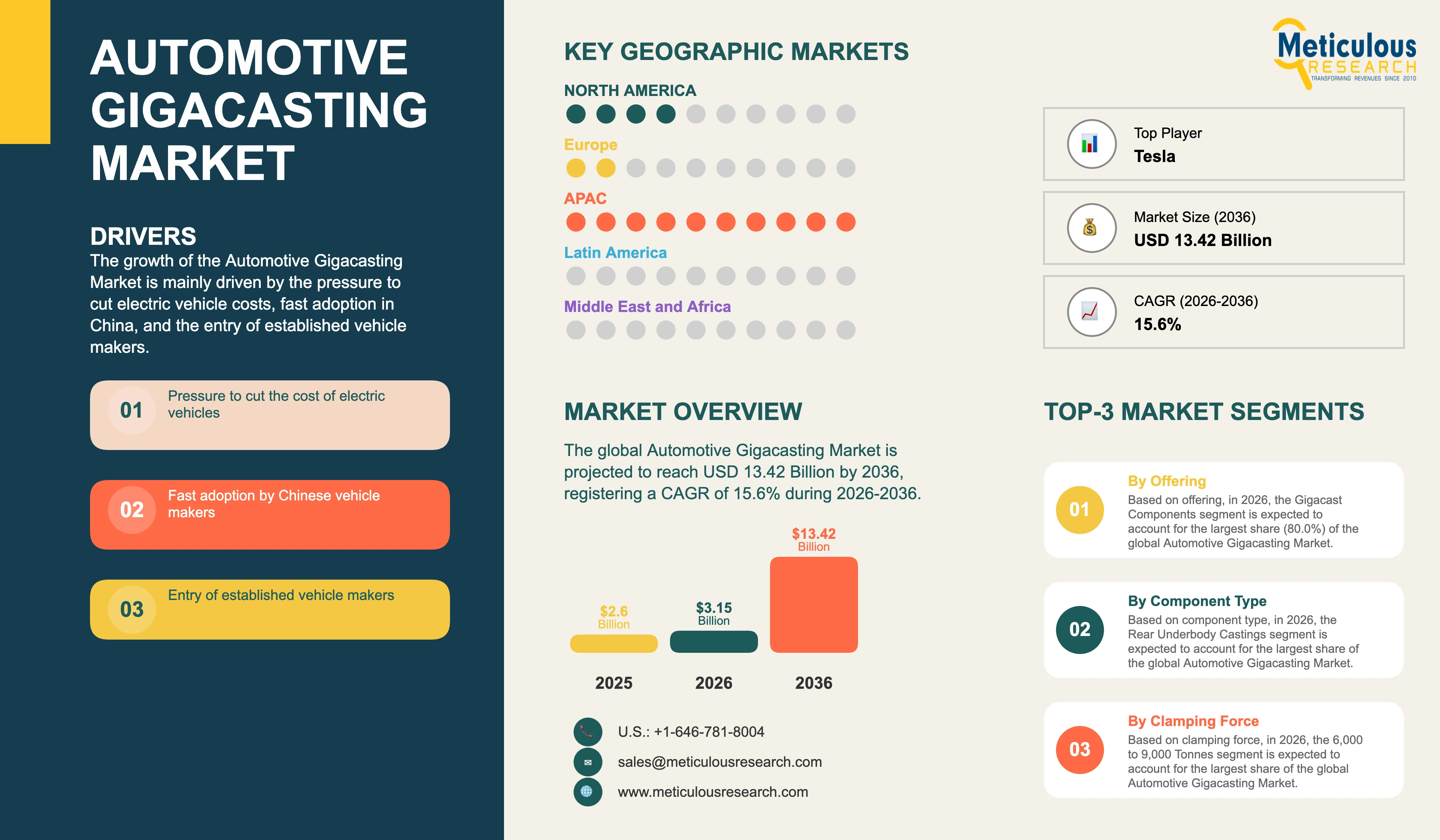
The global automotive gigacasting market was valued at USD 2.60 billion in 2025. This market is expected to reach USD 13.42 billion by 2036 from an estimated USD 3.15 billion in 2026, registering a CAGR of 15.6% during the forecast period (2026-2036).
- Published
- Nov 2026
- Pages
- 264
- Format
- PDF + Excel
- Report ID
- MRAUTO - 1042855
- Base year
- 2025
- 2025 · BASELINE
- $2.60B
- 2036
- $13.42B
- CAGR 2026–2036
- 15.6%
2025 baseline · 2026–2036 forecast at 15.6% CAGR · hover a bar for the value
Key highlights
Tesla pioneered automotive gigacasting with the Model Y, starting with a single rear underbody casting that replaced 70 separate parts, according to Tesla's 2020 Battery Day and Reuters. Tesla began using an IDRA OL 6100 CS Giga Press in late 2020 and now uses gigacasting at its plants in Fremont, Texas, Shanghai, and Berlin, including 9,000-tonne machines for the Cybertruck. Tesla's approach led many other vehicle makers to study and adopt large castings.
Volvo's EX60 electric crossover entered production at its Torslanda plant in Sweden in April 2026, with the rear underbody cast as a single piece that replaces hundreds of stamped and welded parts. Volvo has also ordered two 9,000-tonne IDRA giga presses for its new electric vehicle plant in Košice, Slovakia.
Toyota plans to use gigacasting machinery that it has developed in-house to make electric vehicles at its new Lexus plant in Shanghai, which is due to start production in 2027, according to Reuters reports in October 2026. Toyota has said gigacasting could cut body assembly time by half.
Hyundai Motor completed the installation of a 9, 000-tonne IDRA giga press at its Ulsan plant in Korea and is building a dedicated hyper casting plant in Ulsan with an investment of 1 trillion won, according to Asia Economy.
Chinese vehicle makers and suppliers have adopted gigacasting faster than those in any other region, supported by very large electric vehicle volumes. Xiaomi uses a 9,100-tonne die-casting machine developed with Haitian for the SU7, Xpeng uses 7,000-tonne in-house machines and a 12,000-tonne Guangdong Hongtu die-casting island for the G7, and Neta signed an agreement with L.K. Technology to develop a die-casting machine of more than 20,000 tonnes.
Gigacasting machines are supplied by a small number of companies, led by L.K. Technology, which owns Italy's IDRA, and including Bühler, Haitian, Yizumi, and UBE Machinery. Large castings are made both in-house by vehicle makers, such as Tesla, Xiaomi, and Xpeng, and by suppliers, such as Guangdong Hongtu, Wencan, Tuopu, HASCO, Nemak, and Ryobi.
By offering, gigacast components account for the larger share of 80.0% in 2026 and also register the higher CAGR.
By component type, rear underbody castings account for the largest share in 2026, while battery trays and enclosures register the highest CAGR.
By clamping force, 6, 000 to 9,000 tonnes account for the largest share in 2026, while above 12,000 tonnes register the highest CAGR.
By propulsion type, battery electric vehicles account for the largest share of 78.0% in 2026 and also register the highest CAGR.
By geography, Asia-Pacific accounts for the largest share of 60.0% in 2026, while Europe registers the highest CAGR of 19.9%.
Report summary
| Particulars | Details |
|---|---|
| Forecast Period | 2026-2036 |
| Base Year | 2025 |
| Estimated Year | 2026 |
| CAGR (Value) | 15.6% |
| Format | PDF, Excel & Cloud Portal · 264 pages |
| Market Size (Value) in 2025 | USD 2.60 billion |
| Market Size (Value) in 2026 | USD 3.15 billion |
| Market Size (Value) in 2036 | USD 13.42 billion |
| Segments Covered | Offering, Component Type, Clamping Force, Propulsion Type, Geography |
| Countries Covered | U.S., Canada, Germany, Sweden, Slovakia, Hungary, Czech Republic, Spain, Italy, France, U.K., Poland, Austria, Belgium, Romania, Portugal, Rest of Europe, China, Japan, South Korea, India, Thailand, Indonesia, Malaysia, Australia, Taiwan, Vietnam, Rest of Asia-Pacific, Mexico, Brazil, Argentina, Chile, Colombia, Rest of Latin America, Turkey, Saudi Arabia, U.A.E., Morocco, Egypt, South Africa, Rest of Middle East & Africa |
| Key Companies | 13 companies and other companies |
| Largest Segment by Offering (2026) | Gigacast Components (80.0%) |
| Largest Segment by Propulsion Type (2026) | Battery Electric Vehicles (78.0%) |
| Largest Region (2026) | Asia-Pacific (60.0%) |
| Fastest-Growing Region | Europe (CAGR 19.9%) |
Report overview
Segments covered: offering, component type, clamping force, propulsion type.
Gigacasting, also called mega casting or hyper casting, uses very large high-pressure die-casting machines with clamping forces of 6,000 tonnes or more to produce large single-piece aluminum body parts that replace dozens of stamped and welded steel parts.
The growth of this market is mainly driven by the need of vehicle makers to cut the cost and complexity of building electric vehicles, the fast adoption of gigacasting by Chinese electric vehicle makers and suppliers, the entry of established vehicle makers such as Toyota, Volvo, and Hyundai, the ability of gigacasting to reduce the number of parts, robots, and factory space needed for body assembly, and the development of larger die-casting machines and new aluminum alloys that allow bigger and more complex castings. In addition, the use of large castings for battery trays and integrated body structures is creating new applications. However, the high investment needed for gigapresses and dies, concerns about repair costs after accidents, and the technical difficulty of producing large castings without defects are expected to restrain the growth of this market to some extent.
Automotive gigacasting is a manufacturing process in which molten aluminum is injected at high pressure into a large steel die to produce a single large structural part of a vehicle body, such as the rear underbody, front underbody, or battery tray. The process uses very large high-pressure die-casting machines, often called gigapresses, with clamping forces of 6,000 tonnes or more. A single gigacast part can replace dozens or even hundreds of stamped steel parts that would otherwise be joined by welding, riveting, and bonding, which simplifies the body shop and reduces the number of robots, tools, and floor space needed. Large castings can also make vehicle bodies lighter and stiffer, which helps electric vehicle range and handling.
This report covers the global automotive gigacasting market, including gigacast components, which are the large structural castings used in vehicle bodies, and equipment and tooling, which includes gigapresses, dies, and related cell equipment sold for automotive gigacasting. Gigacast components produced in-house by vehicle makers are valued at an estimated market price, and components bought from suppliers are valued at selling prices. The market is analyzed by offering, component type, clamping force, propulsion type, and geography. Conventional die-cast parts made on machines below 6,000 tonnes, such as engine blocks, gearbox housings, and smaller structural parts, are not included.
Tesla brought gigacasting into vehicle production with the Model Y, starting with a single rear underbody casting that replaced 70 separate parts, according to Tesla's 2020 Battery Day. The company has since expanded gigacasting to the front underbody and to the Cybertruck, which uses castings made on 9,000-tonne machines. Tesla's success led many Chinese electric vehicle makers and suppliers to adopt the process, and established vehicle makers in Europe, Japan, and Korea are now following.
China leads the world in gigacasting, both in the number of vehicles built with large castings and in machine making. Chinese vehicle makers, such as Xiaomi, Xpeng, Zeekr, NIO, Aito, Li Auto, and Leapmotor, use large castings in many of their electric vehicles, either made in-house or by suppliers such as Guangdong Hongtu, Wencan, Tuopu, and HASCO. Chinese machine makers, led by L.K. Technology and Haitian, have built machines of 9,000 to 16,000 tonnes and are developing even larger machines. The large scale of Chinese electric vehicle production and the willingness of Chinese vehicle makers to adopt new manufacturing methods have made China the largest market for gigacasting.
Outside China, gigacasting is spreading mainly through new electric vehicle plants built by established vehicle makers. Volvo began producing the EX60 with a gigacast rear underbody at its Torslanda plant in Sweden in April 2026 and has ordered two 9,000-tonne presses for its new plant in Slovakia. Toyota plans to use its own gigacasting machines at its new Lexus plant in Shanghai from 2027, Hyundai has installed a 9,000-tonne press in Ulsan, and Ford and other vehicle makers have also bought gigapresses. These moves show that gigacasting is becoming a mainstream manufacturing method for electric vehicles.
Gigacasting also brings new technical requirements for materials, tooling, process control, and vehicle design. Large castings need special aluminum alloys that can be used without heat treatment, very precise control of the casting process to avoid defects, large and complex dies with good cooling, and careful design for crash safety and repair. Machine makers, alloy suppliers, die makers, and vehicle makers are working together to improve these areas, and new alloys and process controls are helping to raise the quality and size of large castings.
In 2026, gigacast components account for the largest share of the market by offering and are also the faster-growing offering. Rear underbody castings account for the largest share by component type, while battery trays and enclosures are the fastest-growing component type. Machines of 6,000 to 9,000 tonnes account for the largest share by clamping force, while machines above 12,000 tonnes are the fastest-growing clamping force range. Battery electric vehicles are the largest propulsion type and are also the fastest-growing propulsion type. Asia-Pacific accounts for the largest share of the market, while Europe is the fastest-growing region.
Over the forecast period, the market is expected to grow strongly as more vehicle makers adopt gigacasting for new electric vehicle platforms, as castings grow larger and are used for more parts of the vehicle body, and as gigacasting spreads from China and Tesla to Europe, Japan, Korea, and North America. Growth will depend on electric vehicle sales, the pace of new platform launches, and progress in solving technical challenges such as casting defects and repair costs.
Battery electric vehicles are expected to account for the largest share of 78.0% of the market in 2026 and are also projected to register the highest CAGR, driven by new electric platforms designed for gigacasting.
Asia-Pacific is expected to account for the largest share of 60.0% of the market in 2026, mainly due to very large electric vehicle production in China, fast adoption by Chinese vehicle makers, and leading Chinese machine makers and casting suppliers.
Europe is projected to register the highest CAGR of 19.9% during the forecast period, driven by Volvo's gigacasting production in Sweden and its new plant in Slovakia, Tesla's Berlin plant, and new electric platforms from other European vehicle makers.
The report profiles 13 companies, including Tesla, L.K. Technology (IDRA), Bühler, Haitian, Yizumi, UBE Machinery, Guangdong Hongtu, Wencan, Tuopu, HASCO, Nemak, Ryobi, and Magna.
Gigacasting uses very large die-casting machines to produce large single-piece aluminum body parts that replace dozens or hundreds of stamped and welded parts. Vehicle makers adopt it to reduce parts, robots, factory space, and cost, especially for electric vehicles.
Report infographic
Market dynamics
17 factors across 5 forcesPressure to cut the cost of electric vehicles
Vehicle makers are under strong pressure to reduce the cost of electric vehicles to compete on price with combustion engine vehicles and with low-cost Chinese electric vehicles. The vehicle body is one of the largest costs after the battery, and conventional body construction uses hundreds of stamped steel parts joined by welding and other methods in large and expensive body shops. Gigacasting can replace many of these parts with a few large castings, which reduces the number of parts, tools, robots, and workers needed.
Tesla has said that its Model Y rear casting replaced 70 separate parts, and Toyota has said that gigacasting could cut body assembly time by half. These savings make gigacasting attractive to vehicle makers designing new electric vehicle platforms, especially those planning lower-cost models. As competition in the electric vehicle market intensifies, more vehicle makers are expected to adopt gigacasting to reduce costs and simplify production.
Fast adoption by Chinese electric vehicle makers and suppliers
Chinese electric vehicle makers have adopted gigacasting faster than vehicle makers in any other region. Xiaomi uses a 9,100-tonne die-casting machine developed with Haitian to produce the rear underbody of the SU7, Xpeng uses its own 7,000-tonne machines and a 12,000-tonne die-casting island from Guangdong Hongtu for the G7, and Zeekr, Aito, NIO, Li Auto, and Leapmotor also use large castings in their vehicles. Neta has signed an agreement with L.K. Technology to develop a machine of more than 20,000 tonnes.
Chinese suppliers, such as Guangdong Hongtu, Wencan, Tuopu, and HASCO, have invested heavily in gigacasting capacity to serve vehicle makers that do not cast in-house. The very large scale of Chinese electric vehicle production and the short development times of Chinese vehicle makers have made China the largest and most dynamic market for gigacasting, and Chinese machine makers and suppliers are now expanding into other regions.
Entry of established vehicle makers in europe, japan, and Korea
After Tesla and Chinese vehicle makers showed the benefits of gigacasting, established vehicle makers have begun to adopt the process. Volvo began producing the EX60 with a gigacast rear underbody at its Torslanda plant in April 2026 and has ordered two 9,000-tonne IDRA presses for its new plant in Košice, Slovakia. Toyota plans to use in-house gigacasting machines at its new Lexus plant in Shanghai from 2027, and Hyundai has installed a 9,000-tonne press in Ulsan and is building a dedicated hyper casting plant there.
Ford and other vehicle makers have also bought gigapresses, according to industry reports. The entry of these large vehicle makers is expected to bring gigacasting to many more vehicle models and regions over the forecast period and to increase demand for both gigacast components and equipment. It also shows that gigacasting is moving from a Tesla and China-specific approach to a mainstream manufacturing method.
Fewer parts, robots, and factory space
Gigacasting greatly simplifies vehicle body production and changes how body shops are planned and built. A single large casting can replace dozens or hundreds of stamped parts, eliminating many welding and joining steps, along with the robots, fixtures, and conveyors needed for them. This reduces the floor space needed for the body shop, lowers capital investment in new plants, and shortens the time needed to build each vehicle. Fewer parts also mean simpler supply chains and fewer suppliers to manage.
For new electric vehicle plants, these benefits can significantly reduce investment and operating costs, which is why many new plants are being designed around gigacasting from the start. Xiaomi has said it can produce an SU7 every 76 seconds at its factory, which uses gigacasting together with highly automated production lines. These productivity gains are a key reason for the growing adoption of gigacasting.
Larger machines and new aluminum alloys
Advances in die-casting machines and materials are making gigacasting more capable and able to produce larger parts. Machine makers have moved from 6,000-tonne machines to machines of 9,000, 12,000, and 16,000 tonnes, and L.K. Technology and Neta are developing a machine of more than 20,000 tonnes. Larger machines can produce bigger castings, such as integrated front and rear underbodies or complete body structures, which further reduce the number of parts. New aluminum alloys that do not need heat treatment after casting have made it possible to produce large castings with good strength, ductility, and dimensional accuracy, while better simulation, die design, and process control are improving quality. Xiaomi has developed its own die-casting alloy, and other vehicle makers and suppliers are developing alloys tailored to gigacasting. These advances are expected to expand the range of parts that can be gigacast and support continued market growth.
Table of contents
12 chapters · 185 sections · 264 pages · click to expandSegmental analysis
| Segment | Largest share (2026) | Fastest growth (2026–2036) |
|---|---|---|
| By Offering | Gigacast components | Rapid growth of this |
| By Component Type | Rear underbody castings | Battery trays and enclosures |
| By Clamping Force | 6,000 to 9,000 tonnes | Above 12,000 tonnes |
| By Propulsion Type | Battery electric vehicles | Battery electric vehicles |
| Other segments | 6,000 to 9,000 tonnes | Above 12,000 tonnes |
By Offering
- Automotive Gigacasting Market Analysis by Offering
- The gigacast components segment is expected to account for the largest share of 80.0% of the global automotive gigacasting market.
- The large share of this segment is mainly due to the large number of electric vehicles produced each year with gigacast rear and front underbodies, especially by Tesla and Chinese vehicle makers, the high value of each large casting, which replaces dozens or hundreds of stamped parts, the growing use of large castings for battery trays and integrated body structures, and the start of gigacasting production at established vehicle makers, such as Volvo.
- Gigacast components are made both in-house by vehicle makers, such as Tesla, Xiaomi, and Xpeng, and by suppliers, such as Guangdong Hongtu, Wencan, Tuopu, HASCO, Nemak, and Ryobi.
- The gigacast components segment is also projected to register the higher CAGR during the forecast period.
- The rapid growth of this segment is driven by the growing number of electric vehicle models using gigacasting, the increasing number and size of castings per vehicle, the expansion of gigacasting to established vehicle makers in Europe, Japan, Korea, and North America, and the growth of outsourced gigacasting by tier-1 suppliers serving multiple vehicle makers.
- As more gigacasting lines move from installation to full production, the value of components produced is expected to grow faster than new equipment sales.
By Component Type
- Automotive Gigacasting Market Analysis by Component Type
- The rear underbody castings segment is expected to account for the largest share of the global automotive gigacasting market.
- The large share of this segment is mainly due to the use of gigacast rear underbodies on the Tesla Model Y and Cybertruck, the Xiaomi SU7, the Volvo EX60, and many other Chinese electric vehicles, the large number of stamped parts that a single rear underbody casting can replace, the relatively simple design and repair needs of the rear underbody compared with the front of the vehicle, and the fact that the rear underbody was the first part to be gigacast and is now a well-proven application.
- Tesla's first Model Y rear casting replaced 70 separate parts.
- However, the battery trays and enclosures segment is projected to register the highest CAGR during the forecast period.
- The rapid growth of this segment is driven by the growth of electric vehicle production, the move by vehicle makers to cell-to-body and cell-to-chassis battery designs, in which the battery tray becomes part of the vehicle structure, the benefits of single-piece castings for sealing and part reduction, and the investment of suppliers in large casting capacity for battery trays.
- Large cast battery trays also allow more integration of mounting points and cooling channels.
- The rear underbody castings segment is expected to account for the largest share of the automotive gigacasting market, while the battery trays and enclosures segment is projected to register the highest CAGR during the forecast period.
By Clamping Force
- Automotive Gigacasting Market Analysis by Clamping Force
- The 6,000 to 9,000 tonnes segment is expected to account for the largest share of the global automotive gigacasting market.
- The large share of this segment is mainly due to the wide use of machines in this range by Tesla, Chinese vehicle makers, and suppliers, the fact that most rear and front underbody castings in current production are made on machines of 6,000 to 9,000 tonnes, the larger installed base and longer production history of these machines, and their lower cost and easier installation compared with larger machines.
- Tesla, Xiaomi, Aito, and Zeekr use machines in this range, and Volvo and Hyundai have installed 9,000-tonne IDRA machines.
- However, the above 12,000 tonnes segment is projected to register the highest CAGR during the forecast period.
- The rapid growth of this segment is driven by the development of machines of 16, 000 tonnes and more, including the machine of more than 20,000 tonnes being developed by L.K.
- Technology and Neta, the move to integrated body structures and larger castings that combine front or rear underbodies with other parts, and the plans of vehicle makers to reduce the number of body parts further.
- These machines are expected to be used for the largest castings in future electric vehicle platforms.
By Propulsion Type
- Automotive Gigacasting Market Analysis by Propulsion Type
- The battery electric vehicles segment is expected to account for the largest share of 78.0% of the global automotive gigacasting market.
- The large share of this segment is mainly due to the use of gigacasting on the Tesla Model Y and Cybertruck, the Xiaomi SU7, the Volvo EX60, and many Chinese battery electric vehicles, the fact that most new platforms designed for gigacasting are battery electric platforms, the need to reduce the cost of electric vehicles to compete on price, and the use of large castings for battery trays and structures that support the battery.
- Battery electric vehicles are also built in new plants that can be designed around gigacasting from the start.
- The battery electric vehicles segment is also projected to register the highest CAGR during the forecast period.
- The rapid growth of this segment is driven by the growing share of battery electric vehicles in new vehicle sales, the launch of new electric vehicle platforms designed for gigacasting by Toyota, Volvo, Hyundai, and other vehicle makers, the growing use of large castings for battery trays and integrated body structures, and the need to lower the cost of electric vehicles to reach more buyers.
- As electric vehicle production grows, the number of vehicles using gigacast parts is expected to rise sharply.
Other segments
- The 6,000 to 9,000 tonnes segment is expected to account for the largest share of the automotive gigacasting market, while the above 12,000 tonnes segment is projected to register the highest CAGR during the forecast period.
Geographic analysis
Asia-Pacific
Largest shareIn 2026, Asia-Pacific is expected to account for the largest share of 60.0% of the global automotive gigacasting market. The large share of this region is mainly due to the very large electric vehicle production in China, the fast adoption of gigacasting by Chinese vehicle makers, such as Xiaomi, Xpeng, Zeekr, NIO, Aito, Li Auto, and Leapmotor, the production of gigacast Model Y bodies at Tesla's Shanghai plant, the presence of leading Chinese machine makers, such as L.K. Technology, Haitian, and Yizumi, and large casting suppliers, such as Guangdong Hongtu, Wencan, Tuopu, and HASCO, and the investment of Hyundai in a hyper casting plant in Ulsan, Korea. Toyota also plans to use in-house gigacasting machinery at its new Lexus plant in Shanghai from 2027, and Japanese casting suppliers such as Ryobi are building large casting capability.
Europe
Fastest growthEurope is projected to register the highest CAGR of 19.9% during the forecast period. The rapid growth of this region is mainly driven by the start of gigacasting production at Volvo's Torslanda plant in Sweden for the EX60 in April 2026, Volvo's new electric vehicle plant in Košice, Slovakia, with two 9,000-tonne IDRA presses, Tesla's gigacasting operations at its plant near Berlin, the plans of other European vehicle makers to adopt large castings for new electric platforms, and the presence of leading equipment makers, such as IDRA in Italy and Bühler in Switzerland. Europe starts from a smaller base than Asia-Pacific and North America, which also supports its high growth rate. European rules on vehicle carbon emissions are pushing vehicle makers to launch more electric models, many of which are expected to use large castings.
North America
North America accounts for a significant share of the market, supported by Tesla's gigacasting operations at its plants in Fremont, California, and Austin, Texas, including 9,000-tonne machines for the Cybertruck, the purchase of gigapresses by Ford and other vehicle makers, and the presence of casting suppliers such as Nemak and Magna. Growth in North America depends on the pace of electric vehicle adoption and new platform launches, which has slowed in recent years, as well as on trade policy, which may encourage local production of large castings and gigacasting equipment. New electric pickup and SUV platforms are expected to be key users of large castings in the region.
Latin America
Latin America and the Middle East & Africa account for very small shares of the market, as gigacasting is currently used mainly at large electric vehicle plants in China, North America, and Europe. Over the forecast period, Mexico is expected to see some demand as global and Chinese suppliers build plants to serve North American vehicle makers, and Brazil may see demand as Chinese electric vehicle makers expand local production.
Middle East & Africa
In the Middle East, new electric vehicle projects in Saudi Arabia and Turkey could adopt gigacasting for new plants. Morocco is also building a growing automotive industry that could attract casting investment.
Competitive landscape
The global automotive gigacasting market includes three main groups of companies: vehicle makers that produce large castings in-house, tier-1 suppliers that produce large castings for vehicle makers, and equipment makers that supply gigapresses and related equipment. The equipment market is highly concentrated, with a small number of machine makers able to build machines of 6,000 tonnes and more.
Tesla is the pioneer and one of the largest users of gigacasting, with operations at its plants in Fremont, Texas, Shanghai, and Berlin. In China, Xiaomi and Xpeng produce large castings in-house, while Guangdong Hongtu, Wencan, Tuopu, and HASCO supply large castings to many vehicle makers. Nemak, Ryobi, and Magna are investing in large casting capabilities outside China. L.K. Technology, which owns IDRA, is the leading maker of gigapresses, supplying Tesla, Volvo, Hyundai, Ford, and many Chinese customers. Bühler, Haitian, Yizumi, and UBE Machinery also supply large die-casting machines.
Companies in this market compete on casting quality and size, cost per part, machine reliability and uptime, die design and lead time, alloy and process know-how, local production close to vehicle plants, and the ability to support new vehicle programs. Key strategies include developing larger machines and new alloys, building casting capacity close to customers, forming partnerships between vehicle makers, suppliers, and machine makers, and expanding into new regions.
Recent competitive activity in the automotive gigacasting market has focused on new programs and capacity. Volvo started gigacasting production at Torslanda in April 2026, Toyota announced plans to use in-house gigacasting machinery at its new Shanghai plant, Hyundai is building a dedicated hyper casting plant in Ulsan, and machine makers continue to develop larger machines, such as the machine of more than 20,000 tonnes being developed by L.K. Technology and Neta.
We expect competition to increase over the forecast period as more vehicle makers adopt gigacasting and as suppliers invest in new capacity. Chinese machine makers and casting suppliers are expected to expand abroad, while European and Japanese companies strengthen their positions in their home regions. Vehicle makers that develop strong in-house capabilities are likely to gain cost advantages, while others will rely on tier-1 suppliers.
Some of the key players operating in the automotive gigacasting market are Tesla, Inc., L.K. Technology Holdings Limited (IDRA), Bühler AG, Haitian International Holdings Limited, Guangdong Yizumi Precision Machinery Co., Ltd., UBE Machinery Corporation, Ltd., Guangdong Hongtu Technology (Holdings) Co., Ltd., Guangdong Wencan Die Casting Co., Ltd., Ningbo Tuopu Group Co., Ltd., HASCO (Huayu Automotive Systems Co., Ltd.), Nemak, S.A.B. de C.V., Ryobi Limited, and Magna International Inc., among others.
- —
Volvo began gigacasting production of the EX60 at Torslanda in April 2026, Toyota announced plans to use in-house gigacasting machinery at its new Shanghai Lexus plant from 2027, and Hyundai installed a 9,000-tonne press and is building a hyper casting plant in Ulsan.
- Tesla, Inc.
- L.K. Technology Holdings Limited (IDRA)
- Bühler AG
- Haitian International Holdings Limited
- Guangdong Yizumi Precision Machinery Co., Ltd.
- UBE Machinery Corporation, Ltd.
- Guangdong Hongtu Technology (Holdings) Co., Ltd.
- Guangdong Wencan Die Casting Co., Ltd.
- Ningbo Tuopu Group Co., Ltd.
- HASCO (Huayu Automotive Systems Co., Ltd.)
- Nemak
- S.A.B. de C.V
- Ryobi Limited
- Magna International Inc.
Expert perspectives
Automotive gigacasting has moved from a Tesla innovation to a widely adopted manufacturing method for electric vehicles. Chinese vehicle makers and suppliers have scaled the technology quickly, and established vehicle makers, such as Volvo, Toyota, and Hyundai, are now adopting it for new electric platforms. The process offers large savings in parts, tools, robots, and factory space, which are especially valuable as vehicle makers try to lower the cost of electric vehicles.
Over the forecast period, the market is expected to grow at a CAGR of 15.6%, from USD 3.15 billion in 2026 to USD 13.42 billion in 2036. Growth will be driven by the growing number of electric vehicle models using gigacasting, the increasing number and size of castings per vehicle, the spread of gigacasting to Europe, Japan, Korea, and North America, and the use of large castings for battery trays and integrated body structures.
Among the market segments, gigacast components are both the larger and the faster-growing offering. Rear underbody castings are the largest component type, while battery trays and enclosures grow fastest. Machines of 6,000 to 9,000 tonnes are the largest clamping force range, while machines above 12,000 tonnes grow fastest. Battery electric vehicles are both the largest and the fastest-growing propulsion type. Asia-Pacific is the largest region, and Europe is the fastest-growing region at a CAGR of 19.9%.
In our view, the pace of electric vehicle adoption and new platform launches will be the main factor shaping market growth. Gigacasting is most attractive for high-volume electric platforms, and slower electric vehicle growth in some regions has led some vehicle makers to delay their plans. However, the cost advantages of gigacasting are expected to make it a standard method for new electric vehicle platforms over the forecast period, especially for lower-cost models built in high volumes.
We also see repair costs, casting quality, and design flexibility as important challenges that will shape how gigacasting is used. Vehicle makers are likely to combine large castings with bolt-on crash parts and modular designs to manage repair costs and keep flexibility. Suppliers and machine makers that help vehicle makers solve these challenges, and that can offer local capacity in new regions, are expected to gain share.
Overall, we believe the automotive gigacasting market will grow strongly over the forecast period, with gigacast components, battery trays and enclosures, machines above 12,000 tonnes, battery electric vehicles, and Europe providing the fastest growth. Companies with strong casting know-how, large and reliable machines, new alloys, and local production close to vehicle plants will be best positioned to capture this growth.
Customer perspectives
Customers in the automotive gigacasting market include vehicle makers that cast in-house, vehicle makers that buy large castings from suppliers, and tier-1 casting suppliers that buy gigapresses and dies. Vehicle makers focus on cost savings, casting quality, crash performance, repairability, production speed, and the ability to launch new models quickly. Casting suppliers focus on machine reliability, cycle time, scrap rates, die life, and support from machine makers. Both groups pay close attention to alloy performance and process control, as these determine the quality and cost of each casting. Vehicle makers that are new to gigacasting also value support from machine makers and suppliers during the start-up of new lines, when defect rates and downtime are often highest. Insurers and repair shops are also becoming important stakeholders, as they influence how vehicles with large castings are repaired and insured.
This comment explains why Asia-Pacific accounts for 60.0% of the market, why rear underbody castings are the largest component type, and why battery electric vehicles account for 78.0% of the market.
This comment explains why Europe is the fastest-growing region and why gigacast components account for 80.0% of the market.
This comment explains why machines above 12,000 tonnes are the fastest-growing clamping force range and why battery trays and enclosures are the fastest-growing component type.
“Our rear underbody used to be dozens of stamped parts and many welding robots. Now it is one casting, and the body shop is much smaller. Every new platform we design starts with gigacasting.”
“We started gigacasting on our new electric model this year and are planning it for our next plants. The savings are real, but we had to work hard on casting quality and repair design.”
“Our customers want bigger castings that combine more parts, and they want battery trays cast in one piece. That is why we are investing in machines above 12,000 tonnes.”
Frequently asked questions
The global automotive gigacasting market was valued at USD 2.60 billion in 2025, up from USD 2.05 billion in 2024, and is estimated at USD 3.15 billion in 2026. The market includes gigacast components and the gigapresses, dies, and related equipment used to make them.
Cite this report
Meticulous Research. (2026). Automotive Gigacasting Market - Global Opportunity Analysis and Industry Forecast (2026-2036) (Report No. MRAUTO - 1042855). Meticulous Market Research Pvt. Ltd. https://www.meticulousresearch.com/product/automotive-gigacasting-market-7538