Stablecoin Payments Market (2026-2036)
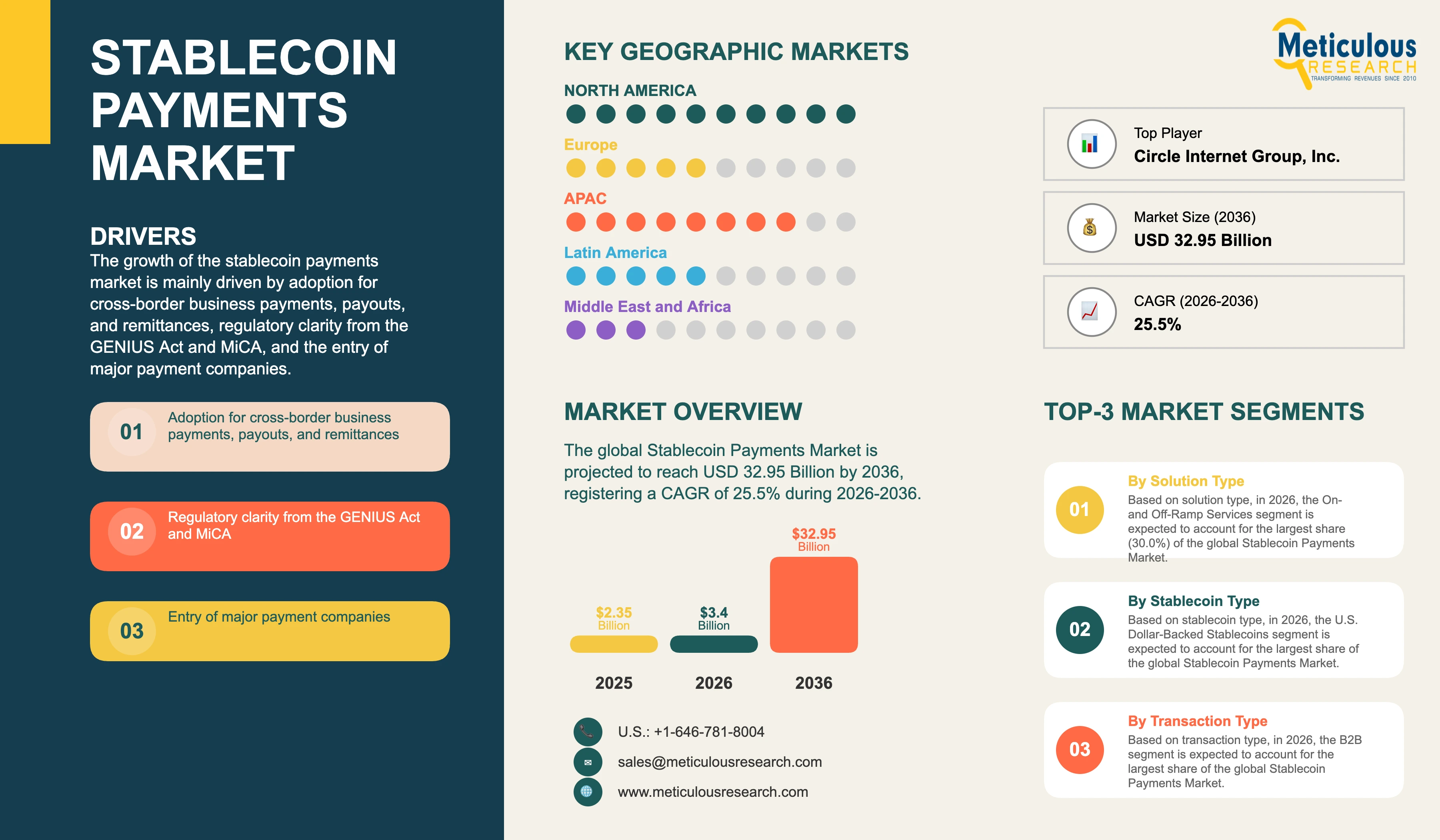
The global stablecoin payments market was valued at USD 2.35 billion in 2025. This market is expected to reach USD 32.95 billion by 2036 from an estimated USD 3.40 billion in 2026, registering a CAGR of 25.5% during the forecast period (2026-2036).
- Published
- Nov 2026
- Pages
- 265
- Format
- PDF + Excel
- Report ID
- MRICT - 1042517
- Base year
- 2025
- 2025 · BASELINE
- $2.35B
- 2036
- $32.95B
- CAGR 2026–2036
- 25.5%
2025 baseline · 2026–2036 forecast at 25.5% CAGR · hover a bar for the value
Key highlights
Total stablecoin market capitalization reached a record of about USD 323 billion in May 2026 and stood at about USD 318.3 billion in early August 2026, according to CoinMarketCap data, with Tether's USDT and Circle's USDC together accounting for more than 80% of supply.
Stablecoin transaction volume reached about USD 33 trillion in 2025, up 72%, according to Artemis data, although a large part of this volume relates to trading and other crypto market activity rather than payments for goods and services.
After adjusting for trading and bot activity, monthly stablecoin transaction volume reached a record of about USD 1.79 trillion in June 2026, showing that payment and transfer use is growing alongside trading activity.
Circle completed its initial public offering in June 2025 and launched the Circle Payments Network, which connects banks, payment providers, and businesses for real-time stablecoin settlement across borders.
The Bank for International Settlements estimated stablecoin supply at about USD 270 billion in March 2026 on a conservative basis and has highlighted both the payment potential and the financial stability risks of stablecoins.
The U.S. GENIUS Act, signed into law in July 2025, created a federal framework for payment stablecoins, including reserve, licensing, and disclosure requirements and a ban on paying interest to holders, and U.S. agencies, including the Treasury, FDIC, and FinCEN, proposed implementing rules in 2026.
The EU's Markets in Crypto-Assets Regulation has applied to stablecoins since June 2024, requiring issuers to be authorized as e-money or credit institutions, which led several exchanges to restrict non-compliant stablecoins, such as USDT, for EU users.
Stripe completed its acquisition of stablecoin infrastructure provider Bridge in 2025 and began offering stablecoin accounts and payouts to businesses, and Meta began paying some creators in USDC through Stripe in 2026.
Visa and Mastercard have expanded stablecoin settlement and card programs, allowing banks and fintech companies to settle card transactions in stablecoins and consumers to spend stablecoin balances at merchants that accept cards.
By solution type, on- and off-ramp services account for the largest share of 30.0% in 2026, while payment processing and merchant acceptance register the highest CAGR.
By stablecoin type, U.S. dollar-backed stablecoins account for the largest share in 2026, while euro-backed stablecoins register the highest CAGR.
By transaction type, B2B accounts for the largest share in 2026, while C2B registers the highest CAGR.
By geography, North America accounts for the largest share of 32.0% in 2026, while the Middle East and Africa registers the highest CAGR of 29.1%.
Report summary
| Particulars | Details |
|---|---|
| Base Year | 2025 |
| Estimated Year | 2026 |
| Forecast Period | 2026-2036 |
| Market Size in 2025 | USD 2.35 billion |
| Market Size in 2026 | USD 3.40 billion |
| Market Size by 2036 | USD 32.95 billion |
| CAGR (2026-2036) | 25.5% |
| Format | PDF, Excel & Cloud Portal · 265 pages |
| Largest Segment by Solution Type (2026) | On- and Off-Ramp Services (30.0%) |
| Largest Region (2026) | North America (32.0%) |
| Fastest-Growing Region | Middle East and Africa (CAGR 29.1%) |
| Segments Covered | Solution Type, Stablecoin Type, Transaction Type, and Geography |
| Geographic Scope | North America, Asia-Pacific, Latin America, Europe, and Middle East and Africa |
| Key Companies Profiled | Circle, Stripe (Bridge), Coinbase, PayPal, Visa, Mastercard, Ripple, Paxos, Fireblocks, BVNK, Zero Hash, MoonPay, and Anchorage Digital |
Report overview
Segments covered: solution type, stablecoin type, transaction type.
The growth of this market is mainly driven by the adoption of stablecoins for cross-border business payments, payouts, and remittances, regulatory clarity from the U.S. GENIUS Act and the EU's Markets in Crypto-Assets Regulation, the entry of major payment companies, such as Stripe, Visa, Mastercard, and PayPal, into stablecoin payments, demand for U.S. dollar access in emerging markets with volatile currencies, and the ability of stablecoins to settle payments in minutes, around the clock, at low cost. However, factors such as regulatory uncertainty in many countries, compliance and anti-money laundering risks, limited merchant acceptance, the cost and complexity of converting between stablecoins and local currencies, and concerns about the stability and transparency of some issuers are expected to restrain the growth of this market to some extent.
Stablecoins are digital tokens issued on blockchain networks that are designed to maintain a stable value, usually one-to-one with a fiat currency, such as the U.S. dollar, and are backed by reserves of cash, bank deposits, and short-term government securities. The largest stablecoins, such as Tether's USDT and Circle's USDC, can be transferred between digital wallets on blockchains such as Ethereum, Tron, and Solana in seconds or minutes, at any time of day, for low fees, which makes them attractive for payments, particularly across borders.
This market covers the global revenue generated from stablecoin payment solutions and services, measured in value, including on- and off-ramp services that convert between stablecoins and local currencies, cross-border payout and remittance services, payment processing and merchant acceptance, treasury and settlement services, and wallet and custody infrastructure for payment use cases. It is segmented by solution type, stablecoin type, transaction type, and geography. Interest income earned by stablecoin issuers on their reserves and revenue from crypto trading are not included.
Stablecoins were first used mainly for trading on crypto exchanges, where they serve as a dollar equivalent, but they are increasingly used for payments. Businesses use stablecoins to pay suppliers and contractors abroad, move funds between subsidiaries, and settle trade, particularly in emerging markets where access to U.S. dollars through banks is limited or expensive. Consumers and freelancers in countries such as Argentina, Nigeria, Turkey, and the Philippines use stablecoins to receive payments, send remittances, and protect their savings from inflation and currency depreciation.
The stablecoin payments ecosystem includes issuers, such as Tether, Circle, and Paxos, which create and redeem stablecoins, infrastructure providers, such as Bridge, BVNK, Zero Hash, Fireblocks, and Anchorage Digital, which provide APIs, wallets, custody, and compliance tools, payment providers and networks, such as Stripe, PayPal, Visa, Mastercard, and Coinbase, which integrate stablecoins into their services, and on- and off-ramp providers, such as MoonPay and local exchanges, which convert between stablecoins and local currencies. Revenue is earned mainly through conversion fees, foreign exchange spreads, transaction fees, and platform and custody fees.
The way revenue is earned differs by type of provider, as on- and off-ramp providers earn a margin on each conversion, which is usually higher for less liquid currencies and smaller transactions. Payout and remittance providers charge per-transaction fees and foreign exchange spreads, payment processors charge merchants a percentage of each payment, and infrastructure and custody providers charge platform fees, API fees, and fees based on assets held. Stablecoin issuers mainly earn interest on the reserves backing their tokens, but this income is excluded from this market because it is not a payment service fee. As volumes grow and competition increases, fees per transaction are expected to fall, while total revenue grows with the much larger number of payments.
The market changed significantly in 2025, when the U.S. passed the GENIUS Act, providing a federal regulatory framework for payment stablecoins, and major payment companies announced or expanded stablecoin services. Stripe completed its acquisition of Bridge, Visa and Mastercard expanded stablecoin settlement and card programs, PayPal expanded the use of its PYUSD stablecoin, and Circle went public and launched the Circle Payments Network. Banks and fintech companies also announced plans to issue their own stablecoins or tokenized deposits.
Over the forecast period, stablecoin payments are expected to grow rapidly, supported by regulatory clarity, integration into mainstream payment services, business adoption for cross-border payments and treasury, and consumer use in emerging markets. Stablecoins are expected to complement rather than replace existing payment systems, serving use cases where speed, around-the-clock availability, and access to U.S. dollars are most valuable.
The market is also shaped by competition with other payment innovations, such as instant payment systems, including Brazil's Pix and India's UPI, and links between national instant payment systems. Stablecoins are expected to be most competitive in corridors and use cases that these systems do not serve well, particularly cross-border payments involving emerging markets and payments that need U.S. dollars.
Report infographic
Market dynamics
17 factors across 5 forcesAdoption for cross-border business payments, payouts, and remittances
Stablecoins allow businesses to send U.S. dollars across borders in minutes, at any time, without relying on correspondent banks, which can be slow and expensive, particularly for payments to and from emerging markets. Companies use stablecoins to pay suppliers, contractors, and employees abroad, to move funds between subsidiaries, and to receive payments from international customers.
Platforms that pay freelancers, creators, sellers, and gig workers in many countries are also using stablecoins for payouts, because they can reach recipients in countries where bank transfers are slow or costly. Remittance providers are using stablecoins to move funds between countries before converting them to local currencies for recipients. B2B accounts for the largest share of the market by transaction type.
Cost savings are a key reason for adoption, because traditional cross-border payments to emerging markets can cost several percent of the payment value once bank fees and foreign exchange spreads are included, and they can take several days to arrive. Stablecoin transfers between wallets cost very little and settle in minutes, and even after on- and off-ramp fees, the total cost is often lower, especially for corridors where banking connections are weak. Faster settlement also reduces the working capital that businesses must tie up in payments in transit.
Regulatory clarity from the GENIUS Act and MiCA
The U.S. GENIUS Act, signed in July 2025, established a federal framework for payment stablecoins, requiring issuers to hold high-quality liquid reserves, publish monthly reserve disclosures, comply with anti-money laundering rules, and obtain federal or state licenses. It also prohibits issuers from paying interest to stablecoin holders. U.S. agencies proposed implementing rules in 2026, and the law's main provisions are expected to take effect by early 2027.
In the EU, the Markets in Crypto-Assets Regulation has applied to stablecoins since June 2024, requiring issuers to be authorized and to meet reserve and disclosure requirements. Other jurisdictions, such as Singapore, Hong Kong, Japan, the UAE, and the U.K., have introduced or proposed stablecoin regulations. Regulatory clarity gives banks, payment companies, and businesses greater confidence to use stablecoins, which is expected to accelerate adoption.
Regulation also affects which stablecoins are used, because under the GENIUS Act, only permitted issuers can offer payment stablecoins to U.S. users, and MiCA has already led EU exchanges to restrict stablecoins that are not authorized in Europe. This is expected to shift payment volumes toward regulated stablecoins, such as USDC and bank-issued stablecoins, and to give banks and large corporations, which have strict compliance requirements, the confidence to use stablecoins for payments and treasury operations.
Entry of major payment companies
Large payment companies are integrating stablecoins into their services, which makes stablecoin payments accessible to millions of businesses and consumers. Stripe acquired Bridge and offers stablecoin accounts, payouts, and acceptance, Visa and Mastercard allow banks and fintech companies to settle card transactions in stablecoins and support stablecoin-linked cards, PayPal offers its PYUSD stablecoin, and Coinbase provides stablecoin payment services for businesses.
These companies bring trusted brands, large customer bases, and compliance capabilities, which helps overcome barriers to adoption. Their entry is also attracting other banks, fintech companies, and platforms to explore stablecoin payments. Payment processing and merchant acceptance is the fastest-growing solution type in this market.
In 2026, Meta began paying some creators in USDC through Stripe, which shows how large platforms can introduce stablecoin payments to many users at once. Fintech companies, such as remittance providers and neobanks, are also adding stablecoin accounts and transfers to their apps, which lets customers hold and send U.S. dollars without understanding the underlying blockchain technology.
Demand for U.S. dollar access in emerging markets
In many emerging markets, such as Argentina, Nigeria, Turkey, Egypt, and Venezuela, high inflation, currency depreciation, and capital controls make it difficult for consumers and businesses to save, pay, and trade in stable currencies. Stablecoins provide a convenient way to hold and transfer U.S. dollars through mobile apps, without a U.S. bank account.
This demand has made emerging markets in Latin America, Africa, and Asia among the most active regions for stablecoin use, and payment providers are building on- and off-ramps and local payment connections to serve them. The Middle East and Africa is the fastest-growing region in this market, and on- and off-ramp services account for the largest share by solution type.
Table of contents
11 chapters · 119 sections · 265 pages · click to expandGeographic analysis
North America
Largest shareIn 2026, North America is expected to account for the largest share of 32.0% of the global stablecoin payments market. The large share of this region is mainly due to the presence of leading stablecoin issuers, infrastructure providers, and payment companies in the U.S., the GENIUS Act, and the growing use of stablecoins by U.S. businesses and platforms for cross-border payments and payouts. The U.S. is home to Circle, Paxos, Coinbase, Stripe and Bridge, PayPal, Visa, Mastercard, Anchorage Digital, and many other companies that are building stablecoin payment services. U.S. platforms use stablecoins to pay freelancers, creators, and sellers abroad, and U.S. businesses are beginning to use stablecoins for treasury and supplier payments. North America is expected to remain the largest region throughout the forecast period. Canada is a smaller market in North America, where regulators have introduced rules for stablecoins traded on crypto platforms. Canadian businesses and platforms also use U.S. providers for stablecoin payouts and cross-border payments.
Middle East & Africa
Fastest growthThe Middle East and Africa is projected to register the highest CAGR of 29.1% during the forecast period. Growth is driven by high demand for U.S. dollar access in African countries, such as Nigeria, Kenya, and South Africa, the use of stablecoins for remittances and trade, and supportive regulation in the UAE and other Gulf countries.
Asia-Pacific
Asia-Pacific holds a significant share of the market, supported by trade, remittances, and stablecoin regulation in Singapore, Hong Kong, and Japan. In Asia-Pacific, the Philippines and Vietnam are among the largest recipients of remittances, and Singapore and Hong Kong have introduced licensing regimes for stablecoin issuers that support regional adoption.
Latin America
Latin America is a major market, led by Argentina, Brazil, Mexico, and Venezuela, while Europe is growing with MiCA and euro stablecoins. In Latin America, high inflation and currency volatility in Argentina and Venezuela have made stablecoins a common way to save and transact in U.S. dollars, while Brazil has seen strong growth in stablecoin use for cross-border payments and is introducing rules for crypto service providers.
Europe
In Europe, MiCA has created a single framework for stablecoins across the EU, which is supporting the growth of regulated euro and dollar stablecoins and the entry of banks and payment companies. The U.K. is developing its own stablecoin regime, and Turkey has high retail stablecoin use due to currency depreciation and high inflation over recent years.
Competitive landscape
The stablecoin payments market is fragmented and evolving rapidly, with stablecoin issuers, infrastructure providers, payment companies, card networks, exchanges, and on- and off-ramp providers. Leading companies include Circle, Stripe through Bridge, Coinbase, PayPal, Visa, Mastercard, Ripple, Paxos, Fireblocks, BVNK, Zero Hash, MoonPay, and Anchorage Digital.
Providers compete on regulatory licenses, compliance capabilities, coverage of currencies and countries, liquidity, pricing, ease of integration, and partnerships with banks and platforms. Large payment companies have an advantage in customer reach and trust, while specialized providers offer advanced stablecoin infrastructure.
Stablecoin issuers, such as Circle and Paxos, are expanding into payment services by building networks and partnerships, while payment companies, such as Stripe, PayPal, Visa, and Mastercard, use their existing customer bases to offer stablecoin services. Infrastructure providers, such as Fireblocks, BVNK, Zero Hash, and Anchorage Digital, serve banks, fintech companies, and platforms that want to add stablecoin features, and on- and off-ramp providers, such as MoonPay, compete on coverage, pricing, and ease of use.
New entrants include banks that plan to issue stablecoins or tokenized deposits, fintech companies that add stablecoin accounts, and blockchain companies that build payment-focused networks. As a result, competition is expected to increase, and pricing for basic services, such as transfers and conversions, is expected to fall, pushing providers to compete on value-added services, such as treasury tools, compliance, and coverage. Scale and regulatory approvals will matter most.
The top five players are estimated to account for 40.0% of the stablecoin payments market in 2025, reflecting the strong positions of large payment and crypto infrastructure companies and the large number of smaller providers.
Players use several strategies to grow in this market, including obtaining licenses, acquiring infrastructure providers, launching stablecoin accounts, cards, and payouts, building payment networks and blockchains, and partnering with banks, platforms, and local payment providers. Stripe's acquisition of Bridge and Circle's launch of the Circle Payments Network are examples.
Competition is expected to center on compliance, liquidity, coverage, cost, and integration with mainstream payment services. Providers with strong regulatory positions and broad networks are expected to gain share, and consolidation is expected as large companies acquire specialized providers.
Some of the key players operating in the stablecoin payments market are Circle Internet Group, Inc., Stripe, Inc. (Bridge), Coinbase Global, Inc., PayPal Holdings, Inc., Visa Inc., Mastercard Incorporated, Ripple Labs, Inc., Paxos Trust Company, LLC, Fireblocks Ltd., BVNK Ltd., Zero Hash Holdings Ltd., MoonPay USA LLC, and Anchorage Digital.
- —
U.S. agencies proposed rules to implement the GENIUS Act in 2026, stablecoin supply reached a record of about USD 323 billion in May 2026, Meta began paying creators in USDC through Stripe, and Visa and Mastercard expanded stablecoin settlement.
- Circle
- Stripe · Bridge
- Coinbase
- PayPal
- Visa
- Mastercard
- Ripple
- Paxos
- Fireblocks
- BVNK
- Zero Hash
- MoonPay
- Anchorage Digital
Expert perspectives
Stablecoin payments are moving from a niche crypto use case to a mainstream payment method, supported by regulation, major payment companies, and business demand for faster and cheaper cross-border payments. The GENIUS Act and MiCA have provided the regulatory clarity needed for banks and large businesses to engage.
Over the forecast period, the market is expected to grow at about 25.5% per year, supported by business payments, payouts, merchant acceptance, treasury, and emerging market demand. Growth will depend on regulatory implementation, the integration of stablecoins into mainstream payment services, and the reduction of conversion costs.
Payment processing and merchant acceptance is the fastest-growing solution type, euro-backed stablecoins are the fastest-growing stablecoin type, and C2B is the fastest-growing transaction type. On- and off-ramp services, U.S. dollar-backed stablecoins, and B2B remain the largest segments.
North America remains the largest region, while the Middle East and Africa is the fastest-growing region at a CAGR of 29.1%. The main swing factors are regulation in the U.S., Europe, and emerging markets, the entry of banks, the reliability of issuers, and the cost of on- and off-ramps.
For businesses, the key decisions are whether and where to use stablecoins, which providers to use, and how to manage compliance and treasury risks. For providers, success depends on licenses, compliance, liquidity, and integration with existing payment services.
The most attractive use cases in the near term are cross-border business payments and payouts to emerging markets, where the cost and speed advantages of stablecoins are largest. Treasury and settlement uses are expected to grow as banks participate, while merchant payments in developed markets are expected to grow more slowly, because card and instant payment systems already serve these markets well. Providers that combine regulatory licenses, local payment connections, and liquidity in many currencies are best positioned to benefit from growth.
Risks to the outlook include slower than expected regulatory implementation, a major issuer failure or security incident that damages trust, restrictions on stablecoins in emerging markets, and competition from bank-led tokenized deposits and instant payment links, which could capture some of the use cases that stablecoins currently serve in cross-border and business payments. On the upside, faster adoption by large banks, corporations, and AI-driven payment platforms could push growth above current expectations. The balance of these factors will determine whether the market grows faster or slower than the base case over the next decade.
Overall, stablecoins are expected to become an important part of global payment infrastructure, particularly for cross-border and around-the-clock payments, over the forecast period.
Customer perspectives
Chief Financial Officer - import-export company, Nigeria
Getting U.S. dollars through banks for supplier payments can take weeks and requires several approvals, but with stablecoins, we can pay our suppliers in Asia within minutes and convert only when needed.
Demand for U.S. dollar access is why the Middle East and Africa is the fastest-growing region and B2B is the largest transaction type.
Head of Payments - creator platform, U.S.
Paying creators in many countries through banks was slow and expensive. Stablecoin payouts let us pay them faster, and many prefer to hold dollars.
The growth of cross-border payouts is supporting demand for stablecoin payout and on- and off-ramp services, which account for 30.0% of the market.
Treasury Manager - fintech company, Europe
MiCA gave us the confidence to use regulated euro and dollar stablecoins for settlement. We now move funds between our entities over weekends.
Regulatory clarity in Europe is supporting the growth of euro-backed stablecoins and treasury and settlement services.
Chief Executive Officer - remittance provider, Philippines
Our customers abroad send money home every month, and stablecoins have helped us cut the cost of moving funds between countries. The challenge is finding reliable local partners to convert the funds into pesos quickly.
This feedback shows why C2C remittances remain significant and why on- and off-ramp services are critical to the market.
Head of E-Commerce - online retailer, Latin America
Accepting stablecoins from international customers lowered our payment costs, and settlement is much faster than with cards.
Merchant demand supports C2B, the fastest-growing transaction type in this market.
Frequently asked questions
The market was valued at USD 2.35 billion in 2025 and USD 1.55 billion in 2024, and is estimated at USD 3.40 billion in 2026, measured as revenue from stablecoin payment solutions and services.
Cite this report
Meticulous Research. (2026). Stablecoin Payments Market - Global Opportunity Analysis and Industry Forecast (2026-2036) (Report No. MRICT - 1042517). Meticulous Market Research Pvt. Ltd. https://www.meticulousresearch.com/product/stablecoin-payments-market-7200