Solid Oxide Fuel Cell Market (2026-2036)
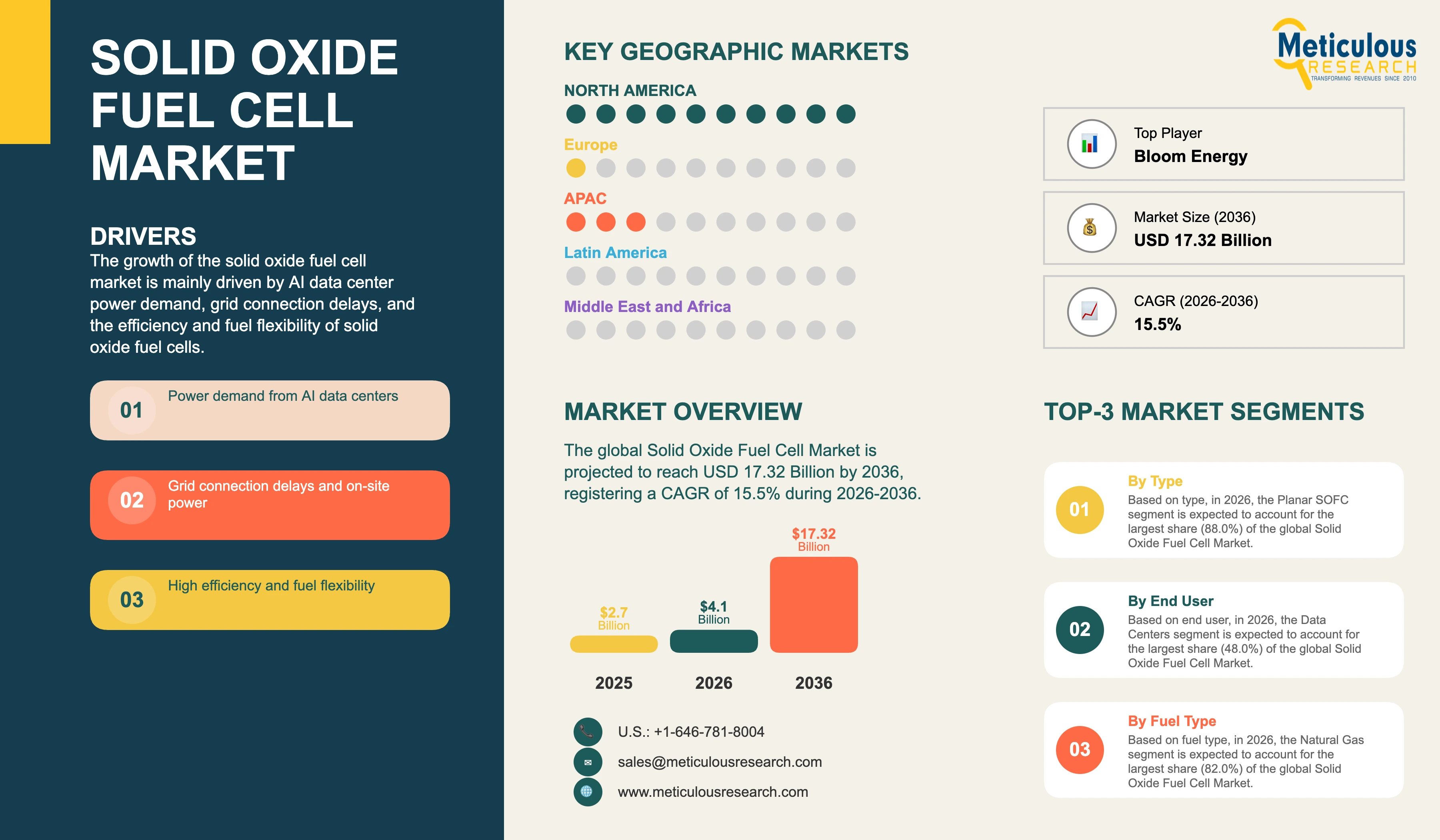
The global solid oxide fuel cell market was valued at USD 2.70 billion in 2025. This market is expected to reach USD 17.32 billion by 2036 from an estimated USD 4.10 billion in 2026, registering a CAGR of 15.5% during the forecast period (2026-2036).
- Published
- Nov 2026
- Pages
- 256
- Format
- PDF + Excel
- Report ID
- MREP - 1042646
- Base year
- 2025
- 2024 · HISTORICAL
- $1.47B
- 2036
- $17.32B
- CAGR 2026–2036
- 15.5%
2024–2025 baseline · 2026–2036 forecast at 15.5% CAGR · hover a bar for the value
Key highlights
Bloom Energy, the largest solid oxide fuel cell supplier, reported record revenue of USD 2.02 billion for 2025, an increase of 37.3% from USD 1.47 billion in 2024, driven by significant growth from the AI data center industry and continued demand from commercial and industrial customers, according to its February 2026 results. The company reported a total backlog of about USD 20 billion, including a product backlog of about USD 6 billion, up about 2.5 times year over year.
Bloom Energy guided 2026 revenue of USD 3.1 billion to USD 3.3 billion, and its chief executive said that bring-your-own-power has shifted from a slogan to a business necessity for AI hyperscalers and manufacturing facilities. The company also said that all of its product shipments are now ready for 800-volt direct current data center architectures.
Bloom Energy's fourth-quarter 2025 announcements included a collaboration with Oracle to power AI data centers and a USD 5 billion strategic partnership with Brookfield Asset Management for AI infrastructure, and its backlog included six hyperscale and neocloud end customers, compared with one a year earlier, according to Fintool's analysis of the company's results. American Electric Power also agreed to deploy up to 1 GW of Bloom's fuel cells.
Doosan Fuel Cell began mass production of fuel cell power systems using Ceres Power's solid oxide technology at a 50 MW facility in South Korea on July 28, 2025, which led to Ceres' first royalty income in March 2026. Ceres also signed a manufacturing license with Weichai Power for China in November 2025 and launched its Ceres Endura standardized SOFC platform for data centers in April 2026.
Solid oxide technology is also being developed for hydrogen production through solid oxide electrolysis, and Ceres Power has worked with Shell on a megawatt-scale electrolysis demonstrator and with DENSO on solid oxide systems, reflecting the growing convergence between fuel cells and electrolysis on the same cell platform. Several of these programs also include plans to expand manufacturing capacity for cells and stacks. These investments are expected to support lower costs.
By type, planar SOFC accounts for the larger share of 88.0% in 2026 and also registers the higher CAGR.
By power rating, above 200 kW accounts for the largest share in 2026 and also registers the highest CAGR.
By fuel type, natural gas account for the largest share in 2026, while hydrogen registers the highest CAGR.
By end user, data centers account for the largest share of 48.0% in 2026 and also register the highest CAGR.
By geography, North America accounts for the largest share of 72.0% in 2026, while Asia-Pacific registers the highest CAGR of 17.4%.
Report summary
| Particulars | Details |
|---|---|
| Forecast Period | 2026-2036 |
| Base Year | 2025 |
| Estimated Year | 2026 |
| CAGR (Value) | 15.5% |
| Format | PDF, Excel & Cloud Portal · 256 pages |
| Market Size (Value) in 2025 | USD 2.70 billion |
| Market Size (Value) in 2026 | USD 4.10 billion |
| Market Size (Value) in 2036 | USD 17.32 billion |
| Segments Covered | Type, Power Rating, Fuel Type, End User, Geography |
| Countries Covered | U.S., Canada, Rest of North America, Japan, South Korea, China, Taiwan, India, Singapore, Australia, Indonesia, Thailand, Malaysia, Vietnam, Philippines, New Zealand, Rest of Asia-Pacific, U.K., Germany, Italy, France, Netherlands, Ireland, Finland, Estonia, Spain, Switzerland, Belgium, Sweden, Denmark, Norway, Austria, Poland, Rest of Europe, Saudi Arabia, U.A.E., South Africa, Israel, Turkey, Egypt, Rest of Middle East & Africa, Brazil, Mexico, Chile, Argentina, Colombia, Peru, Rest of Latin America |
| Key Companies | 15 companies and other companies |
| Largest Segment by Type (2026) | Planar SOFC (88.0%) |
| Largest Segment by End User (2026) | Data Centers (48.0%) |
| Largest Region (2026) | North America (72.0%) |
| Fastest-Growing Region | Asia-Pacific (CAGR 17.4%) |
Report overview
Segments covered: type, power rating, fuel type, end user.
The growth of this market is mainly driven by the rapid growth of power demand from AI data centers and the shift toward on-site, behind-the-meter power generation, long wait times for grid connections in major data center markets, the high electrical efficiency and fuel flexibility of solid oxide fuel cells, growing demand for resilient and low-emission distributed power at commercial and industrial sites, large utility and infrastructure financing agreements, and the development of hydrogen-ready and combined heat and power systems. However, factors such as the high capital cost of solid oxide fuel cell systems, dependence on natural gas and the associated carbon emissions, long-term durability and stack degradation concerns, and the limited manufacturing base outside a few leading companies are expected to restrain the growth of this market to some extent.
A solid oxide fuel cell is an electrochemical device that converts the chemical energy of a fuel directly into electricity using a solid ceramic electrolyte, typically operating at temperatures between about 600 degrees Celsius and 1,000 degrees Celsius. Because of their high operating temperature, solid oxide fuel cells can internally reform natural gas, biogas, and other hydrocarbon fuels into hydrogen, which allows them to run on a wide range of fuels without the expensive external reformers and precious metal catalysts required by low-temperature fuel cells. They also achieve high electrical efficiency, often above 60% for some systems, and their high-temperature exhaust heat can be used for combined heat and power or cooling. These characteristics make solid oxide fuel cells well suited to continuous, stationary power generation at commercial, industrial, data center, utility, and residential sites.
This report covers solid oxide fuel cell systems, stacks, and related installation and service revenue for stationary power generation, combined heat and power, and other applications such as marine, military, and auxiliary power. The market is analyzed by type, power rating, fuel type, end user, and geography. Solid oxide electrolysis systems used to produce hydrogen, other fuel cell technologies such as proton exchange membrane and molten carbonate fuel cells, and electricity sold under power purchase agreements are analyzed in separate reports. The market is measured on a revenue basis, based on sales of solid oxide fuel cell systems, stacks, installation, and maintenance services.
The solid oxide fuel cell market has changed significantly in recent years, driven mainly by demand from data centers. The rapid growth of AI computing has sharply increased the power requirements of data centers, while grid connection timelines in many major markets have extended to several years. As a result, data center developers, hyperscalers, and neocloud providers are increasingly turning to on-site power generation that can be deployed quickly and scaled in modular increments. Solid oxide fuel cells, which can be installed in months, operate continuously, and produce very low levels of local air pollutants, have become one of the leading options for this bring-your-own-power approach. Bloom Energy's chief executive has said that on-site power has moved from being a decision of last resort to a vital business necessity.
Bloom Energy is the dominant supplier in the market, particularly in North America. The company reported record revenue of USD 2.02 billion in 2025 and guided revenue of USD 3.1 billion to USD 3.3 billion for 2026, supported by a backlog of about USD 20 billion. Its major agreements include a USD 5 billion strategic partnership with Brookfield Asset Management to finance AI infrastructure deployments, a collaboration with Oracle to power AI data centers, and an agreement with American Electric Power to deploy up to 1 GW of fuel cells. Bloom has also introduced systems that natively produce 800-volt direct current power for the next generation of AI data center racks.
In Asia-Pacific, Japan has long been the largest market for small solid oxide fuel cells, through the Ene-Farm residential fuel cell program, under which companies such as Aisin and Kyocera have supplied solid oxide fuel cell units for homes. Mitsubishi Heavy Industries has developed larger tubular solid oxide fuel cell hybrid systems for commercial and industrial users. South Korea has become an important manufacturing hub, with Doosan Fuel Cell beginning mass production of systems based on Ceres Power's technology in July 2025, and Bloom Energy has also been active in the Korean market through its partnership with SK ecoplant. In China, Ceres Power signed a manufacturing license with Weichai Power in November 2025.
In Europe, solid oxide fuel cell development is led by technology developers and manufacturers such as Ceres Power in the U.K., Elcogen in Estonia, SolydEra in Italy, and Convion in Finland. Ceres Power has adopted an asset-light licensing model, partnering with manufacturers such as Doosan, Delta Electronics, Weichai, and DENSO, and has entered agreements with companies such as Centrica for deployment in Europe. European interest in solid oxide fuel cells is supported by data center growth, grid constraints in markets such as Ireland, the Netherlands, and Germany, and the potential to use hydrogen and biogas.
Planar solid oxide fuel cells account for the largest share of the market by type, while systems above 200 kW are the largest and fastest-growing power rating, reflecting large data center and utility deployments. Natural gas is the dominant fuel, while hydrogen is the fastest-growing fuel type. Data centers are the largest and fastest-growing end user. North America accounts for the largest share of the market, while Asia-Pacific is the fastest-growing region, supported by manufacturing scale-up and data center demand in South Korea, Japan, China, and other countries.
Over the forecast period, the solid oxide fuel cell market is expected to grow rapidly, supported by data center power demand, grid constraints, utility interest in dispatchable distributed power, and the gradual introduction of hydrogen and biogas. At the same time, the market's growth will depend on reductions in system costs, improvements in stack life, the expansion of manufacturing capacity, and policies relating to natural gas use and carbon emissions.
Licensing proven solid oxide technology allowed us to start mass production quickly, and we see strong demand from data centers and industrial customers in Korea and abroad.
This comment explains why Asia-Pacific is the fastest-growing region and how licensing is expanding the manufacturing base for solid oxide fuel cells.
Systems above 200 kW are expected to account for the largest share of the market in 2026 and are also projected to register the highest CAGR, driven by large data center and utility deployments.
Data centers are expected to account for the largest share of 48.0% of the market in 2026 and are also projected to register the highest CAGR.
North America is expected to account for the largest share of 72.0% of the market in 2026, mainly due to Bloom Energy's leading position, AI data center growth, grid connection delays, low-cost natural gas, and federal tax incentives.
Asia-Pacific is projected to register the highest CAGR of 17.4% during the forecast period, driven by mass production in South Korea, data center growth, Japan's fuel cell experience, and licensing agreements with manufacturers in China and Taiwan.
The report profiles 15 companies, including Bloom Energy, Ceres Power, Doosan Fuel Cell, Mitsubishi Heavy Industries, Kyocera, Aisin, Elcogen, FuelCell Energy, SolydEra, Convion, Watt Fuel Cell, Weichai Power, Delta Electronics, Miura, and Upstart Power.
Data centers are adopting solid oxide fuel cells because they can be deployed quickly where grid connections are delayed, scaled in modular increments, operate continuously with high reliability and efficiency, produce very low local emissions, and supply direct current power and heat for cooling.
Report infographic
Market dynamics
18 factors across 5 forcesRapid growth of power demand from AI data centers
The growth of AI computing is the most important driver of the solid oxide fuel cell market. AI training and inference require large clusters of graphics processing units and other accelerators, and Bloom Energy's chief executive noted that AI computer racks consume nearly 100 times more power than traditional racks. The construction of large AI data centers is therefore creating unprecedented demand for electricity in the U.S., Europe, and Asia. Data center operators require power that is reliable, available quickly, and scalable as their campuses grow, and many are deploying on-site generation to supplement or replace grid power.
Solid oxide fuel cells meet these requirements because they can be manufactured in modular units, installed in months, and scaled by adding additional units, while providing continuous power with high efficiency and low local emissions. Bloom Energy's backlog included six hyperscale and neocloud end customers by the end of 2025, compared with one a year earlier, and its agreements with Oracle, Brookfield, and American Electric Power reflect the scale of demand from AI infrastructure.
The transition to 800-volt direct current power architectures in AI data centers also favors solid oxide fuel cells, since they produce direct current power natively and can therefore reduce conversion losses and equipment compared with alternating current generation. Bloom has said that all of its product shipments are now ready for 800-volt direct current systems.
Grid connection delays and the shift toward on-site power
In many major data center and industrial markets, the time required to obtain a new grid connection has extended to several years, due to limited transmission capacity, long interconnection queues, and the need for new generation. These delays can prevent data centers, factories, and other large facilities from starting operations on schedule, which creates substantial lost revenue. On-site power generation using solid oxide fuel cells allows these facilities to begin operations without waiting for grid upgrades, and the systems can later operate alongside the grid for resilience.
Utilities are also adopting solid oxide fuel cells to serve large customers quickly. American Electric Power's agreement to deploy up to 1 GW of Bloom Energy's fuel cells illustrates how utilities can use distributed fuel cells to provide capacity to data centers and other large loads while longer-term grid investments are made.
High efficiency, fuel flexibility, and low local emissions
Solid oxide fuel cells offer higher electrical efficiency than many conventional generation technologies at a similar scale, which reduces fuel consumption and carbon dioxide emissions per unit of electricity. Because they convert fuel electrochemically rather than by combustion, they produce very low levels of nitrogen oxides, sulfur oxides, and particulate matter, which makes them easier to permit in urban and suburban areas than reciprocating engines or gas turbines. Their high-temperature operation allows them to use natural gas, biogas, hydrogen, and blends of these fuels, which gives customers a pathway to reduce emissions over time as low-carbon fuels become available.
The high-temperature exhaust heat from solid oxide fuel cells can also be used for heating, cooling through absorption chillers, or industrial processes, which further increases overall efficiency. Bloom Energy has said that heat recovery could reduce data center electricity consumption by at least 20% by providing cooling.
Demand for resilient power at commercial and industrial sites
Commercial and industrial customers, including hospitals, retailers, manufacturers, semiconductor fabs, and biotech companies, are increasingly concerned about power reliability due to extreme weather, aging grid infrastructure, and rising electricity prices. Solid oxide fuel cells provide continuous on-site power that can operate independently of the grid during outages, which reduces the risk of costly disruptions. Bloom Energy serves many Fortune 500 companies in these sectors, and semiconductor manufacturers in particular require highly reliable power for their production processes.
Fuel cells can also help commercial and industrial customers manage electricity costs and meet sustainability goals, particularly when combined with heat recovery or low-carbon fuels. Tax incentives in the U.S., such as the investment tax credit for fuel cell property under IRC Section 48, have supported the economics of these projects.
Large financing and partnership agreements
Large financing and partnership agreements are accelerating deployment by providing capital and reducing risk for customers. Bloom Energy's USD 5 billion partnership with Brookfield provides a financing pathway for AI data center deployments, and agreements with utilities such as American Electric Power demonstrate the willingness of regulated utilities to invest in solid oxide fuel cell capacity. These agreements allow customers to purchase power from fuel cells without making large up-front investments, which expands the potential customer base.
In Asia, partnerships between technology developers and large industrial manufacturers, such as Ceres Power's agreements with Doosan, Weichai, and Delta Electronics, are expanding manufacturing capacity and creating new suppliers, which will increase competition and reduce costs over time.
Table of contents
12 chapters · 166 sections · 256 pages · click to expandSegmental analysis
| Segment | Largest share (2026) | Fastest growth (2026–2036) |
|---|---|---|
| By Type | Planar solid oxide fuel cell | — |
| By Power Rating | Above 200 kW | Above 200 kW |
| By Fuel Type | Natural gas | Hydrogen |
| By End User | Data centers | Large share of this |
| Other segments | Natural gas | Hydrogen |
By Type
- Solid Oxide Fuel Cell Market Analysis by Type
- The planar solid oxide fuel cell segment is expected to account for the largest share of 88.0% of the global solid oxide fuel cell market.
- The large share of this segment is mainly due to the higher power density of planar cell designs, their suitability for compact stacks and modular systems, their lower manufacturing costs compared with tubular designs at scale, and their use by the leading suppliers in the market, including Bloom Energy, Ceres Power and its licensees, Elcogen, and many residential fuel cell manufacturers in Japan.
- Planar designs can be manufactured using processes similar to those used for other ceramic components, which supports cost reductions as production volumes increase.
- This segment is also projected to register the highest CAGR during the forecast period, driven by the rapid growth of large data center and utility deployments using planar systems, the expansion of manufacturing capacity by licensees in Asia, and continued improvements in power density and durability.
- Metal-supported planar cells, such as those developed by Ceres Power, can operate at lower temperatures and are more robust to thermal cycling, which broadens their range of applications.
- Improved stack designs are also allowing manufacturers to reduce the amount of material used in each cell.
- The tubular solid oxide fuel cell segment accounts for the remaining share of the market.
- Tubular designs, such as those developed by Mitsubishi Heavy Industries, offer advantages in sealing, thermal cycling, and durability, and they are well suited to large hybrid systems that combine fuel cells with gas turbines or other equipment.
- However, tubular designs generally have lower power density and higher manufacturing costs, which limits their share of the market.
- Tubular systems remain attractive for large hybrid plants where durability and long operating life are the main priorities.
- Advances in materials, such as lower-temperature electrolytes and improved electrodes, are benefiting both designs, since lower operating temperatures can reduce material costs and extend stack life.
- Planar designs are also easier to integrate into modular power systems that can be scaled from a few hundred kilowatts to tens of megawatts by adding standard units, which suits data center operators that expand capacity in phases.
- Manufacturers continue to improve cell materials, seals, and interconnects to extend stack life and reduce degradation, which lowers the lifetime cost of power and strengthens the competitiveness of planar systems against other on-site power options.
- The planar SOFC segment is expected to account for the larger share of 88.0% of the solid oxide fuel cell market, and it is also projected to register the higher CAGR during the forecast period.
By Power Rating
- Solid Oxide Fuel Cell Market Analysis by Power Rating
- The above 200 kW segment is expected to account for the largest share of the global solid oxide fuel cell market.
- The large share of this segment is mainly due to the deployment of large solid oxide fuel cell installations at data centers, utilities, and large commercial and industrial sites, where systems are typically built from multiple modules to provide several megawatts or more of power.
- Bloom Energy's data center and utility agreements, including deployments for Oracle, Brookfield, and American Electric Power, involve installations of tens to hundreds of megawatts.
- This segment is also projected to register the highest CAGR during the forecast period, driven by the growth of AI data centers, utility deployments for large new loads, and the availability of large financing agreements for multi-megawatt projects.
- Large installations also benefit from economies of scale in installation, fuel supply, and maintenance, which improves project economics.
- The 10 kW to 200 kW segment forms the second-largest segment, supported by commercial and smaller industrial installations, telecommunications sites, and distributed power for buildings.
- The below 10 kW segment accounts for the remaining share of the market and mainly includes residential combined heat and power units, such as those sold under Japan's Ene-Farm program, as well as small systems for remote and portable power.
- Growth in this segment is expected to be slower, since residential fuel cells face competition from heat pumps and solar power.
- Small systems are also used for telecommunications towers and remote monitoring sites where reliable grid power is unavailable.
- Large systems benefit from economies of scale in installation, fuel supply, and maintenance, and they can be combined with heat recovery or carbon capture to improve overall efficiency and reduce emissions.
- Systems in the 5 to 200 kW range are mainly used in commercial buildings, telecom sites, and small industrial facilities, while residential systems below 5 kW are concentrated in Japan and Europe.
By Fuel Type
- Solid Oxide Fuel Cell Market Analysis by Fuel Type
- The natural gas segment is expected to account for the largest share of the global solid oxide fuel cell market.
- The large share of this segment is mainly due to the widespread availability of natural gas pipeline infrastructure at commercial, industrial, and data center sites, the ability of solid oxide fuel cells to internally reform natural gas without external reformers, the relatively low cost of natural gas in North America, and the reliability of gas supply for continuous power generation.
- Most data center and commercial installations currently operate on natural gas.
- However, the hydrogen segment is projected to register the highest CAGR during the forecast period.
- The rapid growth of this segment is driven by decarbonization targets, the development of hydrogen-ready systems, government support for hydrogen production and use, and the growing availability of hydrogen in industrial clusters and hubs.
- Biogas forms the third-largest segment, supported by projects at landfills, wastewater treatment plants, and agricultural sites, particularly in Europe and North America.
- Other fuels, including propane, liquefied natural gas, ammonia, and methanol for marine applications, account for the remaining share of the market.
By End User
- Solid Oxide Fuel Cell Market Analysis by End User
- The data centers segment is expected to account for the largest share of 48.0% of the global solid oxide fuel cell market.
- The large share of this segment is mainly due to the rapid growth of AI data centers, the need for fast and scalable on-site power in markets with long grid connection timelines, the high reliability requirements of data centers, and the large agreements signed by Bloom Energy with hyperscale and neocloud customers and infrastructure investors.
- Data centers also benefit from the ability of solid oxide fuel cells to provide direct current power and heat for cooling.
- This segment is also projected to register the highest CAGR during the forecast period, driven by continued investment in AI infrastructure, the adoption of on-site power by hyperscalers and colocation providers, and the expansion of data center construction in Asia-Pacific and Europe.
- The commercial and industrial segment forms the second-largest segment, supported by demand from hospitals, retailers, manufacturers, semiconductor fabs, and other businesses for resilient and efficient on-site power.
- The utilities segment is growing rapidly, supported by utility programs to serve large new loads, while the residential segment, mainly in Japan, and the military, marine, and other end users segment account for the remaining share of the market.
- Semiconductor manufacturing is an important part of the commercial and industrial segment, since fabs require extremely reliable power and are expanding in the U.S., South Korea, Japan, and Taiwan, often in areas where grid capacity is constrained.
- Biotech, healthcare, and retail customers also value fuel cells for resilience during extended grid outages.
- Utilities are expected to remain an important source of large orders as they seek fast ways to serve new loads.
- Utilities are also emerging as important customers, using solid oxide fuel cells to support grid reliability and serve large new loads quickly, while industrial users are evaluating fuel cells for combined heat and power and for decarbonizing on-site energy use with hydrogen or biogas.
Other segments
- The natural gas segment is expected to account for the largest share of the solid oxide fuel cell market, while the hydrogen segment is projected to register the highest CAGR during the forecast period.
Geographic analysis
North America
Largest shareIn 2026, North America is expected to account for the largest share of 72.0% of the global solid oxide fuel cell market. The large share of this region is mainly due to the dominant position of Bloom Energy, which is headquartered in the U.S. and has its largest customer base there, the rapid growth of AI data centers in the U.S., long grid interconnection timelines in major data center markets such as Northern Virginia, Texas, Ohio, and California, the availability of relatively low-cost natural gas, federal tax incentives for fuel cells, and state programs that support distributed generation. Large agreements with Oracle, Brookfield, and American Electric Power are concentrated in the U.S., and Canada is also adopting fuel cells for data centers and industrial facilities.
Asia-Pacific
Fastest growthAsia-Pacific is projected to register the highest CAGR of 17.4% during the forecast period. The rapid growth of this region is mainly driven by the start of mass production by Doosan Fuel Cell in South Korea using Ceres Power technology, South Korea's support for fuel cell power generation, data center growth in South Korea, Japan, Singapore, India, and China, Japan's long experience with residential and commercial solid oxide fuel cells, and the entry of large Chinese manufacturers such as Weichai Power through licensing agreements. Taiwan is also emerging as a manufacturing location through Delta Electronics' license from Ceres Power. Local manufacturing in Asia-Pacific is also expected to reduce delivered costs and lead times for customers in the region.
Europe
Europe accounts for a smaller share of the market but is growing rapidly, supported by solid oxide fuel cell developers such as Ceres Power in the U.K., Elcogen in Estonia, SolydEra in Italy, and Convion in Finland, data center growth in markets with constrained grids such as Ireland, Germany, the Netherlands, and the U.K., and the European Union's support for hydrogen and biogas. Ceres Power's agreement with Centrica targets deployment in Europe.
Latin America
Latin America and the Middle East & Africa account for the smallest shares of the market, with early interest in data centers, oil and gas facilities, and remote power applications in countries such as Brazil, Mexico, Saudi Arabia, and the U.A.E. Regional differences in gas prices, grid constraints, data center growth, and policy support will shape the adoption of solid oxide fuel cells over the forecast period. Regions combining fast data center growth with limited grid capacity are expected to see the strongest demand.
Middle East & Africa
Israel and Turkey have also shown interest in distributed generation for critical facilities, and local partnerships with engineering firms and utilities are expected to be important for market entry.
Competitive landscape
The global solid oxide fuel cell market is highly consolidated, with the top five players estimated to account for more than 80% of the market in 2025, led by Bloom Energy. The market includes vertically integrated system manufacturers, technology developers that license their designs, large industrial manufacturers producing systems under license, residential fuel cell manufacturers, and component suppliers.
Bloom Energy is the market leader, offering vertically integrated systems from cell manufacturing to installation and service, with a strong position in data centers, commercial and industrial customers, and utilities. Ceres Power licenses its metal-supported solid oxide technology to partners including Doosan Fuel Cell, Weichai Power, Delta Electronics, and DENSO. Mitsubishi Heavy Industries develops tubular solid oxide fuel cell hybrid systems, while Kyocera and Aisin supply cells and units for residential systems in Japan. Elcogen supplies cells and stacks, SolydEra and Convion develop stationary systems in Europe, FuelCell Energy develops solid oxide technology alongside its carbonate fuel cells, and companies such as Watt Fuel Cell and Upstart Power target smaller applications.
Companies in this market compete on electrical efficiency, system cost, deployment speed, durability and stack life, fuel flexibility, manufacturing capacity, service capabilities, and access to financing. Key strategies include large partnerships with data center operators, utilities, and infrastructure investors, expansion of manufacturing capacity, licensing agreements with industrial manufacturers, the development of hydrogen-ready and direct current systems, and investment in solid oxide electrolysis.
Bloom Energy's scale, track record, and financing partnerships give it a strong lead, particularly in North America. However, the growth of licensed manufacturers in Asia, such as Doosan and Weichai, is expected to increase competition and expand supply, particularly in Asia-Pacific markets. We expect the market to become somewhat less concentrated over the forecast period as new manufacturers scale up, although Bloom Energy is expected to remain the largest supplier. Partnerships with data center developers, utilities, and investors will remain critical for winning large projects. Pricing discipline will also matter as new entrants compete for data center contracts. Service capability and installed-base performance will also become more important as customers compare suppliers for multi-year programs.
Some of the key players operating in the solid oxide fuel cell market are Bloom Energy Corporation, Ceres Power Holdings plc, Doosan Fuel Cell Co., Ltd., Mitsubishi Heavy Industries, Ltd., Kyocera Corporation, Aisin Corporation, Elcogen AS, FuelCell Energy, Inc., SolydEra SpA, Convion Oy, Watt Fuel Cell Corporation, Weichai Power Co., Ltd., Delta Electronics, Inc., Miura Co., Ltd., and Upstart Power, Inc., among others.
- —
Bloom Energy reported record 2025 revenue of USD 2.02 billion and guided USD 3.1 billion to USD 3.3 billion for 2026, Ceres Power launched its Endura platform in April 2026 and received its first royalty income in March 2026, and Doosan Fuel Cell began mass production in July 2025.
- Bloom Energy Corporation
- Ceres Power Holdings plc
- Doosan Fuel Cell Co., Ltd.
- Mitsubishi Heavy Industries, Ltd.
- Kyocera Corporation
- Aisin Corporation
- Elcogen AS
- FuelCell Energy, Inc.
- SolydEra SpA
- Convion Oy
- Watt Fuel Cell Corporation
- Weichai Power Co., Ltd.
- Delta Electronics, Inc.
- Miura Co., Ltd.
- Upstart Power, Inc.
Expert perspectives
The solid oxide fuel cell market has moved from a niche distributed generation technology to a central part of the power strategy for AI data centers. The combination of rapid power demand growth, long grid connection timelines, and the modular, efficient, and low-emission characteristics of solid oxide fuel cells has created a large and fast-growing market.
Over the forecast period, the market is expected to grow at a CAGR of 15.5%, from USD 4.10 billion in 2026 to USD 17.32 billion in 2036. Growth will be supported by data centers, utility programs, commercial and industrial demand, hydrogen and biogas fuels, and the expansion of manufacturing in Asia-Pacific.
Among the market segments, planar solid oxide fuel cells are the largest and fastest-growing type. Systems above 200 kW are the largest and fastest-growing power rating, natural gas is the largest fuel type, while hydrogen grows fastest, and data centers are the largest and fastest-growing end user. North America is the largest region, and Asia-Pacific is the fastest-growing region at a CAGR of 17.4%.
In our view, the most important factor for the market over the forecast period will be the pace at which data center operators continue to adopt on-site power. If grid constraints persist and AI investment continues, solid oxide fuel cells are likely to remain one of the fastest options for adding reliable capacity. However, as grid upgrades are completed and competing technologies such as gas turbines, reciprocating engines, and battery storage scale up, the market may face greater price competition. Suppliers that can reduce costs, demonstrate long stack life, and deliver projects quickly will be best positioned.
We also expect the role of natural gas to be an important question. In the near term, natural gas will remain the dominant fuel, but customers and regulators will increasingly expect a credible pathway to low-carbon fuels or carbon capture. Hydrogen-ready systems, biogas projects, and carbon capture integration will therefore become important differentiators, particularly in Europe and for customers with strong climate commitments. Air permitting rules for on-site generation will also influence project timelines in some U.S. states and European countries.
The growth of licensed manufacturing in South Korea, China, Taiwan, and Japan is likely to reshape the competitive landscape by adding supply and reducing costs, which will help the market reach a broader range of customers. Overall, we believe the solid oxide fuel cell market will grow rapidly over the forecast period, with data centers and utilities driving large-scale deployments and Asia-Pacific becoming an increasingly important manufacturing and demand center. Suppliers that expand capacity responsibly while maintaining quality will capture the largest share of this growth.
Customer perspectives
Buyers of solid oxide fuel cells include hyperscale and colocation data center operators, neocloud providers, utilities, commercial and industrial companies, semiconductor manufacturers, hospitals, retailers, residential customers in Japan, and military and marine operators. Their purchase decisions depend mainly on deployment speed, reliability and availability, electrical efficiency, total cost of power, fuel flexibility and emissions, scalability, financing options, and the supplier's track record and service capabilities. Buyers increasingly compare solid oxide fuel cells with gas turbines, reciprocating engines, and batteries, and they value the speed of deployment, low local emissions, and modular expansion that fuel cells provide. Long-term service agreements and performance guarantees also play an important role in purchase decisions because buyers depend on continuous power.
Vice President of Energy - hyperscale data center developer, U.S.
Grid power for our new campuses is years away, so we use fuel cells to start operations on time and scale capacity in blocks. Reliability and speed of deployment matter more to us than the lowest cost per kilowatt-hour.
This comment explains why data centers account for 48.0% of the market, why systems above 200 kW are the leading power rating, why planar SOFCs account for 88.0% of the market, and why North America is the largest region.
Director of Distributed Generation - utility, U.S.
Large new customers want capacity faster than we can build transmission, so distributed fuel cells give us a way to serve them while we upgrade the grid.
This comment explains the growing role of utilities in the market and the importance of large financing and partnership agreements.
Frequently asked questions
The global solid oxide fuel cell market was valued at USD 2.70 billion in 2025, up from USD 2.05 billion in 2024, and is estimated at USD 4.10 billion in 2026. The market includes solid oxide fuel cell systems, stacks, installation, and maintenance services for stationary power, combined heat and power, and other applications.
Cite this report
Meticulous Research. (2026). Solid Oxide Fuel Cell Market - Global Opportunity Analysis and Industry Forecast (2026-2036) (Report No. MREP - 1042646). Meticulous Market Research Pvt. Ltd. https://www.meticulousresearch.com/product/solid-oxide-fuel-cell-market-7329