AI in Energy & Utilities Market (2026-2036)
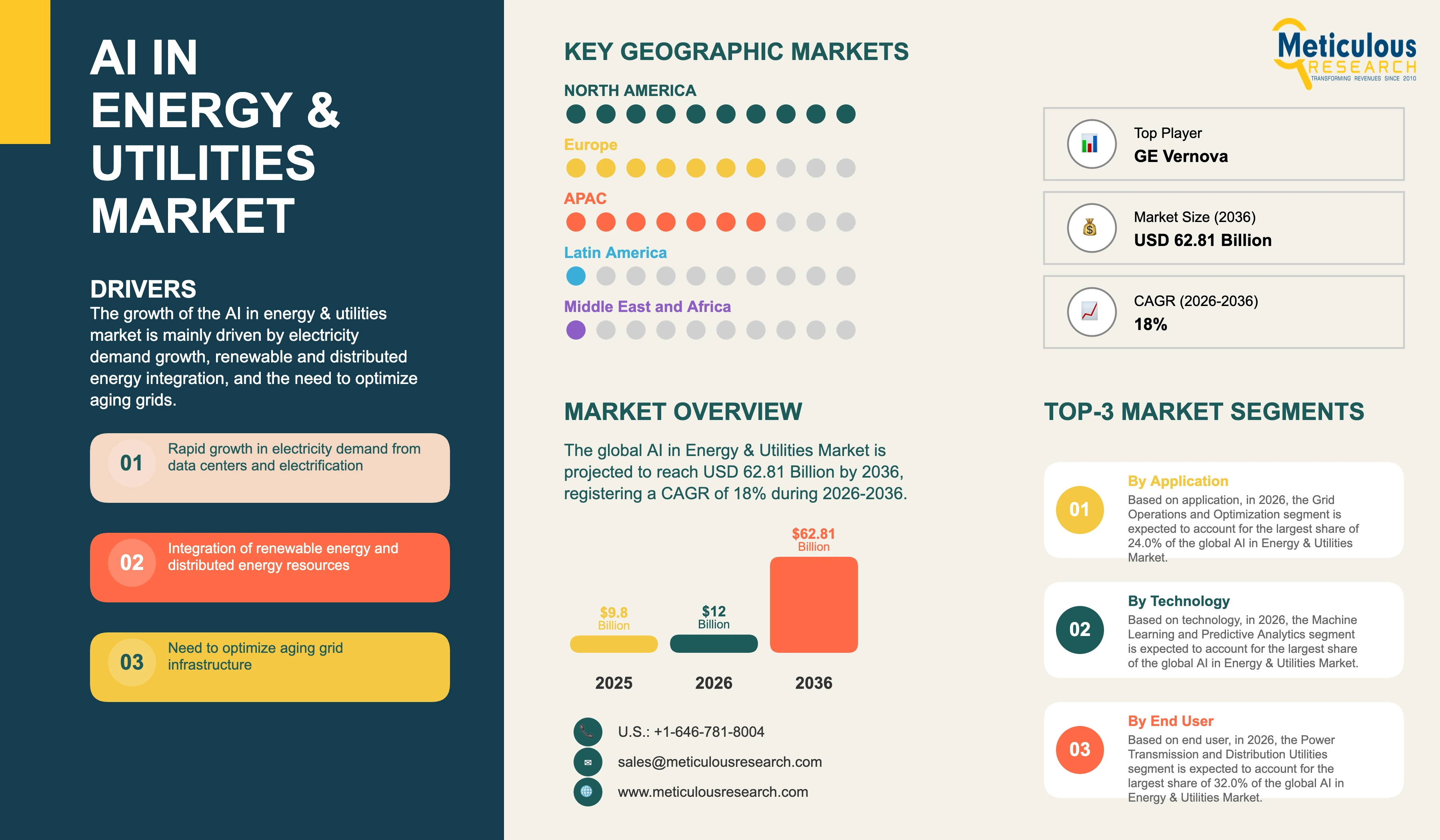
The global AI in energy & utilities market was valued at USD 9.80 billion in 2025. This market is expected to reach USD 62.81 billion by 2036 from an estimated USD 12.00 billion in 2026, registering a CAGR of 18.0% during the forecast period (2026-2036).
- Published
- Nov 2026
- Pages
- 249
- Format
- PDF + Excel
- Report ID
- MREP - 1042602
- Base year
- 2025
- 2025 · BASELINE
- $9.80B
- 2036
- $62.81B
- CAGR 2026–2036
- 18.0%
2025 baseline · 2026–2036 forecast at 18.0% CAGR · hover a bar for the value
Key highlights
The International Energy Agency (IEA) estimated in its 2026 update on energy and AI that electricity consumption by data centers rose to about 485 TWh in 2025 and is set to roughly double to about 950 TWh by 2030, with electricity demand from AI-focused data centers rising by around 50% in 2025, which is placing new pressure on utilities to plan, connect, and operate grids more efficiently.
The IEA's 2025 Energy and AI report estimated that AI-based grid management tools could unlock up to 175 GW of additional transmission capacity without building new lines, and that AI-based fault detection can reduce outage durations by 30% to 50%, while it also noted that cyberattacks on utilities have tripled over the past four years.
The Electric Power Research Institute (EPRI) launched the Open Power AI Consortium in March 2025 with NVIDIA, Microsoft, Amazon Web Services, Duke Energy, Exelon, and other companies to develop open AI models and tools for the power sector, and the consortium had grown to more than 80 members by mid-2025, with Landis+Gyr joining in May 2026.
EPRI reported in March 2026 that it had reviewed more than 250 AI use cases across the power sector and that data readiness is the main barrier to scaling AI in utilities, while the IEA's 2026 survey of energy companies identified skills shortages, fragmented data, and cybersecurity as the main obstacles to AI adoption.
Orders for gas turbines rose by about 70% in 2025, according to the IEA, as utilities and developers added generation to meet data center and other demand growth, which is increasing demand for AI-based predictive maintenance, performance optimization, and fleet management for generation assets from companies such as GE Vernova and Siemens Energy.
By application, grid operations and optimization accounts for the largest share of 24.0% in 2026, while DER and energy storage optimization registers the highest CAGR.
By offering, software and platforms account for the largest share in 2026 and also register the highest CAGR.
By technology, machine learning and predictive analytics account for the largest share in 2026, while generative AI and large language models register the highest CAGR.
By end user, power transmission and distribution utilities account for the largest share of 32.0% in 2026, while power generation and renewables register the highest CAGR.
By geography, North America accounts for the largest share of 40.0% in 2026, while Asia-Pacific registers the highest CAGR of 20.7%.
Report summary
| Particulars | Details |
|---|---|
| Base Year | 2025 |
| Estimated Year | 2026 |
| Forecast Period | 2026-2036 |
| Market Size in 2025 | USD 9.80 billion |
| Market Size in 2026 | USD 12.00 billion |
| Market Size by 2036 | USD 62.81 billion |
| CAGR (2026-2036) | 18.0% |
| Format | PDF, Excel & Cloud Portal · 249 pages |
| Largest Segment by Application (2026) | Grid Operations and Optimization (24.0%) |
| Largest Segment by End User (2026) | Power Transmission and Distribution Utilities (32.0%) |
| Largest Region (2026) | North America (40.0%) |
| Fastest-Growing Region | Asia-Pacific (CAGR 20.7%) |
| Companies Profiled | 16 companies and other companies |
| Segments Covered | Application, Offering, Technology, End User, Geography |
| Countries Covered | U.S., Canada, Germany, U.K., France, Spain, Italy, Netherlands, Denmark, Sweden, Norway, Switzerland, Rest of Europe, China, India, Japan, South Korea, Australia, Singapore, Indonesia, Vietnam, Thailand, Rest of Asia-Pacific, Brazil, Mexico, Chile, Argentina, Colombia, Rest of Latin America, Saudi Arabia, U.A.E., Qatar, South Africa, Rest of Middle East & Africa |
Report overview
Segments covered: application, offering, technology, end user.
The growth of this market is mainly driven by rapid growth in electricity demand from data centers, electrification, and industry, the integration of large volumes of variable renewable energy, distributed energy resources, and battery storage into power systems, the need to operate aging grid infrastructure more efficiently and reliably, rising exposure to extreme weather and wildfire risks, and the digitalization of utility operations with smart meters, sensors, and cloud platforms. However, factors such as fragmented and poor-quality utility data, cybersecurity risks to critical infrastructure, shortages of AI and data skills in the energy sector, and the cautious, regulated nature of utility investment are expected to restrain the growth of this market to some extent.
AI in energy & utilities refers to the use of artificial intelligence technologies, including machine learning and predictive analytics, computer vision, generative AI and large language models, and optimization and reinforcement learning, to plan, operate, maintain, and manage energy and utility systems and businesses. It includes AI for grid operations and optimization, predictive maintenance and asset management, demand and renewable generation forecasting, distributed energy resources and energy storage optimization, energy trading and market optimization, customer engagement and billing, and safety, security, and other applications. This report covers AI software and platforms, related services, and AI-enabled hardware such as edge computing devices and intelligent sensors, sold to power transmission and distribution utilities, power generation and renewable energy companies, oil and gas companies, and gas and water utilities and energy retailers. General utility software and grid equipment without AI capabilities are analyzed in separate reports. The market is measured on a revenue basis.
The energy sector is undergoing a major transformation that is changing how power systems are planned and operated. Electricity demand is rising after years of slow growth, driven by data centers, electric vehicles, heat pumps, industrial electrification, and manufacturing, and the IEA estimates that data center electricity consumption alone will roughly double from about 485 TWh in 2025 to about 950 TWh by 2030. At the same time, power systems are integrating large volumes of variable solar and wind generation, battery storage, and distributed energy resources, while much grid infrastructure in developed countries is aging and must be replaced or upgraded. These changes make power systems far more complex to plan and operate, which creates a strong need for AI.
Grid operations and optimization accounts for the largest share of the market. Utilities use AI to forecast and manage grid loads, detect and locate faults, optimize voltage and power flows, manage congestion, support restoration after outages, and maximize the use of existing transmission and distribution capacity. The IEA estimates that AI-based grid management could unlock up to 175 GW of additional transmission capacity without new lines, and that AI-based fault detection can reduce outage durations by 30% to 50%.
Predictive maintenance and asset management is the second-largest application, used across utilities, generators, and oil and gas companies. Utilities, generators, and oil and gas companies use AI to analyze sensor data, inspection images, maintenance records, and weather data to predict equipment failures, prioritize maintenance, and extend asset life for transformers, lines, turbines, pipelines, and other critical assets. AI-based analysis of drone, satellite, and LiDAR imagery is also widely used to inspect lines and manage vegetation, which is particularly important for reducing wildfire risks.
Demand and renewable generation forecasting, distributed energy resources and energy storage optimization, energy trading and market optimization, and customer engagement and billing are other important applications. Distributed energy resources and energy storage optimization is the fastest-growing application, supported by the rapid growth of battery storage, rooftop solar, electric vehicles, and virtual power plants, which require AI to forecast, aggregate, and dispatch large numbers of small resources.
The market is served by several groups of companies with different strengths in energy and technology. Grid and automation technology companies, such as GE Vernova, Siemens, Schneider Electric, Hitachi Energy, and ABB, offer AI-enabled grid software, asset performance management, and automation. Metering and grid edge companies, such as Itron, Landis+Gyr, and Utilidata, embed AI in smart meters and edge devices. Enterprise software and cloud companies, such as C3 AI, Oracle, IBM, Microsoft, and Google, offer AI platforms and applications for utilities. Specialized companies, such as Uplight, AiDash, and Envision Digital, focus on customer engagement, distributed energy management, vegetation and asset intelligence, and renewable energy optimization.
Power transmission and distribution utilities are the largest end users, followed by power generation and renewables, oil and gas, and gas and water utilities and energy retailers. North America is the largest regional market, supported by large utility investment, data center growth, wildfire and extreme weather risks, and the presence of leading technology companies, while Asia-Pacific is the fastest-growing region.
Industry collaboration on AI in the power sector has also increased significantly since 2025. EPRI launched the Open Power AI Consortium in March 2025 with technology companies and utilities to develop open AI models and tools for the power sector, and the consortium grew to more than 80 members by mid-2025. EPRI has also highlighted data readiness as the main barrier to scaling AI in utilities, which shows that data management and integration will be important parts of the market.
Over the forecast period, the AI in energy & utilities market is expected to grow strongly, supported by electricity demand growth, renewable and distributed energy integration, grid modernization, extreme weather risks, and digitalization. At the same time, data quality, cybersecurity, skills shortages, and regulatory processes will influence how quickly utilities move from pilot projects to large-scale AI deployments.
AI forecasting and battery optimization are now essential to how we run our business. They directly affect our market revenues and how well we can balance our solar and wind portfolio.
This comment explains why DER and energy storage optimization is the fastest-growing application and why power generation and renewables is the fastest-growing end user.
Our smart meter rollout is generating large volumes of data, and we want to use AI to reduce losses, improve billing, and manage rooftop solar, but data quality and security come first.
This comment explains why Asia-Pacific is the fastest-growing region and why data readiness and cybersecurity are key purchase criteria.
North America is expected to account for the largest share of 40.0% of the market in 2026, mainly due to rapid data center-driven demand growth, large grid modernization and resilience investments, wildfire and extreme weather risks, and the presence of leading technology and energy companies.
Asia-Pacific is projected to register the highest CAGR of 20.7% during the forecast period, driven by rapid electricity demand growth, large renewable energy additions, grid investment programs, smart meter deployments, and national AI strategies.
The report profiles 16 companies, including GE Vernova, Siemens, Schneider Electric, Hitachi Energy, ABB, C3 AI, Itron, Landis+Gyr, Uplight, Oracle, IBM, Microsoft, Google, AiDash, Utilidata, and Envision Digital.
The IEA estimates that AI-based grid management tools could unlock up to 175 GW of additional transmission capacity without building new lines, and that AI-based fault detection can reduce outage durations by 30% to 50%.
Report infographic
Market dynamics
18 factors across 5 forcesRapid growth in electricity demand from data centers and electrification
After many years of flat or slowly growing electricity demand in developed countries, demand is now rising rapidly, driven by data centers, particularly those used for AI, electric vehicles, heat pumps, industrial electrification, and new manufacturing facilities. The IEA estimates that data center electricity consumption rose to about 485 TWh in 2025 and will roughly double to about 950 TWh by 2030, and that electricity demand from AI-focused data centers rose by about 50% in 2025. Utilities in many regions face very large volumes of requests to connect new data centers and other large loads, often in locations where grid capacity is limited.
Meeting this demand requires utilities to plan new generation and grid capacity faster, connect new loads more quickly, and make better use of existing infrastructure. AI tools for load forecasting, interconnection studies, grid planning, and capacity optimization can help utilities do this, and many utilities are investing in AI for these purposes. Rising demand also increases the need for AI-based maintenance and performance optimization of generation assets, as shown by the roughly 70% increase in gas turbine orders in 2025 reported by the IEA.
Data center operators themselves are also interested in AI tools that help them work with utilities on flexible connection arrangements, demand response, and on-site generation and storage, which creates further demand for AI in energy management.
Integration of renewable energy and distributed energy resources
The share of variable solar and wind generation in power systems is rising rapidly, and large numbers of distributed energy resources, such as rooftop solar, batteries, electric vehicles, smart thermostats, and heat pumps, are being connected to distribution networks. Variable renewable generation requires accurate forecasting and flexible balancing resources, while distributed resources create two-way power flows, voltage issues, and congestion in distribution networks that were not designed for them. AI-based forecasting, distributed energy resource management, and optimization tools help utilities and system operators integrate these resources while maintaining reliability.
Battery storage is growing particularly quickly, and AI is widely used to optimize battery charging, discharging, and participation in energy and ancillary service markets, which increases revenue for battery owners and supports grid stability.
Virtual power plants, which aggregate large numbers of distributed resources to provide grid services, depend on AI to forecast resource availability and customer behavior and to dispatch resources reliably, and they are expanding in the U.S., Europe, and Australia.
Need to optimize aging grid infrastructure
Much of the transmission and distribution infrastructure in North America, Europe, and Japan was built decades ago and is approaching or exceeding its design life. Utilities must invest heavily to replace and upgrade this infrastructure, but they face constraints on capital, supply chains for transformers and other equipment, and long permitting times for new lines. AI-based asset management, predictive maintenance, dynamic line rating, and grid optimization allow utilities to extend asset life, prioritize investments, and increase the capacity of existing infrastructure, which delays or reduces the need for new construction.
Regulators in several countries are also encouraging grid-enhancing technologies and data-driven asset management to reduce costs for customers, which supports adoption of AI.
Rising extreme weather and wildfire risks
Extreme weather events, such as hurricanes, storms, heat waves, floods, and wildfires, are causing more frequent and costly outages and damage to energy infrastructure, and utilities in several regions, particularly the western U.S., face major liabilities related to wildfires caused by power lines. AI is used to predict storm impacts, position restoration crews, assess damage from images, monitor vegetation near lines, detect faults and fire risks, and support decisions on public safety power shutoffs. These applications can reduce outage durations, damage, and liabilities, which makes them a high priority for utilities and regulators.
Companies such as AiDash use AI and satellite imagery to manage vegetation and assess risks across large utility networks, and utilities are expanding the use of AI-based cameras and sensors to detect wildfires early.
Digitalization of utility operations
Utilities have deployed large numbers of smart meters, sensors, intelligent electronic devices, and drones, and they are moving operational and enterprise systems to cloud platforms. This generates large volumes of data that AI can use to improve operations, customer service, and planning. Smart meters with edge computing capabilities, such as those offered by Itron, Landis+Gyr, and Utilidata, allow AI to run directly at the grid edge to detect issues, manage distributed resources, and improve situational awareness.
Cloud and AI platform providers, such as Microsoft, Google, Amazon Web Services, Oracle, and IBM, are developing utility-specific AI solutions and partnering with utilities and grid technology companies, which is accelerating digitalization and AI adoption across the sector.
Table of contents
12 chapters · 167 sections · 249 pages · click to expandSegmental analysis
| Segment | Largest share (2026) | Fastest growth (2026–2036) |
|---|---|---|
| By Application | Grid operations and optimization | DER and energy storage optimization |
| By Offering | Software and platforms | Rapid growth of this |
| By Technology | Machine learning and predictive analytics | Generative AI and large language models |
| By End User | Power transmission and distribution utilities | Power generation and renewables |
| Other segments | Software and platforms | Generative AI and large language models |
By Application
- AI in Energy & Utilities Market Analysis by Application
- The grid operations and optimization segment is expected to account for the largest share of 24.0% of the global AI in energy & utilities market.
- The large share of this segment is mainly due to the increasing complexity of grid operations with rising demand, variable renewable generation, and distributed energy resources, the need to maximize the use of existing transmission and distribution capacity, large utility investments in advanced distribution management systems and grid analytics, and the importance of reliability and fast outage restoration.
- Utilities use AI for load and congestion management, fault detection and location, voltage optimization, outage prediction and restoration, and capacity planning.
- Grid operations applications are used by almost all transmission and distribution utilities and system operators, and the growing number of new connection requests from data centers, renewable projects, and storage facilities is increasing the importance of AI for planning and interconnection studies.
- AI-based dynamic line rating and congestion management are attracting particular interest from transmission operators.
- Within this segment, AI for outage prediction and restoration is growing rapidly, supported by rising extreme weather risks, while AI for interconnection studies is emerging as an important new application as utilities face long queues of projects waiting to connect.
- However, the DER and energy storage optimization segment is projected to register the highest CAGR during the forecast period.
- The rapid growth of this segment is driven by the rapid growth of battery storage, rooftop solar, electric vehicles, and smart devices, the development of virtual power plants and flexibility markets, and the need for AI to forecast, aggregate, and dispatch large numbers of distributed resources.
- Predictive maintenance and asset management form the second-largest segment, followed by demand and renewable generation forecasting, energy trading and market optimization, customer engagement and billing, and safety, security, and other applications.
- Predictive maintenance and asset management is particularly important for generators and oil and gas companies, which operate high-value assets where unplanned downtime is very costly, and for utilities seeking to extend the life of aging infrastructure.
By Offering
- AI in Energy & Utilities Market Analysis by Offering
- The software and platforms segment is expected to account for the largest share of the global AI in energy & utilities market.
- The large share of this segment is mainly due to the wide use of AI-enabled grid management, asset performance management, forecasting, trading, and customer engagement software, the shift of utility applications to cloud platforms, and the integration of AI capabilities into widely used utility software from GE Vernova, Siemens, Schneider Electric, Hitachi Energy, Oracle, and others.
- This segment is also projected to register the highest CAGR during the forecast period.
- The rapid growth of this segment is driven by the adoption of AI platforms and applications, the growth of software-as-a-service models, the development of generative AI applications for utilities, and the scalability of software-based solutions across utility operations.
- The services segment forms the second-largest segment and includes consulting, data preparation, integration, implementation, and managed services, which are essential for utilities with limited in-house AI expertise.
- The AI-enabled hardware segment, which includes edge computing devices, intelligent sensors, and AI-enabled meters and cameras, accounts for the remaining share.
- Hardware is essential for collecting data and running AI at the grid edge, and its use is growing with deployments of smart meters and sensors, although it grows more slowly than software.
By Technology
- AI in Energy & Utilities Market Analysis by Technology
- The machine learning and predictive analytics segment is expected to account for the largest share of the global AI in energy & utilities market.
- The large share of this segment is mainly due to the wide use of machine learning for load and renewable generation forecasting, predictive maintenance, anomaly and fault detection, energy trading, and customer analytics, the long track record of these techniques in the energy sector, and the large volumes of time-series data generated by meters, sensors, and control systems.
- Machine learning models are well suited to many energy applications because they can learn complex patterns from historical and real-time data, and they are embedded in most AI-enabled utility software.
- However, the generative AI and large language models segment is projected to register the highest CAGR during the forecast period.
- The rapid growth of this segment is driven by the use of generative AI for customer service, document processing, regulatory filings, engineering and maintenance support, operator assistants, and knowledge management, together with industry efforts such as EPRI's Open Power AI Consortium to develop power sector AI models.
- Computer vision, used for inspection of lines, substations, and generation assets and for vegetation and wildfire monitoring, forms the second-largest segment, while other technologies, such as optimization, reinforcement learning, and digital twins, account for the remaining share.
By End User
- AI in Energy & Utilities Market Analysis by End User
- The power transmission and distribution utilities segment is expected to account for the largest share of 32.0% of the global AI in energy & utilities market.
- The large share of this segment is mainly due to the increasing complexity of grid operations, rapid demand growth and new connection requests, the integration of distributed energy resources, aging infrastructure, rising extreme weather and wildfire risks, and large investments in grid modernization, smart meters, and digital platforms.
- Transmission and distribution utilities use AI across grid operations, asset management, vegetation management, outage management, planning, and customer service.
- Large investor-owned utilities in North America and Europe are the most advanced users, while state-owned utilities in Asia-Pacific and the Middle East are increasing their investments as part of grid modernization programs.
- Distribution utilities in particular are investing in AI as distributed energy resources and electric vehicles transform their networks, since they need much greater visibility and control at the grid edge than in the past.
- However, the power generation and renewables segment is projected to register the highest CAGR during the forecast period.
- The rapid growth of this segment is driven by the rapid growth of solar, wind, and battery storage capacity, the use of AI for renewable generation forecasting, performance optimization, predictive maintenance, and market bidding, and growing investment in gas generation to meet demand growth, which increases demand for AI-based fleet management.
- Oil and gas forms the second-largest segment, supported by the use of AI for exploration, production optimization, predictive maintenance, pipeline monitoring, and emissions detection, while gas and water utilities and energy retailers account for the remaining share.
Other segments
- The software and platforms segment is expected to account for the largest share of the AI in energy & utilities market, and it is also projected to register the highest CAGR during the forecast period.
- The machine learning and predictive analytics segment is expected to account for the largest share of the AI in energy & utilities market, while the generative AI and large language models segment is projected to register the highest CAGR during the forecast period.
Geographic analysis
North America
Largest shareIn 2026, North America is expected to account for the largest share of 40.0% of the global AI in energy & utilities market. The large share of this region is mainly due to rapid electricity demand growth from data centers and electrification, large utility investments in grid modernization and resilience, high wildfire and extreme weather risks, large oil and gas and renewable energy industries, and the presence of leading technology and energy companies such as GE Vernova, C3 AI, Itron, Oracle, IBM, Microsoft, Google, Amazon Web Services, Uplight, AiDash, and Utilidata. The U.S. is the largest market in the region, followed by Canada. EPRI's Open Power AI Consortium, which is based in the U.S., also supports industry collaboration on AI in the region.
Asia-Pacific
Fastest growthAsia-Pacific is projected to register the highest CAGR of 20.7% during the forecast period. The rapid growth of this region is mainly driven by rapid electricity demand growth, very large renewable energy additions in China, India, and other countries, large grid investment programs by state-owned utilities, large smart meter deployments in India and other countries, growing data center construction, and national AI and digitalization strategies. China, India, Japan, South Korea, Australia, Singapore, Indonesia, Vietnam, and Thailand are important markets, and Australia is a global leader in rooftop solar and virtual power plants. Japan and South Korea are investing in grid digitalization and AI to support renewable integration and energy security, while Singapore is a regional hub for energy technology companies and data centers.
Europe
Europe accounts for a significant share of the global market, supported by ambitious renewable energy and decarbonization targets, large investments in grid modernization under the EU Grid Action Plan, the growth of distributed energy resources and flexibility markets, and leading companies such as Siemens, Schneider Electric, Hitachi Energy, ABB, and Landis+Gyr. Germany, the U.K., France, Spain, Italy, the Netherlands, the Nordic countries, and Switzerland are important markets, and European utilities are among the most active adopters of AI for renewable forecasting and grid optimization.
Latin America
Latin America and the Middle East & Africa account for smaller shares of the market but are growing rapidly, supported by renewable energy growth in Brazil, Chile, and Mexico, smart grid and smart meter programs, oil and gas digitalization in Saudi Arabia, the U.A.E., and other Gulf countries, and national AI strategies in the Gulf region.
Middle East & Africa
Saudi Arabia and the U.A.E. are also building large data center capacity, which increases the need for AI-based grid planning and operations.
Competitive landscape
The global AI in energy & utilities market is fragmented, with the top five players estimated to account for about 25% of the market in 2025. The market includes grid and automation technology companies, metering and grid edge companies, enterprise software and cloud providers, AI platform companies, and specialized AI companies focused on specific energy applications.
GE Vernova, Siemens, Schneider Electric, Hitachi Energy, and ABB are leading providers of AI-enabled grid software, advanced distribution management systems, asset performance management, and automation, and they have long-standing relationships with utilities and generators. Itron, Landis+Gyr, and Utilidata offer AI at the grid edge through smart meters and distribution devices. C3 AI offers enterprise AI applications for utilities and oil and gas companies, while Oracle offers utility customer, billing, and network management software with AI capabilities. IBM, Microsoft, Google, and Amazon Web Services provide AI and cloud platforms and partner with utilities and technology providers. Uplight offers customer engagement and distributed energy management solutions, AiDash offers AI and satellite-based vegetation and asset management, and Envision Digital offers AI-based renewable energy and energy management platforms.
Companies in this market compete on domain expertise, AI performance, integration with utility operational and enterprise systems, cybersecurity, regulatory compliance, scalability, and customer relationships. Key strategies include launches of AI applications and generative AI features, partnerships between grid technology companies and cloud and AI providers, acquisitions of AI and software companies, participation in industry consortia such as EPRI's Open Power AI Consortium, and expansion in Asia-Pacific and other growth markets.
Established grid technology companies benefit from deep domain knowledge and installed bases of software and equipment, while cloud providers and AI companies bring advanced AI capabilities and computing resources. We expect partnerships between these groups to remain important, since utilities need solutions that combine power systems expertise with advanced AI.
Specialized AI companies have found success in specific applications, such as vegetation management, renewable forecasting, and distributed energy management, and some are likely to be acquired by larger companies seeking to expand their AI portfolios. Uplight's acquisition of AutoGrid is an example of consolidation in distributed energy management software.
Some of the key players operating in the AI in energy & utilities market are GE Vernova Inc., Siemens AG, Schneider Electric SE, Hitachi Energy Ltd., ABB Ltd., C3.ai, Inc., Itron, Inc., Landis+Gyr Group AG, Uplight, Inc., Oracle Corporation, IBM Corporation, Microsoft Corporation, Google LLC, AiDash, Inc., Utilidata, Inc., and Envision Digital, among others.
- —
EPRI launched the Open Power AI Consortium in March 2025 with NVIDIA, Microsoft, Amazon Web Services, and utilities, and Landis+Gyr joined in May 2026, while the IEA reported in 2026 that data center electricity demand reached about 485 TWh in 2025 and could roughly double by 2030.
- GE Vernova Inc.
- Siemens AG
- Schneider Electric SE
- Hitachi Energy Ltd.
- ABB Ltd.
- C3.ai, Inc.
- Itron, Inc.
- Landis+Gyr Group AG
- Uplight, Inc.
- Oracle Corporation
- IBM Corporation
- Microsoft Corporation
- Google LLC
- AiDash, Inc.
- Utilidata, Inc.
- Envision Digital
Expert perspectives
The energy and utilities sector is entering a period of rapid change, with rising electricity demand, the integration of renewable and distributed energy, aging infrastructure, and growing climate risks. AI is becoming an essential tool for managing this complexity, and its adoption is moving from isolated pilots to broader deployments across grid operations, asset management, forecasting, and customer service.
Over the forecast period, the market is expected to grow at a CAGR of 18.0%, from USD 12.00 billion in 2026 to USD 62.81 billion in 2036. Growth will be supported by data center and electrification-driven demand growth, renewable and distributed energy integration, grid optimization needs, extreme weather risks, and digitalization.
Among the market segments, grid operations and optimization is the largest application, while DER and energy storage optimization grows fastest. Software and platforms are the largest and fastest-growing offering, machine learning and predictive analytics is the largest technology, while generative AI and large language models grow fastest, and power transmission and distribution utilities are the largest end users, while power generation and renewables grow fastest. North America is the largest region, and Asia-Pacific is the fastest-growing region at a CAGR of 20.7%.
In our view, the most important near-term opportunity is the use of AI to get more out of existing grid infrastructure. With long lead times for new lines and equipment, AI-based grid optimization, dynamic line rating, interconnection studies, and flexible connection of large loads will be critical for meeting demand growth from data centers and electrification.
We also expect distributed energy resources and virtual power plants to become a major growth area, as batteries, electric vehicles, and smart devices become important sources of flexibility, and as regulators and markets develop rules to use them. AI will be essential for forecasting, aggregating, and dispatching these resources.
Data readiness and cybersecurity will remain the main constraints on the pace of AI adoption in utilities. Utilities that invest in data management, integration, and secure architectures will be able to scale AI more quickly, and vendors that help utilities address these issues will have an advantage. Partnerships with experienced technology providers will be particularly valuable for smaller utilities.
Regulatory frameworks will also need to evolve to encourage investment in AI and software, and we expect more regulators to support grid-enhancing technologies and performance-based approaches that reward efficiency.
Overall, we believe AI will become a core part of energy and utility operations within the forecast period, and the AI in energy & utilities market will be one of the fastest-growing areas of energy technology.
Customer perspectives
Buyers of AI solutions in energy and utilities include transmission and distribution utilities, system operators, power generators and renewable energy developers, oil and gas companies, gas and water utilities, and energy retailers. Their purchase decisions depend mainly on reliability and accuracy, proven results in utility environments, integration with operational and enterprise systems, cybersecurity and regulatory compliance, explainability for operators and regulators, total cost and regulatory recovery, and vendor expertise and support.
Vice President of Grid Operations - investor-owned utility, U.S.
We have more data center connection requests than we can study with traditional methods, so we are using AI for load forecasting, interconnection studies, and congestion management to make the most of our existing grid.
This comment explains why grid operations and optimization accounts for 24.0% of the market and why power transmission and distribution utilities account for 32.0% of the market.
Frequently asked questions
The global AI in energy & utilities market was valued at USD 9.80 billion in 2025, up from USD 7.90 billion in 2024, and is estimated at USD 12.00 billion in 2026.
Cite this report
Meticulous Research. (2026). AI in Energy & Utilities Market - Global Opportunity Analysis and Industry Forecast (2026-2036) (Report No. MREP - 1042602). Meticulous Market Research Pvt. Ltd. https://www.meticulousresearch.com/product/ai-in-energy-utilities-market-7285