Silver Paste for Solar Market (2026-2036)
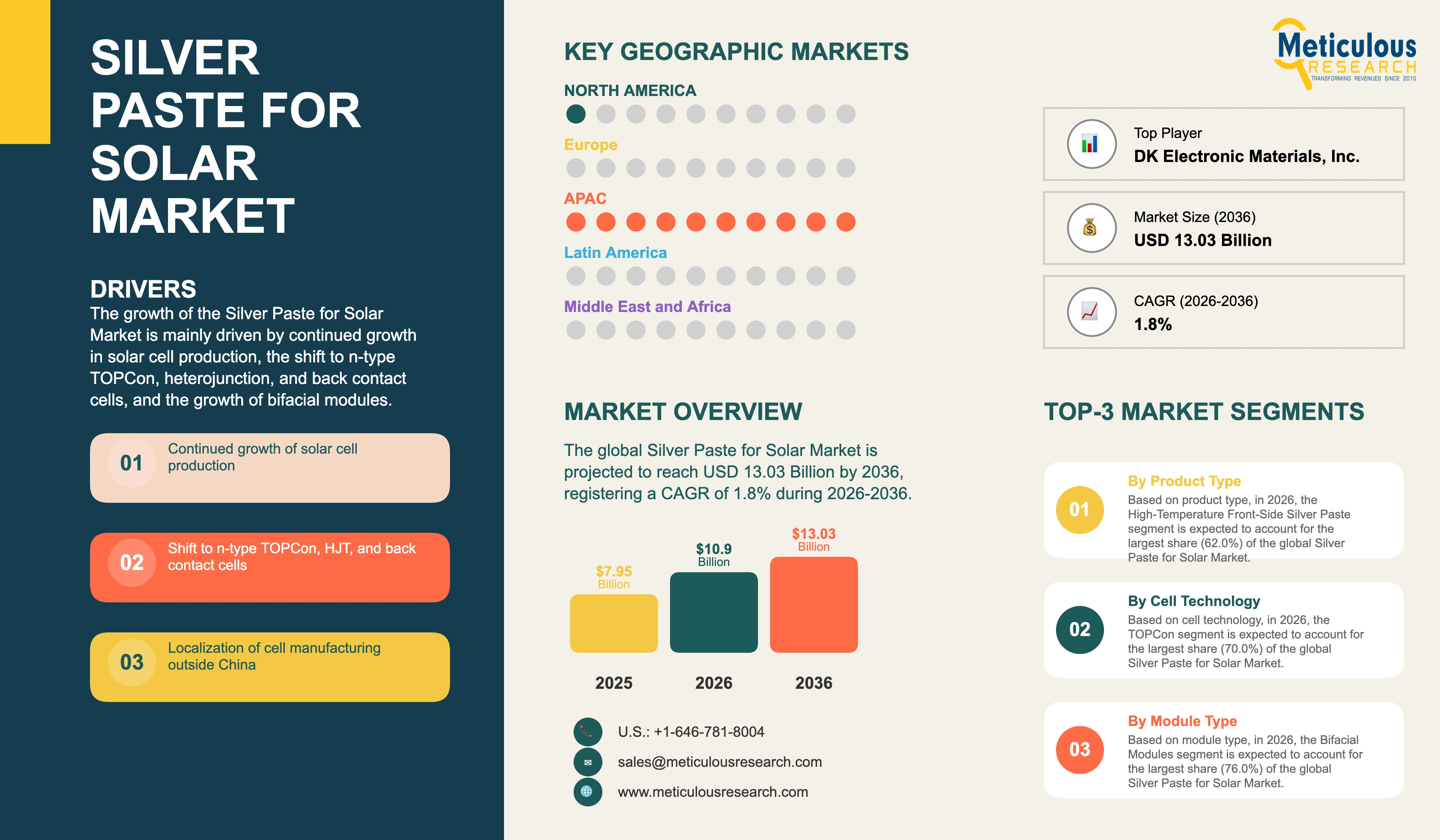
The global silver paste for solar market was valued at USD 7.95 billion in 2025. This market is expected to reach USD 13.03 billion by 2036 from an estimated USD 10.90 billion in 2026, registering a CAGR of 1.8% during the forecast period (2026-2036).
- Published
- Nov 2026
- Pages
- 280
- Format
- PDF + Excel
- Report ID
- MREP - 1042563
- Base year
- 2025
- 2025 · BASELINE
- $7.95B
- 2036
- $13.03B
- CAGR 2026–2036
- 1.8%
2025 baseline · 2026–2036 forecast at 1.8% CAGR · hover a bar for the value
Key highlights
According to the World Silver Survey 2026, compiled by Metals Focus for the Silver Institute, silver demand from the photovoltaic industry fell 6% to 186.6 million ounces in 2025 from 197.5 million ounces in 2024, and it is forecast to fall by a further 19% to around 151 million ounces in 2026 as manufacturers cut silver use per cell in response to high prices.
Silver prices rose sharply over the past two years, averaging just over USD 40 per ounce in 2025, a 42% increase over 2024 according to the World Silver Survey 2026, and reaching an all-time high of about USD 120 per ounce in January 2026 before falling back to around USD 70 per ounce by March 2026, according to pv magazine.
Heraeus has reported that silver paste can account for up to 30% of total solar cell production costs, and that silver prices remained 187% higher than at the start of 2025 in early 2026, which has made silver reduction a top priority for cell manufacturers already facing overcapacity and low module prices.
LONGi has announced plans to switch to copper-based metallization for mass production of its back contact cells, while DK Electronic Materials, one of the largest silver paste suppliers, reported that a gigawatt-scale customer will adopt its high-copper paste for commercial production, showing the rapid shift toward reduced-silver pastes.
Solar is one of the largest industrial uses of silver, and research cited by pv magazine has suggested that photovoltaics could account for as much as 40% of global silver demand by 2030 if current technologies continue, which explains why cell makers, paste suppliers, and research institutes such as ISC Konstanz are working intensively on copper-based alternatives.
The silver market recorded its fifth consecutive annual deficit in 2025, at 40.3 million ounces, according to the World Silver Survey 2026, which suggests that silver prices are likely to remain elevated and that pressure on paste makers to reduce silver content will continue.
By product type, high-temperature front-side silver paste accounts for the largest share of 62.0% in 2026, while silver-coated copper and low-silver paste registers the highest CAGR.
By cell technology, TOPCon accounts for the largest share of 70.0% in 2026, while back contact (BC) registers the highest CAGR.
By module type, bifacial modules account for the larger share in 2026 and also register the higher CAGR.
By geography, Asia-Pacific accounts for the largest share of 89.0% in 2026, while North America registers the highest CAGR of 7.0%.
Report summary
| Particulars | Details |
|---|---|
| Base Year | 2025 |
| Estimated Year | 2026 |
| Forecast Period | 2026-2036 |
| Market Size in 2025 | USD 7.95 billion |
| Market Size in 2026 | USD 10.90 billion |
| Market Size by 2036 | USD 13.03 billion |
| CAGR (2026-2036) | 1.8% |
| Format | PDF, Excel & Cloud Portal · 280 pages |
| Largest Segment by Product Type (2026) | High-Temperature Front-Side Silver Paste (62.0%) |
| Largest Segment by Cell Technology (2026) | TOPCon (70.0%) |
| Largest Region (2026) | Asia-Pacific (89.0%) |
| Fastest-Growing Region | North America (CAGR 7.0%) |
| Companies Profiled | 10 companies and other companies |
| Segments Covered | Product Type, Cell Technology, Module Type, Geography |
| Countries Covered | China, India, Vietnam, Malaysia, Thailand, Indonesia, Cambodia, Laos, South Korea, Japan, Taiwan, Rest of Asia-Pacific, U.S., Canada, Mexico, Turkey, Germany, Italy, France, Rest of Europe, Saudi Arabia, U.A.E., Oman, Egypt, Ethiopia, Rest of Middle East & Africa, Brazil, Rest of Latin America |
Report overview
Segments covered: product type, cell technology, module type.
The growth of this market in value terms is mainly driven by the continued expansion of global solar cell production, the shift to n-type TOPCon, heterojunction, and back contact cells that use more metallization paste per watt than older PERC cells, the growth of bifacial modules that require silver contacts on both sides of the cell, the localization of cell manufacturing in India, the U.S., Southeast Asia, the Middle East, and Turkey, and the sharp rise in silver prices since 2025, which has increased the value of each kilogram of paste. However, factors such as aggressive silver thrifting, the replacement of silver with copper in some cell technologies, overcapacity and price pressure across the solar supply chain, volatile silver prices, and the possible slowdown of solar installations in some markets are expected to restrain the growth of this market to some extent.
Silver paste for solar is a conductive paste made of fine silver powder, glass frit, and organic binders and solvents that is screen-printed onto silicon solar cells to form the metal contacts, known as fingers and busbars, that collect and carry electric current. After printing, the paste is either fired at high temperatures, for most crystalline silicon cells such as TOPCon and PERC, or cured at low temperatures, for heterojunction cells, to form conductive lines that bond to the silicon. This report covers the global revenue from silver paste and reduced-silver metallization paste used in photovoltaic cell production, including high-temperature front-side and rear-side silver pastes, low-temperature silver pastes, and silver-coated copper and low-silver pastes.
Metallization paste is one of the most important and expensive non-silicon materials in a solar cell. Silver is the best electrical conductor of all metals and is resistant to corrosion, which makes it well suited to forming reliable contacts that last for decades. However, silver is expensive, and the solar industry has become one of the largest users of silver worldwide. The Silver Institute has reported that solar accounted for a significant share of global industrial silver demand in recent years, and research has suggested that photovoltaics could account for a much larger share of global silver demand by 2030 if current technologies continue.
The amount of silver used per watt of solar capacity has fallen dramatically over the past decade through improvements in paste formulation, finer printed lines, more busbars, and higher cell efficiency. However, the shift from PERC to n-type cell technologies has increased silver use per cell, because TOPCon cells need silver contacts on both sides and heterojunction cells use low-temperature paste with lower conductivity. Rapid growth in total solar production has also increased overall paste demand, even as silver use per watt has fallen.
The market value of silver paste depends heavily on the price of silver, since silver accounts for most of the cost of the paste. Paste makers typically price their products based on the silver price plus a processing fee. As silver prices rose sharply in 2025 and early 2026, the value of the paste market increased even though the volume of silver used fell. This creates a difficult environment for cell makers, which face higher costs at the same time as module prices have fallen because of overcapacity.
In response, the industry is pursuing several silver reduction strategies, which include thinner printed fingers using advanced screen printing and stencil printing, laser-assisted firing to improve contact with less paste, multi-busbar and zero-busbar designs, higher-efficiency cells that produce more power per gram of silver, silver-coated copper pastes, and copper plating or copper pastes that replace silver entirely in some cell types. Back contact cells, which place all contacts on the rear side, are particularly suited to copper metallization.
China dominates both silver paste production and consumption, because Chinese companies make most of the world's solar cells. Chinese paste makers such as DK Electronic Materials, Changzhou Fusion New Material, and Soltrium have gained most of the market from international suppliers such as Heraeus, Solamet, and Samsung SDI's former paste business, through lower prices, fast product development, and close cooperation with domestic cell makers. International and Taiwanese, Japanese, and Korean suppliers remain important in specialized segments, such as low-temperature pastes for heterojunction cells and supply to cell makers outside China.
The market includes Chinese paste makers, international precious metals and electronic materials companies, and specialized suppliers of low-temperature and copper-based pastes. Leading companies include DK Electronic Materials, Inc., Changzhou Fusion New Material Co., Ltd., Solamet Electronic Materials (Solar Applied Materials Technology Corp.), Heraeus Precious Metals, Soltrium Technology Ltd., Giga Solar Materials Corp., Suzhou iSilver Materials, Kyoto Elex Co., Ltd., Namics Corporation, and Daejoo Electronic Materials Co., Ltd.
Over the forecast period, the silver paste for solar market is expected to grow slowly in value, as continued growth in solar cell production and the shift to n-type and bifacial technologies are largely offset by silver thrifting and copper substitution. The market's value will remain highly sensitive to silver prices, and the product mix is expected to shift toward low-silver, silver-coated copper, and low-temperature pastes.
Asia-Pacific is expected to account for the largest share of 89.0% of the market in 2026, mainly due to China's dominance of solar cell manufacturing and the location of leading paste makers in China.
North America is projected to register the highest CAGR of 7.0% during the forecast period, driven by new U.S. solar cell factories supported by domestic manufacturing incentives and trade measures.
The report profiles 10 companies, including DK Electronic Materials, Changzhou Fusion New Material, Solamet Electronic Materials, Heraeus Precious Metals, Soltrium, Giga Solar Materials, Suzhou iSilver, Kyoto Elex, Namics, and Daejoo Electronic Materials.
Report infographic
Market dynamics
16 factors across 5 forcesContinued growth of solar cell production
Global solar cell production has grown rapidly over the past decade, and it reached several hundred gigawatts per year in 2025, according to industry data from the International Energy Agency Photovoltaic Power Systems Programme and the China Photovoltaic Industry Association. Although the growth of installations is expected to slow in some years because of policy changes and overcapacity, long-term forecasts by the International Energy Agency and other organizations expect solar to remain the fastest-growing source of electricity worldwide, supported by low costs, climate policies, and rising electricity demand from data centers, electrification, and industry.
Every crystalline silicon solar cell requires metallization paste, so growth in cell production directly supports demand for silver and reduced-silver pastes. Even with significant thrifting, the large and growing volume of cell production will keep total paste demand high over the forecast period. Growth in emerging solar markets in the Middle East, Africa, India, and Southeast Asia is also expected to support demand for cells and paste.
Rising electricity demand from data centers, electric vehicles, and heat pumps is adding to the long-term outlook for solar installations, since solar is one of the fastest and cheapest ways to add new generation capacity. Large utility-scale projects in the U.S., India, the Middle East, and China are expected to continue driving cell production over the forecast period.
Shift to n-type TOPCon, heterojunction, and back contact cells
The solar industry has rapidly shifted from p-type PERC cells to n-type cell technologies, mainly TOPCon, which now accounts for most global cell production, along with heterojunction and back contact cells. These n-type technologies offer higher efficiency and better performance, but they generally use more silver paste per cell than PERC. TOPCon cells require silver contacts on both the front and rear sides, including a special silver-aluminum paste for the front boron-doped emitter, while heterojunction cells use low-temperature silver paste that is less conductive and requires more silver per cell.
This shift has increased paste demand per watt compared with PERC and has created demand for new, specialized paste formulations, which carry higher processing fees and give technology leaders an advantage. Paste makers that develop pastes for new cell structures, such as laser-enhanced contact optimization for TOPCon and fine-line printing for heterojunction cells, can capture higher-value business. New cell designs also change frequently, so paste makers must continuously reformulate their products, which favors suppliers with strong research teams and close customer relationships.
Growth of bifacial modules
Bifacial modules, which capture sunlight on both the front and rear sides, have become standard for utility-scale solar projects and are increasingly used in commercial and residential installations. Bifacial cells need a grid of metal fingers on the rear side instead of a full aluminum layer, which increases the amount of silver paste used per cell. The shift to bifacial modules therefore supports demand for rear-side silver paste and for front-side pastes that can be used on both sides of TOPCon cells.
As dual-glass bifacial modules continue to gain share in all market segments, demand for bifacial-compatible paste is expected to remain strong over the forecast period. The combination of bifacial modules with single-axis trackers in utility-scale projects is particularly common in the U.S., the Middle East, India, and Latin America, where high irradiance and reflective ground surfaces increase the energy gain from the rear side.
Localization of cell manufacturing outside China
Governments in India, the U.S., Turkey, the Middle East, and Southeast Asia are supporting domestic solar cell manufacturing through incentives, tariffs, and local content rules. India's Approved List of Models and Manufacturers for cells, which applies to many projects from June 2026, and production-linked incentives are driving rapid growth in Indian cell manufacturing capacity, while U.S. tax credits and tariffs have encouraged new cell factories in the U.S. Cell factories are also being built in Saudi Arabia, the U.A.E., Oman, Egypt, Ethiopia, and Turkey.
These new cell factories need reliable supplies of metallization paste and technical support, which creates demand outside China and opportunities for paste makers that can serve these markets, including international suppliers and Chinese companies setting up local operations. Paste demand outside China is expected to grow much faster than demand in China over the forecast period. Many new factories are buying production lines and process know-how from Chinese equipment suppliers, which often recommend specific paste suppliers, so paste makers with strong relationships with equipment makers are well placed.
Table of contents
11 chapters · 138 sections · 280 pages · click to expandSegmental analysis
| Segment | Largest share (2026) | Fastest growth (2026–2036) |
|---|---|---|
| By Product Type | High-temperature front-side silver paste | Silver-coated copper and low-silver paste |
By Product Type
- The bifacial modules segment is expected to account for the larger share of the silver paste for solar market, and it is also projected to register the higher CAGR during the forecast period.
Geographic analysis
Asia-Pacific
Largest shareIn 2026, Asia-Pacific is expected to account for the largest share of 89.0% of the global silver paste for solar market. The large share of this region is mainly due to China's dominance of global solar cell manufacturing, with Chinese companies producing the large majority of the world's cells in China and in Southeast Asian factories, the location of the leading paste makers, including DK Electronic Materials, Changzhou Fusion New Material, and Soltrium, in China, and the rapid growth of cell manufacturing in India, Vietnam, Malaysia, Thailand, Indonesia, Cambodia, and Laos. Taiwan, South Korea, and Japan also have cell manufacturing and paste supply industries, with Taiwanese and Japanese suppliers serving specialized segments. India is the fastest-growing market within Asia-Pacific, as government policies, including the Approved List of Models and Manufacturers for cells and production-linked incentives, drive rapid growth in domestic cell manufacturing by companies such as Waaree, Adani Solar, Premier Energies, ReNew, and Tata Power Solar. Southeast Asian countries remain important cell manufacturing locations, although trade measures in the U.S. have shifted some production between countries in the region.
North America
Fastest growthNorth America is projected to register the highest CAGR of 7.0% during the forecast period. The rapid growth of this region is mainly driven by new solar cell factories in the U.S. supported by tax credits for domestic manufacturing and tariffs on imported cells and modules, and by the need for domestic supply chains for the large U.S. solar market. Several companies have announced or started U.S. cell production, which creates new demand for metallization paste and opportunities for paste makers with local technical support. Mexico is also attracting interest as a location for cell and module factories serving the North American market, and Canada has a small but growing module and cell manufacturing base.
Middle East & Africa
The Middle East & Africa is also growing quickly, as Saudi Arabia, the U.A.E., Oman, Egypt, and Ethiopia attract new cell and module factories to serve local and export markets.
Europe
Europe has a small cell manufacturing base, with Germany, Italy, and other countries supporting domestic production through the Net-Zero Industry Act, while Turkey has become an important cell and module producer. In Europe, high energy costs and competition from imports have made cell manufacturing difficult, so paste demand there is expected to remain small despite policy support.
Latin America
Latin America accounts for a small share of the market, with limited cell production in Brazil.
Competitive landscape
The global silver paste for solar market is concentrated, with the top five players estimated to account for about 70% of the market in 2025. Chinese paste makers dominate the market, supported by close relationships with domestic cell makers, fast product development, and competitive pricing, while international suppliers focus on specialized products and markets outside China.
DK Electronic Materials is one of the largest suppliers of front-side silver paste for TOPCon cells and is developing high-copper pastes, while Changzhou Fusion New Material is another leading supplier with a broad product range. Soltrium and Suzhou iSilver are also important Chinese suppliers. Solamet Electronic Materials, now owned by Taiwan's Solar Applied Materials Technology, and Heraeus Precious Metals are leading international suppliers with long histories in solar paste, while Giga Solar Materials of Taiwan, Kyoto Elex and Namics of Japan, and Daejoo Electronic Materials of South Korea serve specialized segments, including low-temperature pastes for heterojunction cells.
Companies compete on paste performance, including conductivity, contact resistance, printability, and reliability, cost and processing fees, silver reduction technologies, technical support and joint development with cell makers, supply reliability, and the ability to develop pastes for new cell technologies. Key strategies include investment in research and development for reduced-silver and copper pastes, backward integration into silver powder production, capacity expansion, partnerships with cell makers and research institutes, and expansion into India, the U.S., and the Middle East.
Competition is intense, and processing fees have come under pressure as cell makers seek to reduce costs. Paste makers with strong technology in new cell structures and reduced-silver pastes are expected to gain share, while suppliers without such capabilities may lose business or exit the market. Consolidation among smaller Chinese paste makers is also expected.
The shift toward copper creates both risks and opportunities for paste makers. Companies that lead in copper-based pastes can retain their customers as the industry reduces silver use, while those that depend on traditional silver pastes may see declining volumes. Cell makers that develop in-house copper plating could also reduce their dependence on paste suppliers.
Some of the key players operating in the silver paste for solar market are DK Electronic Materials, Inc., Changzhou Fusion New Material Co., Ltd., Solamet Electronic Materials (Solar Applied Materials Technology Corp.), Heraeus Precious Metals GmbH & Co. KG, Soltrium Technology Ltd., Giga Solar Materials Corp., Suzhou iSilver Materials Co., Ltd., Kyoto Elex Co., Ltd., Namics Corporation, and Daejoo Electronic Materials Co., Ltd., among others.
- —
Silver prices reached an all-time high of about USD 120 per ounce in January 2026, the World Silver Survey 2026 forecast a 19% fall in photovoltaic silver demand in 2026, LONGi announced plans for copper metallization in mass production, and DK Electronic Materials reported commercial adoption of its high-copper paste by a gigawatt-scale customer.
- DK Electronic Materials, Inc.
- Changzhou Fusion New Material Co., Ltd.
- Heraeus Precious Metals GmbH & Co. KG
- Soltrium Technology Ltd.
- Giga Solar Materials Corp.
- Suzhou iSilver Materials Co., Ltd.
- Kyoto Elex Co., Ltd.
- Namics Corporation
- Daejoo Electronic Materials Co., Ltd.
Expert perspectives
The silver paste for solar market is going through a major transition. High silver prices since 2025 have increased the value of the market, but they have also accelerated efforts to reduce silver use and replace silver with copper. The World Silver Survey 2026 forecast of a 19% decline in photovoltaic silver demand in 2026 shows how quickly the industry can respond to price signals, and we expect thrifting and substitution to remain the most important forces shaping the market over the forecast period.
Over the forecast period, the market is expected to grow at a CAGR of 1.8% in value terms, from USD 10.90 billion in 2026 to USD 13.03 billion in 2036. This slow growth reflects a balance between continued growth in solar cell production and the shift to n-type and bifacial technologies on the one hand, and silver thrifting, copper substitution, and price pressure on the other. Market value will remain highly sensitive to silver prices, and a sustained fall or rise in silver prices would significantly change the market's value.
High-temperature front-side silver paste remains the largest product type, while silver-coated copper and low-silver paste grows fastest. TOPCon remains the largest cell technology, while back contact grows fastest. Bifacial modules account for the larger share and grow faster than monofacial modules. Asia-Pacific remains by far the largest region, while North America is the fastest-growing region at a CAGR of 7.0%.
For paste makers, the key priorities are to lead in reduced-silver and copper-based pastes, to develop pastes for next-generation cell technologies such as back contact and tandem cells, to manage silver price risk, and to expand into growing cell manufacturing markets outside China. Close cooperation with cell makers on process integration and reliability testing will be essential to win business in this fast-changing market.
We expect the market's product mix to change significantly over the next decade. Pure silver pastes will remain important for TOPCon front-side contacts for several years, but copper-based solutions are expected to gain a large share in heterojunction and back contact cells and eventually in top-contact cells. Paste makers that adapt quickly will be able to maintain or grow their revenue even as silver content declines.
Finally, the localization of cell manufacturing in India, the U.S., the Middle East, and Turkey will gradually reduce China's share of paste demand, although China will remain dominant. This creates opportunities for international suppliers and for Chinese paste makers that establish local operations and technical support close to new customers.
Customer perspectives
Chief Technology Officer - new cell manufacturer, U.S.
We are building domestic cell capacity to meet local content requirements, and we need paste suppliers who can support us on site, qualify their products quickly, and guarantee supply.
Vice President, Research and Development - back contact cell manufacturer, Asia-Pacific
Back contact cells let us use copper metallization on the rear side, which cuts our silver use dramatically. We expect this to be a major advantage as silver prices stay high.
“Silver paste is now our largest non-wafer cost, so every milligram counts. We work closely with our paste supplier on laser-assisted firing and finer lines, and we are testing high-copper pastes, but front-side TOPCon contacts still need high-performance silver paste.”
Frequently asked questions
The global silver paste for solar market was valued at USD 7.95 billion in 2025, up from USD 5.90 billion in 2024, and is estimated at USD 10.90 billion in 2026. The increase in value mainly reflects the sharp rise in silver prices, even as the amount of silver used by the solar industry declined.
Cite this report
Meticulous Research. (2026). Silver Paste for Solar Market - Global Opportunity Analysis and Industry Forecast (2026-2036) (Report No. MREP - 1042563). Meticulous Market Research Pvt. Ltd. https://www.meticulousresearch.com/product/silver-paste-for-solar-market-7246