Hydrogen Fuel Cell Forklift Market (2026-2036)
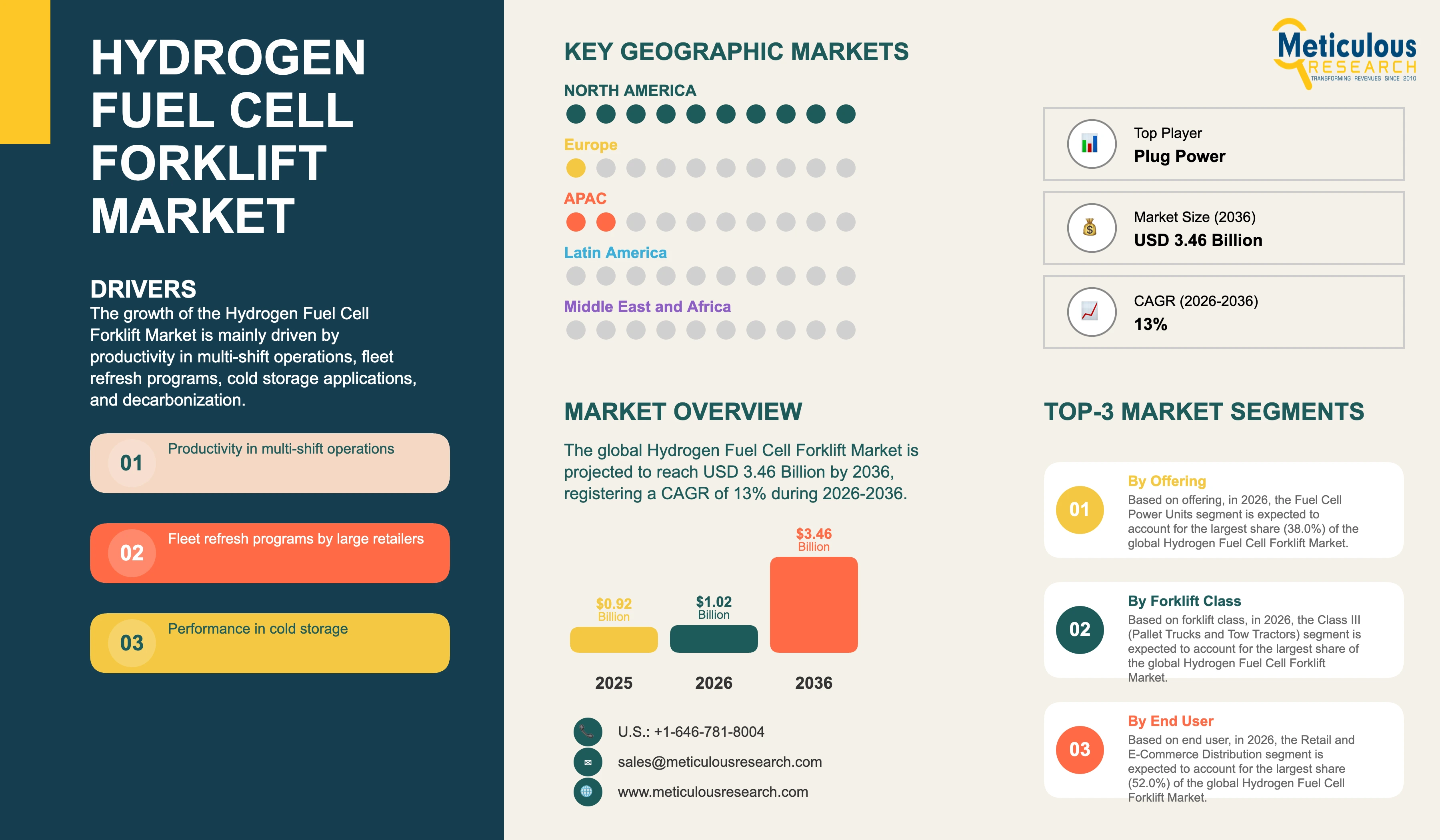
The global hydrogen fuel cell forklift market was valued at USD 0.92 billion in 2025. This market is expected to reach USD 3.46 billion by 2036 from an estimated USD 1.02 billion in 2026, registering a CAGR of 13.0% during the forecast period (2026-2036).
- Published
- Nov 2026
- Pages
- 249
- Format
- PDF + Excel
- Report ID
- MREP - 1042645
- Base year
- 2025
- 2025 · BASELINE
- $920.0M
- 2036
- $3.46B
- CAGR 2026–2036
- 13.0%
2025 baseline · 2026–2036 forecast at 13.0% CAGR · hover a bar for the value
Key highlights
According to the Fuel Cell & Hydrogen Energy Association (FCHEA) in February 2026, Plug Power, the market leader, has deployed more than 60,000 fuel cell systems and over 180 hydrogen fueling stations worldwide, and major operators such as Amazon and Walmart rely on tens of thousands of fuel cell units in their logistics operations.
Plug Power deployed 1, 666 GenDrive fuel cell units in the second quarter of 2026, up 125% year over year, and said that two of its largest material handling customers plan to refresh more than 20,000 GenDrive units over the next three years. Its hydrogen fuel revenue rose about 15% year over year to about USD 39 million in the quarter, while fuel gross margin improved to about negative 48% from about negative 91%, according to ChemXplore.
In China, Hangcha Group completed a batch delivery of 108 units of its 3.5-ton hydrogen fuel cell forklifts in November 2025, which Forkliftaction News reported as the largest single delivery of hydrogen-powered forklifts in China.
Fuel cells are expanding beyond warehouse forklifts into heavy-duty container handling equipment at ports. A Hyster top-pick container handler with two Nuvera fuel cell engines was deployed at the Port of Los Angeles, according to FCHEA, and in September 2026, Hyster delivered the U.K.'s first hydrogen fuel cell-powered reachstacker to the Port of Tilbury.
Toyota Material Handling and STEF collaborated in April 2025 to supply fuel cell forklifts to STEF's cold storage centers in France and Spain, and Toyota Industries has installed its H2Plaza facility, which fuels fuel cell forklifts with hydrogen produced from solar electricity, at its Takahama Plant in Japan. Linde Material Handling has also introduced the first Linde Roadster with fuel cell drive, reflecting the growing availability of factory-integrated fuel cell trucks. Large retailers and logistics companies continue to expand fuel cell fleets at new distribution centers, which supports steady demand for power units and hydrogen supply.
By offering, fuel cell power units account for the largest share of 38.0% in 2026, while hydrogen fuel supply registers the highest CAGR.
By forklift class, class III (pallet trucks and tow tractors) accounts for the largest share in 2026, while heavy-duty and container handlers register the highest CAGR.
By power output, below 5 kW accounts for the largest share in 2026, while above 10 kW registers the highest CAGR.
By end user, retail and e-commerce distribution accounts for the largest share of 52.0% in 2026, while ports and other end users register the highest CAGR.
By geography, North America accounts for the largest share of 74.0% in 2026, while Asia-Pacific registers the highest CAGR of 17.2%.
Report summary
| Particulars | Details |
|---|---|
| Base Year | 2025 |
| Estimated Year | 2026 |
| Forecast Period | 2026-2036 |
| Market Size in 2025 | USD 0.92 billion |
| Market Size in 2026 | USD 1.02 billion |
| Market Size by 2036 | USD 3.46 billion |
| CAGR (2026-2036) | 13.0% |
| Format | PDF, Excel & Cloud Portal · 249 pages |
| Largest Segment by Offering (2026) | Fuel Cell Power Units (38.0%) |
| Largest Segment by End User (2026) | Retail and E-Commerce Distribution (52.0%) |
| Largest Region (2026) | North America (74.0%) |
| Fastest-Growing Region | Asia-Pacific (CAGR 17.2%) |
| Companies Profiled | 12 companies and other companies |
| Segments Covered | Offering, Forklift Class, Power Output, End User, Geography |
| Countries Covered | U.S., Canada, Rest of North America, China, Japan, South Korea, India, Australia, Indonesia, Thailand, Singapore, Malaysia, Vietnam, Philippines, Taiwan, New Zealand, Rest of Asia-Pacific, Germany, France, U.K., Netherlands, Spain, Italy, Sweden, Norway, Denmark, Switzerland, Belgium, Finland, Austria, Poland, Ireland, Rest of Europe, Brazil, Mexico, Chile, Argentina, Colombia, Peru, Rest of Latin America, Saudi Arabia, U.A.E., South Africa, Israel, Turkey, Egypt, Rest of Middle East & Africa |
Report overview
Segments covered: offering, forklift class, power output, end user.
The growth of this market is mainly driven by the productivity advantages of fuel cell forklifts in high-throughput, multi-shift warehouse and distribution operations, fleet conversions and refresh programs by large retailers and e-commerce companies, the superior performance of fuel cells in cold storage environments, corporate decarbonization targets and restrictions on internal combustion forklifts, government support for hydrogen and fuel cells in North America, Asia-Pacific, and Europe, and the expansion of fuel cell solutions to heavy-duty and port handling equipment. However, factors such as the high cost of hydrogen and fueling infrastructure, competition from lithium-ion battery forklifts, the limited availability of low-cost hydrogen supply in many regions, and the high upfront investment required for fleet conversions are expected to restrain the growth of this market to some extent.
Hydrogen fuel cell forklifts are electric lift trucks and other material handling vehicles powered by hydrogen fuel cells instead of lead-acid or lithium-ion batteries or internal combustion engines. A fuel cell power unit, typically based on proton exchange membrane technology, combines hydrogen with oxygen from the air to produce electricity, with water and heat as the only byproducts. The power unit usually includes a small battery or ultracapacitor to handle peak loads and is designed as a drop-in replacement for the battery compartment of an electric forklift, although manufacturers are increasingly offering factory-integrated fuel cell trucks. Fuel cell forklifts can be refueled in a few minutes at indoor or outdoor hydrogen dispensers, which allows them to operate continuously across multiple shifts without battery changes or long charging times.
This report covers the hydrogen fuel cell forklift market, including fuel cell power units for forklifts and other material handling equipment, hydrogen fuel supplied to forklift fleets, hydrogen fueling infrastructure such as storage, compression, and dispensers at customer sites, and maintenance and other services. The market is analyzed by offering, forklift class, power output, end user, and geography. Sales of the forklift chassis and other material handling equipment, battery-electric and internal combustion forklifts, and fuel cells for road vehicles are analyzed in separate reports. The market is measured on a revenue basis.
Fuel cell forklifts were among the first commercially successful applications of hydrogen fuel cells, particularly in North America. Large distribution centers operated by retailers, grocers, and e-commerce companies adopted fuel cells because they eliminate battery changing and charging rooms, maintain constant power throughout a shift, and can be refueled in a few minutes, which increases forklift availability and labor productivity in high-throughput, multi-shift operations. According to FCHEA, major operators such as Amazon and Walmart rely on tens of thousands of fuel cell units, and Plug Power has deployed more than 60,000 fuel cell systems and over 180 hydrogen fueling stations worldwide.
The market is closely linked to the cost and availability of hydrogen. Plug Power, which supplies fuel cells, hydrogen fuel, fueling infrastructure, and service under integrated agreements, has faced high hydrogen costs and negative margins on fuel, although it reported improving fuel margins in 2026 as it increased production efficiency and plant utilization. The economics of fuel cell forklifts depend on the price of delivered hydrogen, the utilization of the fleet, and the cost of labor and space saved by eliminating battery operations.
Lithium-ion battery forklifts have become a strong competitor in recent years, since they offer opportunity charging, longer battery life, and lower maintenance than lead-acid batteries. As a result, fuel cells are increasingly focused on applications where their advantages are greatest, such as large, high-throughput distribution centers operating around the clock, cold storage facilities where batteries lose performance, and heavy-duty applications where batteries are large and charging times are long.
Outside North America, the market for fuel cell forklifts is growing steadily in Asia-Pacific and Europe. China is developing hydrogen forklifts through manufacturers such as Hangcha and Heli, supported by national and local hydrogen policies, and Hangcha completed the largest single delivery of hydrogen forklifts in China in November 2025. Japan, through Toyota Industries, and South Korea are also deploying fuel cell forklifts. In Europe, companies such as BMW, STEF, and others are using fuel cell forklifts and tugger trains, and manufacturers such as Linde Material Handling, STILL, Toyota Material Handling, and Jungheinrich offer fuel cell trucks.
Fuel cell power units account for the largest share of the market by offering, while hydrogen fuel supply is the fastest-growing offering, supported by the growing installed base of fuel cell forklifts. Class III pallet trucks and tow tractors account for the largest share by forklift class, while heavy-duty forklifts and container handlers are the fastest-growing class. Retail and e-commerce distribution is the largest end user. North America accounts for the largest share of the market, while Asia-Pacific is the fastest-growing region.
Over the forecast period, the hydrogen fuel cell forklift market is expected to grow steadily, supported by fleet refresh programs, cold storage and heavy-duty applications, decarbonization, and expansion in Asia-Pacific and Europe. At the same time, the market's growth will depend on reducing the cost of hydrogen, competing effectively with lithium-ion batteries, and building fueling infrastructure in new regions.
North America is expected to account for the largest share of 74.0% of the market in 2026, mainly due to the large installed base of fuel cell forklifts at retailers and e-commerce companies, Plug Power's leading position, fleet refresh programs, and federal incentives.
Asia-Pacific is projected to register the highest CAGR of 17.2% during the forecast period, driven by China's hydrogen policies and forklift manufacturers, Japan's hydrogen strategy and Toyota Industries, and South Korea's hydrogen economy policies.
The report profiles 12 companies, including Plug Power, Toyota Industries, KION Group, Hyster-Yale, Jungheinrich, Mitsubishi Logisnext, Crown Equipment, Hangcha Group, Anhui Heli, Air Products, Linde plc, and Air Liquide.
Fuel cell forklifts offer faster refueling, constant power, and better cold-temperature performance, which favors them in large multi-shift, cold storage, and heavy-duty operations, while lithium-ion forklifts avoid the need for hydrogen supply and fueling infrastructure and are often lower cost for smaller fleets.
Report infographic
Market dynamics
18 factors across 5 forcesProductivity advantages in high-throughput multi-shift operations
Productivity is the main reason that large distribution and manufacturing companies adopt fuel cell forklifts. In large distribution centers operating two or three shifts per day, lead-acid battery forklifts require battery changes during each shift, which take time, require dedicated battery rooms, and can involve heavy lifting equipment and safety risks. Battery performance also declines as charge is depleted, which slows forklift speed and lifting toward the end of a shift. Fuel cell forklifts can be refueled in a few minutes by the operator and maintain constant power throughout the shift, which increases the time forklifts are available for work and improves operator productivity.
Eliminating battery rooms also frees valuable warehouse space for storage or operations, and reduces the labor and equipment needed to manage batteries. For large operations with hundreds of forklifts, these benefits can be substantial, which is why large retailers, grocers, and e-commerce companies have been the main adopters of fuel cell forklifts.
Productivity benefits are greatest in facilities with high utilization and continuous operations, which is why the largest deployments are concentrated in high-volume distribution centers operating around the clock.
Fleet conversions and refresh programs by large retailers
Large retailers and e-commerce companies with existing fuel cell fleets are a major source of ongoing demand, since fuel cell power units must be refreshed or replaced after several years of operation, and fleets expand as companies open new distribution centers. Plug Power said in 2026 that two of its largest material handling customers plan to refresh more than 20,000 GenDrive units over the next three years, which illustrates the scale of replacement demand from the installed base. Plug deployed 1,666 GenDrive units in the second quarter of 2026, up 125% year over year.
New distribution centers and fleet expansions by companies that already use fuel cells are also important, since these companies have experience with hydrogen operations and can deploy fuel cells quickly at new sites. Multi-site agreements covering fuel cells, hydrogen, fueling infrastructure, and service simplify adoption for large customers.
Superior performance in cold storage environments
Cold storage and freezer facilities are a strong application for fuel cell forklifts, since battery performance and life decline significantly in cold temperatures, and charging batteries in cold environments is difficult. Fuel cells generate heat as they operate and are not adversely affected by cold temperatures, which allows forklifts to maintain consistent performance in freezers and coolers. Air Products has noted that, unlike battery-powered forklifts, hydrogen-powered fuel cells are not adversely affected by temperature when operating in coolers, freezers, or arid warehouse conditions.
The growth of cold chain logistics for groceries, meal kits, pharmaceuticals, and other temperature-sensitive goods is increasing demand for cold storage capacity, which supports demand for fuel cell forklifts. Toyota Material Handling's collaboration with STEF to supply fuel cell forklifts to cold storage centers in France and Spain illustrates this trend in Europe.
Decarbonization targets and restrictions on combustion forklifts
Companies are setting targets to reduce greenhouse gas emissions from their operations, including emissions from forklifts powered by propane, diesel, and gasoline engines. Fuel cell forklifts produce no emissions at the point of use, and when powered by low-carbon hydrogen, they can significantly reduce lifecycle emissions. Regulations restricting internal combustion forklifts, such as California's rules for zero-emission forklifts, and indoor air quality requirements also encourage the shift to electric and fuel cell forklifts.
For operations that currently use internal combustion forklifts because they need fast refueling and high power, fuel cells offer a zero-emission alternative that maintains these advantages, which makes them attractive for heavy-duty and outdoor applications. As companies seek to decarbonize their logistics operations, fuel cell forklifts are expected to benefit alongside battery-electric alternatives.
Government support for hydrogen and fuel cells
Government programs supporting hydrogen production and fuel cells are helping to reduce the cost of fuel cell forklifts and hydrogen supply. In the U.S., federal tax credits for fuel cell equipment and clean hydrogen production and Department of Energy programs have supported deployments, and the Department of Energy has worked with companies such as BMW to deploy fuel cell forklifts and tuggers at manufacturing plants. In China, national and provincial hydrogen policies support the development of hydrogen forklifts as part of broader hydrogen industry development.
In Europe and Japan, hydrogen strategies and funding programs support fuel cell applications in logistics and industry, including forklifts and other material handling equipment. These programs reduce costs and encourage early adoption in new markets.
Table of contents
12 chapters · 166 sections · 249 pages · click to expandSegmental analysis
| Segment | Largest share (2026) | Fastest growth (2026–2036) |
|---|---|---|
| By Offering | Below 5 kW | Above 10 kW |
By Offering
- The below 5 kW segment is expected to account for the largest share of the hydrogen fuel cell forklift market, while the above 10 kW segment is projected to register the highest CAGR during the forecast period.
- The retail and e-commerce distribution segment is expected to account for the largest share of 52.0% of the hydrogen fuel cell forklift market, while the ports and other end users segment is projected to register the highest CAGR during the forecast period.
Geographic analysis
North America
Largest shareIn 2026, North America is expected to account for the largest share of 74.0% of the global hydrogen fuel cell forklift market. The large share of this region is mainly due to the large installed base of fuel cell forklifts in the U.S., early and large-scale adoption by retailers, grocers, and e-commerce companies such as Walmart and Amazon, the leading position of Plug Power, which has deployed more than 60,000 fuel cell systems and over 180 fueling stations worldwide, ongoing fleet refresh programs, and federal tax incentives for fuel cells and clean hydrogen. Automotive manufacturers such as BMW and Mercedes-Benz also use fuel cell forklifts at their U.S. plants, and ports in California are deploying fuel cell container handling equipment. Canada also has deployments in distribution and manufacturing.
Asia-Pacific
Fastest growthAsia-Pacific is projected to register the highest CAGR of 17.2% during the forecast period. The rapid growth of this region is mainly driven by China's national and provincial hydrogen policies and the development of hydrogen forklifts by manufacturers such as Hangcha and Heli, Hangcha's delivery of 108 hydrogen forklifts in November 2025, the largest single delivery in China, Japan's national hydrogen strategy and Toyota Industries' development of fuel cell forklifts and on-site renewable hydrogen, and South Korea's hydrogen economy policies. Growing logistics and manufacturing activity in the region also supports demand.
Europe
Europe accounts for a significant share of the market, supported by fuel cell forklift deployments at automotive plants such as BMW, cold storage operators such as STEF in France and Spain, and logistics centers, as well as fuel cell products from Linde Material Handling, STILL, Toyota Material Handling, and Jungheinrich and the first fuel cell reachstacker at a U.K. port. Germany, France, the U.K., the Netherlands, and the Nordic countries are the main markets.
Latin America
Latin America and the Middle East & Africa account for the smallest shares of the market, with early projects in Brazil, where Plug Power has partnered to deploy hydrogen logistics hubs, and in the Middle East. Regional differences in hydrogen prices, policy support, and the scale of distribution operations shape adoption across the world. Regions with growing hydrogen supply and large logistics operations are expected to see the strongest growth. The availability of competitively priced hydrogen near major logistics hubs will be a key factor in regional adoption. Government funding for hydrogen hubs is expected to support this. Green hydrogen projects planned in Chile, Saudi Arabia, and the U.A.E. could eventually provide local hydrogen supply for material handling. In the near term, adoption in these regions is expected to be limited to pilot projects and multinational companies that replicate their North American or European warehouse models.
Competitive landscape
The global hydrogen fuel cell forklift market is moderately consolidated, with the top five players estimated to account for about 70% of the market in 2025, led by Plug Power. The market includes fuel cell power unit suppliers, forklift manufacturers offering factory-integrated fuel cell trucks, industrial gas companies supplying hydrogen and fueling infrastructure, and service providers.
Plug Power is the market leader, offering GenDrive fuel cell power units, GenFuel hydrogen and fueling infrastructure, and GenCare service under integrated solutions, with a large installed base among retailers, grocers, and e-commerce companies. Toyota Industries, through Toyota Material Handling, develops fuel cell forklifts and on-site renewable hydrogen solutions. KION Group, through Linde Material Handling and STILL, offers fuel cell trucks in Europe, while Hyster-Yale, through Nuvera, supplies fuel cell engines for heavy-duty forklifts and container handlers. Jungheinrich, Mitsubishi Logisnext, and Crown Equipment offer fuel cell-ready trucks, and Chinese manufacturers Hangcha and Anhui Heli are scaling up hydrogen forklift production. Industrial gas companies such as Air Products, Linde plc, and Air Liquide supply hydrogen and fueling equipment.
Companies in this market compete on fuel cell reliability and performance, total cost of ownership, hydrogen supply cost and reliability, fueling infrastructure, service networks, and integration with forklift fleets. Key strategies include integrated solutions combining fuel cells, hydrogen, and service, fleet refresh agreements, factory-integrated fuel cell trucks, expansion into heavy-duty and port equipment, on-site hydrogen production, and expansion in Asia-Pacific and Europe.
Plug Power's large installed base and integrated offering give it a strong position in North America, but forklift manufacturers and industrial gas companies are increasingly competing with integrated trucks and hydrogen supply. We expect forklift manufacturers to play a larger role as factory-integrated fuel cell trucks gain acceptance, and Chinese manufacturers to become important competitors in Asia-Pacific. Hydrogen supply cost and reliability will remain the most important competitive factors, and partnerships between fuel cell suppliers, forklift manufacturers, and hydrogen producers are likely to increase. Service capability will also become more important as installed fleets grow. Customers will increasingly evaluate suppliers on uptime guarantees and the speed of on-site service.
Some of the key players operating in the hydrogen fuel cell forklift market are Plug Power Inc., Toyota Industries Corporation, KION Group AG (Linde Material Handling and STILL), Hyster-Yale, Inc. (Nuvera Fuel Cells), Jungheinrich AG, Mitsubishi Logisnext Co., Ltd., Crown Equipment Corporation, Hangcha Group Co., Ltd., Anhui Heli Co., Ltd., Air Products and Chemicals, Inc., Linde plc, and Air Liquide S.A., among others.
- —
Plug Power deployed 1,666 GenDrive units in the second quarter of 2026 and reported refresh plans for more than 20,000 units, Hyster delivered the U.K.'s first fuel cell reachstacker in September 2026, and Hangcha completed China's largest single delivery of 108 hydrogen forklifts in November 2025.
- Plug Power Inc.
- Toyota Industries Corporation
- Hyster-Yale, Inc. (Nuvera Fuel Cells)
- Jungheinrich AG
- Mitsubishi Logisnext Co., Ltd.
- Crown Equipment Corporation
- Hangcha Group Co., Ltd.
- Anhui Heli Co., Ltd.
- Air Products and Chemicals, Inc.
- Linde plc
- Air Liquide S.A.
Expert perspectives
Hydrogen fuel cell forklifts are one of the most commercially established applications of fuel cells, with a large installed base in North America and growing adoption in Asia-Pacific and Europe. Their value lies in productivity for high-throughput, multi-shift operations, performance in cold storage, and zero-emission heavy-duty operation.
Over the forecast period, the market is expected to grow at a CAGR of 13.0%, from USD 1.02 billion in 2026 to USD 3.46 billion in 2036. Growth will be supported by fleet refresh programs, cold storage and heavy-duty applications, decarbonization, government support, and expansion in Asia-Pacific and Europe.
Among the market segments, fuel cell power units are the largest offering, while hydrogen fuel supply grows fastest. Class III pallet trucks and tow tractors are the largest forklift class, while heavy-duty forklifts and container handlers grow fastest, below 5 kW is the largest power output, while above 10 kW grows fastest, and retail and e-commerce distribution is the largest end user, while ports and other end users grow fastest. North America is the largest region, and Asia-Pacific is the fastest-growing region at a CAGR of 17.2%.
In our view, the most important factor for the market over the forecast period will be the cost of delivered hydrogen. Fuel cell forklifts already offer clear productivity benefits in large multi-shift operations, but high hydrogen costs have limited their adoption and affected supplier profitability. As clean hydrogen production capacity expands, on-site electrolysis becomes more economical, and supply networks become more resilient, fuel cells will become more competitive with lithium-ion batteries.
We also expect the market to diversify beyond its traditional base of large North American retailers. Heavy-duty and port equipment, cold storage, automotive manufacturing, and logistics in Asia-Pacific and Europe will account for a growing share of demand. Forklift manufacturers offering factory-integrated fuel cell trucks will play a larger role, which will reduce dependence on a single supplier and improve customer confidence. Industrial gas companies are also likely to take a larger role in supplying hydrogen to forklift fleets. This should improve supply reliability for customers.
Competition from lithium-ion batteries will remain intense, and fuel cells will increasingly focus on applications where their advantages are greatest. Overall, we believe the hydrogen fuel cell forklift market will grow steadily over the forecast period, with value shifting gradually toward hydrogen supply and services as the installed base expands, and with heavy-duty and Asia-Pacific applications providing the fastest growth. Suppliers that can offer reliable hydrogen at stable prices will be best placed to convert this potential into long-term contracts. Partnerships with hydrogen producers will be critical.
Customer perspectives
Buyers of hydrogen fuel cell forklifts include large retailers, grocers, and e-commerce companies, third-party logistics providers, automotive and manufacturing companies, cold storage operators, food and beverage companies, and port and terminal operators. Their purchase decisions depend mainly on productivity and fleet availability, total cost of ownership, hydrogen price and supply reliability, fueling infrastructure requirements, cold-temperature performance, emissions reduction, and supplier service and financial stability. Many customers evaluate fuel cell forklifts against the latest lithium-ion battery forklifts, comparing total cost of ownership, uptime, space requirements, and hydrogen supply reliability, and they often run pilot projects before committing to large fleets.
Director of Distribution Operations - National retailer, U.S.
Our distribution centers run around the clock, so refueling in a few minutes instead of changing batteries keeps our pallet trucks working. Our biggest concern is the price and reliability of hydrogen supply.
This comment explains why North America accounts for 74.0% of the market, why Class III vehicles are the leading forklift class, why retail and e-commerce distribution accounts for 52.0% of the market, and why hydrogen supply cost is a key factor in purchase decisions.
This comment explains why cold storage is an important application and why Europe is adopting fuel cell forklifts in temperature-controlled logistics.
This comment explains why heavy-duty forklifts and container handlers are the fastest-growing forklift class and why fuel cell power units account for 38.0% of the market.
“Batteries lose performance in our freezers, while fuel cells keep running at full power through the shift. That made the business case for hydrogen in our cold stores.”
“Our heavy equipment works long hours, and batteries large enough for it take too long to charge. Fuel cells give us zero emissions without losing productivity.”
Frequently asked questions
The global hydrogen fuel cell forklift market was valued at USD 0.92 billion in 2025, up from USD 0.86 billion in 2024, and is estimated at USD 1.02 billion in 2026. The market includes fuel cell power units, hydrogen fuel supply, hydrogen fueling infrastructure, and maintenance and other services for forklifts and other material handling equipment.
Cite this report
Meticulous Research. (2026). Hydrogen Fuel Cell Forklift Market - Global Opportunity Analysis and Industry Forecast (2026-2036) (Report No. MREP - 1042645). Meticulous Market Research Pvt. Ltd. https://www.meticulousresearch.com/product/hydrogen-fuel-cell-forklift-market-7328