Solar Trackers Market (2026-2036)
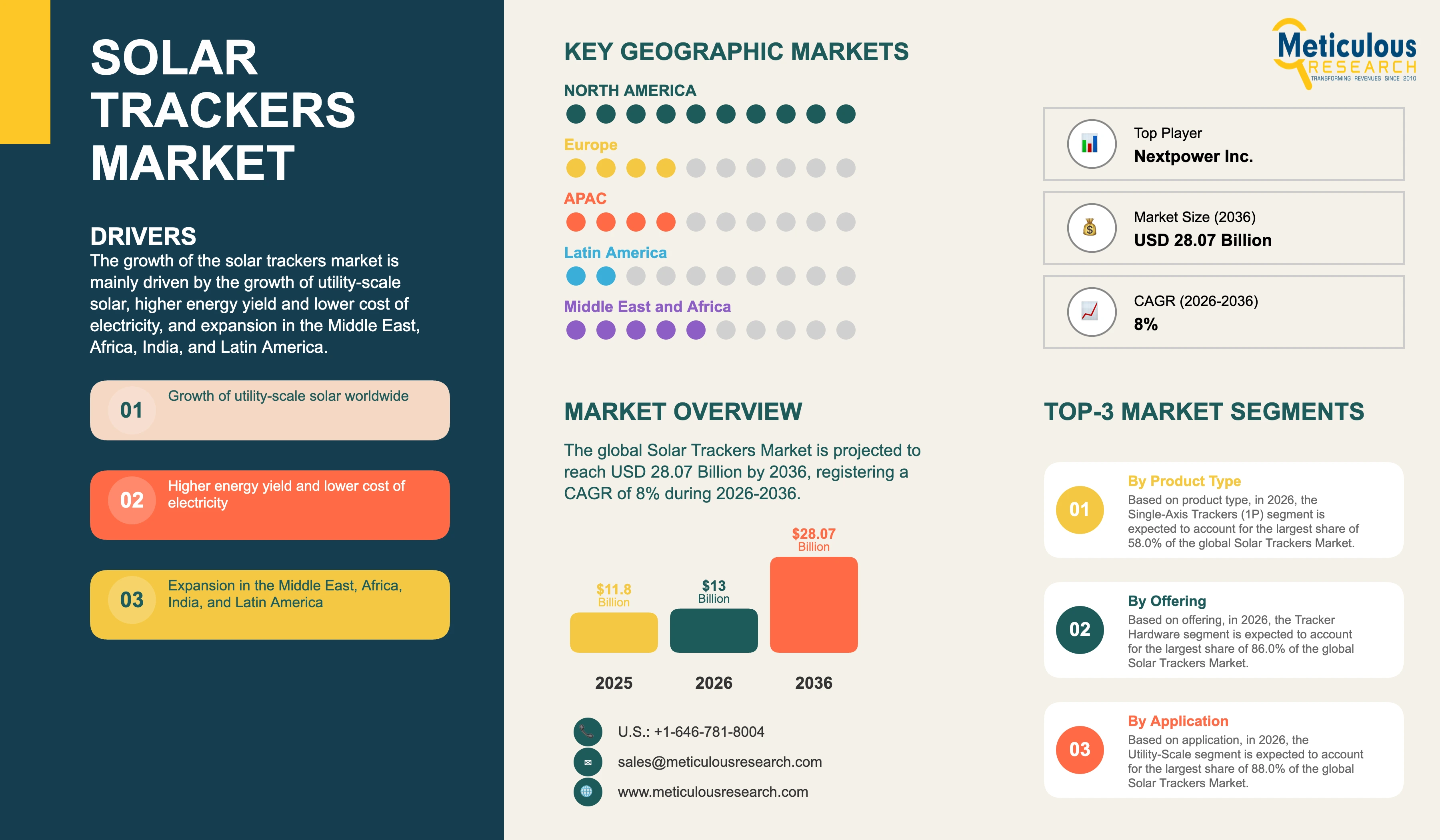
The global solar trackers market was valued at USD 11.80 billion in 2025. This market is expected to reach USD 28.07 billion by 2036 from an estimated USD 13.00 billion in 2026, registering a CAGR of 8.0% during the forecast period (2026-2036).
- Published
- Nov 2026
- Pages
- 250
- Format
- PDF + Excel
- Report ID
- MREP - 1042528
- Base year
- 2025
- 2025 · BASELINE
- $11.80B
- 2036
- $28.07B
- CAGR 2026–2036
- 8.0%
2025 baseline · 2026–2036 forecast at 8.0% CAGR · hover a bar for the value
Key highlights
Wood Mackenzie reported that global solar tracker shipments grew 19% in 2025 to a record of more than 134 GWdc, up from 111 GWdc in 2024, and that Nextpower, formerly Nextracker, held the top global position for the eleventh consecutive year with nearly 40 GWdc of shipments, or about 30% of the global market.
According to Wood Mackenzie, U.S. tracker demand rebounded by more than 25% in 2025 to exceed 40 GWdc of shipments for the first time, with Nextpower's U.S. market share rising above 50%, and Nextpower, Array Technologies, and GameChange Solar together accounting for nearly 90% of the U.S. market.
Wood Mackenzie also reported that Africa was the fastest-growing region for tracker demand in 2025, that Saudi Arabia surpassed Spain to become the third-largest tracker market, and that Europe reached a record 25 GWdc of tracker shipments, with Axial capturing the highest share in Europe helped by agrivoltaic trackers in Italy.
The International Energy Agency reported that more than 600 GW of solar PV capacity was added worldwide in 2025, making solar the largest single contributor to global energy supply growth, and Wood Mackenzie's figures indicate that trackers were used for roughly one-fifth of global solar installations, mostly in utility-scale projects outside China.
GameChange Solar, Arctech Solar, Array Technologies, and PV Hardware completed the global top five tracker suppliers in 2025, the same group as in the previous two years, according to Wood Mackenzie, while Nextpower filed a patent lawsuit against GameChange over tracker technology, showing intense competition among leading suppliers.
Wood Mackenzie found that India and Saudi Arabia together generated more tracker demand than all of Europe in 2024, and that Arctech Solar, the largest Chinese tracker supplier, gained significant share through projects in those countries, showing how tracker demand is shifting toward fast-growing emerging markets in Asia and the Middle East.
By product type, single-axis trackers (1P) account for the largest share of 58.0% in 2026, while single-axis trackers (2P) register the highest CAGR.
By offering, tracker hardware accounts for the largest share in 2026, while control systems and software register the highest CAGR.
By application, utility-scale projects account for the largest share of 88.0% in 2026, while agrivoltaic projects register the highest CAGR.
By geography, North America accounts for the largest share of 38.0% in 2026, while the Middle East and Africa registers the highest CAGR of 10.8%.
Report summary
| Particulars | Details |
|---|---|
| Base Year | 2025 |
| Estimated Year | 2026 |
| Forecast Period | 2026-2036 |
| Market Size in 2025 | USD 11.80 billion |
| Market Size in 2026 | USD 13.00 billion |
| Market Size by 2036 | USD 28.07 billion |
| CAGR (2026-2036) | 8.0% |
| Format | PDF, Excel & Cloud Portal · 250 pages |
| Largest Segment by Product Type (2026) | Single-Axis Trackers (1P) (58.0%) |
| Largest Segment by Application (2026) | Utility-Scale (88.0%) |
| Largest Region (2026) | North America (38.0%) |
| Fastest-Growing Region | Middle East and Africa (CAGR 10.8%) |
| Segments Covered | Product Type, Offering, Application, and Geography |
| Geographic Scope | North America, Middle East and Africa, Europe, Asia-Pacific, and Latin America |
| Key Companies Profiled | Nextpower, GameChange Solar, Arctech Solar, Array Technologies, PV Hardware, Soltec, Trina Tracker, FTC Solar, Axial, and Ideematec |
Report overview
Segments covered: product type, offering, application.
The growth of this market is mainly driven by the continued expansion of utility-scale solar worldwide, the higher energy yield and lower levelized cost of electricity that single-axis trackers provide compared with fixed-tilt systems, the rapid growth of large solar projects in the Middle East, Africa, India, and Latin America, the use of bifacial modules, which gain additional energy on trackers, advances in tracker control software, such as backtracking and terrain-following algorithms, domestic manufacturing incentives in the U.S., and the growing use of trackers in agrivoltaic and solar-plus-storage projects. However, factors such as pricing pressure from Chinese suppliers, changes in U.S. tax credit policy for solar projects, grid connection and permitting delays, higher upfront and maintenance costs compared with fixed-tilt systems, and project risks in high-wind, snow, and hail regions are expected to restrain the growth of this market to some extent.
Solar trackers are mounting systems that move solar modules to follow the sun across the sky, increasing the amount of sunlight the modules receive and therefore the electricity they produce. Single-axis trackers rotate modules around one axis, usually aligned north to south, so that modules face east in the morning and west in the afternoon, while dual-axis trackers move modules on two axes to follow the sun's daily and seasonal movement. Single-axis trackers can increase energy output by about 15% to 25% compared with fixed-tilt systems, depending on location, and they have become the standard mounting system for utility-scale solar projects in many regions outside China.
This market covers the global revenue from solar tracker systems, including tracker hardware such as torque tubes, posts, bearings, drives, motors, and structural components, control systems and software, such as tracker controllers, sensors, weather monitoring, and optimization algorithms, and services such as engineering, installation support, commissioning, and operation and maintenance. It is segmented by product type, offering, application, and geography. Fixed-tilt mounting structures, solar modules, inverters, and other balance of system components are not included.
Single-axis trackers are available in two main configurations, which suit different module sizes, soils, and wind conditions. One-in-portrait (1P) trackers hold one row of modules in portrait orientation on each torque tube and are the most common design in the U.S. and many other markets. Two-in-portrait (2P) trackers hold two rows of modules and can reduce the number of posts and foundations per megawatt, which is valuable on difficult soils and is popular in Europe, Latin America, the Middle East, and other regions. Dual-axis trackers are used mainly for concentrated photovoltaics, small installations, and specialized applications, and they represent a small share of the market.
The tracker market has grown rapidly with utility-scale solar, and its regional mix has broadened considerably in recent years. Wood Mackenzie reported that global tracker shipments reached more than 134 GWdc in 2025, a 19% increase from 2024, and that the U.S. remained the largest market with more than 40 GWdc of shipments. India, Saudi Arabia, Spain, Australia, Brazil, Chile, and South Africa are other important markets, and Africa was the fastest-growing region in 2025. Trackers are less common in China, where most utility-scale projects use fixed-tilt systems because of lower costs and land and grid conditions, although tracker adoption in China is increasing.
Technology improvements have made trackers more reliable and cost-effective, which has expanded their use into harsher climates and more difficult sites. Suppliers have developed designs that handle high winds, snow, and hail, with stow strategies that move modules to safe positions during storms. Terrain-following trackers reduce the need for land grading, and software algorithms such as backtracking, which avoids shading between rows, and diffuse light optimization increase energy output. The rise of bifacial modules, which capture light reflected from the ground, has increased the energy gain from trackers. Trackers also support integrated solar-plus-storage projects and agrivoltaic designs.
Trackers also require more maintenance than fixed-tilt systems because they have moving parts, motors, and control electronics, but improvements in drive design, self-powered controllers, and wireless communications have reduced failure rates and maintenance needs. Suppliers increasingly offer long-term service agreements and performance guarantees, which help project owners manage risks and give suppliers recurring revenue.
U.S. policy has strongly influenced the market, both by supporting domestic manufacturing and by changing project economics. The Inflation Reduction Act introduced manufacturing tax credits for tracker components such as torque tubes and structural fasteners, which encouraged domestic production by Nextpower, Array, GameChange, and their suppliers. However, the 2025 U.S. tax law accelerated the phase-out of investment and production tax credits for new solar projects, which creates uncertainty for demand later in the decade, even as developers rush to start construction before deadlines.
The market is relatively concentrated, with a few large suppliers holding most of the market. Leading companies include Nextpower (formerly Nextracker), GameChange Solar, Arctech Solar, Array Technologies, PV Hardware, Soltec, Trina Tracker, FTC Solar, Axial, and Ideematec.
Over the forecast period, the solar trackers market is expected to grow steadily, as utility-scale solar continues to expand worldwide and trackers gain share in new markets. North America is expected to remain the largest market, while the Middle East and Africa is expected to grow fastest at a CAGR of 10.8%.
Our gigawatt-scale projects need trackers that handle sand, dust, and extreme heat, with local manufacturing to meet content rules and fast delivery to keep construction on schedule.
This explains why the Middle East and Africa is the fastest-growing region and why 2P trackers and local manufacturing are gaining importance.
We use tracker software to protect our plants from hail and to reduce output when prices turn negative, so software quality and cybersecurity now matter as much as the steel structure itself.
This explains why control systems and software form the fastest-growing offering in this market.
Report infographic
Market dynamics
16 factors across 5 forcesGrowth of utility-scale solar worldwide
Utility-scale solar has become one of the cheapest sources of new electricity in many countries, and governments and utilities are adding large amounts of solar capacity to meet growing demand and climate targets. The International Energy Agency reported that more than 600 GW of solar PV was added globally in 2025, with record installations in China, the EU, and India, and the U.S. also installed large amounts of utility-scale solar. Rising electricity demand from data centers, electrification, and industry is supporting further growth.
Most utility-scale solar projects outside China now use single-axis trackers because they increase energy output and improve project economics. As utility-scale solar grows in the U.S., India, the Middle East, Africa, Latin America, Europe, and Australia, demand for trackers grows with it. Utility-scale projects account for the largest share of the market by application, and North America accounts for the largest share by region.
Utility-scale solar is also increasingly paired with battery storage, which allows solar output to be shifted into evening hours. Tracker-based projects, which already produce more energy in the morning and late afternoon, fit well with storage and can improve the economics of hybrid projects. Large corporate buyers, including technology companies that need clean power for data centers, are signing long-term power purchase agreements for tracker-based solar projects, which supports project pipelines in the U.S., Europe, and other regions. As solar penetration increases and midday power prices fall in some markets, the ability of trackers to produce more energy outside midday hours is becoming even more valuable.
Higher energy yield and lower cost of electricity
Single-axis trackers increase the energy output of solar projects compared with fixed-tilt systems, typically by around 15% to 25% depending on latitude and climate, and they produce more energy in the morning and late afternoon, when electricity prices are often higher. Although trackers cost more than fixed-tilt structures, the additional energy usually reduces the levelized cost of electricity and increases project revenues. As module prices have fallen, the cost of trackers has become a smaller share of total project costs relative to the energy they add, which has further improved their economics.
The combination of trackers and bifacial modules is particularly attractive, since bifacial modules capture reflected light from the ground and trackers keep both sides well exposed. This combination has become the standard design for many large projects, and it supports strong demand for both 1P and 2P single-axis trackers.
Tracker suppliers have also reduced the cost of their systems through design improvements, such as longer rows, fewer posts per megawatt, lighter structures, and faster installation methods, and through higher manufacturing volumes. Lower installation labor requirements are particularly valuable in markets with high labor costs, such as the U.S. and Australia. These cost reductions have narrowed the price gap with fixed-tilt systems and have allowed trackers to compete in more markets, including higher-latitude regions in Europe and Canada where the energy gain from tracking is smaller.
Expansion in the Middle East, Africa, India, and Latin America
Large solar programs in Saudi Arabia, the UAE, Oman, Egypt, Morocco, South Africa, India, Brazil, Chile, and Mexico are creating new demand for trackers. These regions have high solar resources and large, flat sites that are well suited to trackers, and many projects are very large, often several hundred megawatts to several gigawatts. Wood Mackenzie reported that Saudi Arabia became the third-largest tracker market in 2025 and that Africa was the fastest-growing region for tracker demand.
Tracker suppliers such as GameChange Solar, Arctech Solar, Nextpower, Array, PV Hardware, and Soltec have expanded sales, manufacturing, and service operations in these regions, often working with local partners and steel suppliers. The Middle East and Africa is the fastest-growing region in this market.
India is also a major growth market, as government tenders, corporate power purchase agreements, and hybrid wind-solar projects increasingly specify trackers to increase energy output. In Latin America, Brazil and Chile continue to develop large tracker-based projects, and Mexico and Colombia offer further potential. Many of these markets are price-sensitive, which favors suppliers with competitive costs and local supply chains.
Advances in tracker software and design
Tracker suppliers are improving their products with smarter control software, better stow strategies for wind, snow, and hail, terrain-following designs, and sensors that monitor performance and weather. Software features such as backtracking, diffuse light optimization, and row-by-row control increase energy output and reduce risks, and some suppliers offer software that coordinates trackers with storage and grid needs. These advances increase the value of trackers and create recurring revenue from software and services. Control systems and software form the fastest-growing offering in this market. Machine learning and digital twin models are also being used to predict tracker performance and identify problems early.
Table of contents
11 chapters · 108 sections · 250 pages · click to expandGeographic analysis
North America
Largest shareIn 2026, North America is expected to account for the largest share of 38.0% of the global solar trackers market. The large share of this region is mainly due to the very large U.S. utility-scale solar market, the near-universal use of single-axis trackers in U.S. utility-scale projects, higher revenue per watt than in many international markets, domestic manufacturing supported by tax credits, and the presence of leading suppliers such as Nextpower, Array Technologies, GameChange Solar, and FTC Solar. Wood Mackenzie reported that U.S. tracker shipments rebounded by more than 25% in 2025 to more than 40 GWdc, a new record, and that Nextpower, Array, and GameChange together held nearly 90% of the U.S. market. Developers are accelerating projects to qualify for federal tax credits before they phase out, while growing electricity demand from data centers and industry supports long-term demand. Canada and Mexico add smaller volumes to the regional market, with Canadian projects in Alberta and Mexican projects in the north of the country using trackers. North America is expected to remain the largest region throughout the forecast period, although its share is expected to decline as other regions grow faster.
Middle East & Africa
Fastest growthThe Middle East and Africa is projected to register the highest CAGR of 10.8% during the forecast period. The rapid growth of this region is mainly driven by very large solar programs in Saudi Arabia, which became the third-largest tracker market in 2025 according to Wood Mackenzie, the UAE, Oman, and Egypt, rapid growth in Africa, which was the fastest-growing region for tracker demand in 2025, high solar resources and large flat sites, and the expansion of local manufacturing by tracker suppliers. Countries such as Morocco, South Africa, Egypt, and Kenya are also developing large solar projects, and development finance institutions are supporting many of them, which improves bankability for tracker-based designs.
Europe
Europe reached a record 25 GWdc of tracker shipments in 2025, according to Wood Mackenzie, led by Spain, Italy, and other southern European markets, while Asia-Pacific is driven mainly by large projects in India and Australia, with gradual adoption in China and Southeast Asia, and Latin America is supported by large projects in Brazil and Chile and growing interest in Mexico and Colombia.
Competitive landscape
The solar trackers market is relatively concentrated, with a few large suppliers holding most of the global market. Leading companies include Nextpower (formerly Nextracker), GameChange Solar, Arctech Solar, Array Technologies, PV Hardware, Soltec, Trina Tracker, FTC Solar, Axial, and Ideematec. Nextpower has been the global market leader for eleven consecutive years, according to Wood Mackenzie, with about 30% of global shipments in 2025. GameChange Solar ranked second globally, helped by strong sales in India and Africa, while Arctech Solar remains the largest Chinese tracker supplier and a strong competitor in the Middle East and Asia.
Companies compete mainly on price, reliability, energy yield, wind and hail performance, software features, ease and speed of installation, bankability, local manufacturing, and service. U.S.-based suppliers benefit from strong positions in the high-value U.S. market and domestic manufacturing incentives, while Spanish and Chinese suppliers are strong in Europe, the Middle East, Latin America, and Asia. Bankability, which reflects the confidence of lenders and insurers in a supplier's products and financial strength, is particularly important, since trackers must perform reliably for 30 years or more.
The top five players are estimated to account for 72.0% of the solar trackers market in 2025. This high concentration reflects the importance of bankability, track record, manufacturing scale, and service capabilities in winning large utility-scale projects.
Players use several strategies to grow and defend their market positions globally, including expanding manufacturing in key markets, developing new tracker designs and software, acquiring adjacent businesses such as foundations and eBOS, forming partnerships with developers and EPC companies, and protecting intellectual property. For example, Nextpower rebranded from Nextracker in 2025 and made several acquisitions to broaden its offering, and it filed a patent lawsuit against GameChange over tracker technology, showing the growing importance of intellectual property in the market.
Competition is expected to remain intense throughout the forecast period, especially on price in international markets, and suppliers that combine reliable hardware, advanced software, and local presence are expected to gain share. Smaller suppliers such as FTC Solar, Ideematec, and Axial may focus on niches such as agrivoltaics, difficult terrain, or specific regions, while larger suppliers continue to expand their product offerings through acquisitions.
Some of the key players operating in the solar trackers market are Nextpower Inc. (formerly Nextracker), GameChange Solar, Arctech Solar Holding Co., Ltd., Array Technologies, Inc., PV Hardware, Soltec Power Holdings, S.A., Trina Tracker (Trina Solar Co., Ltd.), FTC Solar, Inc., Axial Structural Solutions, and Ideematec Deutschland GmbH.
- —
Recent developments include the following: global tracker shipments reached a record 134 GWdc in 2025, Nextracker rebranded as Nextpower and made several acquisitions, U.S. shipments exceeded 40 GWdc, and Saudi Arabia became the third-largest tracker market.
- Nextpower
- GameChange Solar
- Arctech Solar
- Array Technologies
- PV Hardware
- Soltec
- Trina Tracker
- FTC Solar
- Axial
- Ideematec
Expert perspectives
Solar trackers have become the standard mounting system for utility-scale solar in most major markets outside China, because they increase energy output and improve project economics. The market reached a record size in 2025, with strong growth in the U.S., the Middle East, Africa, Europe, and India, and a stable group of leading suppliers has held the top positions for several years.
Over the forecast period, the solar trackers market is expected to grow at a CAGR of 8.0%, driven by continued expansion of utility-scale solar, higher tracker adoption in new markets, and growing software and service revenue. U.S. policy changes create uncertainty for demand later in the decade, but strong electricity demand growth and project pipelines in other regions support steady global growth.
1P single-axis trackers remain the largest product type because of the U.S. market, while 2P trackers grow fastest in international markets. Tracker hardware remains the largest offering, while control systems and software grow fastest as suppliers add advanced features and recurring services. Utility-scale remains by far the largest application, while agrivoltaic projects grow fastest.
North America remains the largest region by value, while the Middle East and Africa is the fastest-growing region at a CAGR of 10.8%.
For tracker suppliers, the key priorities over the forecast period are to maintain bankability and reliability, reduce costs through design and local manufacturing, develop software that increases energy yield and protects assets from extreme weather, and expand into high-growth regions. For solar developers, trackers remain one of the most effective ways to increase project returns, provided that suppliers are bankable and designs are suited to local wind, hail, and soil conditions. We believe that suppliers with strong balance sheets, global manufacturing, and advanced software will gain the most from this market.
We also expect the role of trackers to evolve over the forecast period as solar plants become more flexible grid assets. Trackers that can respond to price signals, curtailment instructions, and storage operations will help project owners increase revenue and reduce losses, while improved stow strategies will reduce weather risks. The main risks to our outlook are a sharper-than-expected slowdown in U.S. utility-scale solar after tax credit deadlines, continued price pressure from international competition, and extreme weather events that raise insurance costs. However, the strong economics of tracker-based solar and fast growth in the Middle East, Africa, India, and Europe support a positive long-term outlook, and we expect global tracker shipments to continue reaching new records in most years of the forecast period.
Customer perspectives
Buyers and specifiers of solar trackers include independent power producers, oil and gas companies investing in renewables, utilities, EPC companies, and large energy companies. They assess trackers on cost, energy yield, reliability, bankability, wind and hail performance, installation speed, and supplier support. Their comments show why utility-scale projects and 1P trackers lead demand in this market and why the Middle East and Africa and software are growing fastest.
Vice President of Engineering - utility-scale developer, U.S.
Single-axis trackers with bifacial modules give us the best energy yield and returns for our projects, and our lenders want suppliers with a long track record. Hail stow and terrain-following designs are now part of every tender.
This comment explains why utility-scale projects account for 88.0% of the market, why 1P trackers account for 58.0% of the market, and why North America accounts for 38.0% of the market.
Frequently asked questions
The market was valued at USD 11.80 billion in 2025 and USD 10.10 billion in 2024, and is estimated at USD 13.00 billion in 2026. These values cover tracker hardware, control systems and software, and services, but exclude solar modules, inverters, and fixed-tilt structures.
Cite this report
Meticulous Research. (2026). Solar Trackers Market - Global Opportunity Analysis and Industry Forecast (2026-2036) (Report No. MREP - 1042528). Meticulous Market Research Pvt. Ltd. https://www.meticulousresearch.com/product/solar-trackers-market-7211