Solar Glass Market (2026-2036)
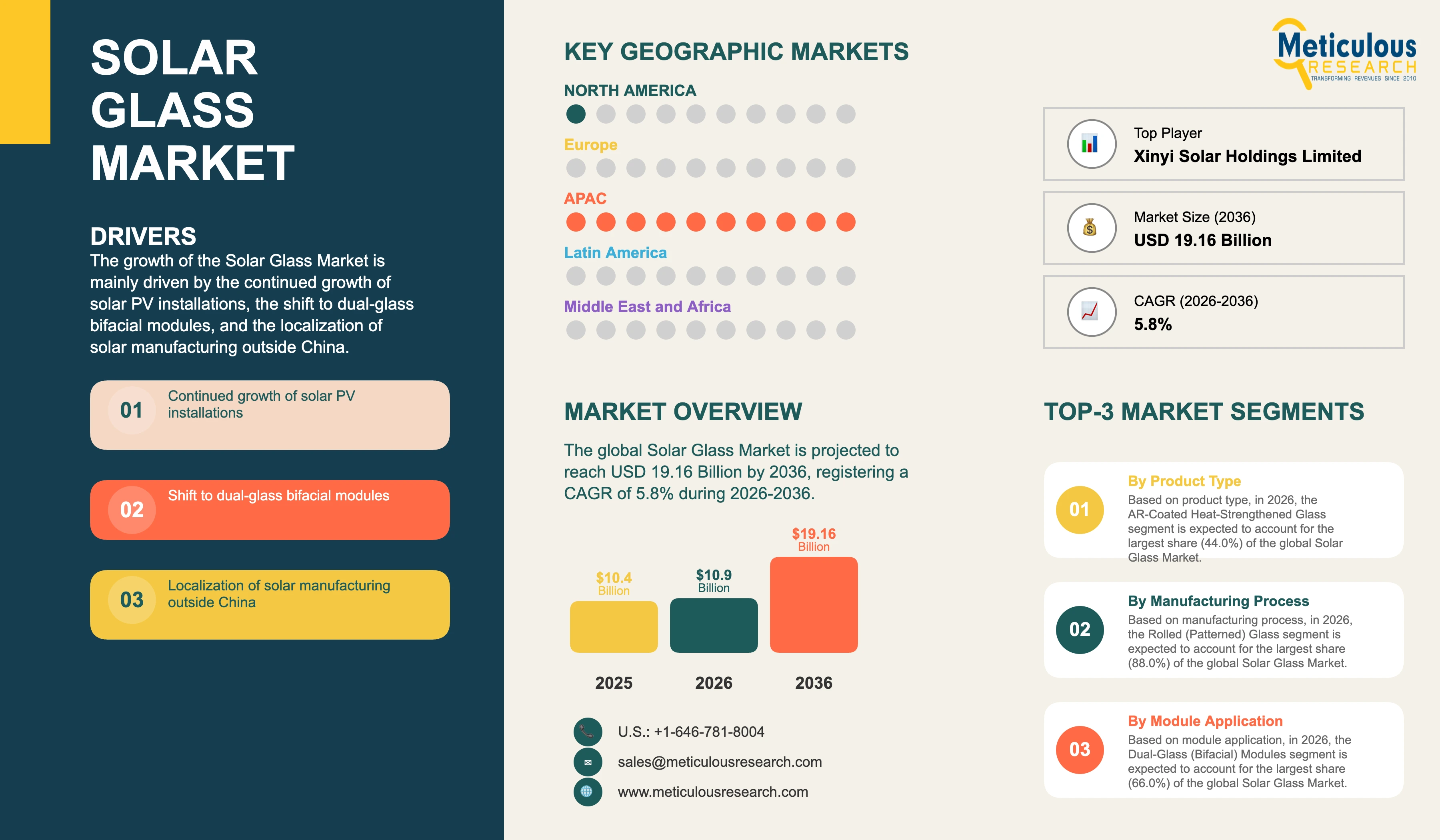
The global solar glass market was valued at USD 10.40 billion in 2025. This market is expected to reach USD 19.16 billion by 2036 from an estimated USD 10.90 billion in 2026, registering a CAGR of 5.8% during the forecast period (2026-2036).
- Published
- Nov 2026
- Pages
- 235
- Format
- PDF + Excel
- Report ID
- MREP - 1042529
- Base year
- 2025
- 2025 · BASELINE
- $10.40B
- 2036
- $19.16B
- CAGR 2026–2036
- 5.8%
2025 baseline · 2026–2036 forecast at 5.8% CAGR · hover a bar for the value
Key highlights
The International Energy Agency Photovoltaic Power Systems Programme reported that a record of about 698 GW of solar PV was installed worldwide in 2025, while global solar cell production reached 779 GW against manufacturing capacity of 1,405 GW, which shows both the large and growing demand for solar glass and the severe overcapacity across the wider solar supply chain.
Xinyi Solar, the world's largest solar glass producer, reported that its revenue fell 6.5% year-on-year in the first half of 2025 mainly because of lower solar glass prices caused by oversupply, intense competition, and weak demand, and it suspended two production lines with a combined daily melting capacity of 1,800 tonnes in July 2025 in response to market conditions.
Xinyi Solar later reported that its solar glass sales fell 24.4% in the first half of 2026, with average selling prices down more than 20% and volumes down 5.8%, while it continued to build new solar glass lines in Indonesia, reflecting the industry's shift toward overseas capacity amid trade barriers and weak prices in China.
IEA PVPS data show that India produced about 45 GW of solar modules and the U.S. about 42 GW in 2025, as industrial policies and trade measures encourage module manufacturing outside China, which is creating new demand for locally produced solar glass in these markets.
The EU and India have applied anti-dumping measures on solar glass imports from China and other countries to protect domestic producers, while companies such as Borosil Renewables, which acquired a majority stake in European producer Interfloat, are expanding production outside China.
The International Energy Agency reported that solar PV met around 70% of global electricity generation growth in 2025 and that annual renewable capacity additions reached about 800 GW, of which solar accounted for around 75%, underlining the scale of long-term demand for photovoltaic glass from module manufacturers.
By product type, AR-coated heat-strengthened glass accounts for the largest share of 44.0% in 2026, while TCO-coated glass registers the highest CAGR.
By manufacturing process, rolled (patterned) glass accounts for the larger share in 2026, while float glass registers the higher CAGR.
By module application, dual-glass (bifacial) modules account for the largest share of 66.0% in 2026, while building-integrated PV registers the highest CAGR.
By geography, Asia-Pacific accounts for the largest share of 86.0% in 2026, while North America registers the highest CAGR of 8.9%.
Report summary
| Particulars | Details |
|---|---|
| Base Year | 2025 |
| Estimated Year | 2026 |
| Forecast Period | 2026-2036 |
| Market Size in 2025 | USD 10.40 billion |
| Market Size in 2026 | USD 10.90 billion |
| Market Size by 2036 | USD 19.16 billion |
| CAGR (2026-2036) | 5.8% |
| Format | PDF, Excel & Cloud Portal · 235 pages |
| Largest Segment by Product Type (2026) | AR-Coated Heat-Strengthened Glass (44.0%) |
| Largest Segment by Module Application (2026) | Dual-Glass (Bifacial) Modules (66.0%) |
| Largest Region (2026) | Asia-Pacific (86.0%) |
| Fastest-Growing Region | North America (CAGR 8.9%) |
| Segments Covered | Product Type, Manufacturing Process, Module Application, and Geography |
| Geographic Scope | Asia-Pacific, North America, Europe, Middle East and Africa, and Latin America |
| Key Companies Profiled | Xinyi Solar, Flat Glass Group, CSG Holding, Irico Group New Energy, CNBM, Kibing, Almaden, AGC, NSG, Borosil Renewables, and Taiwan Glass |
Report overview
Segments covered: product type, manufacturing process, module application.
The growth of this market is mainly driven by the continued expansion of global solar PV installations, the shift to dual-glass bifacial modules, which use two sheets of glass per module instead of one, larger module formats, the growth of solar module manufacturing in India, the U.S., Southeast Asia, and the Middle East supported by industrial policies and trade measures, demand for thin-film modules that use transparent conductive oxide (TCO) coated glass, new technologies such as perovskite and tandem cells, and growing use of building-integrated photovoltaics. However, factors such as severe overcapacity and falling prices in China's solar glass industry, volatility in solar module demand and prices, high energy consumption and emissions of glass furnaces, trade disputes and anti-dumping duties, and the high capital cost of new furnaces are expected to restrain the growth of this market to some extent.
Solar glass, also called photovoltaic glass or PV glass, is specialized glass used in solar modules to protect solar cells from weather, moisture, and mechanical damage while allowing as much sunlight as possible to pass through to the cells. Most solar glass for crystalline silicon modules is low-iron patterned glass produced by the rolled process, which has very high light transmission, and it is usually coated with an anti-reflective (AR) coating to further increase transmission. The glass is then tempered or heat-strengthened to improve its strength. Thin-film modules, such as cadmium telluride modules, use float glass with a transparent conductive oxide (TCO) coating, which acts as an electrode as well as a cover.
This market covers the global revenue from the sale of solar glass used in photovoltaic modules, including AR-coated heat-strengthened glass, AR-coated tempered glass, TCO-coated glass, and other solar glass such as uncoated and specialty glass for building-integrated photovoltaics, measured at the value of glass sold to module manufacturers. Geography is based on where the glass is consumed by module manufacturers. The market is segmented by product type, manufacturing process, module application, and geography. Solar thermal glass, mirrors for concentrated solar power, glass for architectural uses without PV, and encapsulants and backsheets are not included.
Solar glass is one of the largest components of a solar module by weight and an important part of its cost. In recent years, the industry has shifted from single-glass modules, which use one front glass sheet and a polymer backsheet, to dual-glass modules, which use glass on both the front and back. Dual-glass modules are more durable, have lower degradation, and are essential for bifacial modules, which capture light from both sides. This shift has greatly increased the amount of glass used per module, although the glass is now thinner, typically 2.0 mm or less for each sheet in dual-glass modules compared with 3.2 mm for traditional single-glass modules. Thinner glass is usually heat-strengthened rather than fully tempered.
China dominates solar glass production, as it does solar module manufacturing, and Chinese companies such as Xinyi Solar, Flat Glass Group, CSG Holding, Irico, CNBM, Kibing, and Almaden operate very large production capacity. After rapid capacity expansion in 2021 to 2023, the industry has faced severe overcapacity, falling prices, and losses, leading companies to suspend production lines and slow expansion. Xinyi Solar reported falling revenues and profits in 2025 and 2026 because of lower solar glass prices. Chinese authorities have encouraged the industry to curb excessive competition and capacity, and some producers have carried out cold repairs or closures of furnaces.
Outside China, solar glass production is growing as countries try to build local solar supply chains. India has a domestic solar glass industry led by Borosil Renewables and is adding capacity to supply its growing module manufacturing sector. The U.S. has expanded module manufacturing rapidly, and new solar glass projects have been announced to supply domestic module makers, while First Solar uses TCO-coated float glass for its thin-film modules produced in the U.S. and other countries. Southeast Asian countries such as Vietnam, Malaysia, and Indonesia host solar glass production that supplies modules for export, and Middle Eastern countries are developing solar manufacturing hubs.
Technology is also changing the market, as module designs evolve and new cell technologies approach commercial production. Glass makers are developing thinner, stronger, and higher-transmission glass, improved AR coatings, and glass for larger module formats. TCO-coated glass is needed for cadmium telluride thin-film modules and is expected to be important for perovskite and perovskite-silicon tandem modules, which are approaching commercialization. Colored, patterned, and lightweight glass is being developed for building-integrated photovoltaics and vehicle-integrated applications.
The market is relatively concentrated, with a few large Chinese producers holding most global capacity. Leading companies include Xinyi Solar Holdings, Flat Glass Group, CSG Holding, Irico Group New Energy, China National Building Material Group (through its glass subsidiaries), Zhuzhou Kibing Group, Changzhou Almaden, AGC, Nippon Sheet Glass, Borosil Renewables, and Taiwan Glass Industry Corporation.
Over the forecast period, the solar glass market is expected to recover and grow steadily as solar installations continue to increase, dual-glass modules dominate, and prices stabilize. Asia-Pacific is expected to remain by far the largest market, while North America is expected to grow fastest at a CAGR of 8.9%.
Report infographic
Market dynamics
16 factors across 5 forcesContinued growth of solar PV installations
Global solar PV installations have reached record levels, with IEA PVPS reporting about 698 GW installed in 2025 and the International Energy Agency reporting that solar PV was the largest single contributor to growth in global energy supply. Solar has become one of the cheapest sources of new electricity in many countries, and governments, utilities, businesses, and households continue to invest in solar to meet growing electricity demand, reduce costs, and meet climate targets. Every solar module requires at least one sheet of solar glass, and most new modules now use two.
Although annual installations may grow more slowly in some years because of policy changes in China and the U.S., long-term forecasts by the IEA and others expect global solar additions to remain very high through the next decade. Rising electricity demand from data centers, electrification of transport and heating, and industry is also supporting solar demand. These factors provide a large and growing base of demand for solar glass, especially in Asia-Pacific, which accounts for the largest share of the market.
Distributed solar, including rooftop systems for homes, businesses, and factories, is also growing quickly, with IEA PVPS reporting that distributed PV accounted for about 41% of global solar additions in 2025. Distributed systems use a mix of single-glass and dual-glass modules, and growth in markets such as Pakistan, India, Brazil, and Europe adds further demand for solar glass. Because glass demand depends on module production rather than installations in a particular country, glass makers benefit from solar growth anywhere in the world, as long as they can supply the module makers that serve those markets.
Shift to dual-glass bifacial modules
The solar industry has rapidly shifted from single-glass modules with polymer backsheets to dual-glass modules, driven by the growth of bifacial modules, which capture light from both sides and increase energy output, particularly on trackers and reflective surfaces. Dual-glass modules also offer better durability, lower degradation, and longer warranties, and they perform well in harsh environments such as deserts and humid climates. As a result, dual-glass modules now account for a large majority of new module production, according to industry roadmaps such as the International Technology Roadmap for Photovoltaic (ITRPV).
Dual-glass modules use two thinner sheets of glass, typically heat-strengthened, which increases the total glass area per module and changes the product mix toward thinner heat-strengthened glass. This shift is the main reason that dual-glass modules account for the largest share of the market by module application and that AR-coated heat-strengthened glass accounts for the largest share by product type.
Glass-glass designs are also replacing backsheets in many residential and commercial modules, as manufacturers seek to offer longer warranties and better reliability. Some manufacturers use transparent backsheets instead of rear glass for lighter bifacial modules, but glass remains the preferred option for utility-scale projects. As a result, the shift to dual-glass designs is expected to continue supporting solar glass demand per gigawatt of module production over the forecast period.
Localization of solar manufacturing outside China
Governments in the U.S., India, the EU, Turkey, and other countries are supporting domestic solar manufacturing through tax credits, production-linked incentives, tariffs, and local content requirements. IEA PVPS data show that India produced about 45 GW of solar modules and the U.S. about 42 GW in 2025. New module factories need reliable supplies of solar glass, and trade measures make imported glass from China more expensive in some markets, which encourages local glass production.
In the U.S., domestic content incentives and tariffs on Chinese solar products have led to announcements of new solar glass plants, while India has expanded domestic glass capacity and used trade measures to protect local producers. These developments are creating new demand centers for solar glass outside China. North America is the fastest-growing region in this market.
Europe is also seeking to rebuild solar manufacturing through the Net-Zero Industry Act and national support programs, although high energy costs and competition from imports make this difficult. Turkey has become an important module manufacturing location for Europe and the Middle East, and Saudi Arabia, Oman, and Egypt have announced large solar manufacturing projects. Each of these developments could create local demand for solar glass, especially if trade rules or incentives favor locally produced components.
Thin-film, perovskite, and new module technologies
Cadmium telluride thin-film modules, produced mainly by First Solar, use TCO-coated float glass, and First Solar has expanded its manufacturing capacity in the U.S., India, Malaysia, and Vietnam. Perovskite and perovskite-silicon tandem modules, which are being developed by many companies and research institutes, also require TCO-coated or specialized glass. As these technologies scale up, demand for TCO-coated glass is expected to grow faster than demand for conventional solar glass. TCO-coated glass is the fastest-growing product type in this market. Building-integrated photovoltaics and vehicle-integrated solar also require specialized glass, which supports demand for higher-value products.
Table of contents
11 chapters · 100 sections · 235 pages · click to expandSegmental analysis
| Segment | Largest share (2026) | Fastest growth (2026–2036) |
|---|---|---|
| By Product Type | AR-coated heat-strengthened glass | TCO-coated glass |
| By Manufacturing Process | — | — |
| By Module Application | Dual-glass (bifacial) modules | Building-integrated PV |
By Product Type
- The AR-coated heat-strengthened glass segment is expected to account for the largest share of 44.0% of the market.
- The large share of this segment is mainly due to the dominant use of dual-glass bifacial modules, which typically use two sheets of thin glass of 2.0 mm or less that are heat-strengthened rather than fully tempered, the very large volume of dual-glass module production in China, Southeast Asia, India, and other regions, and the shift of module makers away from single-glass designs.
- Heat-strengthened glass is less strong than fully tempered glass but is better suited to thin glass and offers good resistance to breakage when used in dual-glass laminates.
- AR coatings improve light transmission by several percentage points, which increases module power output and value.
- Large Chinese producers such as Xinyi Solar, Flat Glass Group, and CSG Holding supply most of this glass to module makers in China and Southeast Asia.
- AR-coated heat-strengthened glass is expected to remain the largest product type over the forecast period, supported by continued dominance of dual-glass modules and the move to even thinner glass.
- However, the TCO-coated glass segment is projected to register the highest CAGR during the forecast period, driven by the expansion of cadmium telluride thin-film manufacturing and the expected commercialization of perovskite and tandem modules.
- AR-coated tempered glass, which is used mainly in single-glass modules with 3.2 mm glass and in some dual-glass modules, remains a large segment, while other solar glass, including uncoated, colored, and specialty glass for building-integrated PV, makes up the rest of the market.
- TCO-coated glass is produced mainly by large float glass makers with advanced coating capabilities, such as Nippon Sheet Glass, AGC, and some Chinese producers, and it is supplied mainly to First Solar and other thin-film manufacturers.
- Perovskite module developers in China, Europe, and the U.S. are also testing TCO glass for their products, and if perovskite and tandem modules reach large-scale production during the forecast period, demand for TCO glass could grow much faster than expected.
- AR-coated tempered glass demand is expected to grow slowly as single-glass modules lose share, although it will remain important for some residential modules and specific markets.
- Prices for all product types fell sharply in 2024 and 2025 because of overcapacity, and price trends will strongly influence the value of each segment over the forecast period.
- Thinner heat-strengthened glass for dual-glass modules has seen the most intense price competition, while TCO-coated and specialty glass have been less affected because fewer producers can make them.
- As capacity is rationalized, we expect prices for mainstream products to recover gradually, which will support value growth in the largest segment.
By Manufacturing Process
- Solar Glass Analysis by Manufacturing Process
- The rolled (patterned) glass segment is expected to account for the larger share of the market, mainly because almost all crystalline silicon modules use low-iron patterned glass produced by the rolled process, which provides very high light transmission and is produced at very large scale in China, with single furnaces producing more than 1,000 tonnes of glass per day.
- However, the float glass segment is projected to register the higher CAGR during the forecast period, driven by TCO-coated float glass for thin-film and perovskite modules and specialty glass for building-integrated PV.
- Some producers are also testing ultra-clear float glass for crystalline modules, although rolled glass is expected to remain dominant for these products.
- Rolled solar glass production is concentrated in China and, increasingly, in Southeast Asia and India, where new lines are being built to serve local module makers.
- Float glass for solar applications is produced mainly by large flat glass makers that also serve architectural and automotive markets, which gives them flexibility to shift capacity between markets.
- This difference in industry structure affects how each process responds to changes in solar demand and prices.
By Module Application
- Solar Glass Analysis by Module Application
- The dual-glass (bifacial) modules segment is expected to account for the largest share of 66.0% of the market.
- The large share of this segment is mainly due to the rapid shift of the solar industry to bifacial modules, which capture light from both sides and increase energy output, the higher durability and longer warranties of dual-glass modules, their suitability for utility-scale projects on trackers and in harsh climates, and the fact that each dual-glass module uses two sheets of glass.
- Dual-glass bifacial modules are now standard for utility-scale projects in most markets and are increasingly used in commercial and residential projects.
- Major module makers produce most of their output as dual-glass bifacial modules.
- Dual-glass modules are expected to remain the largest application throughout the forecast period, supported by the continued growth of utility-scale solar on single-axis trackers, where bifacial gains are highest, and by longer warranties that buyers increasingly expect.
- The share of dual-glass modules is also rising steadily in residential and commercial rooftop markets, as manufacturers introduce lighter dual-glass products and buyers value durability.
- In addition, some manufacturers are introducing modules with glass on both sides and frameless designs, which further increases glass use per module.
- These trends support steady growth in demand for thin, high-quality glass over the forecast period.
- Building-integrated PV, while small, is attracting investment from glass makers and building product companies that see it as a higher-margin market less exposed to commodity price swings.
- However, the building-integrated PV segment is projected to register the highest CAGR during the forecast period, driven by building energy regulations, architectural demand for solar facades and roofs, and new colored and semi-transparent products.
- Single-glass modules, which are still used in some residential and commercial products, and thin-film modules make up the rest of the market.
- Single-glass modules are expected to continue losing share over the forecast period, while thin-film modules are expected to grow steadily, led by the capacity expansion of First Solar in the U.S. and India.
Geographic analysis
Asia-Pacific
Largest shareIn 2026, Asia-Pacific is expected to account for the largest share of 86.0% of the global solar glass market. The large share of this region is mainly due to China's dominant position in solar module manufacturing, the very large solar glass production capacity of Chinese producers, the growth of module manufacturing in India, Vietnam, Malaysia, Thailand, Indonesia, and other Southeast Asian countries, and the region's large domestic solar installations. China consumes most of the world's solar glass because it produces most of the world's solar modules, and Chinese producers dominate global capacity. India is growing quickly as domestic module manufacturing expands under government incentives, and Southeast Asian countries host module and glass production that serves export markets. Asia-Pacific is expected to remain by far the largest region throughout the forecast period, although its share is expected to decline slightly as manufacturing grows in other regions. India in particular is expected to see strong growth in solar glass demand as its module manufacturing capacity expands and as the government encourages domestic sourcing of components, and Borosil Renewables and new entrants are adding capacity to meet this demand.
North America
Fastest growthNorth America is projected to register the highest CAGR of 8.9% during the forecast period. The rapid growth of this region is mainly driven by the expansion of U.S. module manufacturing, which IEA PVPS estimated at about 42 GW of production in 2025, domestic content incentives and tariffs that favor local supply chains, First Solar's thin-film manufacturing in the U.S., and announced investments in domestic solar glass production. Mexico and Canada also host some module production that serves the U.S. market, and supply chains across the region are becoming more integrated.
Europe
Europe accounts for a small share of global solar glass consumption because most modules installed in Europe are imported from Asia. However, efforts by the EU to rebuild solar manufacturing, anti-dumping duties on Chinese solar glass, and the presence of producers such as Interfloat support a small domestic industry, and demand for building-integrated PV glass is growing in the region. Europe has a small solar glass industry supported by anti-dumping duties and efforts to rebuild solar manufacturing, while the Middle East and Africa and Latin America are small but growing markets. Turkey has become an important module manufacturing hub serving Europe, and Gulf countries are planning integrated solar manufacturing complexes that could include glass production.
Competitive landscape
The solar glass market is concentrated, with a few large Chinese producers holding most global capacity. Leading companies include Xinyi Solar Holdings, Flat Glass Group, CSG Holding, Irico Group New Energy, China National Building Material Group, Zhuzhou Kibing Group, and Changzhou Almaden in China; AGC and Nippon Sheet Glass in Japan; Borosil Renewables in India, which also owns a majority stake in Interfloat in Europe; and Taiwan Glass Industry Corporation.
Companies compete mainly on price, production scale, energy efficiency, light transmission, glass strength and thinness, coating quality, reliability of supply, and proximity to module makers. In the current oversupplied market, cost leadership, energy efficiency, and financial strength are critical, and the largest producers with the most efficient furnaces are best able to withstand low prices.
The top five players are estimated to account for 62.0% of the solar glass market in 2025. This high concentration reflects the large scale and cost advantages of leading Chinese producers, which have built very large furnaces and integrated operations.
Players use several strategies to protect margins and grow, including capacity management through furnace suspensions and cold repairs, overseas expansion in Southeast Asia and other regions, development of thinner and higher-performance glass, TCO and specialty products, and long-term supply agreements with module makers. For example, Xinyi Solar suspended two production lines in 2025 while building new lines in Indonesia.
Competition is expected to remain intense until supply and demand come back into balance, and consolidation and capacity exits are likely among weaker producers. Producers with overseas capacity and strong relationships with leading module makers are expected to perform better than those that rely only on the Chinese domestic market. Outside China, producers such as Borosil Renewables are expanding with support from trade measures and local content policies.
Japanese producers AGC and Nippon Sheet Glass focus more on higher-value products, such as TCO-coated glass for thin-film modules and glass for building-integrated PV, rather than competing directly with Chinese producers on mainstream rolled glass. Taiwan Glass and other regional producers serve module makers in their home markets and nearby countries. New entrants in the U.S., India, and the Middle East are expected to add competition over the forecast period, particularly where trade measures and incentives support local production.
Some of the key players operating in the solar glass market are Xinyi Solar Holdings Limited, Flat Glass Group Co., Ltd., CSG Holding Co., Ltd., Irico Group New Energy Company Limited, China National Building Material Group Co., Ltd., Zhuzhou Kibing Group Co., Ltd., Changzhou Almaden Co., Ltd., AGC Inc., Nippon Sheet Glass Co., Ltd., Borosil Renewables Limited, and Taiwan Glass Industry Corporation.
- —
Xinyi Solar suspended two production lines in 2025 and reported lower solar glass sales in 2026 because of falling prices, Chinese producers expanded capacity in Indonesia and other countries, and module manufacturing grew strongly in India and the U.S.
- Xinyi Solar
- Flat Glass Group
- CSG Holding
- Irico Group New Energy
- CNBM
- Kibing
- Almaden
- AGC
- NSG
- Borosil Renewables
- Taiwan Glass
Expert perspectives
The solar glass market is going through a difficult period of overcapacity and falling prices, which has reduced market value and profits despite record solar installations. However, the long-term outlook remains positive, because solar installations are expected to stay at very high levels, dual-glass modules use more glass per module, and new manufacturing regions are creating new demand centers.
Over the forecast period, the market is expected to grow at a CAGR of 5.8%, as prices stabilize, capacity is rationalized, and demand continues to grow. The main risks are prolonged overcapacity, trade disputes, and slower solar growth in some markets. We expect prices to recover gradually as weaker capacity exits and as demand continues to grow, but the timing of this recovery is uncertain.
AR-coated heat-strengthened glass remains the largest product type, while TCO-coated glass grows fastest. Rolled glass remains the larger manufacturing process, while float glass grows faster. Dual-glass modules remain the largest application, while building-integrated PV grows fastest.
Asia-Pacific remains by far the largest region, while North America is the fastest-growing region at a CAGR of 8.9%.
For solar glass producers, the key priorities are to manage capacity carefully, reduce energy costs and emissions, improve product quality to reduce breakage, and expand into regions with local content demand. For module makers, the priority is to secure reliable, high-quality glass supply, increasingly from multiple regions, to reduce trade risks and meet local content requirements. We believe that producers with low costs, strong technology, and global production footprints will gain the most as the market recovers.
We also expect the geography of solar glass production to change over the forecast period. While China will remain dominant, new capacity in India, Southeast Asia, the U.S., and the Middle East will create a more diversified supply base, driven by trade policies and local content rules. Glass producers that invest early in these regions and build strong relationships with local module makers are expected to benefit. At the same time, technology changes such as perovskite and tandem modules could increase demand for TCO-coated and specialty glass, which would favor producers with advanced coating capabilities.
Price recovery will be a key factor for the value of the market over the next few years. We expect the current downturn to lead to the closure of older and less efficient furnaces, particularly in China, which should gradually improve the balance between supply and demand. However, the industry has a history of rapid capacity additions when prices rise, so producers and investors should expect continued price cycles over the forecast period. Companies that focus on cost efficiency, product quality, and diversified customer bases are best placed to manage these cycles.
Customer perspectives
Buyers of solar glass globally are mainly crystalline silicon and thin-film solar module manufacturers, ranging from large global producers to new module makers in India, the U.S., and other regions. They assess glass on price, light transmission, strength, thickness, quality consistency, delivery reliability, and local content eligibility. Their comments show why dual-glass and heat-strengthened glass lead demand and why North America and specialty glass are growing fastest.
This explains why dual-glass modules account for 66.0% of the market, why heat-strengthened glass accounts for 44.0% of the market, and why Asia-Pacific accounts for 86.0% of the market.
Supply Chain Director - Crystalline silicon module manufacturer, U.S.
Domestic content incentives and tariffs on imported components strongly push us to source glass locally, so we are working with new U.S. glass suppliers and qualifying their products for our modules.
This comment explains why North America is the fastest-growing region and why new glass plants are being planned outside China.
This comment explains why TCO-coated glass is the fastest-growing product type and why float glass is growing faster than rolled glass.
“Almost all our new production capacity produces dual-glass bifacial modules, so we need large volumes of thin, strong glass, and local supply helps us meet content rules and reduce shipping damage.”
“Our tandem modules need high-quality TCO glass with very consistent coatings and flat surfaces, and only a few suppliers can meet our specifications today, so we are building long-term partnerships with them.”
Frequently asked questions
Based on sales of solar glass to module manufacturers, the market was valued at USD 10.40 billion in 2025 and USD 11.80 billion in 2024, and is estimated at USD 10.90 billion in 2026. The decline in 2025 reflects falling solar glass prices caused by overcapacity in China, despite higher sales volumes.
Cite this report
Meticulous Research. (2026). Solar Glass Market - Global Opportunity Analysis and Industry Forecast (2026-2036) (Report No. MREP - 1042529). Meticulous Market Research Pvt. Ltd. https://www.meticulousresearch.com/product/solar-glass-market-7212