Agrivoltaics Market (2026-2036)
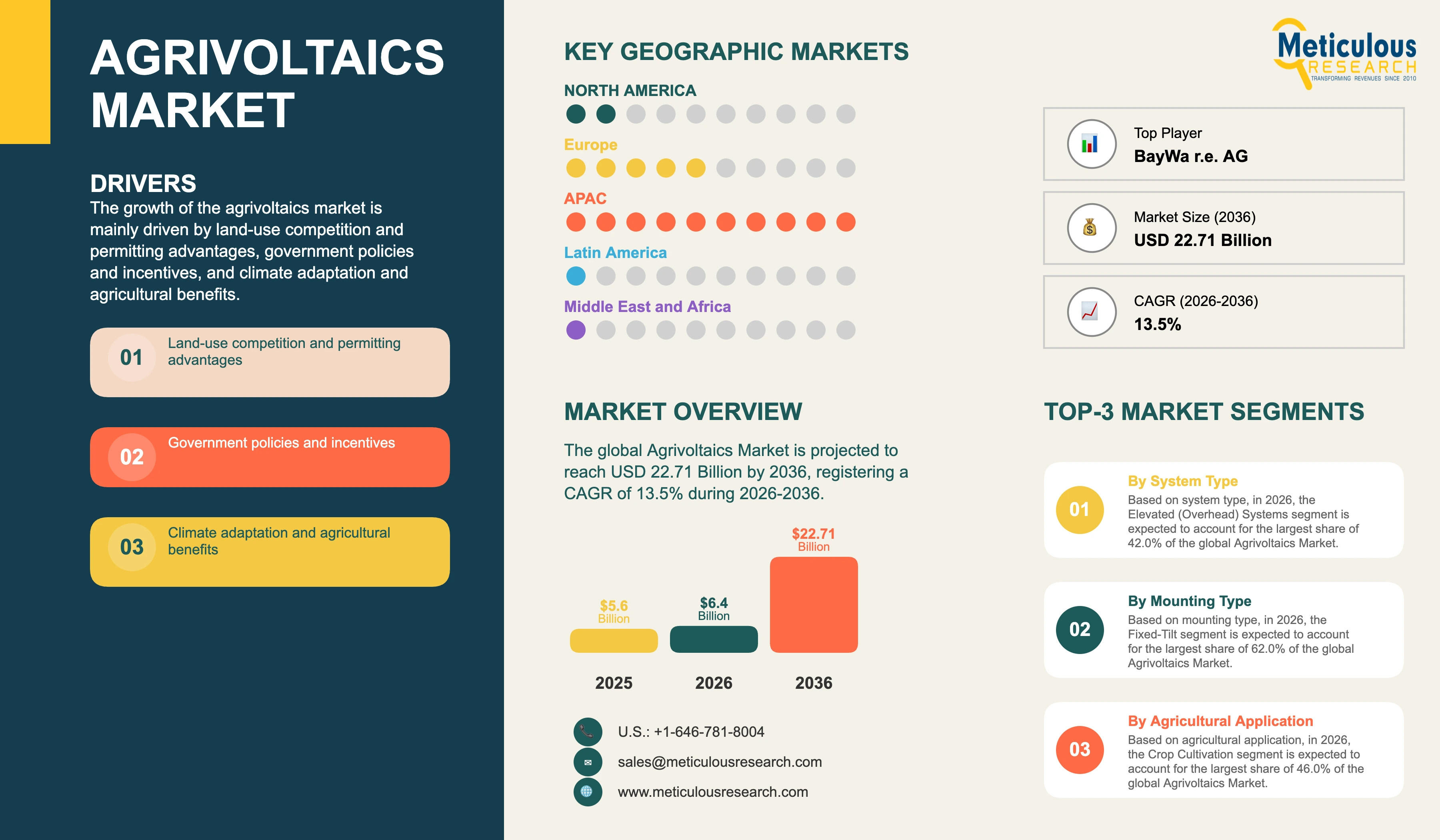
The global agrivoltaics market was valued at USD 5.60 billion in 2025. This market is expected to reach USD 22.71 billion by 2036 from an estimated USD 6.40 billion in 2026, registering a CAGR of 13.5% during the forecast period (2026-2036).
- Published
- Nov 2026
- Pages
- 315
- Format
- PDF + Excel
- Report ID
- MREP - 1042525
- Base year
- 2025
- 2025 · BASELINE
- $5.60B
- 2036
- $22.71B
- CAGR 2026–2036
- 13.5%
2025 baseline · 2026–2036 forecast at 13.5% CAGR · hover a bar for the value
Key highlights
Italy's Ministry of the Environment and Energy Security launched a EUR 1.7 billion measure under the National Recovery and Resilience Plan to support at least 1.04 GW of innovative agrivoltaic systems by 30 June 2026, and the related procedures selected more than 700 projects with a combined capacity close to 2 GW, making Italy one of the fastest-growing agrivoltaics markets in the world.
France formally defined agrivoltaics in its 2023 law on accelerating renewable energy production and adopted an implementing decree in April 2024, which requires agrivoltaic installations to provide a direct service to agriculture, such as climate adaptation or protection from hazards, while keeping farming as the main activity, giving France one of the most demanding regulatory frameworks for agrivoltaics.
Germany's Renewable Energy Sources Act has supported agrivoltaics on a larger scale since 2023, and the Solarpaket I package of 2024 introduced a dedicated auction segment for special solar systems, including agrivoltaics, while the DIN SPEC 91434 standard requires agriculture to remain the primary land use.
Japan pioneered agrivoltaics under the name solar sharing, and the International Energy Agency's PVPS programme has noted that more than 4,000 farms had adopted agrivoltaic systems by 2021, supported by rules that link permission to continued agricultural production, while data collected by the U.S. National Renewable Energy Laboratory identified more than 2.8 GW of agrivoltaic sites in the U.S., most of them involving sheep grazing or pollinator habitat.
Wood Mackenzie reported that Spanish tracker maker Axial captured the highest tracker market share in Europe in 2025, helped by its agrivoltaic tracker products in Italy and other countries where EU funding supports dual land use projects, showing how agrivoltaics is shaping demand for specialized mounting structures.
The International Energy Agency reported that more than 600 GW of solar PV capacity was added worldwide in 2025, and the rapid growth of utility-scale solar has increased pressure on agricultural land in many countries, which is encouraging governments to direct new solar capacity toward dual-use agrivoltaic designs.
By system type, elevated (overhead) systems account for the largest share of 42.0% in 2026, while vertical bifacial systems register the highest CAGR.
By mounting type, fixed-tilt systems account for the larger share in 2026, while single-axis tracking systems register the higher CAGR.
By agricultural application, crop cultivation accounts for the largest share of 46.0% in 2026, while horticulture and orchards register the highest CAGR.
By geography, Asia-Pacific accounts for the largest share of 52.0% in 2026, while Europe registers the highest CAGR of 16.2%.
Report summary
| Particulars | Details |
|---|---|
| Forecast Period | 2026-2036 |
| Base Year | 2025 |
| Estimated Year | 2026 |
| CAGR (Value) | 13.5% |
| Format | PDF, Excel & Cloud Portal · 315 pages |
| Market Size (Value) in 2025 | USD 5.60 billion |
| Market Size (Value) in 2026 | USD 6.40 billion |
| Market Size (Value) in 2036 | USD 22.71 billion |
| Largest Segment by System Type (2026) | Elevated (Overhead) Systems (42.0%) |
| Largest Segment by Agricultural Application (2026) | Crop Cultivation (46.0%) |
| Largest Region (2026) | Asia-Pacific (52.0%) |
| Fastest-Growing Region | Europe (CAGR 16.2%) |
| Segments Covered | System Type, Mounting Type, Agricultural Application, and Geography |
| Countries Covered | Asia-Pacific, Europe, North America, Latin America, and Middle East and Africa |
| Key Companies | BayWa r.e., Enel Green Power, TotalEnergies, EDF power solutions, Next2Sun, Sun'Agri, REM Tec, Axial, Insolight, Ombrea, LONGi, and Arctech Solar |
Report overview
Segments covered: system type, mounting type, agricultural application.
The growth of this market is mainly driven by competition for land between solar energy and agriculture, government policies and incentives that support dual land use in Italy, France, Germany, Japan, South Korea, China, and the U.S., the need to protect crops and livestock from heat, drought, hail, and extreme weather, the opportunity for farmers to earn stable additional income from energy production, public and local acceptance benefits compared with conventional ground-mounted solar, falling costs of solar modules, bifacial technology, and trackers, and the growing interest of food companies and utilities in sustainable land use. However, factors such as higher capital costs than conventional solar farms, complex permitting and unclear legal definitions in many countries, the need to balance agricultural yields with energy output, limited long-term field data for some crops and climates, and the difficulty of coordinating farmers, landowners, and energy developers are expected to restrain the growth of this market to some extent.
Agrivoltaics, also called agri-PV, agrophotovoltaics, or solar sharing, refers to the combined use of the same land for agricultural production and solar photovoltaic power generation. In an agrivoltaic system, solar modules are installed above crops, between rows of crops, along field edges, or on greenhouses, or livestock graze under or around the modules, so that the land continues to be used for farming while also producing electricity. Well-designed agrivoltaic systems can increase the total productivity of land, protect crops from excessive heat, sun, hail, and drought, reduce water evaporation, provide shade for animals, and give farmers a second source of income.
This market covers the global value of agrivoltaic systems installed each year, including solar modules, mounting structures and trackers designed for agricultural use, inverters and electrical balance of system, and engineering, procurement, and construction services, for systems in which agricultural production continues on the same land. It is segmented by system type, mounting type, agricultural application, and geography. Conventional ground-mounted solar farms without continued agricultural use, rooftop solar on farm buildings, floating solar, and fishery-solar complementary projects on ponds are not included, and the value of agricultural produce and electricity sales is not counted.
There are several types of agrivoltaic systems, which differ in height, layout, cost, and the farming activities they support. Elevated or overhead systems place modules on high structures, typically several meters above the ground, so that farm machinery can work underneath and crops grow under partial shade. Inter-row ground-mounted systems place modules in rows with wide spaces between them for crops or grazing. Vertical bifacial systems use bifacial modules mounted vertically in rows, usually facing east and west, which take up very little land and allow farming between rows. Greenhouse-integrated systems install modules on greenhouse roofs. Systems can use fixed-tilt structures or single-axis trackers, which can also be adjusted to control shading for crops.
Agrivoltaics has grown because of the increasing competition for land between food production, energy, housing, and nature. Large solar farms require significant land areas, and in many countries, farmers, local communities, and governments are concerned about converting productive farmland to energy production. Agrivoltaics addresses these concerns by keeping land in agricultural use, which can make projects easier to permit and more acceptable to local communities. At the same time, climate change is increasing heat stress and drought for crops and livestock, and partial shade from solar modules can protect some crops, reduce water use, and improve animal welfare.
Asia-Pacific has the largest installed base of agrivoltaics, while Europe has the most active policy environment. Japan pioneered solar sharing in the early 2000s and has thousands of small farm systems. China has built very large agrivoltaic projects that combine solar with crops, herbal medicines, and other agricultural uses, often as part of rural development programs. South Korea is promoting agrivoltaics to support farmers and meet renewable energy targets, and India is piloting agrivoltaics under its farmer solar programs. In Europe, Italy, France, Germany, and the Netherlands have introduced legal definitions, standards, and incentives, and Italy's EUR 1.7 billion PNRR measure has made it one of the most active markets. In the U.S., agrivoltaics is growing through state programs, research, and projects that combine solar with sheep grazing and pollinator habitats.
The economics of agrivoltaics differ from conventional solar in several important ways that affect project returns. Elevated structures and wider spacing increase capital costs, and energy output per hectare is often lower because of lower module density. However, these costs can be offset by incentives, higher land acceptance, faster permitting, agricultural benefits, and premium electricity prices in some markets. Falling module prices, bifacial modules, and specialized agrivoltaic trackers have improved the economics, and many developers now offer agrivoltaic designs as standard options.
The market includes energy developers, specialized agrivoltaic technology companies, mounting structure and tracker suppliers, and module manufacturers. Leading participants include BayWa r.e., Enel Green Power, TotalEnergies, EDF power solutions, Next2Sun, Sun'Agri, REM Tec, Axial, Insolight, Ombrea, LONGi Green Energy Technology, and Arctech Solar.
Over the forecast period, the agrivoltaics market is expected to grow rapidly, as more countries adopt legal frameworks and incentives, developers seek land-efficient and socially accepted solar sites, and farmers look for climate protection and additional income. Asia-Pacific is expected to remain the largest market, while Europe is expected to grow fastest at a CAGR of 16.2%.
Report infographic
Market dynamics
16 factors across 5 forcesLand-use competition and permitting advantages
Solar energy is expanding rapidly worldwide, and the International Energy Agency reported that more than 600 GW of solar PV capacity was added globally in 2025. Large ground-mounted solar farms need substantial land areas, and in many countries farmland is the most accessible land for solar projects because it is flat, open, and close to grid connections. However, converting farmland to solar farms has raised concerns about food security, rural livelihoods, landscape changes, and the loss of agricultural land, and some governments and local authorities have restricted ground-mounted solar on productive farmland.
Agrivoltaics offers a way to expand solar while keeping land in agricultural production. Projects that meet agrivoltaic criteria often receive preferential treatment in permitting, zoning, and land classification, and they are more likely to gain the support of farmers and local communities. In Germany, for example, agrivoltaic land can keep its agricultural tax status, and in Italy and France, agrivoltaic projects are eligible for specific incentives and permitting routes. These advantages are making agrivoltaics an attractive option for solar developers in land-constrained regions, and they support the growth of elevated systems, which account for the largest share of the market by system type.
Grid connection constraints and local opposition to large solar farms are also pushing developers toward projects that local communities see as beneficial. Agrivoltaic projects can involve farmers as partners, share revenues with landowners, and support local food production, which helps them win approval in areas where conventional solar faces resistance. As solar deployment continues to grow, these social and permitting advantages are expected to become even more important.
Government policies and incentives
Governments in Europe and Asia have introduced specific frameworks and incentives for agrivoltaics. Italy's PNRR measure provides EUR 1.7 billion in capital grants and tariff incentives for at least 1.04 GW of innovative agrivoltaic systems, Germany supports agrivoltaics through its Renewable Energy Sources Act and a dedicated auction segment for special solar systems, and France has created a legal definition and regulatory framework that allows agrivoltaic projects to be developed on agricultural land under strict conditions. Japan has supported solar sharing through its feed-in tariff and land-use rules, South Korea is preparing legislation to support agrivoltaics on farmland, and several U.S. states, such as Massachusetts, New Jersey, and Colorado, have programs or pilots for dual-use solar.
These policies provide financial support, legal certainty, and permitting routes that make agrivoltaic projects viable despite their higher costs. As more countries adopt definitions and incentives, the market is expected to expand into new regions. Europe, where policy support has increased most rapidly in recent years, is the fastest-growing region in this market.
Climate adaptation and agricultural benefits
Climate change is increasing the frequency of heat waves, droughts, hailstorms, and heavy rain, which damage crops and reduce yields. Partial shade from solar modules can protect crops such as berries, grapes, apples, lettuce, and some vegetables from sunburn, heat stress, and hail, and it can reduce water evaporation from soil, lowering irrigation needs. Research by Fraunhofer ISE and other institutes has shown that some crops perform well or even better under agrivoltaic systems in hot and dry years. Solar structures can also support protective nets, rain covers, and irrigation systems.
For livestock, shade from solar modules reduces heat stress for sheep and cattle, and sheep grazing is a low-cost way to manage vegetation under solar arrays. These benefits are especially important in Mediterranean, arid, and semi-arid regions, where heat and water scarcity are major concerns. Horticulture and orchards, which can gain significant protection from extreme weather, form the fastest-growing agricultural application in this market.
Additional income for farmers and falling technology costs
Farmers face volatile crop prices, rising input costs, and climate risks, and agrivoltaics can provide a stable second source of income through land lease payments, revenue sharing, or direct ownership of solar systems. This income can help farms invest in new equipment, diversify their businesses, and remain viable. At the same time, falling solar module prices, the wide availability of bifacial modules, and specialized agrivoltaic trackers and structures have reduced the cost of agrivoltaic systems.
Bifacial modules are particularly well suited to vertical and elevated agrivoltaic systems because they capture light from both sides, and trackers allow operators to adjust module angles to balance energy production with crop shading needs. These technology improvements support the rapid growth of vertical bifacial systems and single-axis tracking systems in this market.
Table of contents
11 chapters · 104 sections · 315 pages · click to expandSegmental analysis
| Segment | Largest share (2026) | Fastest growth (2026–2036) |
|---|---|---|
| By System Type | Elevated (overhead) systems | Vertical bifacial systems |
| By Mounting Type | — | — |
| By Agricultural Application | Crop cultivation | Horticulture and orchards |
By System Type
- The elevated (overhead) systems segment is expected to account for the largest share of 42.0% of the market.
- The large share of this segment is mainly due to the widespread use of elevated structures in Japan, China, South Korea, and Italy, where they allow crops to grow underneath and farm machinery to operate, their eligibility for incentives as advanced agrivoltaic systems in Italy and other countries, their ability to provide protection from heat, hail, and heavy rain, and the higher value per watt of elevated structures.
- Elevated systems are commonly used for vegetables, rice, herbs, berries, and orchards, and they often integrate protective nets, irrigation, and rain covers.
- Developers such as REM Tec, Enel Green Power, and many Asian companies have built large elevated agrivoltaic projects.
- This segment is expected to remain the largest system type over the forecast period, supported by Italy's incentives for advanced agrivoltaic systems and continued growth in East Asia.
- However, the vertical bifacial systems segment is projected to register the highest CAGR during the forecast period.
- The rapid growth of this segment is mainly driven by the low land footprint of vertical rows, which allows arable farming and grassland to continue with large machinery between them, lower structural costs than elevated systems, the higher value of electricity produced in the morning and evening, and growing support for this design under German, Austrian, and other national rules.
- Companies such as Next2Sun have built many vertical bifacial projects in Germany and Austria and are expanding into Italy, Japan, and other markets.
- Inter-row ground-mounted systems are widely used for livestock grazing and for crops that tolerate partial shade, and they are often the lowest-cost agrivoltaic option, especially when combined with single-axis trackers that leave wide spaces between rows.
- Greenhouse-integrated systems place modules on greenhouse roofs, and they are common in China, Spain, and other countries with large greenhouse sectors, although they require careful design to avoid reducing light for crops too much.
- Semi-transparent and spectrally selective modules, such as those developed by Insolight, are improving the suitability of greenhouse and elevated systems for light-sensitive crops.
- The choice of system type depends strongly on the crop, climate, farm size, and national rules.
- Elevated systems are preferred for high-value crops that need protection and for countries such as Italy where incentives favor advanced systems, while vertical systems suit large arable farms and grassland in Central and Northern Europe.
- Inter-row systems are common where grazing is the main agricultural use, and greenhouse systems are concentrated in regions with large protected horticulture sectors.
- Over the forecast period, we expect developers to offer a wider range of standardized designs for each crop type, which will lower costs and make agrivoltaics easier to replicate across regions.
By Mounting Type
- The fixed-tilt segment is expected to account for the larger share of the market.
- The large share of this segment is mainly due to the widespread use of fixed elevated structures in Asia-Pacific, the lower cost and simpler maintenance of fixed systems, and their use in vertical bifacial and greenhouse-integrated designs.
- However, the single-axis tracking segment is projected to register the higher CAGR during the forecast period.
- This segment's growth is mainly driven by the development of specialized agrivoltaic trackers that can be raised high enough for farm machinery, adjusted to control shading for crops, and moved to protect crops from hail or heavy rain, as well as strong demand for these systems in Italy and other European markets supported by EU funding.
- Wood Mackenzie reported that Axial captured the highest tracker market share in Europe in 2025, helped by its agrivoltaic tracker products, and other tracker suppliers such as Arctech Solar have launched dedicated agrivoltaic products.
- Fixed-tilt systems are expected to remain common in small farm projects in Japan, South Korea, and other countries where simplicity and low maintenance are priorities, and in vertical bifacial designs that do not require tracking.
- Tracker-based systems are expected to gain share in larger projects in Europe, the U.S., Australia, and Latin America, where developers can use software to optimize both energy yield and agricultural performance, and where trackers can be parked in positions that protect crops during storms.
By Agricultural Application
- Agrivoltaics Analysis by Agricultural Application
- The crop cultivation segment is expected to account for the largest share of 46.0% of the market.
- The large share of this segment is mainly due to the large area of arable farming and vegetable production under agrivoltaic systems in China, Japan, South Korea, and Europe, the eligibility of crop-based projects for incentives in Italy, France, and Germany, and the ability of partial shade to protect crops such as vegetables, rice, potatoes, herbs, and grains from heat stress and drought.
- Crop-based agrivoltaics ranges from small solar sharing systems on Japanese rice and vegetable farms to large Chinese projects that combine solar with crops and medicinal plants, and arable farming under vertical and elevated systems in Europe.
- Crop cultivation is expected to remain the largest application over the forecast period, supported by new incentive programs and growing climate risks for farmers.
- However, the horticulture and orchards segment is projected to register the highest CAGR during the forecast period.
- This segment's growth is mainly driven by the high value of fruit and specialty crops, increasing damage from heat waves, hail, and late frosts, the ability of agrivoltaic structures to replace protective nets and covers, and successful pilot projects in vineyards and orchards in France, Germany, Italy, and the Netherlands.
- Livestock grazing, mainly sheep grazing under solar arrays, accounts for a significant share in the U.S., the U.K., Australia, and other countries, while other applications, such as pollinator habitats and beekeeping, make up the rest of the market.
- Livestock grazing is the most common form of agrivoltaics in the U.S., the U.K., and Australia, where many solar farms use sheep to manage vegetation instead of mowing.
- This approach requires little change to standard solar designs and creates benefits for both solar operators and farmers, which makes it one of the easiest ways to combine solar with agriculture.
- Other applications include pollinator-friendly plantings, beekeeping, and aquaponics, which are increasingly included in solar projects to support biodiversity and local agriculture.
Geographic analysis
Asia-Pacific
Largest shareIn 2026, Asia-Pacific is expected to account for the largest share of 52.0% of the global agrivoltaics market. The large share of this region is mainly due to the large installed base and continued development of agrivoltaic projects in China, Japan's long-established solar sharing sector, South Korea's support for farmland solar, India's farmer-focused solar programs, high population density and limited farmland in many countries, and strong government interest in combining food and energy production. China is the largest national market, with large agrivoltaic projects that combine solar with crops, tea, medicinal herbs, and other agricultural uses, often as part of rural revitalization and desert control programs. Japan has thousands of small solar sharing systems on farms, supported by land-use rules that allow solar on farmland if agriculture continues, and South Korea is developing legislation and programs to expand agrivoltaics on farmland to support aging farmers and meet renewable energy targets. India is testing agrivoltaics through pilot projects and its farmer solar schemes. Asia-Pacific is expected to remain the largest region throughout the forecast period, although its share is expected to decline gradually as Europe and North America grow faster.
Europe
Fastest growthEurope is projected to register the highest CAGR of 16.2% during the forecast period. The rapid growth of this region is mainly driven by Italy's EUR 1.7 billion PNRR agrivoltaics measure, France's legal framework and decree for agrivoltaics, Germany's EEG support and dedicated auction segment for special solar systems, growing interest in the Netherlands, Spain, and Austria, strong concerns about using farmland for conventional solar, and the presence of specialized agrivoltaic companies such as Next2Sun, Sun'Agri, REM Tec, Axial, Insolight, and Ombrea.
North America
North America is a growing market, supported by more than 2.8 GW of agrivoltaic sites identified by the U.S. National Renewable Energy Laboratory, state dual-use programs in Massachusetts, New Jersey, and Colorado, and the growth of sheep grazing on solar farms, while Latin America and the Middle East and Africa are smaller but growing markets, with pilots in Chile, Brazil, Kenya, and the Gulf countries focused on water savings and crop protection. In the U.S., the Department of Agriculture and universities are studying agrivoltaics for specialty crops, and some states give extra incentives for dual-use projects in community solar programs.
Competitive landscape
The agrivoltaics market is fragmented, with energy developers, specialized agrivoltaic technology companies, mounting structure and tracker suppliers, and module manufacturers. Leading participants operating in this market include developers such as BayWa r.e., Enel Green Power, TotalEnergies, and EDF power solutions; agrivoltaic technology specialists such as Next2Sun, Sun'Agri, REM Tec, Insolight, and Ombrea; tracker and structure suppliers such as Axial and Arctech Solar; and module manufacturers such as LONGi Green Energy Technology, which supply bifacial and specialized modules and develop agrivoltaic projects in China.
Companies compete mainly on system design, agricultural expertise and field data, ability to meet national agrivoltaic criteria, cost, energy yield, project development capabilities, and partnerships with farmers and agricultural organizations. Specialist companies differentiate through crop-adaptive technologies, such as dynamic shading and semi-transparent modules, while large developers compete through financing strength, project pipelines, and grid access. Many projects are delivered through partnerships between developers and specialists, which combine financing and project experience with agrivoltaic design expertise.
The top five players are estimated to account for 20.0% of the agrivoltaics market in 2025. This low concentration reflects the many regional developers, installers, and structure suppliers involved in agrivoltaic projects, particularly in China, Japan, and Italy.
Players use several strategies to grow and differentiate in this market, including long-term partnerships with farmers, agricultural cooperatives, research institutes, and food companies, development of crop-specific system designs, participation in national incentive programs such as Italy's PNRR measure, launches of agrivoltaic trackers and structures, and expansion into new countries. For example, Next2Sun has expanded from Germany into Italy and Japan, and tracker suppliers have launched products designed specifically for agricultural use.
Competition is expected to increase steadily as more developers, utilities, and equipment suppliers enter the market, and companies that can demonstrate strong agricultural performance with field data are expected to gain an advantage in permitting and incentive programs. Consolidation may occur as larger developers acquire specialist agrivoltaic companies to gain technology and agronomic expertise. Module manufacturers are also developing products for agrivoltaic use, such as bifacial and semi-transparent modules and lighter modules for elevated structures, which increases competition among technology suppliers and gives developers more design options.
Some of the key players operating in the agrivoltaics market are BayWa r.e. AG, Enel Green Power S.p.A., TotalEnergies SE, EDF power solutions, Next2Sun GmbH, Sun'Agri SAS, REM Tec S.r.l., Axial Structural Solutions, Insolight SA, Ombrea SAS, LONGi Green Energy Technology Co., Ltd., and Arctech Solar Holding Co., Ltd.
- —
Italy selected more than 700 agrivoltaic projects under its PNRR measure, France implemented its agrivoltaics decree, Germany opened a dedicated auction segment for special solar systems, and Axial led Europe's tracker market in 2025 with agrivoltaic trackers.
- BayWa r.e
- Enel Green Power
- TotalEnergies
- EDF power solutions
- Next2Sun
- Sun'Agri
- REM Tec
- Axial
- Insolight
- Ombrea
- LONGi
- Arctech Solar
Expert perspectives
Agrivoltaics is moving from research and pilot projects to a mainstream part of solar deployment in several major markets. The main reasons are land-use pressure, local opposition to conventional solar farms on farmland, climate risks for agriculture, and government policies that reward dual land use. Asia-Pacific has the largest installed base, while Europe has become the most dynamic policy environment. North America is developing steadily through grazing-based projects, research programs, and state incentives.
Over the forecast period, the agrivoltaics market is expected to grow at a CAGR of 13.5%, supported by Italy's PNRR measure, France's and Germany's frameworks, continued growth in China, Japan, and South Korea, and emerging programs in the U.S. and other regions. The main risks are higher costs, regulatory uncertainty, changes in incentive programs, and the need to prove agricultural performance, but we expect these to ease as standards mature and field data accumulate.
Elevated systems remain the largest system type because of their wide use in Asia and Italy, while vertical bifacial systems grow fastest in Central and Northern Europe. Fixed-tilt systems remain the larger mounting type, while single-axis tracking grows faster in large European and American projects. Crop cultivation remains the largest application, while horticulture and orchards grow fastest.
Asia-Pacific remains the largest region, while Europe is the fastest-growing region at a CAGR of 16.2%.
For solar developers, the key priorities are to design systems that meet national agrivoltaic criteria, work closely with farmers, and monitor agricultural results. For technology suppliers, the opportunity lies in crop-adaptive trackers, vertical bifacial systems, semi-transparent modules, and monitoring tools that measure crop performance. For policymakers, clear definitions, consistent standards, stable incentives, and simple permitting procedures are essential to unlock the potential of agrivoltaics. We believe that companies combining energy expertise with real agricultural knowledge will gain the most from this growing market.
We also see agrivoltaics becoming an increasingly important tool for solar developers to secure land and social acceptance in mature solar markets, where opposition to conventional solar farms is rising. As grid connection queues lengthen and good sites become scarce, agrivoltaic designs may allow developers to build on land that would otherwise be unavailable. In the longer term, we expect agrivoltaics to be integrated into national agricultural and climate adaptation policies, not only energy policies, which would support stable demand. The main uncertainty for the market is whether incentives will continue after initial programs such as Italy's PNRR measure end, so developers should prepare for markets where agrivoltaics must compete more directly with conventional solar.
Customer perspectives
Buyers and partners in agrivoltaic projects include individual farmers, agricultural cooperatives, landowners, energy developers, utilities, and food companies. They assess systems on agricultural performance, energy yield, cost, eligibility for incentives, and ease of farming operations. Their comments show why elevated systems and crop cultivation lead demand and why Europe and specialty crops are growing fastest.
This explains why elevated systems account for 42.0% of the market and why Europe is the fastest-growing region.
This explains why vertical bifacial systems are growing fastest.
This explains why crop cultivation accounts for 46.0% of the market and why Asia-Pacific accounts for 52.0% of the market.
Head of Development - solar developer, U.S.
Sheep grazing and pollinator plantings help us win local support from farming communities and reduce mowing costs, so we now include them in most of our new projects.
This explains why livestock grazing is a large and growing application in North America.
“The elevated structure protects our fruit from hail and the hottest sun, and the PNRR incentives made the project affordable. We still farm the same land, and the energy income helps us cope with bad seasons.”
“Vertical rows let us keep using our normal machinery between the panels, the land stays classified as farmland, and the extra income is reliable even in poor harvest years.”
“Solar sharing gives our small farm a steady income while we keep growing rice under the panels, which matters as our farmers get older.”
Frequently asked questions
The market was valued at USD 5.60 billion in 2025 and USD 4.90 billion in 2024, and is estimated at USD 6.40 billion in 2026. These values represent the installed value of agrivoltaic systems, including modules, structures, electrical equipment, and installation.
Cite this report
Meticulous Research. (2026). Agrivoltaics Market - Global Opportunity Analysis and Industry Forecast (2026-2036) (Report No. MREP - 1042525). Meticulous Market Research Pvt. Ltd. https://www.meticulousresearch.com/product/agrivoltaics-market-7208