Reciprocating Engine Power Generation Market (2026-2036)
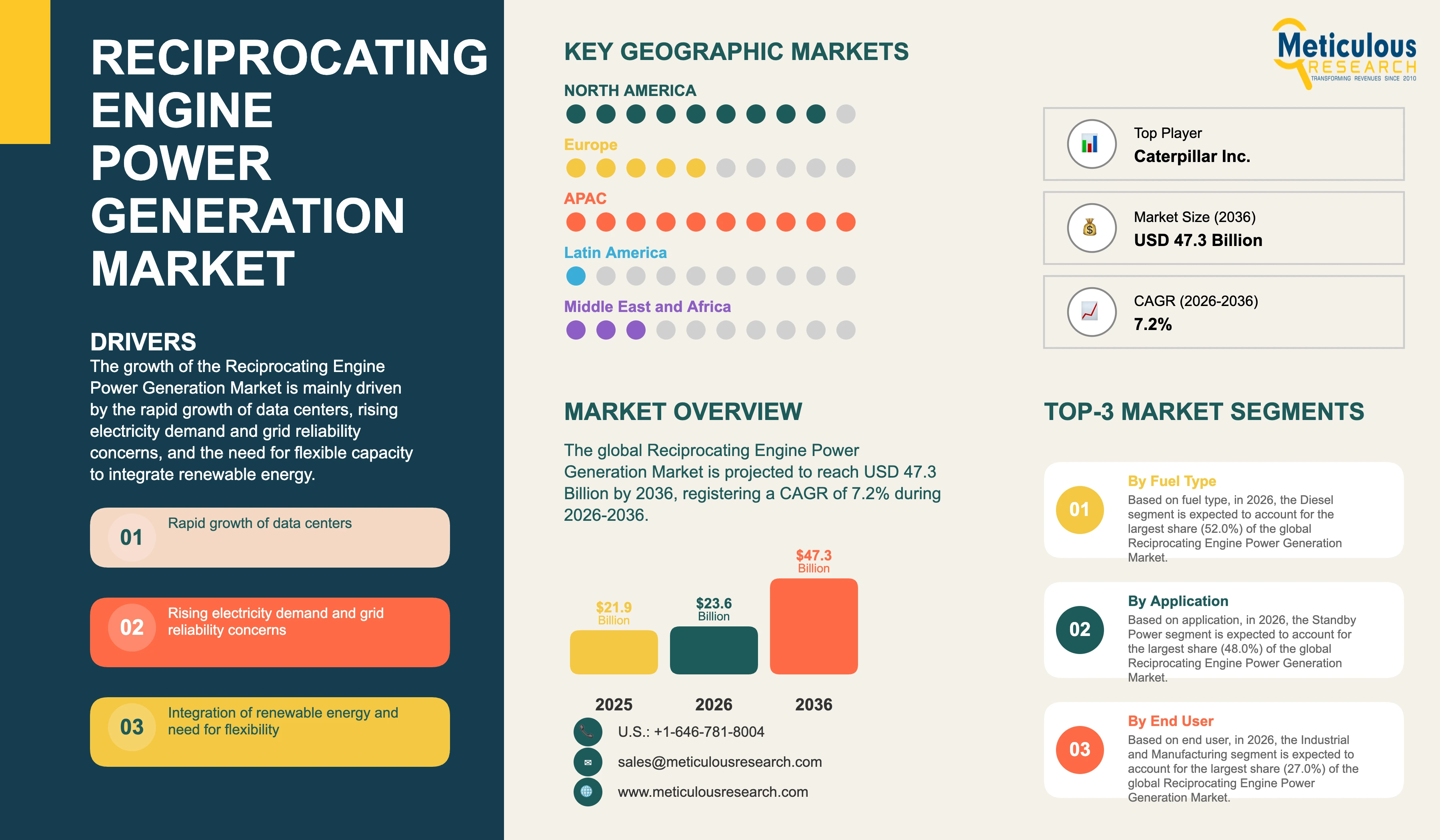
The global reciprocating engine power generation market was valued at USD 21.90 billion in 2025. This market is expected to reach USD 47.30 billion by 2036 from an estimated USD 23.60 billion in 2026, registering a CAGR of 7.2% during the forecast period (2026-2036).
- Published
- Nov 2026
- Pages
- 265
- Format
- PDF + Excel
- Report ID
- MREP - 1042533
- Base year
- 2025
- 2025 · BASELINE
- $21.90B
- 2036
- $47.30B
- CAGR 2026–2036
- 7.2%
2025 baseline · 2026–2036 forecast at 7.2% CAGR · hover a bar for the value
Key highlights
The International Energy Agency's Energy and AI report, published in April 2025, projected that global electricity consumption by data centers will more than double to around 945 TWh by 2030, and data center developers rely on reciprocating engine generator sets for backup power, with many now also deploying gas engines for on-site prime power because grid connections can take years.
The North American Electric Reliability Corporation's 2025 Long-Term Reliability Assessment, released in January 2026, forecast that summer peak demand will rise by about 224 GW over the next ten years, mainly because of data centers, and found that 13 of 23 assessment areas face elevated or high resource adequacy risk, which supports demand for fast-to-deploy engine power plants and backup generation.
Leading engine makers have announced major investments to expand production capacity for large engines and generator sets, including Caterpillar's expansion of its large engine facilities in the U.S. and capacity investments by Cummins, Rolls-Royce Power Systems, and INNIO, as order backlogs for data center and grid applications have grown.
INNIO and VoltaGrid announced a multi-gigawatt agreement in 2025 for Jenbacher gas engines to provide on-site power for data centers, illustrating the growing use of reciprocating engines as primary power sources for large computing campuses, alongside their traditional role in backup power.
Wärtsilä and other engine makers continue to win orders for gas engine power plants used for grid balancing in the U.S., Europe, Latin America, and Australia, where fast-starting engines complement wind, solar, and battery storage.
Data center operators such as Microsoft, Equinix, and others have switched many backup generators to hydrotreated vegetable oil (HVO) to reduce emissions, and engine makers have certified their engines to run on HVO and are developing hydrogen-ready gas engines.
Grid operators and utilities in Europe and North America are also procuring fast-start engine capacity to replace retiring coal and older gas plants, which adds to demand from data centers and industrial customers.
By fuel type, diesel accounts for the largest share of 52.0% in 2026, while dual-fuel and alternative fuel engines register the highest CAGR.
By application, standby power accounts for the largest share in 2026, while peaking and grid balancing registers the highest CAGR.
By end user, industrial and manufacturing accounts for the largest share of 27.0% in 2026, while data centers register the highest CAGR.
By geography, Asia-Pacific accounts for the largest share of 36.0% in 2026, while North America registers the highest CAGR of 8.4%.
Report summary
| Particulars | Details |
|---|---|
| Forecast Period | 2026-2036 |
| Base Year | 2025 |
| Estimated Year | 2026 |
| CAGR (Value) | 7.2% |
| Format | PDF, Excel & Cloud Portal · 265 pages |
| Market Size (Value) in 2025 | USD 21.90 billion |
| Market Size (Value) in 2026 | USD 23.60 billion |
| Market Size (Value) in 2036 | USD 47.30 billion |
| Largest Segment by Fuel Type (2026) | Diesel (52.0%) |
| Largest Segment by End User (2026) | Industrial and Manufacturing (27.0%) |
| Largest Region (2026) | Asia-Pacific (36.0%) |
| Fastest-Growing Region | North America (CAGR 8.4%) |
| Segments Covered | Fuel Type, Power Rating, Application, End User, and Geography |
| Countries Covered | Asia-Pacific, North America, Europe, Middle East and Africa, and Latin America |
| Key Companies | Caterpillar, Cummins, Rolls-Royce Power Systems, Wärtsilä, INNIO, Everllence, Mitsubishi Heavy Industries, Rehlko, Generac, HD Hyundai Heavy Industries, Weichai Power, Kirloskar Oil Engines, Yanmar, Bergen Engines, and Liebherr |
Report overview
Segments covered: fuel type, power rating, application, end user.
The growth of this market is mainly driven by the rapid construction of data centers, which require large amounts of backup power and, increasingly, on-site prime power while waiting for grid connections, rising electricity demand and grid reliability concerns in North America, Europe, and Asia, the need for flexible, fast-starting capacity to balance variable wind and solar generation, the expansion of industrial, healthcare, and commercial facilities that need reliable power, and the use of reciprocating engines for power in remote locations, mines, and oil and gas operations. However, factors such as tightening emission regulations for diesel engines, competition from batteries for short-duration backup and grid balancing, fuel price volatility, long lead times for large generator sets, and pressure to decarbonize are expected to restrain the growth of this market to some extent.
Reciprocating engine power generation refers to the use of internal combustion piston engines, fueled by diesel, natural gas, dual fuels, biogas, or alternative fuels such as hydrotreated vegetable oil (HVO) and hydrogen blends, to drive generators that produce electricity. Reciprocating engine generator sets range from small units used in homes and small businesses to engines of 20 MW or more used in power plants. They are used for standby power during grid outages, prime and continuous power where the grid is unavailable or unreliable, peaking and grid balancing to meet short-term demand and support renewable integration, and combined heat and power, in which waste heat from the engine is used for heating or industrial processes.
This market covers the global sales of reciprocating engine generator sets and engine-based power generation equipment with power ratings of 0.5 MW and above, measured in value. It is segmented by fuel type, power rating, application, end user, and geography. Generator sets below 0.5 MW, gas turbines, steam turbines, fuel cells, rental power services, and aftermarket parts and services are not included, although engine makers earn significant revenue from these areas.
Reciprocating engines have several advantages over other technologies for distributed and flexible power generation. They start quickly, often reaching full load in minutes, which makes them well suited to backup and peaking applications. They maintain high efficiency at partial load and in hot or high-altitude conditions, can be installed in modular blocks that are added as demand grows, and can run on a range of fuels. Engine power plants can be built faster than large gas turbine or coal plants, and individual engines can be serviced while the rest of the plant continues to operate.
The market has been transformed in recent years by the rapid growth of data centers. Data centers require highly reliable backup power, typically provided by banks of diesel generator sets of 2 to 3.5 MW each, and the construction of large artificial intelligence and cloud campuses has created unprecedented demand for these units. Because grid connections in many regions now take years, some data center developers are also installing natural gas engine plants to provide prime power on site, either as a bridge until grid power is available or as a long-term solution. Demand from data centers has led to long lead times for large generator sets and capacity expansions by major engine makers.
Reciprocating engines also play an important role in power systems with high shares of renewable energy. Gas engine power plants can start and stop many times a day to balance fluctuations in wind and solar output, and they are increasingly used alongside battery storage to provide longer-duration flexibility. In emerging markets in Asia, Africa, and Latin America, reciprocating engines provide prime power for industries, mines, islands, and grids with limited capacity.
The market is closely linked to the investment cycles of its main customers. Data center developers, utilities, industrial companies, and oil and gas producers each have different requirements for power rating, fuel, emissions, and reliability, and engine makers offer a wide range of products and services to serve them. Aftermarket services, including maintenance, overhauls, and remote monitoring, are an important source of recurring revenue for engine makers, although they are outside the scope of this market.
The market includes global engine and generator set manufacturers, such as Caterpillar, Cummins, Rolls-Royce Power Systems with its mtu brand, Wärtsilä, INNIO with its Jenbacher and Waukesha brands, Everllence (formerly MAN Energy Solutions), Mitsubishi Heavy Industries, Rehlko (formerly Kohler Energy), Generac, and HD Hyundai Heavy Industries, as well as regional manufacturers, such as Weichai Power in China, Kirloskar Oil Engines in India, Yanmar in Japan, Bergen Engines in Norway, and Liebherr in Europe.
Over the forecast period, the reciprocating engine power generation market is expected to grow steadily, supported by data centers, grid reliability needs, renewable integration, and industrial growth. Asia-Pacific is expected to remain the largest market, while North America is expected to grow fastest because of data center construction and rising demand for flexible capacity.
Standby power is expected to account for the largest share of the market in 2026, while peaking and grid balancing is projected to register the highest CAGR, driven by renewable integration and capacity needs.
Data centers require reliable backup power, typically provided by banks of large diesel generator sets, and grid connection delays are leading some developers to install natural gas engine plants for on-site prime power. The IEA projects that data center electricity use will more than double to around 945 TWh by 2030.
Engine makers are offering engines that meet EPA Tier 4 and EU emission limits, certifying engines to run on HVO and biogas, developing hydrogen-ready engines, and combining engines with batteries to reduce run time and fuel use.
The 2 MW to 5 MW segment is projected to register the highest CAGR, driven by demand for large generator sets for data centers, while the 1 MW to 2 MW segment accounts for the largest share.
Report infographic
Market dynamics
16 factors across 5 forcesRapid growth of data centers
The construction of data centers for cloud computing and artificial intelligence is the most important driver of the reciprocating engine power generation market. The International Energy Agency projected in 2025 that global data center electricity consumption will more than double to around 945 TWh by 2030, and large technology companies are investing hundreds of billions of dollars a year in data center capacity. Every data center requires backup power to keep operating during grid outages, and diesel generator sets remain the standard solution, with large campuses installing dozens or even hundreds of 2 to 3.5 MW units.
Grid connection delays have also created a new market for on-site prime power. In the U.S. and other countries, utilities cannot connect large new data centers quickly enough, so developers are installing natural gas reciprocating engine plants to power their facilities until grid capacity is available, and in some cases permanently. Engine makers such as Caterpillar, INNIO, Wärtsilä, and Cummins have received large orders for these applications. Data centers form the fastest-growing end user in this market.
Data center backup systems are typically designed with redundancy, such as N+1 or 2N configurations, which increases the number of generator sets required for each megawatt of IT load. Large AI training campuses of several hundred megawatts may require hundreds of generator sets, and developers often place orders years in advance to secure supply. Hyperscale operators in the U.S., Europe, and Asia are building multiple campuses at once, which has created record order backlogs for engine makers.
Rising electricity demand and grid reliability concerns
Electricity demand is rising in many countries because of data centers, electrification, and industrial growth, while older power plants are retiring. NERC's 2025 Long-Term Reliability Assessment forecast that summer peak demand in North America will rise by about 224 GW over ten years and found that 13 of 23 assessment areas face elevated or high resource adequacy risk. Extreme weather events, such as winter storms and heat waves, have caused major outages in recent years, which has increased demand for backup power at hospitals, factories, commercial buildings, and critical infrastructure.
Utilities and independent power producers are also building reciprocating engine plants to add capacity quickly, since engine plants can be built in months rather than the years needed for large power plants. Standby power accounts for the largest share of the market by application, reflecting the large installed base and continuing demand for backup generation.
Hospitals, airports, telecommunications facilities, water treatment plants, and other critical infrastructure are required by codes or regulations to maintain backup power, which provides a steady base of demand. Commercial buildings and retailers also install backup generators to protect against outages, particularly in regions exposed to hurricanes, wildfires, and winter storms.
Integration of renewable energy and need for flexibility
The growing share of wind and solar generation increases the need for flexible capacity that can respond quickly to changes in renewable output and demand. Gas engine power plants can start within minutes, run efficiently at partial load, and start and stop many times a day, which makes them well suited to balancing renewables. Grid operators in the U.S., Europe, Latin America, and Australia have procured engine plants for this purpose, often alongside battery storage, which provides short-duration flexibility while engines cover longer periods of low renewable output.
Peaking and grid balancing forms the fastest-growing application in this market, supported by renewable integration and capacity markets that reward flexible resources.
In Texas, for example, independent power producers have built gas engine plants to capture high prices during periods of scarcity and support the grid during extreme weather, and in the U.K. and other European countries, engine plants participate in capacity and balancing markets.
Industrial growth and power needs in emerging markets
Industrial growth in Asia, the Middle East, Africa, and Latin America creates demand for reliable power, and many factories, mines, and oil and gas facilities rely on reciprocating engines for prime or backup power where grids are weak or unavailable. Island grids and remote communities also depend on engine power plants. Industrial and manufacturing customers account for the largest share of the market by end user, reflecting their wide use of engine generation for backup and prime power.
Manufacturing investment in the U.S., including semiconductor fabrication plants, battery factories, and other large facilities, is also increasing demand for backup and on-site power.
Mining companies in Africa, Australia, and Latin America use engine power plants at remote mine sites, often combined with solar and batteries to reduce fuel costs, and oil and gas companies use engines for power at production sites and pipelines.
Table of contents
12 chapters · 123 sections · 265 pages · click to expandSegmental analysis
| Segment | Largest share (2026) | Fastest growth (2026–2036) |
|---|---|---|
| By Fuel Type | Diesel | Dual-fuel and alternative fuels |
| By Power Rating | 1 MW to 2 MW | 2 MW |
| By Application | Standby power | Peaking and grid balancing |
| By End User | Industrial and manufacturing | Data centers |
By Fuel Type
- Reciprocating Engine Power Generation Market Analysis by Fuel Type
- The diesel segment is expected to account for the largest share of 52.0% of the market.
- The large share of this segment is mainly due to the dominance of diesel generator sets in standby power for data centers, hospitals, commercial buildings, and industrial facilities, their reliability and fast start capability, the ease of storing diesel fuel on site, and their wide use for prime power in remote locations and emerging markets.
- Diesel generator sets are the standard solution for data center backup power, where they must start and reach full load within seconds during a grid outage, and large campuses install dozens or hundreds of units.
- Leading suppliers include Caterpillar, Cummins, Rolls-Royce Power Systems with its mtu brand, Rehlko, and Mitsubishi Heavy Industries.
- Many operators now run their diesel generators on HVO to reduce emissions, which allows them to keep diesel engines while meeting sustainability goals.
- Diesel is expected to remain the largest fuel type over the forecast period, supported by data center construction, although its share is expected to decline as gas and alternative fuel engines grow faster.
- Diesel generator sets are also widely used for prime power in Africa, the Middle East, South Asia, and other regions where grids are unreliable, and for backup power in hospitals, telecommunications sites, and commercial buildings worldwide.
- Emission rules in the U.S. and Europe are encouraging the use of aftertreatment systems and cleaner engines, while in many emerging markets, lower-cost diesel generator sets remain the main option for backup power.
- However, the dual-fuel and alternative fuels segment is projected to register the highest CAGR during the forecast period.
- The rapid growth of this segment is driven by decarbonization goals and the adoption of HVO, biogas, and hydrogen-ready engines.
- Natural gas engines make up the rest of the market and are growing quickly for prime power, peaking, grid balancing, and combined heat and power.
- Natural gas engines are used for prime power at data centers, industrial facilities, and remote sites with gas supply, for peaking and grid balancing plants, and for combined heat and power in industries, hospitals, and district heating systems.
- They offer lower emissions and fuel costs than diesel engines for applications with long running hours, and their share is expected to increase as data centers adopt on-site gas power.
- Leading suppliers include INNIO Jenbacher, Wärtsilä, Caterpillar, Rolls-Royce Power Systems, Everllence, and Mitsubishi Heavy Industries.
- Dual-fuel engines, which can switch between gas and diesel, offer fuel security for critical applications, and engines running on biogas, HVO, and hydrogen blends are growing as customers seek lower emissions.
By Power Rating
- Reciprocating Engine Power Generation Market Analysis by Power Rating
- The 1 MW to 2 MW segment is expected to account for the largest share of the market, due to the wide use of generator sets in this range for commercial, industrial, and healthcare backup power.
- However, the 2 MW to 5 MW segment is projected to register the highest CAGR during the forecast period, driven by demand for large generator sets for data centers.
- The 0.5 MW to 1 MW and above 5 MW segments make up the rest of the market, with large engines above 5 MW used mainly in power plants.
- Generator sets of 2 MW to 5 MW, such as the 3 MW and larger units now offered by several manufacturers, are increasingly preferred for large data centers because they reduce the number of units and the footprint required.
- Engines above 5 MW are mainly used in power plants for utilities, independent power producers, and industrial users, where multiple large engines are combined into plants of tens or hundreds of megawatts.
By Application
- Reciprocating Engine Power Generation Market Analysis by Application
- The standby power segment is expected to account for the largest share of the market, due to demand for backup power at data centers, hospitals, commercial buildings, and industrial facilities.
- However, the peaking and grid balancing segment is projected to register the highest CAGR during the forecast period, driven by renewable integration and capacity needs.
- Prime and continuous power and combined heat and power make up the rest of the market.
- Prime and continuous power applications include remote sites, industrial facilities, and data centers using on-site generation, while combined heat and power is widely used in Europe for district heating, greenhouses, and industrial processes.
- Peaking and grid balancing plants are used by utilities and independent power producers to meet peak demand and balance renewable output.
By End User
- Reciprocating Engine Power Generation Market Analysis by End User
- The industrial and manufacturing segment is expected to account for the largest share of 27.0% of the market.
- The large share of this segment is mainly due to the wide use of reciprocating engines for backup and prime power in factories, process industries, and industrial parks, particularly in Asia, the Middle East, and other regions with less reliable grids, and the use of gas engines for combined heat and power in industrial facilities.
- Industries such as chemicals, food processing, textiles, cement, and metals rely on engine generation to avoid costly production interruptions, and many industrial parks in emerging markets operate captive engine power plants.
- Industrial and manufacturing is expected to remain the largest end user over the forecast period.
- In regions with frequent outages, such as parts of South Asia, Africa, and the Middle East, industrial companies often operate engines for many hours each year, which increases demand for efficient gas and diesel engines and for combined heat and power.
- In developed markets, industrial companies are also installing backup and combined heat and power systems to improve resilience and reduce energy costs.
- However, the data centers segment is projected to register the highest CAGR during the forecast period.
- The rapid growth of this segment is driven by the construction of AI and cloud data centers and the need for on-site power.
- Utilities and independent power producers, commercial and healthcare, and oil, gas, and mining make up the rest of the market.
- Utilities and independent power producers use reciprocating engines for peaking and grid balancing plants and for power in island grids and remote areas.
- Commercial and healthcare customers, including hospitals, offices, retail, and hotels, use generator sets for backup power, while oil, gas, and mining companies use engines for power at remote production and mine sites.
Geographic analysis
Asia-Pacific
Largest shareIn 2026, Asia-Pacific is expected to account for the largest share of 36.0% of the global reciprocating engine power generation market. The large share of this region is mainly due to rapid industrial growth, unreliable grids in several countries, large data center construction in China, India, Japan, Singapore, Malaysia, and Australia, and the use of engines for power in island grids and remote areas. China and India have large domestic engine industries, led by companies such as Weichai Power and Kirloskar Oil Engines, and strong demand for backup and prime power. Southeast Asian countries, such as Indonesia and the Philippines, use engine power plants for island grids. Asia-Pacific is expected to remain the largest region throughout the forecast period. Data center construction in Singapore, Malaysia, Japan, India, and Australia has added significant demand for large generator sets, and Malaysia's Johor region has become one of the fastest-growing data center hubs in Asia. Japan and South Korea use engines for backup power and combined heat and power. Rapid electrification and industrial growth in India and Southeast Asia, combined with grid constraints, are expected to sustain strong demand for both backup and prime power engines across the region.
North America
Fastest growthNorth America is projected to register the highest CAGR of 8.4% during the forecast period. Growth is driven by the rapid construction of data centers, grid reliability concerns, and demand for on-site prime power. The U.S. accounts for the largest share of global data center construction, and developers in Texas, Virginia, Ohio, Arizona, and other states are installing large fleets of backup generators and, increasingly, on-site gas engine plants. NERC's forecast of rapid peak demand growth and concerns about winter reliability are also driving utilities and independent power producers to build engine plants for peaking capacity. Canada is a smaller market, with demand from data centers, mining, and remote communities.
Europe
Europe holds a significant share, supported by data centers and grid balancing, while the Middle East and Africa and Latin America are important markets for prime power. In Europe, data center hubs in Ireland, Germany, the Netherlands, the U.K., and the Nordic countries require large backup generator fleets, and gas engines are widely used for combined heat and power and grid balancing.
Middle East & Africa
In the Middle East and Africa, engines provide prime and backup power for industries, oil and gas operations, and grids with limited capacity, while Latin America uses engine plants for remote power and grid support.
Competitive landscape
The reciprocating engine power generation market is moderately concentrated, with a few global engine makers holding large shares. Leading companies include Caterpillar, Cummins, Rolls-Royce Power Systems, Wärtsilä, INNIO, Everllence, Mitsubishi Heavy Industries, Rehlko, Generac, HD Hyundai Heavy Industries, Weichai Power, Kirloskar Oil Engines, Yanmar, Bergen Engines, and Liebherr.
Companies compete on reliability, power density, efficiency, emissions, fuel flexibility, delivery times, service networks, and price.
Caterpillar and Cummins are the largest suppliers of diesel and gas generator sets worldwide, with extensive dealer and service networks. Rolls-Royce Power Systems, with its mtu brand, is a leading supplier of large generator sets for data centers. Wärtsilä and Everllence specialize in large engine power plants for utilities and independent power producers, while INNIO, with its Jenbacher brand, is a leader in gas engines for prime power, combined heat and power, and data centers. Mitsubishi Heavy Industries, Rehlko, and Generac supply generator sets for data center, industrial, and commercial applications, and HD Hyundai Heavy Industries, Weichai Power, Kirloskar Oil Engines, Yanmar, Bergen Engines, and Liebherr serve regional and specialized markets.
Data center customers often qualify only a small number of generator suppliers, and long-term framework agreements with hyperscale operators have become an important competitive advantage for leading manufacturers.
The top five players are estimated to account for 50.0% of the reciprocating engine power generation market in 2025.
Players use several strategies to grow in this market, including capacity expansion, new products, partnerships with data center developers, and fuel flexibility.
For example, engine makers have announced investments to expand production of large engines and generator sets, launched larger and more power-dense units for data centers, certified engines for HVO and hydrogen blends, and signed framework agreements with data center developers. Some have formed partnerships with developers to supply complete on-site power plants.
Competition is expected to center on capacity and delivery times.
Suppliers that can deliver large volumes of generator sets quickly, support customers with service and fuel flexibility, and meet emission requirements are expected to gain share. Competition from Chinese and Korean manufacturers is increasing in price-sensitive markets, while established suppliers rely on their reliability records and service networks.
Some of the key players operating in the reciprocating engine power generation market are Caterpillar Inc., Cummins Inc., Rolls-Royce Power Systems AG, Wärtsilä Corporation, INNIO Group, Everllence SE, Mitsubishi Heavy Industries, Ltd., Rehlko, Generac Holdings Inc., HD Hyundai Heavy Industries Co., Ltd., Weichai Power Co., Ltd., Kirloskar Oil Engines Limited, Yanmar Holdings Co., Ltd., Bergen Engines AS, and Liebherr Group.
- —
Engine makers expanded production capacity for large engines, INNIO and VoltaGrid announced a multi-gigawatt data center power agreement, and NERC forecast rapid peak demand growth.
- Caterpillar
- Cummins
- Rolls-Royce Power Systems
- Wärtsilä
- INNIO
- Everllence
- Mitsubishi Heavy Industries
- Rehlko
- Generac
- HD Hyundai Heavy Industries
- Weichai Power
- Kirloskar Oil Engines
- Yanmar
- Bergen Engines
- Liebherr
Expert perspectives
Reciprocating engines have become central to meeting the power needs of data centers and to maintaining grid reliability during a period of rapid demand growth.
The market is benefiting from a combination of strong data center demand, grid reliability concerns, and the need for flexible capacity to balance renewables. Data centers have transformed the market for large generator sets, creating record order backlogs and prompting major capacity investments by engine makers. At the same time, grid operators and utilities need fast-to-build, flexible capacity, which supports demand for gas engine power plants.
Emission regulations, competition from batteries, and decarbonization goals will shape the market, pushing engine makers toward cleaner engines, alternative fuels, and hybrid systems. Engines are expected to run fewer hours in some applications as batteries take on short-duration roles, but the need for reliable backup and long-duration flexibility is expected to keep demand strong.
Over the forecast period, the market is expected to grow at about 7.2% per year, supported by data centers, grid balancing, and industrial growth.
Growth is expected to be strongest in data centers, peaking and grid balancing, and alternative fuel engines, while diesel standby generators remain the largest segment. On-site prime power for data centers could become a major new application if grid constraints persist.
Diesel is the largest fuel type, while alternative fuels grow fastest. Industrial customers are the largest end user, while data centers grow fastest.
The 2 MW to 5 MW segment is expected to grow fastest by power rating, reflecting the shift to larger generator sets for data centers.
Asia-Pacific will remain the largest region because of its industrial base and growing data center market, while North America grows fastest on the back of data centers and grid needs. Europe will be shaped by data center growth in a few hubs and by grid balancing needs as coal and nuclear capacity retires in some countries.
Asia-Pacific remains the largest region, while North America is the fastest-growing region at a CAGR of 8.4%.
For engine makers, the key priorities are capacity, fuel flexibility, and emissions.
The main swing factors are the pace of data center construction, the speed of grid expansion, emission regulations, and the competitiveness of batteries and other technologies. For customers, the key priorities are securing supply early, planning for low-carbon fuels, and combining engines with batteries and other resources to improve efficiency and reduce emissions. Overall, reciprocating engines are expected to remain an essential part of power systems over the forecast period, providing backup, prime, and flexible power.
Customer perspectives
Vice President of Critical Infrastructure - Data center developer, U.S.
Our campuses need hundreds of megawatts of backup generators, and lead times are now our biggest constraint. We also build gas engine plants when the grid cannot connect us in time.
This explains why data centers are the fastest-growing end user and diesel accounts for 52.0% of the market.
For data center developers, power availability has become one of the most important factors in site selection and project timelines, ahead of land and fiber connectivity in some markets.
This explains why industrial and manufacturing accounts for 27.0% of the market.
For industrial companies in regions with unreliable grids, engine generation is an essential part of operations and a significant factor in production costs.
Head of Generation Planning - Independent power producer, U.S.
Our gas engine plants can start in five minutes and run whenever wind and solar fall off. They are the right tool for a grid with more renewables.
This explains why peaking and grid balancing is the fastest-growing application and why North America is the fastest-growing region.
Facilities Director - Hospital network, U.K.
Our generators have to start every time the grid fails. We are moving them to HVO to meet our net zero commitments without compromising reliability.
This explains why alternative fuels are the fastest-growing fuel type and why commercial and healthcare customers remain an important end user.
“Grid outages cost us production. Our gas engines keep the plant running and supply heat for our processes.”
Frequently asked questions
The market was valued at USD 21.90 billion in 2025 and USD 20.10 billion in 2024, and is estimated at USD 23.60 billion in 2026.
Cite this report
Meticulous Research. (2026). Reciprocating Engine Power Generation Market - Global Opportunity Analysis and Industry Forecast (2026-2036) (Report No. MREP - 1042533). Meticulous Market Research Pvt. Ltd. https://www.meticulousresearch.com/product/reciprocating-engine-power-generation-market-7216