Demand Response Management Systems Market (2026-2036)
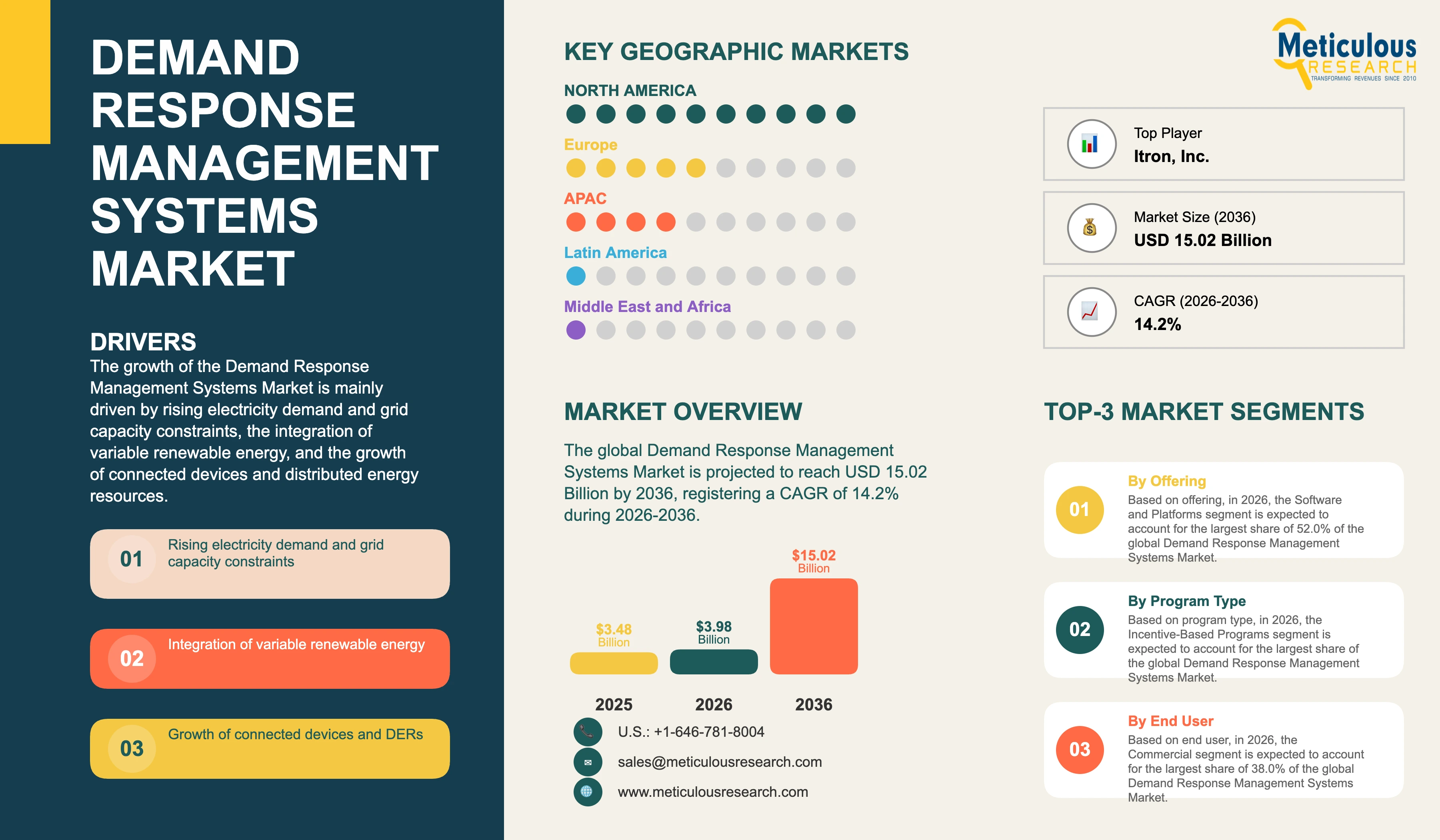
The global demand response management systems market was valued at USD 3.48 billion in 2025. This market is expected to reach USD 15.02 billion by 2036 from an estimated USD 3.98 billion in 2026, registering a CAGR of 14.2% during the forecast period (2026-2036).
- Published
- Nov 2026
- Pages
- 249
- Format
- PDF + Excel
- Report ID
- MREP - 1042521
- Base year
- 2025
- 2025 · BASELINE
- $3.48B
- 2036
- $15.02B
- CAGR 2026–2036
- 14.2%
2025 baseline · 2026–2036 forecast at 14.2% CAGR · hover a bar for the value
Key highlights
The North American Electric Reliability Corporation's 2025 Long-Term Reliability Assessment, released in January 2026, forecast that summer peak demand will rise by about 224 GW and winter peak demand by about 245 GW over the next ten years, driven mainly by data centers, and found that 13 of 23 assessment areas face elevated or high resource adequacy risk, which increases the value of demand flexibility for utilities, grid operators, and large energy users.
The Federal Energy Regulatory Commission's 2025 Assessment of Demand Response and Advanced Metering found that demand response participation in the seven U.S. wholesale markets reached about 33,272 MW in 2024, and that demand response resources could meet about 6.5% of wholesale market peak demand.
FERC Order 2222 requires regional transmission organizations and independent system operators to allow aggregations of distributed energy resources, including demand response, to participate in wholesale markets, and grid operators such as CAISO, PJM, NYISO, ISO-NE, and MISO are implementing their compliance plans in phases through the second half of the decade.
The EU's reformed electricity market design, adopted in 2024, requires member states to assess flexibility needs and allows them to introduce support schemes for non-fossil flexibility, including demand response, while a European network code on demand response is being developed to remove barriers to participation.
The U.S. Department of Energy's virtual power plant liftoff report estimated that scaling virtual power plants to 80 to 160 GW by 2030 could address 10% to 20% of U.S. peak demand and save billions of dollars in grid costs each year, and utilities and aggregators are rapidly expanding programs that control smart thermostats, batteries, and electric vehicles.
Utilities and technology companies are expanding partnerships with device makers, automakers, and charger manufacturers to enroll smart thermostats, home batteries, and electric vehicles in demand response programs directly through manufacturers' cloud platforms, which lowers enrollment costs and allows programs to scale to hundreds of thousands of devices.
By offering, software and platforms account for the largest share of 52.0% in 2026 and register the higher CAGR.
By program type, incentive-based programs account for the largest share in 2026, while price-based programs register the higher CAGR.
By end user, the commercial segment accounts for the largest share of 38.0% in 2026, while the residential segment registers the highest CAGR.
By geography, North America accounts for the largest share of 48.0% in 2026, while Asia-Pacific registers the highest CAGR of 17.1%.
Report summary
| Particulars | Details |
|---|---|
| Forecast Period | 2026-2036 |
| Base Year | 2025 |
| Estimated Year | 2026 |
| CAGR (Value) | 14.2% |
| Format | PDF, Excel & Cloud Portal · 249 pages |
| Market Size (Value) in 2025 | USD 3.48 billion |
| Market Size (Value) in 2026 | USD 3.98 billion |
| Market Size (Value) in 2036 | USD 15.02 billion |
| Segments Covered | Offering, Program Type, Deployment Mode, Customer Type, End User, and Geography |
| Countries Covered | North America, Europe, Asia-Pacific, Latin America, and Middle East and Africa |
| Key Companies | Itron, Oracle, Siemens, Schneider Electric, GE Vernova, Hitachi Energy, Landis+Gyr, Uplight, EnergyHub, Renew Home, Kraken Technologies, Voltus, CPower, Enel X, and Generac |
| Largest Segment by Offering (2026) | Software and Platforms (52.0%) |
| Largest Segment by End User (2026) | Commercial (38.0%) |
| Largest Region (2026) | North America (48.0%) |
| Fastest-Growing Region | Asia-Pacific (CAGR 17.1%) |
Report overview
Segments covered: offering, program type, deployment mode, customer type, end user.
The growth of this market is mainly driven by the rapid rise in electricity demand from data centers, electrification, and industrial growth, which is straining grid capacity and increasing the value of flexible demand, the growing share of variable wind and solar generation that requires more flexibility to balance supply and demand, the rapid spread of smart thermostats, electric vehicles, home batteries, heat pumps, and smart meters that can be controlled remotely, regulatory reforms such as the U.S. Federal Energy Regulatory Commission's Order 2222 and the EU's electricity market design reform that open markets to demand-side resources, and the growth of virtual power plants. However, factors such as low customer enrollment and fatigue in some programs, complex and fragmented market rules, the cost and difficulty of integrating diverse devices and utility systems, concerns about data privacy and cybersecurity, and uncertain revenue streams for aggregators are expected to restrain the growth of this market to some extent.
Demand response is the practice of changing electricity consumption in response to grid conditions, prices, or signals from utilities and grid operators, for example by reducing or shifting load during periods of peak demand or high prices, or increasing load when there is surplus renewable generation. Demand response management systems (DRMS) are the software platforms and related services that utilities, grid operators, aggregators, and retail energy providers use to design, enroll, forecast, dispatch, monitor, measure, and settle demand response programs. They connect to devices such as smart thermostats, water heaters, electric vehicle chargers, home and commercial batteries, heat pumps, building management systems, and industrial processes, and they increasingly operate as virtual power plants that aggregate many distributed resources into a single controllable resource.
This market covers the global revenue from demand response management software and platforms and related services, measured in value, including program management and managed demand response services. It is segmented by offering, program type, deployment mode, customer type, end user, and geography. Payments made to customers for participating in demand response programs, smart meters and other hardware, and energy savings from efficiency programs are not included, nor are distributed energy resource management systems used only for grid operations without demand response functions.
Electricity systems in most major economies are facing rapid and simultaneous changes in demand and supply. Demand is rising again after years of flat growth, driven by data centers, electrification of transport and heating, and new manufacturing, and the North American Electric Reliability Corporation forecasts that summer peak demand in North America will grow by about 224 GW over the next decade. At the same time, the share of variable wind and solar generation is increasing and older dispatchable plants are retiring, which makes it harder to balance supply and demand. Building new generation and transmission takes years, so utilities and grid operators are turning to demand flexibility as a faster and cheaper way to manage peaks and maintain reliability.
The number of devices that can provide demand response has grown rapidly. Millions of homes have smart thermostats, electric vehicles, rooftop solar, and home batteries, and commercial and industrial buildings have advanced building management and energy storage systems. Smart meters, which are now installed in most homes in the U.S., many European countries, China, and other markets, allow utilities to measure consumption in short intervals and offer time-varying prices. These developments allow demand response to move from a few large industrial customers to millions of small resources coordinated by software.
The value of demand response has also increased because of higher and more volatile wholesale prices and capacity costs. In PJM, the largest U.S. wholesale market, capacity auction prices rose sharply for the 2025/2026 and 2026/2027 delivery years, which increased payments to demand response resources and encouraged utilities and aggregators to expand programs. Similar price signals in Texas, Europe, and Australia have increased interest in flexible demand.
Regulatory changes are also opening wholesale and retail electricity markets to demand response. FERC Order 2222 requires U.S. wholesale markets to allow aggregations of distributed energy resources to participate, and the EU's reformed electricity market design and planned network code on demand response aim to remove barriers in Europe. In the U.K., the National Energy System Operator's Demand Flexibility Service and other programs have paid households and businesses to reduce or shift consumption, and Australia and Japan have introduced wholesale demand response mechanisms.
The market includes several types of providers with different customers and business models. Grid technology and software companies, such as Itron, Oracle, Siemens, Schneider Electric, GE Vernova, Hitachi Energy, and Landis+Gyr, offer DRMS and related grid software to utilities. Specialist platform providers, such as Uplight, EnergyHub, Renew Home, and Kraken Technologies, focus on residential and small business flexibility and virtual power plants. Demand response aggregators, such as Voltus, CPower, and Enel X, enroll commercial and industrial customers and bid their flexibility into wholesale markets, while Generac offers grid services software that connects distributed energy resources.
Over the forecast period, the demand response management systems market is expected to grow strongly, supported by load growth, renewable integration, device adoption, and market reforms. North America is expected to remain the largest market, while Asia-Pacific is expected to grow fastest as China, Japan, Australia, South Korea, and India expand demand response programs.
Incentive-based programs are expected to account for the largest share of the market in 2026, while price-based programs are projected to register the higher CAGR, driven by smart meters and dynamic tariffs.
A virtual power plant aggregates many distributed resources, such as smart thermostats, batteries, electric vehicles, and water heaters, and controls them through software so that they act like a single power plant that can reduce or shift demand or supply power to the grid.
Aggregators and retail energy providers are projected to register the highest CAGR among customer types, as wholesale markets open to aggregated distributed resources and retailers launch flexibility tariffs and virtual power plants.
FERC Order 2222, issued by the Federal Energy Regulatory Commission in 2020, requires U.S. regional transmission organizations and independent system operators to allow aggregations of distributed energy resources, including demand response, to participate in wholesale energy, capacity, and ancillary services markets.
NERC forecasts that summer peak demand in North America will rise by about 224 GW over ten years, driven by data centers, while the share of variable renewables grows, so demand flexibility offers a fast and low-cost way to maintain reliability while new generation and transmission are built.
Report infographic
Market dynamics
16 factors across 5 forcesRising electricity demand and grid capacity constraints
Electricity demand is rising rapidly in many countries after years of slow growth. In North America, NERC's 2025 Long-Term Reliability Assessment forecast that summer peak demand will grow by about 224 GW and winter peak demand by about 245 GW over the next ten years, mainly because of new data centers, as well as electrification and industrial growth, and found that 13 of 23 assessment areas face elevated or high resource adequacy risks. Similar trends are seen in Europe and Asia, where electrification of transport and heating and new industrial loads are increasing demand.
Building new power plants and transmission lines takes many years and faces permitting and supply chain delays, so utilities and grid operators are turning to demand response as a faster and cheaper way to manage peak demand and maintain reliability. Demand flexibility from large new loads, such as data centers, is also being explored as a way to connect them to the grid more quickly. These trends increase the value of demand response and drive investment in DRMS.
Interconnection queues for new generation are long in many regions, and supply chain constraints for transformers, turbines, and other equipment have delayed projects. Demand response can be deployed in months rather than years and at lower cost than building new peaking capacity, which makes it an attractive part of utility resource plans. Several utilities and grid operators have included large amounts of demand response and virtual power plant capacity in their integrated resource plans and capacity procurements.
Integration of variable renewable energy
The growing share of wind and solar generation increases the need for flexibility to balance supply and demand, since output varies with the weather and time of day. Demand response can shift consumption to periods of high renewable output, reduce demand during evening peaks when solar output falls, and provide fast-responding ancillary services. Grid operators in California, Texas, Europe, and Australia are increasingly using demand flexibility to manage the integration of renewables.
Price-based programs, such as time-of-use and dynamic tariffs that encourage customers to shift consumption, are growing quickly as smart meters and automated devices make it easier for customers to respond. Price-based programs form the faster-growing program type in this market.
In Europe, dynamic electricity price contracts are now required to be offered by larger suppliers under EU rules, and energy suppliers in the U.K. and other countries have launched tariffs that reward customers for shifting consumption to periods of low prices. These tariffs, combined with automated control of devices, are creating a new form of demand response that depends on software platforms.
Growth of connected devices and distributed energy resources
Smart thermostats, electric vehicles, home and commercial batteries, heat pumps, smart water heaters, and building management systems can all be controlled remotely to provide demand response. Sales of electric vehicles and home batteries have grown rapidly, and many device manufacturers now include demand response capabilities and standard communication protocols, such as OpenADR. This allows utilities and aggregators to enroll large numbers of devices quickly through manufacturers' cloud platforms, often with little or no hardware installation.
Standards such as OpenADR, IEEE 2030.5, and Matter, as well as device-specific interfaces offered by thermostat, battery, and vehicle manufacturers, make it easier for DRMS to communicate with devices. Bring-your-own-device programs, in which customers enroll devices they already own, have become a popular and low-cost way for utilities to build demand response capacity.
The residential segment forms the fastest-growing end user in this market, driven by the rapid adoption of connected devices and residential virtual power plant programs.
Regulatory reforms and market access
Regulators in North America, Europe, and Asia-Pacific are opening electricity markets to demand-side resources. FERC Order 2222 requires U.S. wholesale markets to allow aggregations of distributed energy resources to participate in capacity, energy, and ancillary services markets, and grid operators are implementing compliance plans. The EU's 2024 electricity market design reform requires member states to assess their flexibility needs and allows support for non-fossil flexibility, and a European network code on demand response is being developed. Many U.S. states have set targets or requirements for demand flexibility and virtual power plants, and countries such as Australia, Japan, and the U.K. have introduced new mechanisms for demand response.
These reforms create new revenue opportunities for demand response and increase demand for software that can manage participation in complex markets.
In Asia-Pacific, Japan has introduced demand response into its capacity market and balancing markets, Australia has a wholesale demand response mechanism, and China has expanded demand response programs in provinces facing peak shortages. India is also developing demand response as part of its smart meter rollout and time-of-day tariff policies.
Table of contents
13 chapters · 125 sections · 249 pages · click to expandSegmental analysis
| Segment | Largest share (2026) | Fastest growth (2026–2036) |
|---|---|---|
| By Offering | Software and platforms | — |
| By Program Type | Incentive-based programs | — |
| By Deployment Mode | Cloud-based | — |
| By Customer Type | Utilities | Aggregators and retail energy providers |
| By End User | Commercial | Residential |
By Offering
- The software and platforms segment is expected to account for the largest share of 52.0% of the market.
- The large share of this segment is mainly due to the growing use of cloud-based DRMS and virtual power plant platforms by utilities and aggregators, the need to manage large numbers of distributed devices and complex market participation, and the shift from manual programs to automated, software-driven flexibility.
- DRMS platforms provide program enrollment, device integration, forecasting, dispatch, monitoring, measurement and verification, and settlement, and they increasingly use AI to optimize performance.
- Software and platforms are expected to remain the largest offering and also to register the higher CAGR over the forecast period.
- Services, including program design, implementation, customer engagement, and managed demand response, make up the rest of the market.
- Utilities are replacing older demand response systems that managed a few programs with modern platforms that can handle many programs, device types, and market products.
- Platform providers increasingly sell virtual power plant software that aggregates distributed resources and offers them into wholesale markets, as well as customer engagement tools that support enrollment and retention.
- Software is typically sold as subscriptions priced by the number of devices, customers, or megawatts managed, which creates recurring revenue for providers.
- Services include program design and implementation, customer marketing and enrollment, device installation support, and managed demand response, in which providers run programs on behalf of utilities and are paid for delivered capacity.
- Services remain important because many utilities lack the staff and expertise to design and operate programs at scale.
- The software segment also benefits from the growth of virtual power plants operated by retailers and aggregators, which need sophisticated platforms to forecast flexibility, optimize bids, and dispatch devices across markets.
- Integration with device manufacturers' platforms, such as those of thermostat, battery, inverter, and electric vehicle makers, is a key capability, and providers that support the widest range of devices can enroll customers most efficiently.
- Artificial intelligence is increasingly used to forecast load, optimize dispatch, and personalize engagement, which improves program performance and adds value for customers.
By Program Type
- The incentive-based programs segment is expected to account for the largest share of the market, due to the wide use of direct load control, capacity, and ancillary services programs.
- However, the price-based programs segment is projected to register the higher CAGR during the forecast period, driven by smart meters and dynamic tariffs.
- Incentive-based programs pay participants for reducing load when called, through direct load control of devices such as thermostats and water heaters, capacity and ancillary services programs in wholesale markets, and interruptible tariffs for large customers.
- Price-based programs use time-of-use, critical peak, and real-time prices to encourage customers to shift consumption, and they are growing as smart meters and dynamic tariffs spread.
- Incentive-based programs are expected to remain the larger segment because they provide reliable, dispatchable capacity that grid operators and utilities can plan around, while price-based programs grow faster as dynamic tariffs and automation spread.
By Deployment Mode
- The cloud-based segment is expected to account for the largest share of the market and is also projected to register the higher CAGR, driven by the scalability needed to manage millions of devices.
- Cloud-based platforms can integrate with device manufacturers' clouds and scale to millions of devices, while on-premises systems remain in use at some utilities with strict security policies.
- Most new DRMS deployments are cloud-based, and many utilities are migrating existing programs to cloud platforms to reduce costs and add capabilities.
By Customer Type
- The utilities segment is expected to account for the largest share of the market, while the aggregators and retail energy providers segment is projected to register the highest CAGR, driven by wholesale market access.
- Utilities run most residential and small business programs and buy software and services to manage them, while aggregators and retail energy providers enroll commercial and industrial customers and, increasingly, residential devices, and bid them into wholesale markets.
- Grid operators use demand response for reliability and balancing.
- Aggregators are expected to gain share as FERC Order 2222 and European market reforms allow them to aggregate small resources and participate directly in wholesale markets.
By End User
- The commercial segment is expected to account for the largest share of 38.0% of the market.
- The large share of this segment is mainly due to the large and controllable loads in office buildings, retail stores, warehouses, hospitals, schools, and data centers, the use of building management systems and batteries, and long-standing participation in demand response programs.
- Commercial customers can reduce load by adjusting heating, ventilation, and air conditioning, lighting, and refrigeration, or by using on-site batteries and generators.
- The commercial segment is expected to remain the largest end user over the forecast period.
- Commercial buildings account for a large share of electricity use during peak periods, particularly for cooling in summer, and building automation systems make it easy to adjust loads with minimal impact on occupants.
- Many commercial customers participate through aggregators such as Voltus, CPower, and Enel X, which manage their participation in wholesale capacity and energy markets.
- On-site batteries and backup generators also allow commercial customers to provide demand response without reducing operations.
- Data centers, hospitals, universities, and retail chains are among the most active commercial participants, and new commercial buildings increasingly include batteries, electric vehicle charging, and smart controls that increase their flexibility.
- However, the residential segment is projected to register the highest CAGR during the forecast period.
- The rapid growth of this segment is driven by smart thermostats, electric vehicles, and home batteries.
- The industrial segment makes up the rest of the market, with large energy users such as steel, cement, chemicals, and cold storage participating in interruptible and capacity programs.
- Industrial customers have large and often flexible loads, such as pumping, refrigeration, electric furnaces, and process equipment, and they have long participated in interruptible and capacity programs.
- Their flexibility is expected to grow as electrification of industrial heat and hydrogen production adds new flexible loads.
- The residential segment is growing rapidly as smart thermostats, electric vehicles, home batteries, and heat pumps are enrolled in programs, and residential virtual power plants are becoming a major source of flexible capacity in many markets.
Geographic analysis
North America
Largest shareIn 2026, North America is expected to account for the largest share of 48.0% of the global demand response management systems market. The large share of this region is mainly due to well-established demand response programs, wholesale markets that allow demand response participation, high adoption of smart thermostats and smart meters, and rapid load growth from data centers. The U.S. is the largest market in the world for DRMS, with about 33 GW of demand response participating in wholesale markets in 2024 according to FERC and many utility programs. North America is expected to remain the largest region throughout the forecast period. U.S. utilities run some of the world's largest residential demand response and virtual power plant programs, such as bring-your-own-thermostat and battery programs in California, Texas, and the Northeast, and wholesale markets such as PJM, MISO, ERCOT, and CAISO allow demand response to provide capacity and other services. Rapid load growth from data centers and high capacity prices are increasing the value of demand response. Canada also has growing programs, particularly in Ontario.
Asia-Pacific
Fastest growthAsia-Pacific is projected to register the highest CAGR of 17.1% during the forecast period. Growth is driven by demand response programs in China, Japan, Australia, South Korea, and India. China has expanded demand response programs in provinces facing summer peak shortages and is developing virtual power plants in major cities, while Japan has integrated demand response into its capacity and balancing markets. Australia's high rooftop solar and home battery adoption supports virtual power plant programs, and South Korea operates a national demand response market. India's smart meter rollout is creating a foundation for demand response. Rising air conditioning demand, rapid electric vehicle adoption, and large renewable additions make demand flexibility increasingly valuable across the region.
Europe
Europe holds a large share, supported by market reforms, while Latin America and the Middle East and Africa are smaller markets. In Europe, the U.K. is a leader in residential flexibility through programs such as the Demand Flexibility Service and dynamic tariffs, while Germany, France, the Netherlands, and the Nordic countries are opening balancing and flexibility markets to demand-side resources. The EU's market design reform and network code on demand response are expected to accelerate growth across the region.
Latin America
Latin America and the Middle East and Africa are smaller markets, but rising air conditioning demand and grid constraints in countries such as Brazil, Mexico, Saudi Arabia, and South Africa are increasing interest in demand response.
Competitive landscape
The demand response management systems market is fragmented, with grid technology companies, specialist platform providers, and aggregators. Leading companies include Itron, Oracle, Siemens, Schneider Electric, GE Vernova, Hitachi Energy, Landis+Gyr, Uplight, EnergyHub, Renew Home, Kraken Technologies, Voltus, CPower, Enel X, and Generac.
Companies compete on device integration, scale, forecasting accuracy, market participation capabilities, customer engagement, and price.
Itron, Oracle, Siemens, Schneider Electric, GE Vernova, Hitachi Energy, and Landis+Gyr offer DRMS and DERMS software to utilities, often integrated with meter data management, customer systems, and grid operations platforms. Uplight, which combined with AutoGrid in 2024, and EnergyHub offer platforms for residential and small business flexibility and virtual power plants. Renew Home focuses on smart thermostat-based virtual power plants, and Kraken Technologies, part of Octopus Energy, provides flexibility software to energy retailers. Voltus, CPower, and Enel X are leading aggregators of commercial and industrial demand response, and Generac provides grid services software for distributed energy resources.
The market is fragmented because different providers focus on different customers, resources, and regions. Utility software vendors compete for enterprise platform contracts, residential platform providers compete for device partnerships and virtual power plant programs, and aggregators compete for commercial and industrial customers and market access. Partnerships between these groups are common.
The top five players are estimated to account for 32.0% of the demand response management systems market in 2025.
Players use several strategies to grow in this market, including acquisitions, partnerships with device makers, and expansion into new markets.
For example, platform providers have merged to gain scale, signed partnerships with thermostat, battery, and electric vehicle manufacturers to expand device coverage, and won multi-year contracts with utilities for virtual power plant programs. Aggregators are expanding into new wholesale markets as FERC Order 2222 is implemented and into Europe and Asia-Pacific.
Competition is expected to center on scale and device coverage.
Providers that can manage large and diverse portfolios of devices reliably, participate in multiple markets, and deliver measurable grid value are expected to gain share. Consolidation is likely to continue as utilities seek fewer, larger platforms that can manage all forms of flexibility, and as larger grid technology companies acquire specialist providers.
Some of the key players operating in the demand response management systems market are Itron, Inc., Oracle Corporation, Siemens AG, Schneider Electric SE, GE Vernova Inc., Hitachi Energy Ltd., Landis+Gyr Group AG, Uplight, Inc., EnergyHub, Inc., Renew Home, Kraken Technologies Limited, Voltus, Inc., CPower Energy, Enel X, and Generac Holdings Inc.
- —
NERC forecast rapid peak demand growth in its 2025 assessment, grid operators continued implementing FERC Order 2222, and utilities expanded virtual power plant programs.
- Itron
- Oracle
- Siemens
- Schneider Electric
- GE Vernova
- Hitachi Energy
- Landis+Gyr
- Uplight
- EnergyHub
- Renew Home
- Kraken Technologies
- Voltus
- CPower
- Enel X
- Generac
Expert perspectives
Demand response is becoming a core grid resource as electricity demand rises and renewables grow.
The demand response management systems market is entering a period of strong and sustained growth. After years of flat electricity demand in many developed countries, load growth from data centers, electrification, and industry is straining grid capacity, while the shift to renewables increases the need for flexibility. Demand response and virtual power plants can be deployed faster and more cheaply than new generation, and the rapid adoption of smart devices and electric vehicles provides a large and growing pool of flexible resources. Regulatory reforms in the U.S., Europe, and Asia are opening markets to these resources.
The main challenges are customer engagement, complex market rules, measurement and verification, and cybersecurity, and providers that address these effectively will lead the market. Utilities and regulators are increasingly recognizing demand response as a resource equivalent to generation in planning, which is expected to drive larger and longer-term program commitments.
Over the forecast period, the market is expected to grow at about 14.2% per year, supported by load growth, virtual power plants, and market reforms.
Growth is expected to be strongest in residential flexibility, virtual power plants, electric vehicle managed charging, and price-based programs, while commercial customers remain the largest end user. Software platforms are expected to account for a growing share of the market as programs become more automated.
Europe and Asia-Pacific are expected to grow faster than North America as market reforms and device adoption accelerate, although North America will remain the largest market because of its mature programs and rapid load growth.
Software is the largest offering, commercial customers are the largest end user, and residential customers grow fastest.
Aggregators are expected to grow faster than utilities as wholesale markets open to distributed resources, and cloud-based deployment is expected to dominate.
North America remains the largest region, while Asia-Pacific is the fastest-growing region at a CAGR of 17.1%.
The main swing factors are the pace of FERC Order 2222 implementation, the design of capacity markets and tariffs, the growth of electric vehicles and home batteries, and customer engagement.
For providers, the key priorities are scale, device integration, reliability, and market access.
For utilities, demand response and virtual power plants should be treated as core resources in resource and grid planning, with programs designed for reliability and customer value. Overall, demand flexibility is expected to become an essential part of modern grids over the forecast period, alongside generation, storage, and transmission.
Customer perspectives
Director of Grid Flexibility - Investor-owned utility, U.S.
We can build a virtual power plant from thermostats and batteries in months, while a new peaker plant takes years.
This explains why software and platforms account for 52.0% of the market and why utilities are expanding virtual power plant programs.
For utilities facing rapid load growth, software-based virtual power plants offer one of the fastest and lowest-cost ways to add peak capacity.
This explains why the commercial segment accounts for 38.0% of the market.
For commercial customers, demand response payments and lower peak charges provide a direct financial benefit with little effect on operations.
This explains why aggregators that handle market participation, metering, and settlement for commercial customers are growing quickly, and why many businesses prefer to outsource demand response rather than manage it themselves.
This explains why the residential segment is growing fastest and why Asia-Pacific, with Australia's high rooftop solar and battery adoption, is the fastest-growing region.
Head of Flexibility - Energy retailer, U.K.
Customers on our smart tariffs shift their EV charging and heating automatically. Software does the work, and they save money.
This explains why price-based programs are growing faster than incentive-based programs and why platforms that automate device control are in demand.
“Our stores adjust cooling and lighting during peak prices, and the payments help cut our energy bill.”
“Our customers earn money when their batteries support the grid during peaks. It has become one of the main reasons people buy a battery.”
Frequently asked questions
The market was valued at USD 3.48 billion in 2025 and USD 3.05 billion in 2024, and is estimated at USD 3.98 billion in 2026.
Cite this report
Meticulous Research. (2026). Demand Response Management Systems Market - Global Opportunity Analysis and Industry Forecast (2026-2036) (Report No. MREP - 1042521). Meticulous Market Research Pvt. Ltd. https://www.meticulousresearch.com/product/demand-response-management-systems-market-7204