Carbon Dioxide Removal (CDR) Market (2026-2036)
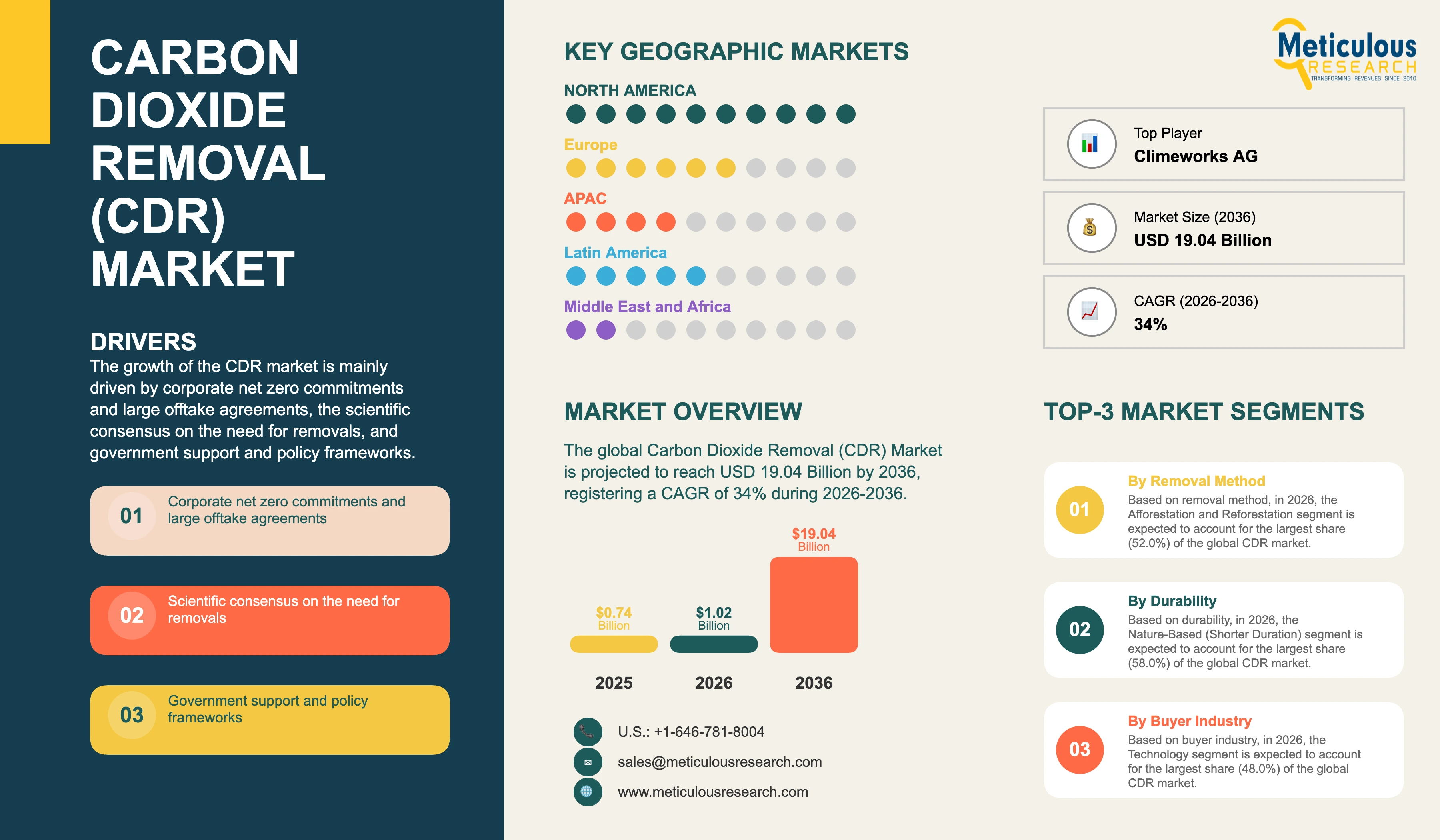
The global carbon dioxide removal (CDR) market was valued at USD 0.74 billion in 2025. This market is expected to reach USD 19.04 billion by 2036 from an estimated USD 1.02 billion in 2026, registering a CAGR of 34.0% during the forecast period (2026-2036).
- Published
- Nov 2026
- Pages
- 287
- Format
- PDF + Excel
- Report ID
- MREP - 1042524
- Base year
- 2025
- 2025 · BASELINE
- $740.0M
- 2036
- $19.04B
- CAGR 2026–2036
- 34.0%
2025 baseline · 2026–2036 forecast at 34.0% CAGR · hover a bar for the value
Key highlights
ClimeFi's 2025 market review found that new contracts for durable carbon removal reached about 29.6 million tonnes in 2025, bringing cumulative commitments to about 42.5 million tonnes, with Microsoft accounting for about 90% of durable purchase volume, while the rest of the durable market still grew by about 73% year on year.
CDR.fyi reported that cumulative deliveries of durable carbon removal passed 1 million tonnes for the first time in late 2025, a milestone for the industry, although deliveries remain far below contracted volumes, which shows the gap between demand commitments and operating capacity.
Including nature-based removals, total long-term CDR offtake volumes reached about 64 million tonnes in 2025, compared with about 30 million tonnes in 2024, according to an analysis by Climeworks based on BloombergNEF and CDR.fyi data, with Microsoft signing very large agreements for reforestation, BECCS, biochar, and enhanced weathering.
The State of Carbon Dioxide Removal report estimated that the world currently removes about 2 billion tonnes of carbon dioxide per year, almost all through conventional methods such as forestry, while novel methods such as biochar, BECCS, and direct air capture remove only around 1 million tonnes, compared with the 7 to 9 billion tonnes per year that many scenarios require by 2050.
The EU's Carbon Removals and Carbon Farming Certification Regulation entered into force in December 2024, creating the first EU-wide voluntary framework for certifying permanent removals, carbon farming, and carbon storage in products, while Denmark, Sweden, and Japan have introduced subsidies or compliance roles for removals.
Microsoft signed several of the largest carbon removal agreements on record in 2025 and early 2026, including agreements with Chestnut Carbon, re.green, Stockholm Exergi, AtmosClear, CO280, and Indigo Ag, which together cover tens of millions of tonnes across reforestation, BECCS, and soil carbon.
Frontier, the advance market commitment backed by Stripe, Google, Shopify, Meta, McKinsey, and others, continued to sign offtake agreements in 2025 for biochar, enhanced weathering, BECCS, and direct air capture projects.
By removal method, afforestation and reforestation account for the largest share of 52.0% in 2026, while direct air capture with storage registers the highest CAGR.
By durability, nature-based removals account for the largest share in 2026, while durable removals register the higher CAGR.
By buyer industry, technology companies account for the largest share of 48.0% in 2026, while governments and the public sector register the highest CAGR.
By geography, North America accounts for the largest share of 40.0% in 2026, while Europe registers the highest CAGR of 37.9%.
Report summary
| Particulars | Details |
|---|---|
| Base Year | 2025 |
| Estimated Year | 2026 |
| Forecast Period | 2026-2036 |
| Market Size in 2025 | USD 0.74 billion |
| Market Size in 2026 | USD 1.02 billion |
| Market Size by 2036 | USD 19.04 billion |
| CAGR (2026-2036) | 34.0% |
| Format | PDF, Excel & Cloud Portal · 287 pages |
| Largest Segment by Removal Method (2026) | Afforestation and Reforestation (52.0%) |
| Largest Segment by Buyer Industry (2026) | Technology (48.0%) |
| Largest Region (2026) | North America (40.0%) |
| Fastest-Growing Region | Europe (CAGR 37.9%) |
| Segments Covered | Removal Method, Durability, Buyer Industry, and Geography |
| Geographic Scope | North America, Latin America, Europe, Asia-Pacific, and Middle East and Africa |
| Key Companies Profiled | Climeworks, 1PointFive, Heirloom, CarbonCapture Inc., Charm Industrial, Stockholm Exergi, Ørsted, Exomad Green, UNDO, Terradot, CarbonCure Technologies, Mombak, Chestnut Carbon, re.green, and Drax Group |
Report overview
Segments covered: removal method, durability, buyer industry.
The growth of this market is mainly driven by corporate net zero commitments that require companies to neutralize residual emissions with carbon removals, very large long-term purchase agreements by technology companies, especially Microsoft, the scientific consensus that billions of tonnes of carbon dioxide will need to be removed from the atmosphere each year by mid-century to meet climate goals, growing government support through tax credits, procurement programs, and certification frameworks such as the EU Carbon Removals and Carbon Farming Certification Regulation, the integration of removals into compliance markets in some countries, and falling costs as projects scale up. However, factors such as the high cost of durable removal methods, limited delivery capacity compared with contracted volumes, the concentration of demand among a few buyers, uncertainty in measurement, reporting, and verification, permanence concerns for nature-based removals, and changes in government policy support are expected to restrain the growth of this market to some extent.
Carbon dioxide removal (CDR) refers to activities that capture carbon dioxide from the atmosphere and store it in geological formations, land, oceans, or long-lived products. CDR is different from emission reductions, which prevent carbon dioxide from being released, because it actively removes carbon dioxide that is already in the atmosphere. CDR methods include nature-based approaches, such as afforestation and reforestation and soil carbon sequestration, and engineered or hybrid approaches, such as biochar, bioenergy with carbon capture and storage (BECCS), direct air capture with storage (DACCS), enhanced rock weathering, and ocean-based methods. Durable methods store carbon for hundreds to thousands of years or more, while nature-based methods store carbon in trees and soils, where it can be released by fires, disease, or land-use changes.
This market covers the global revenue from the sale of carbon dioxide removal, measured in value as the value of removal credits and removal services delivered to buyers. It includes removals sold through voluntary carbon markets, long-term offtake agreements, government procurement programs, and compliance schemes that accept removals. It is segmented by removal method, durability, buyer industry, and geography, with geography based on the location of removal projects. The value of contracted but not yet delivered removals, carbon capture from fossil fuel power or industrial emissions that does not remove carbon dioxide from the atmosphere, and emission reduction credits are not included.
Carbon removal is needed for two main reasons, both linked to the goal of reaching net zero emissions. First, some emissions, such as those from aviation, agriculture, and certain industrial processes, are very difficult to eliminate, so companies and countries aiming for net zero will need removals to balance them. Second, many climate scenarios that limit warming to 1.5°C or well below 2°C require removing large amounts of carbon dioxide to reduce atmospheric concentrations after emissions peak. The State of Carbon Dioxide Removal report estimated that the world currently removes about 2 billion tonnes of carbon dioxide each year, mainly through forestry, but only about 1 million tonnes through novel methods, while many scenarios require 7 to 9 billion tonnes of removals per year by 2050.
The market for carbon removal has grown rapidly since 2022, driven mainly by corporate buyers. Microsoft has become by far the largest buyer, signing long-term agreements for tens of millions of tonnes of removals from reforestation, BECCS, biochar, enhanced weathering, and direct air capture projects. Frontier, an advance market commitment founded by Stripe, Google, Shopify, Meta, McKinsey, and others, has committed to buy more than USD 1 billion of durable removals by 2030, and other buyers, including airlines, banks, and consumer brands, have made smaller purchases. According to ClimeFi, new contracts for durable removals reached about 29.6 million tonnes in 2025.
However, deliveries remain small compared with contracted volumes, and this gap is one of the most important features of the market today. CDR.fyi reported that cumulative deliveries of durable removals passed 1 million tonnes only in late 2025, mostly from biochar projects, while large BECCS and direct air capture plants are still under construction or ramping up. The gap between contracted and delivered volumes reflects the time needed to build projects and the challenges of financing and scaling new technologies.
Governments are increasingly supporting carbon removal through tax credits, grants, procurement programs, and certification frameworks. The U.S. provides a tax credit under section 45Q of up to USD 180 per tonne for carbon dioxide captured by direct air capture and stored geologically, and the EU's Carbon Removals and Carbon Farming Certification Regulation provides a framework for certifying removals. Denmark and Sweden have launched subsidy programs for BECCS, Japan's GX emissions trading system recognizes removals, and the Paris Agreement's Article 6.4 mechanism has adopted standards for removal activities.
The market includes a wide range of project developers and technology companies. Direct air capture companies include Climeworks, 1PointFive, a subsidiary of Occidental, Heirloom, and CarbonCapture Inc. BECCS developers include Stockholm Exergi and Ørsted, which have signed large agreements with Microsoft. Biochar producers include Exomad Green, the largest supplier by volume, while Charm Industrial converts biomass into bio-oil for underground storage. Enhanced weathering companies include UNDO and Terradot, CarbonCure Technologies stores carbon in concrete, and reforestation developers include Mombak, Chestnut Carbon, and re.green.
Over the forecast period, the CDR market is expected to grow very rapidly from a small base, as contracted volumes are delivered, costs fall, and policy support increases. North America is expected to remain the largest market, while Europe is expected to grow fastest because of BECCS projects, government support, and the EU certification framework.
We cannot eliminate all of our flight emissions with today's technology, so we are starting to buy durable removals now. Prices are high, but we want to support projects early and learn how to build a removal portfolio before regulations require it.
This explains why durable removals are growing faster than nature-based removals, why aviation buyers are increasing purchases, and why Europe is the fastest-growing region.
Our BECCS support scheme gives developers a guaranteed price for removals over many years, which makes large projects bankable.
This explains why governments and the public sector form the fastest-growing buyer group and why public procurement is expected to add steady demand over the forecast period.
Report infographic
Market dynamics
16 factors across 5 forcesCorporate net zero commitments and large offtake agreements
Thousands of companies have set net zero targets, and standards such as the Science Based Targets initiative's Corporate Net-Zero Standard require companies to reduce emissions deeply and neutralize residual emissions with carbon removals. As companies approach their interim and final target dates, demand for high-quality removals is expected to rise steadily. Technology companies, which have ambitious climate goals and fast-growing emissions from data centers and artificial intelligence workloads, have become the largest buyers. Microsoft accounted for about 90% of durable removal purchases in 2025, according to ClimeFi, and has signed agreements such as 3.33 million tonnes of BECCS removals from Stockholm Exergi, multi-million-tonne reforestation agreements with Chestnut Carbon and re.green, and large biochar and enhanced weathering agreements.
Other buyers, including Google, Frontier members, airlines such as JetBlue and Alaska Airlines, banks, consulting firms, and consumer brands, are also buying removals, and Climeworks reported that more than 100 first-time buyers entered the durable market in 2025. Long-term offtake agreements give project developers the revenue certainty they need to raise debt and equity for construction, which converts corporate commitments into physical capacity. These agreements are now commonly signed for 10 to 15 years and cover several hundred thousand to several million tonnes each. Technology companies account for the largest share of the market by buyer industry, and the steady arrival of new buyers is expected to broaden demand over the forecast period.
Scientific consensus on the need for removals
The Intergovernmental Panel on Climate Change has concluded that carbon dioxide removal is necessary to reach net zero and to limit warming to 1.5°C or well below 2°C, and nearly all of its pathways that meet these goals rely on billions of tonnes of removals per year by mid-century. Removals are needed to balance hard-to-abate emissions from sectors such as aviation, shipping, cement, and agriculture, and in the second half of the century to bring atmospheric concentrations down after any overshoot. This scientific consensus has increased political and corporate support for developing removal methods now, so that they can be proven, improved, and scaled in time.
The State of Carbon Dioxide Removal report highlighted the very large gap between current novel removals of about 1 million tonnes per year and the billions of tonnes that will be required. This gap underlines the scale of growth that is needed, and it has encouraged governments, philanthropic organizations, and investors to support early projects, which in turn supports demand in this market.
Government support and policy frameworks
Governments are increasingly supporting carbon removal through tax credits, grants, procurement programs, and certification frameworks. In the U.S., the section 45Q tax credit provides up to USD 180 per tonne for direct air capture with geological storage, and it was retained in the 2025 tax legislation. The EU's Carbon Removals and Carbon Farming Certification Regulation, which entered into force in December 2024, creates a framework for certifying permanent removals, carbon farming, and carbon storage in products, and the EU is assessing how removals could be counted toward its climate targets and integrated into its emissions trading system.
Denmark and Sweden have launched funds and reverse auctions to support BECCS, the U.K. is developing support for engineered removals and plans to integrate them into its emissions trading scheme, and Japan's GX emissions trading system, which becomes mandatory for large emitters from April 2026, allows companies to use certain removal credits. At the international level, the Article 6.4 mechanism of the Paris Agreement has adopted standards for removal activities. Governments and the public sector form the fastest-growing buyer group in this market, and Europe is the fastest-growing region.
Technology development and cost reduction
Carbon removal technologies are moving from pilots and demonstration plants to commercial scale across several methods. Climeworks commissioned its Mammoth direct air capture plant in Iceland in 2024, 1PointFive is commissioning its Stratos plant in Texas, designed to capture up to 500,000 tonnes per year, and Stockholm Exergi and Ørsted are building large BECCS facilities at biomass-fired combined heat and power plants. Biochar production has scaled rapidly in the U.S., Latin America, and Africa, and enhanced weathering projects are being deployed on farmland in the U.S., Brazil, India, and other countries.
As projects scale, costs are expected to fall through learning, standardized equipment, cheaper clean energy, and economies of scale, which will make removals affordable for a wider group of buyers. Durable removals form the faster-growing durability segment in this market, and direct air capture is the fastest-growing removal method from a small base.
Table of contents
11 chapters · 111 sections · 287 pages · click to expandGeographic analysis
North America
Largest shareIn 2026, North America is expected to account for the largest share of 40.0% of the global CDR market. The large share of this region is mainly due to the presence of leading direct air capture, biochar, and reforestation projects, the 45Q tax credit, abundant geological storage capacity, a strong venture capital ecosystem, and the concentration of major buyers in the U.S. The U.S. hosts major direct air capture projects, such as 1PointFive's Stratos plant in Texas, as well as many biochar producers, reforestation projects such as those of Chestnut Carbon in the southeastern U.S., and BECCS projects at ethanol plants in the Midwest. Canada contributes through carbon mineralization companies such as CarbonCure Technologies and growing direct air capture and BECCS activity, supported by its investment tax credit for carbon capture. North America is expected to remain the largest region throughout the forecast period, although policy uncertainty around federal funding programs may affect the pace of some projects.
Europe
Fastest growthEurope is projected to register the highest CAGR of 37.9% during the forecast period. The rapid growth of this region is mainly driven by large BECCS projects in the Nordic countries, government support programs in Denmark, Sweden, and the U.K., the EU Carbon Removals and Carbon Farming Certification Regulation, shared carbon dioxide transport and storage networks such as Northern Lights, and the expected integration of removals into compliance markets.
Latin America
Latin America holds a significant share of the market because of large reforestation projects in Brazil and growing biochar and enhanced weathering activity. Brazil is expected to remain the largest market in Latin America, supported by large native-species reforestation agreements with Microsoft and other buyers, as well as growing enhanced weathering activity on its large agricultural land base.
Asia-Pacific
Asia-Pacific is growing with biochar and enhanced weathering projects in India and Australia and with demand from Japan's GX emissions trading system, while the Middle East and Africa offer potential for direct air capture, mineralization, and biochar projects. Kenya's Great Rift Valley has attracted direct air capture developers because of its geothermal energy and suitable geology, and several African countries are hosting biochar and reforestation projects. Australia and India are expected to lead growth in Asia-Pacific.
Competitive landscape
The CDR market is fragmented, with many project developers and technology companies operating across different removal methods and regions. Leading companies include direct air capture developers such as Climeworks, 1PointFive, Heirloom, and CarbonCapture Inc.; BECCS developers such as Stockholm Exergi, Ørsted, and Drax Group; biochar and bio-oil companies such as Exomad Green and Charm Industrial; enhanced weathering companies such as UNDO and Terradot; carbon mineralization company CarbonCure Technologies; and reforestation developers such as Mombak, Chestnut Carbon, and re.green.
Companies compete on cost per tonne, durability, scale, measurement quality, co-benefits, and delivery reliability. Buyers increasingly assess developers on their track record of deliveries, the strength of their measurement, reporting, and verification, and their ability to finance and build projects on schedule. Developers with access to low-cost energy, biomass, land, or geological storage hold important advantages, while those with strong buyer relationships can secure long-term revenue.
The top five players are estimated to account for 20.0% of the CDR market in 2025. This low concentration reflects the large number of reforestation, biochar, and other project developers and the early stage of many engineered removal companies, whose plants are still being built.
Players use several strategies to grow in this market, including long-term offtake agreements with technology companies and airlines, project financing from infrastructure investors and government programs, partnerships with energy, industrial, and agricultural companies, and certification of projects under recognized registries and standards. Several companies are also expanding into new regions with lower costs, such as Latin America, Africa, and Asia.
Competition is expected to center on cost reduction, delivery at scale, and credible verification, and the market may consolidate as larger energy and industrial companies acquire or partner with removal developers. Recent examples include Occidental's acquisition of Carbon Engineering, which supports 1PointFive's direct air capture business, and growing investment by oil and gas, utility, and industrial companies in BECCS and storage projects. Smaller developers are expected to rely on partnerships, project finance, and buyer coalitions to compete with these larger players, and many are focusing on a single method or region where they hold cost or resource advantages, such as cheap renewable power or local biomass.
Some of the key players operating in the CDR market are Climeworks AG, 1PointFive (Occidental Petroleum Corporation), Heirloom Carbon Technologies, Inc., CarbonCapture Inc., Charm Industrial, Inc., Stockholm Exergi AB, Ørsted A/S, Exomad Green, UNDO Carbon Ltd., Terradot, CarbonCure Technologies Inc., Mombak, Chestnut Carbon, re.green, and Drax Group plc.
- —
Durable CDR contracts reached about 29.6 million tonnes in 2025, cumulative durable deliveries passed 1 million tonnes, and the EU Carbon Removals and Carbon Farming Certification Regulation entered into force. Microsoft also signed large agreements with Stockholm Exergi, Chestnut Carbon, re.green, AtmosClear, CO280, and Indigo Ag, and 1PointFive moved toward commissioning its Stratos direct air capture plant in Texas.
- Climeworks
- 1PointFive
- Heirloom
- CarbonCapture Inc.
- Charm Industrial
- Stockholm Exergi
- Exomad Green
- UNDO
- Terradot
- CarbonCure Technologies
- Mombak
- Chestnut Carbon
- Drax Group
Expert perspectives
Carbon dioxide removal is moving from an emerging concept to a real market, driven by large corporate offtake agreements, growing government support, and a clear scientific case for removals. The market is still small and depends heavily on a few buyers, but the volume of long-term contracts signed in 2024 and 2025 gives developers a strong pipeline of future deliveries.
Over the forecast period, the market is expected to grow at a CAGR of 34.0% from a small base, as contracted volumes are delivered, new plants come online, costs fall, and compliance demand begins to emerge. The main uncertainty is whether buyer demand broadens beyond technology companies quickly enough to absorb the growing supply, and whether governments follow through on plans to integrate removals into compliance markets.
Afforestation and reforestation remain the largest removal method because of their scale and low cost, while direct air capture grows fastest from a small base and biochar continues to deliver most durable removals. Technology companies remain the largest buyers, while governments and the public sector grow fastest as procurement and compliance programs expand.
North America remains the largest region because of its projects, tax credits, and buyers, while Europe is the fastest-growing region at a CAGR of 37.9%, supported by BECCS projects, shared storage networks, and EU policy.
For project developers, the key priorities are delivering contracted volumes on time, lowering costs, building robust measurement systems, and diversifying their buyer base. For buyers, the priority is to build portfolios that balance cost, durability, and co-benefits while supporting new capacity through long-term agreements. Companies that can prove reliable delivery and credible verification are expected to gain the most from the growth of this market.
Investors should watch three signals closely over the next few years: the volume of removals actually delivered compared with contracted volumes, the number of new buyers outside the technology sector, and the progress of compliance market integration in the EU, the U.K., and Japan. Strong progress on these signals would support growth toward the upper end of expectations, while weak delivery or slow policy action could delay market development. The ratio between delivered and contracted volumes is especially important, because buyer confidence depends on projects meeting their commitments. Over the longer term, we expect the market to shift from a small group of pioneering buyers to a broad base of corporate and government buyers, with average prices for durable removals falling steadily as capacity grows and technologies mature, while nature-based removals continue to provide low-cost volume.
Customer perspectives
Buyers of carbon removal usually purchase through long-term offtake agreements, brokers, or marketplaces, and they assess projects on durability, verification quality, cost, delivery risk, and co-benefits. Their comments show why technology companies dominate demand and why durable removals and European projects are growing fastest.
Carbon Removal Portfolio Lead - technology company, U.S.
We need removals at a scale that the market cannot yet supply, so we sign long-term contracts across many methods, from reforestation to BECCS and direct air capture. Our contracts help projects raise financing and get built, and we look closely at verification and delivery track records before we commit.
This explains why technology companies account for 48.0% of the market, why verification quality matters so much, and why long-term offtake agreements have become the main way removals are bought.
Frequently asked questions
The market was valued at USD 0.74 billion in 2025 and USD 0.52 billion in 2024, and is estimated at USD 1.02 billion in 2026. These values are based on removals delivered to buyers rather than contracted volumes, which are much larger and will be delivered over many years.
Cite this report
Meticulous Research. (2026). Carbon Dioxide Removal (CDR) Market - Global Opportunity Analysis and Industry Forecast (2026-2036) (Report No. MREP - 1042524). Meticulous Market Research Pvt. Ltd. https://www.meticulousresearch.com/product/carbon-dioxide-removal-cdr-market-7207