Software Supply Chain Security Market (2026-2036)
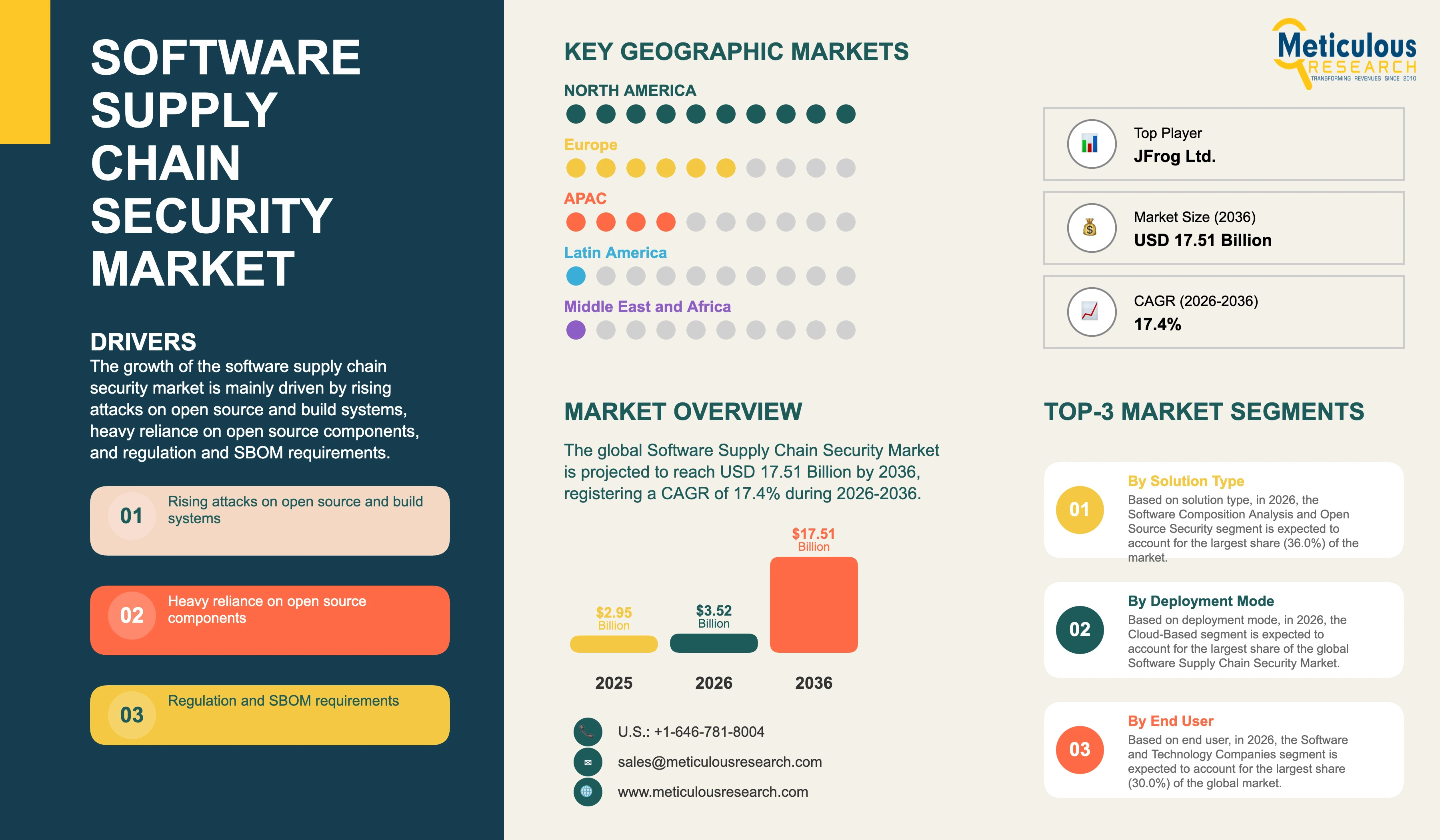
The global software supply chain security market was valued at USD 2.95 billion in 2025. This market is expected to reach USD 17.51 billion by 2036 from an estimated USD 3.52 billion in 2026, registering a CAGR of 17.4% during the forecast period (2026-2036).
- Published
- Nov 2026
- Pages
- 252
- Format
- PDF + Excel
- Report ID
- MRICT - 1042530
- Base year
- 2025
- 2025 · BASELINE
- $2.95B
- 2036
- $17.51B
- CAGR 2026–2036
- 17.4%
2025 baseline · 2026–2036 forecast at 17.4% CAGR · hover a bar for the value
Key highlights
Sonatype's 2026 State of the Software Supply Chain report found that 454, 648 new malicious open source packages were discovered in 2025, bringing the cumulative total to more than 1.23 million, while developers downloaded open source components about 9.8 trillion times across Maven Central, PyPI, npm, and NuGet in the same year.
Verizon's 2025 Data Breach Investigations Report found that the share of breaches involving a third party doubled from 15% to 30%, and that the median time to remediate leaked secrets discovered in GitHub repositories was 94 days.
The EU Cyber Resilience Act entered into force in December 2024, and since 11 September 2026 manufacturers of products with digital elements sold in the EU must report actively exploited vulnerabilities and severe incidents, with full obligations, including machine-readable SBOMs, applying from 11 December 2027.
A series of high-profile incidents, including the backdoor discovered in the XZ Utils compression library in 2024, the compromise of the widely used tj-actions GitHub Action in 2025, and self-replicating worm attacks on npm packages in 2025, has shown how attackers can reach thousands of organizations through a single compromised component.
Investors and platform vendors are investing heavily in the market, as shown by Chainguard's USD 356 million funding round in 2025 for secure container images and open source artifacts, and by GitHub, GitLab, JFrog, and Docker expanding their supply chain security capabilities.
Package registries such as npm and PyPI have introduced trusted publishing, mandatory multi-factor authentication for maintainers, and provenance attestations to make it harder for attackers to take over accounts and publish malicious versions.
IBM's Cost of a Data Breach Report 2025 found that breaches caused by supply chain compromise cost an average of USD 4.91 million, above the global average of USD 4.44 million, and they took longer than average to identify and contain, which underlines the business case for securing software supply chains.
By solution type, software composition analysis and open source security account for the largest share of 36.0% in 2026, while malicious package detection and dependency firewalls register the highest CAGR.
By deployment mode, cloud-based solutions account for the largest share in 2026 and register the higher CAGR.
By end user, software and technology companies account for the largest share of 30.0% in 2026, while automotive, industrial, and device manufacturers register the highest CAGR.
By geography, North America accounts for the largest share of 47.0% in 2026, while Europe registers the highest CAGR of 19.8%.
Report summary
| Particulars | Details |
|---|---|
| Forecast Period | 2026-2036 |
| Base Year | 2025 |
| Estimated Year | 2026 |
| CAGR (Value) | 17.4% |
| Format | PDF, Excel & Cloud Portal · 252 pages |
| Market Size (Value) in 2025 | USD 2.95 billion |
| Market Size (Value) in 2026 | USD 3.52 billion |
| Market Size (Value) in 2036 | USD 17.51 billion |
| Segments Covered | Offering, Solution Type, Deployment Mode, Organization Size, End User, and Geography |
| Countries Covered | North America, Europe, Asia-Pacific, Latin America, and Middle East and Africa |
| Key Companies | Sonatype, JFrog, Snyk, Black Duck, Checkmarx, Mend.io, GitHub, GitLab, Chainguard, Socket, Endor Labs, ReversingLabs, Anchore, Veracode, and Cycode |
| Largest Segment by Solution Type (2026) | Software Composition Analysis and Open Source Security (36.0%) |
| Largest Segment by End User (2026) | Software and Technology Companies (30.0%) |
| Largest Region (2026) | North America (47.0%) |
| Fastest-Growing Region | Europe (CAGR 19.8%) |
Report overview
Segments covered: offering, solution type, deployment mode, organization size, end user.
The growth of this market is mainly driven by the sharp rise in attacks on open source packages, build systems, and software vendors, the heavy reliance of modern applications on open source components, new regulations that require software producers to manage and disclose the components in their products, such as the EU Cyber Resilience Act and U.S. federal secure software requirements, the growing use of software bills of materials (SBOMs), and the use of AI coding assistants that increase the volume of code and dependencies entering applications. However, factors such as alert fatigue from large numbers of vulnerability findings, the complexity of securing diverse build pipelines and toolchains, limited security resources among smaller software producers and open source maintainers, and the immaturity of some standards for SBOM sharing and attestation are expected to restrain the growth of this market to some extent.
Software supply chain security refers to the tools, processes, and services that protect the components, tools, and systems used to build and deliver software, from the open source libraries and container images that developers use to the source code repositories, build pipelines, artifact registries, and distribution channels that turn code into running applications. It includes software composition analysis, which identifies open source components and their known vulnerabilities and licenses; artifact and container image security, which secures the packages and images stored in registries and deployed to production; CI/CD pipeline and code integrity security, which protects build systems, secrets, and source repositories from tampering; SBOM management, which creates, stores, and shares software bills of materials; code signing, provenance, and attestation, which prove where software came from and that it has not been altered; and malicious package detection and dependency firewalls, which block harmful packages before they enter an organization.
This market covers the global revenue from software supply chain security solutions and related services, measured in value. It is segmented by offering, solution type, deployment mode, organization size, end user, and geography. Static and dynamic application security testing of first-party code, runtime application protection, general vulnerability management for infrastructure, and third-party vendor risk management questionnaires are not included, although many vendors sell these alongside supply chain security products.
Modern software is largely assembled from existing components rather than written from scratch. Most applications contain a large proportion of open source code, and each open source package may depend on dozens of other packages, creating complex dependency trees that few organizations fully understand. Applications are built using automated CI/CD pipelines, third-party build tools, plug-ins, and cloud services, and they are packaged into container images that include operating system components and libraries. Each of these elements is a potential entry point for attackers, and a single compromised component can affect thousands of downstream users.
Attackers have recognized the opportunity that this complexity creates and are targeting it directly. They publish malicious packages with names similar to popular libraries, take over the accounts of open source maintainers, insert backdoors into widely used projects, compromise build systems and CI/CD tools, and steal secrets such as access tokens and cloud keys from code repositories. Sonatype reported that 454,648 new malicious open source packages were discovered in 2025, and its research shows that campaigns have evolved from opportunistic attacks into sustained, industrialized operations, many linked to nation-state groups. Verizon's 2025 Data Breach Investigations Report found that the share of breaches involving third parties doubled to 30%, highlighting the growing risk from suppliers and software dependencies.
Governments have responded to these risks with new requirements for software producers and manufacturers. In the U.S., Executive Order 14028 and related guidance from the Office of Management and Budget and the Cybersecurity and Infrastructure Security Agency require software producers selling to federal agencies to attest that they follow secure development practices, and they encourage the use of SBOMs. In the EU, the Cyber Resilience Act requires manufacturers of products with digital elements to manage vulnerabilities in the components they use, report actively exploited vulnerabilities from September 2026, and maintain machine-readable SBOMs from December 2027. Regulators in financial services, healthcare, automotive, and other sectors are also adding software supply chain requirements.
The market includes several types of vendors with different origins and areas of strength. Software composition analysis specialists, such as Black Duck, Mend.io, Snyk, Sonatype, and Checkmarx, identify vulnerable and risky open source components. Artifact management and DevOps platform vendors, such as JFrog, GitHub, GitLab, and Docker, secure repositories, registries, and pipelines. Newer companies focus on specific areas, such as Chainguard with hardened container images and secure open source artifacts, Socket and ReversingLabs with malicious package and binary analysis, Endor Labs with reachability-based dependency analysis, Anchore with SBOM and container security, and Cycode with pipeline and code integrity security. Application security vendors, such as Veracode, are also adding supply chain capabilities.
Over the forecast period, the software supply chain security market is expected to grow strongly, supported by rising attacks, regulation, SBOM adoption, and AI-assisted development. North America is expected to remain the largest market, while Europe is expected to grow fastest as the Cyber Resilience Act brings software supply chain obligations to a wide range of manufacturers.
The Cyber Resilience Act means we must track every component in our firmware and report exploited vulnerabilities within a day. We are building that capability now.
This explains why Europe and automotive, industrial, and device manufacturers are growing fastest in this market.
For industrial manufacturers, the Cyber Resilience Act requires new capabilities in SBOM management, vulnerability monitoring, and incident reporting that many did not have before.
Platform Engineering Lead - global bank, U.K.
After the npm worm attacks, we put a dependency firewall in front of every build. Nothing reaches our pipelines unless it passes policy.
This explains why malicious package detection and dependency firewalls form the fastest-growing solution type and why financial institutions are investing in prevention rather than only detection.
We moved to hardened base images and our vulnerability backlog dropped sharply. Our developers now spend time on real issues.
This explains why artifact and container image security and curated open source are growing quickly and why Asia-Pacific software companies are adopting supply chain security.
Cloud-based solutions are expected to account for the largest share of the market in 2026 and to register the higher CAGR, driven by cloud source code platforms, CI/CD services, and SaaS security tools.
A software bill of materials (SBOM) is a list of the components in a piece of software. SBOMs help organizations identify vulnerable components quickly and are required or encouraged by regulations such as the EU Cyber Resilience Act, U.S. federal guidance, and FDA requirements for connected medical devices.
A dependency firewall sits between developers and public package registries and blocks packages that are malicious, vulnerable, or do not meet policy before they are downloaded into an organization's environment.
The Act requires manufacturers of products with digital elements sold in the EU to handle vulnerabilities in their components, report actively exploited vulnerabilities from September 2026, and maintain machine-readable SBOMs from December 2027, which creates demand for supply chain security tools and services.
Sonatype found 454,648 new malicious open source packages in 2025, bringing the cumulative total to more than 1.23 million, and many campaigns were linked to state-sponsored groups.
Report infographic
Market dynamics
16 factors across 5 forcesRising attacks on open source and build systems
Attacks on the software supply chain have grown rapidly in number and sophistication. Sonatype's 2026 State of the Software Supply Chain report found that 454,648 new malicious packages were discovered in 2025, bringing the cumulative total to more than 1.23 million, and that many campaigns were linked to state-sponsored groups. High-profile incidents have shown the potential impact of these attacks. The backdoor discovered in the XZ Utils library in 2024 was inserted by an attacker who spent years gaining the trust of the project's maintainers and could have given access to many Linux systems. In 2025, attackers compromised the tj-actions/changed-files GitHub Action, used by thousands of repositories, to steal secrets from build pipelines, and self-replicating malware spread through npm packages by stealing maintainers' tokens and publishing infected versions.
These attacks target developers, build systems, and package registries rather than production systems, which means that traditional security tools often miss them. Organizations are therefore investing in tools that block malicious packages, secure CI/CD pipelines, detect leaked secrets, and verify the integrity and provenance of software. Malicious package detection and dependency firewalls form the fastest-growing solution type in this market.
Attackers increasingly target developer machines and CI/CD environments because they hold valuable secrets, such as cloud credentials, signing keys, and publishing tokens, which can be used to move into production systems or to publish malicious versions of legitimate software. Sonatype noted that a malicious package is increasingly the first step in a larger intrusion rather than the whole attack, which raises the stakes for organizations that consume open source.
Heavy reliance on open source components
Open source software is the foundation of modern applications, and its use continues to grow. Sonatype estimated that developers downloaded open source components about 9.8 trillion times in 2025 across the four major registries. Each application may include hundreds or thousands of open source dependencies, many of which are indirect dependencies that developers never chose directly. New vulnerabilities are disclosed in these components every day, and many components are maintained by small teams or individual volunteers with limited resources.
Organizations need to know which components they use, which have known vulnerabilities or license risks, and which are poorly maintained, and they need to prioritize fixes based on whether vulnerable code is actually reachable. Software composition analysis and open source security account for the largest share of the market by solution type, reflecting this need.
Large enterprises often have thousands of applications with millions of dependencies across many languages, and they need automated tools that can scan continuously, integrate with developer workflows, and enforce policies on which components and versions may be used. Open source license compliance is another concern, since some licenses impose obligations that conflict with commercial use.
Regulation and SBOM requirements
Regulations are making software supply chain security a legal requirement for many organizations. The EU Cyber Resilience Act applies to manufacturers of hardware and software products with digital elements sold in the EU, including those based outside the EU. Since 11 September 2026, manufacturers must report actively exploited vulnerabilities and severe incidents, with an early warning within 24 hours, and from 11 December 2027 they must meet full security requirements, including vulnerability handling and machine-readable SBOMs covering at least top-level dependencies. Fines can reach EUR 15 million or 2.5% of worldwide turnover for the most serious breaches.
In the U.S., software producers selling to federal agencies must attest to secure development practices, and agencies may request SBOMs. The U.S. Food and Drug Administration requires SBOMs for new connected medical devices, and financial, automotive, and telecommunications regulators are adding similar requirements. These rules drive demand for SBOM management, vulnerability tracking, provenance, and attestation tools, and SBOM management and compliance is one of the fastest-growing solution types in this market.
AI-assisted development and growing code volumes
AI coding assistants are increasing the speed at which developers write code and add dependencies, which also increases the speed at which vulnerable or malicious components can enter applications. AI tools sometimes suggest packages that do not exist, and attackers have begun registering such package names to exploit this behavior, a technique known as slopsquatting. AI models, datasets, and model files from public hubs are also becoming part of the software supply chain, creating new risks.
Organizations are therefore extending supply chain security to cover AI-generated code, AI models, and AI development tools, which creates new demand for dependency firewalls, model scanning, and policy enforcement in developer workflows.
Sonatype's research noted that AI is increasing developer output but also amplifying the impact of poor inputs, such as outdated or vulnerable dependencies suggested by AI tools. Organizations need guardrails that check AI-suggested packages against policy before they are added to projects.
Table of contents
13 chapters · 130 sections · 252 pages · click to expandSegmental analysis
| Segment | Largest share (2026) | Fastest growth (2026–2036) |
|---|---|---|
| By Offering | Solutions | — |
| By Solution Type | Software composition analysis and open source security | Malicious package detection and dependency firewalls |
| By Deployment Mode | Cloud-based | — |
| By Organization Size | Large enterprises | — |
| By End User | Software and technology companies | Device manufacturers |
By Offering
- Software Supply Chain Security Market Analysis by Offering
- The solutions segment is expected to account for the largest share of the market, due to the wide adoption of software composition analysis, artifact security, and pipeline security tools by software producers and enterprises.
- However, the services segment is projected to register the higher CAGR during the forecast period, driven by demand for help with Cyber Resilience Act compliance, SBOM programs, and secure development practices, particularly among manufacturers new to software security.
- Services include consulting, implementation, training, and managed services.
By Solution Type
- Software Supply Chain Security Market Analysis by Solution Type
- The software composition analysis and open source security segment is expected to account for the largest share of 36.0% of the market.
- The large share of this segment is mainly due to the heavy reliance of applications on open source components, the long history of software composition analysis tools in identifying vulnerable and non-compliant components, and their wide adoption by software producers, banks, government agencies, and other organizations as a core part of application security programs.
- Software composition analysis tools scan source code, manifests, and binaries to identify open source components and their dependencies, match them against vulnerability databases and license information, and recommend fixes such as upgrading to safe versions.
- Leading providers include Black Duck, Snyk, Sonatype, Mend.io, Checkmarx, Veracode, GitHub, and GitLab.
- The segment is evolving from simple vulnerability detection toward reachability analysis, automated pull requests for fixes, package health scoring, and policy enforcement in developer workflows.
- Many tools also generate SBOMs, linking this segment with SBOM management and compliance.
- Large enterprises typically deploy software composition analysis across all their development teams and integrate it with source code platforms, CI/CD pipelines, ticketing systems, and security dashboards.
- Pricing is usually based on the number of developers, applications, or scans.
- Vendors are also adding package health signals, such as maintainer activity, release frequency, and security practices, to help organizations avoid risky or abandoned components before they become a problem.
- Software composition analysis benefits from regulatory requirements, such as the Cyber Resilience Act's requirement to handle vulnerabilities in third-party components and U.S. federal secure software development requirements, as well as from customer demand for SBOMs.
- Software composition analysis and open source security are expected to remain the largest solution type over the forecast period, although their share is expected to decline as newer segments grow faster.
- However, the malicious package detection and dependency firewalls segment is projected to register the highest CAGR during the forecast period.
- The rapid growth of this segment is driven by the surge in malicious packages and attacks on registries.
- Artifact and container image security, CI/CD pipeline and code integrity security, SBOM management and compliance, code signing, provenance, and attestation, and other solutions make up the rest of the market.
- Artifact and container image security covers scanning, signing, and policy enforcement for packages and images stored in registries such as JFrog Artifactory, Sonatype Nexus, Docker Hub, and cloud container registries, as well as hardened image offerings.
- CI/CD pipeline and code integrity security protects source repositories, build systems, and secrets from tampering and theft.
- SBOM management and compliance covers the generation, storage, sharing, and analysis of SBOMs and VEX statements.
- Code signing, provenance, and attestation verify the origin and integrity of software, while other solutions include open source license compliance and binary analysis.
By Deployment Mode
- Software Supply Chain Security Market Analysis by Deployment Mode
- The cloud-based segment is expected to account for the largest share of the market and is also projected to register the higher CAGR during the forecast period, driven by the adoption of cloud-based source code platforms, CI/CD services, and SaaS security tools.
- On-premises and self-hosted deployments remain important for government, defense, financial services, and manufacturers with air-gapped or highly regulated development environments.
- Cloud-based tools integrate easily with cloud source code platforms such as GitHub and GitLab, and they can use shared threat intelligence to detect new malicious packages quickly across many customers.
By Organization Size
- Software Supply Chain Security Market Analysis by Organization Size
- The large enterprises segment is expected to account for the largest share of the market, due to their large software portfolios, regulatory exposure, and security budgets.
- However, the small and medium-sized enterprises segment is projected to register the higher CAGR during the forecast period, driven by developer-friendly SaaS tools, built-in security features in source code platforms, and Cyber Resilience Act obligations that apply to manufacturers of all sizes.
By End User
- Software Supply Chain Security Market Analysis by End User
- The software and technology companies segment is expected to account for the largest share of 30.0% of the market.
- The large share of this segment is mainly due to the large volume of software they build and distribute, their heavy use of open source, customer and regulatory demands for SBOMs and secure development attestations, and the severe reputational impact of shipping compromised software to customers.
- Software vendors, cloud providers, and technology companies are typically the earliest adopters of supply chain security tools and practices, such as SBOM generation, signed builds, and provenance attestations, and many contribute to open source security initiatives.
- Software and technology companies are expected to remain the largest end user over the forecast period.
- Enterprise software vendors face growing demands from customers for SBOMs, vulnerability disclosure, and secure development attestations, particularly from government agencies and regulated industries.
- Cloud and SaaS providers must protect large and complex build systems that deliver updates to millions of users, where a single compromise could have widespread impact.
- Technology companies also use supply chain security to protect their own internal development, which often involves thousands of developers and repositories.
- However, the automotive, industrial, and device manufacturers segment is projected to register the highest CAGR during the forecast period.
- The rapid growth of this segment is driven by the Cyber Resilience Act, automotive cybersecurity regulations, and the growing software content of connected products.
- Banking, financial services, and insurance, government and defense, healthcare and life sciences, telecommunications, retail and e-commerce, and other end users make up the rest of the market.
- Banks and insurers use supply chain security to protect internally developed applications and to manage risks from software vendors.
- Government and defense agencies require secure software from suppliers and use supply chain security for their own development.
- Healthcare and life sciences companies, including medical device manufacturers, must meet FDA SBOM requirements, while telecommunications companies secure network software and devices.
Geographic analysis
North America
Largest shareIn 2026, North America is expected to account for the largest share of 47.0% of the global software supply chain security market. The large share of this region is mainly due to the large software industry, the presence of most leading supply chain security vendors and DevOps platforms, early adoption of SBOMs and secure development practices, and U.S. federal requirements for secure software development attestation. The U.S. is the largest market in the world for software supply chain security. Executive Order 14028 and subsequent guidance from the Office of Management and Budget and the Cybersecurity and Infrastructure Security Agency have made secure software development and SBOMs a priority for federal suppliers, and the FDA requires SBOMs for new connected medical devices. North America is expected to remain the largest region throughout the forecast period. Most leading vendors, including Sonatype, Snyk, Black Duck, GitHub, GitLab, Chainguard, Socket, Endor Labs, Anchore, Veracode, and JFrog's U.S. operations, are based in or have major operations in the U.S., and the region has seen large venture investment in supply chain security start-ups. CISA has promoted secure by design principles and published guidance on SBOMs and open source security, and many large enterprises have adopted SBOM requirements for their suppliers. Canada is also strengthening cybersecurity requirements for critical infrastructure and government suppliers.
Europe
Fastest growthEurope is projected to register the highest CAGR of 19.8% during the forecast period. Growth is driven by the Cyber Resilience Act, which applies to a wide range of manufacturers and software producers, together with NIS2 and DORA requirements for supply chain security. The Cyber Resilience Act covers a very wide range of products, from consumer electronics and smart home devices to industrial control systems and software products, and it applies to manufacturers worldwide that sell into the EU. Germany, France, the Netherlands, the Nordic countries, and the U.K., which has its own product security regulations, are the largest European markets, with strong demand from automotive, industrial, telecommunications, and financial sectors. ENISA's single reporting platform for vulnerabilities and incidents became operational in September 2026.
Asia-Pacific
Asia-Pacific holds a significant share, supported by large software and electronics industries, while Latin America and the Middle East and Africa are smaller but growing markets. Japan, South Korea, China, Taiwan, and India have large electronics, automotive, and software industries, and many manufacturers in these countries sell products into the EU and must comply with the Cyber Resilience Act. India's large IT services industry is also adopting supply chain security practices to meet client requirements.
Middle East & Africa
Israel is a major center of innovation, home to JFrog, Checkmarx, and other vendors.
Competitive landscape
The software supply chain security market is fragmented, with application security vendors, DevOps platform vendors, and many specialist start-ups. Leading companies include Sonatype, JFrog, Snyk, Black Duck, Checkmarx, Mend.io, GitHub, GitLab, Chainguard, Socket, Endor Labs, ReversingLabs, Anchore, Veracode, and Cycode.
Companies compete on detection accuracy, prioritization, developer experience, ecosystem coverage, integration with development platforms, compliance features, speed of malicious package detection, and price.
Sonatype, which operates Maven Central, offers software composition analysis, repository management, and a repository firewall that blocks malicious packages. JFrog combines its widely used Artifactory repository with security scanning, curation, and runtime protection. Snyk is known for developer-friendly security across open source, code, containers, and infrastructure as code. Black Duck, formerly part of Synopsys, is a long-established software composition analysis and license compliance provider. Checkmarx and Veracode offer application security platforms that include supply chain capabilities, while Mend.io focuses on open source security and remediation. GitHub and GitLab build supply chain features into their platforms, and Chainguard provides hardened images and libraries. Socket and ReversingLabs focus on malicious package and binary analysis, Endor Labs on reachability-based prioritization, Anchore on SBOM and container security, and Cycode on pipeline and code security.
The top five players are estimated to account for 38.0% of the software supply chain security market in 2025, reflecting a fragmented field of established and emerging vendors.
Players use several strategies to grow in this market, including platform expansion, acquisitions, AI capabilities, and partnerships.
For example, vendors are adding malicious package detection, AI model scanning, and Cyber Resilience Act compliance features, acquiring start-ups to expand capabilities, and partnering with cloud providers and DevOps platforms. Several vendors are also contributing to open source security initiatives, such as the OpenSSF, Sigstore, and SLSA, which builds credibility with developers and shapes industry standards.
Competition is expected to center on prioritization, prevention, and platform breadth.
Vendors that can reduce noise for developers, prevent malicious components from entering organizations, and support compliance across the full software lifecycle are expected to gain share. Built-in features from DevOps platforms may put pressure on stand-alone tools, while consolidation is likely as larger security vendors, cloud providers, and DevOps platforms acquire specialists to fill gaps in their portfolios.
Some of the key players operating in the software supply chain security market are Sonatype, Inc., JFrog Ltd., Snyk Limited, Black Duck Software, Inc., Checkmarx Ltd., Mend.io, GitHub, Inc. (Microsoft), GitLab Inc., Chainguard, Inc., Socket, Inc., Endor Labs, ReversingLabs, Anchore, Inc., Veracode, and Cycode.
- —
Cyber Resilience Act reporting obligations took effect in September 2026, Chainguard raised USD 356 million in 2025, and attacks such as the tj-actions compromise and npm worm campaigns highlighted pipeline and registry risks.
- Sonatype
- JFrog
- Snyk
- Black Duck
- Checkmarx
- Mend.io
- GitHub
- GitLab
- Chainguard
- Socket
- Endor Labs
- ReversingLabs
- Anchore
- Veracode
- Cycode
Expert perspectives
Software supply chain security has moved from a niche concern to a board-level and regulatory priority, driven by high-profile attacks and new laws.
The market is driven by a structural shift in how software is built and how it is attacked. Applications depend on thousands of open source components and automated pipelines, and attackers have learned that compromising one component or build system can give access to many targets. Regulations such as the Cyber Resilience Act are turning supply chain security from a best practice into a legal obligation for a wide range of manufacturers, and customers increasingly demand SBOMs and secure development attestations from their suppliers.
Over the forecast period, the market is expected to grow at about 17.4% per year, supported by attacks, regulation, and AI-driven development.
Growth is expected to be strongest in malicious package detection, SBOM management, provenance and attestation, and CI/CD pipeline security, while software composition analysis remains the largest segment. Hardened images and curated open source are expected to grow quickly as organizations shift from detecting problems to preventing them, and AI artifacts are expected to become an important new area.
Services are also expected to grow quickly as manufacturers seek help with Cyber Resilience Act readiness, SBOM programs, and secure development training.
Software composition analysis is the largest solution type, while malicious package detection grows fastest. Software companies are the largest end user, while manufacturers grow fastest.
Software and technology companies will remain the largest buyers, but manufacturers of connected products are expected to grow fastest as the Cyber Resilience Act takes full effect. Government, financial services, and healthcare also offer strong growth as regulators add supply chain requirements.
North America remains the largest region, while Europe is the fastest-growing region at a CAGR of 19.8%.
North America benefits from a large software industry and federal requirements, while Europe's growth is driven by the Cyber Resilience Act. Asia-Pacific manufacturers selling into the EU are also expected to invest heavily in compliance, which supports growth across the region's electronics, automotive, and software industries.
For vendors, the key priorities are prioritization, prevention, and compliance.
For software producers and manufacturers, the key priorities are to build complete SBOMs, block malicious components, secure build pipelines and secrets, sign and attest software, and prepare for regulatory reporting. Overall, software supply chain security is expected to become a standard part of software development and product security over the forecast period, in the same way that vulnerability scanning and code review became standard practice in earlier decades.
Customer perspectives
VP of Product Security - enterprise software company, U.S.
Our customers ask for SBOMs and secure development attestations in almost every deal. Composition analysis and signed builds are now part of how we sell.
This explains why software composition analysis accounts for 36.0% of the market and software companies 30.0%.
For software vendors, supply chain security has become part of the commercial process, since customers and regulators increasingly require evidence of secure development.
Many enterprise buyers now include SBOM delivery and vulnerability disclosure timelines in their contracts, which turns supply chain security into a competitive requirement for software vendors.
Frequently asked questions
The market was valued at USD 2.95 billion in 2025 and USD 2.45 billion in 2024, and is estimated at USD 3.52 billion in 2026.
Cite this report
Meticulous Research. (2026). Software Supply Chain Security Market - Global Opportunity Analysis and Industry Forecast (2026-2036) (Report No. MRICT - 1042530). Meticulous Market Research Pvt. Ltd. https://www.meticulousresearch.com/product/software-supply-chain-security-market-7213